

How to Structure a Group Coaching Program That Retains
Group coaching sounds like the perfect model on paper. Higher revenue per hour than one-on-one, stronger peer accountability, scalable delivery. Then the second cohort hits week five and half the group has gone quiet. The Slack channel dies. Attendance on the live call drops to three people. You are running twice the calls to keep the same energy, and renewals are already looking soft.
The problem is almost never the coaching itself. It is the structure. Group coaching programs that retain look nothing like a series of Zoom calls with a shared curriculum. They are engineered systems built around cohort dynamics, session rhythm, between-session accountability, and the right ratio of live to self-paced content. Get the structure right and retention takes care of itself. Get it wrong and no amount of great coaching will save you.
This guide walks through how to structure a group coaching program that retains, from cohort length and group size to weekly session design, community rhythm, and the tools that hold it all together. If you have been running one-on-one coaching and are ready to move to a leveraged model, or if your current group program is leaking members, this is the operating manual.
What Is the Ideal Structure for a Group Coaching Program?
Before you pick a length or a group size, get clear on what a group coaching program actually is. According to the International Coaching Federation, group coaching is a facilitated process in which a coach works with multiple clients simultaneously, using peer dynamics as a core accelerant of learning. That last part matters. If your program is really just one-to-many teaching with a Q&A tacked on, you are running a group course, not group coaching, and the retention playbook is different.
A well-structured group coaching program has five pillars:
- A defined transformation. One specific outcome, one persona, one timeframe. Not “grow your business.” Something like “land your first five paying clients as a fractional CMO in ninety days.”
- A cohort model. Members start and finish together, so they progress through the same content at the same pace and form real peer relationships.
- A rhythm. Predictable weekly cadence for live calls, self-paced content, community touchpoints, and accountability check-ins.
- A blended delivery format. Live group calls for coaching and hot-seats, self-paced lessons for foundational content, community for between-session momentum.
- A clear finish line. A capstone, a graduation, a public commitment, or a measurable outcome that marks completion.
Skip any one of these and retention starts to slip. A program without a defined transformation attracts the wrong buyers, who churn when they realize the program is not for them. A program without cohort structure loses the peer dynamic. A program without rhythm feels like homework. A program without a finish line has no natural completion moment, so members drift instead of graduating.
The structure is not the coaching. The structure is the container that lets the coaching land.
How Long Should a Group Coaching Program Run?
The length question is where most coaches get stuck. Twelve weeks feels standard. Six months feels premium. A year feels like a mastermind. None of these are wrong, but they solve different problems.
Here is the framework: match the program length to the depth of transformation you are promising.
- 4 to 6 weeks. Best for a single skill or tactical outcome. Launching a first cohort of a workshop-style program. Great for testing an offer. Retention risk is low because the finish line is so close, but the transformation is limited, so lifetime value depends on running back-to-back cohorts and upselling.
- 8 to 12 weeks. The sweet spot for most group coaching programs. Long enough for meaningful behavior change, short enough to keep energy high. According to research surfaced in Kajabi’s coaching structure analysis , twelve-week cohorts consistently outperform both shorter and longer formats on completion rate for skill-based transformations.
- 4 to 6 months. Right for deeper transformations that require sustained accountability, like building a business to a specific revenue milestone, changing a health baseline, or completing a career pivot. Requires stronger community and rhythm design to prevent the midpoint slump.
- 12 months and up. Really a mastermind or a continuity program. Different retention model entirely, based on ongoing value and community, not a single transformation arc.
If you are unsure, start with a twelve-week cohort. It is long enough to deliver real change, short enough that members can see the end, and it gives you a natural rhythm for enrollment (four cohorts per year). You can always extend later.
One tactical note. Whatever length you pick, resist the temptation to run continuously with open enrollment. Rolling admissions kills cohort dynamics because everyone is on a different week. If you want continuous revenue, run overlapping cohorts (cohort A starts January, cohort B starts April) rather than letting people join at any point.
The Right Group Size for Peer Dynamics and Attention
Group size is the single most underrated variable in program design. Too small and there is no peer dynamic. Too big and members feel invisible. Both kill retention, just in different ways.
The sweet spot for most group coaching programs is eight to fifteen members per cohort. Here is why:
- Under eight members. The peer dynamic collapses. If two people are absent, you have a coaching session with four people, which starts to feel more like group therapy than a cohort. Peer accountability partners are harder to match. Community engagement drops because there are not enough voices to sustain a conversation between calls.
- Eight to fifteen members. Everyone can get meaningful airtime on a ninety-minute call. There are enough peers to form sub-groups, accountability pairs, and lively community threads. Members feel seen but also part of something bigger than a private coaching relationship.
- Sixteen to twenty-five members. Still workable, but you need to invest more in structure. Break-out rooms become mandatory. Hot-seat rotations need a scheduling system so nobody feels skipped. Consider a co-facilitator or a program coordinator.
- Over twenty-five members. You are running a mastermind or a group program, not group coaching. Retention now depends on community and content, not on you personally coaching each member. Requires a fundamentally different operating model.
One nuance worth calling out. The right size also depends on price point. A $500 program can absorb larger cohorts because expectations are lower. A $5,000 program better deliver individual attention, which caps group size around ten to twelve. If you are charging $10,000 or more, consider capping at eight and adding one-on-one calls between group sessions.
How to Design a Weekly Session (Hot-Seat, Discussion, Commitments)
The weekly live session is the heartbeat of the program. If members show up energized and leave with clear next steps, retention takes care of itself. If sessions feel like generic Q&A or worse, a lecture, engagement dies fast.
Here is a proven ninety-minute session structure that works across almost every group coaching context:
Minutes 0 to 10: Opening and check-in
Start on time, every time. Open with a specific question that gets members talking, not a generic “how is everyone.” Something like “what is one commitment from last week that you followed through on, and one you dropped?” Rotate through the group quickly. This does three things: it establishes accountability, warms up the room, and surfaces the emotional temperature so you know where to focus.
Minutes 10 to 25: Teaching or framework
Introduce the concept for the week. Keep it short. Fifteen minutes maximum. If it needs to be longer, it belongs in the self-paced content, not the live call. The live call is for coaching, not teaching. A common mistake is turning group coaching into weekly lectures with Q&A, which trains members to consume passively.
Minutes 25 to 65: Hot-seat coaching
This is the core of the session. Two to three members get the hot-seat, meaning they bring a specific challenge related to the week’s topic and get coached in front of the group. Everyone else observes and learns. Rotate the hot-seat across the cohort so nobody dominates and nobody hides.
Hot-seat coaching works because it delivers three benefits simultaneously. The person on the hot-seat gets real coaching. The rest of the group learns vicariously (research consistently shows that observed coaching often produces insights comparable to direct coaching). And peer intimacy builds because members see each other’s real struggles.
Minutes 65 to 80: Group discussion or breakout
Peer discussion in the full group or small breakout rooms. Give a specific prompt tied to the week’s topic. This is where the peer dynamic pays off, and it also gives quieter members a chance to contribute without the pressure of the hot-seat.
Minutes 80 to 90: Commitments and close
Every member says out loud what specific action they are committing to before the next session. Write these down. Reference them at next week’s check-in. Public commitment is one of the most reliable behavior-change mechanisms known, and it is criminally underused in group programs.
Close on time. A session that ends fifteen minutes late every week trains members to leave early, which erodes the closing ritual and hurts commitment.
One final tip. Record every session. Members who miss should be able to catch up asynchronously, but the recording should not become an excuse to skip live. Communicate clearly that showing up live is where the transformation happens.
Combining Self-Paced Lessons With Live Group Calls
Live group calls do not scale forever, and they are not the right medium for foundational content. Trying to teach frameworks, tools, and background material on live calls means you use up coaching time on delivery, and members who miss the live are stuck watching a recording of you lecturing.
The right model is a hybrid: self-paced lessons for foundational content, live calls for coaching and application.
Here is how to split the content:
- Put in self-paced lessons: frameworks, methodologies, background context, tool walkthroughs, templates, worksheets. Anything that is essentially a one-way transfer of information.
- Keep for live calls: application of frameworks to real member situations, coaching around blocks and resistance, peer discussion, hot-seats, accountability, and any content that benefits from real-time back-and-forth.
Structure the self-paced content on a weekly drip schedule. Each week, unlock the module that pairs with that week’s live call. Members watch the lesson before the live call, then use the call to apply it to their situation.
Time-locked drip content is critical here. If you unlock everything on day one, motivated members race ahead, get lost, and disengage. Less motivated members get overwhelmed by the volume and never start. Drip pacing keeps the cohort synchronized, which is how peer dynamics stay strong.
The self-paced portion should be short. Fifteen to thirty minutes of video per week is plenty. Add a downloadable worksheet or template that members complete before the live call. That completion becomes the ticket to the hot-seat: you get coached on what you filled in.
This is where an integrated platform matters. Running self-paced content on a course tool while running the community on Circle and the live calls on Zoom creates seams where members drop off. Zanfia keeps courses, community, and live-call scheduling in one interface, with progress memory that tracks each participant’s position across the program. Members see their progress, their next lesson, the upcoming live call, and the community feed in one place, which removes the friction that kills momentum in stitched-together stacks.
How to Build Accountability and Community Between Sessions
The live call is one hundred and thirty-five minutes per week if you count preparation. That leaves ten thousand three hundred and five other minutes per week where members are on their own. Whether they show up next week energized or defeated depends almost entirely on what happens in those minutes.
Between-session community is the retention lever that most coaches under-invest in. Here is what actually moves the needle.
1. Structured accountability pairs
At the start of the cohort, pair every member with an accountability partner. Two people who agree to check in with each other between sessions. The commitment is small: a five-minute call or a quick message every week, sharing what you committed to and whether you followed through.
Rotate pairs every four weeks so members build multiple relationships and the whole cohort feels connected, not just their one partner.
2. A dedicated community space
You need one place where the cohort lives between sessions. This is not the Slack channel your team uses. Not a Facebook group. A dedicated space for this cohort, ideally organized by discussion channels so different conversation threads do not collide.
Structure the community with a small number of clear channels:
- General discussion (for connection and off-topic chat)
- Weekly wins (a public accountability channel where members post what they accomplished)
- Ask for help (peer support requests)
- Announcements (read-only, from you)
- Resources (links, templates, useful references)
Too many channels and conversations get fragmented. Too few and the important stuff gets lost in the noise. Five to seven channels is the right range for most cohorts.
3. A weekly rhythm outside the live call
Community engagement does not happen by accident. Set a rhythm:
- Monday: You post the week’s focus and prompt members to share their intention.
- Wednesday: Midweek check-in thread. What is working, what is stuck.
- Friday or Sunday: Weekly wins post. Members share what they accomplished, no matter how small.
Consistency is more important than volume. If you post three prompts every week for twelve weeks, members build a habit of showing up. If you post sporadically, they stop checking.
4. Peer recognition
Publicly acknowledge members who show up, help others, or hit milestones. This costs nothing and dramatically increases engagement. According to research summarized in Harvard Business Review’s coverage of behavioral research on motivation, public recognition consistently outperforms private praise for driving sustained engagement in group settings.
5. Small ceremonies
Kick off the cohort with a welcome ritual. Mark the midpoint with a check-in. End with a graduation. These small ceremonies create the sense that the cohort is a shared journey, not a subscription to a Zoom link.
How Zanfia Helps Coaches Run Group Coaching Programs
The tooling problem is real. Most coaches end up running their group program across three or four disconnected tools: a course platform for self-paced lessons, a community tool like Circle or Discord, a scheduling tool for live calls, an email tool for reminders, and maybe a separate payment processor. Every seam is a place where members drop off and where you burn time on integrations that break.
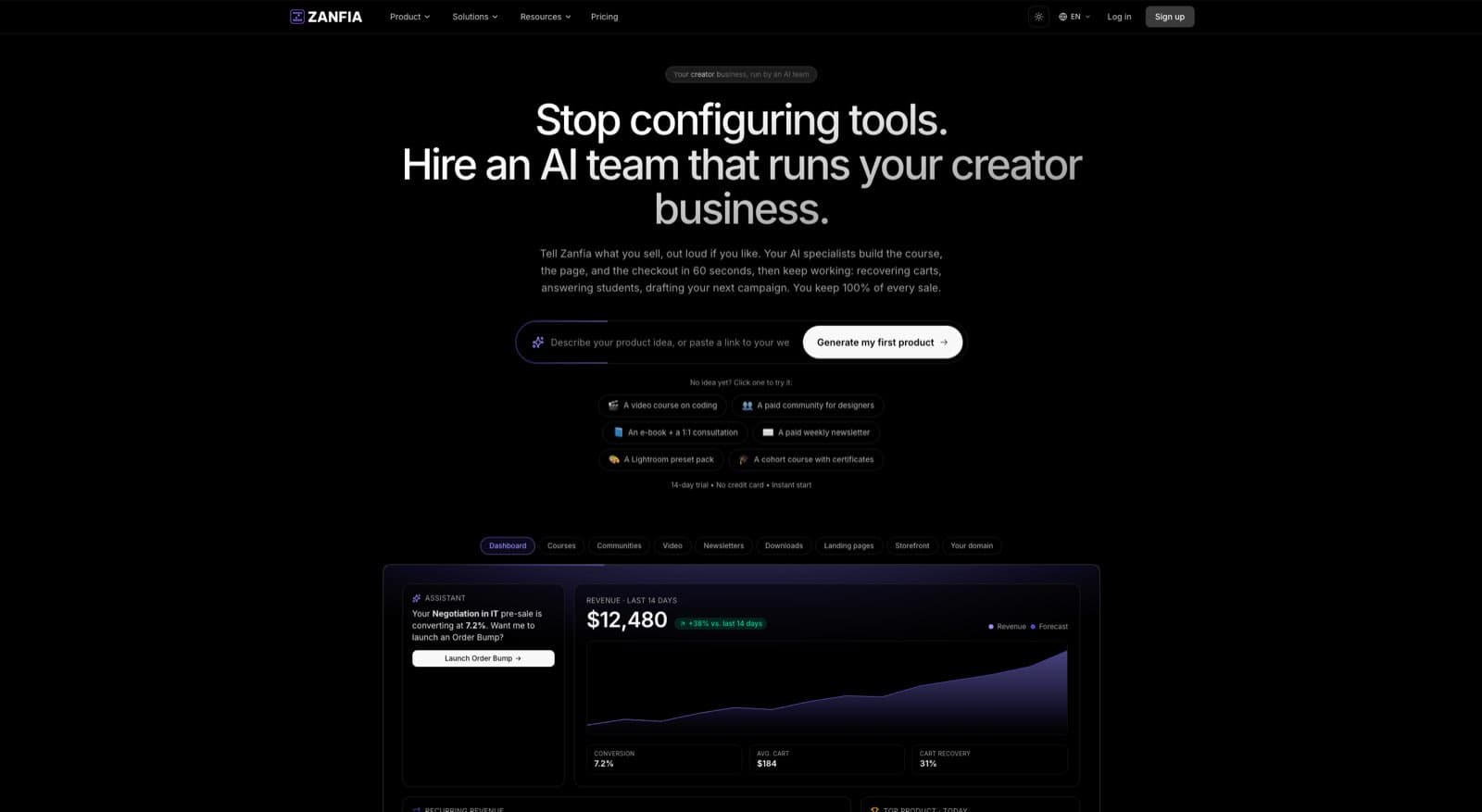
Zanfia is built around an AI team that runs the operational side of a creator business, with courses, communities, and checkout as the surfaces where that work lands. The assistant knows the workspace and can perform actions available in the interface by chat or by voice, so a coach can dictate “unlock module three for cohort B” or “message anyone who missed this week” instead of clicking through settings. Deeper AI capabilities, including an MCP endpoint that lets outside AI assistants act on the workspace directly, are plan-dependent; check the current Zanfia pricing page for what unlocks where. Here is how the rest of the platform maps to the structure this guide describes.
Self-paced content lives alongside the live-call cohort. You can build your course modules with drip-released lessons, so each week’s foundational content unlocks in sync with the live call. Native video hosting means you do not need a separate Vimeo or Wistia subscription, and the smart video player remembers exactly where each member left off across desktop and the native iOS and Android apps.
Community lives in the same interface as the course. Zanfia combines a community (channels, groups, announcements) with course content in one interface, so coaches can run live-call cohorts alongside drip-released lessons without stitching together Circle and a separate course tool. Members log in once and see their next lesson, the community feed, and upcoming session information in one place. Progress memory keeps each participant’s position tracked across the program.
Cohorts are supported through group-based organization. You can organize members into groups, which is essential when you are running multiple cohorts in parallel. Announcement-only channels let you send cohort-wide messages without opening a discussion, and topic channels give each cohort its own space for peer conversation. Because twelve different product types (courses, communities, memberships, downloads, consultations, bundles and more) live under one brand, you can add a paid follow-on community or an alumni bundle to your cohort without moving members to another tool.
Checkout is built for how coaching programs actually sell. Cart 2.0 handles one-time payments, installment plans (split a $2,500 program into four monthly payments instead of discounting to close the sale), and subscription pricing for a continuity program after the cohort ends. Stripe and PayPal are supported, along with Apple Pay and Google Pay for mobile buyers. Order bumps let you add a one-on-one intensive as an add-on at checkout without complicated funnel plumbing, and test mode lets you buy your own program end to end before enrollment opens, so broken flows or tracking gaps get caught before a real member ever hits them.
Pricing is aligned with the coaching business model. Zanfia charges 0% platform fees on customer sales (only payment processor fees apply, such as Stripe’s standard rates), which matters when you are moving high-ticket coaching packages. A single sale of a $2,500 program on a platform that takes a percentage cut can cost hundreds of dollars per transaction. Over a cohort of twelve members, that adds up fast.
White-label domain support keeps the experience yours. Each program gets its own subdomain (or you can map a custom domain), so members experience your brand, not Zanfia’s, from the first login through graduation.
If you want to see how this fits together, you can explore Zanfia’s pricing and plans, or start with the 14-day free trial and build a first cohort container before you commit.
FAQ
How many hours per week should I plan for running a group coaching program?
Budget six to ten hours per week during an active cohort. This includes one ninety-minute live call, two to three hours of preparation (reviewing member submissions, planning hot-seats, prepping content), two to three hours in the community responding to threads and posting prompts, and one to two hours on operations (scheduling, follow-ups, admin). If you are also running one-on-one calls between group sessions, add another two to four hours depending on cohort size.
Should I record live sessions and if so, how do I make sure members still show up live?
Yes, record every session. Members will miss occasionally, and the recording protects the value they paid for. To keep live attendance high, do the coaching in the live call, not the teaching. Hot-seats, breakouts, and real-time application cannot be replicated by watching a recording. Make clear at enrollment that recordings are a backup, not a substitute, and reference live-call moments (“remember when Sarah asked about X on the call?”) in the community so members feel the FOMO of missing.
What should I do if a member goes quiet mid-cohort?
Reach out personally within one week of noticing. Not a group post, a direct message. Ask what is going on, no judgment. Sometimes it is life (illness, work crunch, family). Sometimes it is that the program is not delivering what they expected, which is critical feedback. Sometimes they are stuck and embarrassed. In all three cases, a direct conversation either brings them back or gives you information you need to improve the program. Do not let members quietly disappear.
How do I handle a member who dominates every live call?
Address it privately, then structurally. Privately, thank them for their engagement and ask them to leave space for others. Structurally, use a hot-seat rotation so nobody can dominate by default, and use breakout rooms so airtime is naturally distributed. If a member continues to dominate after a private conversation, you have permission to redirect on the live call: “Great point, let’s hear from someone we have not heard from yet this week.”
Can I run a group coaching program without doing live calls at all?
You can, but do not call it group coaching. Without live interaction and hot-seats, you are running a group course or a community-plus-content program. Both are valid models with their own retention playbooks, but they lack the peer coaching dynamic that makes group coaching work. If cost or scale is the concern, consider running fewer, larger cohorts, or bringing in trained facilitators to run some of the calls.
How should I price a group coaching program?
Price based on the transformation, not the hours delivered. A twelve-week program that helps someone land their first five clients is worth thousands of dollars, even though your marginal delivery cost per member is low. Most successful group programs price between $1,500 and $10,000 for a full cohort experience. Anchor to the outcome, not to your hourly rate.