

Live vs Self-Paced Courses in 2026: Which Format Actually Earns More?
If you sold a self-paced course in 2022, you probably priced it at $297 or $497 and called it a day. In 2026, that same course content—repackaged as a six-week cohort—routinely sells for $1,500 to $3,000. Same outcomes, same instructor, two to three times the revenue. So why isn’t every creator running cohorts?
Because the math is more complicated than the headline. Cohorts earn more per student but cost more per student in time. Self-paced scales infinitely but converts at a fraction of the price and finishes at a fraction of the rate. The right answer for your business depends on your audience size, your hourly rate, and whether you actually want to be on a Zoom call every Tuesday at 7 p.m.
This guide breaks down the real economics of live vs self paced courses in 2026, the hybrid model most six-figure creators are quietly running, and how to decide which format fits your current stage—plus how to evolve from one to the other without rebuilding your entire stack.
The 2026 reality: cohort courses command 2-3x the price
The pricing gap between live and self-paced has widened every year since 2022, and 2026 is the most lopsided yet. A self-paced video course teaching email marketing now sits in the $200 to $600 range for solo creators. The same instructor running a four-to-six-week cohort on the same topic charges $800 to $2,500, with premium operators pushing past $3,500.
Three forces drive the spread:
1. AI commoditized passive content. When ChatGPT can summarize any tutorial in fifteen seconds and YouTube has a free version of nearly everything, evergreen video alone stopped feeling scarce. Cohorts sell what AI can’t replicate: live feedback, peer accountability, and a real human watching you stumble through the work.
-
Buyers learned that finishing matters. The dirty secret of self-paced is that most buyers never complete the course. Cohort buyers know they’ll be held accountable, so they pay for the structure—not just the content.
-
Premium positioning works. A $2,000 cohort signals professional intent. A $97 video course signals a weekend curiosity. Creators who want serious clients increasingly use cohorts as a high-ticket entry point, then offer self-paced versions as upsells or downsells.
The cohort vs self paced earnings gap isn’t temporary. According to the Harvard Business Review’s analysis of professional development pricing, structured, time-bound programs consistently outperform on-demand alternatives by 200% or more in revenue per enrolled student—a pattern that has held across executive education for decades and is now reshaping the creator economy.
Completion rates: 10-15% self-paced vs 70-80% cohort
This is the statistic every course creator should have tattooed somewhere visible: roughly 10 to 15 percent of self-paced course buyers finish what they paid for. Cohort programs typically clock 70 to 80 percent completion rates, and some elite operators exceed 90 percent.
Why this matters has less to do with ego and more to do with revenue:
- Finishers refer. A student who completed your program tells their network. A student who bought and forgot doesn’t.
- Finishers buy again. Your highest-LTV customers are people who got results from the first thing they bought.
- Finishers post testimonials. The marketing material that sells your next cohort comes from the people who finished the last one.
- Finishers don’t refund. The chargeback risk on a course someone never logged into is meaningfully higher than on a course someone showed up to every week.
Self-paced isn’t broken—it just has a fundamentally different relationship with completion. If you’re selling a $49 reference course, you don’t need 80% completion. You need 80% of buyers to feel like they got their money’s worth from the first module they watched. That’s a different product than a $2,000 transformation program.
The Pew Research Center’s ongoing work on adult online learning behavior reinforces this: structured deadlines and cohort accountability are the two strongest predictors of course completion, far outweighing factors like content quality, pricing, or instructor reputation.
Time per student: where live courses lose at scale
Here’s the part cohort enthusiasts skip past. A self-paced course requires roughly the same instructor time whether you sell 10 copies or 10,000. A cohort requires linear time per student—and when you’re honest about the hours, the per-student economics can flip ugly.
Run the numbers on a typical four-week cohort with 25 students at $1,500 each:
- Revenue: $37,500
- Live calls: 8 sessions × 90 minutes = 12 hours
- Prep time: 8 sessions × 30 minutes = 4 hours
- Async feedback (Slack, Loom, written): ~1 hour per student per week = 100 hours
- Office hours and 1:1s: ~10 hours
- Onboarding, payments, support: ~10 hours
Total: roughly 136 hours of instructor time. That’s $276 per hour—respectable, but not the dream of “scaling yourself out of the equation.” Push the cohort to 75 students and the async feedback alone consumes 300 hours. At that point your effective hourly rate craters unless you raise the price aggressively or hire support staff.
Self-paced inverts this curve. Once your course is built, doubling sales doesn’t double your time. Your hourly rate climbs every month the course keeps selling. The catch: it took you 200+ hours to build the course in the first place, and you’re now responsible for marketing it forever.
The right question isn’t “which format earns more?” It’s “which format earns more per hour of your time, given how you actually want to spend your week?”
The hybrid model: pre-recorded core + monthly live calls
The fastest-growing format in 2026 isn’t pure live or pure self-paced. It’s hybrid: a self-paced video library that students can move through on their own schedule, paired with one or two live calls per month and an active community channel for async questions.
This structure pulls premium pricing without the time cost of weekly live sessions:
- Pre-recorded core curriculum: Students access lessons on demand. You record once, sell forever.
- Monthly group call: A 60-to-90-minute session covering hot seats, Q&A, and live teaching on whatever students are stuck on that month.
- Active community: Topic channels for peer support, an announcements channel for you, optional groups for cohort batches.
- Quarterly intensives: Optional add-on workshops at $300 to $800 each for students who want deeper work.
Pricing typically lands between pure self-paced and pure cohort. A self-paced course that would sell for $500 and a cohort that would sell for $2,000 can both be repackaged as a hybrid at $1,200 to $1,800—with significantly less weekly time commitment than running a true cohort.
The hybrid model is also a graceful answer to the “my list is too small for cohorts but too engaged for $97 courses” problem. You don’t need 50 students to fill a hybrid intake. Eight to fifteen is plenty, because the live calls are group format rather than 1:1.
What makes a hybrid actually work
The failure mode is when creators slap a single monthly call on top of an old self-paced course and call it premium. Students notice. To run a hybrid that justifies its price:
- The live calls need to be about something —a real curriculum theme, not generic Q&A.
- The community needs daily activity in the first two weeks. If new members log in and see ghost-town channels, they churn fast.
- The pre-recorded content needs to be current. A 2023 evergreen course with 2026 live calls feels stitched together.
Which audience size justifies live vs self-paced
The single biggest predictor of which format will work isn’t your topic or your teaching style. It’s the size and engagement of your audience.
Under 1,000 engaged subscribers: Cohort or hybrid wins. You can’t sell a $200 self-paced course at scale because you don’t have the traffic—but you can absolutely fill a 10-person cohort at $1,500 each. Small lists overperform on cohorts because conversion rates on high-trust audiences for high-ticket offers regularly exceed 5%, while self-paced at $97 might convert at 1 to 2%.
1,000 to 10,000 engaged subscribers: Hybrid is usually the sweet spot. You have enough volume to fill an intake every 60 to 90 days, but not so much that running pure self-paced at $99 outearns a $1,200 hybrid.
10,000 to 50,000 engaged subscribers: Both formats earn well, but the strategic move is a ladder. Lead with a $49 to $99 self-paced course as a wide funnel, then upsell hybrid or cohort to your best-fit buyers.
50,000+ engaged subscribers: Self-paced wins on absolute revenue, full stop. At this audience size, a $200 self-paced course converting at 1% generates more revenue than a $2,500 cohort capped at 50 students—and your hourly rate is dramatically better. The cohort becomes a high-margin add-on, not the core offer.
What changes the math: list quality. A 500-person list of warm, segmented buyers outperforms a 15,000-person list of cold opt-ins on cohort sales. Pricing strategy data from Forbes’ coverage of the creator economy consistently shows that audience trust, not audience size, predicts high-ticket conversion.
How to evolve a self-paced course into a cohort program
If you already have a self-paced course earning some revenue, you don’t need to throw it out and start over. The evolution path most creators run looks like this:
Step 1: Keep the self-paced course alive as a downsell
Don’t delete it. Reprice it as the entry-level option. If your cohort is $2,000, sell the self-paced version at $400 to $600 as the “do it on your own” track. About 30 to 40 percent of cohort applicants who can’t afford or schedule the live program will buy the self-paced version. Pure upside.
Step 2: Identify the highest-friction parts of the self-paced experience
What do students email you about most? What concepts do they get stuck on? Those become your live call topics. You’re not rebuilding the curriculum—you’re adding live support around the parts students were already failing on alone.
Step 3: Run a small beta cohort at half price
Pick 8 to 12 students. Charge $750 instead of $1,500. Run a four-week pilot. Use it to:
- Test your live call structure
- Collect testimonials
- Build a case study deck
- Refine your onboarding flow
The beta is a working session, not a profit center. The next cohort is where you earn.
Step 4: Build a waitlist instead of an evergreen funnel
Cohort sales work through scarcity. “Doors close Friday” and “only 25 spots” are not gimmicks—they’re how the format works. Switch your opt-ins to waitlist signups for the next intake, and run two to four cohorts per year rather than constant evergreen sales.
Step 5: Decide whether to keep the self-paced version listed publicly
Some creators hide the self-paced track and only offer it as a downsell during cohort enrollment windows. This protects the cohort’s premium positioning. Others keep both publicly listed for SEO and self-serve traffic. There’s no single right answer—test which sales pattern works better for your audience.
How Zanfia supports both formats on one platform
The painful part of running multiple course formats has historically been the tool sprawl. Self-paced lives in Teachable, cohorts in Maven, the community in Circle, the newsletter in ConvertKit, and you’re sending students between four different logins to access one program.
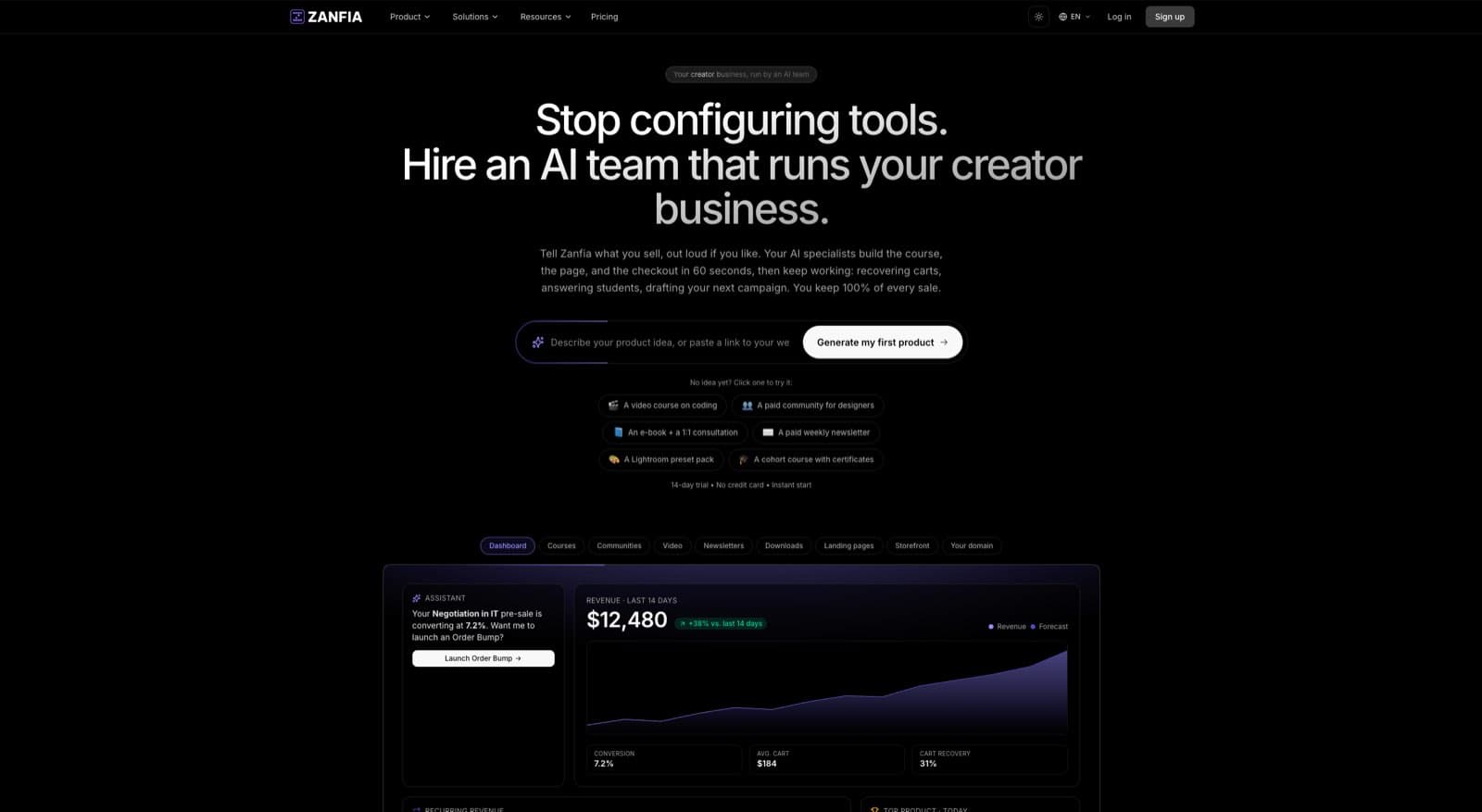
Zanfia collapses that stack into one workspace, and the framing on the pricing page tells you why: you’re hiring an AI team that runs the business, not renting another course tool. The assistant knows the whole interface, so you can set up a cohort, adjust drip timing, or push an announcement by dictating what you want out loud instead of clicking through five settings screens. Anything doable in the app is exposed through an MCP endpoint too, so your own AI agents can act on your workspace directly—availability depends on the plan, see the current Zanfia pricing.
For self-paced courses, Zanfia includes native video hosting with a smart progress-memory player, so students return to exactly where they left off without you paying for Vimeo Pro on the side. Time-locked module unlocking handles drip content delivery—you can release a new lesson every Monday for ten weeks, or unlock modules based on enrollment date. The course content duplication feature lets you clone an entire program to spin up a new cohort intake or franchise the curriculum without rebuilding from scratch.
For live cohorts, the community module gives each cohort its own topic channels and an announcement-only channel for you to broadcast schedule changes or session recordings. Group-based organization means you can run multiple cohorts in parallel, each with their own private space, without students mixing across batches. The community lives natively alongside the course content, so members aren’t toggling between Zanfia and Circle every time they want to ask a question.
For hybrid programs, all of the above runs under one login. Students see the pre-recorded curriculum, the community discussion, and announcements for upcoming live calls in the same interface. Cart 2.0 is where the AI-first work ends in a sale: order bumps and upsells at checkout, installment plans so you can split a $1,800 hybrid into four payments, a subscription track for ongoing community access, and test mode so you can run a real test purchase through your own checkout before you send a single ad. Twelve product types live side by side under one brand, so a self-paced track, a cohort track, and a paid community can all sit in the same catalog without a second platform.
For the business side: 0% platform transaction fees on customer sales (only payment processor fees apply through Stripe or PayPal), white-label custom domains so your cohort doesn’t live on someone else’s branded URL, and a native iOS and Android app so students can watch lessons and read announcements on the go. Communities in the mobile app are rolling out and may already be on your workspace by the time you read this. Custom domains and order bumps are available on higher plans—see the current Zanfia pricing for what unlocks where.
If you want to see how the format flexibility works in practice, you can explore Zanfia on the 14-day free trial (no credit card required) and build out both a self-paced course and a cohort intake on the same workspace before deciding which to lead with. Entry pricing after the trial starts at $39/month, or $31/month billed annually, on Starter.
Choosing your 2026 format: a practical recommendation
If you’re earning under $50,000 a year from courses, default to cohort or hybrid. The economics favor higher ticket prices at lower volumes, and the completion rates protect your reputation and referral pipeline. Don’t try to compete with the giant self-paced libraries on price—compete on outcomes.
If you’re earning $50,000 to $250,000, run a ladder. Use a self-paced course as your wide top-of-funnel offer at $99 to $299, then convert your best-fit buyers into a $1,500 to $2,500 hybrid or cohort program two to four times a year. This is where most creators in the live vs self paced courses debate find the highest hourly rate.
If you’re earning past $250,000, self-paced earns more in absolute terms, and a cohort becomes a high-margin specialty offer rather than the core business. At this stage you’re optimizing for hours, not revenue.
Whichever format you choose, the platform should bend to your business, not the other way around. Build the offer that fits your audience, your time, and your hourly rate goals—and pick infrastructure that lets you evolve without rebuilding.
FAQ
Is a live course really worth 2-3x the price of a self-paced course?
For the right audience, yes. The premium covers live feedback, peer accountability, and a structured timeline—all of which drive completion rates from roughly 10-15% to 70-80%. Buyers who finish refer, buy again, and produce testimonials, which compounds the long-term revenue beyond the upfront price difference.
How many students do I need to make a cohort profitable?
Most creators break even on time at 8 to 12 students for a four-week cohort priced at $1,500 to $2,000. Below that, the time investment usually outweighs the revenue. Hybrid formats can work with as few as 6 to 8 students because the live time commitment is lower.
Can I sell both formats without confusing my audience?
Yes, if you position them clearly. The standard pattern is to lead marketing with the higher-ticket cohort or hybrid and offer the self-paced version as a downsell during enrollment. The two formats serve different buyer intents—”I want structure and accountability” vs “I want the information at my own pace”—and most audiences appreciate the choice.
What completion rate should I expect from a hybrid course?
Hybrid programs typically land between pure self-paced and pure cohort, with completion rates of 35 to 55 percent. The monthly live call and active community drive accountability higher than self-paced, but lower than the weekly intensity of a true cohort. If completion is your top priority, run a full cohort. If revenue per hour is your top priority, hybrid usually wins.
Do I need a separate platform for cohorts and self-paced courses?
No. Platforms like Zanfia handle both formats natively, with self-paced video, drip unlocking, live community channels, announcements, and Cart 2.0 pricing all running under one workspace. Splitting tools across multiple platforms usually creates more friction than it solves, especially when you want to upsell students from one format to the other.
How do I price a hybrid course in 2026?
Start between 60 and 80 percent of what a comparable cohort would cost. If a four-week cohort on your topic sells at $2,000, price a hybrid with monthly calls at $1,200 to $1,600. Adjust based on the size and engagement of your community and the depth of live access you’re offering.