Scaling With Systems: The Creator’s Guide to Sustainable Growth

When we talk about "scaling with systems," we're talking about building a business that grows without you manually turning every gear. It’s about creating repeatable, automated workflows that handle the day-to-day grind so you can focus on creating.
For creators, influencers, and entrepreneurs, this is the secret to building a business that runs smoothly—even when you’re not actively in the weeds. You replace sheer manual effort with smart, automated processes, breaking free from the burnout cycle.
Table of Contents
Why Scaling With Systems Is Your Next Breakthrough
If you’re a creator, you know the drill. You’re the content producer, the marketer, the community manager, and the accountant—all rolled into one. That hustle is essential when you're starting, but it has a hard limit.
Eventually, you hit a wall. Growth flatlines simply because there aren't enough hours in the day. This is the ceiling every creator hits when they rely on manual effort.
Scaling with systems is how you smash through that ceiling. It’s a deliberate shift from a business that depends on your constant presence to one that operates like a well-oiled machine. This mindset shift unlocks predictable growth, cuts down stress, and lets you serve a larger audience without burning out.
Here’s what that looks like in practice:
- You get more done. When you automate repetitive tasks like sending welcome emails to new members, you free up time to create the amazing content your audience pays for.
- Your customer experience becomes rock-solid. Systems ensure every person who joins your community or buys your course gets the same high-quality experience. From onboarding to support, consistency builds trust and loyalty.
- Your business becomes more profitable. By fine-tuning your workflows, you stop wasting time and money on inefficient tasks. This allows you to pour your energy into activities that actually drive revenue.
This visual breakdown shows the stark difference between manual processes and a business driven by systems.
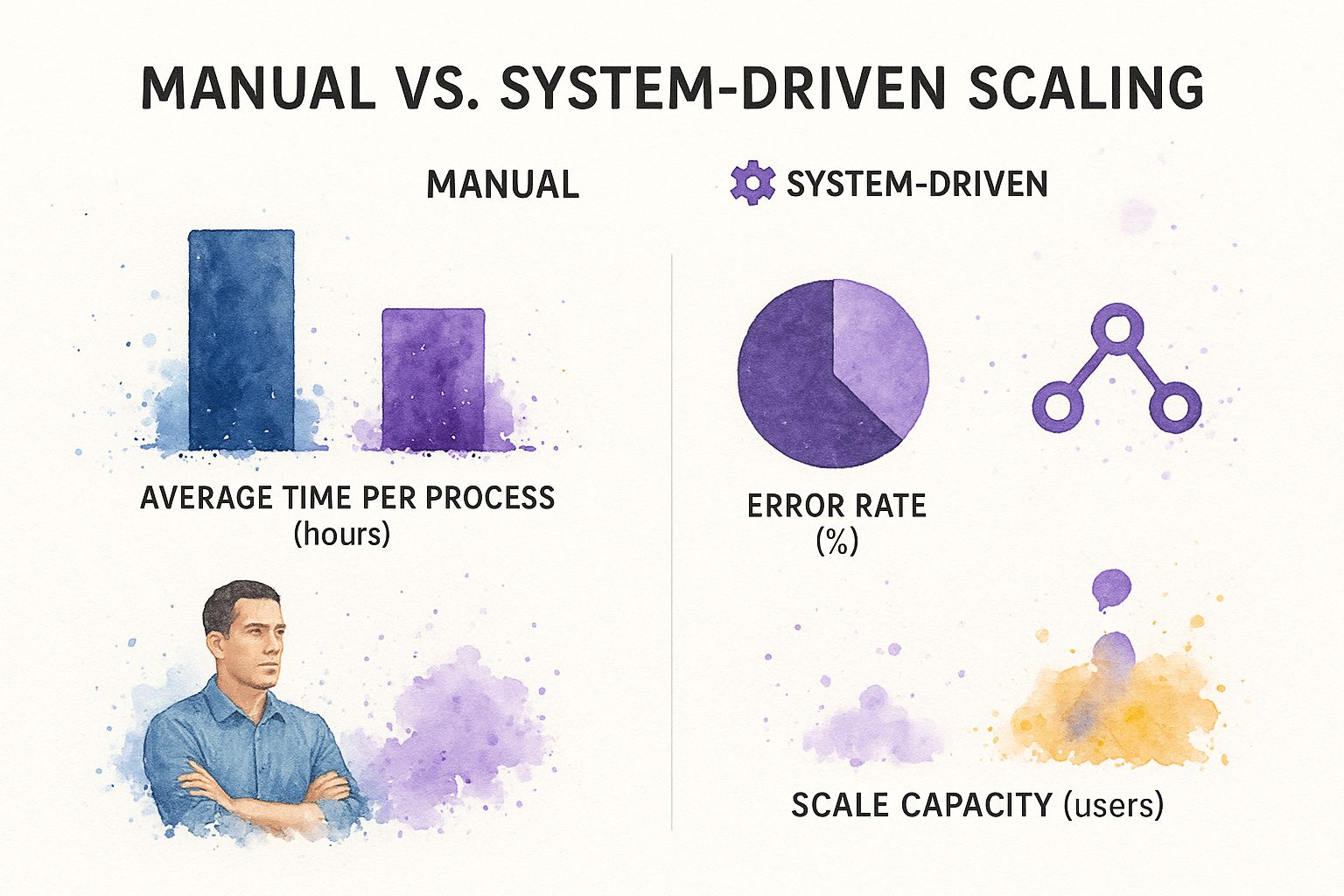
As you can see, systems don't just shave a little time off; they dramatically cut the hours spent on each process. They also slash error rates and give you the capacity to serve more people.
This isn't just a business concept. The core principle of scaling is critical in other fields, too. Major breakthroughs in AI are driven by what researchers call "scaling laws," which show that massive performance gains come from simply increasing data and computing power. It's a powerful idea: bigger, better-designed systems lead to disproportionately better results.
A Practical Framework: The 3 Core System Categories
To scale your business with systems, you can't just throw a bunch of tools at the problem. Think of it like building a house: you need a foundation, walls, and a roof, and you have to build them in the right order.
Your business systems fall into three categories. Knowing which is which will help you build them in an order that supports real growth.
1. Foundational Systems
These are the non-negotiables—the bedrock of your operation. Foundational systems are about planning and managing your resources, giving you a stable base to build on. If you skip this, any attempt to scale later will feel chaotic.
Here are a few real-world examples:
- Content Calendars: A podcast host planning an entire season of episodes, guest interviews, and promo assets well in advance.
- Financial Tracking: A solopreneur who pulls all expense and revenue data into one place to see which products are truly profitable.
- Audience Research Hub: A simple database for tracking audience feedback, survey results, and common questions to guide what you create next.
Inside Zanfia, you can lean on the built-in calendar and content planners to map out your entire quarter. This isn’t just about putting dates on a calendar; it's about creating a predictable, repeatable process for your content engine that you can eventually hand off to someone else.
2. Operational Systems
Once your foundation is solid, it's time to build the walls. Operational systems are the "how-to" workflows that run your day-to-day execution. They turn your plans into consistent, repeatable actions. This is often the first place you'll feel the massive relief that comes with good automation.
These systems are where you start to reclaim your time. They answer the question, "How does this get done perfectly every time, without me having to think about it?"
Operational systems cover everything from task delegation to new customer onboarding. A course creator, for example, can set up an automated email sequence in Zanfia that welcomes new students, delivers their login details, and checks in on their progress after the first week. Every student gets the same high-quality, welcoming experience—without any manual effort.
3. Strategic Systems
Finally, with a strong foundation and smooth operations, you can add the roof. Strategic systems are all about growth and optimization. They help you understand your audience on a deeper level, test new ideas with minimal risk, and make decisions based on data, not gut feelings.
A coach with a membership community could use Zanfia’s segmentation tools to create automated, targeted offers for different tiers. By testing out different 7 subscription business model examples for creators in 2025, they can see exactly which pricing and benefits resonate the most, directly impacting their revenue.
Before you dive into massive operational frameworks, it's a good idea to start with yourself. Sharpening your own workflow habits first is key, and it helps to learn how to Build Effective Personal Productivity Systems on a personal level.
By looking at your business through these three categories, you can spot your biggest gaps and decide which system to build first to get the highest return on your effort.
Building Operational Systems For Workflow Efficiency
To scale, you can't get by on messy, improvised workflows. You need rock-solid operational systems. Without them, you’ll hit bottlenecks, waste time on administrative chaos, and burn out.
For a content or community business, this often starts with your content pipeline. Think about every step, from the initial brainstorm all the way to hitting "publish." When you map this out, nothing slips through the cracks. Every draft, edit, and approval has a home, and everyone knows what to do next.
This is where a platform like Zanfia becomes your central operations hub. Instead of juggling spreadsheets, emails, and DMs, you can:
- Define every stage of your content pipeline with clear ownership.
- Set up automated notifications so writers and editors are always in sync.
- Schedule content to be published in batches, saving time and keeping your release schedule consistent.
- Repurpose content into different formats—like turning a blog post into social media snippets—right from your dashboard.
Mapping Your Content Pipeline
Let’s get practical. Visualize the journey of a single piece of content. The key stages are usually ideation, drafting, editing, approval, and publishing.
In Zanfia, you can use workflow templates to drag and drop these stages into a visual pipeline. From there, you assign roles and set deadlines. This simple act prevents that common problem where a task sits in limbo, waiting for someone to pick it up.

I worked with a creator who saved over 10 hours a week just by automating their edit assignments and approval reminders in Zanfia. The system automatically pings the right person at the right time, so nothing gets buried in an inbox. This small change cut their time-to-publication in half.
"Having a single hub for content tasks more than doubled our throughput,” says content strategist Maya Lee, who credits Zanfia for keeping her team aligned.
Crafting Crystal-Clear Task Briefs and SLAs
Vague instructions are a huge time-waster. That back-and-forth clarification kills momentum. The solution is creating simple, standardized task brief templates.
Inside Zanfia, you can create a template with fields for the essentials: objective, key deliverables, due date, and acceptance criteria. You can also embed Service Level Agreements (SLAs) directly into each task. This means everyone knows when feedback is expected, holding the entire team accountable.
Here’s how to put it into practice:
- Draft a concise task brief template outlining the goals for a piece of content.
- Set clear SLA deadlines for reviews, edits, and final approvals (e.g., "24-hour turnaround on first drafts").
- Use Zanfia’s comment threads to keep all feedback attached to the specific task.
- Automate follow-up reminders that trigger when deadlines are approaching.
This structure does more than tighten up handoffs. It creates a historical log of every decision, which is invaluable when you bring new team members on board. They can see exactly how things are done without asking a dozen questions.
The need for solid infrastructure isn't just a challenge for small businesses; it's a global trend. As digital demand explodes, the infrastructure powering our platforms has to keep pace. McKinsey forecasts that capital spending on data center infrastructure will blow past $1.7 trillion by 2030, largely driven by the needs of AI and cloud computing.
A Quick Checklist to Audit Your Workflows
Before moving on, audit your current process. Here’s a quick checklist you can run through right inside Zanfia:
- Workflow Completeness: Is every single stage, from idea to published piece, defined in the system?
- Task Clarity: Do your task briefs consistently include an objective, deliverables, and SLAs?
- Automation Coverage: Are you using automations for notifications, batch scheduling, and content repurposing?
- Handoff Efficiency: Look at comment logs and approval loops. Where are the delays?
- Role Accountability: Is it crystal clear who is responsible for each stage?
If you're exploring different tools, check out our guide on the best online teaching platforms to see how Zanfia stacks up against other solutions.
Ultimately, these systems are what allow you to stay lean and effective as your audience and team grow. The key is to continuously refine your workflows based on team feedback and data. Use Zanfia’s analytics to spot recurring delays or resource gaps, and then fix them. This ongoing optimization locks in your efficiency gains for the long haul.
Automating Community Engagement With Zanfia Tools
Keeping your community active drives predictable, stable revenue without constant manual work. With Zanfia’s no-code automation, you can set up welcome series, milestone celebrations, and gentle re-engagement prompts in minutes.
Automated engagement campaigns on Zanfia often deliver a 30% bump in member retention within the first quarter. By tagging members based on their activity, you ensure each message lands at the right time.
- Three branded welcome emails right after signup
- Achievement badges at 7, 30, and 90 days
- Re-engagement nudges when someone’s inactive for 14 days
Setting Up Personalized Welcome Flows
Head to Community Automations in Zanfia and start a new workflow. Choose “New Member Joined” as your trigger, then drag in an email step. Write a friendly note using {first_name} so it feels personal.
“Our first welcome series cut drop-off by 45%, thanks to Zanfia’s modular editor,” shares membership coach Dina Parker.
Key setup options:
- New Member Joined to send an instant greeting
- Tag Applied to display resource popups
- Profile Updated to invite members into a dedicated group
Milestone Rewards And Re-engagement Nudges
After your welcome flow is live, add milestone rewards via dynamic tags. Tag members when they hit certain activity levels to trigger unique perks or discount codes.
- Define activity milestones like 5 comments or 10 posts
- Craft reward templates with short videos or PDF downloads
- Fire off automated messages whenever a tag applies
Zanfia’s cloning feature makes it easy to test new ideas without rebuilding from scratch. You can even schedule live Q&A check-ins to keep the human touch.
For conversation starters and poll ideas to enrich your flows, read our guide on creative prompts in community circles.
- A/B test subject lines for better open rates
- Keep sequences brief to avoid member fatigue
- Track response metrics in your dashboard to spot drop-offs
Balancing automated touchpoints with live engagement builds a system that scales while staying personal. You’ll spend less time on admin and more on meaningful interactions.
Tips For Authentic Automations
- Write in a first-person voice to keep messages warm
- Reference join dates or achievements for context
- Sign off personally to reinforce genuine connection
Regularly review open rates, clicks, and opt-outs in Zanfia. If a template underperforms, tweak the timing or copy. Small adjustments keep your sequences feeling fresh and member-focused.
Watch which badges drive the most engagement. Use Zanfia’s A/B test dashboard to compare send times and subject lines. With ongoing iteration, you’ll hit steady weekly results.
Measuring Performance and Iterating
You've built your systems. That's a massive win, but the real magic happens when you treat those systems not as a finished product, but as a living part of your business that needs constant refinement.
No system is perfect on day one. The secret to scaling isn't just having systems; it's the continuous cycle of measuring, learning, and improving. This is where data becomes your best friend.
But not just any data. It’s easy to get lost in vanity metrics that look good but don't move the needle. Your goal is to zero in on the key performance indicators (KPIs) that tell you the real story of your business's health.

Key Metrics To Track In Zanfia
Think of your Zanfia dashboard as your operations command center. It’s your single source of truth, giving you a real-time pulse on what’s happening so you can make smart, data-driven calls.
Here are the core metrics I recommend keeping a close eye on:
- Content Output Rate: This isn't about churning out content for the sake of it. It’s a direct measure of your team's efficiency. Is it steady? Increasing? If so, your operational systems are humming.
- Community Churn Rate: This is your early warning system. It tells you how many members you're losing each month. A high churn rate is a red flag that you might need to rethink your engagement strategy.
- Monthly Recurring Revenue (MRR): For any subscription business, this is the ultimate health metric. I suggest tracking it by membership tier in Zanfia—it's a fantastic way to pinpoint which offerings are resonating most with your audience.
A good rule of thumb: if a metric doesn't inspire a potential action, it's probably not worth tracking. Your dashboard should answer critical business questions, not just be a wall of numbers.
Running Small Experiments To Drive Growth
Once you have a handle on your core numbers, you can start tinkering. Think small, controlled experiments, not massive overhauls.
I worked with a creator who was stuck on a revenue plateau. Looking at their Zanfia analytics, we saw their mid-tier plan had amazing engagement, but its growth was flat. They ran a simple A/B test.
- Group A: Got the standard onboarding sequence.
- Group B: Received a tweaked sequence with an invite to an exclusive Q&A and a bonus resource.
The result? After just 30 days, Group B showed an 18% higher upgrade rate to the premium tier. It was a small, data-backed change that led to a serious revenue bump.
This iterative mindset isn't just for small businesses. Look at the global energy sector's transition around 2025. System-wide changes were crucial for growth. As renewables got cheaper—solar power costs dropped 41% and wind 53%—it fueled the fastest improvement in the Energy Transition Index in a decade. A perfect macro example of how measuring and adjusting parts of a huge system leads to incredible outcomes.
To ensure your systems are fueling your growth, focus on building effective business performance dashboards that deliver actionable insights. When you layer these feedback loops into everything you do, your business stops being a static machine and becomes a resilient, self-improving engine.
Common Mistakes To Avoid When Scaling With Systems
Building systems is a huge step forward, but a bad system can create more chaos than it solves. I've seen many creators fall into the same traps, turning what should be a breakthrough into a breakdown. Knowing what not to do is just as important as building the workflows.
One of the biggest mistakes is trying to over-automate the human element. I once made this mistake myself. I set up an automation that sent a generic “We miss you!” email to community members who hadn't logged in for two weeks. The result? A wave of unsubscribes from people who felt spammed, not genuinely missed. Automation is for repetitive tasks; it should never replace real connection.
The point of scaling with systems isn't to remove yourself from the business. It's to free you up to focus on the high-impact, personal interactions that only you can provide.
Another classic error is building systems before validating demand. It’s tempting to spend weeks mapping out a perfect onboarding sequence for a new course. But what if the topic doesn't land with your audience? That’s a massive waste of energy. It's much smarter to launch with a simpler, manual process first. You can learn more about this lean approach by validating ideas with cohort-based courses.
Diagnosing Your System Breakdowns
When a system hiccups, you need to figure out why—fast. Don't just slap a bandage on the immediate issue; get to the root cause.
Here are a few questions I always ask:
- Is this a tool problem or a process problem? Often, the software isn't the culprit. The real issue is a fuzzy step in the workflow. I recommend auditing your task briefs and handoffs right inside Zanfia to make sure they're crystal clear.
- Are we tracking the right things? It’s easy to chase vanity metrics like social media likes. What really matters are KPIs like customer lifetime value. Your Zanfia dashboards should reflect the true health of your business, not surface-level engagement.
- When was the last time we audited this system? Systems need regular check-ups. I schedule quarterly reviews to cut out what’s no longer working. Your business is always evolving, and your systems have to evolve with it.
Frequently Asked Questions and Your Next Steps

As you get ready to systemize your business, it’s normal to have questions. I’ve been there. Here are straight-up answers to the most common things I hear from creators who are right where you are.
What System Should I Build First?
It's easy to get overwhelmed, but my advice is always the same: start with your foundation. Before you build anything complex, you need stability.
Inside a platform like Zanfia, this means focusing on two core areas right away: the content calendar and your basic financial tracking. These two systems are the bedrock of your operation. They give you the clarity you need before you can effectively build anything else on top.
How Much Time Should I Block Out for the Initial Setup?
I won't sugarcoat it—be prepared to invest some time upfront. Realistically, you should expect to spend 5 to 10 hours getting your first system dialed in. It's a mix of building, testing, and refining until it feels right for your workflow.
But here’s the payoff: once you nail that first one, you've created a template for success. Using Zanfia's clone features, you can replicate that perfected system for a new project in minutes.
Your initial time investment pays dividends exponentially. Building one solid system saves you hundreds of hours down the road by creating a repeatable, scalable asset.
Can I Connect Zanfia With the Tools I Already Use?
Absolutely. The point of a central hub is to bring everything together, not force you to abandon tools you already love.
Zanfia was built with this in mind, offering native integrations with the major platforms you’re likely already using. For everything else, it connects to thousands of other apps through Zapier, which means your data can flow automatically between your entire tech stack. No more tedious, manual data entry.
What Are the "Must-Watch" Metrics Each Week?
You can track a million things, but that just leads to noise. Instead, focus on the vital signs of your business. Every week, your dashboard should give you a clear view of these three numbers:
- Output Consistency: Is your content engine humming along, or is it sputtering?
- Subscriber Churn Rate: Are you holding onto the audience you fought so hard to build?
- Revenue Per Subscriber: Is the value you're creating turning into predictable, sustainable income?
Hopefully, these answers give you the confidence to get started.
If you’re ready to swap chaos for clarity and build a business that can scale without you burning out, Zanfia is the central operations hub I recommend. It’s designed from the ground up to solve these exact problems for professional creators.
You can start putting these systems into practice today.