

What Is Passive Income and How Does It Actually Work
Let's be clear: passive income isn't about getting money for nothing. It’s a common misconception. The real secret is to front-load your effort—to build assets now that can generate revenue down the road with much less hands-on work. The goal is to create something once that pays you over and over again.
This fundamentally breaks the traditional link between the hours you work and the money you make.
So, What Is Passive Income, Really?
If you're picturing yourself on a beach, cocktail in hand, while cash magically flows into your bank account… well, that’s not quite it. The reality of passive income is far more strategic, but for digital creators and experts, it’s also far more achievable than you might think. It’s all about shifting your mindset from trading time for money to building systems that work for you.
Think of it like a musician recording a hit song. All the hard work happens upfront—writing the lyrics, composing the music, and spending endless hours in the studio to get it just right. But once that song is released, it can earn royalties for years, sometimes even decades, with very little ongoing effort. Every stream, every radio play, every use in a movie generates a little bit of income. That's the essence of passive income.

Active vs. Passive: A Quick Comparison
To really get a handle on this, it helps to see how passive income stacks up against the active income most of us are used to—things like a salary from a job, freelance project fees, or consulting payments. With active income, if you stop working, the money stops coming in. It's a direct trade.
Here's a quick breakdown to make the difference crystal clear.
Active Income vs Passive Income at a Glance
| Attribute | Active Income | Passive Income |
|---|---|---|
| Effort | Ongoing, direct effort is required to earn. | Upfront effort is high; ongoing effort is low. |
| Time Investment | You trade your time directly for money. | You invest time upfront to create an asset. |
| Scalability | Limited by the number of hours you can work. | Highly scalable; sell to 1 or 10,000 people. |
| Income Potential | Often capped by your role or rates. | Potentially unlimited; not tied to your time. |
As you can see, the two models are worlds apart. One is about doing, while the other is about building.
The Big Shift from "Doing" to "Owning"
Passive income, on the other hand, flows from assets you've built and now own.
For digital creators and experts, these assets aren't real estate or stocks. They are your knowledge, your skills, and your content, packaged into valuable digital forms that people will pay for. Think about things like:
- Online courses that teach a skill you've already mastered.
- E-books and downloads that solve a specific, nagging problem for your audience.
- Paid communities or newsletters that deliver consistent value to loyal subscribers.
This isn’t just a niche trend; it’s a massive economic shift. As serial entrepreneur and investor Artur Kurasiński notes, platforms like Zanfia are now “the most convenient and simplest solution for paid newsletters, courses and community” in markets like Poland, empowering a new generation of creators to build sustainable online businesses.
Why This Matters for Creators and Entrepreneurs
Building passive income streams is about more than just making some extra cash on the side. It's about creating freedom and building a business that can grow beyond your own two hands.
It helps you finally escape the "time-for-money" trap, where your earning potential is always limited by the hours in a day. When you create a digital product, you build an asset that can serve hundreds or even thousands of customers at the same time—something that's physically impossible with one-on-one services.
Of course, creating the product is only half the battle. Many authors, for instance, dive deep into whether self-publishing is worth it to figure out a sustainable path. You also have to think about how you'll find and connect with the people who need what you're offering. This is where building a direct line to your audience becomes critical. For a solid foundation on this, our guide on how to start an email list is the perfect place to begin.
The Best Passive Income Ideas for Digital Creators
If you're a digital creator, expert, or small business owner, the question isn't just "what is passive income?" It's "what can I build with the skills I already have?" The great thing about working online is that your knowledge, your content, and your experience are the raw materials for creating real, sellable assets.
Instead of getting lost in a sea of options, let's look at four proven models that are a perfect fit for creators. Each one lets you package your expertise in a slightly different way, building systems that can generate revenue long after the initial work is done.
1. Create and Sell Digital Products
This is often the most direct route to earning passively. You create a digital asset once—an e-book, a template, a preset—and you can sell it forever. The heavy lift is upfront, but once it's live, sales and delivery can be completely automated.
This model shines when you're solving one specific, nagging problem for your audience.
- E-books: Have a system or deep knowledge about a topic? Package it into a guide. A fitness coach could write an e-book on home workout routines. A financial advisor could create one on budgeting for freelancers.
- Templates & Worksheets: Save your customers time by selling them a pre-made solution. Think social media content calendars for marketers or project management templates for small business owners.
- Downloads & Printables: These are smaller, high-value assets like digital art, planners, or checklists. They work fantastically as entry-level products to get customers acquainted with your brand.
The secret here is to find a recurring pain point your audience has and build a simple, effective solution for it. If you need some ideas to get started, we have a detailed guide exploring the most profitable digital products to sell online.
2. Launch Knowledge-Based Online Courses
If you have a skill or a process you can teach from start to finish, an online course is one of the most powerful assets you can create. It lets you scale your teaching in a way one-on-one coaching never can, reaching hundreds or even thousands of students at once.
Sure, the initial effort is significant—you have to plan modules, record videos, and create supporting materials. But a well-made course becomes a flagship asset for your business. As veteran developer Daniel Roziecki highlights, the right platform gives you the "peace of mind" to focus on teaching instead of wrestling with tech.
On a platform like Zanfia, you can host your videos natively, eliminating the need for costly external services like Vimeo, while also supporting flexible integrations. The smart video player even saves a student's progress, creating a smooth learning experience that keeps them coming back.
3. Build Community-Based Subscriptions
Subscriptions are the holy grail for any online business because they create predictable, recurring revenue. Instead of relying on one-off sales, you build a loyal community of members who pay a monthly or annual fee for ongoing access to you and your content.
This model is all about fostering deep relationships and dramatically increasing what each customer is worth to your business over time.
- Paid Newsletters: Deliver your best, most exclusive insights straight to subscribers' inboxes. An investor could share in-depth market analysis, or a writer might provide weekly creative prompts.
- Membership Sites: Create a private hub with exclusive resources, a content library, and a place for members to connect. This could be a "knowledge base" for a specific industry or a support community for people working toward a common goal.
The real magic of a membership is keeping your audience engaged under your own brand. Platforms like Zanfia let you integrate a community right alongside your courses and products. This keeps everyone in one place—instead of scattered across Discord or Facebook—which dramatically boosts engagement, lifetime value, and member retention.
4. Monetize Your Audience with Affiliate Marketing
Affiliate marketing is simply recommending products or services you use and trust, then earning a commission when someone buys through your unique link. It might not bring in as much per transaction as selling your own products, but it's a fantastic way to add another income stream with very little creation effort on your part.
Authenticity is everything here. Your audience trusts your judgment, so only promote things you genuinely believe in. A food blogger, for example, could share affiliate links to their favorite kitchen tools. A business consultant could recommend the software they actually use to run their own operations.
This income stream works best once you have an established audience that looks to you for advice. It becomes a natural extension of the helpful content you're already creating, turning your recommendations into a reliable source of revenue.
Your Step-by-Step Plan to Build a Passive Income Stream
Going from a great idea to an actual, income-generating asset can feel like a huge leap. It's easy to get stuck in the "what if" stage, especially when the technical side of things feels overwhelming. But here’s the good news: you don't have to figure it all out at once.
This five-step roadmap will walk you through the entire process, breaking it down into small, manageable actions. We'll go from uncovering your unique value to launching your first automated product, effectively turning your expertise into a reliable income stream.
This flowchart gives you a bird's-eye view of how creators can turn what they know into digital products, online courses, and subscriptions.
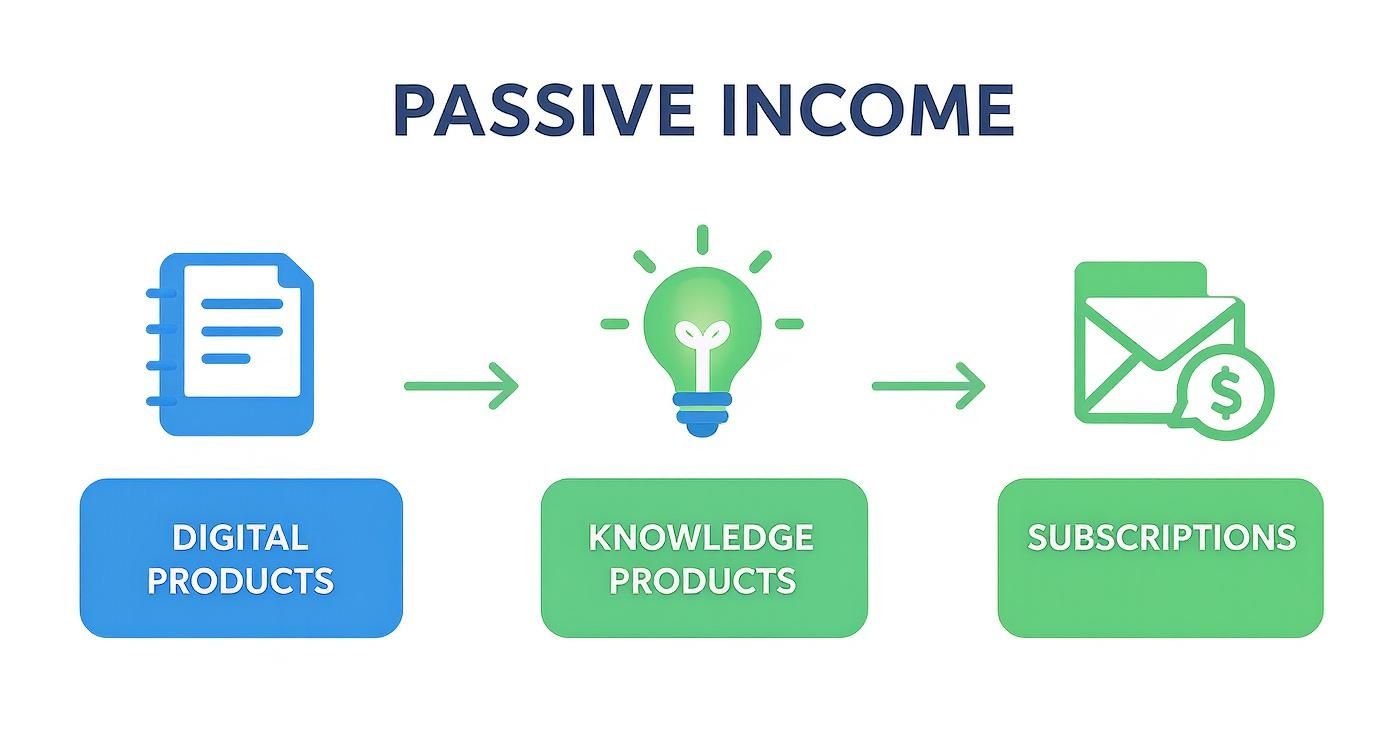
As you can see, everything from a simple e-book to a thriving community membership can be transformed into an automated revenue source.
Step 1: Pinpoint Your Unique Expertise and Niche
Before you build anything, you need a solid foundation. That foundation is the knowledge you already have—the skills, experiences, and passions that are uniquely yours.
To figure this out, just ask yourself a few simple questions:
- What do friends and colleagues always ask me for help with? This is often a huge clue to a skill you might be taking for granted, but others find incredibly valuable.
- What problem did I solve for myself that I know others are struggling with? Turning your personal solutions into a product is a powerful way to connect with an audience.
- What topic could I talk about for hours without getting bored? Real passion is magnetic. It’ll not only attract customers but also keep you motivated through the creation process.
The goal isn't to appeal to everyone. It's about finding a specific niche where your expertise provides a clear, focused solution for a well-defined group of people.
Step 2: Validate Your Idea with Your Audience
This is probably the single most important step, and it’s the one most people skip. Don't just assume people want what you're planning to create. You absolutely have to check if there's real demand before you sink hours and energy into building it.
Validating an idea doesn't have to be some complex market research project. You can:
- Run a quick poll on social media. Ask something simple like, "If I created a guide, which of these topics would help you the most?"
- Set up a "coming soon" landing page. Briefly describe your future product—maybe an e-book or a mini-course—and let people sign up for a waitlist. A flood of sign-ups is a great sign.
- Just talk to people. Reach out to a handful of folks in your target audience and ask them about their biggest challenges related to your topic. Then, listen more than you talk.
Think of this feedback as your insurance policy against building something nobody wants.
Step 3: Choose the Right Platform to Build On
With a validated idea in hand, you need to decide where it’s going to live online. The technology you choose can either be a massive help or a huge headache. For most creators, an all-in-one platform is the simplest and fastest way to get going.
Look for a system that keeps everything in one place: your digital downloads, courses, community, and payments. This avoids the messy and expensive nightmare of trying to stitch together a dozen different plugins and subscriptions.
A huge factor here is the fee structure. Some platforms take a cut of your sales, which means they penalize you for doing well—the more you make, the more they take. A platform like Zanfia, with a 0% transaction fee model, is a game-changer. You just pay a flat subscription and keep 100% of the revenue you worked so hard for.
Step 4: Create a High-Value Minimum Viable Product
Your first product doesn't need to be your magnum opus. Instead, start with a Minimum Viable Product (MVP). This is the simplest version of your idea that still delivers real, tangible value to your customer.
An MVP could be something like:
- A short e-book that solves one very specific problem.
- A "beta" version of your course with just the essential modules.
- A small but mighty library of templates or checklists.
Starting small gets your product out the door faster, which means you can start earning sooner. It also lets you collect feedback from actual customers to make your next version even better. If you're aiming for recurring revenue, our guide on how to build a membership website is a fantastic starting point for developing an MVP community.
Step 5: Launch and Automate Your Sales Funnel
Your product is ready, and your platform is set up. The final piece of the puzzle is creating a system that sells for you 24/7. This is where automation turns your hard work into truly passive income.
A basic automated funnel includes a sales page, a checkout process, and a simple email follow-up sequence. This is where an all-in-one platform really pays off. For example, Zanfia's automation features can save you 5–10+ hours a month on tedious but crucial tasks.
When someone buys from you, the system can instantly grant them access to their course, add them to your community, and send a welcome email—all without you lifting a finger. This frees you up to do what you do best: create more great content. To go deeper on this, check out these proven strategies for building passive income.
How to Scale From a Side Hustle to a Full-Time Business
Making that first sale on your digital product is an incredible feeling. You've officially proven people will pay for what you create. But going from a weekend project to a business that supports you full-time? That’s a whole different ballgame. It demands a shift in thinking—from simply creating to strategically optimizing, expanding, and scaling.
This is the next chapter for creators who know their idea has legs and are ready for real growth. It's about moving past one-off sales and building a cohesive ecosystem of products that makes every customer relationship more valuable.
Evolving Your Product Offerings
To truly scale, you have to stop thinking one product at a time. The real goal is to give your customers multiple ways to buy from you, creating a "value ladder" they can climb. This means layering your products to serve different needs and budgets.
Some of the smartest ways to do this are:
- Product Bundling: Package complementary products into a single, high-value offer. Imagine selling your main online course bundled with exclusive access to a private community. Not only does this bump up the average order value, but it pulls customers deeper into your world.
- Tiered Memberships: Instead of one price for everything, create different levels of access. A basic tier might get a paid newsletter, a mid-tier adds a library of resources, and the premium tier includes your signature course and group coaching calls.
- Upsells and Cross-sells: When someone trusts you enough to buy once, they’re your best candidate for another purchase. That customer who just bought your e-book on project management? Offer them a full set of templates or a mini-course on productivity right after they check out.
These strategies just work. Why? Because selling to a happy customer you already have is infinitely easier than finding a brand new one.
The Power of a Unified Platform for Growth
As your business picks up steam, you'll quickly find yourself drowning in a messy collection of tools. You've got one platform for your courses, another for your community, and a third for your email list. This "plugin-stack" nightmare creates data silos, a clunky customer experience, and a mountain of administrative headaches.
Scaling effectively requires a single source of truth. When all your customer data, products, and community discussions are in one place, you get a crystal-clear, 360-degree view of your business. You can instantly see who bought what, track their journey, and pinpoint opportunities for new offers.
This is where an all-in-one platform becomes non-negotiable. It brings all your operations under one roof, giving you the clarity you need to make smart, confident decisions. To see why this is so critical, check out our guide on the importance of scaling with systems for building a business that lasts.
Protecting Your Margins as You Grow
Growth should feel good, not expensive. But many platforms are designed to penalize your success. They slice off a percentage of every sale, so the more you make, the more they take.
This is a massive deal for established creators. A platform with 0% transaction fees means your success isn't taxed. We built Zanfia's pricing model for creators who are fed up with watching commissions gut their profit margins. You pay a simple, flat subscription fee, and 100% of your hard-earned revenue is yours. The only other fees are from payment processors like Stripe or PayU. You can learn more about how Zanfia's 0% fee structure helps creators keep more of their income.
Using Analytics to Fuel Smart Decisions
Finally, lasting growth runs on data, not guesswork. With everything in one place, you get access to deep analytics that tell the story of your entire sales process.
By tracking the right metrics, you can finally answer those nagging questions:
- Where are people leaving my sales page?
- Which of my products creates the most loyal, long-term customers?
- Are people actually engaging in my community, or is it a ghost town?
These insights let you stop guessing and start making targeted improvements. You can tweak your page design, refine your content, and adjust your offers based on what your customers are actually doing—ensuring your business doesn't just grow, but thrives.
Managing the Financial and Legal Side of Your Earnings
Making that first dollar of passive income feels amazing. But right after the celebration, a new reality sets in: you have to manage the money. Questions about taxes, invoicing, and keeping everything organized start to pop up. This admin side of things can feel a bit daunting, but with the right approach, it's completely manageable—and crucial for building a real business.
The first thing to get your head around is how this new income is classified. Tax authorities have very specific rules for what they consider "passive income," and it's often treated differently than the salary you earn from a traditional job.
Understanding Tax and Legal Definitions
For creators, this isn't just boring paperwork. It's a critical distinction that directly impacts how you file your taxes. In the United States, for example, the IRS has its own definitions, usually tied to rental income or businesses you don't actively run day-to-day. Things like royalties from an e-book or sales from an automated course can fall into a unique tax category.
If you're a creator in Poland, the challenges are often more immediate and practical. You need to handle VAT correctly and generate a compliant invoice for every single sale. Imagine trying to manually create hundreds of invoices a month—it's not just a time-sink, it’s a recipe for mistakes that can get you into trouble.
Automating Your Financial Workflow
This is where technology can save you from a massive headache. Instead of getting buried in spreadsheets and manual data entry, you can use a platform that handles all the heavy lifting automatically. This frees up your time and keeps you on the right side of the law.
A good creator platform should take care of these financial tasks for you:
- Automatic Invoicing: Generates a correct invoice the moment a customer makes a purchase. No manual work needed.
- VAT Handling: Calculates and applies the right VAT based on the customer's location and what they bought.
- Clean Record Keeping: Keeps a perfect, organized log of every transaction, making tax season far less painful.
Platforms like Zanfia are designed specifically with these needs in mind. Through integrations with Polish accounting systems like inFakt and Fakturownia, the entire financial workflow is put on autopilot. A customer buys your e-book, and the invoice is created and sent without you ever having to think about it.
This kind of automation is a game-changer. We've seen it save creators 5–10+ hours of tedious admin work every single month. That's time you can put back into creating content, talking to your audience, or planning your next big launch.
When you have a system that handles the financial backend, it stops being a barrier to your growth. It just becomes a quiet, efficient process humming in the background. You can focus on what you do best, confident that your books are clean and compliant. For more tips on setting up your business for success, check out our guide on how to sell digital products.
Common Mistakes to Avoid on Your Passive Income Journey
The idea of earning passive income is electrifying, but it's far too easy to get caught up in the fantasy of overnight riches. Let's be real: genuine passive income isn't a get-rich-quick scheme. It’s a marathon that pays off for those who put in the smart work upfront.
To get there, you have to sidestep the common traps that trip up even the most talented people. Let’s break down the biggest mistakes so you can build something that actually lasts.

Mistake 1: Building a Product Nobody Wants
I’ve seen this happen countless times, and it's absolutely heartbreaking. A creator spends months pouring their soul into a course or an e-book, only to launch to the sound of crickets. Why? They skipped the single most important step: idea validation. They built what they assumed people needed, instead of what their audience was actually asking for.
Before you write a single word or film one second of video, test your idea. Run a poll on social media. Start a simple waitlist. Just talk to your audience and ask them directly about their biggest pain points. Think of this feedback as your insurance policy against months of wasted work.
Mistake 2: Getting Tangled in a Tech Mess
So many creators start out by patching together a solution themselves. They might use a WordPress site and then staple on a dozen different plugins for their courses, payments, and community features. This "plugin stack" almost always turns into a technical nightmare. It’s clunky, insecure, and demands constant updates and troubleshooting. When one little piece breaks, the whole system can go down.
A messy tech setup doesn't just eat up your time—it creates a frustrating experience for your customers. A much better approach is to choose an all-in-one platform where everything is built to work together from the start.
A managed SaaS platform like Zanfia gives you stability and peace of mind that a piecemeal solution just can't match. With native video hosting, an integrated community, and a single login for your customers, you can stop being a part-time IT manager and get back to creating.
Mistake 3: Forgetting About Marketing and Audience Building
A fantastic product will not sell itself. I repeat: it will not sell itself. One of the most common missteps is putting 100% of your energy into creation and zero into distribution. You have to build an audience before or during your product development—not after. This means consistently sharing valuable content, growing an email list, and actually engaging with people.
Your audience is the engine that powers your passive income. Without a group of people who know, like, and trust you, even the world's best product won't get off the ground. Marketing isn't something you just do at launch; it's the ongoing work of building real relationships.
Finally, a huge hurdle is simple impatience. People often get discouraged and quit when they don't see huge results in a few weeks. Remember, building a passive income stream is like planting a tree. It needs time to grow deep roots before it can ever bear fruit. Stay consistent, pay attention to what's working, and trust the process.
Common Questions About Passive Income, Answered
Let's tackle some of the most common questions that pop up when creators start thinking about building passive income streams for their business.
How Much Money Do I Actually Need to Start?
This is the big one, and the answer is: it depends, but probably a lot less than you think. For digital products like an e-book or an online course, your biggest investment is your own time and knowledge. The actual cash you need upfront can be surprisingly low.
If you use an all-in-one platform with a simple subscription, you can avoid a lot of the initial setup costs. More importantly, this model helps you steer clear of those pesky transaction fees that eat into your profits as you grow. It's a smart, low-risk way to test the waters.
Is Passive Income Really "Passive"?
Honestly, no income stream is ever 100% hands-off. The real goal isn't to do zero work forever; it's to build a system that works for you with very little day-to-day effort.
Think of it like building a machine. An online course, for instance, requires a ton of work to plan, record, and produce. That's the heavy lifting. But once it's built and launched, the sales and delivery can run on autopilot. Your job then shifts to marketing, helping customers, and maybe updating a lesson once a year—a tiny fraction of the time it would take to deliver that value one-on-one.
Should I Try to Build Multiple Streams at Once?
It's tempting, but hold off. While having several income streams is the ultimate goal for a stable, resilient business, you should absolutely focus on just one at a time.
Why? Because you need to master the entire process first. Nail down everything from creation and launching to marketing and automation with a single product. Get your online course or paid community running like a well-oiled machine. Once it’s bringing in consistent revenue, then you can confidently branch out and add a second stream, like a paid newsletter or a set of digital templates.
Ready to turn your expertise into a real passive income stream? With Zanfia, you get an all-in-one platform to build your community, launch online courses, and sell digital products—all with a game-changing 0% platform fee model. Start building your online business with full control and clarity.
Explore the Zanfia platform and see how it works.

One comment
Comments are closed.

[…] truly unlock your earning potential from home, it's essential to begin by understanding passive income, as many online ventures offer this scalable revenue model. We will dissect each opportunity, […]