

What Is Thought Leadership and How Does It Build Authority
Thought leadership is so much more than just being an expert. It’s about becoming the trusted, go-to source in your field—the person whose insights don't just inform but actually shape conversations and guide decisions. It means offering a unique perspective that helps your audience see around the corner, solve their toughest problems, and understand their own world in a new light.
Defining What Thought Leadership Actually Means

Let's cut through the noise with a simple analogy. An expert can give you a map. It’s packed with accurate data and is technically perfect. But a thought leader is the guide who’s already walked that terrain. They know the shortcuts, can point out the hidden dangers the map misses, and understand the why behind the journey.
An expert knows a subject inside and out, but a thought leader shapes the thinking around it. That's the critical difference. It’s not about having all the answers but about asking the right questions and providing a clear, forward-thinking viewpoint that people actually want to follow.
The Core of True Influence
Real thought leadership isn't about repackaging old ideas or just being the loudest voice on social media. It grows from a powerful mix of deep experience, genuine curiosity, and an unwavering commitment to helping your audience win. That's how you build unbreakable trust and authority over time.
It demands that you develop a distinct point of view. For creators, this means grounding your content in your authentic journey—sharing not just the wins but the lessons learned from the failures, too. That kind of transparency is what forges a real connection with your audience.
"Thought leadership is the art of turning your unique expertise and perspective into influence, building a reputation as the person people seek out for guidance and inspiration in your niche."
Expert vs. Thought Leader
The shift from being a knowledgeable expert to an influential thought leader is a big one. It involves a fundamental change in both mindset and strategy—moving from simply providing information to creating a genuine impact. If you want to grow your influence, learning how to become a thought leader is the first step, and understanding this distinction is key.
This journey is about more than just a title; it’s a strategic shift that moves you from being a knowledgeable voice to an indispensable guide. The table below breaks down the crucial differences.
Expert vs Thought Leader: A Quick Comparison
| Attribute | Expert | Thought Leader |
|---|---|---|
| Primary Goal | To inform and provide answers. | To provoke new thinking and guide decisions. |
| Focus | Shares what they know (data, facts). | Explains why it matters and what's next. |
| Perspective | Looks at the present and past. | Looks toward the future, anticipating trends. |
| Audience Role | The audience is a recipient of information. | The audience is a community to be led and inspired. |
| Impact | Answers immediate questions. | Changes long-term perspectives and behaviors. |
Making this transition successfully means you stop just answering questions and start shaping the conversation.
This also means defining a clear value proposition for your audience. You need to articulate exactly why they should listen to you over anyone else, which is something we cover in our guide on what makes a strong value proposition. By positioning yourself as a trusted guide, you attract a loyal community that is eager to invest in your digital products—from online courses to paid newsletters—because they don't just value your content; they trust your vision.
How Thought Leadership Drives Real Business Growth
Putting in the work to build thought leadership pays off in a huge way. Why? Because it’s one of the most powerful assets you can own as a creator or entrepreneur. It’s the direct line connecting your authority to actual business results, creating a growth model that doesn't rely on chasing the latest shiny object.
When you establish deep trust, you stop chasing clients and start attracting them. And not just any clients—you attract higher-quality people who aren’t hunting for the cheapest deal. They're looking for real expertise to solve a real problem. That trust is what allows you to confidently charge premium prices for your courses, community memberships, or specialized e-books.
Moving Beyond Traditional Marketing
The modern marketplace is incredibly noisy. Thought leadership is the magnet that cuts through it all. Instead of pushing your message out with ads that interrupt people, it pulls the right audience to you. People start seeking out what you have to say, sharing your content, and essentially becoming volunteer marketers for your brand.
This kicks off a powerful flywheel. A loyal community begins to form around your work, championing your ideas and amplifying your reach far beyond what you could ever achieve with paid ads alone. This kind of organic growth isn't just cheaper; it builds a much stronger, more resilient business.
Trust as a Conversion Driver
This isn't just a "feel-good" concept; it translates directly into sales. Decision-makers are actively looking for credible sources to guide their choices. In fact, the data from the Edelman–LinkedIn B2B Thought Leadership Impact Report is incredibly compelling: 73% of decision-makers said an organization's thought leadership is a more trustworthy way to gauge its capabilities than its own marketing materials. You can see more data on how businesses are using thought leadership statistics for growth.
The same report found that 89% of decision-makers said high-quality thought leadership improved their perception of a brand. Even more telling, a massive 23% initiated a purchase right after engaging with it.
This is proof positive that consistently delivering valuable insights is a direct path to revenue. When you become the trusted guide, your recommendations—including your own products—carry immense weight.
This entire approach is fundamental to how modern digital businesses operate. By building your authority, you're laying the foundation for a sales funnel where your audience is already warmed up and ready to buy, simply because they believe in your expertise. It’s a core principle behind the most effective content marketing best practices, which all focus on building the relationship before asking for the sale.
Ultimately, thought leadership isn’t some abstract idea. It's a strategic asset that fuels every single stage of your business, from attracting your first follower to keeping your most valuable customers.
Crafting Content That Establishes Your Authority
So, what separates a decent blog post from a true pillar of authority? It’s not about pumping out more content; it’s about a deliberate, strategic approach grounded in delivering undeniable value. Before you even think about writing, you need a plan. That’s why the first step is always developing a robust content strategy to ensure every article, course, and newsletter you create has a clear purpose.
Think of it this way: authority builds trust, and trust is the bedrock of sustainable business growth.
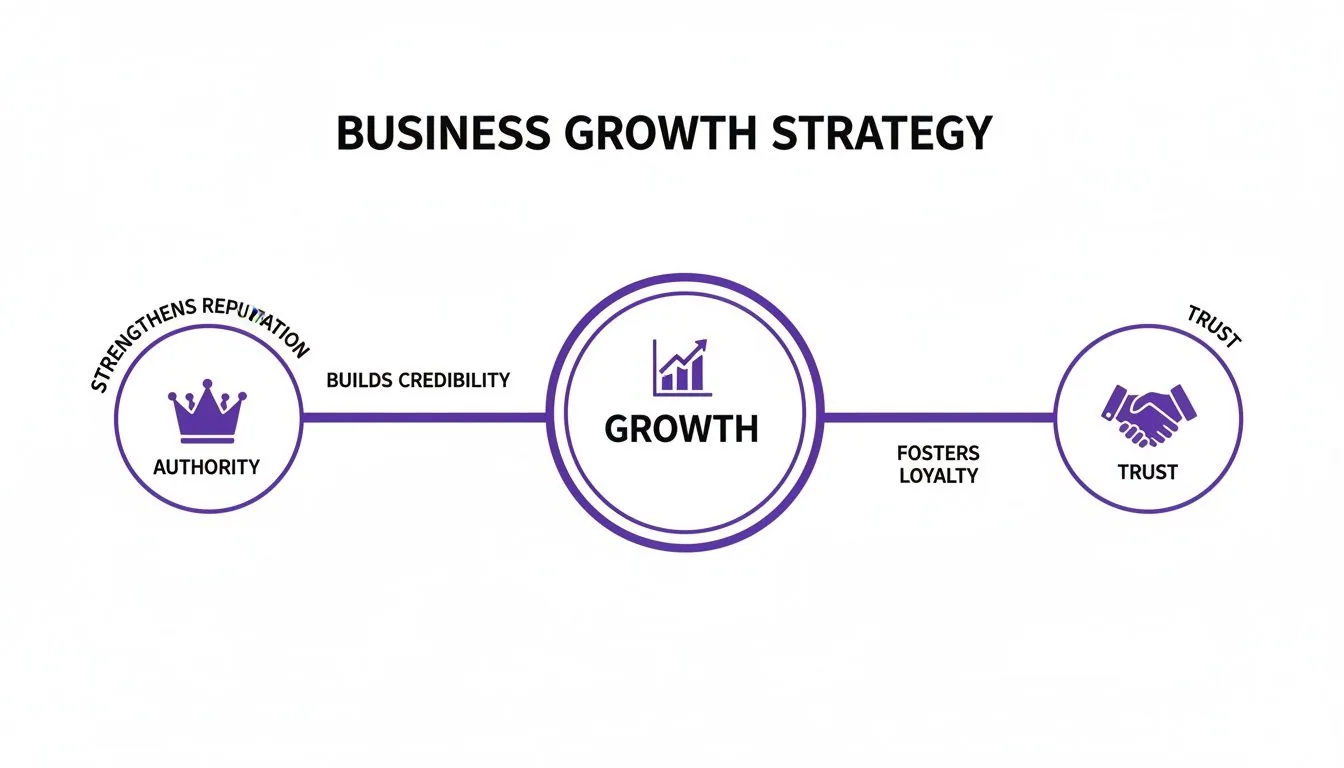
Growth isn't a direct result of just creating; it's the outcome of the trust your authoritative content builds with your audience over time.
The Four Pillars of Authoritative Content
True thought leadership content doesn't just materialize out of thin air. It’s built on a foundation of four key principles that elevate your work above the noise. By focusing on these pillars, you can methodically craft pieces that resonate deeply and position you as the go-to guide in your niche.
A Grist survey of senior executives revealed exactly what they look for. The top traits they valued most were content that helped them make better decisions (51%), offered genuinely fresh thinking (35%), and provided forward-thinking analysis (28%).
Let’s break down exactly how you can put these ideas into practice.
1. Fresh Thinking
This is all about offering a new lens on an old problem. Instead of just repeating the same tired advice everyone else is, you challenge the status quo. You connect two seemingly unrelated ideas to create a novel insight that makes your audience stop and think.
- Example for Creators: Don't just teach "how to use a new software feature." Instead, frame it as "How This New Feature Makes a Popular Best Practice Completely Obsolete." That’s a fresh take.
2. Forward-Thinking Analysis
You have to look beyond today's challenges and help your audience prepare for what’s coming next. Analyze emerging trends, make informed predictions, and give your community a strategic advantage by helping them see around the corner.
- Example for Creators: Instead of publishing a simple "2024 trends" list, create a deep-dive analysis on why a specific trend is emerging. Then, offer a framework your audience can use to capitalize on it before it becomes mainstream.
By consistently helping your audience anticipate the future, you move from being just another source of information to an indispensable strategic partner in their journey.
3. Actionable Guidance
Theory is great, but practical, tangible steps are what people really crave. Your content must bridge the gap between a big idea and its real-world execution. Provide clear, step-by-step guidance, frameworks, and tools your audience can implement immediately.
- Example for Creators: Take a high-level concept from your online course and turn it into a downloadable checklist or a template. This allows students to directly apply the lesson to their own projects. For more ideas like this, check out our guide on content repurposing strategies .
4. Authentic Experience
Finally, you have to ground every insight in your own real-world journey. Share your wins, but more importantly, be open about your failures and the hard-won lessons you learned from them. Authenticity is the glue that makes your expertise relatable and trustworthy. Your unique story is the one thing no competitor can ever duplicate.
Building Your All-In-One Thought Leadership Platform

Turning your expertise into a thriving business requires the right technology. Cobbling together a messy collection of plugins, payment processors, and community apps often creates more admin work than value. This is where an all-in-one platform like Zanfia earns its keep: it hires an AI team that handles the work behind your courses, community, newsletters, and checkout, and lets you dictate what happens next by chat or by voice through an assistant that can act on anything available in the interface. For creators building for the long haul, that combination lets you execute a thought leadership strategy without the technical headaches.
The goal is to build a seamless digital ecosystem under your own brand and domain. A single place where your audience can learn from you, connect with each other, and buy from you in one unified experience. This means creating a central hub where every piece of your content works together to prove your authority and guide followers on a clear path.
Establishing Your Central Content Hub
Your best insights shouldn't be scattered across the internet like digital breadcrumbs. The first step is to build a centralized home for your high-value content, turning your knowledge into structured, tangible assets. This hub becomes the definitive source for anyone wanting to learn from you.
With a platform like Zanfia, you can easily create:
- Knowledge Libraries: House your foundational articles, frameworks, and playbooks in an organized, easy-to-navigate library. This is where you establish your core ideas.
- Online Courses: Go deeper with structured learning programs. With native video hosting, you can create premium courses without paying for external services like Vimeo or Wistia , saving you significant costs while keeping students on your own domain.
By pulling all your best work into one place, you create a powerful asset that shows off the depth of your expertise and serves as the foundation for everything you offer. And because the assistant sits on top of the whole workspace through an MCP endpoint, you can dictate a new lesson outline, a knowledge-base article, or an email to buyers without clicking through six screens to do it.
Nurturing a Thriving Community
Thought leadership isn't a lecture; it's a conversation. A dedicated community space is where you turn passive followers into active, engaged members who feel like they truly belong. It's where the deepest trust is forged.
Unlike platforms that push your audience out to third-party tools like Discord or Facebook Groups, Zanfia keeps everything unified under your brand. You can launch paid newsletters to deliver exclusive insights straight to your most loyal fans and create topical discussion channels where members can connect directly with you and each other. Zanfia communities also include an AI agent that writes from your own content, and every post it publishes is labeled as AI, so members always know when they are hearing from you and when they are hearing from your assistant.
By integrating your community directly with your course content, you create a powerful feedback loop. Students can discuss lessons, ask questions, and apply what they’ve learned in a supportive environment, dramatically boosting engagement and long-term retention.
Monetizing Your Expertise Flexibly
Finally, your platform has to give you the flexibility to get paid for your work in a way that fits your business. A one-size-fits-all approach just doesn't cut it for creators with different products and audience needs.
Zanfia’s all-in-one system is built to sell. Key features include:
- 12 Product Types Under One Brand: Sell e-books, downloads, courses, communities, memberships, knowledge bases, services, events, consultations, and bundles—all from the same dashboard, under the same domain.
- A Checkout Built to Convert: Offer one-time purchases, subscriptions, and installment plans (for example, splitting a $600 course into four payments), stack order bumps and post-purchase upsells, and run test-mode purchases end-to-end before your first real sale so you know the checkout and tracking work.
- 0% Platform Fees: Keep 100% of your revenue . Zanfia's SaaS subscription model means no cut of your sales as of publication. You only pay standard fees from payment processors like Stripe and PayPal.
This integrated approach is a game-changer. Imagine a new customer buying your e-book and then automatically getting an invitation to a relevant community channel—all without you lifting a finger. Powerful automations like this can save you 5–10+ hours a month, freeing you up to focus on creating value. If you're weighing your options, our breakdown of the best platform for content creators offers even more detail.
Comparing Your Technology Options
Choosing between a unified platform and a piecemeal approach can feel overwhelming. Let’s break down what it really means for your business.
A self-managed tech stack (think WordPress with a dozen plugins) gives you control but often comes at the cost of complexity, security risks, and endless maintenance. An all-in-one platform handles the technical heavy lifting so you can focus on your content and community.
| Feature | Piecemeal Tech Stack (e.g., WordPress + Plugins) | Zanfia (All-in-One Platform) |
|---|---|---|
| Initial Setup & Maint. | High complexity; requires constant updates and plugin compatibility checks. | Fast and simple; all features are built-in and maintained. |
| User Experience | Often disjointed; users need multiple logins for courses, community, etc. | Seamless; one login gives access to everything under your brand. |
| Automation & AI | Possible with tools like Zapier, but can be brittle and expensive; AI is a separate stack. | Native visual automations plus an assistant you can drive by chat or voice, with an MCP endpoint so your own AI agents can act on the workspace (plan-dependent, see the current Zanfia pricing). |
| Checkout Mechanics | Depends on the plugin stack; order bumps, installments, and post-purchase upsells often need extra tools. | Order bumps, installment plans, subscriptions, and a test-mode checkout for verifying a funnel before launch, built in. |
| Cost Structure | "Death by a thousand cuts"—multiple subscriptions for plugins, hosting, etc. | A single, predictable monthly fee with 0% platform fees. |
| Security & Reliability | Your responsibility; vulnerable to plugin conflicts and security breaches. | Managed by the platform, ensuring uptime and data security. |
Ultimately, the right choice depends on how you want to spend your time. Do you want to be a systems integrator or a thought leader? An all-in-one platform like Zanfia is built to help you be the latter.
Measuring The True Impact Of Your Thought Leadership
If you can't measure your efforts, you can't improve them. While creating killer content feels good, true thought leadership has to drive real, tangible results for your business. This means looking past simple vanity metrics like social media likes and digging into the data that reveals the actual impact on your growth.
To get this right, you need to track a mix of quantitative and qualitative signals. The numbers tell you what is happening, while the qualitative feedback tells you why it's happening. This balanced view gives you a complete picture of your return on investment and helps you make smarter bets on where to focus your energy next.
Reach and Awareness Metrics
The first layer of measurement is just figuring out how many people your ideas are actually reaching. Think of these as foundational, top-of-funnel metrics that show whether your message is spreading and pulling in a new audience.
Key numbers to keep an eye on here include:
- Website and Blog Traffic: Are your articles, case studies, and guides attracting more visitors over time?
- Subscriber Growth: Are your email lists and paid newsletter subscriber counts climbing consistently?
- Content Views and Downloads: How many people are actually watching your course videos or downloading your e-books?
These figures help you spot which topics and formats are grabbing the most attention, so you can double down on what’s clearly working.
Engagement and Authority Metrics
Next, you need to see how deeply your content is connecting with your audience. High engagement is a powerful signal that people don't just see you—they value and trust you as a credible voice.
True authority isn't just about reach; it’s about the quality of the conversations you inspire. Deep engagement in a small, dedicated community is often more valuable than shallow interactions with a massive audience.
Look for these signs that your authority is growing:
- Community Discussion Quality: Are members in your Zanfia community asking sharp questions and genuinely helping each other?
- Unsolicited Mentions: Are other experts, podcasts, or media outlets referencing your work without you having to ask?
- Inbound Inquiries: Are you getting more partnership offers, speaking requests, or collaboration proposals out of the blue?
Conversion and Revenue Metrics
At the end of the day, your thought leadership has to connect to the bottom line. This is where you measure how your authority translates directly into sales and business growth. The Harris Poll found that investments in thought leadership can deliver a massive 14x return, and that buyers are willing to pay up to 13.57x more for a premium expert.
With an integrated platform like Zanfia, you can finally connect your content directly to revenue. The built-in analytics give deep visibility at every stage of the funnel to help you track:
- Sales Attributed to Content: Which blog posts or newsletters are driving the most course sales or e-book downloads?
- Lead-to-Customer Conversion Rate: How many of your free content subscribers eventually become paying customers?
- Customer Lifetime Value (LTV): Are the members of your paid community sticking around longer and buying more of your products over time?
By blending these three areas of measurement, you get a full, 360-degree view of your impact. For a deeper dive into this process, check out our guide on how to measure content marketing ROI. This data-driven approach is what lets you refine your strategy, prove your value, and build a truly sustainable business.
Got Questions About Thought Leadership?
Stepping into the world of thought leadership is exciting, but let's be real—it also brings up a ton of questions. As you shift from theory to actually doing the work, you're bound to hit a few snags. Here are some of the most common ones I hear, with straight-up answers to help you get moving.
How Do I Find a Unique Angle in a Crowded Market?
It’s easy to look at a crowded space and think, "What could I possibly add?" But your biggest advantage isn’t being smarter than everyone else; it's being the only you. Your unique angle is hiding at the intersection of your professional expertise and your personal story.
Forget trying to be the ultimate guru for an entire industry. That’s a recipe for burnout and sounding generic. Instead, niche down. Get laser-focused on a specific audience or a specific problem you understand on a gut level. Your unique perspective is the lens you see the world through—forged by your wins, your failures, and the lessons learned along the way. Nobody else has that.
How Long Does It Realistically Take to See Results?
Building real authority is a lot more like planting an oak tree than flipping a light switch. It's a long-term play, not an overnight hack. You have to consistently show up and deliver real value for months—sometimes even a year or more—before you see the big wins.
At first, the results will feel small. A few new email subscribers here, a really thoughtful comment there. But those little wins are the foundation. They compound over time. The key is to stay consistent and be patient. Think of it as a marathon. Every article you write, every video you post, is another mile marker on the road to building a bedrock of trust that will pay off for years.
Can I Be a Thought Leader if I Am Not a Famous CEO?
Absolutely. The idea that you need a C-suite title and a corner office to be a thought leader is completely obsolete. In fact, independent creators, solo consultants, and small business owners have a massive advantage today. You can be more nimble, more authentic, and far more relatable than some faceless corporate brand.
Your power comes from your direct connection with your audience. You can share your journey in real-time, build a genuine community, and create content grounded in your day-to-day work. This builds a type of trust that big brands often struggle to achieve.
What Are the Biggest Mistakes to Avoid?
While everyone's path is different, a few classic blunders can stop you in your tracks. Steer clear of these, and you'll be way ahead of the game.
- Inconsistency: This is the #1 momentum killer. If you only post when you feel inspired or engage with your community in random bursts, people will tune out. Commit to a sustainable schedule and stick to it.
- Ignoring Your Audience: Thought leadership is a conversation, not a lecture. If you aren't listening to what your community is asking, struggling with, and talking about, your content will eventually become irrelevant. Let their feedback be your guide.
- Chasing Perfection: Waiting for the "perfect" idea or the "perfect" podcast episode is a trap. It leads to analysis paralysis. It’s so much better to publish good, helpful content consistently than to wait forever for some flawless masterpiece that never gets made.
- Selling Too Hard, Too Soon: Your first job is to be generous with your expertise. If every post is just a thinly veiled sales pitch, you’ll burn through trust before you even have a chance to build it. Earn the right to sell by delivering incredible value first.
By getting ahead of these common questions, you can move forward with a clear, actionable plan to become a trusted voice in your space.
Ready to build your all-in-one thought leadership platform without the technical headaches? Zanfia gives you courses, communities, paid newsletters, and a checkout built to sell, plus an AI team you can direct by chat or voice through an assistant that acts on your workspace, with 0% platform fees as of publication. Start with a 14-day free trial, no credit card required, at https://zanfia.com.