7 Subscription Business Model Examples for Creators in 2025

The creator economy is booming, and at its heart lies a powerful engine for sustainable growth: the subscription model. Moving beyond one-time sales, creators, entrepreneurs, and educators are now building thriving businesses with predictable, recurring revenue. This strategic shift allows for deeper community engagement, consistent income, and the freedom to focus on creating value rather than chasing the next transaction.
This guide explores seven diverse subscription business model examples, breaking down the strategies that make them successful. We will show you how to leverage online courses, membership platforms, and paid communities to build your own subscription empire. For each example, you’ll find a detailed analysis, screenshots, and direct links to see the model in action.
Our goal is to provide a comprehensive playbook you can adapt for your own venture. We’ll examine how leading platforms and educational institutions structure their offerings, from pricing tiers to content delivery. You’ll see how tools like Zanfia can automate the entire process, from creating a seamless checkout for digital products to managing community access and triggering process automations. This list is designed to help you find the best platforms and replicable strategies to launch or scale your own recurring revenue business. Let’s dive into the examples.
Table of Contents
1. The All-in-One Creator Platform: Zanfia
Zanfia stands out as a powerful and sophisticated example of an integrated subscription business model tailored for the modern creator economy. It offers a single, unified ecosystem where creators can build a multi-faceted digital business without juggling disparate tools. This platform allows entrepreneurs to sell online courses, manage exclusive paid communities, distribute premium newsletters, and offer a variety of digital products from one branded hub.
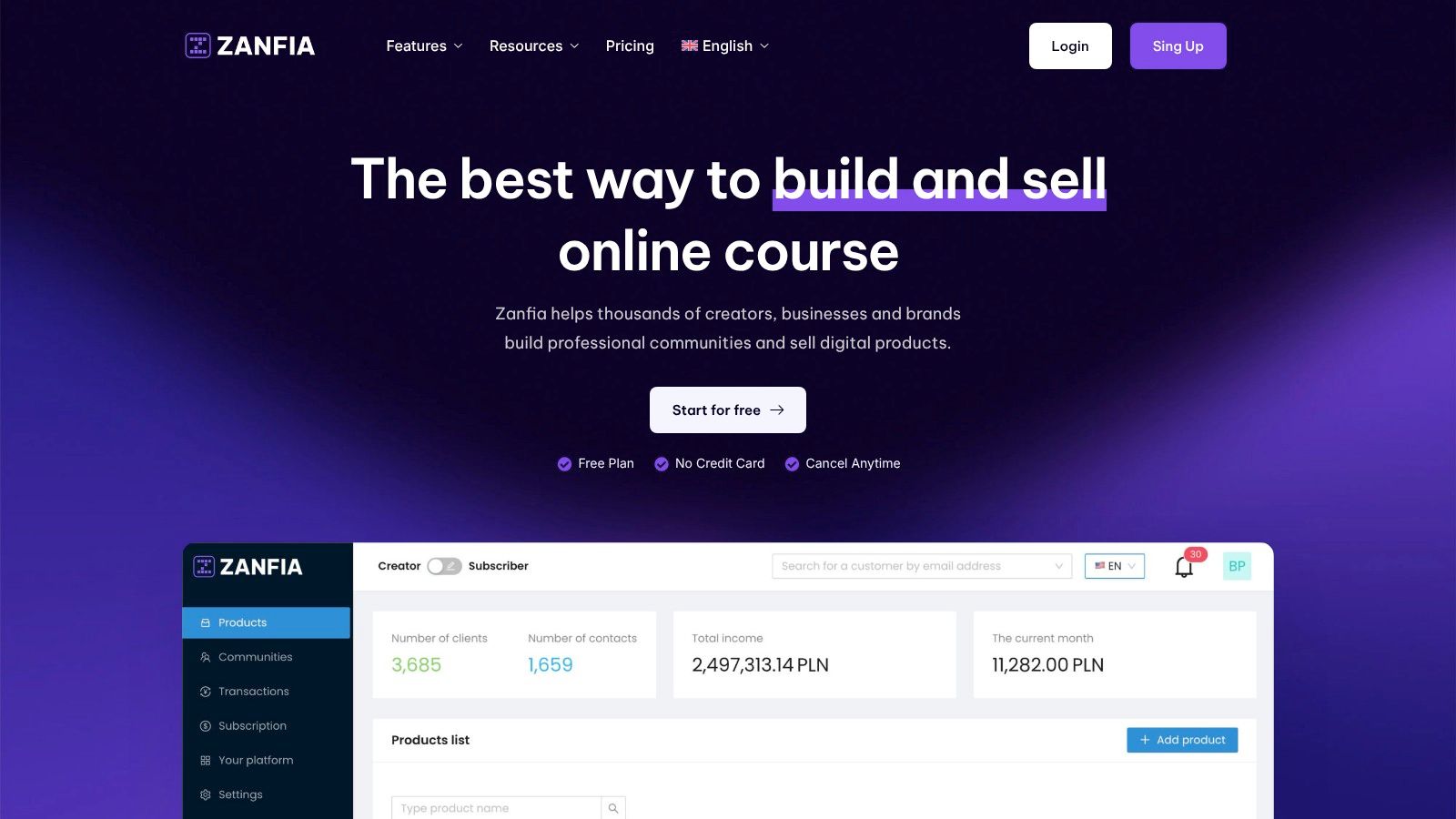
The core strength of Zanfia’s approach is its ability to create a seamless customer journey, transforming casual followers into deeply engaged, high-value community members. For creators, this centralization simplifies operations and unlocks powerful, unified analytics to track growth and engagement across their entire product suite. Zanfia perfectly embodies the “community-as-a-service” subscription, where the primary value is continuous access to a curated space, its content, and its creator.
Strategic Deep Dive: Maximizing Lifetime Value (LTV)
The strategic brilliance of an all-in-one platform like Zanfia lies in its inherent ability to maximize customer Lifetime Value (LTV). By housing all digital offerings under one roof, creators can effortlessly guide their audience up a value ladder. A free newsletter subscriber can be nurtured into a customer for a one-off digital product, then upsold to a comprehensive online course, and ultimately converted into a recurring member of a premium paid community.
Key Strategic Insight: Centralizing the customer experience removes friction from the buying process. When a user can access a course, join a community, and download a product with a single login, the likelihood of conversion and retention increases dramatically.
Zanfia’s architecture is built to support this model through several key features:
- Tiered Subscriptions: Creators can design multiple membership levels, offering different combinations of access to courses, exclusive content, online communities, and direct interaction.
- Built-in Automation: The platform includes robust process automations, handling everything from new member onboarding to content delivery. This is crucial for scaling a subscription business, as it minimizes administrative tasks and allows creators to focus on what drives retention: creating high-quality content and fostering engagement.
- Integrated Checkout: A seamless checkout for digital products is integrated directly, simplifying the sales process for both one-time purchases and recurring subscriptions.
Actionable Takeaway for Your Business
To replicate this successful subscription business model, map out a clear value ladder for your audience. Begin with a low-barrier entry point, such as a free newsletter, to capture leads and build trust. From there, use a platform like Zanfia to introduce a mid-tier offering, like a standalone online course or a collection of digital downloads.
The final step is to establish a premium subscription tier, creating a paid community that bundles all your content and offers exclusive benefits, such as direct access to you, live Q&A sessions, or early access to new material. This tiered strategy is one of the most effective subscription business model examples for building a sustainable and profitable creator business. If you are looking to build your own membership-based platform, Zanfia offers an insightful guide on how to create a membership website in 2025.
Platform Snapshot
| Feature Analysis | Key Advantages |
|---|---|
| Unified Ecosystem | Combines courses, communities, newsletters, and digital products in one branded space, eliminating the need for multiple third-party tools. |
| Advanced Automation | Built-in workflows for onboarding, content delivery, and marketing save significant time and improve operational efficiency. |
| Zero Commission Fees | Creators keep all their revenue, a significant advantage over platforms that take a percentage of sales. |
| Powerful Analytics | Provides a holistic view of the business, helping identify conversion bottlenecks and opportunities to optimize funnels. |
Pros:
- Comprehensive, all-in-one platform for creators.
- Advanced automation and workflow features to streamline operations.
- Flexible pricing plans with no commission fees.
- Praised for excellent customer support and ease of use.
Cons:
- Pricing is displayed only in Polish Złoty (PLN), which may be inconvenient for international users.
- Customer base is primarily focused on the Polish market, potentially limiting resources for a global audience.
Visit the website: https://zanfia.com
2. Harvard Business Publishing Education (HBPE)
Harvard Business Publishing Education (HBPE) offers a unique meta-perspective for anyone studying business models. While not a subscription service itself, it stands as the premier library for detailed case studies analyzing the successes and failures of others. For educators, entrepreneurs, and digital marketers, HBPE provides an unparalleled resource for deconstructing real-world subscription business model examples, from Adobe’s shift to the cloud to the nuances of media paywalls.
The platform is designed primarily for educators who need authoritative, ready-to-teach materials. Its catalog contains over 50,000 learning assets, including simulations, articles, and its world-renowned case studies. This deep dive into corporate strategy makes it an essential tool for understanding the mechanics behind recurring revenue.

Strategic Analysis: The “Pick-and-Shovel” Play
HBPE’s model is a classic “pick-and-shovel” strategy. Instead of launching its own direct-to-consumer subscription, it profits by providing the essential educational tools to those studying the subscription economy. It sells access to premium, vetted knowledge on a per-unit basis rather than a recurring one. This approach grants it authority and avoids competing directly with the companies it analyzes.
Key Insight: HBPE monetizes expertise and analysis about subscription models, positioning itself as a critical educational layer in the industry rather than a participant. This creates a high-margin, evergreen content library that remains relevant as long as business education is in demand.
This focus on educational content makes it an invaluable resource for creators looking to launch their own knowledge-based products. For instance, the strategic lessons learned from HBPE case studies can be directly applied to structuring and marketing paid newsletters, which function as niche subscription products. You can learn more about how to build a successful paid newsletter.
Pricing and Access Breakdown
HBPE’s pricing structure is transparent but tiered based on user type.
| User Type | Access Level | Pricing Model |
|---|---|---|
| Educators | Full catalog, teaching notes, free previews | Per-unit purchase for coursepacks |
| Students | Access to assigned materials via coursepack link | Discounted coursepack pricing |
| Individuals | Purchase individual cases/articles | Standard per-unit pricing |
The core value for educators lies in the teaching notes, which provide a structured framework for classroom discussion. For entrepreneurs and creators, purchasing individual case studies offers a masterclass in strategic decision-making without the commitment of a full course.
Actionable Takeaways for Creators
- Monetize Your Niche Expertise: HBPE proves there is a significant market for high-quality, analytical content. If you have deep knowledge in a specific area, package it as a premium digital product like a detailed report, course, or case study.
- Leverage Authority: The Harvard brand is a powerful asset. Build your own authority through well-researched content to justify premium pricing for your digital products.
- Use a Flexible Checkout: HBPE sells individual items and custom bundles (coursepacks). When selling digital products, use a platform like Zanfia that offers a flexible checkout system, allowing you to sell one-off guides, bundled resources, or recurring memberships from a single platform.
3. The Case Centre
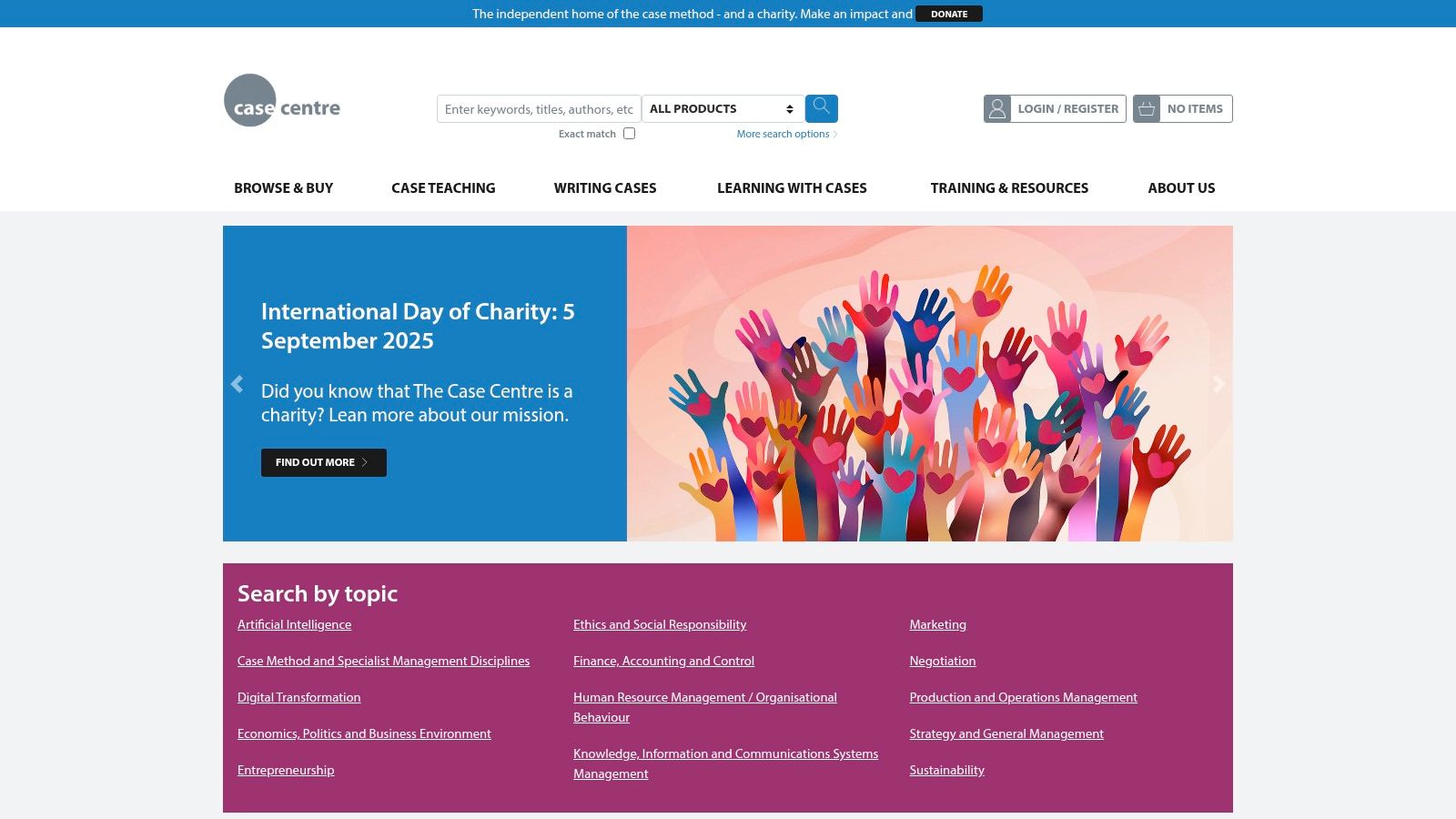
The Case Centre serves as a global clearinghouse for business education, acting as the world’s largest repository of management teaching cases. It aggregates over 75,000 cases from premier institutions like Harvard and INSEAD, providing a centralized hub for educators and strategists. This platform offers unparalleled access to a vast library of subscription business model examples, covering everything from SaaS startups to media conglomerates.
For creators and entrepreneurs, it’s a goldmine of strategic insights. The platform’s extensive catalog allows you to dissect the operational, financial, and marketing strategies of countless recurring revenue businesses, making it an essential resource for anyone planning to launch a knowledge-based product or a membership community.
Strategic Analysis: The Knowledge Aggregator Model
The Case Centre’s strategy is built on aggregation and distribution. Instead of creating its own content, it partners with the world’s top business schools to license and distribute their intellectual property. This makes it an indispensable one-stop shop, saving educators and researchers the immense effort of sourcing materials from dozens of separate institutions.
By not competing with its content providers, it has become the trusted intermediary for business education. It monetizes access and convenience, selling individual cases, videos, and teaching materials on a per-unit basis, supplemented by institutional licenses for broader access.
Key Insight: The Case Centre’s power comes from being a neutral, comprehensive platform. It thrives by providing the infrastructure for knowledge exchange rather than by producing the knowledge itself. This aggregator model creates a powerful network effect where more institutions and users lead to a more valuable resource for everyone.
This model is directly applicable to creators looking to build a paid community or membership site. By curating and organizing high-value content from multiple experts in your niche, you can create a go-to resource that becomes more valuable than any single contributor’s offering. You can learn more about how to build a successful paid community.
Pricing and Access Breakdown
The Case Centre offers a tiered pricing structure that accommodates different user needs, from individual researchers to entire universities.
| User Type | Access Level | Pricing Model |
|---|---|---|
| Educators | Full catalog, inspection copies, teaching notes | Per-unit purchase (minimum 5 copies for classes) |
| Students | Access via coursepack from their educator | Included in course fees or direct purchase |
| Corporate/Individual | Purchase individual cases and articles | Standard per-unit pricing (some restrictions apply) |
A key feature for institutions is the volume licensing, which simplifies access and budget management for classroom use. The platform’s advanced search also allows qualifying users to preview materials, ensuring they find the perfect case study for their needs before committing.
Actionable Takeaways for Creators
- Become the Hub for Your Niche: You don’t always have to create 100% of your content. Aggregate and curate valuable resources from others (with permission) to build a comprehensive platform that becomes the go-to destination in your field.
- Offer Tiered Access: The Case Centre successfully serves students, educators, and corporations with different access levels and pricing. Apply this to your membership site by offering different tiers with varying levels of content access, community features, or direct coaching.
- Simplify the Purchase Process: The platform’s success relies on a simple, transactional model for accessing complex information. When you sell digital products, use a tool like Zanfia that provides a streamlined checkout experience, allowing customers to easily purchase your online courses, paid newsletters, or digital downloads without friction.
4. Zuora – Subscribed Institute
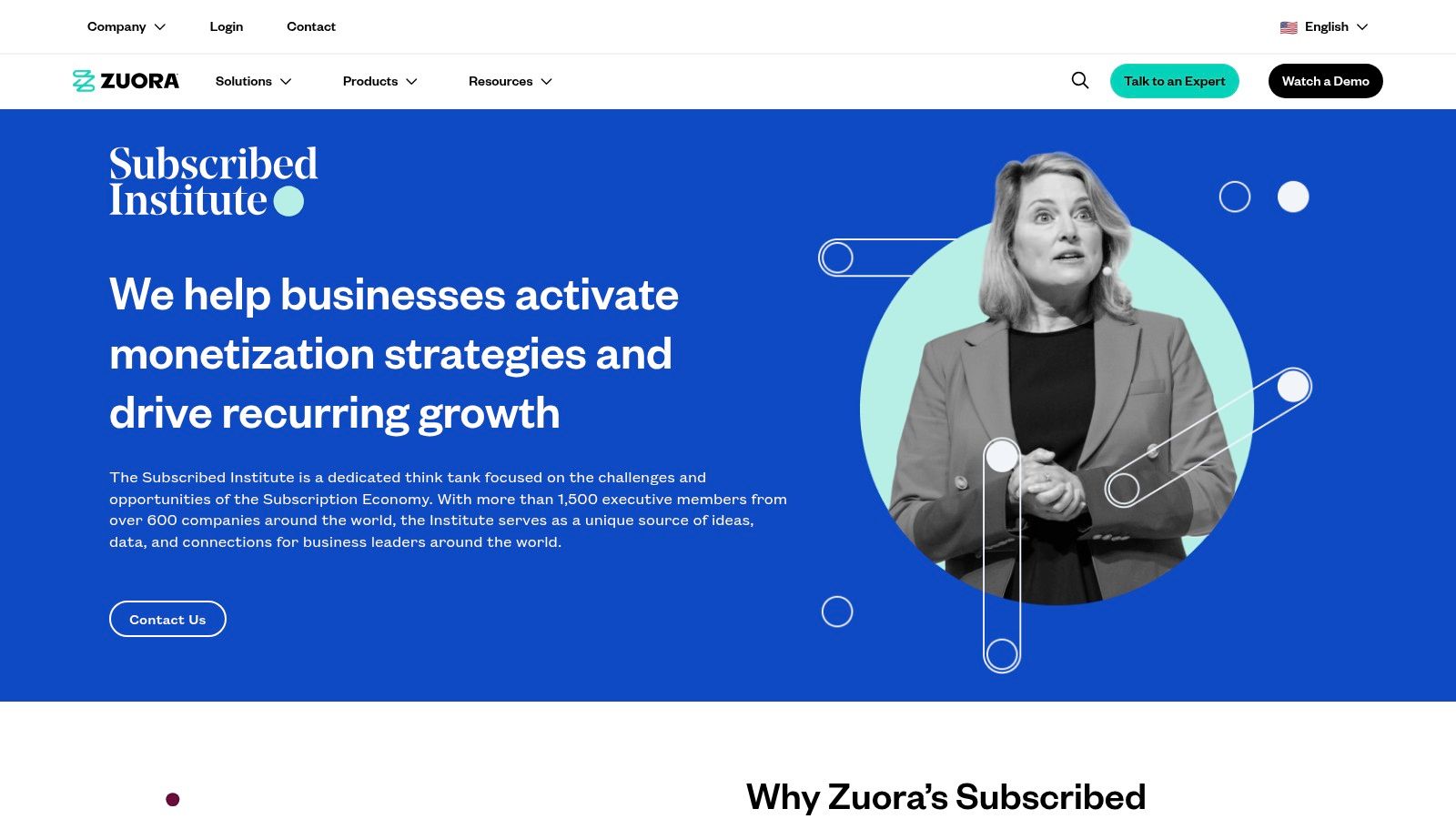
Zuora’s Subscribed Institute operates as a high-level think tank for the subscription economy, offering data-driven insights rather than individual products. As the research and strategy arm of Zuora, a leading subscription management platform, the Institute provides free reports, benchmarks, and webinars that analyze the health and growth of recurring revenue models. This makes it an essential resource for entrepreneurs and creators seeking to understand the macro trends shaping subscription business model examples.
The Institute’s primary output is its annual Subscription Economy Index, which aggregates performance data from over 600 global companies. This research provides a bird’s-eye view of what’s working across different sectors, from SaaS to digital media, offering quantified insights into growth, churn, and customer lifetime value that are rarely available for free.
Strategic Analysis: The “Data as a Magnet” Play
The Subscribed Institute’s strategy is a masterful example of content marketing as a lead-generation engine. By providing invaluable, proprietary data for free, it attracts its ideal customer profile: executives and founders who are serious about building or scaling a subscription business. The Institute doesn’t sell its reports; it uses them to establish Zuora’s authority and build a pipeline for its core software product.
Key Insight: Zuora monetizes the solution (its platform), not the information. The Subscribed Institute acts as a powerful top-of-funnel asset, educating the market and demonstrating the complexity of the subscription economy, which in turn highlights the need for a robust management tool like Zuora.
This approach builds trust and positions Zuora as an indispensable partner rather than just a vendor. Creators can learn from this model by offering a high-value free resource-like an industry report or a detailed guide-to attract qualified leads for their premium courses, memberships, or digital products. A powerful growth tactic to amplify this strategy is to create a customer-driven growth loop; you can discover more about how to build a referral program.
Pricing and Access Breakdown
The Subscribed Institute’s content is almost entirely free, though some assets require registration, functioning as a lead capture mechanism.
| Content Type | Access Level | Pricing Model |
|---|---|---|
| Reports & Guides | Instant download after registration | Free |
| Webinars & Events | Live access and on-demand recordings | Free |
| Subscription Economy Index | Full access to data and analysis | Free |
| Executive Briefings | High-level summaries and insights | Free |
The value exchange is clear: users provide their contact information in return for access to premium, data-backed research that would otherwise be expensive or impossible to obtain.
Actionable Takeaways for Creators
- Create a “State of the Industry” Report: Package your unique knowledge and data into a flagship annual report for your niche. This establishes you as a thought leader and generates qualified leads for your paid offerings.
- Use Data to Justify Your Product: Leverage industry benchmarks (like those from Zuora) to validate the need for your digital product. If data shows a growing demand for a specific skill, use that to market your online course or paid community.
- Gate Your Best Content for Lead Gen: Don’t give everything away with no strings attached. Use a simple form to capture emails in exchange for your most valuable free resources. With a platform like Zanfia, you can easily manage these leads and automate follow-up sequences to convert them into paying customers.
5. Business Model Navigator (University of St. Gallen / BMI Lab)
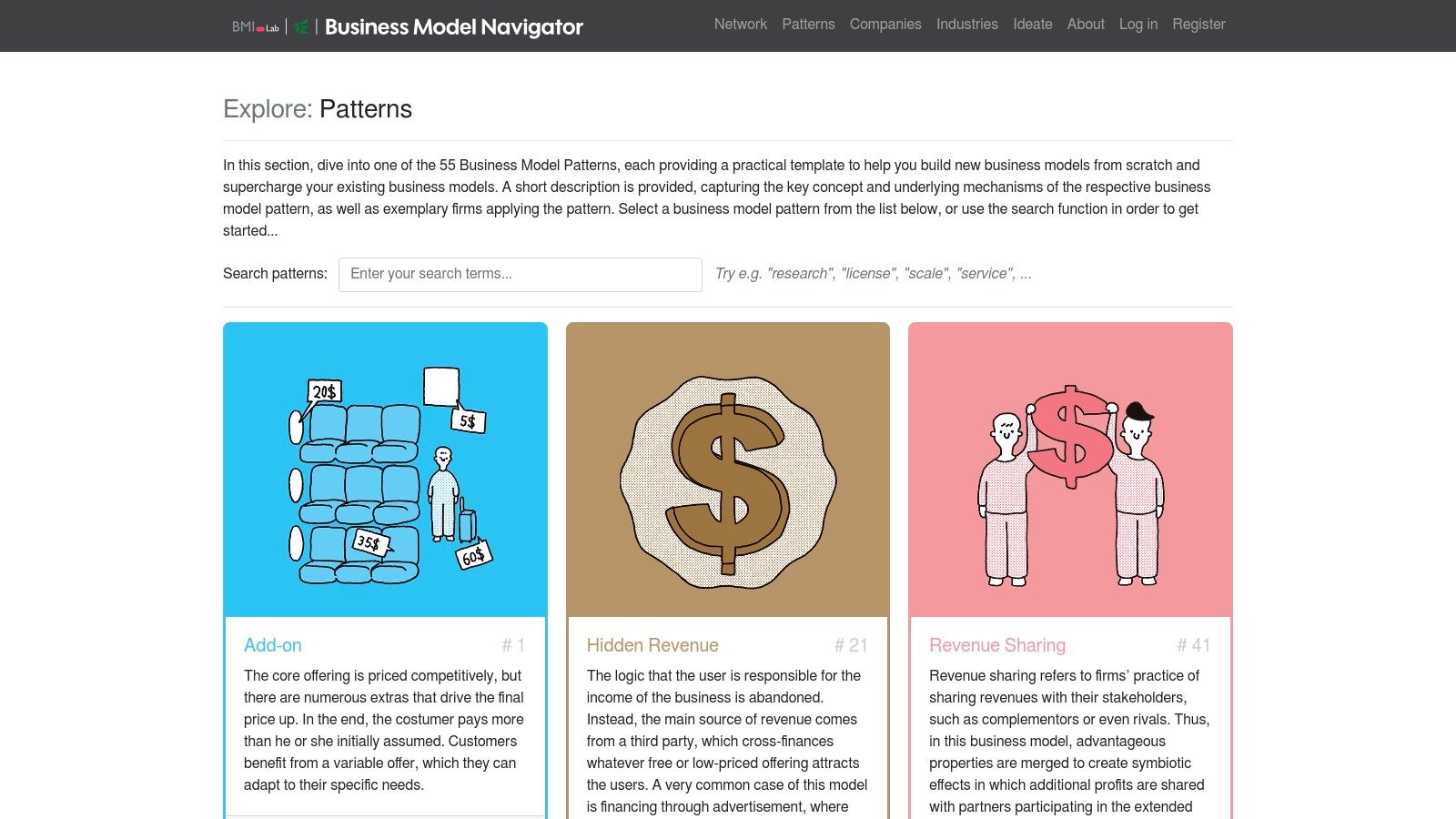
The Business Model Navigator, developed by the University of St. Gallen and BMI Lab, serves as a rapid-fire idea generator for anyone exploring business model innovation. It functions as a structured online library of over 55 distinct business model patterns, allowing users to quickly find and benchmark real-world subscription business model examples. Unlike deep-dive case studies, its strength lies in providing concise summaries and a broad overview of how companies like Salesforce, Netflix, and Dollar Shave Club implement recurring revenue strategies.
This platform is invaluable for entrepreneurs and creators in the initial stages of ideation. It helps answer the fundamental question: “What are the different ways I can structure my business?” By offering a searchable database of patterns and corresponding company examples, it accelerates the brainstorming process, making it an essential first stop before committing to a specific model.
Strategic Analysis: The Pattern-Matching Engine
Business Model Navigator’s strategy is to systematize innovation. It operates on the principle that 90% of business model innovations are recombinations of existing, proven patterns. By deconstructing complex business models into digestible patterns, it makes innovation accessible and less intimidating. The platform itself uses a freemium subscription model, offering a taste of its content for free to draw users into its paid plans for unrestricted access.
Key Insight: The platform monetizes the framework for innovation, not just the examples. It sells a structured methodology for thinking about business models, turning a complex academic concept into a practical, interactive tool for business leaders and creators.
This approach is highly relevant for creators building online communities or membership sites. By exploring patterns like “Subscription” or “Community,” they can quickly identify proven structures for their own ventures. The key is transforming that idea into a sellable product with a streamlined customer experience. This is where platforms that handle the technical details, like providing a flexible checkout for digital products, become critical for execution.
Pricing and Access Breakdown
The platform’s pricing is designed to cater to different user needs, from individual explorers to entire corporate teams.
| User Type | Access Level | Pricing Model |
|---|---|---|
| Guest/Free User | Limited access (e.g., 5 free views per month) | Free |
| Professional | Unlimited access to all patterns and examples | Monthly or annual subscription (€29/month) |
| Enterprise | Team access, workshops, and custom solutions | Custom quote-based pricing |
The freemium tier is an effective lead magnet, giving users a clear sense of the value before asking for a commitment. The Professional plan is ideal for individual entrepreneurs, creators, and consultants who need continuous access for research and client work.
Actionable Takeaways for Creators
- Don’t Reinvent the Wheel: Use the Navigator to study existing subscription patterns. See how others have successfully built paid communities or membership sites and adapt their models to your niche.
- Offer a Freemium Tier: Provide a free, limited version of your digital product or community access. This builds trust and provides a natural pathway for users to upgrade to your paid offerings.
- Systematize Your Offerings: Just as the Navigator organizes complex business models, you should structure your digital products clearly. Whether selling a one-off course or a recurring membership, use a platform like Zanfia to manage your product catalog and automate sales, ensuring a smooth process for both you and your customers.
6. Shopify App Store – Subscriptions Category
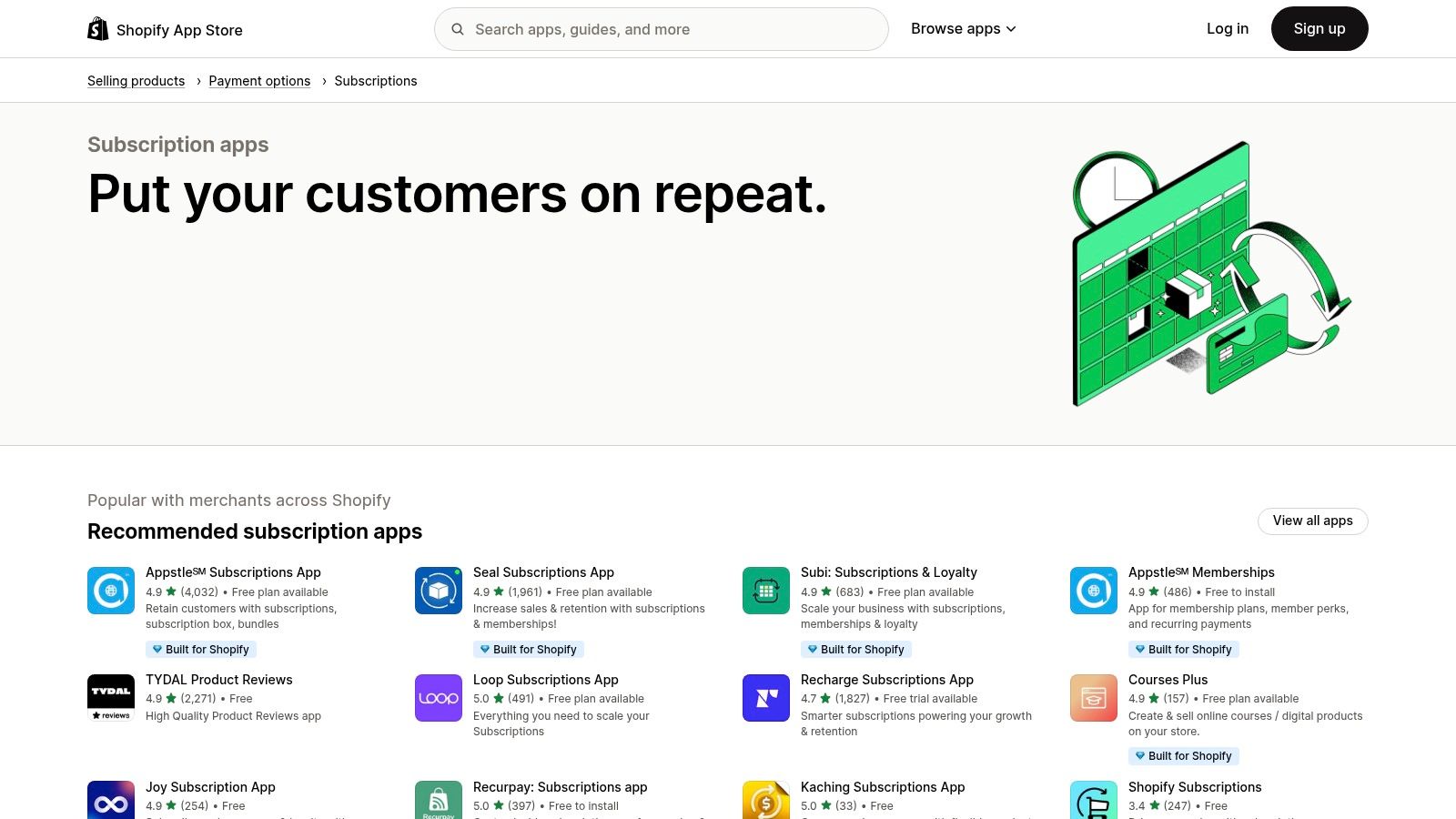
The Shopify App Store’s Subscriptions category provides a powerful, real-world laboratory for e-commerce entrepreneurs. Instead of just offering theoretical case studies, this marketplace presents a curated suite of ready-to-deploy tools that transform standard online stores into recurring revenue machines. For business owners and marketers, it’s an essential resource for researching, comparing, and implementing various subscription business model examples directly into their operations.
This platform isn’t just a list; it’s a dynamic ecosystem where you can see live brand examples, read thousands of user reviews, and access how-to guides for each app. It demystifies the technical side of subscriptions, making it possible for anyone to launch models like monthly boxes, “subscribe and save” programs, or exclusive memberships with just a few clicks.
Strategic Analysis: The “Enabling Technology” Play
The Shopify App Store’s subscription category operates as an “enabling technology” marketplace. Shopify provides the core e-commerce platform, while third-party developers build the specialized apps that unlock advanced subscription functionalities. This creates a competitive environment where apps must constantly innovate on features, user experience, and pricing to win over merchants. The store profits by taking a commission, effectively monetizing the growth of the entire subscription economy on its platform.
Key Insight: By creating a dedicated marketplace, Shopify empowers merchants to experiment with recurring revenue without needing massive development resources. It turns a complex business model into a plug-and-play feature, lowering the barrier to entry and fueling widespread adoption.
This model is a blueprint for creators selling digital products. Rather than building every feature from scratch, creators can use platforms with integrated tools to manage their offerings. For example, a robust platform can handle everything from selling online courses and paid communities to managing recurring payments. You can learn more about how to leverage subscription tools on Zanfia.
Pricing and Access Breakdown
The app ecosystem has a varied pricing structure, catering to businesses of all sizes.
| Feature Level | App Functionality | Pricing Model |
|---|---|---|
| Free/Freemium Plans | Basic subscription features, limited subscriber counts | Free, often with transaction fees |
| Mid-Tier Plans | Dunning management, analytics, customer portal customization | Monthly fee ($20 – $100) plus potential fees |
| Premium/Plus Plans | API access, advanced workflows, priority support | High-tier monthly fee ($100+) |
The true value lies in the free trials offered by most apps, allowing merchants to test the user interface and functionality before committing. The thousands of user reviews provide unfiltered feedback on reliability, customer support, and ease of use, which is critical for choosing the right long-term partner.
Actionable Takeaways for Creators
- Offer “Subscribe & Save” for Digital Products: Physical products aren’t the only things that benefit from subscriptions. Apply this model to digital goods, like offering a monthly “asset pack” for designers or a recurring “content bundle” for marketers at a discounted subscription rate.
- Leverage User Reviews as Social Proof: The Shopify App Store demonstrates the power of transparent customer feedback. Encourage reviews and testimonials for your own digital products, courses, or memberships to build trust and drive conversions.
- Choose a Platform with Built-in Flexibility: Shopify’s success comes from its app ecosystem that adds functionality. When selling digital products, choose an all-in-one platform like Zanfia that provides built-in tools for subscriptions, online courses, and paid communities, eliminating the need to piece together multiple costly apps.
7. Amazon – Books with Real-World Subscription Examples
While not a direct subscription service, Amazon serves as an indispensable resource for anyone serious about mastering the subscription economy. It offers a vast library of books filled with rich case studies and firsthand operator insights from pioneers like Netflix, Salesforce, and Adobe. For creators and entrepreneurs, these books offer comprehensive strategic frameworks and practical playbooks.
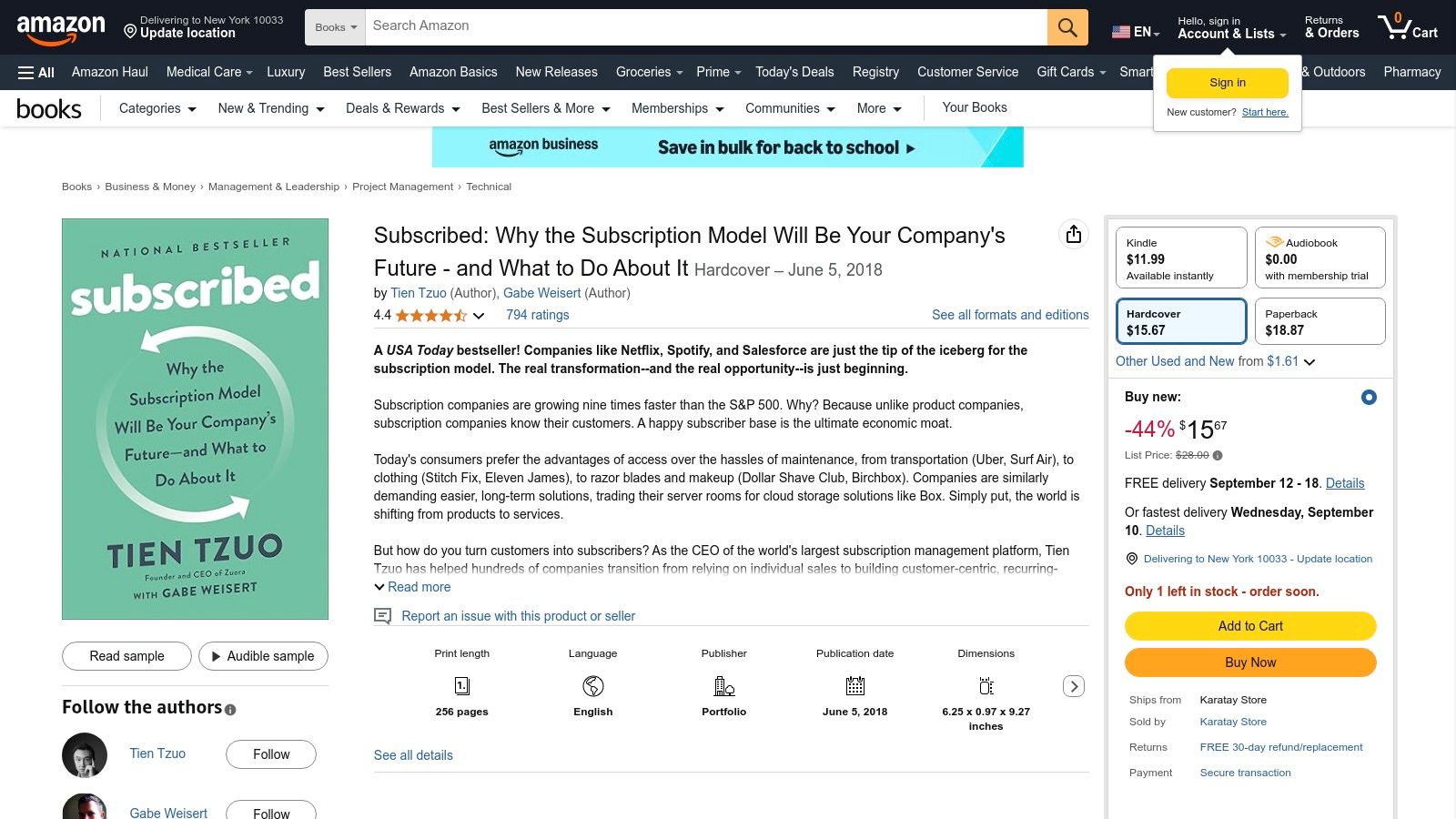
Titles like Tien Tzuo’s Subscribed and Robbie Kellman Baxter’s The Membership Economy are essential reading, providing deep dives into the models that power modern recurring revenue. This makes Amazon a foundational learning platform for understanding the theory behind successful subscription business model examples before putting them into practice.
Strategic Analysis: The Foundational Knowledge Layer
Amazon’s role in the subscription economy is to democratize access to expert knowledge. Unlike platforms offering singular courses, it aggregates decades of strategic thinking from various authors and experts into easily accessible formats like Kindle and paperback. This allows anyone, from a solo creator to a startup founder, to learn directly from the architects of the membership economy.
The value proposition is simple: for a small one-time investment, you gain access to structured, in-depth knowledge that would otherwise require years of trial and error to accumulate. These books provide the strategic “why” behind the operational “how.”
Key Insight: Amazon functions as the world’s biggest bookstore for subscription strategy, monetizing curated, long-form content. It provides the essential foundational knowledge that empowers creators and businesses to build and scale their own recurring revenue models with confidence.
This deep knowledge is critical for creators launching their own digital products. For example, the principles outlined in these books can be applied to structure tiered access for a paid community or to create compelling value propositions for an exclusive online course.
Pricing and Access Breakdown
Amazon’s pricing for these strategic resources is straightforward and based on format.
| Format | Access Level | Pricing Model |
|---|---|---|
| Kindle (eBook) | Instant, permanent digital access | One-time purchase, often discounted |
| Paperback/Hardcover | Physical copy ownership | One-time purchase + shipping |
| Audible (Audiobook) | Digital audio access | One-time purchase or via Audible subscription credit |
The immediate delivery of Kindle versions makes it incredibly efficient for creators to start learning instantly. Many titles are also part of Kindle Unlimited, offering a subscription-based “all-you-can-read” model for a vast selection of books.
Actionable Takeaways for Creators
- Invest in Foundational Strategy: Before building your product, read the playbooks. Understanding core principles from books like Subscribed will save you from common mistakes in pricing, positioning, and member retention.
- Synthesize and Apply Learnings: Don’t just read; take notes and apply the frameworks to your own project. Use the case studies to model your membership tiers or community engagement strategies.
- Build Your Own Knowledge Product: Inspired by these authors, you can package your own niche expertise. A platform like Zanfia lets you easily sell your own digital products, whether it’s an eBook, a detailed guide, or an online course, using a flexible and secure checkout system designed for creators.
Subscription Model Examples Comparison
| Platform / Source | Implementation Complexity 🔄 | Resource Requirements ⚡ | Expected Outcomes 📊 | Ideal Use Cases 💡 | Key Advantages ⭐ |
|---|---|---|---|---|---|
| Zanfia | Moderate – all-in-one setup with automation | Medium – requires platform subscription | High – professional communities, monetization | Creators, entrepreneurs building branded digital businesses | Comprehensive features, powerful automation, no commission fees |
| Harvard Business Publishing Education | Low – mainly content purchase | Low to Medium – pay per case, educator access | High – authoritative case studies for education | Educators and students seeking business cases | Trusted, authoritative content with teaching notes |
| The Case Centre | Low to Medium – individual and volume purchases | Medium – institutional licenses for classrooms | High – large case collection with teaching materials | Business schools needing broad case libraries | Largest case collection, licensing for institutions |
| Zuora – Subscribed Institute | Low – access to free reports and webinars | Low – mostly free content, some registration | Medium – insights and benchmarks on subscription trends | Researchers and execs needing up-to-date subscription insights | Free, data-driven, current subscription economy reports |
| Business Model Navigator | Low – accessible online browsing and limited free | Low to Medium – free with paid unlock options | Medium – quick understanding of many business models | Quick business model benchmarking and education | Fast, affordable access to diverse model patterns |
| Shopify App Store – Subscriptions | Medium – choosing/installing apps on Shopify | Medium to High – app costs vary, platform-specific | Medium to High – practical app implementation | E-commerce brands building or studying subscription apps | Actionable apps, rich user feedback, Shopify integration |
| Amazon – Books with Subscription Cases | Low – simply purchase or download books | Low – one-time purchase or Kindle subscription | Medium – deep operator insights from cases and theory | Learners/practitioners seeking comprehensive context | Extensive case & operator perspectives in one place |
Building Your Subscription Flywheel: The Final Blueprint
Throughout this deep dive into diverse subscription business model examples, a powerful, recurring theme has emerged: the most resilient and profitable subscription ventures are not just transactional. They are ecosystems. From the academic rigor of Harvard Business Publishing Education to the practical applications found in the Shopify App Store, success hinges on creating a self-reinforcing loop where value, community, and revenue generation fuel each other. This is the subscription flywheel, and it’s the blueprint for building a sustainable, long-term business.
The examples we’ve explored demonstrate that a subscription is not merely a payment plan; it’s a promise of ongoing value. Whether you’re a content creator launching a paid newsletter, an educator selling online courses, or an entrepreneur building a paid community, the initial transaction is just the beginning of the customer relationship, not the end. The goal is to create an experience so valuable and integrated that leaving feels like a significant loss.
Synthesizing the Core Strategies
As you reflect on the variety of subscription business model examples covered, several core strategic pillars stand out. These are the foundational elements you must consider when designing or refining your own model.
- The Power of Curation and Exclusivity: As seen with The Case Centre and specialized newsletters, people will pay to have the noise filtered for them. Your ability to curate high-quality, niche-specific content or access is a significant value proposition that justifies a recurring fee.
- Community as a Moat: A vibrant online community is one of the strongest defenses against churn. It transforms a solo experience into a shared journey, creating network effects where each new member adds value for all existing members. This is where your business becomes truly indispensable.
- Layered Value Stacking: The most sophisticated models don’t rely on a single offering. They stack value. A free newsletter leads to a paid deep-dive. A paid community offers exclusive access to an online course. A course provides entry into a premium mastermind group. This tiered approach maximizes customer lifetime value and provides multiple entry points into your ecosystem.
Your Actionable Next Steps: From Blueprint to Build
Moving from inspiration to implementation requires a clear, focused plan. Don’t try to build your entire flywheel at once. Instead, focus on getting one component spinning with incredible momentum, and then build from there.
- Identify Your Core Value Engine: What is the single most valuable thing you can offer right now? Is it a weekly curated newsletter, a foundational online course, or a private space for industry peers to connect? Start there and make it exceptional.
- Choose an Integrated Platform: The biggest operational mistake is stitching together a dozen different tools. This creates data silos, a disjointed user experience, and a nightmare of process automations. You need a unified platform that can handle your newsletter, digital products, community, and checkout process seamlessly from day one. This is non-negotiable for scaling.
- Automate to Elevate: Leverage AI tools and built-in automations to handle the repetitive tasks. This includes welcome sequences for new members, referral program tracking, and delivering digital products. By automating the technical side, you free up your time to focus on creating content and engaging with your community, which are the activities that actually drive growth.
Ultimately, the most powerful lesson from these subscription business model examples is that technology should be an enabler, not a bottleneck. The right toolset empowers you to bring your vision to life without needing a team of developers. With a platform like Zanfia, you can manage every piece of your subscription flywheel, from selling digital products and hosting online courses to nurturing your paid community, all under one roof. By centralizing your operations, you’re not just building a business; you’re building an asset that generates predictable, scalable revenue, giving you the freedom to serve your audience and do your best work.
Ready to stop juggling tools and start building your unified subscription business? See how Zanfia brings your online courses, paid communities, and digital products together on one powerful, easy-to-use platform. Explore Zanfia today and turn your vision for a subscription business into a reality.