How to Sell Digital Goods Online: A Step-by-Step Guide

Your first big move when selling digital goods is picking the right platform to host everything. Think of this as the foundation of your online business—it affects your brand, how your customers experience your products, and ultimately, how much money you make. My advice? Go for an all-in-one system that brings your courses, community, and sales together under one roof. It saves you from technical nightmares and protects your profits.
Build Your Business On The Right Foundation
Choosing where to sell your digital goods is honestly the most critical decision you'll make right out of the gate. This isn't just about finding a spot to list an e-book or a course. It's about building an entire ecosystem that can grow with you.
Get this part right, and you'll spend your time creating incredible content for your audience. Get it wrong, and you’ll find yourself playing the role of a frustrated, full-time IT manager, constantly fighting with plugins, updates, and things that just won't talk to each other.
The Great Debate: DIY vs. All-in-One Platforms
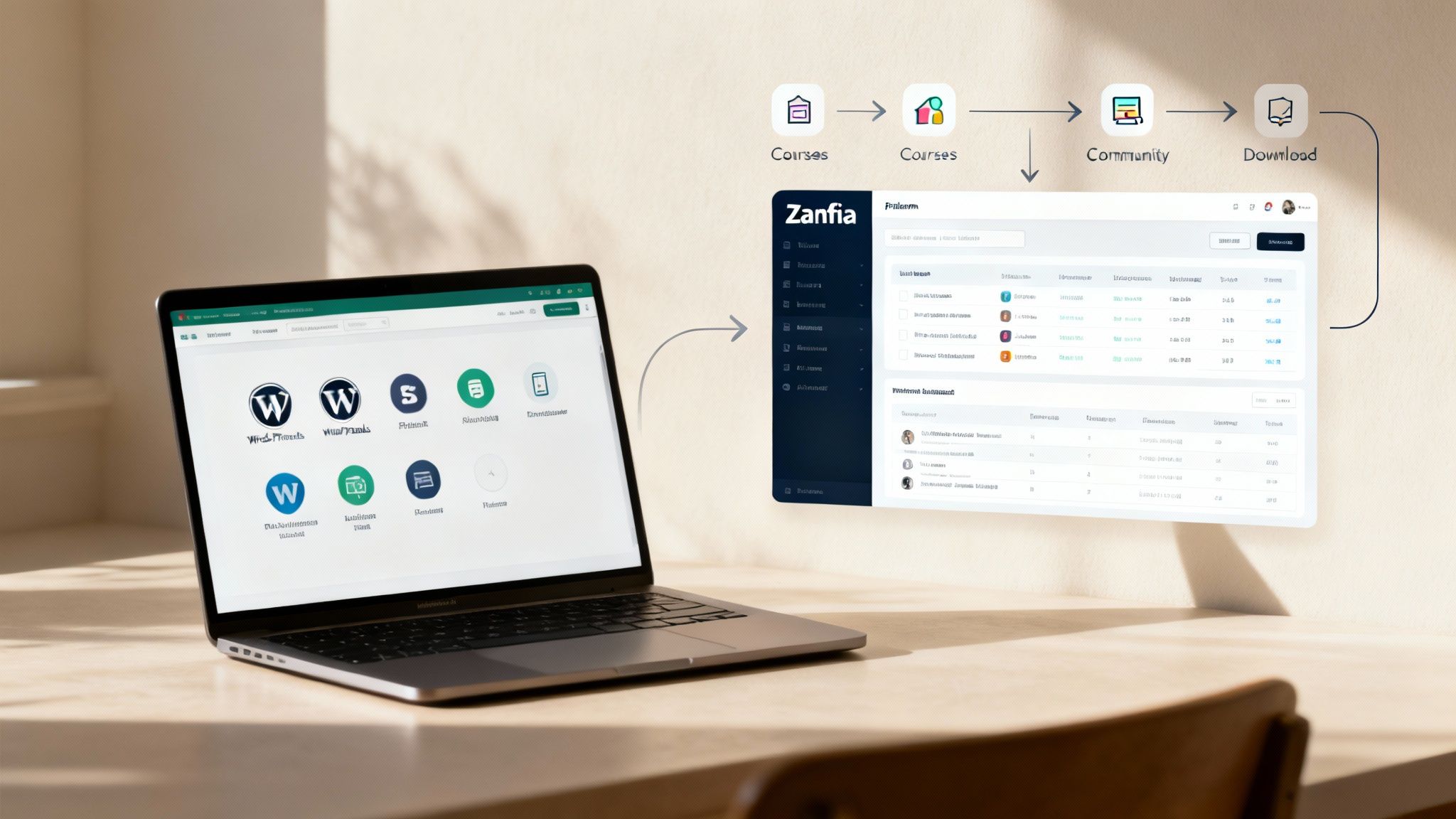
A lot of creators I've seen are first tempted by a Do-It-Yourself (DIY) approach. This usually means setting up a WordPress site and trying to stitch together a bunch of different e-commerce, membership, and course plugins. On the surface, it looks like you get total control for a lower upfront cost, but this path is often paved with hidden problems.
The most common and costly mistake I see is creators building a fragile tech stack by taping together multiple plugins and tools. This always leads to integration failures, security vulnerabilities, and endless maintenance, creating a clunky and frustrating experience for customers.
In contrast, an all-in-one platform is built from the start to be a seamless, unified system. Everything from payment processing and course delivery to your community forum just works together. For instance, Zanfia, a comprehensive Polish platform, integrates professional communities, online courses, paid newsletters, and e-books into a single ecosystem, eliminating the need for creators to juggle multiple tools. This approach lets you focus on what you do best—your content and your audience—not on troubleshooting tech issues.
Key Factors That Directly Impact Your Bottom Line
When you're figuring out how to sell digital goods online, a few critical things can make or break your business. Let's look past the flashy features and focus on what actually affects your revenue and brand.
- Transaction Fees: Many platforms will skim a percentage off every single sale, often between 5% to 10%. That might not sound like a lot at first, but as you grow, those fees can quietly eat up thousands of dollars of your profit. You really want to find a partner with a 0% transaction fee model, like Zanfia, which means you keep 100% of your hard-earned cash.
- White-Labeling and Custom Domains: Your brand is everything. When a platform slaps its own branding all over your pages, it cheapens your identity and makes you look less professional. Look for true white-labeling that lets you use your own custom domain—a feature included on every Zanfia plan—giving your customers a consistent, branded experience from the moment they land on your site.
- Integrated Community and Content: The most successful online businesses are built on deep engagement. If your community lives in a separate Facebook group, disconnected from your courses, participation will inevitably drop off. An integrated system where the community and content live together under a single login is a game-changer for member retention and lifetime value.
- Built-in Automation: How much is your time really worth? A solid platform will automate all the repetitive stuff—granting course access after a purchase, sending welcome emails, managing subscription renewals. These workflows, a core part of Zanfia, can easily save you 5 to 10+ hours every month, freeing you up to create more value for your people. You can find a deeper comparison and discover which platform to sell digital products is best for you in our detailed guide.
Picking your platform is way more than a technical choice; it's a strategic business decision. If you prioritize a solution with 0% platform fees, true white-label control, and a deeply integrated ecosystem, you’re setting yourself up for scalable, profitable, and stress-free growth. To really get your business foundation humming, you might also look into strategies like making money with affiliate marketing using Pinterest, a fantastic way to drive traffic and sales.
Crafting Digital Products People Eagerly Buy
So, you’ve picked your platform. Now for the fun part—actually creating something your audience will be clamoring to buy. This is where a lot of creators get it backward. They build what they think is cool, not what their audience is desperate for.
The secret to a successful digital product is simple: solve a real, nagging problem. Think like a detective. Before you even think about formats like e-books or courses, your main job is to uncover the specific pain points of your audience. What are they stuck on? What’s that one hurdle they just can't seem to clear? The answers you find are gold—they’re the blueprint for a product that practically sells itself.
From there, you can map out a clear path from understanding your audience to generating revenue.
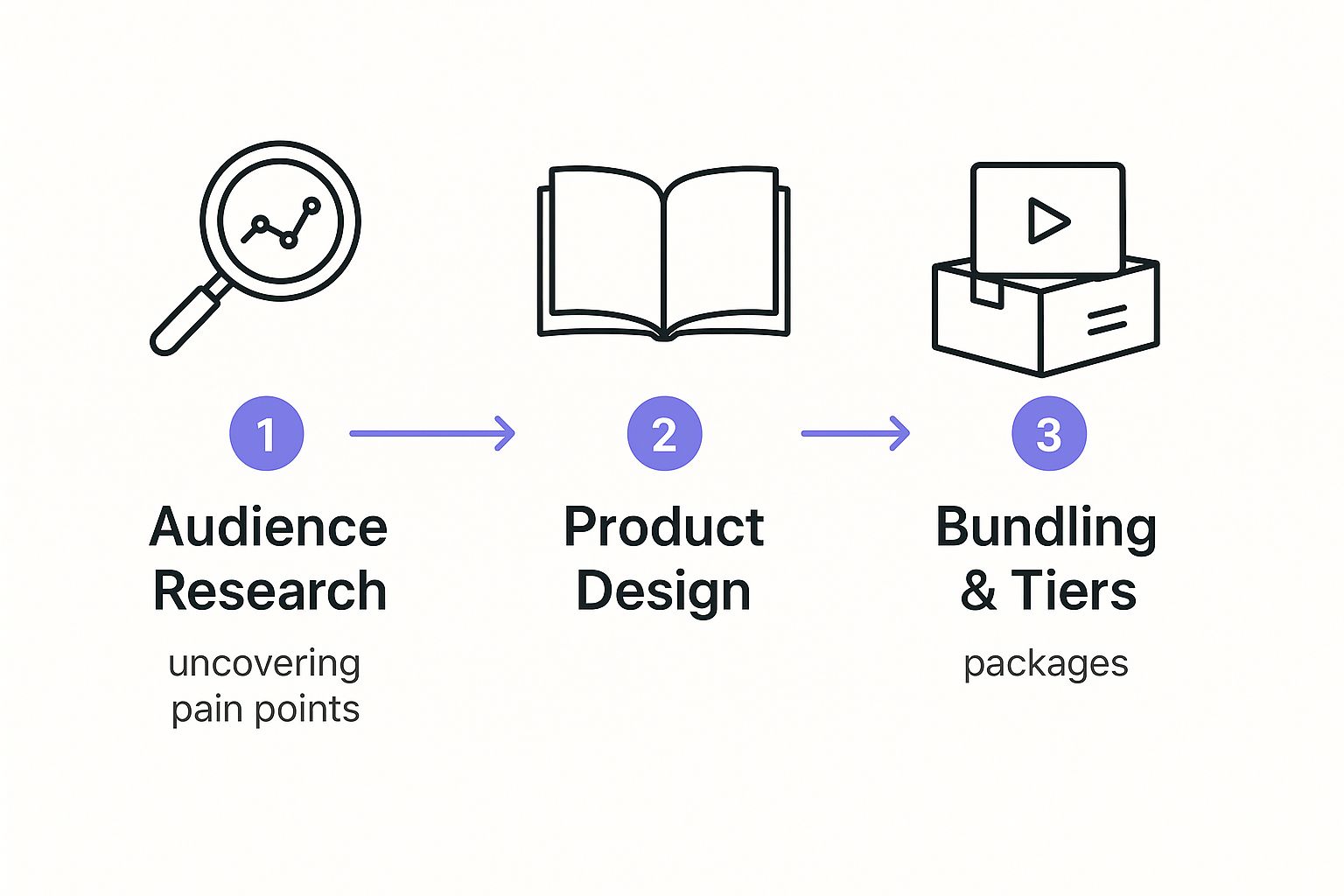
This workflow shows it all starts with your audience. Once you get that right, you can build out layered offers that keep customers coming back for more.
Designing Your Core Offer
Once you've zeroed in on that core problem, it’s time to choose the right vehicle to deliver the solution. Don't just pick what's easiest for you; pick the format that will get your customer the best result.
- Online Courses: Perfect for teaching complex skills that need a step-by-step approach. If you’re showing someone how to code an app or master a marketing framework, a well-structured course provides a clear roadmap from beginner to pro. Platforms like Zanfia offer advanced features like native video hosting and smart players that save student progress automatically.
- E-books and Guides: Fantastic for delivering focused, actionable information. Think checklists, in-depth guides, or foundational primers that solve one specific problem quickly. If you're leaning this way, our guide on how to make and sell an ebook is a great place to start.
- Paid Newsletters and Communities: The go-to option for providing ongoing support, accountability, and exclusive, timely insights. This isn't just a product; it's a relationship, building recurring revenue by making people feel like they belong.
No matter the format, your core offer needs to deliver a tangible outcome. The real value isn't the e-book or the course itself—it's the transformation your customer experiences because of it.
Beyond a Single Product: The Power of Bundles and Tiers
If you truly want to succeed in selling digital goods online, you have to think beyond a single sale. The smartest creators don't just have one product; they build an entire product ecosystem. This is how you dramatically increase the lifetime value of every single customer.
This is where you get creative with bundles and tiered pricing. Instead of just offering your course for one price, why not create a few different packages? You'll be surprised how many people are willing to pay more for extra value.
A single purchase is a transaction. A tiered offer that invites a customer deeper into your world is the beginning of a relationship. It transforms a one-time buyer into a loyal fan.
Here’s a simple but incredibly effective way to structure your offers:
- Basic Tier: The core product—your e-book or online course.
- Standard Tier: The core product plus access to a private community for support and live Q&A sessions.
- Premium Tier: Everything in the standard tier, plus exclusive bonuses like live coaching calls, extra templates, or even direct access to you.
This strategy just works. It lets you meet customers exactly where they are. The person looking for a quick fix can grab the basic e-book, while the person ready for a major transformation can go all-in on the premium package. You end up making more money without excluding anyone. Flexible platforms allow you to sell products as one-time purchases, subscriptions, installment plans, or bundles, giving you maximum monetization options.
And the market for this stuff is absolutely massive. By 2025, the digital product economy is expected to be worth over $2.5 trillion. Data already shows that 68% of internet users worldwide have paid for some kind of digital content. This isn't a fleeting trend; it’s a sustained shift in how people learn and solve problems. By building out a smart product portfolio, you're positioning yourself to grab a piece of that ever-growing pie.
Make Payments and Operations Run Themselves
Let's be honest: you can create the most amazing digital product in the world, but if your checkout process is a nightmare, you're just leaving money on the table. A clunky, confusing payment screen is the fastest way to make an excited buyer close the tab and never come back. Getting this right is about building a smooth, trustworthy system that actually turns interest into income.
The easiest way to build that trust? Familiarity. When people see payment options they already know and use, it removes a huge layer of friction. This is non-negotiable, especially when you're selling to a local audience that has its own preferred ways to pay.
Give Your Customers a Painless Way to Pay
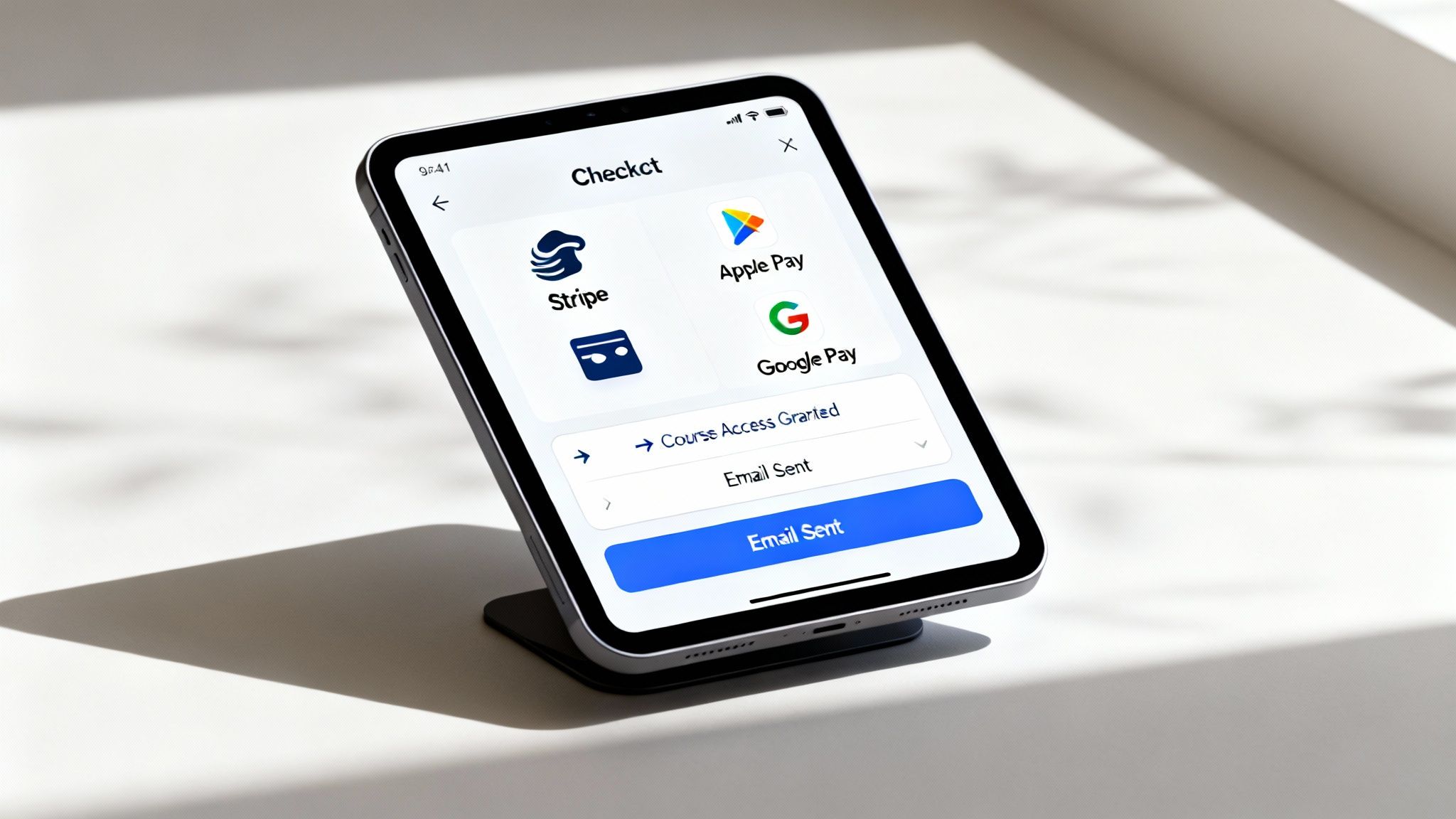
If you want to sell digital goods effectively, you have to meet your customers where they are. For Polish creators, that means offering local favorites like PayU, Przelewy24, and BLIK right alongside global standards like Stripe. Having this flexibility isn't just a nice-to-have; it's a core part of maximizing your sales. Platforms built with local insight, like Zanfia, provide seamless integrations with these gateways.
And don't forget the power of one-tap payments. Modern options like Apple Pay and Google Pay are game-changers. They let customers skip the tedious process of digging out a credit card and manually typing in numbers. That speed is a massive advantage, especially on mobile, where every extra step can lead to an abandoned cart.
Speaking of mobile, it's not just a trend—it's how most people shop now. Mobile commerce is expected to make up about 59% of all online sales by 2025. But even with that massive shift, cart abandonment is still a huge problem, with the global average sitting around a staggering 70.2%. The two biggest culprits? Unexpected costs and forcing people to create an account. You can tackle these head-on with clear pricing and a variety of easy payment methods.
The Real Magic: Putting Your Business on Autopilot
Getting paid is just the beginning. The real freedom comes when your system takes over and handles all the tedious follow-up, letting you focus on creating instead of getting buried in admin tasks. This is where automation really shines.
Think about this for a second. A customer buys your course, and instantly:
- They get access to all the materials.
- They’re added to your private community channel.
- A personalized welcome email hits their inbox.
- An invoice is automatically generated and sent.
This isn't some far-off dream. It's exactly what an integrated platform like Zanfia is designed to do. By connecting with leading Polish invoicing suites like inFakt and Fakturownia, it can generate and send invoices automatically, simplifying your finances and compliance.
My take: Automation isn't just about saving time; it's a powerful branding tool. When a customer gets instant access and a warm welcome without any delays, it validates their purchase and sets the perfect tone for your entire relationship.
These automated workflows can easily free up 5-10+ hours of mind-numbing work every single month. That’s time you can pour back into what you love—creating new products, engaging with your audience, or just taking a well-deserved break. To really nail this, it's worth learning how to optimize your website's checkout process.
For anyone running a subscription or membership, automation becomes even more vital. Trying to manually chase failed payments, manage access levels, and handle renewals is a surefire path to burnout.
I've put together a quick table to show you just how different the experience can be.
Essential Features for a Modern Digital Sales Platform
| Feature | DIY Approach (e.g., WordPress + Plugins) | All-in-One Platform (e.g., Zanfia) |
|---|---|---|
| Instant Delivery | Requires separate plugins (e.g., for downloads or course access) that need to be configured and integrated. Potential for delays or conflicts. | Built-in and immediate. The system automatically grants access to the product the moment the payment is confirmed. |
| Email Automation | Relies on third-party integrations (like Mailchimp or ConvertKit) connected via tools like Zapier. Can become complex and costly. | Native integration. Trigger welcome emails, onboarding sequences, and invoices automatically without leaving the platform. |
| Invoice Generation | Often needs a dedicated invoicing plugin, which may not sync perfectly with your payment gateway or customer records. | Fully automated. Integrates with local invoicing systems (like inFakt, Fakturownia) to generate and send compliant invoices without any manual effort. |
| Subscription Management | Requires a robust (and often expensive) subscription plugin. Handling failed payments and prorations can be a major headache. | Core functionality. Manages recurring billing, handles dunning (failed payment recovery), and adjusts access levels automatically. |
As you can see, an all-in-one system is built from the ground up to handle these tasks for you. Advanced platforms also provide tools like API access and webhooks, allowing you to connect with your favorite CRMs and marketing software for a truly personalized tech stack. At the end of the day, a smart, automated backend is the engine that lets your digital business grow without you being the bottleneck.
Marketing Strategies That Actually Launch Your Products
So you’ve poured your heart and soul into creating an amazing digital product. That’s fantastic, but it's only half the equation. If nobody knows your product exists, it can't help them, and it certainly won't make you any money.
A killer launch isn't about just screaming from the rooftops on day one. It’s about building real relationships and positioning yourself as a go-to expert long before you ever ask for a credit card. You need to shift your focus from a one-off sale to an ongoing conversation. This approach builds momentum, warms up your audience, and gets them excited to buy when you finally open the doors.

Build Your Most Valuable Asset First
Let's get one thing straight: your email list is the single most important marketing tool you will ever have. Full stop. Social media algorithms are fickle and can change overnight, but your email list gives you a direct line to your audience. This is where your sales will come from.
Before you even think about launching, your number one job is to get the right people on that list. The best way to do this is with a compelling "lead magnet"—a freebie like a checklist, a short e-book, or a quick video that solves a small, specific problem for your ideal customer. Once they're subscribed, you can start building trust. We've got a whole playbook on how to build an email list that you can dive into for some proven tactics.
The Art of the Pre-Launch Buzz
A great launch doesn’t just happen on launch day; it starts weeks, sometimes months, in advance. The whole point of a pre-launch is to build anticipation and get your audience ready to buy. You want them to feel like insiders who are part of something special.
Here’s a simple, battle-tested pre-launch sequence that works wonders:
- Introduce the Problem: Start the conversation around the pain point your product solves. Share your own stories, some surprising data, or relatable scenarios. Make it real.
- Hint at a Solution: Casually mention you've been working on something to fix that exact problem. Share a few behind-the-scenes glimpses to spark curiosity.
- Reveal the Product: It’s time for the official announcement. Clearly state what the product is and, more importantly, the transformation it delivers.
- Create an Early-Bird Offer: This is key. Give your most loyal followers a reason to buy now with a time-sensitive discount or exclusive bonuses. It creates urgency and kickstarts your sales momentum.
This entire sequence should play out primarily over email, with support from your blog and social media channels.
Turn Your Community Into a Marketing Engine
One of the most powerful, and often overlooked, marketing levers is the community you've already built. When you create a space where people feel seen and supported, they organically become your biggest cheerleaders.
Your most loyal community members are your best salespeople. Their genuine enthusiasm and success stories provide the powerful social proof that new customers need to see before they feel comfortable making a purchase.
Instead of siloing your community on a platform like Discord, try integrating it directly with your products. This creates an incredible feedback loop. As serial entrepreneur Artur Kurasiński notes about Zanfia, it's “the most convenient and simplest solution for paid newsletters, courses and community on the Polish market”. When a member has a win with your course, they can share it right there, instantly inspiring others who might be on the fence.
You can stoke this fire by:
- Spotlighting member wins: Regularly share testimonials and case studies.
- Running community-only challenges: Get people engaged with your products and sharing their progress.
- Setting up an affiliate program: Give your members a financial incentive to spread the word.
By nurturing a vibrant community, you're doing more than just selling a product—you're building a self-powering ecosystem where your best customers help you grow. It's how you turn a basic marketing plan into a word-of-mouth machine.
Scale Your Business with Community and Analytics
Getting those first few sales is an amazing feeling, no doubt. But the real engine for long-term growth isn't just about those initial transactions. The secret lies in building genuine relationships that turn a first-time buyer into a loyal fan for life. This is where community-focused products become your most valuable tool.
You're not just building a store; you're creating an entire ecosystem. When customers feel like they're part of something bigger—a group of like-minded people on the same path—their connection to your brand goes so much deeper. That sense of belonging is what keeps them engaged and eager to see what you'll offer next.
Why Integrated Communities Win
A classic mistake I see all the time is creators shunting their community off to a separate, third-party platform like a random Facebook group or a Discord server. On the surface, it seems easy. But in reality, it creates a clunky, disconnected experience for your customers.
Think about it. Now they have to juggle another login, learn a different interface, and mentally switch gears between your content and the conversation. That friction is a killer for engagement.
The solution is an integrated community, where the discussion forums and chat channels live right alongside your course materials. This creates a single, seamless world under your brand. Learning and connecting happen in the same place.
When your course and community are unified, you're not just selling content; you're selling an experience. This seamless integration dramatically boosts member retention and lifetime value because the community becomes as valuable as the product itself.
This approach keeps your audience immersed and focused. It strengthens their loyalty and makes them far more likely to stick around and invest in your future products. To dive deeper into this, check out our guide on how to build an online community that actually thrives.
Stop Guessing and Start Measuring
If you're serious about scaling, you have to shift from wishful thinking to making data-driven decisions. Analytics are your roadmap. They show you precisely what's working, what's not, and where people are dropping off. Without solid data, you're flying blind.
Getting a handle on a few key metrics can completely change the game. It lets you pinpoint bottlenecks, tweak your sales pages, and refine your offers to boost both engagement and revenue. Platforms with built-in analytics provide deep visibility at every stage of your funnel.
Here’s what you should be tracking:
- Page Views & Conversion Rates: How many people land on your sales page, and how many of them actually click "buy"? A low conversion rate is a clear sign that your messaging, offer, or pricing might be off.
- Customer Lifetime Value (LTV): This is the total amount of money you can expect from a single customer over time. A rising LTV is proof that your products and community are successfully encouraging repeat business.
- Member Engagement: Are people actively participating in your community? Are they completing your courses? High engagement is a fantastic predictor of customer satisfaction and loyalty.
- Retention & Churn: This is critical for subscriptions. You need to know what percentage of customers stick around each month. High churn is a massive red flag that something needs fixing—fast.
Tracking these numbers gives you the clarity to make smart, strategic moves instead of just guessing. It’s how you turn a side hustle into a real business.
And the opportunity here is massive. The global eCommerce market is rocketing upward; by 2025, retail eCommerce sales are expected to reach $7.4 trillion. With the number of digital buyers worldwide projected to top 2.77 billion, a data-informed strategy isn't just a good idea—it's essential. You can find more details on the growth of online shopping on Statista.com.
By pairing a vibrant, integrated community with sharp analytics, you create a powerful, predictable engine for sustainable success.
Common Questions About Selling Digital Goods (Answered)
When you're first starting out with digital products, a million questions can start swirling around. That's totally normal. Getting some straight answers is the best way to cut through the noise and start making real progress.
Let's dive into some of the most common hurdles I see new creators face.
What Digital Products Actually Make the Most Money?
Honestly, the most profitable digital goods aren't tied to a specific format. They're the ones that solve a painful, high-value problem for a very specific group of people.
While trends shift, a few categories are always solid bets:
- Online Courses: Perfect for teaching a complex skill that delivers a clear result, like landing a new job or mastering a piece of software.
- Specialized E-books & Toolkits: Think focused guides, templates, or playbooks that solve one nagging problem quickly and effectively.
- Premium Communities: People gladly pay for access to a network of peers, accountability, and a direct line to experts.
- Paid Newsletters: This is a great model if you can provide exclusive, timely insights that your audience can't easily find elsewhere.
Profitability isn't about the format—it's about the transformation you provide. A course that helps a freelance designer double their income is inherently more valuable than a generic guide on design principles. The real magic happens where your unique expertise meets a clear market need. Starting with a flexible platform allows you to experiment—maybe you start with an e-book, then expand it into a course, and later add a community to see what your audience craves most.
How Do I Figure Out What to Charge?
Pricing is always a tricky blend of art and science. A good strategy has to balance the real-world value you’re delivering, what people in your niche are used to paying, and your own business goals.
The biggest mistake I see is pricing based on length or volume (like the number of pages in an e-book or hours of video). Don't do that. Instead, price your product based on the outcome it creates.
Start by looking at what competitors charge to get a feel for the landscape, but never be afraid to charge a premium if you know your product delivers better results or a superior experience. You can also boost sales by offering different ways to pay. Think about creating tiers—like a basic version versus a premium package with coaching calls—or offering payment plans to make a high-ticket course more accessible.
One thing you absolutely have to factor in is your platform's fee structure. Choosing a platform like Zanfia with 0% transaction fees means you keep 100% of your revenue. This gives you way more freedom to price competitively without seeing your profits get chipped away by commissions.
Do I Need a Huge Audience to Get Started?
Nope. What you need is an engaged audience, not a massive one.
I’ve seen creators with 10,000 followers who can't sell a thing because their audience is passive. On the flip side, I know people with just 100 true fans who sell out every time they launch something new. The difference is trust.
Your first job isn't to get a million followers; it's to build a small, dedicated email list or a free community. Spend your time giving away incredible value to that small group and prove you know what you're talking about. Your first customers will almost always come from this core group. Their testimonials are the social proof you'll use to attract a much larger audience later on. The goal is to start small and warm, get feedback, and build from there.
What's the Biggest Tech Mistake People Make?
Without a doubt, the most common and costly mistake is trying to stitch together a dozen different plugins and tools to save a few bucks. It feels like a smart move at first, but it almost always ends in a technical nightmare.
This "DIY" approach leads to broken integrations, security vulnerabilities, and you spending all your time playing IT support instead of actually creating. Worse, it creates a clunky and frustrating experience for your customers, who have to deal with multiple logins and confusing checkout processes.
An all-in-one platform solves this problem from day one. You get a single, reliable system where your payments, courses, community, and emails all work together seamlessly. As 30-year developer Daniel Roziecki highlights, Zanfia provides “peace of mind”, letting him focus on teaching instead of wrestling with tech. This frees you up to focus on what actually moves the needle: making great content and serving your audience.
Ready to stop wrestling with technology and start building your digital business on a solid foundation? Zanfia is a true all-in-one platform designed for Polish creators, offering 0% platform fees, integrated courses and community, and powerful automation tools. Discover how Zanfia can help you launch and scale with confidence.