Best Transaction Coordinator Classes: 2026 Guide

A lot of people find transaction coordinator classes when they're already standing in the middle of real estate chaos.
An agent is texting for a missing disclosure. The lender needs an update. Title wants a document that should have been sent yesterday. The client thinks silence means something is wrong. Nothing is technically on fire, but everything feels one missed deadline away from becoming a problem.
That's the environment a strong transaction coordinator is built for. The job isn't glamorous. It's operational. It's deadline-driven. It rewards the person who can keep files moving, communicate clearly, and catch small issues before they become expensive ones.
If you're looking at transaction coordinator classes, the smart question isn't “Which course gives me a certificate fastest?” It's “Which path gets me competent fast enough to handle real files without creating risk for the people who hire me?” That's a different standard, and it leads to better decisions on training, software, pricing, and long-term career growth.
Table of Contents
Why Every Real Estate Team Needs a Great Transaction Coordinator
A sale goes under contract at 4:47 p.m. By 5:15, the agent is already juggling inspection windows, earnest money confirmation, lender requests, title outreach, disclosure follow-up, and a client who wants to know what happens next. On a busy team, that work does not sort itself out. A strong transaction coordinator keeps it organized from day one.
That matters because real estate teams do not lose time only on big problems. They lose it on dozens of small handoffs. A signature request sits too long. A contingency date is tracked on the wrong calendar. Title is waiting on information nobody realized was missing. One sloppy file can drain an agent's week and put the client experience at risk.
A great TC protects the team from that kind of drag. They build repeatable process into a business that can otherwise run on memory and inbox search.
Teams hire TCs for capacity, consistency, and risk control
The immediate value is capacity. Agents get back the hours they should be spending on pricing, negotiation, prospecting, and client conversations. The less obvious value is consistency. A reliable TC handles every file with the same cadence, the same checklist discipline, and the same follow-up habits, which is exactly what growing teams need if they want closings to stay predictable as volume increases.
There is also a clear risk-control benefit. TCs are usually handling the administrative side of the transaction, not licensed activities like giving legal advice, writing terms, or negotiating. That division of labor is why good training focuses on file management, communication standards, document handling, and deadline tracking. The role works best when everyone on the team is clear about that boundary.
For a new TC, that clarity matters for career planning too. It gives you a practical entry point into real estate operations without forcing you into a sales path you may not want.
What a strong TC changes inside the business
The difference shows up in the day-to-day work.
- Deadlines stay visible: inspection periods, financing milestones, deposits, disclosures, and closing tasks are tracked before they become emergencies.
- Communication gets cleaner: clients, lenders, title, and agents hear the same story at the right time instead of chasing updates across text threads.
- Files stay audit-ready: documents are named, stored, and followed up in a way that reduces preventable mistakes.
- The team can scale: adding transactions is easier when the process lives in checklists and systems instead of one agent's memory.
If you want to see the level of detail a coordinator may be managing, this 2026 real estate agent checklist gives a useful file-level view of how many moving parts exist after a deal goes pending.
There is practical crossover here for people who plan to work with investors too. A coordinator who understands conventional resale files and assignment-heavy deals is more useful in the market, and this guide to a wholesaling real estate course shows why the process changes once the deal structure changes.
The long-term upside is bigger than one job title. Many people start by learning the file, then build systems, then become the person others rely on to train a team. That full path matters. The same coordinator who learns how to protect a transaction today can later turn that experience into higher-fee services, consulting, or even a course of their own.
The Core Skills Every Top Transaction Coordinator Masters
The best transaction coordinator classes don't try to impress you with broad business talk. They train you to manage a file correctly, in order, under pressure.
Expert training often teaches the transaction as a staged pipeline: opening, inspection, title/financing, pre-close, and post-close, with each checklist item mapped to the right phase. That process matters because the job is highly deadline-sensitive, and one missed step can delay closing. ListedKit explains this staged model in its guide to transaction coordinator training.
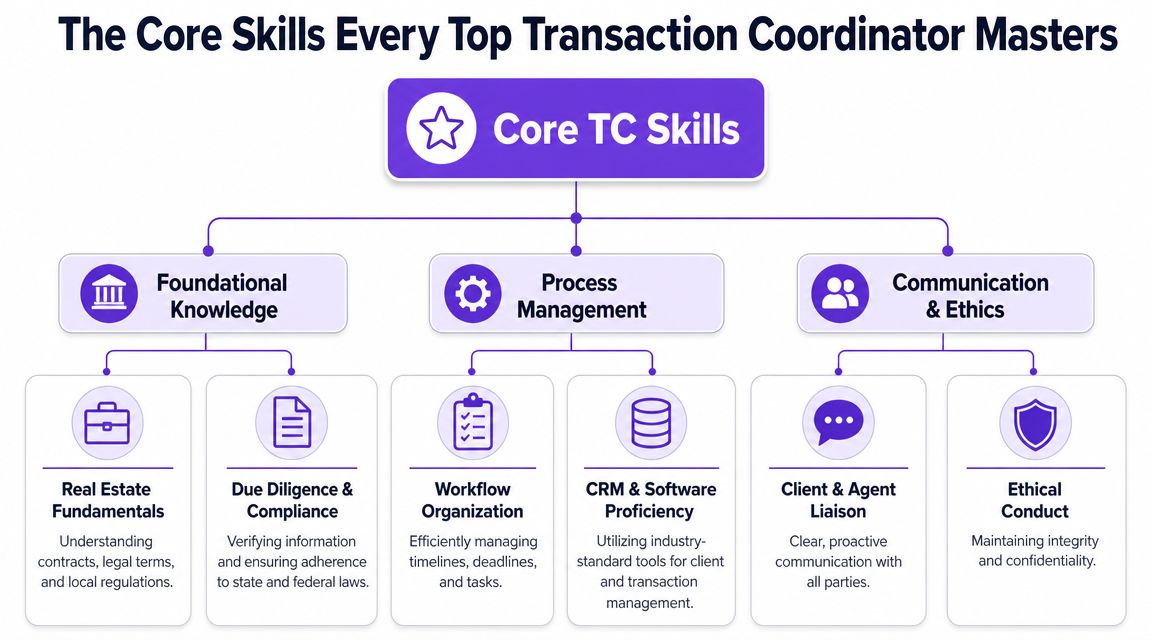
Contract and timeline control
You don't need to negotiate terms to manage a file well, but you do need to read a purchase agreement carefully enough to build an accurate deadline map from it.
That means a good class should teach you how to:
- Open the file correctly: Pull key dates, parties, contingencies, and required documents from the contract.
- Track the timeline: Maintain a live checklist so inspection, financing, title, and closing tasks stay visible.
- Handle disclosures in sequence: Not all documents belong at the same stage. Order matters.
- Escalate issues early: If something is missing, late, or inconsistent, the TC needs to alert the right party before it becomes a closing problem.
A lot of newcomers underestimate this part. They think organization means “good with spreadsheets.” Real file control is closer to process management.
Communication that prevents bottlenecks
Top TCs don't just send updates. They reduce uncertainty.
The job usually puts you at the center of communication between agents, lenders, attorneys, inspectors, title officers, and clients. That means you need to know when to follow up, what to confirm in writing, and how to keep messages concise enough that people respond.
Practical rule: Every communication should answer one of three questions. What happened, what's needed next, and by when?
Strong classes should include communication templates or at least communication logic for common moments in a file. Without that, students leave with theory and freeze when the first lender asks for an update.
If you also plan to freelance, it helps to understand service boundaries and written expectations. This guide on drafting contracts for services is helpful for thinking through scope, responsibilities, and what should be clear before work starts.
Systems and software fluency
A TC without systems will eventually hit a ceiling.
You need one place to track tasks, one process for storing documents, and one repeatable way to manage communication. That can include transaction management software, e-signature tools, cloud storage, and a CRM, but the exact stack matters less than the discipline behind it.
Here's what to look for in a course syllabus:
| Skill area | What good training should include | What weak training often does |
|---|---|---|
| Workflow setup | File naming, checklist creation, deadline sequencing | Talks generally about “being organized” |
| Document control | Required docs, status tracking, version awareness | Assumes students will figure it out live |
| Client updates | Message timing, handoff points, escalation rules | Focuses only on internal admin tasks |
| Tool usage | Practical demos and process examples | Lists software names without context |
If you teach adults later, this matters even more. Adults learn best when they can see how a tool fits a workflow, not when they're handed abstract theory. This breakdown of adult learning styles is worth reading if you're evaluating how a class is taught, not just what it includes.
State-specific compliance awareness
Generic national training has limits. The workflow may be universal, but forms, timelines, and compliance expectations are not.
A class is more useful when it either teaches your market directly or clearly tells you where the state-specific adaptation must happen. If a course pretends one generic method covers every market, that's a red flag.
The strongest students learn the system first, then localize it.
How to Choose the Best Transaction Coordinator Classes
Initial comparisons of transaction coordinator classes often prioritize price. That's understandable, but it's rarely the best filter. The better question is how the class is delivered, who teaches it, and whether it gets you close to real-file competence.
There's also one industry reality you should keep in mind before paying for any “certified” program. In 49 of 50 U.S. states, there is no state-issued TC certification or governing body, and self-paced private courses may take about 20 to 40 hours, according to Freedom Real Estate Services' certification guide. In most markets, “certified” usually means you completed a private course, not that you earned a regulated credential.
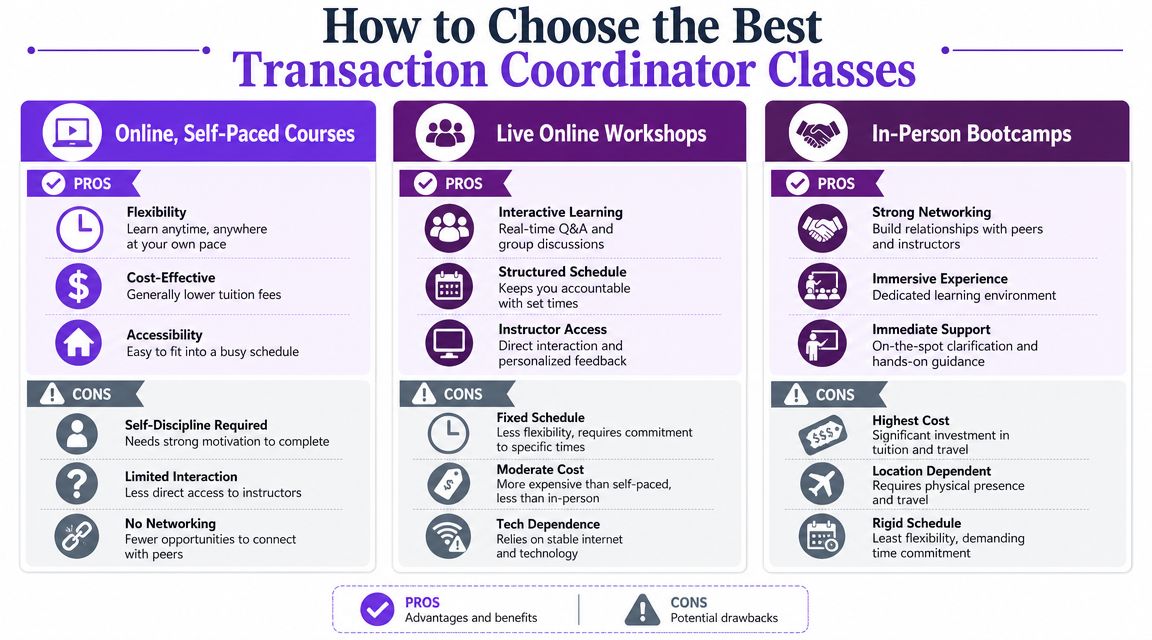
Comparing delivery formats
Each class format solves a different problem.
| Format | Best for | Main trade-off |
|---|---|---|
| Online, self-paced | Career changers with irregular schedules | Easy to start, easy to delay |
| Live online workshops | Students who want feedback and accountability | Less flexible calendar |
| In-person bootcamps | Learners who value immersion and networking | Higher friction and less convenience |
Self-paced courses work well if you already know how to study independently and practice outside the lessons. Live programs are often better for people who need structure, real-time Q&A, and external accountability. In-person options can be valuable, but only if the instruction quality justifies the time and travel commitment.
How to vet the instructor
Course design matters, but instructor relevance matters more.
Look for someone who is either currently handling files or has very recent field experience. A former TC who hasn't worked inside current workflows in years can still be helpful, but practical details age fast. Forms change. Team structures change. Software habits change.
Ask questions like these before you buy:
- What kind of files has the instructor handled recently?
- Does the course show actual workflow examples, or only slides?
- Is there state-specific guidance, or only national generalities?
- Will I finish with mock files, templates, or a usable checklist system?
If a course page spends more time selling lifestyle promises than showing curriculum depth, move on.
Classroom knowledge helps. Managed files build judgment.
What good classes include and weak ones avoid
A worthwhile class usually has a few signs you can spot quickly.
Good signs
- Process-based structure: The class follows the life of a transaction instead of random disconnected topics.
- Hands-on practice: Students work through checklists, sample timelines, or file simulations.
- Boundary clarity: The course explains what a TC does not do, which protects both the student and future clients.
- Tool realism: Software is taught as part of a workflow, not as a collection of unrelated features.
Warning signs
- Overuse of “certification” language: Especially when no regulated credential exists in that market.
- Generic entrepreneurship filler: Useful eventually, but not a substitute for transaction competence.
- No mention of compliance adaptation: A serious omission for a role that depends on local practice.
- No practice component: You can't learn this work by passive watching alone.
If you're comparing platforms and thinking ahead to building educational products yourself someday, this guide to the best LMS for small business is useful because it helps you evaluate training from the creator's side too.
Building Your Career Path After the Course
You finish the course on Friday. On Monday, an agent asks whether you can manage an active file with missing disclosures, a financing deadline coming up, and a buyer who keeps replying to the wrong email thread. That moment decides whether your training turns into income.
Course completion gives you direction. Career traction comes from repetition, judgment, and a system you can run under pressure.
A new transaction coordinator should treat the first stage after training like an apprenticeship, even if it is self-directed. Build the habits before you chase titles. In practical terms, that means working through file flow, communication cadence, deadline tracking, and document control until your process feels steady.
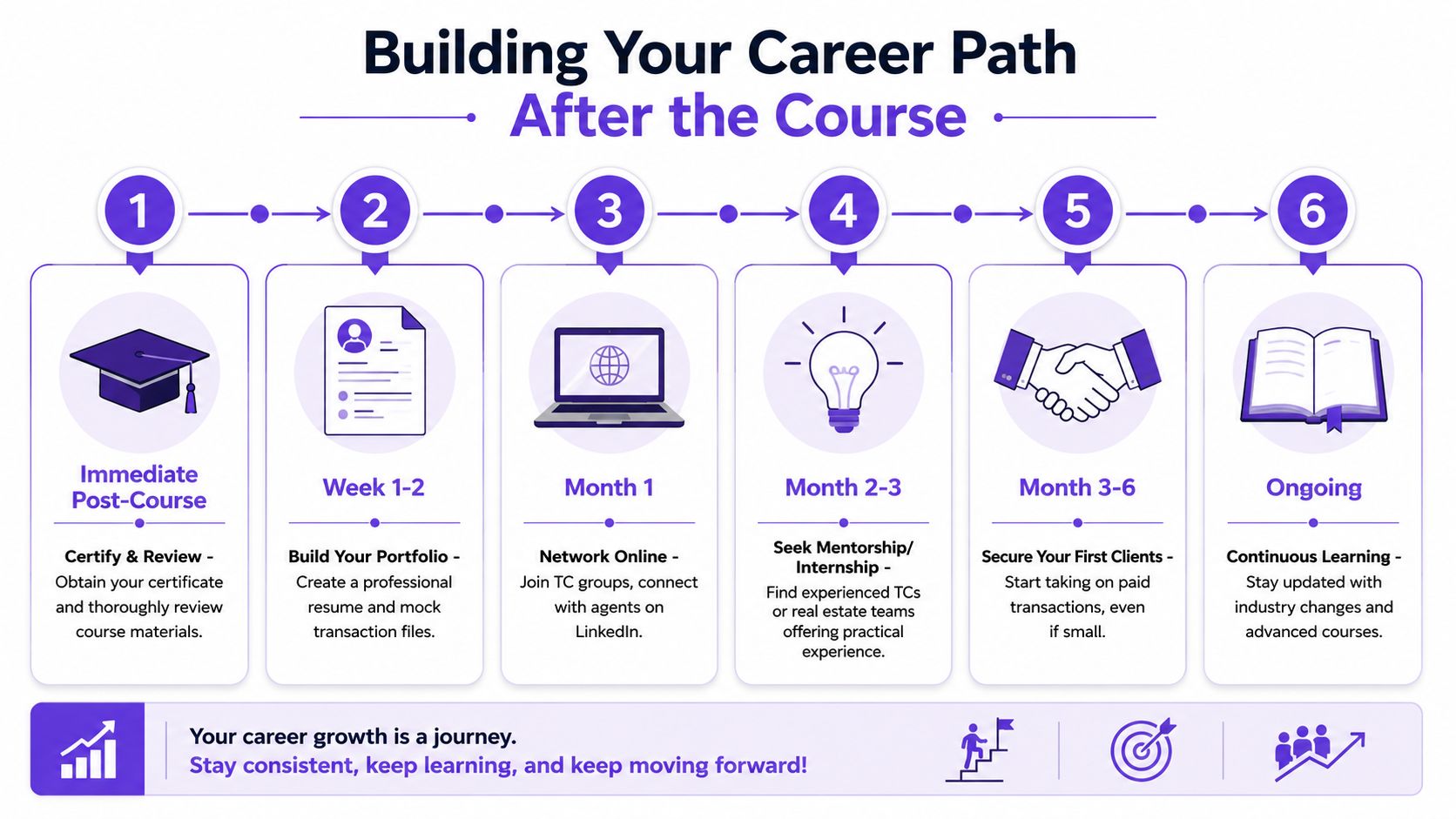
The first month after training
The best first month is hands-on.
Set up two or three mock transactions from contract to close. Build the folder structure, pull deadlines from the agreement, create status updates, log missing items, and close the file cleanly. Repeat until the sequence feels natural. New TCs often want another class at this stage. Practice usually gives a better return than more theory.
A useful 30-day plan looks like this:
- Turn course notes into your own SOPs. Write the steps in plain language you can follow quickly during a live file.
- Build sample files. Include opening documents, contingency tracking, amendment handling, and closing documents.
- Create communication templates. Prepare emails for file opening, missing signatures, deadline reminders, lender follow-up, and closing confirmation.
- Test your tools. Use your transaction software, e-signature platform, calendar, and storage system until routine actions are fast.
- Review for risk points. Mark where delays, incomplete paperwork, or poor communication would create trouble.
If you want a practical way to judge whether your training time is paying off, use a simple framework for calculating return on effort and spend. The context is different, but the discipline is the same. Track inputs, track outputs, and stop guessing.
Employee path versus freelance path
Pick your first lane early. You can switch later, but your first few moves should match the type of work you want.
An in-house team role is usually the faster path to judgment. You see real files, real bottlenecks, and real personalities. You also inherit existing systems, which is helpful when you are still learning what good file management looks like. The trade-off is lower flexibility and less control over pricing, process, and client selection.
Freelance work offers more upside once your process is solid. It also exposes weaknesses faster. Agents hiring an independent TC expect you to define scope, set boundaries, communicate clearly, invoice properly, and protect your time. If your systems are loose, freelance work gets stressful fast.
Here's the practical difference:
| Path | Best first move | What clients or employers care about most |
|---|---|---|
| In-house team role | Apply with a process-focused resume and sample workflow documents | Reliability, speed, consistency |
| Freelance TC | Package your services clearly and network with agents | Boundaries, responsiveness, confidence |
How to land the first opportunity
Early on, proof beats polish.
A hiring manager or agent wants to see that you can keep a file organized, communicate without creating confusion, and catch deadlines before they become problems. A certificate may help you get a conversation. Your system gets you the job.
Show tangible work:
- A one-page workflow checklist that shows how you move a file from contract to close
- Sample client and agent updates written in a professional tone
- A sample file structure with clear naming conventions
- A short service sheet that explains what you handle and what stays with the agent, broker, lender, or attorney
This is also where the student-to-teacher path begins, even if you are not thinking about teaching yet. Save your templates. Refine your SOPs. Document the mistakes you catch and the steps that prevented them. Those assets help you win work now, and later they become training material.
Building toward specialist status
Strong TCs do more than move paperwork. They become known for a certain kind of reliability.
One coordinator becomes the person teams trust with messy files. Another becomes known for clean communication with lenders and title. Another gets repeat business because her checklists reduce last-minute surprises. That reputation grows from repeated execution, not from broad personal branding.
A smart career path often looks like this:
- Learn the workflow
- Support real transactions
- Tighten your systems
- Choose a niche or client type
- Raise your rates or move into higher-responsibility roles
- Package your process into training
That last step matters more than many people realize. Once you have managed enough transactions to know where beginners get stuck, you have the raw material for coaching, templates, workshops, or a paid course. The TCs with the strongest long-term earning potential often build two income streams. Client work first. Education second.
If you keep records on time spent, tool costs, revision cycles, and client results, you will also be in a much better position to decide when teaching makes financial sense. That is how a course stops being just something you bought and starts becoming expertise you can sell.
The Real ROI of Becoming a Transaction Coordinator
A new coordinator spends $700 on a course, another few hundred on software and business setup, then waits three months to land the first steady client. That is a very different investment than the tuition page suggests.
The return on transaction coordinator classes depends on your full cost to become hireable, how quickly you can handle live files without hand-holding, and whether the role leads to better income options six to twelve months later. Tuition matters. Time-to-first-client matters more.
Freedom Real Estate Services makes this point well in their guide to becoming a certified transaction coordinator. The financial decision is broader than course price because software, association access, continuing education, and actual workflow readiness all affect payback.
What to include in your ROI calculation
Start with a simple worksheet. Use real numbers, not guesses.
Track three buckets:
- Startup costs: Course tuition, business registration if you plan to freelance, laptop upgrades, headset, and any file-management tools you need right away.
- Monthly operating costs: Transaction management software, e-signature tools, cloud storage, CRM, bookkeeping, and insurance if applicable.
- Time investment: Practice files, onboarding time, shadowing, revisions, unpaid admin work, and the slower pace that comes with your first few transactions.
That third bucket is where beginners underprice the decision. If a class is inexpensive but leaves you building your own checklists, correcting avoidable mistakes, and asking basic contract questions on live files, the cheap option can cost more in lost time than a stronger course.
A practical ROI formula is simple: total money spent plus the value of your unpaid time, divided by the income you can reasonably produce in your first stage of work.
What the payoff usually looks like
Income varies a lot in this role. Market type, transaction volume, brokerage structure, and whether you work as an employee or an independent TC all change the math.
Earlier sources in this article noted that entry-level compensation often starts modestly and rises with volume, specialization, and reliability. That tracks with what experienced coordinators see in the field. The first goal is rarely maximum income. It is getting competent fast enough to earn repeat work, tighten your process, and raise your rate from a position of proof.
If you want a cleaner framework for breakeven, payback period, and return over time, use the same logic outlined in this guide on how to calculate marketing ROI. The categories transfer well. Replace campaign spend with training and setup costs, then measure how long it takes your new skill set to produce dependable revenue.
There is also a second layer of return that newer coordinators miss. A solid class can become the first asset in a longer career cycle. First you learn the work. Then you get faster, build templates, and document your process. Later, those systems can become training material, workshops, template packs, or a course of your own.
That is why the smartest students look past sticker price. They calculate whether a class shortens the path to paid work now and creates teachable expertise later. That is the stronger return.
The Expert Leap: Sell Your Own TC Course with Zanfia
A lot of transaction coordinators hit the same ceiling. You get faster, take on more files, answer more agent questions, and eventually realize your next income jump will not come from squeezing one more transaction into the week. It comes from turning your process into something other people can buy.
That shift matters because TC work produces teachable systems. After enough closings, you stop relying on memory and start relying on checklists, email sequences, file standards, and issue-prevention habits. Those are the raw materials of a course business.

Why teaching is a logical next step
The best instructors in this niche are usually working TCs first. They know where new coordinators freeze up. They know which forms create confusion, which handoffs get missed, and which “small” communication errors turn into expensive closing delays.
That experience gives you several ways to sell what you know:
- A beginner course for people moving in from admin, escrow, or agent support roles
- A specialty workshop on communication, compliance habits, file setup, or deadline control
- Template packs with checklists, email scripts, intake forms, and onboarding docs
- A paid community where newer TCs can get feedback as they start handling real files
The business advantage is straightforward. Client work pays once. A training asset can pay repeatedly, especially if you update it as your process improves.
What a sellable TC course should include
New course creators usually miss in one of two directions. They either record everything they know and bury the student in content, or they stay so broad that the material never becomes useful on the job.
A good TC course follows the way competence develops in this role.
Build it around the work students need to perform:
- Role boundaries and risk points so students understand what they can handle and what belongs with the agent, broker, lender, title officer, or attorney
- The full transaction timeline with repeatable checklists at each stage
- Communication systems including status updates, handoff emails, and problem escalation
- Tool use in context so software supports the workflow instead of becoming a feature tour
- Practice files and scenarios that force decision-making, not passive watching
- Localization guidance so students know what must be adapted to their state, brokerage, and transaction type
Students do not buy a course because the outline looks impressive. They buy because they want to get job-ready faster.
How to calculate whether teaching is actually worth it
This is the part many experienced coordinators skip. They assume course revenue is mostly margin because they already know the material. That is not how the math works.
True ROI includes more than recording time. Count curriculum planning, slide creation, editing, platform fees, payment processing, customer support, refunds, promotion, and the hours you could have spent on paid TC work instead. If your course takes 40 hours to build and you normally earn income from active files during those same hours, that opportunity cost belongs in the calculation.
Then look at the other side of the equation. Estimate how many students you need to cover production cost, how many sales are realistic without an audience, and how often the course will need updates. A small, practical offer often beats a giant flagship launch because it gets to market faster and starts validating demand sooner.
The long-term upside is where this gets interesting. One course can lead to templates, workshops, office training, private consulting, and licensing your material to team leaders or brokerages. That is the student-to-teacher path at its best. First you learn the work. Then you document it. Then you sell the documented version.
Why platform choice affects margins and delivery
If you want course revenue to be real profit, the platform has to reduce admin instead of creating more of it. TC education rarely works as a video library alone. Students ask questions. They need downloads, updates, reminders, and a place to get support when a live file does not match the example in the lesson.
Zanfia fits that model because it lets you sell courses, digital products, and community access under your own brand and domain. That keeps the student experience cleaner and gives you more control over pricing, presentation, and follow-up.
Here is the practical breakdown:
| Need as a TC educator | Why it matters | Zanfia advantage |
|---|---|---|
| Keep more revenue | Course margins shrink fast if the platform takes a cut | 0% platform transaction fees, with only payment operator fees applying |
| Host process training | TC lessons often depend on screen recordings and walkthroughs | Native video hosting |
| Support students after purchase | New coordinators often need discussion and feedback, not just lessons | Integrated community plus courses under one login |
| Price offers different ways | Some buyers want one-time access, others want payment flexibility | One-time, subscriptions, installment plans, and bundles |
| Reduce manual admin | Manual access management and follow-up can eat into profit | Automations for access, sequences, renewals, and permissions |
| Build a branded school | Serious educators usually want their own site, not a generic marketplace page | White-label and custom domain included on every plan |
Zanfia also supports payment methods including Stripe, PayU, Przelewy24, BLIK, and Tpay, along with Apple Pay and Google Pay through a Stripe-linked cart. It connects with inFakt and Fakturownia for automatic invoicing. For a TC who wants one operating system instead of five separate tools, that setup can save both time and cleanup work.
A practical blueprint for monetizing your expertise
Start with the smallest offer that solves a real beginner problem.
Build a short course on how to manage a file from contract to close. Add the checklists and email templates you already use. Sell that first. Once students start asking the same questions, turn those questions into a second product. That might be an advanced module, a live workshop, or a paid implementation group.
This approach keeps risk lower. You do not need a giant content library on day one. You need proof that your process helps another person become competent faster.
If you want a stronger framework for packaging, pricing, and promotion, read this guide on selling online courses successfully. It is a useful next step for turning field experience into an offer with clear market value.
If you have handled enough transactions to explain your workflow clearly, you are closer to teaching than you think. The strongest TC educators are not celebrities. They are practitioners who documented what works, priced it sensibly, and built products that save newer coordinators time and mistakes.
If you've built real expertise and you're ready to turn it into a course, community, or digital product business, Zanfia gives you a practical way to do it under your own brand. You get 0% platform transaction fees, native video hosting, integrated courses and community, flexible pricing, automations, and white-label control on your own domain, so you can teach transaction coordination without stitching together multiple tools.