Build a Membership Website: How to build a membership website that converts

Before you even think about which platform to use or what your website will look like, let's talk strategy. So many membership sites fail because they get this part wrong. A flashy website with no clear purpose is a ghost town waiting to happen, but a simple, focused site that solves a real problem for a specific group of people? That's where you build a sustainable business.
This initial planning is the bedrock of everything you'll build. Don't skip it.
Laying the Groundwork for a Profitable Membership Site
The success of your membership business is decided long before you write a single line of code. It’s all about the strategic foundation you lay first. Let's walk through the three core pillars that will support your entire venture.
Define Your Unique Transformation
Here's the truth: people don't buy access to content. They buy results. They're investing in a transformation, a specific outcome that will make their life or business better.
So, what promise are you making? Get laser-focused. "Learn to run" is vague. "Run your first 5K in just 8 weeks without injury" is a powerful promise. "Improve your business" gets lost in the noise. "Land your first high-ticket client in 90 days" is a tangible result someone will pay for.
This core transformation becomes your north star. It dictates the content you create, the community you build, and every single marketing message you put out there. When the value is this clear, it makes saying "yes" to your membership a no-brainer for the right person.
Identify Your Ideal Member
Once you know the what (the transformation), you need to figure out the who. Who is this membership built for? You have to go deeper than just basic demographics. You need to get inside their head.
A great way to do this is to build a detailed avatar of your ideal member. Ask yourself:
- What are their biggest headaches and daily frustrations related to your niche?
- What have they already tried that failed them? This is a goldmine of information.
- What are their real goals and dreams? What are they truly hoping to achieve?
- Where do they hang out online? What blogs, forums, or social media groups are they active in?
When you understand these details, you can create an experience that feels like it was made just for them. Every piece of content will hit home because you're speaking their language and directly addressing their struggles.
This process—defining the value, pinpointing the member, and then building the model—is the essential strategic flow.
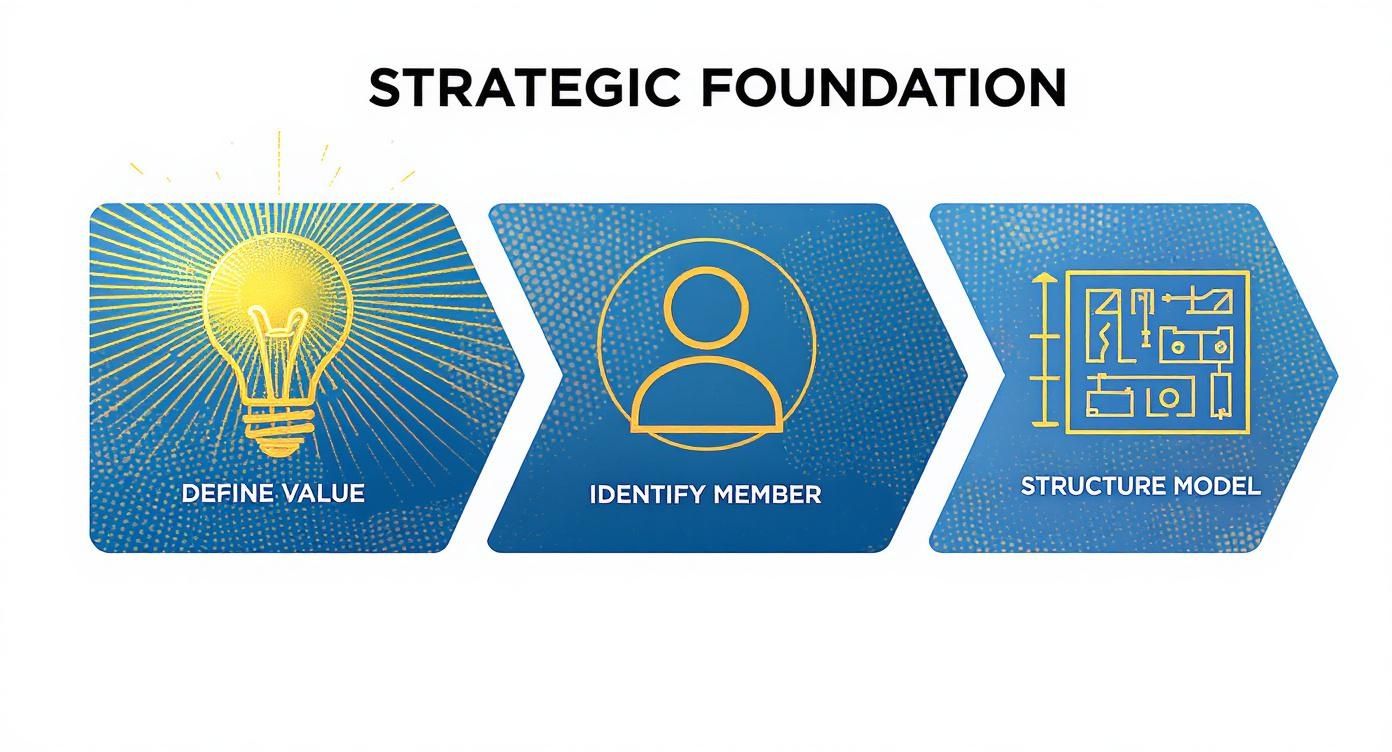
Following this path ensures every decision you make serves a specific audience and delivers a specific outcome.
Structure Your Membership Model
Okay, you have your transformation and your ideal member. Now, how will you actually deliver that value? It's time to structure your business model. This means deciding what members get and how they get it. A strong model usually blends a few key components to keep people engaged and happy to pay you every month.
Your model could be built around:
- Core Content: This is your anchor. It might be a signature online course, a deep resource library, or a series of expert workshops.
- Community: A private space for members to connect, get feedback, and support each other is often the glue that makes people stay.
- Ongoing Value: Think regular, fresh additions like paid newsletters, monthly expert Q&A calls, or new templates and tools.
It's a well-known fact in this business that getting a new member can cost five times more than keeping an existing one. That’s why your model absolutely must be built for long-term engagement to keep churn low. You can dive deeper into the different options in our guide on 7 subscription business model examples for creators in 2025.
If you’re building something around education, this guide on how to create an online training academy is a fantastic blueprint that covers these foundational steps in detail.
And don't underestimate the power of early engagement. Data shows that members who don't engage within their first 90 days have a staggering 73% higher chance of canceling. Getting them involved from day one is absolutely critical.
Choosing Your Membership Technology Stack

The technology you choose to run your membership can either be a massive headache or your secret weapon. I’ve seen it go both ways. This single decision impacts everything from how you spend your days to how easily your business can grow down the line.
When you boil it down, you're really looking at two main paths: the do-it-yourself route with WordPress or a streamlined, all-in-one platform.
The WordPress path gives you incredible freedom. You can tweak and customize just about anything. The catch? You’re now the system administrator. It's on you to find, integrate, and maintain a whole stack of separate plugins for memberships, payments, courses, and community features. For tech-savvy creators, this can work. But for most, it quickly becomes a tangled mess of compatibility issues, security worries, and endless updates that eat up valuable time.
The All-in-One Advantage
This is exactly the kind of complexity that all-in-one platforms like Zanfia were built to solve. Instead of duct-taping different tools together, you get a single, unified system where courses, community, payments, and e-commerce all work together perfectly from day one. That means one login, one dashboard, and one team to call when you need help.
The biggest win here is the sheer amount of time you get back. Forget about juggling a dozen plugin subscriptions and playing detective when something breaks. You can finally focus on what really matters: creating great content and engaging with your members.
On top of that, many platforms include features that would cost you extra elsewhere, like native video hosting, so you don't have to pay for a separate service like Vimeo or Wistia.
For anyone tired of watching platform fees chip away at their hard-earned money, the financial model is a breath of fresh air. Zanfia, for instance, uses a simple SaaS subscription model with 0% platform transaction fees. You keep 100% of your revenue, minus the standard processing fees from payment gateways like Stripe or PayU. This can be a revolutionary advantage for creators earning PLN 10k–100k+ a month.
This integrated setup doesn't just make your life easier; it creates a much better experience for your members. When someone buys a course, they instantly get access and are automatically added to the right community groups. Trying to create that same seamless journey with a cobbled-together WordPress site is tough, and any friction can be a major cause of member churn.
Membership Platform Comparison: WordPress vs. All-in-One
To help you visualize the trade-offs, here’s a quick breakdown of how the two approaches stack up against each other.
| Feature | WordPress + Plugins | All-in-One Platform (e.g., Zanfia) |
|---|---|---|
| Technical Maintenance | High: You manage all updates, security, and plugin conflicts. | Low: The platform handles all technical upkeep for you. |
| Setup & Integration | Complex: Requires piecing together multiple plugins that may not work well together. | Simple: All features are pre-integrated and designed to work seamlessly. |
| Cost Structure | Unpredictable: Multiple plugin fees, hosting, and potential developer costs. | Predictable: A single, transparent monthly or annual subscription. |
| Support | Fragmented: You'll need to contact multiple plugin developers for help. | Centralized: One dedicated support team for all your questions. |
| Member Experience | Potentially disjointed: Can require multiple logins for different features. | Unified: A single login provides access to all content and community areas. |
Ultimately, choosing an all-in-one platform is about trading the complexity of a DIY setup for the simplicity of a managed system, allowing you to focus on growth instead of technical troubleshooting.
Key Factors for Your Decision
So, how do you decide what’s right for your business? It comes down to being honest about your technical skills, budget, and long-term goals.
Think through these critical points:
- Your Time & Sanity: Are you ready to be your own IT department, dealing with updates and troubleshooting? Or would you rather have a managed system that just works, giving you peace of mind?
- True Cost: A DIY build might look cheaper at first glance, but the costs for premium plugins, robust hosting, themes, and maybe even a developer can spiral. All-in-one platforms give you predictable pricing.
- Room to Grow: Will your tech stack buckle under pressure as you add more members and content? Integrated platforms are built to scale with you, so you don't have to worry about performance issues later on.
- The Member Journey: A smooth, unified experience with a single login is a huge factor in keeping members happy and engaged. A clunky site with multiple logins can lead to frustration and cancellations.
As you figure out how to build a membership website, it's clear the technology you pick is a huge strategic decision. For a more detailed look, check out our guide on finding the best platform for a membership site that fits your specific needs.
Adopting Modern Tools for Growth
Smart creators are always looking for an edge, and right now, that means looking at tools that can help them grow faster. A recent report showed that AI adoption among membership businesses is surging, with 31% now using or implementing AI—a big jump from just 18%. They're mainly using it for content creation, data analysis, and SEO.
This just goes to show how important it is to choose a modern platform that can keep up with new innovations. You can learn more about these membership marketing trends and see how they might apply to your own business.
At the end of the day, your technology should be an enabler, not a bottleneck. It should free you up to do what you do best: create amazing content and build a thriving community. For most creators who value their time and want a reliable, powerful system, an all-in-one platform is the straightest line to a successful and profitable membership business.
Designing Your Membership Tiers and Pricing Strategy
Figuring out what to charge for your membership is probably one of the biggest decisions you'll make. It’s a real make-or-break moment. If you nail it, you've got a sustainable business on your hands. But if you miss the mark, you end up either undervaluing all your hard work or, worse, scaring everyone away before they even sign up.
This isn't just about plucking a number out of thin air. It’s a strategic choice that signals the value of what you're offering. The goal is to land on a price that feels like an easy "yes" for your ideal member while also being profitable for you.
Structuring Your Membership Tiers
When you're just starting, the simplest path is often the best: a single, all-access tier. It’s clean and easy for everyone to understand—one price gets you everything. This approach works beautifully if your core offer is a unified experience, like a tight-knit community or a complete content library.
As your community and content library expand, though, you might find that a multi-level approach makes more sense. Creating tiers allows you to meet different people where they are, both in terms of their needs and their budgets. A classic, effective setup usually looks something like this:
- A "Basic" or "Starter" Tier: Think of this as your foot-in-the-door offer. It might include access to the main community forum or a handful of foundational content. It’s a low-risk way for curious followers to see what you're all about.
- A "Pro" or "Premium" Tier: This is your sweet spot, the main event. It should have the full experience that most people are looking for—all the courses, exclusive content, Q&As, and full community access.
- A "VIP" or "Mastermind" Tier: This is the top shelf, designed for your most committed members. It’s where you offer high-touch benefits like 1-on-1 coaching, direct access to you, or small-group strategy sessions.
No matter how you structure it, clarity is king. When you build a membership website, you have to spell out exactly what someone gets at each level. Any confusion is a conversion killer.
Setting the Right Price Point
Let’s be honest, pricing feels like a mix of art and science. The most common mistake I see creators make is pricing too low out of fear. But your price shouldn't be based on the quantity of your content; it should be anchored to the value of the transformation you provide.
With a platform like Zanfia, you have the flexibility to implement a variety of models that work for you and your audience:
- Recurring Subscriptions: This is the bread and butter. Monthly and annual plans create predictable revenue. I always recommend offering a discount on the annual plan—something like "get two months free"—because it improves your cash flow and reduces member churn.
- One-Time Payments: Perfect for lifetime access to a flagship course or a digital product bundle. These can provide fantastic cash injections for your business.
- Installment Plans: For your higher-priced programs, breaking the cost down into a few smaller payments can make a huge difference in your sign-up rate. It just makes the offer feel much more achievable.
- Bundles and Upsells: Package a course with a related e-book or a set of templates. Bundling is a proven strategy for increasing the average order value and delivering even more value to your members.
A massive advantage for Polish creators using Zanfia is its 0% platform transaction fee. Most platforms will skim a percentage off every single sale you make. Zanfia’s model means you keep 100% of your revenue, aside from the standard fees from payment processors like Stripe or Przelewy24. For anyone earning PLN 10k–100k+ a month, this is a total game-changer.
This simple difference can put thousands back in your pocket every year—money you can reinvest into growing your business instead of handing it over in fees.
Don’t forget, the entire subscription economy is booming. Projections show the global subscription e-commerce market rocketing from $199.41 billion in 2023 to an eye-watering $2,227.63 billion by 2028. This isn't just a passing trend; it's a fundamental shift in how people want to buy. Consumers are more comfortable than ever paying for ongoing access to valuable communities and content. If you're curious, you can discover more insights about these membership trends and see just how big this opportunity really is.
Creating Content and Community That Members Love

Here’s something I’ve learned from years of building these sites: great content gets people to sign up, but a strong community makes them stay. It’s so easy to get fixated on churning out a massive library of resources when you first build a membership website. And while content is absolutely crucial, the real secret to keeping members around for the long haul—the key to reducing churn—is fostering a place where they feel like they truly belong.
Think of it this way: content is the fuel, but community is the engine. The best membership sites don't treat them as separate things. They weave them together into an ecosystem where learning, connection, and conversation all happen in one place.
Planning a Content Calendar That Delivers Value
If there's one thing that kills momentum, it's inconsistency. When content drops are sporadic, members start to wonder what they’re paying for. A well-thought-out content calendar is your best friend here. It creates a predictable rhythm that both you and your members can rely on.
Your calendar shouldn't be a one-trick pony. People learn in different ways, so a mix of formats is essential to keep everyone engaged and feeling like they're getting their money's worth.
Try to build a schedule that includes a blend of these:
- Cornerstone Content: These are your big, high-value assets. Think of a multi-module flagship course or a deep-dive resource library that becomes a go-to for your members. Using a platform like Zanfia really helps here, as its native video hosting means you aren't paying for a separate service like Vimeo or Wistia.
- Episodic Content: This is the stuff that keeps people coming back week after week. It could be a paid newsletter with exclusive analysis, a monthly live Q&A with an expert, or a fresh batch of downloadable templates. It’s the regular pulse of your membership.
- Community-Driven Content: Pay attention to what your members are talking about. Host a live workshop to tackle the most common questions from your forums. Create a guide that solves a problem everyone seems to be struggling with. This is how you show you're listening.
Fostering a True Community, Not Just a Forum
Let’s be blunt: a forum is not a community. A community is a living, breathing space where people feel seen and connected—to each other and to you. Just giving them a place to post messages and hoping for the best is a recipe for a ghost town.
The single biggest mistake I see people make is outsourcing their community to a third-party platform. Sending members off to a Facebook Group or a Discord server fractures the entire experience. It forces them to leave your site, navigate a distracting environment, and mentally disconnect from your brand.
The most powerful membership sites keep everything under one roof. When your community channels are integrated directly with your course content, it creates a unified hub. Members can discuss a specific lesson right where they're learning it, creating a powerful, context-rich feedback loop that dramatically boosts engagement.
This is where all-in-one platforms truly shine. Zanfia, for instance, lets you create specific discussion channels for different topics, read-only announcement spaces for important news, and private groups for members who've bought a particular product. The entire experience feels cohesive and stays under your brand. For a deeper dive, check out these powerful community engagement strategies to get your members talking.
Integrating Content and Community Seamlessly
The real magic happens when your content and community stop being two separate pillars and start working as one. This is how you turn a simple content library into something truly indispensable.
Here are a few practical ways to make that happen:
- Link Discussions to Lessons: Inside every video lesson or article, drop a direct link to a dedicated community channel for that specific topic. This encourages immediate questions and helps members learn from each other.
- Use Announcements for Content Drops: When you release a new course module or e-book, post it in a read-only "announcements" channel. This guarantees your most important updates don't get lost in the shuffle of a busy feed.
- Automate Access: Set up automations so that the moment someone buys a product, they are instantly added to the relevant community channels. This makes for a smooth onboarding and gets them connected with other members right away.
When you weave your community into the very fabric of your content, you’re no longer just selling information. You’re building a home for your people. And that is the ultimate defense against churn.
Executing a Smooth and Successful Website Launch
A powerful launch isn't about luck—it's the direct result of a well-executed plan. The real work happens in the days and weeks leading up to your grand opening, building the momentum that will carry you through a successful first month. Now, we’re shifting gears from building the site to getting it ready for its first visitors and paying members.
This isn't just about flipping a switch and hoping people show up. A great launch is a carefully orchestrated series of technical checks and marketing moves designed to make sure everything runs flawlessly from the moment you go live.
The Pre-Launch Technical Checklist
Before you even dream of marketing, your site's foundation has to be solid. A glitchy payment button or a broken link can kill your launch buzz in a heartbeat. Think of this as your pre-flight checklist; these are the non-negotiables.
First, connect your custom domain. This is huge for your brand. When you use a platform like Zanfia that offers full white-label features on every plan, your members see your brand, not the platform's. A custom domain makes you look professional and established from day one.
Next up, configure your payment gateways. Double-check that your accounts with Stripe, PayU, or Przelewy24 are active and properly linked. I always recommend running a few real-world test transactions on a low-priced product to ensure payments go through without a hitch. Offering local favorites like BLIK alongside global options like Apple Pay and Google Pay can make a surprising difference in your conversion rates.
Finally, set up automated invoicing. This will be a massive time-saver and keeps you compliant. Integrated platforms can automatically generate and send invoices through services like inFakt or Fakturownia after every single purchase. This simple automation saves you hours of admin work and lets you focus on your new members instead of drowning in paperwork.
Building Buzz Before You Go Live
The best launches I've ever seen started generating excitement long before launch day. Your goal here is to build a waiting list of people who are genuinely eager to buy the second you open the doors. This creates a powerful wave of social proof and secures that critical initial revenue.
Start by throwing up a simple "coming soon" landing page. Its only job is to capture email addresses. Give people a compelling reason to sign up—maybe they'll be the first to know when you launch or they'll get an exclusive early-bird discount.
Use this pre-launch window to build anticipation on social media:
- Share behind-the-scenes peeks of the content you're creating.
- Run polls asking your audience what they'd love to see inside the membership.
- Post a few early testimonials or snippets of social proof if you have any.
- Start a countdown a week or two out from launch day to get people excited.
Your pre-launch offer is your single most powerful marketing tool. Put together a special deal just for your founding members. This could be a lifetime discount on the membership price, a bonus 1-on-1 coaching call, or exclusive access to a resource bundle. It’s the perfect way to reward your earliest supporters and create a strong incentive to join right now.
Your Launch Day Sequence of Events
When the big day arrives, your job is to simply execute the plan you’ve already laid out. Having a clear sequence of events will keep you focused and prevent that feeling of launch-day overwhelm.
Your day should be built around communication. The first and most important move is to email your waiting list. These are your warmest leads, the people most primed to buy. Send them a clear, direct email announcing that the doors are open and reminding them of their exclusive offer.
At the same time, announce the launch across all your social media channels. Update the links in your bios to point directly to your sales page. Craft engaging posts that clearly state who the membership is for and the transformation it promises.
Lastly, be present and available. Launch day is not a "set it and forget it" affair. Plan to spend the day inside your new community, personally welcoming the first members as they join. Stay active on social media and in your email inbox, ready to answer questions from people who are on the fence. This high-touch engagement shows potential members you're committed and builds trust right from the start.
Scaling Your Membership Business for Long-Term Growth
Getting your first handful of members feels incredible, doesn't it? But that initial rush is just the starting line. The real work—and the real reward—is building a business that can grow and thrive for years to come. This is where you graduate from working in your business to working on it.
You have to move past guesswork and gut feelings. Sustainable growth is all about understanding what your members are actually doing, what they love, and where they're getting stuck. The story is right there in your data.
Platforms like Zanfia are built to give you this kind of visibility, pulling back the curtain on your entire funnel. This isn't just a sea of numbers; it's a treasure map pointing you toward powerful insights. You can start answering the big questions:
- Where are people abandoning the sign-up process?
- Which videos or articles are the most popular?
- What's the real lifetime value of a member?
- Are people actually finishing the courses they sign up for?
Once you spot these patterns, you can make smarter decisions. Maybe a small tweak to your checkout page could boost conversions, or perhaps one piece of content is so popular it deserves its own dedicated course. This is how you optimize for real results.
The Power of Smart Automation
As your community grows, the manual admin work can start to feel like a full-time job. Onboarding, sending welcome emails, managing renewals—it all adds up, and it can quickly drain the energy you need for creating great content. This is precisely where automation steps in to become your most reliable team member.
Think about what a smooth, automated workflow looks like:
- A new member signs up and pays.
- Instantly, a welcome email with their login info hits their inbox.
- They're automatically granted access to the right content or courses.
- They're even added to the correct community channels based on their membership level.
Setting up systems like this can easily save you 5–10+ hours every single month. That's time you can pour back into what really matters: connecting with your members and creating the value they pay for. This focus on efficiency is a cornerstone of smart scaling.
Focusing on Member Retention
The thrill of landing a new member is great, but keeping your existing members happy is the financial bedrock of your business. A high churn rate is a silent killer, trapping you on an expensive treadmill of constantly having to find new customers.
To build a truly sustainable business, you have to improve customer retention. It's far cheaper and more effective to keep a happy member than to acquire a new one.
A core differentiator for many successful Polish creators is the peace of mind that comes from a reliable, automated system. Serial entrepreneur and developer Daniel Roziecki highlights this as a key benefit of Zanfia, noting it allows him to focus on teaching future developers instead of wrestling with tech—a crucial factor in delivering the consistent value that keeps members happy.
Scaling isn't about working harder; it's about working smarter. By using analytics to guide your strategy and automation to handle the heavy lifting, you build a resilient business that can grow without burning you out. This focus creates a thriving community where people don't just join—they stick around.
Common Questions We Hear About Membership Websites
When you're first mapping out your membership site, a lot of the same questions tend to pop up. Let's walk through some of the most common ones I hear from creators just getting started.
What's the Real Cost to Build a Membership Site?
This is the big one, and the honest answer is: it depends.
If you go the DIY route with a platform like WordPress, your initial costs might seem low. But then you start adding things up—premium themes, essential plugins for memberships and payments, robust hosting, and maybe even a developer's time when something breaks. It can easily run into hundreds, if not thousands, of dollars pretty quickly.
On the other hand, an all-in-one platform like Zanfia gives you a clear, predictable monthly cost. What’s really compelling about this approach, especially as you grow, is a 0% platform transaction fee model. It means you’re only paying the standard payment processor fees, not giving away a cut of every single sale on top of that. This transparent model is especially attractive for creators who want to protect their margins.
What Kind of Content Actually Works for a Membership?
The most successful membership content zeroes in on solving a specific, nagging problem for your audience. It's less about quantity and more about targeted value.
Think about what that looks like in practice:
- A well-structured online course, complete with its own native video hosting so members don't have to go elsewhere.
- A growing library of downloadable resources—things like templates, e-books, or checklists they can use immediately.
- A premium newsletter packed with insights they can't get from your free content.
- A private, members-only community where people can connect, ask questions, and learn from each other.
The goal isn't just to provide a one-time download but to create an ecosystem of continuous, evolving value that makes staying a no-brainer.
How Do I Stop Members From Leaving After a Month?
Keeping members around comes down to two things: engagement and results. If people feel connected and see the value they're paying for, they stick around.
You have to be proactive about retention from day one. That means fostering a real sense of community, not just a quiet forum. It also means consistently adding new, relevant content and, most importantly, actually listening to what your members are saying. Their feedback is your roadmap for what to build next.
Ready to build a membership business where you keep what you earn? Zanfia is an all-in-one platform with 0% platform fees, a built-in community, and powerful tools to help you grow. Start building your business today at Zanfia.