

Unlock what is community management and grow your online community
At its core, community management is the art of building a genuine digital home for your audience. It’s so much more than just posting updates or deleting spam comments; it's the hands-on work of nurturing relationships, sparking real conversations, and creating a space where people feel like they actually belong.
Beyond Moderation: The True Meaning Of Community

It’s easy to mix up community management with social media management, but they play very different roles. Social media is usually a one-to-many broadcast, designed to cast a wide net and attract new followers. Community management is all about the many-to-many connections that happen inside a group you've already brought together.
Think of your community manager less like a security guard and more like a gardener. Their job isn't just to pull weeds; it's to tend to the soil, connect people, celebrate growth, and listen to what the community needs to thrive.
A great community manager is a two-way ambassador. In the community, they serve as the representative for the brand—and behind closed doors, they serve as the community’s ambassador to the people making the decisions.
Core Functions And Goals
This isn't just a feel-good role; it’s a strategic one that blends empathy with business sense. The main goals are to build fierce loyalty, gather priceless feedback, and create an environment where members start helping each other. The results speak for themselves. In fact, brands with active community managers report up to a 70% increase in customer retention.
To give you a clearer picture, here’s a simple breakdown of what a community manager actually does day-to-day.
Community Management At A Glance
This table breaks down the essential duties and objectives.
| Core Function | Primary Goal | Example Action |
|---|---|---|
| Engagement | Foster Member Interaction | Seeding conversation prompts in discussion channels. |
| Advocacy | Represent Member Needs | Relaying feedback to the product development team. |
| Content | Provide Member Value | Hosting exclusive Q&A sessions or workshops. |
| Growth | Welcome Newcomers | Creating a structured and warm onboarding process. |
Each of these functions works together to build a strong, self-sustaining group.
Why It Matters For Digital Creators
For digital creators, a community isn't just a nice bonus—it's a powerful business asset. A well-run community turns passive followers into your biggest fans and advocates. This is why having your own dedicated platform is so important, and you can explore more perspectives on what is community management to see why.
Instead of scattering your audience across disconnected tools like Facebook Groups or Discord, a platform like Zanfia brings your online courses, communities, paid newsletters and digital products under one brand, and lets an AI team do the operational work behind them. You describe what you want by chat or voice, the assistant performs any action available in the interface, and agents can reach the same workspace through an MCP endpoint on higher plans (check the current Zanfia pricing). Selling is built in too: a checkout with order bumps, installments and upsells, test mode so you can buy your own product before launch, and 12 product types living under one roof.
Ready to start? Check out our guide on how to build a thriving online community from scratch.
The Core Responsibilities Of A Community Manager
So, what does a community manager actually do all day? It's a question I get a lot. People often picture someone just deleting spam comments, but that barely scratches the surface. The role is a dynamic mix of strategy, empathy, and constant execution. A great community manager wears many hats, but their work really boils down to four key pillars that are essential for building a healthy, thriving online space.
This role is what transforms a passive audience into an active, engaged group. It's the real difference between just having a list of customers and building a loyal tribe that sticks with you.
Engagement And Moderation
This is the most visible part of the job—the day-to-day work in the trenches. It involves sparking conversations, asking thought-provoking questions, and celebrating member contributions to keep the energy high. For a creator with an online course, this might look like creating a dedicated channel for students to share their wins and ask for help on challenges.
At the same time, you're also the guardian of the space. Moderation is about ensuring the community remains a safe and constructive environment. This means gently enforcing guidelines, stepping in to resolve conflicts, and protecting everyone from spam or negativity. Good moderation isn't about censorship; it's about protecting the culture you've worked so hard to build.
A community manager acts as both a host and a guardian. They start the party, make sure everyone feels welcome, and ensure the conversation stays positive and on track.
This balance of encouraging interaction while maintaining order is the bedrock of a healthy community. If you want to see how this overlaps with other digital roles, this piece on the 10 Key Social Media Manager Responsibilities does a great job outlining the diverse duties involved.
Content And Programming
A great community needs more than just random discussion prompts to survive. It needs a rhythm—a calendar of valuable events and exclusive content that gives people a reason to show up. This is where programming comes in.
This responsibility includes things like:
- Planning Virtual Events: Think monthly live Q&As, interviews with guest experts, or even member-led workshops.
- Creating Exclusive Content: This could be behind-the-scenes updates, bonus tutorials, or early access to new material that only members get.
- Facilitating Connections: Designing fun challenges or group projects that get members to collaborate and learn from each other.
These activities provide real, tangible value, constantly reminding members why they joined in the first place.
Growth And Outreach
While the main focus is always on the current members, a community manager also has an eye on sustainable growth. This isn't about spammy marketing tactics. It's about creating a space so valuable and welcoming that it naturally attracts new people.
A big part of this is developing a warm, clear onboarding process for new members so they know exactly how to get involved from day one. It also means spotting and empowering your "superusers"—those enthusiastic members who can become leaders and help welcome newcomers. To get more ideas on this, check out our guide on proven community engagement strategies.
Feedback And Advocacy
This is perhaps the most strategic, and often overlooked, responsibility. The community manager is the bridge between the community and the business. They have their finger on the pulse of the members, constantly gathering insights, identifying pain points, and spotting new trends.
This feedback is pure gold. It gets channeled back to the creator or the product team to inspire new products, refine existing content, or fix things that aren't working. This two-way street makes members feel heard and valued, turning them from passive customers into genuine partners in your brand's journey. Don't just take my word for it; one study showed that 85% of professionals believe branded communities significantly improve the customer journey and build trust.
Why Community Is Your Greatest Business Asset
In a world filled with endless digital noise, a real community isn't just a nice-to-have; it's your single biggest competitive edge. Think about it: social media followers can come and go with the changing algorithms, but an engaged community builds a protective moat around your business. It creates a kind of loyalty that no marketing budget can buy on its own.
This isn't just about starting a chat group. A well-run community is an engine for real, measurable business growth. It's what turns one-time customers into members who are invested in your brand for the long haul.
Boosting Customer Lifetime Value
Let's talk money. The most direct financial win from a strong community is a huge jump in Customer Lifetime Value (LTV). When your members feel genuinely connected to you and to each other, they simply stick around longer. This is absolutely critical if you're running a subscription business with memberships or paid newsletters.
High churn can kill a digital business, but an active community is one of the best retention tools you can have. People stay for the relationships and the sense of belonging, not just for the content. They become invested in the group's success, which makes them far less likely to hit "cancel" when their subscription is up for renewal.
This is exactly why having an all-in-one platform is so powerful. When your courses and community live together on a platform like Zanfia, the value for your members goes through the roof. Community channels sit right next to course lessons under your own brand, and the AI team behind the interface handles the operational work so you spend your time with members, not with settings.
An audience buys your products. A community invests in your mission. The first group is transactional; the second is transformational for your business.
A Direct Line To Product Innovation
Who are your most honest critics and most brilliant collaborators? Your most engaged community members. A community gives you an incredible feedback loop that can steer your entire business strategy. Instead of guessing what your audience wants next, you can just ask.
By paying attention to the conversations happening inside, you can:
- Spot Pain Points: Uncover the exact problems your members are wrestling with. This gives you a clear roadmap for your next online course, e-book, or workshop.
- Validate New Ideas: Before you spend weeks building a new product, you can pitch the idea to your community and get instant, unfiltered feedback.
- Improve What You Already Have: Members will tell you what they love about your current products and what could be better, letting you constantly refine your work.
If you're a serious operator running a real business, this direct line to your customers is priceless. It dramatically cuts the risk of launching something nobody wants and keeps your efforts locked in on what the market is actually asking for.
Generating Authentic Social Proof
There's no marketing asset more powerful than genuine, user-generated content. When potential customers see real people celebrating their wins and raving about your products, it builds trust in a way that slick ad campaigns just can't match.
Your community is a goldmine for this stuff. Every time a member posts about a breakthrough they had thanks to your course or helps someone else solve a problem, they're creating powerful social proof for you.
For a creator focused on authority, this is essential. Their community becomes a living, breathing portfolio of their value, with members acting as your most authentic brand ambassadors. This kind of organic word-of-mouth marketing attracts better, more committed customers who are already sold on your expertise. For more practical steps, explore our guide on creating online communities that spark this kind of engagement.
How To Build Your Community With The Right Tools

Knowing why a community is so valuable is one thing. Actually building one is a whole different ballgame. The good news? You don't need a massive audience on day one. A thriving community really just starts with two things: a clear purpose and the right tech to help you grow.
The very first step is to nail down your community's mission. What's the central idea? Is it a support group for students taking your course? A high-level mastermind for industry pros? Maybe it's a dedicated space for fans of your paid newsletter to connect with each other. A strong "why" is your North Star—it guides every decision, from the content you create to the rules you set.
Once that mission is clear, it's time to establish some ground rules. Simple, straightforward guidelines are essential for creating a space where people feel safe and conversations are productive. This sets the tone right from the start and manages member expectations, which is a huge part of good community management.
The Pitfall of Fragmented Tools
So many creators start out by duct-taping a bunch of separate tools together. You know the setup: a Facebook Group for discussion, course content on another platform, payments handled by a third, and a newsletter sent from a fourth. It seems cheap and easy at first, but it almost always ends in a fragmented, frustrating experience for both you and your members.
Think about it from your members' perspective. They're forced to juggle multiple logins, learn different interfaces, and often feel disconnected from the very content they paid for. And for you, the creator? It’s an administrative nightmare. You’re stuck manually granting access, cross-referencing user lists, and trying to make sense of data scattered across a half-dozen different dashboards.
This disjointed approach actively works against your goals. It adds friction, kills engagement, and makes it nearly impossible to get a clear picture of how your members are really doing.
The Power Of An Integrated Platform
The alternative is a single, integrated platform where every piece of your digital business lives under one roof. Imagine a world where your community discussions, online courses, member subscriptions, and exclusive content are all seamlessly connected—all under your own brand and domain.
This is the whole idea behind a platform like Zanfia. By bringing everything together, it removes the biggest headaches of the fragmented approach:
- A Seamless Member Experience: Your members get one single login to access everything. Courses, discussion forums, downloads, and their subscription details are all in one place. This removes all the friction and makes it dead simple for them to participate.
- An AI team that runs the ops: You describe what you want by chat or voice and the assistant performs any action available in the interface, from setting up a checkout to answering members inside a community from your own content (everything the community agent publishes is labeled as AI). On higher plans, an MCP endpoint lets you bring your own agents into the workspace, so automation is not stitched together from external services.
- A checkout built to sell: Order bumps, installment plans (split a $600 course into four payments), subscription upsells, wallet payments with Apple Pay and Google Pay, and a test mode so you can buy your own product before launch. All 12 product types (courses, communities, paid newsletters, bundles, downloads, services and more) live under the same brand and share the same cart.
- Transparent economics: Zanfia charges 0% platform commission on customer sales, so you only pay the payment processor (roughly 2.9% + $0.30 in the US on Stripe).
By keeping your community and content unified, you're not just buying software; you're investing in a better, stickier experience that dramatically boosts member retention and lifetime value.
Choosing The Right Platform For You
Picking your tech stack is one of the most critical decisions you'll make. It’s the digital home where your community will put down roots and grow. To help you sort through your options, you can find great advice on what to look for in different community management software guides.
To really see the difference, it helps to compare the two approaches side-by-side.
Integrated Platform vs Disjointed Tools: A Comparison
The choice between an all-in-one system and a collection of separate tools has a massive impact on your day-to-day work and your members' satisfaction. Here’s a quick breakdown of what that looks like in practice.
| Feature | Integrated Platform (e.g., Zanfia) | Disjointed Tools (e.g., FB Group + External Course) |
|---|---|---|
| Member Access | Single login for all content and community spaces. | Multiple logins and passwords for different platforms. |
| Onboarding | Fully automated; access granted instantly after purchase. | Manual process of inviting and approving new members. |
| Branding | Complete white-label control under your own domain. | Generic branding of third-party platforms dilutes your brand. |
| Checkout mechanics | Order bumps, installments, subscription upsells and a test mode built in. | Basic checkout, add-ons often require another paid tool. |
| Data & Analytics | Unified dashboard showing engagement, sales, and retention. | Fragmented data across multiple systems, hard to analyze. |
| Monetization | Flexible options like subscriptions, bundles, and installments with 0% platform fees. | Limited, often with high transaction fees on every sale. |
An integrated platform solves major problems for creators at every stage. If tech is holding you back, it removes the pre-launch paralysis; if you're already established, it provides the professional, scalable foundation needed to protect profits and deliver a premium experience that truly reflects the quality of your brand.
Measuring the Success of Your Community
So, how do you actually know if your community is working? It's easy to get a rush from watching your member count go up, but that number is often just a vanity metric. It looks good on the surface, but it doesn't tell you if people are actually engaged, happy, or finding any real value in the space.
To get a true read on your community's health, you need to dig deeper and look at the numbers that tie directly to your business goals. This is where you move past guesswork and start making smart, strategic decisions based on what your members are really doing.
Going Beyond Member Count to Engagement Metrics
The single most important sign of a thriving community is engagement. A community isn't just a list of names; it's a living, breathing hub of interaction. The best way to measure this is by tracking how many of your members are consistently showing up.
A great metric for this is the Weekly Active Members to Monthly Active Members (WAM/MAM) ratio. This simple percentage tells you how many of your monthly users come back every single week, giving you a crystal-clear picture of how "sticky" your community is. In fact, 57% of community professionals rely on these ratios to gauge member retention and health.
This is where a platform with built-in analytics, like Zanfia, becomes your best friend. You don't have to bolt on third-party tools to get this kind of clarity. Its analytics give you visibility at every stage of the funnel, helping you identify bottlenecks, optimize content, and work on retention.
Connecting Community Activity to Business Goals
While engagement is the heartbeat of your community, the real test is how that activity impacts your bottom line. A great community isn't just a cost center; it's a powerful growth engine that should directly contribute to things like customer retention and sales.
Here are a few ways to connect the dots:
- Member Retention: This is the holy grail, especially if you run a membership or subscription business. You can track the retention rates of community members and compare them to non-members. If your community members stick around longer, you've just proven the direct financial value of what you're building.
- Impact on Sales: Do people who hang out in your community end up buying more from you? With an all-in-one system, you can see if your most active members are also purchasing your courses, e-books, or other products. That data is your ticket to demonstrating a clear return on investment.
- Reduced Support Costs: When members start helping each other solve problems, you'll see your customer support load get a whole lot lighter. Tracking the number of questions answered by the community is a fantastic way to measure this and show how the community saves the business time and money.
Measuring success isn't just about pulling numbers for a report. It's about asking the right questions: Does our community make people more likely to stay? Does it encourage them to buy more? The answers are your proof of value.
Using Data to Make Smarter Decisions
The real magic of analytics isn't just about proving your worth—it's about improving your work. The data you collect should be a roadmap for your community strategy, telling you exactly what to do more of and what to ditch.
For instance, Zanfia's analytics might reveal that your monthly Q&A sessions get off-the-charts engagement. That's a huge green light to double down on live events. On the flip side, if a particular discussion channel is a ghost town, you can decide whether to relaunch it with a fresh angle or simply archive it.
By paying attention to these patterns, you can learn how to reduce customer churn by giving your members more of what they truly value.
Your Actionable Community Management Blueprint
We’ve covered the roles, the business value, and the tools. Now, let’s put it all together into a practical game plan. Think of successful community management as standing on four strong pillars: strategy, engagement, content, and technology. Get these right, and you're building something that lasts.
The biggest shift you can make is to stop seeing your community as an add-on and start treating it as the core of your digital business. It's the engine that powers loyalty, gives you priceless feedback, and builds a moat around your brand that advertising just can't buy.
Strategy: The "Why" Behind Your Community
Before you even think about creating a channel or writing a welcome post, you need to know why you're doing this. What's the mission? Are you building a support hub for students in your online course? A mastermind for peers in your industry? Or a place for your newsletter subscribers to connect on a deeper level?
A solid strategy clearly defines three things:
- Your Target Member: Who is this for? Get specific. "Entrepreneurs" is too broad; "SaaS founders bootstrapping to their first $10k MRR" is much better.
- The Core Value Proposition: Why should they join? And, just as important, why should they stick around a month from now?
- Business Goals: How does this community actually help your business? Maybe it’s about increasing customer retention, generating new product ideas, or even reducing support tickets.
Getting this foundation right from the start ensures every decision you make is intentional and moves you closer to your goal.
Engagement and Content: The Heartbeat of Your Community
Once your strategy is locked in, it’s time to breathe life into the space. This is all about creating a valuable, vibrant environment. You'll need to spark those first few conversations, give new members a warm welcome, and get into a rhythm of sharing content that keeps people checking in.
Think of yourself as the host of a great party. You need to provide the snacks (content) and get people talking (engagement).
The absolute best way to do this is to weave your community directly into what you already offer. With a platform like Zanfia, discussion channels sit next to your course modules under one brand, and you can dictate the setup by chat or voice instead of clicking through settings. An AI community agent can even reply from your own content, with every AI post clearly labeled so members always know what came from a human and what came from a bot.
Of course, you need to know if your efforts are paying off. Measuring success is a simple, repeating cycle: you collect data, analyze it against your KPIs, and make smart decisions to fine-tune your approach.
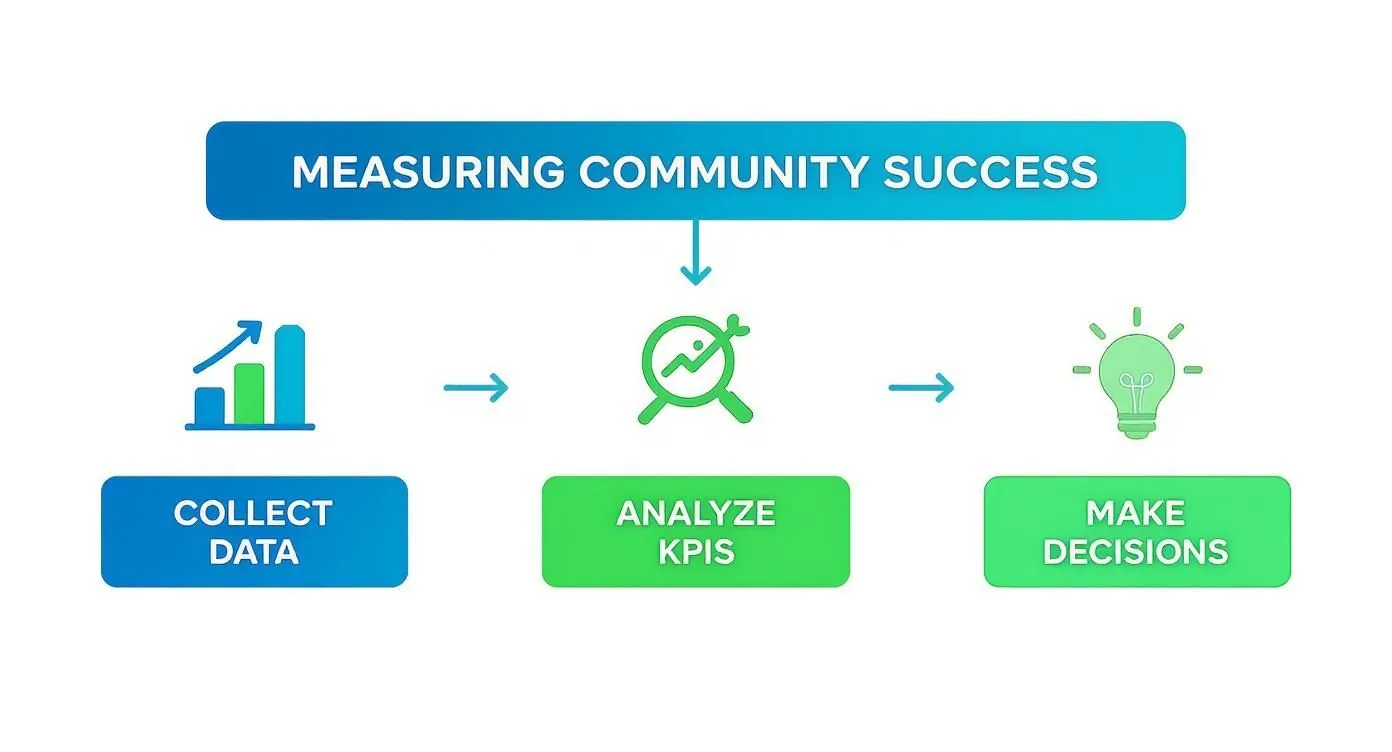
This isn’t about creating reports that gather dust. This data is the fuel for making your community better every single week.
Technology: The Foundation Holding It All Together
The final piece of the puzzle is the technology that makes it all run smoothly. Choosing an all-in-one platform isn't just a convenience—it's a strategic move that creates a much better experience for your members and saves you a ton of headaches.
Instead of wrestling with a dozen different tools, a unified system like Zanfia handles the tedious admin work for you. Powerful automations, such as instantly granting course access after payment or adding buyers to the right community channels, can save you 5-10+ hours every month that you can spend connecting with your members instead of fighting with software. The same interface lets you dictate actions to an AI assistant or, on higher plans, plug your own agents into the workspace through an MCP endpoint (see the current Zanfia pricing).
For anyone feeling stuck on the sidelines, this is your sign. With a clear strategy and a powerful platform built to support you, building a profitable and impactful community is completely within your reach.
By bringing everything under one roof, you gain the clarity, control, and confidence you need to truly grow your digital business.
Your Top Community Management Questions, Answered
Starting a community can feel like a big leap, and it's natural to have questions. Let's tackle some of the most common ones that creators and entrepreneurs ask so you can move forward with confidence.
How Much Time Will This Actually Take?
This is the big question, isn't it? The honest answer is: it depends on the size and energy of your community. When you're just starting out, plan on dedicating around 5-10 hours a week to get the conversation going and create a welcoming vibe.
As your community grows, so does the time commitment. This is where having the right tools makes all the difference. Using a platform like Zanfia with built-in automation and an AI assistant you can talk to can be a lifesaver. Routine work like new member welcomes and access management gets handled for you, saving 5-10+ hours a month so you can focus on what really matters—connecting with your people.
Can I Really Do This By Myself?
Yes, you absolutely can! In fact, most of the best communities start with one passionate person at the helm. You don't need a team to get started.
The trick is to work smart. Use tools that automate the administrative grunt work, establish clear community guidelines right from the start, and empower your earliest members to become leaders. Let them help you build the culture. You can always bring on moderators later, but flying solo is more than possible—it's how most great communities begin.
Isn't This Just Social Media Management?
Not at all, and this is a really important distinction. Think of social media management as broadcasting—it's a one-to-many relationship. You're standing on a stage, speaking to a crowd, hoping to attract as many people as possible.
Community management, on the other hand, is about connection. It's a many-to-many relationship that happens within a dedicated space. It’s less like a stage performance and more like hosting a great dinner party, where your job is to spark interesting conversations and help people connect with each other.
One is about building an audience; the other is about building a tribe. Social media casts a wide net, while community management cultivates deep roots.
Ready to build a thriving community without the technical headaches? Zanfia gives you courses, communities, paid newsletters and a checkout with order bumps and installments under one brand, with 0% platform commission, an AI team you can dictate to by chat or voice, and a 14-day free trial with no credit card required. Start building your community on Zanfia today.