

How to create online course platform and monetize your expertise

Before you ever think about filming a lesson or designing a logo, you need a rock-solid blueprint. This is the foundational work that separates the online course platforms that print money from the ones that collect digital dust. It’s about building something people actually need and are genuinely excited to pay for.
Your Blueprint for a Profitable Online Course Platform
Forget about the tech for a minute. The real magic happens long before you write a single line of code or choose a platform. It's in the strategic planning, the deep work of understanding your audience, proving your idea has legs, and carving out your unique corner of the market.
And what a market it is. The demand for online learning is absolutely exploding. The massive open online courses (MOOC) market hit USD 26 billion in 2024 and is on track for a mind-boggling 39.3% CAGR through 2034. This isn't just a trend; it's a fundamental shift in how people learn, driven by a global hunger for accessible skills. For creators who get the foundation right, the opportunity is immense.
Pinpoint Your Ideal Student
First things first: who are you actually helping? Vague answers like "entrepreneurs" or "aspiring artists" won't cut it. You need to get painfully specific and build a crystal-clear profile of your ideal student. Dig beyond simple demographics and get into their heads.
- What's the real problem they're stuck on? Are they trying to land a promotion, learn a new software to save time at work, or finally master a hobby they've been dreaming about?
- What's stopping them from solving it now? Is it the overwhelming amount of free (and often conflicting) information online? A fear of failure? Or maybe they just don't have hours to waste on theory.
- What does their "promised land" look like? Get specific about the tangible result. This is the transformation you’re selling, the "after" state they'll achieve because of your course.
Think of it this way: instead of a generic "photography course for beginners," you could target "busy parents who want to take professional-quality photos of their kids with just their smartphone." See the difference? That level of focus makes every other decision, from your curriculum to your marketing, ten times easier.
A clean, unified dashboard like this is crucial. It lets you manage every piece of your business, courses, members, community, without getting lost in a dozen different tabs. This is what makes delivering a seamless student experience possible as you grow.
Prove People Will Actually Pay for Your Idea
This is the step most creators skip, and it's a fatal mistake. Never, ever assume your brilliant idea is something people will open their wallets for. You have to validate it first.
"The biggest mistake creators make is building a product in isolation. You must validate demand early and often to avoid creating something nobody wants. Your audience will tell you exactly what to build if you listen."
One of the best ways to do this is with a simple pre-launch. Create a quick landing page that spells out your course concept, what students will learn, and the transformation they can expect. Then, add a call-to-action to join a waitlist. Drive your target audience to that page. If you can't get a decent number of people to raise their hands and say "I'm interested," you've just saved yourself months of wasted effort.
For a great deep dive on this, check out this roadmap to making money with online courses.
Define What Makes You Different
Finally, you need to answer one question: Why should someone choose your course over the thousands of others out there? This is your Unique Selling Proposition (USP), and it's the core of your marketing.
Maybe it's your specific teaching style, unparalleled access to a community, or a hyper-focused curriculum that cuts out all the fluff. Your USP is your promise and your competitive edge. Not sure how to nail this down? Our guide on what is a value proposition is a great place to start. A strong USP is what turns a casual browser into a committed student.
Choosing Your Tech: The All-In-One vs. DIY Approach
When it’s time to build your online course platform, the technology you choose is one of the most critical decisions you'll make. It’s the very foundation of your entire business. You essentially have two main paths: the Do-It-Yourself (DIY) route, usually involving WordPress and a bunch of plugins, or an all-in-one platform that gives you a single, managed solution.
The Allure and Agony of a DIY WordPress Stack
On the surface, the DIY path seems attractive. You register a domain, install WordPress, and start piecing together different tools: an LMS plugin for courses, another for a community forum, a third for e-commerce, and a fourth for your email marketing. This approach gives you absolute control, but it also casts you in the role of system integrator, IT support, and head of security.
This is where the hidden costs of DIY start creeping in. It’s not just the price tags on the plugins; it’s the countless hours you'll spend fixing conflicts, running security updates, and wrestling with integrations that just won't play nice. Every new feature you add introduces another layer of complexity. Before you know it, you're spending more time managing technology than actually creating content for your students.
This flowchart really breaks down the core decision between building it yourself and opting for a ready-made solution.
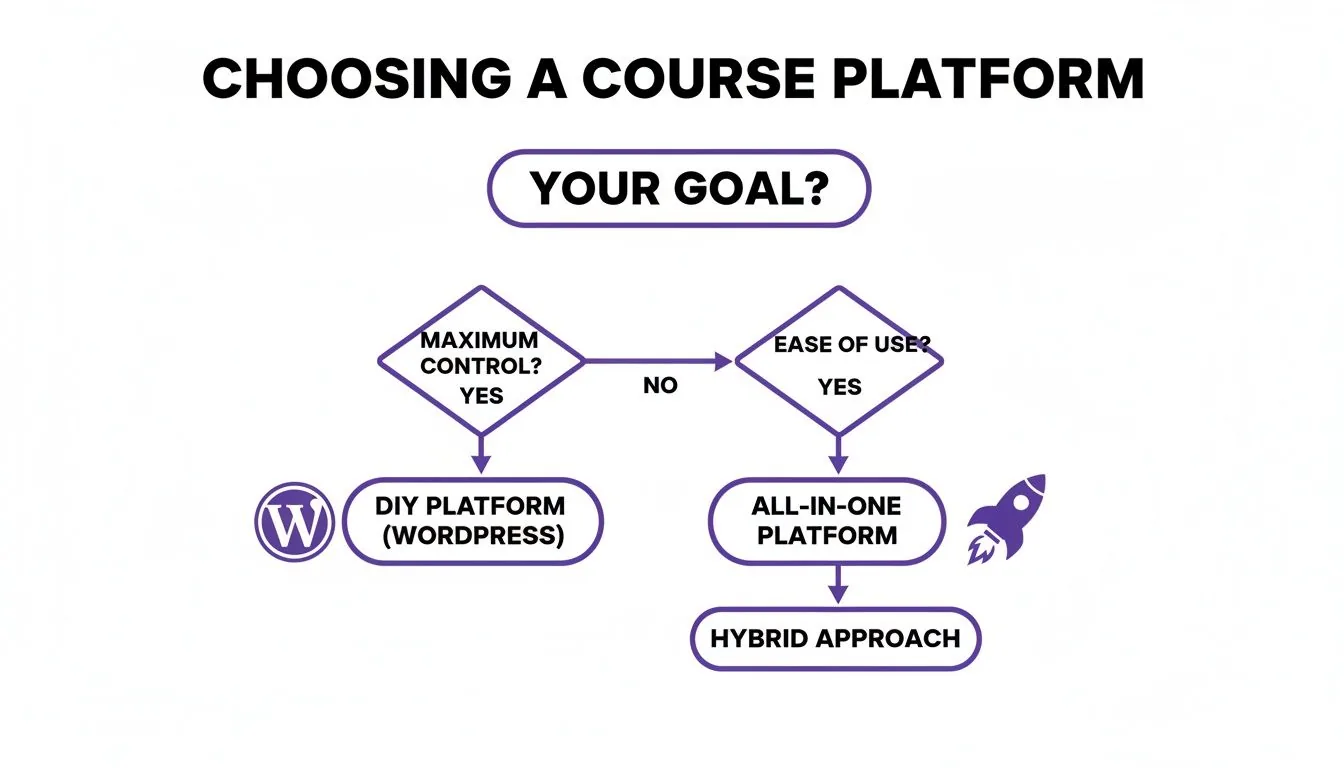
As you can see, there’s a clear trade-off. The DIY path offers maximum control but demands a huge technical lift, while the all-in-one approach is all about speed and simplicity, freeing you up to focus on growing your business.
Why an All-In-One Platform Wins for Most Creators
An all-in-one platform like Zanfia, on the other hand, integrates all these essential functions into one cohesive system. The entire model is designed to eliminate tech headaches so you can get back to what you do best: teaching. Zanfia sells itself as an AI team that runs a creator business, not just software you configure. An AI Assistant, voice dictation and a Magic Box that turns one sentence into a course, page and checkout are baked into the product on every plan, and higher plans open up the full AI team plus an MCP endpoint so your own AI assistants can act on your workspace (plan-dependent, see the current Zanfia pricing).
With a unified platform, your courses, community, payments, and marketing tools are all built to work together from day one. When a student buys a course, powerful automations instantly grant them access, add them to the right community channels, and trigger welcome emails, no clunky Zaps or manual work needed. You can also dictate the setup out loud instead of clicking through menus, because the assistant can perform anything available in the interface, by chat or by voice. This alone can save creators 5–10+ hours a month on tedious admin tasks.
Better yet, features like native video hosting are often baked right in, so you can ditch expensive third-party services like Vimeo or Wistia. Everything lives under your own custom domain, creating a professional, white-label experience that strengthens your brand, not the platform's. And the checkout is built to sell: order bumps, upsells at checkout, and installment plans that let you split a $600 course into four payments. Perhaps the biggest win is the current pricing model: as of August 2026, Zanfia charges a flat zero-percent (0%) platform commission on customer sales. While competitors take a cut, Zanfia's clean SaaS model means you keep your revenue and only pay the standard processor fee (roughly 2.9% + $0.30 on Stripe in the US).
All-In-One Platform vs. DIY WordPress Stack Comparison
| Feature | All-In-One Platform (e.g., Zanfia) | DIY WordPress Stack |
|---|---|---|
| Setup & Maintenance | Fast setup; updates and security are managed for you. | Requires technical skill; you manage all updates and security. |
| Integration | All tools are built-in and work together seamlessly. | Requires multiple plugins that can conflict with each other. |
| True Cost | Predictable monthly fee with 0% platform commission today. | Multiple plugin costs, hosting fees, and your own time. |
| Checkout mechanics | Order bumps, upsells, installments and a test-mode purchase built in. | Each of these is a separate plugin or SaaS add-on you stitch together. |
| Support | Centralized support team for the entire platform. | You rely on different developers for each separate plugin. |
| Focus | On creating content and growing your business. | On managing technology and troubleshooting issues. |
The choice really boils down to where you want to spend your time. If you'd rather be a business owner than a tech manager, the all-in-one path is almost always the smarter move.
For a deeper dive into how different solutions stack up, check out our detailed online course platform comparison.
Of course, for some, building a completely custom solution from scratch is the goal. This is a massive technical undertaking and usually means bringing in expert help. If you're set on this path, hiring dedicated offshore developers can be a strategic way to build out your infrastructure without breaking the bank.
Building Your Platform with the Features That Actually Matter
Let's be honest: a successful online course platform is way more than just a place to upload some videos. It's the entire engine of your digital business, the ecosystem where your students learn, you get paid, and your community comes to life. If you want to build something that lasts, you have to start with the right foundation of non-negotiable features.
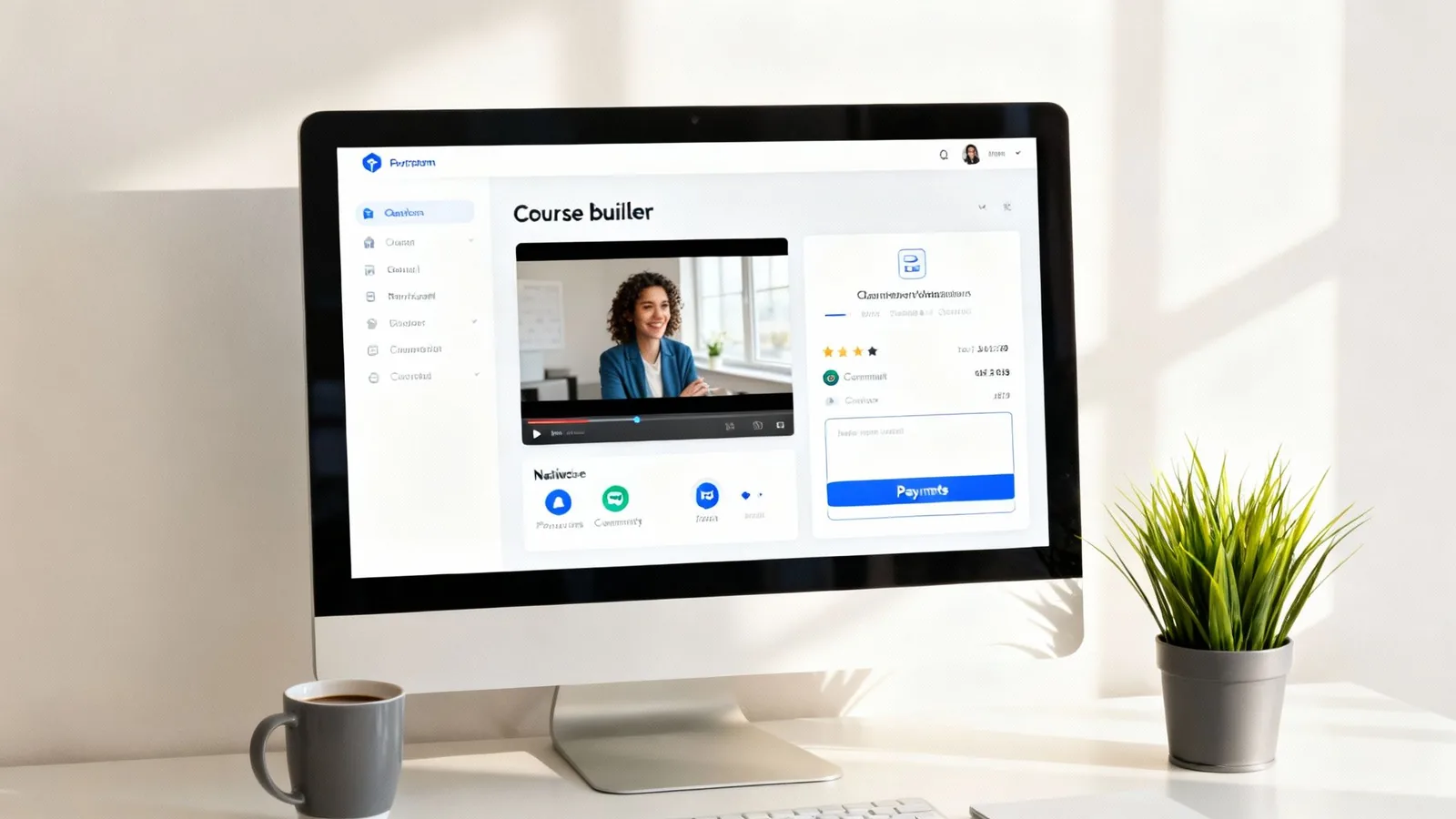
The opportunity here is massive. We're talking about a global online learning market projected to hit US$61.59 billion by 2026, with the wider online education space rocketing towards $184.29 billion by 2029. That growth tells you one thing: people are hungry for high-quality digital learning experiences that blend video, interaction, and community.
An Intuitive Course Builder with Native Video
The heart and soul of your operation is the course builder. It has to be dead simple. You should be able to upload content, structure lessons, and rearrange modules without ever needing to call a developer. On Zanfia you can also just dictate the change: the assistant can perform any action available in the interface, by chat or by voice, so restructuring a module doesn't mean click-hunting through menus.
One of the most critical pieces here is native video hosting. Bolting on external services like Vimeo or Wistia just adds another monthly bill and a layer of complexity you don't need. A platform like Zanfia that includes smart, built-in video hosting saves you cash and headaches, while still supporting integrations with YouTube, Vimeo, and others. The smart video player automatically saves student progress, a small touch that makes the learning journey feel incredibly seamless.
Flexible Ways to Get Paid
How you sell your courses is just as important as what you're selling. If your platform only offers a single, rigid payment option, you are absolutely leaving money on the table. You need the flexibility to meet your customers where they are.
Your platform must support these options:
- One-Time Purchases: The classic model. Perfect for standalone courses and digital downloads.
- Subscriptions & Memberships: The key to building predictable, recurring revenue and a sustainable business.
- Installment Plans: This is a conversion booster. It breaks down the price barrier for your premium programs, making them accessible to more people. On Zanfia you can split a $600 course into four auto-charged payments right at checkout.
- Product Bundles: A simple way to increase your average order value by packaging complementary courses and products.
And don't forget the checkout itself. Zanfia integrates with Stripe and PayPal for card, Apple Pay and Google Pay payments, so customers can pay their preferred way and conversion rates climb. Order bumps, upsells at checkout and a test-mode purchase (so you can buy your own product end to end before launch, without polluting your real order list) are built into the same checkout, on higher plans (plan-dependent, see the current Zanfia pricing).
A Community Hub That Lives with Your Courses
Sending your paying students to a chaotic Facebook group or a separate Discord server is a terrible idea. It fractures the student experience, weakens your brand, and forces them to juggle multiple logins. An integrated community isn't a "nice-to-have" anymore; it's essential for engagement and retention.
By keeping your community and courses under a single login on your own domain, you dramatically boost engagement and long-term customer value. This unified environment turns a simple course into a thriving ecosystem.
Platforms like Zanfia nail this by letting you create discussion channels right alongside your course content. You can automatically add new students to exclusive groups based on what they bought, making them feel like part of an inner circle from day one. This is also the perfect place to build a searchable knowledge library that members contribute to over time. Check out our guide on how to create a knowledge base to see how powerful this can be.
Automation and Branding That Put You in Control
The real difference between a stressed-out creator and a scalable business owner? Automation. If you're manually granting course access, sending welcome emails, or chasing failed payments, you're setting yourself up for burnout. Your platform should handle all of that for you, easily saving you 5-10+ hours of admin work every single month.
Here are the automations that should be non-negotiable:
- Instantly grant course and community access the second a payment goes through.
- Trigger a welcome email sequence to onboard new students.
- Handle subscription renewals and automatically revoke access if a payment fails or is canceled.
- Push tags, lists and fields into your email tool (ActiveCampaign, Kit, MailerLite and others) so the right sequence fires from your ESP.
Finally, your brand needs to be the star of the show. A platform that offers full white-label control lets you use your own custom domain, logo, and colors. This ensures your students have an experience with your business, not the software company's. It's the kind of professional polish that separates serious experts from hobbyists and is absolutely critical for building an independent brand that people trust.
Launching and Marketing Your Online Courses
You’ve poured your expertise into crafting an incredible online course. The lessons are polished, the community hub is ready to go, and your platform looks fantastic. But here’s the hard truth: a great course doesn’t sell itself.
Now for the fun part: getting that first wave of excited students through the door and building the kind of momentum that leads to long-term, sustainable sales.

A successful launch isn't about flipping a switch and hoping people show up. It’s a strategic game plan that kicks off weeks, sometimes even months, before you officially open for enrollment. The real goal is to build so much anticipation that you have a list of eager buyers ready the moment you go live.
The Pre-Launch Playbook: Building Buzz
For any course creator, your single most valuable asset is a dedicated email list. Forget chasing social media algorithms; your email list is a direct, unfiltered line to the people who've already raised their hands and said, "I'm interested."
The key to unlocking this is a killer lead magnet. This is a free, high-value piece of content you give away in exchange for an email address. Think PDF checklists, an exclusive video tutorial, or a short e-book. Whatever it is, it needs to solve a small but specific problem for your ideal student, giving them a quick win.
Once your lead magnet is ready, it's time to get it out there.
- Hit Social Media: Share teaser content from your course and point your followers directly to your lead magnet's landing page.
- Create Relevant Content: Write blog posts or record videos that explore your course topic, naturally leading into the value your free resource provides.
- Show Up in Communities: Find the online groups where your ideal students hang out. Offer genuine help and, when it feels right, mention your freebie.
Having an engaged audience before you even think about selling is non-negotiable. For a deep dive into practical strategies, check out our guide on how to build an email list that’s primed and ready to buy.
Crafting a High-Converting Sales Page
Think of your sales page as your 24/7 salesperson. Its only job is to convince a visitor that your course is the exact solution they’ve been searching for. A great sales page doesn't just list features, it sells the transformation.
So, shift your language to focus on benefits. Instead of saying, "The course includes 10 video modules," try this: "Master the core skills you need in just 10 focused lessons, so you can achieve [desired outcome] faster." See the difference?
Social proof is the other secret weapon here. Testimonials from early beta testers or respected figures in your industry can dramatically increase conversions. This is where Zanfia’s own social proof from industry leaders like Artur Kurasiński shows just how powerful expert endorsement can be.
"Zanfia [is] the most convenient and simplest solution for paid newsletters, courses and community on the Polish market." – Artur Kurasiński, serial entrepreneur and tech investor
A quote like that instantly builds credibility. Your job is to collect your own and display them proudly.
Sustainable Growth Beyond the Launch
A massive launch is thrilling, but the real win is a consistent, reliable stream of sales. This is where having an integrated platform becomes your biggest advantage. Use content marketing, blogging, podcasting, making videos, to continuously draw in new students long after the launch hype has faded.
And don't forget to tap into the power of your community. When you build a vibrant, valuable community space right inside your platform, you turn your students into your best advocates. Their success stories and positive interactions become powerful, organic marketing that works for you around the clock.
Finally, think about maximizing the lifetime value of each student. With a platform like Zanfia, it's incredibly simple to offer upsells, bundle products, or create tiered membership plans across 12 product types (courses, communities, newsletters, memberships, downloads, ebooks, consultations and more) that all live under one brand. This lets you serve your audience on a deeper level while growing your revenue, and today Zanfia takes 0% on customer sales.
Scaling Your Business Beyond a Single Course
Getting your first online course out the door is a massive win, but it’s really just the starting line. The real magic happens when you start thinking bigger, transforming that one product into a full-blown digital ecosystem. This is the moment you graduate from being a course instructor to a genuine business owner, building multiple, sustainable revenue streams on the foundation you’ve already laid.
Going from a single offer to a diverse suite of products isn't just a nice-to-have; it's critical for long-term survival. Relying on one course makes your business fragile, vulnerable to every little shift in the market. By expanding, you not only unlock more earning potential but also build a much deeper connection with your audience, giving them more ways to learn from you.
The e-learning market is on an explosive trajectory, projected to hit $325 billion by 2025. Even more telling, the number of users on these platforms is expected to blow past 1 billion by 2029. This isn't just a trend; it's a clear signal that people are hungry for digital products well beyond traditional courses. For a deeper dive, check out the latest e-learning market trends on amraandelma.com.
From One-Off Sales to Recurring Revenue
The single most powerful move you can make to scale is to introduce recurring revenue. Think memberships or subscriptions. Instead of constantly chasing the next sale, you build a predictable, monthly income stream. This shift completely transforms the financial health of your business, giving you the stability to actually plan ahead and invest in growth.
Using an integrated platform is the key to making this work seamlessly. You can easily set up tiered membership levels that bundle your products in a smart way.
- Tier 1 (Starter): Give them access to your core course and a private community channel.
- Tier 2 (Pro): Everything in Tier 1, plus a new monthly workshop and a library of downloadable resources.
- Tier 3 (VIP): All of the above, plus exclusive access to a paid newsletter and one-on-one coaching calls.
This kind of structure lets people self-select the level of engagement they want, creating natural upsell paths as they get more bought into your world. If you want to get a better handle on this strategy, we've broken it all down in our guide on building a membership and subscription model.
Expanding Your Digital Product Shelf
Your expertise can be packaged in so many ways beyond just courses and memberships. Each new product you create can serve a different slice of your audience. Some people might not be ready for your high-ticket course, but they’d happily pay for a smaller, more accessible item that solves an immediate problem.
Think about adding these to your platform:
- E-books and Guides: The perfect low-cost entry point for new customers.
- Digital Downloads: Checklists, templates, and spreadsheets that offer a quick win.
- Paid Newsletters: Deliver your best, curated insights directly to your most dedicated followers for a recurring fee.
With an all-in-one platform like Zanfia, you can sell all of these from a single, unified dashboard, across 12 product types that all live under one brand. A customer can buy your e-book, join your community, and enroll in your course, all with one login. It's a frictionless experience that keeps them coming back.
The goal here is simple: build a business where your revenue grows, but your admin work doesn't. That’s only possible with automation and an integrated system. By keeping all your products in one place, you stay in control and protect your profit margins.
This is especially critical for established creators already pulling in serious monthly revenue. Platforms that take a percentage of your sales are literally punishing you for your own success. A flat-fee model, like Zanfia’s current 0% platform commission on customer sales, ensures that as your revenue scales, your platform's cut doesn't. You keep your hard-earned revenue after standard processor fees, a massive advantage for building a truly sustainable business.
Still Have Questions About Building Your Online Course Platform?
Diving into the world of online courses can feel like navigating a maze. Questions pop up at every turn, about the right tools, the real costs, and whether you even have the skills to pull it off. Getting straight answers is the only way to move forward with confidence.
Let's tackle some of the most common questions we hear from creators who are ready to build their own platform.
What Is the Best Platform to Create and Sell Online Courses?
Honestly, the "best" platform is the one that aligns with your specific goals. There's no single right answer, but there are definitely clear choices depending on what you're trying to achieve.
If your main goal is building a powerful, independent brand and keeping most of what you earn, Zanfia is a strong fit for creators who want an AI team behind them, not just a course app. As of August 2026, its 0% platform commission on customer sales means your only cut is the standard payment processor fee (roughly 2.9% + $0.30 on Stripe in the US). It also offers true white-label control, deep integration between courses and community, an AI Assistant with voice dictation on every plan, and an MCP endpoint on higher plans so your own AI tools can act on your workspace, something international giants like Kajabi and community-only tools like Skool don't offer today.
The right platform should feel like a partner in your growth, not a tax on your success. Always lean towards solutions that give you complete ownership over your brand, your audience, and your money.
How Much Does It Cost to Build an Online Course Platform?
This is a classic "it depends" question, but we can break it down. The cost to create your own platform can swing wildly. A DIY setup using WordPress might look cheap upfront, but the hidden costs stack up fast.
Just think about the basic expenses for a DIY build:
- LMS Plugin: You're easily looking at $150+ per year .
- Community Tools: A separate forum plugin? That's another $200+ annually .
- Premium Video Hosting: Services like Vimeo or Wistia will run you $20+ per month .
Before you know it, you're shelling out over $1,000 a year just on software, and that doesn't even count the hours you'll lose to maintenance, updates, and troubleshooting when things inevitably break.
All-in-one platforms simplify this with a predictable subscription. As of August 2026, Zanfia starts at $39/month, or $31/month billed annually, on Starter, with a 14-day free trial and no credit card required. Higher plans (Growth, Pro, Scale) unlock things like the MCP endpoint, the full AI team and white-label AI, so check the current Zanfia pricing for what fits your stage. The real difference-maker is the fee structure: Zanfia takes 0% platform commission on customer sales today, so the only fees you see on each sale are the standard rates from Stripe or PayPal.
How Can I Integrate a Community with My Online Course?
So many creators immediately turn to Facebook Groups or Discord, but this splinters the student experience. It forces your customers to remember another login, pulls them away from your learning environment, and ultimately dilutes your brand. Engagement plummets.
A much smarter approach is to use a platform with a native, built-in community. This lets you build your entire community hub right inside your course platform, all under your own domain.
When everything is seamlessly integrated, you can:
- Automatically add new students to the right community channels when they enroll.
- Spark discussions in spaces right next to your course lessons.
- Keep every conversation, resource, and interaction in one branded home.
This unified setup is a game-changer for engagement, strengthens your brand, and dramatically improves student retention and success.
Do I Need Technical Skills to Create an Online Course Platform?
Not anymore. As long as you choose the right tool for the job, you need zero technical skills. Modern all-in-one platforms were built specifically for creators and experts, not developers. The entire point is to get the tech out of your way.
These platforms give you intuitive, no-code tools like drag-and-drop page builders. You can design everything from your sales page to your course curriculum without ever looking at a line of code. On Zanfia you can go one step further and just dictate what you want: the assistant can perform any action available in the interface, by chat or by voice, and Magic Box turns a one-sentence description into a course, page and checkout for you to refine.
Meanwhile, the platform is handling all the complex stuff behind the scenes:
- Secure hosting and server management.
- Constant software updates and security patches.
- Performance tuning to keep things running fast for your students.
This frees you up to pour all your energy into what you do best: creating amazing content and connecting with your audience.
Ready to build a thriving online business with full control and zero platform commission today? With Zanfia, an AI team runs the busywork while you launch professional courses, build an engaged community, and sell across 12 product types, from ebooks to consultations, all under one brand and one checkout built to sell. Start your 14-day free trial with Zanfia today.