From Free Discovery Calls to Paid Strategy Sessions: A Coach’s 2026 Pivot
You booked twelve free discovery calls last month. Three ghosted. Four wanted to “think about it.” Two haggled you down 40%. One signed. That’s a 8.3% close rate on your calendar—and it’s bleeding you dry. In 2026, the free discovery call model has quietly collapsed for most coaches, and the ones still winning have made a specific pivot: they charge for the intake conversation itself. Not $997. Not $47. Somewhere between $97 and $297—enough to filter out tire-kickers, cheap enough to feel like a no-brainer for serious buyers.
This isn’t a trick. It’s a business model shift that changes who shows up, what happens on the call, and how you convert them into your high-ticket program afterward. Here’s how to make the pivot without torching your pipeline.
Why free discovery calls underperform in 2026
The free discovery call was designed for a different internet. In 2015, when coaching was less crowded and buyers had fewer options, offering 30 minutes of your time in exchange for a chance to pitch made sense. The math worked because attention was cheaper, competition was thinner, and prospects treated a booked call as a real commitment.
That world is gone. Today’s coaching buyer has been on 14 sales calls this year. They know the script. They know the “3-part framework” close. They’ve been ghosted by coaches, and they’ve ghosted coaches. The free call has become a low-friction, low-commitment browsing behavior—closer to reading a landing page than making a purchase decision.
The math nobody wants to admit
Let’s run the numbers on a typical free-call funnel:
- You book 20 discovery calls per month
- 25% no-show rate (5 calls that vanish)
- Of the 15 who show, roughly 60% are “just exploring” (9 tire-kickers)
- 6 are actual buyers, and you close 33% of them (2 clients)
- Total time invested: 20 calls × 45 minutes = 15 hours per month, before prep and follow-up
Add prep, follow-up sequences, CRM entry, and calendar management, and you’re spending 25-30 hours a month for 2 clients. If your program is $3,000, that’s $6,000 in revenue for about 30 hours of intake work—roughly $200/hour, before the actual coaching delivery.
The real cost: your energy
Beyond the math, there’s a psychological tax nobody talks about. Free calls train you to perform. You have to bring high energy, make the case, handle objections, and manage rejection—all while pretending you’re just “having a conversation.” By call number four in a day, your voice is flat, your patience is thin, and the buyer feels it. You lose deals you should have closed because the model itself burns you out.
The $97 – $297 strategy session: how it filters and qualifies
The paid strategy session vs free discovery call debate isn’t really about the money. It’s about who chooses to be in the room. When someone spends $197 to sit down with you, three things happen automatically:
- Ghost rate collapses. No-shows drop from 25% to under 5%. People show up for what they paid for.
- Buyer intent is pre-qualified. A person willing to pay for your time has already decided you’re worth investment. The question shifts from “is this coach legit?” to “can this coach help me specifically?”
- The power dynamic inverts. You’re no longer auditioning. You’re delivering.
Where to price it
The $97-$297 range is where the pivot works. Here’s how to pick your number:
- $97: Entry-level coaches, newer market presence, or when you want maximum call volume with filtered intent
- $147-$197: Established coaches with clear positioning, mid-market clientele, sweet spot for most operators
- $247-$297: Premium positioning, experienced coach with waitlist dynamics, targeting executives or founders
Go under $97 and you’re not filtering—you’re just adding a small toll booth. Go over $297 without established authority and you’re pricing yourself out of the intake conversation entirely.
Who self-selects out (and why that’s the whole point)
The person who won’t pay $197 for your time is telling you something important: they aren’t buying your $5,000 program either. They’re browsing. They want validation, free advice, or a coach who’s willing to prove they’re “worth it” upfront. Every one of those calls you take is a lottery ticket with terrible odds and a real time cost.
According to the International Coaching Federation’s 2026 benchmark report on paid intake practices, coaches who moved to paid consultations reported a 62% reduction in unqualified pipeline volume and a 34% increase in average client contract value within six months.
Outcome promise on the paid session (no, it’s not a sales call)
This is where most coaches botch the pivot. They charge $197, then run the exact same discovery script they ran when it was free—”tell me about your business, what’s your biggest challenge, here’s how I can help.” Buyers feel bait-and-switched. They paid for value; you gave them a pitch.
The paid strategy session must deliver an actual outcome. Not “clarity” (too vague). Not “a plan” (too generic). Something the buyer can name in one sentence before they book.
Examples of outcome promises that convert
- Business coach: “In 60 minutes, we’ll audit your current offer suite and identify the one price change or productization move that will add $30K to next quarter’s revenue.”
- Life/mindset coach: “You’ll leave with a written 90-day priority framework and the two limiting patterns most sabotaging your progress right now.”
- Fitness coach: “We’ll analyze your current training and nutrition, and you’ll walk out with a personalized 6-week protocol tailored to your goals and constraints.”
- Career coach: “You’ll get a full positioning audit of your LinkedIn, resume, and pitch—plus the specific narrative angle that will land the interview you actually want.”
Deliverables that make the session tangible
To reinforce that this is a session, not a sales call, always send a deliverable within 24 hours:
- Written summary of what you diagnosed
- Recording of the call (Loom or Zoom transcript)
- A 1-2 page action document specific to their situation
- Any templates, frameworks, or resources you referenced live
This deliverable is the receipt. It’s what makes the $197 feel earned, and it’s what makes them remember you three weeks later when they’re ready to enroll in the full program.
Pricing math: how a paid session can outperform a free one for revenue
Let’s rerun the numbers with a paid session model at $197.
The revenue comparison
| Metric | Free Discovery Calls | Paid Strategy Sessions ($197) |
|---|---|---|
| Monthly bookings | 20 | 10 |
| Show rate | 75% | 95% |
| Actual calls held | 15 | 9.5 |
| Qualified buyers | 6 | 8 |
| Close rate to program | 33% | 50% |
| Program clients closed | 2 | 4 |
| Session revenue | $0 | $1,870 |
| Program revenue ($3,000 avg) | $6,000 | $12,000 |
| Total monthly revenue | $6,000 | $13,870 |
| Time invested (hrs) | ~28 | ~16 |
| Effective hourly rate | $214 | $867 |
Why the close rate jumps
The close rate improvement isn’t magic. It’s structural. Paid session buyers are:
- Already comfortable transacting with you (they’ve done it once)
- Emotionally invested in continuity (they don’t want to “waste” the momentum)
- Working from a deliverable that shows what full engagement looks like
- Not comparison-shopping in the same way (they picked you already)
A Forbes Coaches Council analysis on coaching pricing trends found that coaches using paid intake models reported a median close rate of 48% into premium programs, compared to 22% for coaches offering free calls only.
Conversion path: from paid session to high-ticket program
The paid session is not the end—it’s the entry point into your program funnel. Design the conversion path deliberately.
The 3-touch conversion sequence
Touch 1: On the call (final 5 minutes)
After delivering the promised outcome, transition naturally: “Everything we covered today is what I help clients execute over the next 90 days in [Program Name]. I’m not going to pitch you here—I want you to sit with what we discussed. If you’d like to explore whether the program is a fit, here’s what happens next.”
Then hand them a specific next step: a program overview link, an enrollment application, or a scheduled follow-up call (this second call is free—they’ve already paid the toll).
Touch 2: The deliverable email (within 24 hours)
Send the recording, written summary, and action document. At the bottom, include one soft CTA: “If you’d like to work through this together over 90 days, here’s how [Program Name] works: [link].”
Touch 3: The follow-up (day 5-7)
A brief personal check-in: “How’s [specific thing we discussed] going? Any questions on the action items?” This is not a sales pitch. It’s a coaching moment that demonstrates you actually remember them and creates space for them to raise their hand.
Application-based enrollment (not another sales call)
For high-ticket programs ($3,000+), skip the “jump on another call to see if we’re a fit” sequence. It signals uncertainty and eats calendar. Instead, use a written application that surfaces the same qualification data:
- Where they are now (specific to their goal)
- Where they want to be in 90 days
- What they’ve tried that hasn’t worked
- Budget confirmation
- Timeline confirmation
Approve, decline, or schedule a brief 15-minute onboarding call. This positioning—that you review applications and pick clients—reinforces authority and further filters your pipeline.
Handling the “shouldn’t this be free” objection
You will get pushback. Usually from people who weren’t going to buy anyway, but sometimes from prospects worth converting. Have your language ready.
Common objections and responses
“Every other coach offers free discovery calls.”
“They do, and it’s part of why the coaching industry has a trust problem—buyers can’t tell who’s serious. My strategy session is a working session, not a sales pitch. You’ll walk away with [specific outcome] whether or not we work together long-term.”
“How do I know it’s worth $197?”
“You don’t yet, which is why I put the deliverable in writing. If you don’t walk away with a clear [outcome you promised], I refund it—no questions.” (This guarantee is optional but lowers resistance for on-the-fence buyers. Refund rates typically run under 3% for coaches who set clear outcome expectations upfront.)
“Can I just get on a free call first?”
“Not currently—my paid intake replaced free calls last quarter. If you want to see how I think before booking, [link to a public workshop, podcast episode, or case study] is the best free resource. If it resonates, the strategy session is the next step.”
“I’ll just book with someone who’s free.”
“Totally fair. If cost is the deciding factor at $197, we’re probably not the right fit for the full program either—my clients typically invest $3,000-$10,000. But if you want a self-directed starting point, [free lead magnet link] covers the core framework.”
The mindset shift you need
Every time someone declines the paid session, remind yourself: this is the system working. You didn’t lose a client—you saved 45 minutes of your life and avoided a low-probability close. The coaches who thrive with this model treat every “no” to the paid session as a signal that the filter is doing its job.
How Zanfia handles paid sessions + post-session upsell to programs
The mechanical execution of paid strategy sessions—taking the payment, scheduling the call, delivering the follow-up, and moving buyers into your high-ticket program—is where most coaches get stuck. Duct-taping a scheduler, a payment processor, a course platform, an email tool, and a community app together creates friction that costs conversions.
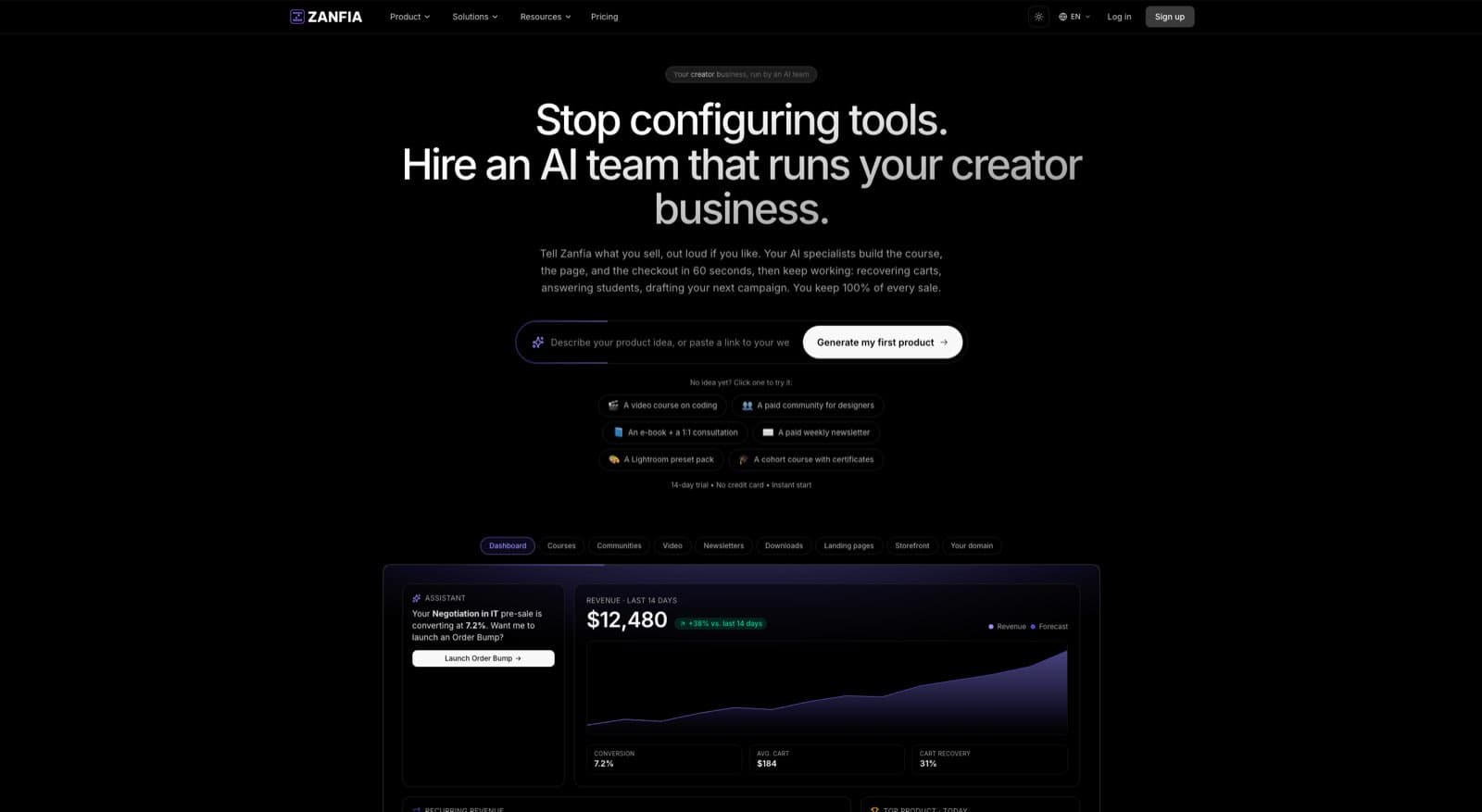
Zanfia is built as an AI team that runs the operational side of a coaching business, with courses, communities, paid newsletters, consultations, and digital products as the surfaces where that work lands. For a coach running the paid-session-to-program funnel, that means the assistant handles the setup work by chat or by voice, so you can dictate a session page or a follow-up email from your phone between calls rather than clicking through a settings tree.
A booking-and-checkout flow built to sell
Zanfia includes scheduling and payment collection for consulting sessions in one flow. You set your session price ($97, $197, $297—your call), define your availability, and buyers pay and book in a single step. Payment processing runs through Stripe or PayPal, with Apple Pay and Google Pay supported at checkout for frictionless mobile buying. Before you take the first real booking, test mode lets you run a full purchase against your own page—the checkout opens through a shareable link and orders are tagged TEST so nothing pollutes your real order list.
0% platform fees on your session revenue
As of 2026, Zanfia charges 0% platform transaction fees on customer sales—you keep everything after payment processor fees (Stripe or PayPal). On a $197 strategy session, that means you pocket the full price minus roughly 3% in Stripe fees. Compare that to platforms that skim 5-10% off consulting bookings and it adds up fast.
Post-session upsell to your high-ticket program
Here’s the piece most tools miss: after the paid session, you need a smooth path into your paid program. Zanfia’s checkout supports order bumps with separate invoicing per add-on, subscription upsells at checkout, and full pricing model flexibility (one-time, subscription, installments, free trial). You can split a $3,000 program into four monthly installments, add an order bump for a workbook, and offer a subscription upsell for ongoing group coaching—all inside one checkout page. Discount codes and multi-quantity offers are built in for cohort-based enrollment.
Everything else the program needs, under one brand
Once someone enrolls, your full program lives inside Zanfia too—online courses with native video hosting and smart progress-memory player, communities with topic channels and announcement channels, paid newsletters for ongoing nurture, knowledge bases for resource libraries, and ebooks or downloadable files for supplementary content. Twelve product types sit under one brand, so a coach can sell a session, a cohort program, a self-paced course, and a members-only community from the same white-label domain. Higher plans also open up an MCP endpoint that lets your own AI assistants act on your workspace directly—availability depends on the plan, so see the current Zanfia pricing for what unlocks where.
Mobile-friendly delivery
Zanfia has a native iOS and Android app that supports courses, paid newsletters, and knowledge bases, so your program content is accessible wherever your clients are. (Community access via mobile app is rolling out.)
The point isn’t that Zanfia is the only way to run paid sessions—it’s that when the AI team, session tool, checkout, program delivery, and community all live in one place, the friction from paid-session-buyer to program-client drops significantly. See how it works at zanfia.com/pricing. Plans start at $39/month, or $31/month billed annually, with a 14-day free trial and no credit card required.
FAQ
Should I charge for discovery calls if I’m a new coach with no testimonials?
Yes, but price lower—$47 to $97 while you’re building case studies. The filter still works: buyers who pay $47 are meaningfully more serious than those who don’t. Just be sure your outcome promise is concrete and you deliver a written follow-up. The paid intake also accelerates your ability to raise your program price, because you’re spending less time on unqualified pipeline and more time delivering to real clients.
What if my free discovery calls are already converting well?
If you’re closing 40%+ on free calls and your calendar isn’t your bottleneck, don’t fix what isn’t broken. The paid session model is for coaches whose calendar is full but revenue isn’t scaling—which is the most common trap. If your issue is volume (not enough calls at all), fix your lead generation before pivoting to paid intake.
Do I need to refund the session fee if they enroll in the program?
You have options. Some coaches credit the $197 toward the program enrollment as a soft close incentive. Others keep it separate to reinforce that the session had standalone value. Both work. Crediting it has a slightly higher enrollment rate but a lower average client value; keeping it separate signals higher confidence in your pricing. Test what works for your buyers.
How long should the paid strategy session be?
60 to 90 minutes for most coaching contexts. Shorter than 45 minutes and you can’t deliver a real outcome. Longer than 90 minutes and buyers get fatigued and the deliverable becomes harder to package. Block a full 2 hours on your calendar so you have prep time and buffer for the follow-up write-up.
What’s the biggest mistake coaches make when pivoting to paid sessions?
Charging money but running the exact same pitch-heavy script from their free calls. The session must deliver an actual outcome that stands on its own, with a written deliverable. If buyers feel you took their money for a sales conversation, they’ll leave 1-star reviews and never enroll. Design the session as coaching first, conversion second—the conversions follow naturally when the session lands.
Can I run paid strategy sessions and free consultations at the same time?
Only if the free option has meaningful friction attached—like a detailed application requirement, a 3-4 week wait for scheduling, or being reserved for referrals only. If both options are equally accessible, prospects will always pick free. Most coaches who try dual-track for more than 60 days end up quietly killing the free option because the paid track outperforms it on every metric that matters.