

How to Price an Online Course in 2026 (Without Guessing)
Pricing is the single highest-leverage decision you’ll make as a course creator. Get it right and you fund your business while serving fewer, better-fit students. Get it wrong and you’ll work twice as hard for half the revenue, attract students who never finish, and watch competitors with worse content outsell you because their price signals confidence.
Most creators underprice. Not by 10 or 20 percent, but by 3x to 10x. They benchmark against the cheapest course in their niche, slap a $97 sticker on six months of work, and wonder why they can’t quit their day job. The good news: pricing is fixable. The better news: a smarter price-ladder, sharper psychology, and the right checkout stack can rebuild your revenue without forcing you to create more content.
This guide walks through how to price an online course in 2026 without guessing. You’ll see why most creators leave money on the table, the three main pricing frameworks, how to build a tripwire-to-premium ladder, the psychology that quietly moves buyers toward your best offer, and how to test prices without burning early supporters.
Why creators underprice (and what it costs them)
Underpricing isn’t humility. It’s a tax on your time, your students’ outcomes, and your business’s runway. Here’s what’s actually happening when you charge $49 for a course that should be $499.
You’re competing on price in a value market
Education is not a commodity. A buyer choosing between two courses on the same topic is not picking the cheaper one — they’re picking the one they trust to deliver the transformation. When you price low, you tell the market: “I don’t believe this works, and neither should you.” Buyers who optimize for cheapest rarely complete the course, rarely refer friends, and demand the most support.
You’re punishing your best customers
Premium pricing self-selects committed students. A buyer who pays $1,500 for a cohort program shows up to every call, does the homework, and posts wins in your community. A buyer who paid $39 ghosts after week one. Underpricing fills your platform with low-effort users who drag down your testimonials, your completion rates, and your energy.
You’re starving the business
Run the math. If your goal is $10,000 in monthly recurring revenue and you charge $50 per course with a 2% conversion rate, you need 10,000 monthly visitors. At $500 per course, you need 1,000 visitors. At $2,500 for a premium cohort, you need 200. Underpricing forces you into a volume game that solo creators almost never win — Harvard Business Review has documented for years that tiered, value-aligned pricing outperforms low-cost positioning in markets where customers can evaluate quality.
You can’t afford to invest in the product
Premium prices fund premium experiences: better video, live Q&A, accountability calls, custom feedback, software, designers, editors. Low prices trap you in a one-person shop where every dollar of revenue goes to survival, not improvement. The cheap creators stay cheap because they can’t afford to get better.
Value-based vs cost-based vs competitor pricing
There are three main ways creators set prices. Two of them are wrong for most online courses. The third is the only one that scales.
Cost-based pricing (don’t do this)
Cost-based pricing adds up what it cost you to make the course — your time, software, contractors — and slaps a markup on top. It’s how factories price widgets. It is a terrible way to price digital education.
The cost of making a course has nothing to do with its value to the buyer. A 90-minute course built in a weekend can be worth $2,000 if it saves a business owner six months of trial and error. A 40-hour mega-course on a topic nobody wants is worth zero. Cost-based pricing also caps your upside: once you’ve recouped costs, you have no internal logic for charging more, even as the course delivers compounding value to thousands of students.
Competitor pricing (do this only as a sanity check)
Competitor pricing benchmarks against what other creators in your niche charge. Useful for context. Dangerous as a strategy. If your niche is full of $97 courses, copying that price tells the market you’re indistinguishable from everyone else. The whole point of building a creator brand is to escape commodity pricing.
Use competitor pricing as a floor check (“am I wildly out of range?”) and as a positioning input (“who’s at the top of the market, and what do they offer that I don’t?”), not as your anchor.
Value-based pricing (this is the answer)
Value-based pricing starts with one question: what is the transformation worth to the buyer? If your course helps a freelancer land $5,000-per-month clients, that’s $60,000 in year-one income. A $1,500 price tag captures 2.5% of year-one value — a no-brainer for the buyer and serious revenue for you.
To price by value, answer these:
- What specific outcome does the buyer get? Be concrete: “land your first three coaching clients,” “build a 1,000-subscriber newsletter,” “pass the PMP exam on the first try.”
- What’s that outcome worth to them in dollars, hours saved, or pain avoided?
- What would they pay for the next-best alternative (a coach, a degree, an agency)?
- What’s the price that signals quality without locking out your core audience?
Your price should be a small fraction of the value delivered — usually 1% to 10%. If your course unlocks $100,000 in lifetime income, $1,000 to $10,000 is defensible. The Forbes Coaches Council has argued repeatedly that value-based pricing is the only sustainable model for creators selling expertise.
The price-ladder: tripwire, core course, premium cohort
A single price point limits your business. A price-ladder — multiple offers at different commitment levels — captures buyers at every stage of trust and willingness to spend. The classic creator ladder has three rungs.
Rung 1: The tripwire ($7 to $47)
The tripwire is a small, irresistible offer designed to turn cold visitors into paying customers. It’s not where you make money — it’s where you build the buyer relationship. Once someone pays you anything, they’re 10x more likely to buy again.
Good tripwires:
- A focused mini-course ($27 for a 90-minute training on one specific skill)
- A premium template or swipe file ($17 for a launch email sequence)
- A short ebook or playbook ($9 for a 30-page tactical guide)
The job of the tripwire is to overdeliver and get the buyer ready to consider your core offer.
Rung 2: The core course ($297 to $997)
The core course is where most creators should focus 80% of their energy. This is your flagship offer: a comprehensive, self-paced course that delivers a clear transformation. It should feel like a serious investment without being out of reach for your core audience.
At $497, a 1% conversion on 5,000 monthly visitors generates $24,850 — real revenue from modest traffic. Teachable’s creator pricing benchmarks consistently show the $300 to $1,000 band as the sweet spot for courses that combine self-paced video, workbooks, and lightweight community access — high enough to fund the business, low enough to convert.
Rung 3: The premium cohort ($1,500 to $5,000+)
The premium cohort is the same transformation as your core course, but delivered with live access, accountability, small-group coaching, and a clear start and end date. Cohorts justify premium prices because you’re not selling content — you’re selling an outcome with hand-holding.
Premium offers can include:
- Weekly live calls with you
- Small-group breakouts and peer accountability
- Custom feedback on student work
- Bonus 1-on-1 sessions
- Lifetime access to future cohorts
Even if only 5% of your audience buys the premium tier, those buyers can account for 40% to 60% of revenue. That’s the math of the ladder.
Payment plans and installments: more sales, same price
Price is psychological. A $1,200 sticker scares off buyers who would happily pay $300 today and $300 a month for three more months. Installments are not a discount — they’re a friction-removal tool. Smart creators use them to expand the buyer pool without lowering the headline price.
When installments work
Installments shine for offers above $500. At $97, the friction of monthly billing isn’t worth it. At $1,500, splitting into three payments of $550 (yes, a small premium for paying over time) often doubles conversion without changing your headline price.
Use this pattern:
- $497 core course: single payment, or $187 x 3 ($561 total)
- $1,500 cohort: single payment, or $550 x 3 ($1,650 total)
- $3,000 mastermind: single payment, or $625 x 6 ($3,750 total)
The installment premium covers payment processor fees, the risk of failed cards, and the value of cash flow today. Most buyers don’t blink — they’re choosing between “I can’t afford this” and “I can afford this monthly.”
Watch the chargeback risk
Installments increase failed payments and chargebacks. Build a recovery workflow: automated card-update emails, friendly retries over 14 days, and clear terms that pause access if payments lapse. Your checkout platform should handle this without you babysitting every failed charge.
Pricing psychology: anchors, tiers, and the decoy
Price is never read in isolation. Buyers compare. The way you present your options can shift conversions by 20% to 40% without changing a single price.
The anchor
The first price a buyer sees sets the reference point. If your highest tier is $4,997, the $997 core course suddenly looks reasonable. If you lead with $97, anything above looks expensive. List your highest-value offer first or most prominently on your pricing page — even if you expect most buyers to choose the middle tier.
The good-better-best tier
Three tiers consistently outperform one. The middle tier is where you funnel most buyers, but the existence of a premium tier makes the middle look like a smart compromise rather than a top-end splurge. This is the same logic behind every SaaS pricing page on the internet.
A simple structure:
- Self-paced ($497): course access, community, lifetime updates
- Cohort ($1,500): everything above plus 8 weeks of live calls, peer pods, and direct feedback
- VIP ($4,997): everything above plus 1-on-1 sessions and Voxer access for 90 days
Most buyers pick the cohort. The VIP exists to make the cohort feel like the obvious choice.
The decoy
A decoy is a deliberately worse-value option that pushes buyers toward the offer you want them to choose. If you sell a $497 self-paced course and a $497 self-paced course + 4 group calls bundle for $597, the bundle is the obvious winner. The standalone $497 is the decoy. Decoys work because buyers crave easy comparisons, and you’re giving them one with a clear answer.
Charm pricing still works (mostly)
$497 outperforms $500 in most direct-to-consumer tests. $1,497 outperforms $1,500. The exception: premium positioning. A $5,000 cohort signals more confidence than $4,997. Above $2,000, round numbers often convert better because they signal quality, not bargain.
How to test pricing without alienating early buyers
You don’t need to guess. You need to test, learn, and adjust. The trick is testing in ways that don’t burn the trust of people who bought yesterday.
Test on the entry, not the exit
Raising prices punishes nobody. Lowering prices punishes everyone who paid more last week. Always test by going up: launch at $497, sell to 50 buyers, raise to $597, sell to 50 more, raise to $697. If conversion holds, keep going. If it drops sharply, you’ve found the ceiling for now.
Use launch windows to test
Cohort launches are natural testing grounds. Each new cohort is a clean slate — different price, different bonuses, different positioning. Compare conversion, refund rate, and student outcomes across cohorts to find your real ceiling.
Grandfather your early buyers
When you raise prices, honor the price your existing students paid. Don’t retroactively charge them more, and explicitly tell them they got the deal. This builds trust and turns price increases into a marketing event: “We’re raising the price next week — last chance at the founding rate.”
Watch the right metrics
Conversion rate alone is misleading. A 5% conversion at $97 generates less revenue than a 1.5% conversion at $497. Track:
- Revenue per visitor (RPV) — the only number that matters at the top of the funnel
- Refund rate — if it spikes after a price increase, your positioning isn’t matching the price
- Completion rate — higher-priced buyers complete more, which boosts testimonials and word-of-mouth
- Lifetime value — premium buyers often buy your next product
The Pew Research Center has documented how online buyers increasingly equate higher prices with quality and safety — particularly for digital education, where the buyer can’t physically inspect what they’re getting before paying.
How Zanfia Cart 2.0 supports one-time, subscription, and installment pricing
A pricing strategy is only as good as the checkout that delivers it. If your platform can only run one-time payments, you can’t build a real price-ladder. You’re stuck selling one course at one price to one type of buyer — and leaving the rest of your revenue on the table.
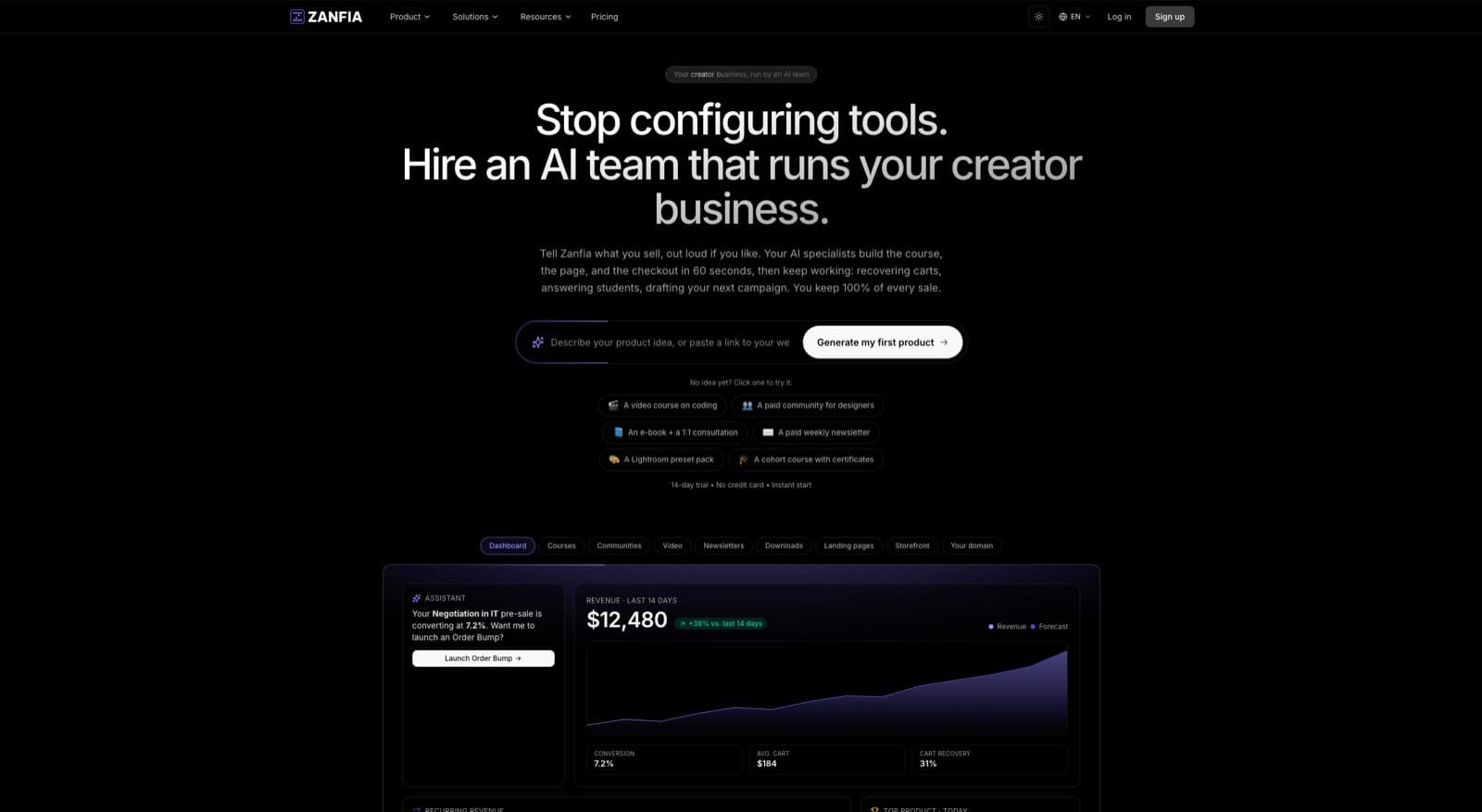
Zanfia is built around an AI team that runs the creator business, not just a checkout that processes payments. The assistant knows the whole application and can perform anything available in the interface, by chat or by voice, so a creator can dictate a new offer, a new price, or a launch sequence instead of clicking through settings. The platform also exposes an MCP endpoint so your own AI agents can act on the workspace directly, and every plan is metered by AI credits per month rather than by seats or feature toggles. Availability of the full assistant, MCP and white-label AI depends on the plan, so check the current Zanfia pricing before you commit to a specific setup.
Cart 2.0 is where that work lands. From a single checkout, you can run one-time payments, recurring subscriptions, multi-payment installments, and free trials — without bolting on third-party tools or stitching together Stripe scripts. That means a creator can sell a $27 tripwire, a $497 core course, a $1,500 cohort with three monthly payments, and a $97/month membership from the same dashboard, on the same domain, under the same brand.
A few specifics that matter when you’re actually running a price-ladder:
- Pricing models built in: one-time, subscription, installments, and free trials are native options at checkout. You configure them on the offer, not on the buyer.
- Stripe and PayPal: both processors are supported, which expands the buyer pool — a meaningful share of US buyers still prefer PayPal for course purchases.
- Apple Pay and Google Pay: wallet payments cut checkout friction sharply on mobile, where most creator traffic now lives.
- Order bumps: add an upsell at checkout (a templates pack, a bonus session) with separate invoicing per add-on. Order bumps regularly lift average order value by 15% to 30% (plan-dependent, see the current Zanfia pricing ).
- Subscription upsells at checkout: offer a recurring membership to buyers of your core course at the moment of purchase, when intent is highest.
- Test mode: open any published checkout in test mode through a shareable link, run a full test purchase, and keep those orders out of your real order list before you send a single ad dollar.
- Discount codes and multi-quantity: run launch promos, team licensing, and grandfathered pricing without rebuilding your offer.
- 0% platform fees: the only deduction from your revenue is what Stripe or PayPal charges. Your $497 course generates $497 minus processor fees — not minus a platform tax on top.
The bigger point: Zanfia carries 12 product types under one brand — courses, communities, paid newsletters, digital products, ebooks, consultations, memberships and more — with white-label custom domains, native video hosting and iOS and Android apps, so your ladder lives in one place rather than scattered across Teachable, Circle, ConvertKit and a checkout plugin. When pricing changes, you change it once, or you dictate the change to the assistant. When a buyer moves up the ladder, they stay inside your brand. Every plan starts with a 14-day free trial, no credit card required. See Zanfia’s current plans to see how it fits your stage.
FAQ
How much should I charge for my first online course?
Most first-time creators should price their core course between $297 and $497. That’s high enough to signal quality, fund the business, and attract committed students, but low enough that you can build social proof and case studies before pushing toward premium tiers. Avoid the $49 to $97 range — it attracts low-effort buyers and starves your business of the revenue you need to improve the product.
Should I offer a payment plan?
Offer installments on anything above $500. Three- or six-month plans typically increase conversion 30% to 60% without changing your headline price. Add a small premium (10% to 15%) to the installment total to cover processor fees, failed payments, and the value of cash flow today. Below $500, installments add friction without unlocking many new buyers.
Is value-based pricing realistic for new creators?
Yes, but with one caveat: you need to be specific about the value. “Learn copywriting” is vague. “Land your first three freelance copywriting clients in 90 days” is concrete and translates into dollar terms a buyer can evaluate. New creators sometimes hide behind cost-based pricing because they’re uncomfortable claiming value. The fix isn’t to price lower — it’s to define the transformation more sharply.
How do I know if my price is too high?
Watch the buying objections. If buyers tell you the price is too high but cite no specific reason, it’s usually positioning, not price. If buyers say “I want this but can’t afford a one-time payment,” add installments. If buyers say “I’ll take the cheaper version instead” and a real alternative exists at half the price, sharpen what’s unique about your offer. A genuinely too-high price produces silence — no objections, no sales, no engagement. That’s your signal to reposition or drop one tier.
Can I raise prices without losing my audience?
Almost always, yes — if you do it right. Announce the increase in advance, grandfather existing customers, and frame the change around added value (“We’re adding live coaching calls, so the cohort price goes from $997 to $1,497 next month”). Buyers respect price increases that come with a clear reason. They resent surprise increases that feel like opportunism.
What pricing model works best for a community-driven course?
Recurring membership pricing tends to outperform one-time pricing for community-heavy offers. A $47 to $97 monthly community plus course access generates stable revenue, justifies ongoing investment in the community, and aligns your incentives with the student’s experience (you have to keep showing up to keep the subscription). Pair this with an annual plan at a 15% to 20% discount to reduce churn.
One final note. The biggest pricing mistake isn’t being too high or too low — it’s being unwilling to revisit the question. Markets shift. Your offer improves. Your authority grows. Plan to review your prices every quarter, raise them whenever your results, social proof, and demand support it, and use a checkout that lets you run the full ladder without rebuilding your stack. That’s how creators in 2026 build durable, premium businesses without grinding through volume.