

Ebook Distribution Strategy: 9 Channels Beyond Amazon KDP
Amazon KDP is the default answer when someone asks where to sell an ebook. It shouldn’t be. Amazon takes 30-65% royalty cuts depending on price tier, owns your reader relationship, can pull your book overnight, and forces exclusivity through KDP Select if you want Kindle Unlimited reach. For US creators building a real digital business in 2026, that’s a single point of failure dressed up as a distribution strategy.
The good news: nine other ebook distribution channels have matured to the point where you can build a healthier, more profitable book business without ever uploading to Amazon. Some replace KDP outright. Most work better stacked alongside it. This guide walks through each channel, the sequencing that actually moves units, the royalty math that determines what you keep, and how to give your ebook a permanent home you control.
Why Amazon KDP isn’t the only path in 2026
Amazon KDP looks attractive on the surface. You upload a file, set a price between $2.99 and $9.99 to qualify for the 70% royalty tier, and suddenly your book is in front of the largest ebook-buying audience on the planet. For fiction authors hunting for discovery, that math still has merit.
For non-fiction creators, course teachers, consultants, coaches, and anyone using an ebook as a business asset rather than a standalone product, the calculus has shifted hard. Here’s what KDP actually costs you beyond the percentage cut.
You don’t own the customer
Amazon keeps the email address, the credit card, and the purchase history. You can’t email your readers about your next book, your course, your newsletter, or your consulting offer. You sold a book and got a deposit. Amazon got a customer.
The 70% royalty is conditional
That headline 70% only applies if you price between $2.99 and $9.99, hit the delivery fee threshold (Amazon charges $0.15 per MB delivered), and meet territory rules. Price below or above and you drop to 35%. A 50MB illustrated ebook at $9.99 loses roughly $7.50 in delivery fees per sale before royalty calculations even start.
KDP Select forces exclusivity
Want your book in Kindle Unlimited? You agree not to sell the ebook anywhere else for 90 days at a time. That kills every other channel in this guide. Some authors accept the trade. Most non-fiction creators shouldn’t.
Discovery is pay-to-play now
Amazon Ads inside KDP have become essentially mandatory for visibility. According to WordsRated’s 2024 Kindle market analysis, the top 1% of authors capture the overwhelming majority of organic discovery. For everyone else, you’re running ads to subsidize Amazon’s marketplace.
None of this means you should never use KDP. It means treating it as one channel among nine, not the entire strategy.
Channel 1-3: Your own platform, email list, and Pinterest
The first three channels share a theme. You own the audience, you own the storefront, and you keep the relationship after the sale. These should be the foundation of your distribution strategy regardless of where else you sell.
Channel 1: Your own direct-sales platform
This is the most important channel and the one most creators skip. When you sell an ebook from your own domain, you keep 95-100% of the revenue (only payment processor fees apply), you capture the customer email automatically, and you control the buying experience from headline to thank-you page.
Selling direct also unlocks pricing flexibility Amazon doesn’t allow. You can sell the ebook for $47 with a $97 video course upsell, bundle it with a community membership, offer payment plans (split a $600 program into four $150 installments), or run a $7 tripwire that feeds into a $497 consulting offer. None of that works on KDP.
The objection people raise: “Direct sales are hard, Amazon brings traffic.” That’s true for fiction. For non-fiction creators who already have a website, an email list, or any audience, your direct channel will outperform KDP within months if you treat it seriously.
Channel 2: Your email list
If you’re not already building an email list, start before you finish writing the ebook. The list is the asset. The book is the offer.
Email converts ebook sales at 3-8% on a good campaign, compared to 1-2% from social traffic and well below 1% from cold organic search. A list of 2,000 engaged subscribers will reliably outsell a year of KDP promotion for most non-fiction creators.
The launch playbook works the same way regardless of niche: announce two weeks out, share the cover and table of contents one week out, send three emails in launch week (introduction, social proof, last-chance close), then move into evergreen automated sequences that pitch the book to every new subscriber within their first 14 days.
Channel 3: Pinterest
Pinterest is wildly underrated for ebook distribution. It’s a visual search engine with a buying audience, the content has a six-month half-life compared to Instagram’s six hours, and the platform actively rewards links to external commerce sites.
For ebook creators, the play is simple. Build 5-10 pin designs per chapter or major idea in the book, link each pin to a landing page that sells the ebook, and post consistently for 90 days. According to Pinterest’s 2024 earnings reporting, the platform now reaches over 500 million monthly active users with the highest commercial intent of any major social platform.
Niches that crush on Pinterest: personal finance, productivity, parenting, wellness, food, home design, business systems, faith, mental health, and anything visually teachable. If your ebook fits, Pinterest will outwork every other social channel you try.
Channel 4-6: Substack, Medium, and content repurposing
The next three channels turn your existing writing into discovery engines for your ebook. They’re slower than paid ads but compound for years.
Channel 4: Substack
Substack is the cleanest way to build an audience around the ideas in your ebook before, during, and after launch. The strategy: publish 60-80% of the ebook’s ideas as free Substack posts over six months, then sell the ebook as the curated, expanded, illustrated version of what you’ve been giving away.
This sounds counterintuitive. Why pay for what you can read free? Because the ebook compresses time. Reading 30 disconnected newsletters takes months. Reading the ebook takes a weekend. People pay for organization, structure, and the promise of completion.
Substack also lets you launch a paid tier that includes the ebook as a bonus, which can sometimes outsell standalone ebook campaigns. A $10/month subscription that includes “the full ebook, plus monthly deep dives” often converts better than “buy the $29 ebook.”
Channel 5: Medium
Medium works differently. It’s a search and recommendation engine that will distribute your writing to readers who don’t yet know you exist. The play is to extract 5-15 chapters or major ideas from your ebook, publish each as a standalone Medium article (3-8 minute read), and include a soft CTA at the end pointing to the full ebook on your site.
Medium’s algorithm rewards articles that get reading time, claps, and shares. Niches that perform: business, technology, productivity, self-improvement, writing, money. If your ebook fits one of these, Medium can deliver thousands of qualified readers per article over years.
One tactical note: don’t publish the ebook itself on Medium’s paid program. Use it as a top-of-funnel discovery channel that drives traffic to your direct-sales home.
Channel 6: Content repurposing into long-form blog SEO
Your ebook is already a content goldmine. Every chapter is a potential 2,000-word blog post, every framework is a how-to article, every case study is a standalone piece. Repurposing the ebook into 15-25 SEO-optimized articles on your own site builds a discovery moat Amazon can’t touch.
The math works like this. A single article ranking for a moderate-volume keyword (500-2,000 searches/month) can deliver 100-400 monthly visitors for years. Twenty articles in your topic cluster compound to 5,000-20,000 monthly visitors. Convert 1% of those to ebook buyers at $39 and you’ve built a $2,000-$8,000 monthly evergreen revenue stream entirely from owned content.
This channel is the slowest to ramp (6-12 months to meaningful traffic) and the most durable. Every article you publish keeps working while you sleep, and you own the entire funnel.
Channel 7-9: Podcasts, YouTube, and creator partnerships
The final three channels rely on borrowed or co-created audiences. They’re high-leverage when they work and require relationship-building rather than algorithm hacking.
Channel 7: Podcast guesting
One good podcast appearance can outsell six months of social media. The format works because podcast listeners are captive, the host’s endorsement transfers trust, and the audience has self-selected into your topic.
The playbook: identify 30-50 podcasts in your niche with engaged audiences (not necessarily massive ones), pitch a specific episode angle tied to your ebook’s central thesis, prepare a memorable URL and offer for listeners (“go to yoursite.com/podcast for the free chapter and 25% discount”), and track which shows actually drive sales.
According to Edison Research’s Infinite Dial 2024 report, monthly podcast listenership now exceeds 47% of US adults aged 12+, and these listeners skew toward higher income and education levels. For non-fiction ebook creators, that’s a near-perfect buyer demographic.
Channel 8: YouTube
YouTube serves two purposes for ebook distribution. First, your own channel becomes a discovery engine where every video can soft-promote the book. Second, guest appearances on other channels in your niche compress months of relationship-building into a single 45-minute conversation.
The ebook-to-YouTube angle that works best: don’t recap the book chapter by chapter, that’s boring. Instead, pull one strong idea from the book and build a 10-minute video around it that delivers genuine value, then mention the ebook once in the video and link it in the description. Repeat 20-50 times.
YouTube also unlocks paid advertising at low CPMs in many niches. Running view-through campaigns to non-fiction ebook buyers can produce $2-4 customer acquisition costs in business, finance, and self-improvement verticals.
Channel 9: Creator partnerships and bundle deals
Other creators in your niche have audiences you don’t have. Partnerships unlock those audiences faster than any ad you can run.
The formats that work: cross-promoted launch emails (you promote their thing, they promote yours), bundle deals where 5-10 creators package their ebooks together for a limited-time offer, joint live events or workshops where the ebook is the takeaway, and affiliate programs where partners earn 30-50% commission on referred sales.
The trap to avoid: don’t approach big creators cold asking for a favor. Build genuine relationships first by promoting their work, engaging in their communities, and waiting until you have something equally valuable to trade. The creators with the largest audiences are also the most pitched, and a transactional approach will get you ignored.
Multi-channel sequencing: which channel first, second, third
You can’t launch all nine channels on day one. Here’s the sequencing that actually works for most non-fiction ebook creators.
Months 1-3: Foundation
Set up your direct-sales home and start building the email list. These are the two non-negotiables. Without them, every other channel is leaking value into a bucket with no bottom.
Specifically: pick a platform, set up the ebook product page, write 5-10 lead magnets that pull people onto your list, and start publishing weekly content (blog, newsletter, or both). Don’t worry about Amazon, Pinterest, or podcasts yet.
Months 4-6: Content multiplication
Layer in Medium, Pinterest, and blog SEO. Repurpose the ebook’s ideas into 15-25 pieces of distributed content. Publish 2-3 Medium articles per month, 30-50 Pinterest pins per month, and 1-2 blog posts per week.
This is the compounding phase. Most creators quit here because traffic looks flat for the first 90 days. The data starts moving in months 4-6 and accelerates from there.
Months 7-9: Authority and audience
Now layer in podcast guesting, YouTube (your own or guesting), and Substack. These channels work best once you have a body of work to reference. Pitching podcasts in month one is hard because you have no credibility signals. Pitching in month seven is easy because you have published articles, an email list, and a real platform.
Months 10-12: Partnerships and paid
By month ten, you have enough audience and reputation to approach creator partnerships as a peer. Negotiate cross-promotions, join bundle deals, and consider launching paid traffic to your highest-converting funnels.
This is also when adding Amazon KDP becomes safe. By now your direct channel is established and you don’t need Amazon’s traffic. Listing on Amazon becomes a way to capture the buyers who only shop there, not your primary distribution.
Pricing across channels (royalty math)
What you keep depends entirely on the channel. Here’s the realistic math for a $29 ebook sale.
Direct sales from your own platform
Revenue per sale: $29.00. Payment processor fee (Stripe at 2.9% + $0.30): $1.14. Platform fee on a 0%-commission platform: $0.00. You keep: $27.86 (96%).
Gumroad direct sales
Revenue per sale: $29.00. Gumroad fee on direct traffic (10% + $0.50): $3.40. You keep: $25.60 (88%).
Gumroad marketplace discovery
Revenue per sale: $29.00. Gumroad takes 30% of sales discovered through the marketplace: $8.70. You keep: $20.30 (70%).
Amazon KDP at $9.99
Note: Amazon caps the 70% tier at $9.99, so you can’t sell at $29 and get 70%. Capping the price changes everything.
Revenue per sale: $9.99. Amazon 70% royalty: $6.99. Delivery fee on a 5MB file ($0.15/MB): $0.75. You keep: $6.24 (62%) on a much smaller sale.
Amazon KDP at $29 (35% tier)
Revenue per sale: $29.00. Amazon 35% royalty: $10.15. You keep: $10.15 (35%).
The lifetime value gap
The royalty math only tells half the story. Direct buyers go on your email list and buy your next product. Amazon buyers buy your book and disappear forever. If your average creator-economy customer is worth $200-$800 over their lifetime, the Amazon sale is actively losing you future revenue.
This is the case for treating Amazon as discovery (if at all) and your direct channel as the revenue engine.
How Zanfia gives you a direct-sales home for your ebook
Most creators agree direct sales should be the foundation. They just don’t have a clean place to do it. Gumroad takes 10% plus $0.50, Payhip takes 5%, Sellfy takes a platform fee on top of a monthly subscription, and stitching together WooCommerce with eight plugins is a maintenance nightmare.
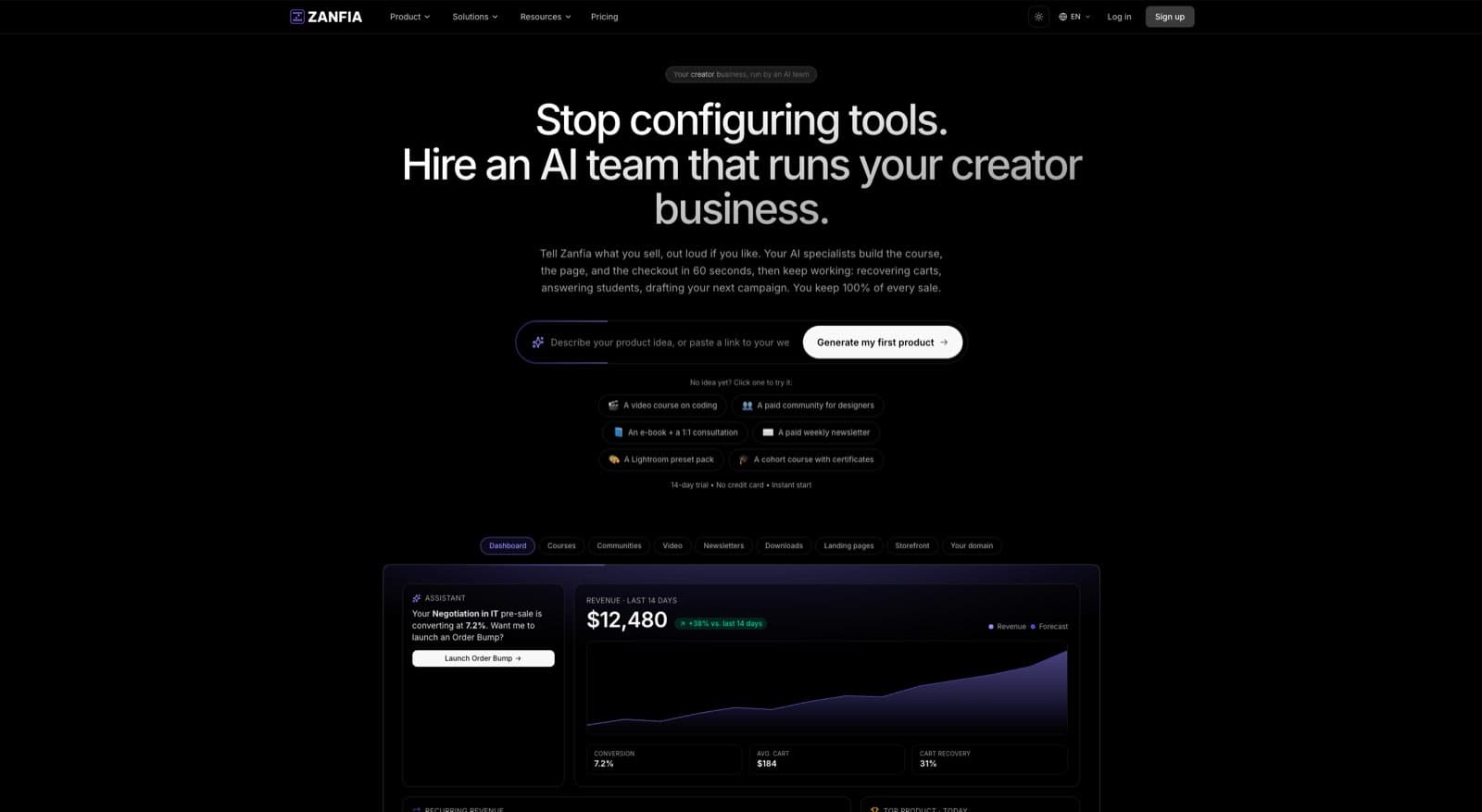
This is exactly the gap Zanfia fills. Zanfia is an AI team that runs a creator business, and a platform second: the AI does the work, and courses, communities, paid newsletters and downloadable ebooks are where that work lands. You describe what you want in plain English, or dictate it out loud, and the assistant performs any action available in the interface. The commercial model matches the product: as of August 2026, Zanfia charges 0% platform commission on customer transactions, so only payment processor fees (Stripe or PayPal) apply.
What that means for your ebook business
You upload the ebook as a digital download product, set your price (one-time, subscription, installments, or free trial), and start selling under your own domain. Zanfia is white-label, so customers see your brand, your domain (custom domains supported, or a clean yourname.zanfia.co subdomain), and your checkout experience.
The checkout itself (Cart 2.0) is built to sell rather than just process payments: order bumps with separate invoicing (add a workbook for $9), subscription upsells at checkout (turn one-time buyers into monthly community members), installments (split a $600 ebook-plus-course bundle into four $150 payments), discount codes, multi-quantity offers for team licensing, and Apple Pay/Google Pay support so mobile buyers convert without typing a card number. Before your launch, test mode opens the real checkout in a hidden test surface so you can buy your own ebook end to end, watch the tracking events fire, and catch a broken funnel before the first real customer does.
Beyond the ebook
Here’s where it stops being just an ebook platform and starts being a business. Zanfia handles 12 product types under one brand: online courses (native video hosting with smart progress memory, no Vimeo subscription needed), communities (topic channels and announcement channels, no Circle or Discord required), paid newsletters (subscription publishing built-in), knowledge bases, consulting bookings, bundles, and recurring subscriptions among them. All under one roof.
That matters for ebook creators because the ebook is rarely the destination. It’s the entry point. The same buyer who reads your $29 ebook on freelance pricing is the perfect customer for your $497 freelance course, your $29/month community of working freelancers, or your $200/hour consulting calls. With Zanfia, all of that lives in one platform, on your domain, with your branding, at 0% platform commission today. Advanced automation surfaces like the MCP endpoint (bring your own AI agents to your workspace) and white-label AI are available on higher plans, so check the current Zanfia pricing for what your plan unlocks.
Native mobile app included
Zanfia ships a native iOS and Android app (live since 2026) so customers can read your courses, paid newsletters, and knowledge bases on their phones. Communities inside the mobile app are rolling out to workspaces, so by the time you read this it may already be available on your account. For ebook creators expanding into the broader knowledge business, that’s distribution your buyers actually want.
Zanfia starts at $39/month, or $31/month billed annually, on the Starter plan, and every plan includes a 14-day free trial with no credit card required. If you’re choosing where to host your direct ebook sales, explore how Zanfia works or see current pricing to compare against what you’re paying in fees today.
FAQ
Do I have to choose between Amazon KDP and selling direct?
No, unless you opt into KDP Select for Kindle Unlimited access (which requires 90-day exclusivity). Standard KDP enrollment lets you sell the same ebook on your own platform, Gumroad, Payhip, and anywhere else. Most non-fiction creators run direct as primary and add Amazon later for incremental reach.
How long does it take to sell ebooks without Amazon?
Realistic timeline: first sales within 30-60 days if you have any existing audience, meaningful monthly revenue (a few thousand dollars) within 6-9 months of consistent multi-channel distribution, and predictable recurring revenue within 12-18 months. Creators without any audience starting from zero should plan for 12 months before expecting meaningful sales.
What’s the best ebook price for non-Amazon channels?
For non-fiction in 2026, the strongest price points are $19-$49 for solo ebooks, $97-$197 for ebook plus bonus bundles, and $7-$15 for tripwire ebooks designed to feed buyers into a larger funnel. Amazon’s $2.99-$9.99 sweet spot doesn’t apply outside KDP, and pricing higher often increases perceived value.
Should I publish on Substack and sell the ebook separately?
Yes, this combination works well. Use Substack to build audience and publish 60-80% of your ideas free, then sell the ebook as the organized, expanded version. Some creators offer paid Substack subscribers a free copy of the ebook as a perk, which can boost paid conversions.
What about Apple Books, Google Play Books, and Kobo?
These are worth considering as additional channels through a distributor like Draft2Digital or Smashwords, especially for fiction. For non-fiction creators using the ebook as a business asset, the customer-acquisition limitation is the same as Amazon (the retailer owns the relationship), so they’re better treated as supplementary rather than primary channels.
Can I use this strategy if I only have a small audience?
Yes, and arguably this strategy matters more if you have a small audience. The compounding channels (SEO blog, Pinterest, Medium, podcast guesting) build audience over time. Amazon KDP requires either an existing audience or significant ad spend to get noticed. Direct sales channels reward patient creators who keep showing up.
How many distribution channels should I actively run?
Three to five active channels is the sweet spot for most creators. Trying to run all nine at once dilutes effort. Pick your direct-sales home, your email list, one content channel (blog, Substack, or YouTube), one social channel (Pinterest if it fits your niche, otherwise the platform where your audience already lives), and one partnership channel (podcast guesting or creator collabs). Master those before adding more.