

Ebook Funnel: How to Upsell From Free Sample to Paid Course
You wrote an ebook. You priced it at $9. You sold 100 copies last month. That’s $900, minus Stripe fees, minus the time you spent writing it, minus the ad spend it took to drive traffic to the landing page. The math doesn’t work, and you know it.
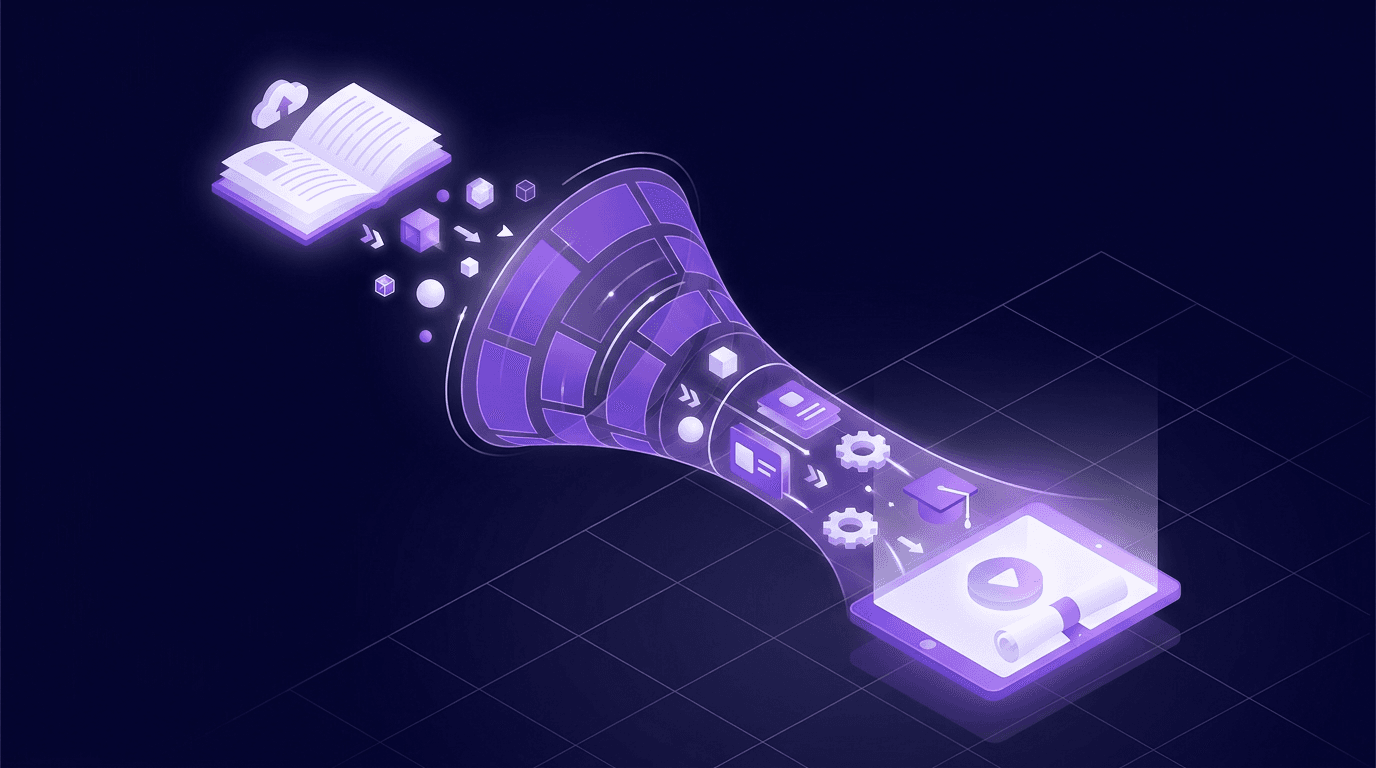
Here’s the part nobody told you when you started: the ebook was never supposed to be the destination. It was supposed to be the front door. Every serious creator who’s built a real business off digital products treats their ebook as the entry point to a much larger ladder, one that climbs from $9 to $97 to $497 and beyond. The ebook qualifies the buyer. The course converts them. The community keeps them.
This guide walks through exactly how to build that ladder, what email sequence moves readers from sample to course, what CTAs to put inside the ebook itself without feeling sleazy, and how to host the entire stack under one roof so you stop duct-taping seven tools together. By the end, you’ll have a funnel that turns a $9 transaction into a $500+ customer relationship.
Why an ebook alone caps your revenue at $9
Let’s do the brutal arithmetic first. An ebook priced at $9 with a 5% conversion rate on cold traffic means you need 20 visitors to make $9. If your customer acquisition cost is $3 per visitor (generous for paid traffic in 2026), you’re spending $60 to earn $9. You’re losing $51 on every sale before you’ve paid yourself a cent.
The standalone ebook model only works in three scenarios: you have massive organic traffic from SEO, a large existing email list, or a viral social presence. For everyone else, the ebook is a loss leader. And that’s fine, as long as you treat it like one.
The single-product trap
Most creators who sell only ebooks fall into the same pattern. They write the book, launch it, see a small spike in sales, then watch revenue plateau within 60 days. They blame the topic, the cover, the price, the launch sequence. The real problem is structural. They’ve built a business with a ceiling of about $9 per customer, in a market where customer acquisition costs are climbing every quarter.
According to ConvertKit’s State of the Creator Economy report, creators who sell only one product type earn a median of less than $1,000 per month. Creators with three or more product tiers earn 4x to 6x more from the same audience size. The difference isn’t audience quality, it’s product architecture.
What changes when you add a ladder
The ebook stops being a profit center and becomes a qualifier. You can now afford to acquire the buyer at break-even or even at a small loss, because you know that 8-15% of ebook buyers will eventually buy your course. The $9 transaction earns you the right to make a $97 offer. The $97 transaction earns you the right to make a $497 offer. Each step pays for the next.
The ebook + course product ladder ($9 to $97 to $497)
Russell Brunson popularized the value ladder framework in DotCom Secrets, and it remains the cleanest mental model for digital product businesses. The structure is simple: a low-ticket front-end offer that’s cheap to acquire customers, a mid-ticket core offer that funds the business, and a high-ticket back-end offer that drives most of the profit.
For an ebook-led funnel, here’s what each rung looks like in practice.
Rung 1: The $9 ebook (qualifier)
The ebook should solve one specific, narrow problem completely. Not 47 chapters covering everything about email marketing, but 30-60 pages on “how to write your first welcome sequence in a weekend.” Specificity converts. Buyers who pay $9 for a focused solution have already self-identified as people willing to pay for shortcuts.
Resist the urge to charge more. The $9 price point isn’t about revenue, it’s about filtering. Free downloads attract tire-kickers. $9 attracts buyers. The difference in lead quality between a free PDF and a $9 PDF is enormous.
Rung 2: The $97 course (core offer)
The course should be the natural next step from the ebook. If the ebook is “write your first welcome sequence,” the course is “build your entire email marketing system from scratch.” The ebook gives them a quick win. The course gives them the complete framework.
Price the course between $97 and $297. Below $97 feels too cheap for serious buyers. Above $297 requires more trust than a $9 ebook buyer typically has after one transaction. The sweet spot for cold-traffic-to-course conversion sits around $97-$147 for most niches.
Rung 3: The $497+ program (profit driver)
This is where the money lives. Group coaching, a cohort-based course, a membership community, or a done-with-you program. According to Harvard Business Review’s analysis of freemium and tiered pricing models, the top 10% of customers in a tiered system generate 60-80% of revenue. Your $497+ offer is what captures those buyers.
You don’t need to launch all three rungs at once. Start with the ebook and course. Add the high-ticket offer once you have at least 50 course buyers, so you have signal on what they actually want next.
Email sequence: from download to course purchase
The email sequence is where the funnel actually works. Most creators botch this step by either pitching too hard too fast or never pitching at all. The right rhythm is roughly 80% value and 20% offer, spread across 10-14 days.
Here’s a sequence that converts cold ebook buyers into course customers at industry-leading rates.
Day 0: Delivery + welcome
Send the ebook immediately after purchase. No upsell on this email. The job of this message is to deliver what they paid for and set expectations for what’s coming. One line at the end: “Over the next two weeks, I’ll send you a few short emails with the exact next steps to put this into practice.”
Day 1: The implementation gap
Acknowledge the obvious: most people who buy an ebook never finish it, and even fewer act on it. Give them one specific action to take from the ebook today, in 15 minutes or less. This email builds trust and gets them into the habit of opening your messages.
Day 3: A quick win story
Tell the story of one reader (real or composite) who applied the ebook’s framework and got a measurable result. Specifics matter. “Sarah added 340 subscribers in 11 days” beats “my readers love this.” No pitch in this email.
Day 5: The deeper problem
Surface the next problem the ebook doesn’t solve. “The welcome sequence works, but it falls apart when you try to scale past 1,000 subscribers without a system for segmentation.” You’re planting the seed for the course without naming it yet.
Day 7: The soft introduction
Mention the course for the first time. Frame it as the solution to the deeper problem from Day 5. Include a link to the sales page but don’t push. “If you want the complete system, here’s where I built it out.” Some readers will buy here.
Day 10: Objection handling
Address the three most common objections to your course: price, time commitment, and “will this work for me.” Use customer testimonials and FAQ-style answers. Soft CTA at the end.
Day 12: Case study deep dive
One long-form story of a course student who got significant results. Walk through their starting point, what they did, and where they ended up. This is your strongest content email and should drive 30-40% of course sales from the sequence.
Day 14: Last call (with deadline)
Offer a time-limited bonus or discount that expires in 48 hours. Real deadlines convert. Fake deadlines that reset every week kill trust. Be honest about what you’re offering and why.
This sequence typically converts 6-12% of ebook buyers into course customers within 14 days. On a list of 500 ebook buyers per month, that’s 30-60 course sales at $97, or roughly $2,910 to $5,820 in monthly revenue from a single sequence.
Inside-ebook CTAs that don’t feel sleazy
The ebook itself is prime real estate for course CTAs, but most creators either spam them on every page or skip them entirely out of fear of being pushy. Both extremes leave money on the table.
The principle: CTAs feel sleazy when they interrupt value. They feel natural when they extend value.
Three CTA placements that work
End-of-chapter callouts. After delivering a complete idea, add a one-paragraph note: “Want the templates and walkthrough videos for this chapter? They’re included in the full course.” Soft, additive, easy to ignore if the reader isn’t ready.
The “go deeper” sidebar. Inside chapters that introduce frameworks, add a styled callout box: “This framework gets covered in depth in Module 3 of the course, with a 25-minute video walkthrough and a fill-in-the-blank template.” You’re not selling, you’re informing.
The final chapter pivot. The last chapter shouldn’t be a summary. It should be a bridge. Title it something like “What to do next” and lay out the natural progression: you’ve learned the basics, here’s what comes after. Then make the course offer explicitly with a 1-2 page pitch including testimonials and a clear CTA button.
Three CTA placements that backfire
Don’t open the ebook with a sales pitch before delivering any value. Don’t put the same CTA on every page. Don’t bury the course offer in a footnote on page 47. Buyers respect directness; they punish manipulation.
Webinar invitations after ebook download
Live webinars and on-demand workshops are the single highest-converting bridge between a $9 ebook and a $497 program. The reason is simple: long-form video lets you build trust at a depth that email can’t match.
When to invite
Add a webinar invitation to your email sequence around Day 6 or Day 8. Frame it as “a free workshop for ebook readers only” to create a sense of exclusivity. Aim for 15-25% of ebook buyers registering, and 30-40% of registrants actually attending.
The webinar structure that converts
Use a three-part structure: teach one specific skill in depth (30-40 minutes), share a case study or transformation story (10-15 minutes), make the offer with Q&A (15-20 minutes). The teaching has to be genuinely useful even for people who never buy. Attendees who feel they got value from the free training convert at 3-5x the rate of attendees who feel they were ambushed with a pitch.
Zanfia doesn’t host live webinars natively, so you’ll use a dedicated tool like Zoom Webinar, Demio, or WebinarJam for the live event, then deliver the recording and course access through your Zanfia account.
The replay sequence
Send the webinar replay to non-attendees within 24 hours. Include a 48-hour deadline for any bonus offered during the live event. Replay sequences typically convert another 2-4% of ebook buyers into course customers, on top of what the live session generates.
Affiliate and referral additions to the funnel
Once your funnel is converting, the next leverage point is getting your existing customers to bring you new ones. Referral programs work in this funnel because ebook buyers and course students are already in a buying mindset and frequently know other people facing the same problem.
How referrals fit the ladder
Offer existing customers a meaningful reward for referring new ebook buyers. The reward can be cash (15-30% of the ebook price), a discount on the next tier (50% off the course), or exclusive content (a bonus module not sold separately).
The math works because referred customers tend to convert higher up the ladder. According to research summarized in Harvard Business Review’s analysis of customer referral value, referred customers have a 16% higher lifetime value and a 18% lower churn rate than customers acquired through paid channels.
Setting up the program
Each customer gets a unique referral link. When a friend buys through that link, the original customer gets credited. Pay out monthly or apply credits to their next purchase automatically. Keep the rules simple, three rules max, no clever exceptions.
Zanfia will include a built-in referral program designed exactly for this use case, so your existing customers will get their own referral links and rewards will apply automatically to their accounts, with no third-party affiliate platform to integrate. Referral programs are marked coming soon on the pricing page, so check the live Zanfia pricing page for current availability.
How Zanfia hosts the entire ladder under one account
Here’s where most creators get stuck operationally. You’ve designed a beautiful funnel on paper: ebook on Gumroad, course on Teachable, community on Circle, newsletter on ConvertKit, webinar on Demio, payments on Stripe in five different accounts. Now your customer has to create five logins, your data lives in five places, and your monthly tool stack costs $400 before you’ve made a single sale.
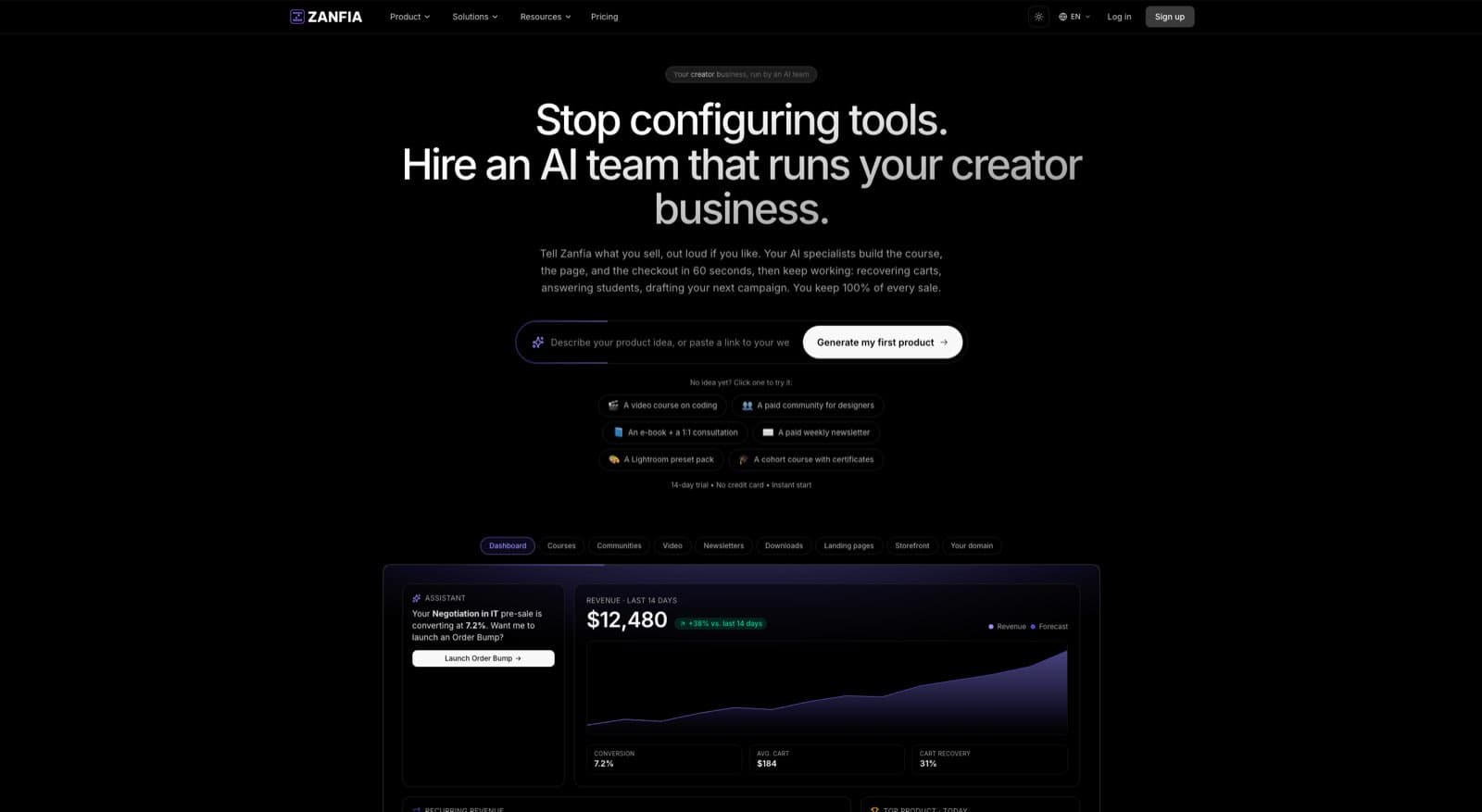
Zanfia is built as an AI team that runs a creator business, hosting the entire product ladder under one account with one customer login, one checkout, and one analytics view. The creator dictates instructions instead of clicking through menus: the assistant handles anything available in the interface by chat or by voice, and anything doable by clicking is also doable through the MCP endpoint that connects outside AI assistants directly to the workspace. The full Assistant and MCP endpoint sit on higher plans, so check the live Zanfia pricing page for current availability.
What lives under one roof
Your $9 ebook is hosted as a downloadable digital product with secure delivery. The same buyer can be upsold into your $97 course, which uses native video hosting with a smart progress-memory player, video chapters, auto-generated transcripts, quizzes with pass-rate stats, and completion certificates issued per student. Time-locked module unlocking handles drip delivery. Your $497 program can include the course plus access to a native community with topic-based discussion channels, admin-only announcement channels, role-based access, and a community AI agent that writes from your own content and labels everything it publishes as AI.
For higher-tier offers, you can layer in a paid newsletter as a subscription product. Consultations and bookings are marked coming soon on Zanfia; check the pricing page for current status. Knowledge bases work well as bonus libraries for top-tier customers.
The checkout that closes the funnel
Cart 2.0 is built to sell: one-time payments for the ebook, subscription billing for memberships, installment plans that let you split a $497 program into four payments of $124, and free trial periods. Order bumps let you add a workbook or template pack at checkout. Subscription upsells turn one-time buyers into recurring revenue. Testimonials can be shown directly on the checkout page. Apple Pay and Google Pay reduce mobile friction. Stripe and PayPal both process US and global customers. Test mode lets you run a full test purchase through your own checkout before launch, with events tagged TEST so nothing pollutes your live analytics.
The white-label experience
The entire ladder lives on your own domain. Customers see your brand, not Zanfia’s, from the ebook landing page through the course player to the community feed. You can map a custom domain or use your slug.zanfia.co subdomain. Custom domain and removing Zanfia branding sit on higher plans, so check the live Zanfia pricing page for current availability.
The math that actually changes
Replacing a five-tool stack with one platform typically cuts software costs by 50-70%, depending on which tools you were using. More importantly, you keep 100% of your sales revenue. Zanfia charges 0% platform transaction fees on customer sales, so the only deductions are payment processor fees from Stripe or PayPal. Gumroad takes 10% plus $0.50 per transaction on direct sales. On a $9 ebook, that’s a 16% effective fee. Across 500 ebook sales per month, you’re handing Gumroad $720 you could keep with Zanfia.
Mobile matters too. The native iOS and Android app supports courses, paid newsletters, and knowledge bases out of the box, so your students can consume content on the go without you building a separate app. Communities support is on the roadmap.
If you’re curious how your specific funnel would map onto the platform, a 14-day free trial with no credit card required lets you build out the full ladder structure before committing to a paid plan. You can see the current plans here, which start at $39 per month, or $31 per month billed annually, on Starter.
FAQ
How many ebook buyers should I expect to convert into course customers?
Industry benchmarks for ebook-to-course conversion range from 5% on the low end (poor sequence, weak product fit) to 15% on the high end (tight funnel, strong product alignment). A well-built sequence on aligned products typically lands between 8-12% within 30 days, with additional conversions trickling in over the following 90 days.
Should I give the ebook away for free instead of charging $9?
Free downloads bring in more leads, but the lead quality is significantly lower. Free downloaders convert into paid customers at roughly one-tenth the rate of $9 buyers. The math usually favors paid downloads unless you have a strong organic traffic source that lets you afford the volume play.
What if I don’t have a course yet, only the ebook?
Start by validating the course topic with your ebook buyers. Send a short survey to your buyer list asking what they’re struggling with after applying the ebook’s lessons. Use the most common answer as your course topic. You can pre-sell the course with a discounted founder’s price before you’ve built it, then use the pre-sales to fund the production.
How long should the email sequence be?
For a $9 to $97 jump, 10-14 days works well. For a $97 to $497 jump, plan on 30-60 days of nurture before pitching. The bigger the price gap, the more trust you need to build, which means more content and more time.
Do I need a webinar in the funnel?
No, but it helps. Funnels without webinars typically convert 6-10% of ebook buyers into course customers. Funnels with a webinar bridge often hit 12-18%. If you’re willing to do live or recorded video at scale, add it. If video isn’t your strength, a strong email sequence alone can carry the funnel.
What’s the right time to launch the high-ticket offer?
Wait until you have at least 50 course customers and at least 10 of them have completed the course. You need real signal on what your buyers want next, not guesses. The high-ticket offer should solve a problem your course students explicitly tell you they have.