How to Create a Curriculum: Build an Engaging Online Course

Building a curriculum is crafting a journey. You're defining who your ideal student is, setting clear goals for them, and then structuring your content to guide them from where they are to where they want to be. Think of it as creating a roadmap for success, where every single lesson and activity has a clear and deliberate purpose.
Table of Contents
Defining Your Course's Core Promise and Audience
Before you even think about hitting 'record' on a video or drafting a lesson, you have to get two things straight: Who are you teaching, and what transformation are you promising them? So many creators skip this part, and it's a huge mistake. It’s like trying to draw a map without knowing the destination—you’ll end up with a bunch of content, but it won't lead your students anywhere meaningful.
Your goal isn't just to dump information on a topic. It's to solve a specific problem for a specific type of person.
This first stage is all about empathy. You need to get inside the head of your ideal student. What are their biggest frustrations? What keeps them up at night? And on the flip side, what does success truly look like in their world? Getting a crystal-clear picture of their starting point (Point A) and their desired outcome (Point B) is absolutely essential.
Conduct a Thorough Needs Analysis
So, how do you uncover these critical insights? Through a needs analysis. This is just a structured way to validate your course idea and make sure you're building something people will actually pay for because it solves a real problem for them. This process is key to aligning what you teach with what your students need to succeed, especially as the global education market, projected to be worth $10 trillion, shifts toward practical, workforce-ready skills.
Here are a few practical ways to do this:
- Survey your audience. If you have an email list or social media following, ask them directly.
- Hop on one-on-one calls. Nothing beats a real conversation with a potential student.
- Lurk in online communities. Sift through questions and comments on forums like Reddit, Facebook groups, or Quora related to your niche. You'll find gold in there.
This process—from identifying your audience to setting your objectives—is a clear, logical progression.
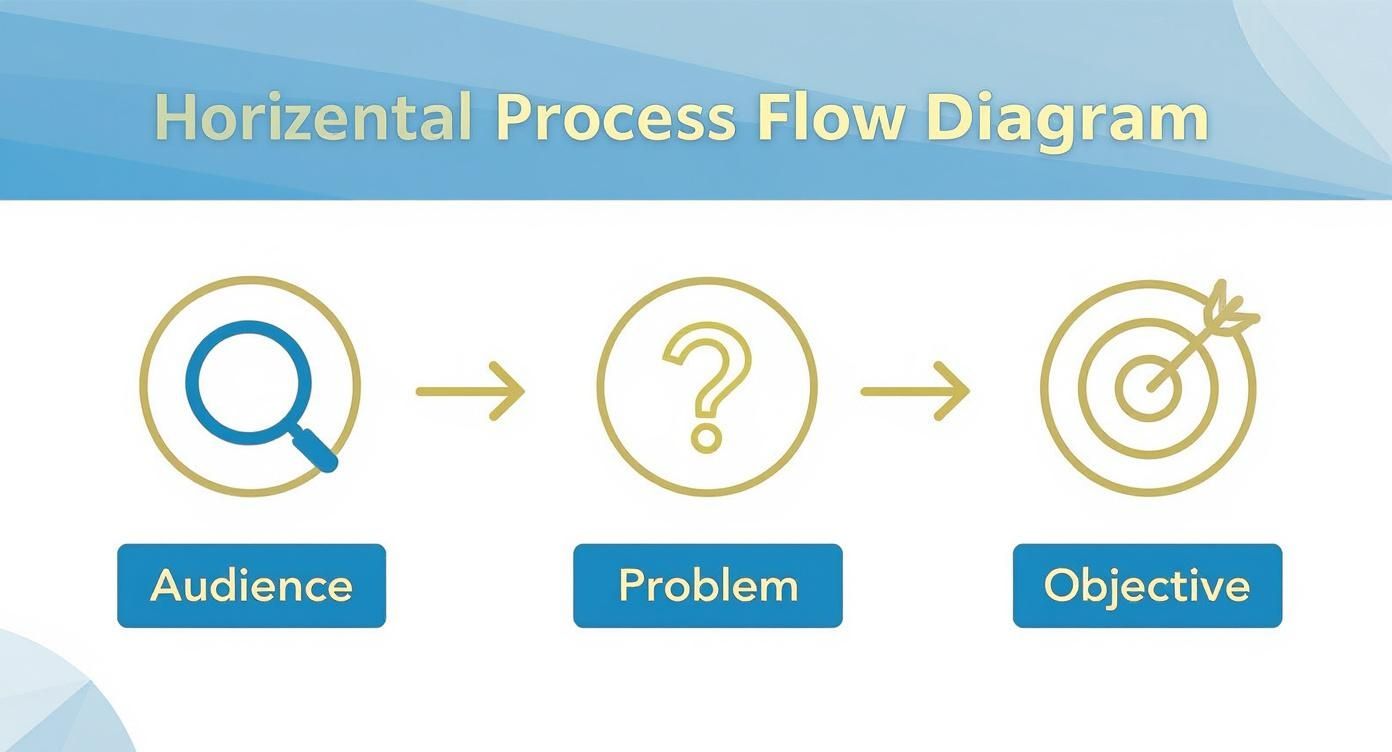
As you can see, a great course always starts with people, zeroes in on their problems, and then defines the solution you'll provide.
Craft Crystal-Clear Learning Objectives
Once you have a solid grasp of what your audience needs, you can translate those needs into actionable learning objectives. These are just specific, measurable statements that spell out exactly what a student will be able to do after finishing your course. They become the North Star for your entire curriculum. For creators working with specialized groups, looking into different approaches like homeschool curriculum planning can provide some great ideas on tailoring experiences.
The table below shows how you can turn a fuzzy idea into a concrete objective that guides your content creation.
From Vague Idea to Clear Learning Objective
| Vague Idea | Needs Analysis Question | Actionable Learning Objective |
|---|---|---|
| I want to teach people how to use Instagram. | "What's your biggest struggle with getting clients on Instagram?" | By the end of this course, you will be able to develop a 30-day content calendar that attracts your ideal client. |
| My course is about healthy eating. | "What stops you from cooking healthy meals during the week?" | After this module, you will be able to prepare five nutritious 20-minute meals for busy weeknights. |
| I'll teach people to be more productive. | "Which productivity app have you tried that didn't work, and why?" | In this lesson, you will implement the "Time Blocking" technique in your digital calendar to reclaim 5 hours per week. |
See the difference? Specific, action-oriented objectives make it much easier to build modules and lessons that actually deliver results.
Key Takeaway: Vague goals lead to vague outcomes. Strong learning objectives use action verbs—like "Develop," "Prepare," or "Implement"—which forces you to create tangible, results-focused content. This clarity isn't just for you; it's also a critical piece of your marketing when you figure out how to sell digital products.
Structuring Your Content for Engagement and Flow
You can have the most brilliant course idea in the world, but it will completely fall apart without a solid structure. Think of your curriculum as the roadmap that guides your students from point A to point B. Without it, they're just wandering through a random collection of videos and PDFs, and that’s a quick recipe for confusion and drop-offs.
A well-structured course turns a data dump into a genuine learning journey. It’s what keeps people clicking "next lesson" instead of closing the tab. The goal is to build a logical flow, whether that's a straight line from beginner to expert or a more flexible, modular approach where students can hop around.

The secret is to break down your big, complex topic into bite-sized, digestible pieces. Each module and lesson should build on the one before it, creating a "scaffolding" effect where students feel supported as they climb higher.
Picking the Right Framework for Your Course
So, how should you actually organize everything? There’s no single right answer—it really depends on what you're teaching and who you're teaching it to. But most successful online courses fall into one of these common frameworks.
-
Linear Progression: This is your classic, step-by-step model. It's perfect for teaching a skill where the order of operations is crucial. Think about learning Adobe Photoshop or baking a cake; you have to master the basics before you can get to the fancy stuff. Lesson 1 leads to Lesson 2, and so on. No skipping ahead.
-
Modular (or Thematic) Design: This approach groups your content into self-contained modules or themes. It’s a great fit for broader subjects where students might have different entry points or interests. A digital marketing course, for instance, could have separate modules for SEO, social media, and email marketing, allowing a student to jump right into the section they need most.
-
Project-Based Structure: Here, the entire curriculum revolves around completing a tangible project. Each lesson or module gives students the specific skills they need to tackle the next phase of that project. This is incredibly effective for creative or technical fields like web design, copywriting, or video editing. To see how this works in a more intensive format, check out our guide on cohort-based courses.
We've seen a major shift in recent years away from old-school, information-heavy teaching. The focus now is on flexible, skill-based learning that gives people practical abilities they can use right away. It's all about real-world outcomes.
Getting the Pacing and Flow Just Right
Once you've settled on a high-level structure, it’s time to zoom in and think about pacing. Pacing is all about the rhythm of your course—how you introduce new concepts without completely frying your students' brains. Shoving too much into one lesson is the fastest way to kill someone's motivation.
A simple but powerful principle I always follow is "one big idea" per lesson. Every single lesson should have one clear, focused takeaway. That’s it. This clarity makes your content so much easier to absorb and remember.
To do this well, you have to get granular. Take a big module and break it down into the smallest possible components.
For example, a module on "Building a 30-Day Content Calendar" could be broken down like this:
- Lesson 1: How to Identify Your Audience's Core Problems
- Lesson 2: Brainstorming and Validating Your Content Pillars
- Lesson 3: Choosing the Right Format (Blog vs. Video vs. Podcast)
- Lesson 4: A Walkthrough of My Favorite Content Planning Template
See how that works? It takes a daunting task and transforms it into a series of manageable, confidence-boosting steps. By mapping out both your structure and your pacing, you create a curriculum that doesn't just teach—it empowers your students and makes them feel like they're actually making progress.
Creating Course Materials That Captivate and Teach
You’ve laid the groundwork and have a solid course structure. Now for the fun part: breathing life into that structure with content that actually teaches and engages your students.
The best courses I've seen—and built—don't just stick to one format. They weave together different types of materials to keep things interesting. Think of it as creating a dynamic learning experience, not a monotonous lecture. This is where you shift from being the architect to the builder, creating the very assets that will deliver the transformation you promised.
Matching Content Formats to Learning Goals
So, how do you decide what to create? Simple: let the learning objective guide you. The format you choose should be the most effective vehicle for the lesson's goal.
Are you showing someone a technical process on a computer? A video is a no-brainer. Are you explaining a complex theory? Maybe a direct-to-camera lecture or a well-structured text lesson is better. Trying to get them to apply what they've learned? A hands-on workbook is the way to go.
To make this crystal clear, I've put together a quick guide to help you pick the right format for the job.
Content Format Decision Guide
Choosing the right format isn't about what's easiest for you; it's about what's most effective for your student. This table breaks down common learning goals and the content types that serve them best.
| Learning Objective | Best Content Format | Why It Works |
|---|---|---|
| Demonstrate a "how-to" process | Screen-recorded video | Students see every click and keystroke as it happens, which is far more effective than just reading about it. |
| Explain a core concept or theory | Short video lecture or text lesson | A "talking head" video builds a personal connection, while a text lesson allows students to absorb info at their own pace. |
| Reinforce learning and check understanding | Interactive quiz or quick survey | This gives students instant feedback so they know they've mastered a concept before they move on. |
| Encourage practical application | Downloadable workbook or project file | This is crucial. It pushes students from passive watching to active doing, which is where real skill-building happens. |
| Provide a quick reference | PDF cheat sheet or checklist | Creates a valuable, scannable resource your students can download and use long after they've finished the course. |
Think of these formats as your teaching toolkit. The more you mix and match, the more engaging and sticky your lessons will be.
Producing High-Quality Content Efficiently
This is the stage where so many creators get bogged down. They think they need a Hollywood-level studio and a five-figure budget. Let me put that myth to rest. Today’s tools have completely changed the game.
Honestly, your smartphone, a decent $50 microphone, and some good natural light are often more than enough to get started. Don't let the pursuit of perfection stop you from making progress.
Even the old technical headaches, like figuring out where to host your videos, are a thing of the past.
Back in the day, you had to pay for a separate service like Vimeo or Wistia just to host your course videos. Platforms like Zanfia now include native video hosting—a huge cost saver—while still supporting integrations with YouTube, Vimeo, and others. You just upload your videos directly into your lessons. It simplifies everything.
This kind of integrated platform lets you stop being a tech wizard and focus on what you do best: creating incredible content. Powerful automation features can save you 5–10+ hours a month by handling tasks like granting course access after payment or adding buyers to the right community channels, freeing you to focus on value-packed content instead of admin chores.
How to Use Assessments to Actually Deepen Learning
Let's be honest, the word "assessment" can sound a bit intimidating. It often brings up memories of stressful final exams. But in the world of online courses, we need to completely reframe that idea. Assessments aren't about assigning a grade; they're about building confidence and making sure what you're teaching actually sticks.
Think of them as crucial checkpoints along your students' journey. They’re the moments where your learners get to apply what they've learned, see how far they've come, and get a clear picture of what to focus on next. When done right, they transform passive learning into active skill-building.

Go Beyond the Standard Quiz
Multiple-choice quizzes are fine for a quick memory jog, but they rarely show if someone can actually use the information. True understanding comes from application, and your assessments should reflect that. This is where you can get really creative and design activities that spark genuine critical thinking.
Instead of just quizzing, try incorporating more dynamic assessments like these:
- Capstone Projects: This is the ultimate test of practical skill. Have students pull everything they’ve learned together into one final project. For a photography course, it might be creating a professional 10-photo portfolio. For a business course, it could be developing a complete marketing plan.
- Reflective Journaling: Prompt students to think about their own learning process. Ask them to write about a "lightbulb moment," a challenge they worked through, or how they plan to use a new skill in their own life. This is fantastic for building self-awareness.
- Peer Reviews: This one is a game-changer. Have students review each other's work and offer constructive feedback. Not only does this reinforce their own knowledge by teaching it to someone else, but it also builds an incredible sense of community. It's a perfect example of what social learning is and how powerful it can be.
Connect Every Assessment Back to Your Goals
This is the most important part: every single assessment must directly connect to the learning objectives you set at the very beginning. It's that simple.
If one of your course objectives is, "Students will be able to write a persuasive sales email," a quiz on email open rates isn't going to cut it. The assessment must be to write an actual sales email for a fictional product.
Your assessments are the proof that the transformation you promised is actually happening. Every task, project, or quiz needs to answer one question: "Does this activity let my student show they've mastered a key skill?"
When you create this alignment, your curriculum becomes a cohesive, goal-driven system. It stops being a random collection of videos and PDFs and starts being a clear path to results. This gives both you and your students tangible proof of their progress, turning the entire experience into a series of motivating wins.
Getting Your Curriculum Ready for Prime Time
Finishing your first curriculum draft is a fantastic feeling, but don't pop the champagne just yet. That draft is your starting point, not the finish line. The real test—and where the real improvement happens—is when your lessons finally get in front of actual students.
This is why I'm a huge advocate for beta testing. Before you open the doors to everyone, you need a small, trusted group of pilot students to run through the material. Think of them as your first-look crew. They’ll catch the awkward phrasing you missed, flag a video with poor audio, or point out a lesson that feels more confusing than helpful. This isn’t about criticism; it's about collaboration.
How to Get Feedback That Actually Helps
To make the most of your beta testers, you need to ask the right questions. Simply asking "What did you think?" is a recipe for vague, unhelpful answers. You have to get specific.
Try using prompts that encourage them to share their experience:
- "Where did you feel most energized and why?" This tells you what's working so you can double down on it.
- "Was there a moment you felt lost or had to re-read something?" This is gold for finding the exact spots that need more clarity.
- "What was your biggest 'aha!' moment?" This confirms your key takeaways are landing as intended.
- "If you had a magic wand, what one thing would you add to this course?" You'd be surprised at the brilliant ideas this question can spark for new content.
As feedback comes in, you’ll start to see patterns. Maybe three people mention the workbook in Module 2 was a game-changer, but five people say the final project instructions were confusing. Group these insights together and turn them into a clear revision plan. Tackle the most impactful changes first.
Your Course Is More Than Just Content—It’s a Community
A curriculum on its own is just a collection of files. The best online courses, the ones people rave about, create a space where students can connect with you and, just as importantly, with each other. A built-in community can be the single biggest factor in keeping students engaged and helping them cross the finish line.
A community isn't just a nice add-on; it's a fundamental part of the learning process. It turns a solitary activity into a shared experience, which makes the information stick and keeps motivation high.
This is where your choice of platform really matters. Juggling a separate Facebook group or a chaotic Discord server pulls your students out of the learning environment. A platform like Zanfia, however, lets you build that community right next to your course materials. Imagine a student watching a lesson and then, without leaving the page, hopping into a discussion to ask a question. This unified approach keeps everything under your brand and dramatically boosts engagement and retention.
To successfully reach your target audience and ensure your curriculum gains visibility, consider exploring strategies for building an effective online presence as part of your launch plan. If you're weighing your options, our online course platform comparison can help you see how an all-in-one system stacks up.
This integrated approach is becoming the standard. When support and discussion are woven directly into the curriculum, learners feel more confident and achieve better results. By putting your curriculum through a beta test and building your community from the start, you're not just selling a course—you're creating an entire learning world that people will want to be a part of.
Frequently Asked Questions About Curriculum Design
Diving into curriculum design always brings up a few common questions. I see them time and time again from creators who are passionate about getting it right. Let's tackle some of the biggest ones head-on so you can move forward with total confidence.
How Long Should My Course Be?
Honestly, there's no single right answer. The perfect length for your course is whatever it takes to deliver the promised transformation, and not a minute more.
Think about it this way: a comprehensive course on mastering video editing software will naturally require more time than a mini-course on baking the perfect sourdough starter. It’s all about the outcome.
Your main job is to guide your student to their goal as efficiently as possible. Be ruthless about cutting fluff. If a lesson doesn't directly serve a core learning objective, it doesn't belong. Your students will thank you for creating focused content that respects their time.
Pro Tip: Flip your thinking. Instead of asking, "How much content should I create?" ask yourself, "What's the absolute minimum my student needs to know and do to get the result they paid for?" This simple shift will make your course infinitely more powerful.
What If I'm Not an Expert?
This is a huge one, and it stops so many talented people from ever starting. You don't need to be the single most knowledgeable person on the planet to teach a topic effectively. You just need to be a few steps ahead of your students.
In fact, your relatability is your superpower. The challenges of learning are still fresh in your mind, which means you can explain concepts and troubleshoot problems in a way that truly connects with a beginner. A world-renowned expert who learned the skill decades ago might completely forget what it's like to start from scratch.
So, focus on the value you can provide right now, from your unique perspective. That’s more than enough.
How Do I Price My Course?
Ah, pricing. It’s a mix of art and science, and it’s where I see most creators get stuck. The best place to start is by looking at the tangible value your course delivers. Are you helping someone earn a promotion, launch a profitable side hustle, or save 10 hours of tedious work every single week? The bigger and more valuable the outcome, the higher the price your course can command.
When you're trying to land on a number, weigh these factors:
- The Transformation's Value: What is this result actually worth to your ideal student in terms of money, time, or well-being?
- The Market Landscape: Take a look at what other courses in your niche are charging. This isn't about copying them, but about understanding the general price expectations.
- Your Time and Expertise: Don't forget to account for the years of experience and countless hours you’ve poured into gaining this knowledge.
Platforms like Zanfia give you the freedom to experiment here. You're not stuck with one pricing model. You can offer one-time purchases, ongoing subscriptions, or even payment plans to see what works best for your audience. Crucially, Zanfia’s 0% platform transaction fee model means you keep 100% of your revenue, paying only standard payment operator fees. This is a game-changer for creators tired of seeing commissions eat into their margins.
Ready to stop wrestling with technology and start building the course your audience is waiting for? With Zanfia, you get a powerful, all-in-one platform built for Polish creators. Enjoy 0% transaction fees, native video hosting, and integrated community tools—all under your own brand. Start building your online business with Zanfia today.