How to Create a Thriving Online Community from Scratch
Building an online community is about so much more than picking the right software or deciding what to post. The real magic, the thing that separates a thriving hub from a digital ghost town, is having an unshakable, crystal-clear mission.
Table of Contents
Defining Your Community's Purpose and Niche
Before you write a single welcome message or set up a channel, you have to answer the most important question of all: Why should this community exist?
And no, a vague answer like "to connect people who like fitness" won't cut it. A powerful purpose digs deeper. It taps into a shared problem, a burning passion, or a life-changing transformation that brings people together. Without this, your community has no anchor. People join because they see their own goals reflected back at them; they stay because you consistently deliver on that promise.
Moving From a Broad Topic to a Specific Niche
Every great online community serves a very specific niche. That specificity is your superpower. It’s what turns a general interest group into a place people can't live without.
Instead of targeting "entrepreneurs," you might zero in on "first-time SaaS founders struggling to land their first 100 customers." See the difference? That tight focus makes your community infinitely more relevant and valuable.
To nail down your niche, ask yourself a few questions:
- What specific problem can I help solve? Forget a generic "baking group." Think bigger. What about a community dedicated to "mastering sourdough for busy parents with no time"?
- What shared passion truly unites my audience? It's often more than just a hobby. A group for "collectors of rare 90s vinyl" connects people through nostalgia, music, and the thrill of the hunt.
- What transformation am I helping people achieve? Maybe your community is for "freelance writers looking to transition from content mills to high-paying corporate clients." The goal is clear, aspirational, and instantly relatable.
A huge part of this is identifying your target audience in detail. You need to know their pain points, their dreams, and what keeps them up at night. Once you have that, crafting a purpose that resonates is easy.
Crafting a Compelling Mission Statement
With your purpose and niche locked in, it's time to boil it all down into a clear, compelling mission statement. This isn't just fluffy marketing copy; it's your North Star. It will guide every single decision you make, from your content calendar to your moderation rules.
Keep it short, memorable, and action-oriented. It should tell someone instantly who the community is for, what you help them do, and the value they'll get.
A Solid Mission Statement Example:
"A private, supportive space for first-generation solopreneurs to share proven client-acquisition strategies, overcome mindset blocks, and build a profitable business from scratch."
This works because it’s incredibly specific. It defines the audience (first-gen solopreneurs), pinpoints their challenges (client acquisition, mindset), and clarifies the desired outcome (a profitable business). A potential member reads that and knows immediately if they're in the right place.
This whole process—finding your purpose, narrowing your niche, and crafting your mission—is the foundation for everything that comes next.
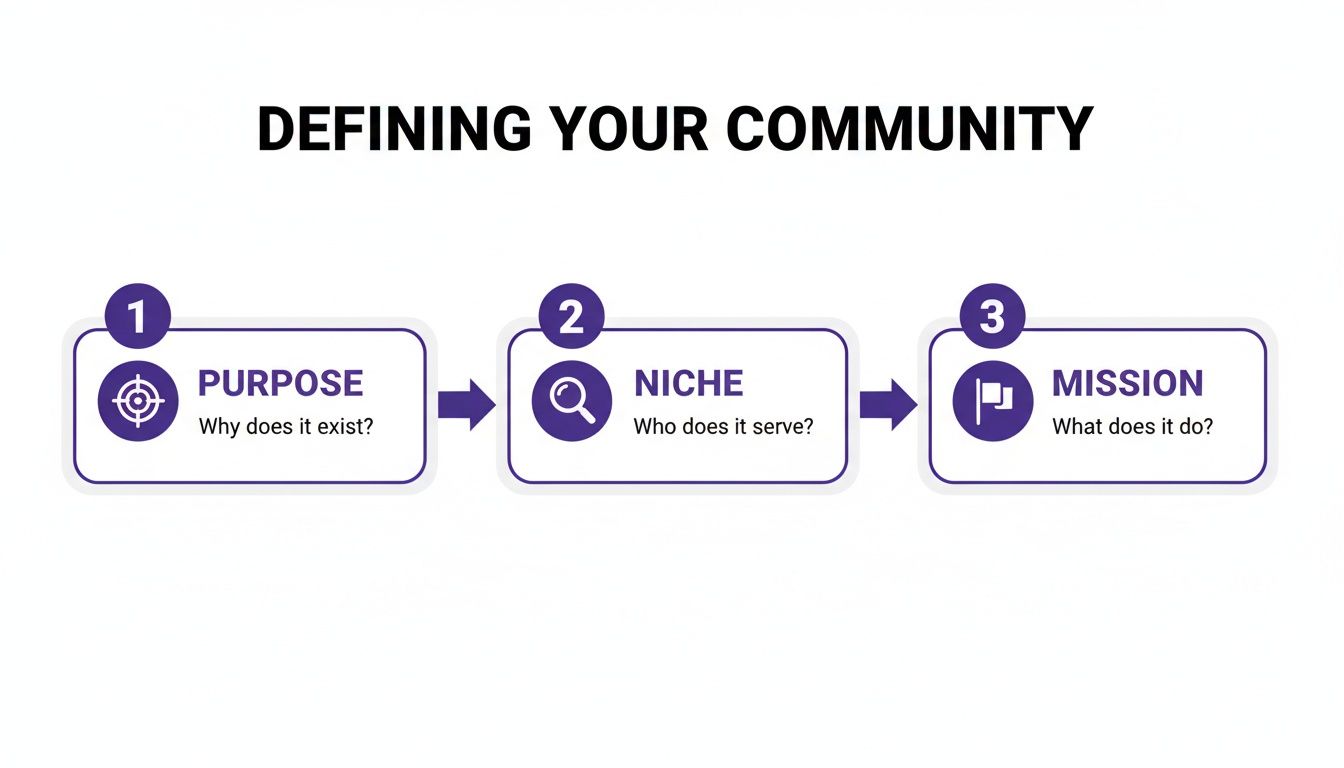
As you can see, a strong mission is the natural outcome of a clear purpose combined with a well-defined niche. Get this part right, and you’re already halfway to building a community that lasts.
Choosing the Right Home for Your Community
Think of your community platform as the digital "clubhouse" for your members. It's not just a piece of software; it's the space where everyone will gather, connect, and learn. This is a big decision, and getting it right from the start saves you the massive headache of a platform migration down the road.
The biggest fork in the road is deciding between a fragmented system and a unified, all-in-one platform. A fragmented approach means stitching together separate tools—maybe Discord for chats, a Facebook Group for discussions, and a WordPress site for your courses. While it might seem flexible at first, this setup often creates more problems than it solves.
The Hidden Costs of a Disconnected System
When you force members to jump between different apps with different logins, you're adding friction. That friction kills engagement. Imagine someone misses a key announcement in the Facebook Group because they were deep into a lesson on your website. That kind of disjointed experience weakens your brand and makes it nearly impossible to build a cohesive culture.
For you, the creator, it’s an administrative nightmare. You’re left juggling permissions, payments, and member data across several disconnected systems. It's a recipe for burnout and mistakes. This isn't just a small hassle; it's a growing industry-wide problem. In fact, one report predicts that by 2025, 58% of community leaders will be wrangling three or more separate tools.
The Power of an All-in-One Platform
An integrated, all-in-one platform is a totally different ballgame. It puts everything—your community, courses, newsletters, and digital products—under a single roof with a single login. This is the secret to creating a frictionless journey for your members.
Picture this: a new customer buys your course. They’re instantly and automatically granted access to both the course content and a private community channel just for students. They can ask questions and discuss lessons right next to the video content without ever leaving your branded space.
That seamless flow is what drives up engagement and keeps people coming back. When everything is in one spot, your community feels less like a jumble of apps and more like a true home.
Community Platform Architecture: Fragmented vs. All-In-One
So, what does this look like in practice? The choice between cobbling tools together and using a unified system has real-world consequences for your time, your members' experience, and your bottom line.
| Feature | Fragmented Approach (e.g., Discord + Facebook + WordPress) | All-in-One Platform (e.g., Zanfia) |
|---|---|---|
| Member Experience | Disjointed. Requires multiple logins and apps. | Seamless. One login for everything, creating a unified brand experience. |
| Admin Workload | High. Manually managing users and data across systems. | Low. Automations handle access, payments, and member management. |
| Data & Insights | Siloed. Hard to see the full picture of member activity. | Centralized. A single dashboard shows all member engagement. |
| Monetization | Complex. Requires integrating separate payment gateways. | Built-in. Easily sell memberships, courses, and bundles. |
| Brand Control | Limited. You're building on third-party platforms. | Total. Use your own domain and branding for a white-label experience. |
Ultimately, an all-in-one platform consolidates your tech stack, which saves you from the administrative drain of managing multiple tools and gives your members a much better, more professional experience.
Key Features to Look For in a Platform
As you evaluate your options, don't get distracted by shiny objects. The right architecture is non-negotiable for a thriving community. Here’s what you should actually prioritize:
- True White-Label Control: Your brand needs to be the star of the show. Look for platforms that let you use a custom domain and remove all of their branding. Members should feel like they're on your site, not a software company's.
- Integrated Community and Content: This is a game-changer. The ability to host discussions right inside your course library turns passive learning into an active, collaborative experience.
- Flexible Monetization Options: Your platform should empower your business model, not limit it. Make sure it can handle one-time payments, recurring subscriptions, installment plans, and product bundles.
- Powerful Automations: A good system should work for you. Look for automations that handle the tedious tasks, like granting access after a purchase, sending welcome emails, and managing subscriptions. This will save you countless hours.
- Native Video Hosting: Relying on external services like Vimeo or Wistia adds another subscription and another tool to manage. Built-in video hosting simplifies everything and keeps costs down.
Choosing a unified platform is one of the most important decisions you'll make. It’s the difference between building on rented land (like a Facebook Group) and owning your digital property, where you set the rules, control the experience, and keep the value you create.
Making the right choice from the beginning is critical for your long-term sanity and success. For a deep dive into specific options, check out our guide on the best membership site platforms to see how different solutions compare.
Designing an Unforgettable Member Experience
A great community doesn't just happen—it’s built, one thoughtful interaction at a time. The moment a new member walks through your virtual door is your single biggest chance to prove they made the right choice. A well-designed member experience is what transforms that initial flicker of curiosity into the burning fire of long-term loyalty.
Your job is to get newcomers from "Okay, what is this place?" to "Wow, I belong here" as fast as possible. This whole journey hinges on their first few moments, starting with a killer onboarding process.
Nail Your Onboarding Flow
First impressions are everything. Onboarding isn't just a welcome email; it’s a strategic welcome mat that guides new members to their first "aha!" moment. This could be their first post, a meaningful reply they receive, or finding that one piece of content that solves a nagging problem. The goal is to cut through the noise and get them engaged immediately.
Think of it as a personal tour of their new digital home. Don't just drop them into the chaos of the main feed and wish them luck.
- The Welcome Message: The second someone joins, an automated message should hit their inbox. It needs to set clear expectations, point to the community rules, and—most importantly—prompt them to take one small, easy action.
- The "Introduce Yourself" Space: Create a dedicated channel just for intros. To make it painless, give them a simple template: "Share who you are, what you're working on, and one thing you're hoping to learn here."
- Low-Hanging Fruit: Seed the community with easy-to-answer prompts. A weekly thread like "What's one win you had this week?" or "What are you stuck on right now?" is a fantastic way to lower the barrier to that all-important first post.
A great onboarding flow builds momentum. It should make a new member feel successful within their first five minutes. Nailing this small, early victory makes them 70% more likely to stick around and become a core contributor.
If you want to go deeper on this, our guide on user onboarding best practices is packed with ideas you can adapt for your own community.
Spark Member-to-Member Connections
People might show up for your content, but they'll stay for the relationships they build with each other. Your real job as a community builder is to be less of a sage on the stage and more of a host at a party, creating an environment where people feel comfortable talking to each other.
The magic happens when the community shifts from a top-down, expert-led broadcast to a living, breathing ecosystem of peer support.
One of the best ways to get this going is by creating smaller, more focused groups within the larger community. Platforms like Zanfia are specifically designed for this, letting you create topical channels, read-only announcement spaces, and group-based organization. This allows you to have dedicated spaces for students of a specific course or members of a premium tier, keeping conversations relevant and organized.
Build a Rhythm with a Content and Event Calendar
Consistency is the heartbeat of engagement. A predictable rhythm of content and events gives people a reason to come back day after day. A good calendar isn't about just posting randomly; it’s about strategically delivering value that your members can count on.
You'll want a healthy mix of formats to keep things interesting. Here’s what a sample monthly schedule could look like:
- Weekly Rituals: These are the bedrock of your community. Think "Mindset Monday" prompts, "Feedback Friday" threads where people can share their work, or a weekly live Q&A session with you.
- Monthly Expert Sessions: Once a month, bring in a guest expert for an interview or host a deep-dive workshop on a topic everyone is asking about. This adds a ton of value and positions your community as a go-to resource.
- Member Spotlights: Make a habit of celebrating your members. Feature someone who's doing amazing work or recently hit a big goal. It’s a powerful way to recognize their efforts and inspire everyone else.
- Group Challenges: Run a 7-day or 30-day challenge where everyone works toward a shared goal. This builds incredible camaraderie and helps your members get real, tangible results.
Ultimately, designing a fantastic member experience means being intentional. From that first welcome email to the weekly rituals they come to anticipate, every touchpoint is an opportunity to create a space that’s valuable, supportive, and impossible to leave.
Building a Sustainable Monetization Model
Once your community is buzzing with activity, it's time to think about building a financial engine to keep it running for the long haul. Monetization isn't about squeezing every last dollar from your members. It's about creating a sustainable model that lets you reinvest, create even better content, and dedicate more of your time to serving them.
A solid monetization strategy is what turns a passion project into a durable business. It’s the difference between a community that eventually fizzles out and one that becomes a permanent, valuable fixture in your members' lives.

Core Monetization Strategies for Communities
The real secret to successful monetization is aligning your revenue model with the value you're already providing. Instead of just slapping a price tag on things, you want to create offers that actually deepen the member experience and solve their biggest problems.
Here are a few proven models I’ve seen work exceptionally well for community-based businesses:
- Recurring Subscriptions: This is the bread and butter for most paid communities. Members pay a monthly or annual fee for access to the private space, exclusive content, and events. This gives you predictable revenue and gives them ongoing value. Simple and effective.
- Tiered Access Levels: Think of it like a "good, better, best" model. You could create different membership tiers (e.g., Bronze, Silver, Gold) with increasing levels of access. The base tier might get you into the community, while premium tiers could unlock live Q&A sessions, one-on-one coaching, or advanced courses.
- Bundled Products: This is a great way to increase the perceived value of your offers. When someone buys your flagship online course, for example, you can automatically grant them six months of access to your private student community. It makes both the course and the community feel more valuable.
- Paid Newsletters: For your most engaged members, a premium, members-only newsletter can be a fantastic perk. It’s another channel to deliver high-value, curated content directly to the people who appreciate it most, often as part of a higher-priced tier.
If you want to go deeper on these models, you can learn more about how to structure a thriving membership and subscription business. These strategies are quickly becoming the primary focus for creators who are serious about building a business.
And it’s not just a hunch. A recent study on online creator trends found that 57% of creators now see direct subscriptions and memberships as more critical to their future than relying on unpredictable social media algorithms.
The Critical Role of Your Platform's Fee Structure
This is a big one that people often overlook. The platform you choose can have a massive impact on your actual take-home revenue. Many platforms quietly skim a percentage off every single sale you make, and those fees really start to add up as you grow.
Let’s do some quick math. For a creator earning PLN 10,000 a month, a platform taking an 8% transaction fee costs them PLN 9,600 over a year. That’s enough to fund a small marketing campaign or hire a part-time assistant. At PLN 100,000 a month, that lost revenue balloons to PLN 96,000 annually.
This is exactly why a 0% platform fee model is so powerful. Platforms like Zanfia operate on a straightforward SaaS subscription. You pay a flat fee, and you keep 100% of the revenue you earn. The only other fees are the standard ones from payment processors like Stripe or PayU. It's a transparent approach that ensures the platform is growing with you, not at your expense, making it especially attractive for creators earning PLN 10k–100k+ a month.
Making Your Offers Accessible and Attractive
Beyond your core models, a few smart pricing tactics can lower the barrier to entry and boost your conversion rates. Offering flexible payment options shows your members you understand their financial situations and genuinely want to make your community accessible.
Consider trying out these strategies:
- Installment Plans: For high-ticket items like a premium course or an annual membership, letting people pay in 3, 6, or 12 monthly installments can make a huge difference in affordability.
- Bundles and Upsells: Package complementary products together for a slight discount. You could bundle an e-book with a mini-course and one month of community access, for instance.
- Diverse Income Streams: Don't put all your eggs in one basket. Expanding your revenue streams with something like an affiliate program can be a smart move. A great primer on this is learning how to start an affiliate program.
Ultimately, a sustainable monetization model is built on two things: delivering incredible value and choosing a technology partner that puts your financial success first. When you get to keep 100% of your revenue, you have more capital to reinvest in what really matters: creating an amazing community.
Growing Your Community Without Losing Its Soul
Getting your community launched is a huge milestone, but the real journey is just beginning. Now, the focus shifts to growth—but not just any growth. We're talking about sustainable growth that doesn't dilute the very culture that made your community special in the first place.
The trick is to walk a tightrope, balancing two critical efforts: bringing in the right new people while simultaneously keeping your founding members happy and engaged. If you only focus on acquisition, you create a classic leaky bucket. New folks arrive, find a quiet or disengaged group, and head for the exit.
Attracting the Right Members
Let's be clear: not all growth is good growth. The goal isn't just to pump up the member count. You want to find people who genuinely connect with your community's purpose and are likely to become contributors, not just names on a list.
So, how do you find them? It takes a more strategic approach than just blasting "join my community!" across social media.
- Content That Acts Like a Magnet: Think of your public content—blog posts, videos, podcasts—as the front porch of your community. Create genuinely helpful stuff that solves a specific problem for your ideal member. Then, naturally weave in an invitation to join the community for more in-depth conversations and peer support.
- Team Up with Friends: Look for creators or brands who serve a similar audience but aren’t direct competitors. You could host a joint webinar, swap guest posts, or do a shout-out in each other's newsletters. This introduces your community to a pre-qualified, interested audience.
- Activate Your Superfans: Your most passionate members are your single greatest marketing asset. Create a simple referral program or just actively encourage them to spread the word. A personal invitation from a happy member is incredibly powerful.
When you follow this path, new members show up with context and realistic expectations. They're far more likely to jump into the conversation and add value from day one.
The Power of Clear Guidelines and Governance
In the early days, everyone just "gets" the vibe. But as you grow, you can't rely on unspoken rules. Ambiguity is the enemy of a healthy community; it leads to misunderstandings and can quickly erode the safe, welcoming atmosphere you've built. This is where clear community guidelines become absolutely non-negotiable.
Think of your guidelines as the constitution for your digital nation. They should clearly spell out what’s encouraged (like constructive feedback and supporting others) and what’s not okay (like spam, self-promotion, or personal attacks). This isn't about being a drill sergeant; it's about creating a predictable and respectful space for everyone.
Strong guidelines are a sign of a mature and healthy community. They protect your members, reduce moderation burnout, and set a standard of behavior that reinforces your core values. Don't see them as a list of "don'ts," but as a framework for positive interaction.
Starting from a blank page can feel intimidating. For some great, real-world inspiration, check out these community guidelines examples to see how others strike the right balance.
Using Automation to Free Up Your Focus
More members means more admin work. A lot more. Manually onboarding every person, chasing payments, and granting access to the right channels is a fast track to burnout. More importantly, it's time you could be spending on what actually matters: sparking conversations, creating content, and connecting with your people.
This is where smart automation becomes your secret weapon.
Imagine a new member signs up. In the background, an automated workflow kicks in:
- Their payment is processed securely via Stripe, PayU, or BLIK.
- They instantly get access to the community platform and any included courses.
- A personalized welcome email sequence starts, guiding them through their first few days.
- They're automatically added to the right channels based on their membership tier.
This all happens without you lifting a finger. For creators in Poland, you can even integrate with tools like inFakt or Fakturownia to automate invoicing. Setting this up can easily save you 5–10+ hours a month—precious time you can pour back into nurturing the human connections at the heart of your community.
Common Questions About Building an Online Community

Jumping into community building always kicks up a few key questions. It's totally normal. Getting a handle on these from the get-go will give you a much clearer path forward.
Let's dive into some of the most common things creators wonder about when they're figuring out how to create an online community.
How Much Time Does It Take to Manage an Online Community?
Honestly, it really depends on the size of your community and just how chatty your members are. When you’re first starting out, a good rule of thumb is to block out 10–15 hours per week. That time will be filled with planning content, getting conversations started, and letting people know your community exists.
As your member count grows, so will the time commitment. But this is where your choice of platform becomes a game-changer.
An all-in-one platform with solid automation can slash your admin time. Think about it: automating member onboarding, payment reminders, and access permissions can easily give you back 5–10+ hours a month. You get to spend your time on what really matters—connecting with members—instead of getting bogged down in busywork.
The end goal? Build systems and empower your core members to take on leadership roles, making the community more self-sufficient over time.
What Are the Most Common Mistakes to Avoid?
I've seen so many passionate founders hit the same roadblocks. Knowing what they are ahead of time can help you steer clear.
- Fuzzy purpose: If you can't clearly state why your community exists, you’ll have a tough time attracting the right people. A vague mission almost always leads to a ghost town.
- The wrong platform: Stitching together a bunch of different tools creates a clunky experience for members and a management headache for you. This is especially true for creators who hit a ceiling with piecemeal solutions and need an integrated system to scale efficiently.
- Chasing numbers over connection: I'll take 100 deeply engaged members over 1,000 silent lurkers any day of the week. Focus on delivering incredible value to your first members. They'll become your best evangelists.
How Do I Keep Members Engaged for the Long Term?
This is the real art of community management. Keeping people invested long-term boils down to three things: value, connection, and a sense of ownership.
First, you have to consistently provide value they can't find anywhere else. This could be exclusive content, Q&As with experts, or unique resources. Next, you need to be the catalyst for member-to-member connections. Things like weekly introduction threads, virtual coffee chats, or small project groups are perfect for this.
Finally, give your members a real stake in the community. Ask for their input on big decisions, act on their feedback, and let them lead their own conversations or events. When people feel like they’re co-creating the space, they transform from passive consumers into true partners.
Ready to build, launch, and scale your online business without technical headaches or hidden fees? Zanfia provides the all-in-one platform you need to create a thriving community, sell courses, and manage memberships—all under your own brand with 0% platform fees. Discover how you can keep 100% of your revenue and save hours every week at https://zanfia.com.