How to Create a Sales Funnel That Converts
Let's get one thing straight: a sales funnel isn't some mystical marketing concept. It's a strategic pathway you build to guide people from "Who are you?" to "Here's my credit card!" At its core, a simple, effective funnel involves offering a valuable freebie (a lead magnet) to get an email address, building a relationship through a series of automated emails, and then making a compelling offer on a dedicated sales page. This is how you turn random visitors into reliable income.
What a Modern Sales Funnel Really Is
Think of your sales funnel as a structured conversation. It’s the journey you design for your ideal customer, leading them from being a curious stranger to becoming a committed member of your community. For anyone selling digital products, this isn't just a "nice-to-have"—it's the very architecture of a sustainable online business.
A well-oiled funnel gives your business predictability. You stop guessing where your next sale will come from and instead build a system that works around the clock to attract, nurture, and convert. Whether you're a "Potential Explorer" launching your first digital download or a "Business Architect" scaling a high-ticket membership, this process is what separates the hobbyists from the pros.
Before we dive deep, let's quickly map out the customer's journey through the funnel. It's a useful framework to keep in mind as you build out your own pages and emails.
The Four Core Stages of a Digital Product Sales Funnel
This table breaks down the classic sales funnel into four key stages. Each stage has a specific goal and requires different types of content to move a person to the next step.
| Funnel Stage | Primary Goal | Example Content and Activities |
|---|---|---|
| Awareness (Top of Funnel) | Grab attention & introduce your brand | Blog posts, social media, podcast interviews, YouTube videos, SEO |
| Interest/Consideration (Middle) | Build trust & showcase your expertise | Free downloads (checklists, e-books), webinars, email mini-courses, case studies |
| Decision (Bottom of Funnel) | Present a clear, compelling offer | Sales pages, checkout pages, limited-time offers, testimonials, demos |
| Loyalty & Advocacy (Post-Purchase) | Retain customers & encourage referrals | Welcome sequences, customer-only content, community access, affiliate programs |
Understanding this flow is crucial. It shows you how to meet your audience where they are and give them exactly what they need to gain trust in you and your solution.
Why Every Digital Creator Needs a Funnel
Without a funnel, your marketing is just a bunch of disconnected activities. You might have a blog post that gets a ton of traffic or a viral video on social media, but without a system to capture that attention, it just evaporates. A sales funnel is the connective tissue that turns eyeballs into email subscribers and subscribers into paying customers.
It's a process of filtering, for sure. Not everyone who enters the top of your funnel will buy. In fact, the numbers can be sobering. It's not uncommon for 79% of initial leads to drop off at the awareness stage, with another 50% of the remaining group lost before they even see an offer. This means only a small slice—maybe 10-15% of the original leads—actually convert. This is precisely why optimizing every single step is so critical. For more on the B2B side of things, this guide on how to build a B2B sales funnel that converts has some great takeaways that apply here, too.
Ultimately, building a great funnel forces you to truly understand your audience. You have to know their pain points, what they've already tried, and what kind of solution they're genuinely willing to pay for. This all starts with figuring out who you're talking to. Our guide on audience segmentation strategies is the perfect place to start if you need to get clear on that first.
Mapping Your Funnel From First Contact to Final Sale
Alright, let's get practical. A sales funnel isn't just a marketing buzzword; it's a deliberate journey you create for your ideal customer. Every single touchpoint, from the first ad they scroll past to the "thank you" email after they buy, needs to be mapped out. The goal is to guide them, not push them.
Let's break down the essential stages for a digital product or membership.
The Awareness Phase: Getting on Their Radar
This is the top of your funnel—the very first "hello." At this stage, you're not selling a thing. Your only job is to be genuinely helpful and introduce your brand as an authority they can trust. You do this by creating and sharing high-value content that solves a real problem for them.
So, what does that look like in the real world?
- Actionable Blog Posts: Think of topics people are actively Googling. If you teach design, write a post on "5 Common Canva Mistakes and How to Fix Them."
- Engaging Social Media: Share quick-win tips on Instagram Reels, host a live Q&A, or start an insightful thread on X. Make it shareable.
- A "Can't-Resist" Lead Magnet: This is the classic value-for-email swap. Offer a downloadable checklist, a free e-book, or a mini-video course that solves a small but urgent problem.
The key here is to offer something so good that people would have paid for it. When you give that away for free, you build instant goodwill and position yourself as the go-to expert from day one.
The Consideration Phase: Building Real Trust
Once you have their attention (and hopefully their email), it's time to build a relationship. They know they have a problem, and now they're considering you as a potential solution. Your task is to show them why you're the right choice.
This is where you go a bit deeper. A free live webinar is a fantastic tool for this stage because it lets people see your expertise in real-time, ask you questions, and feel a personal connection.
Another powerful move is an automated email course—maybe a 3-5 part series dripped out over a week that teaches a core concept. Each email should deliver an "aha!" moment, building undeniable proof that you know your stuff and can get them results.
By the way, if you need to beef up your email list before this stage, our guide on how to build an email list is a great place to start.
The Conversion Phase: Making an Irresistible Offer
You've provided value, built trust, and demonstrated your expertise. Now, and only now, have you earned the right to ask for the sale. The conversion phase is where you present your paid product—your online course, membership community, or premium e-book—as the clear, logical next step.
This is all about your sales page. A high-converting page needs a few non-negotiables:
- A headline that hits on their biggest pain point or dream outcome.
- Copy that focuses on the transformation they'll get, not just a list of features.
- Plenty of social proof, like testimonials, case studies, and screenshots from happy customers.
- A dead-simple checkout process that doesn't cause friction, supporting preferred payment methods like BLIK, Przelewy24, Stripe, and PayU.
My Two Cents: This is where an all-in-one platform like Zanfia really shines. Instead of duct-taping a bunch of tools together, you can host your course with native video, run your community, and take payments all in one place under your own domain. It creates a seamless experience for your customer, which absolutely boosts conversions. Best of all, with 0% platform transaction fees, you keep 100% of your revenue.
This simple diagram shows how each stage flows into the next.
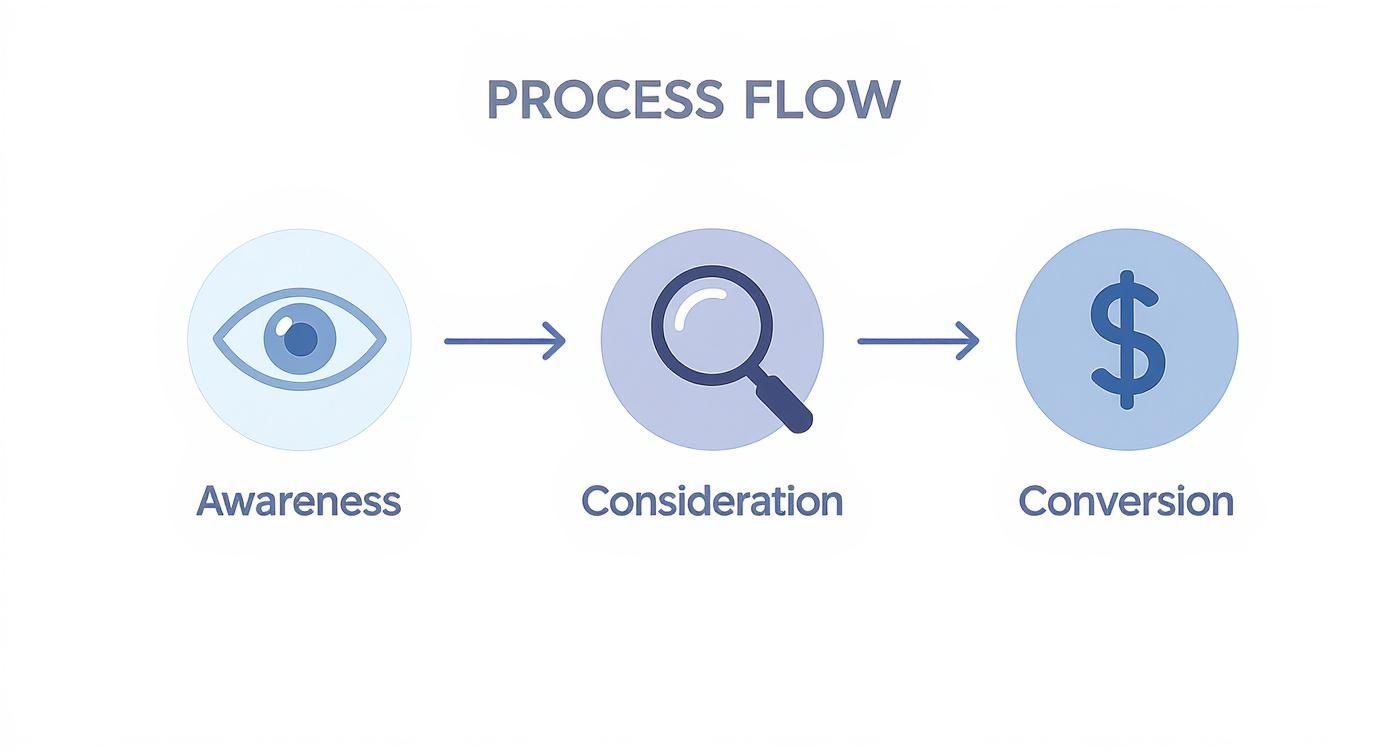
It’s a natural progression, with each step building on the trust earned in the one before it.
The Retention Phase: Turning Buyers Into Raving Fans
The sale isn't the finish line. It's the start of a whole new relationship. The way you treat a customer right after they buy is what turns them from a one-time purchaser into a true fan who buys from you again and again.
A killer post-purchase experience is all about automation and delight. Imagine this: someone buys your course at 2 AM. A platform like Zanfia instantly grants them access, adds them to your private community channels based on their purchase, and kicks off a welcome email sequence. That's instant gratification for them and a completely hands-off process for you, saving you 5-10+ hours a month in admin work.
Ultimately, building a community around your products is the best retention strategy there is. Unlike sending customers to external tools like Discord, integrating your courses and community under your brand on a unified platform boosts member retention and lifetime value, creating an ecosystem that people never want to leave.
Building Your Funnel Assets and Core Content
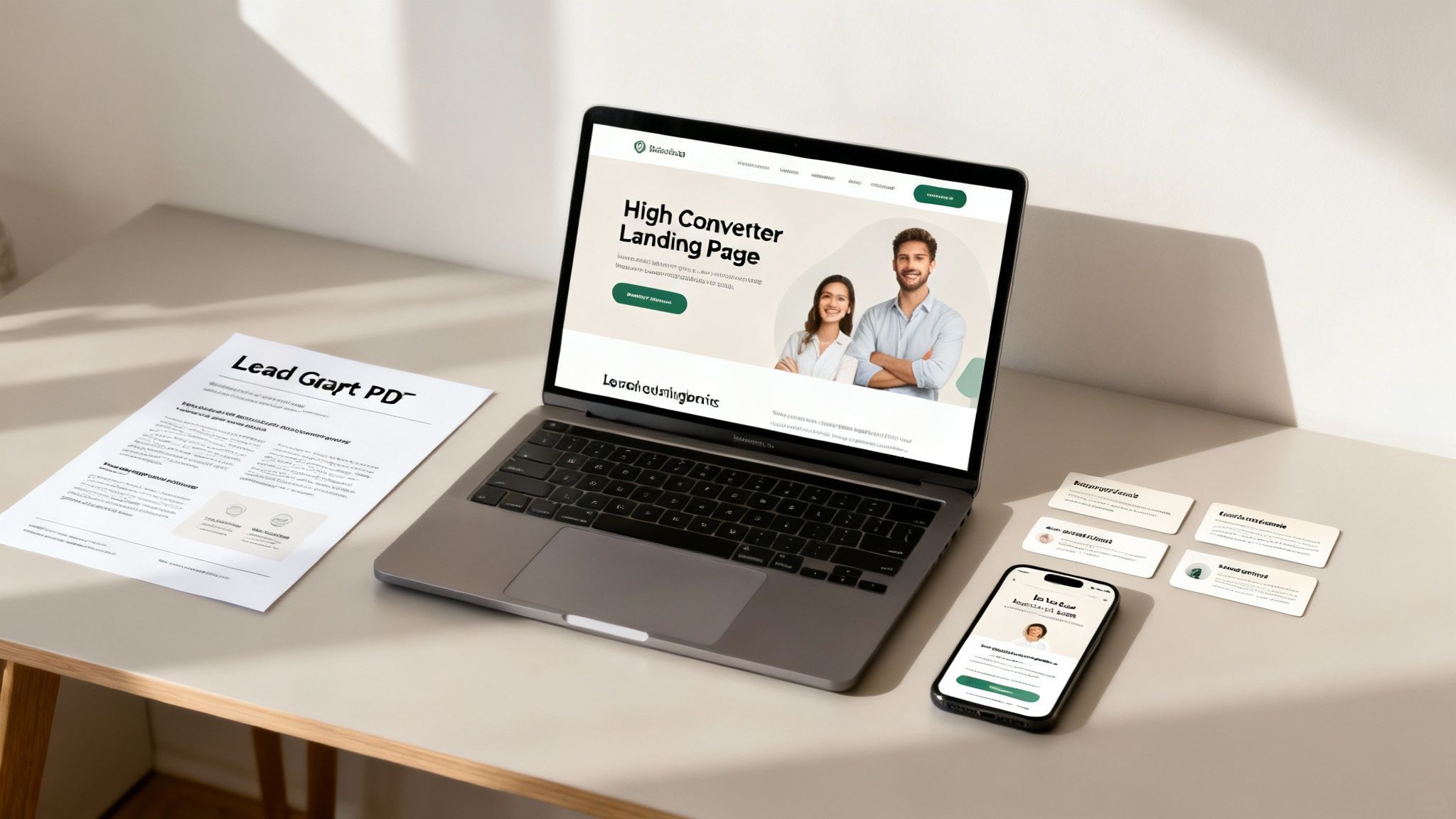
With your funnel map sketched out, it's time to get your hands dirty and build the actual assets. These are the pages, downloads, and content that will do the heavy lifting for you—the tangible touchpoints where people will interact with your brand.
Think of it like building a house. Your funnel map is the blueprint, but now you need to pour the foundation and put up the walls. This is where you create your compelling lead magnet, a high-converting landing page, a persuasive sales page, and a strategic thank-you page. Each piece has a specific job, and getting the details right is what separates a funnel that fizzles out from one that reliably generates sales.
Crafting a High-Converting Landing Page
Your landing page has one job and one job only: to convince someone to trade their email address for your lead magnet. That’s it.
The best landing pages are ruthlessly simple. They are completely free of distractions—no navigation menu, no links to your blog, just a clear, direct path to the sign-up form.
To make it effective, you’ll need:
- A Killer Headline: Don't just say what it is; communicate the result they'll get. Focus on the transformation.
- Benefit-Driven Copy: Use short, punchy bullet points to explain what they'll learn or achieve. Frame everything in terms of "what's in it for them."
- A Clear Call-to-Action (CTA): Use action words like "Download Your Free Guide Now" or "Get Instant Access." Make that button pop.
- Simple Visuals: A nice mockup of your e-book or a clean image representing the value you're offering goes a long way.
Using an all-in-one platform makes this so much easier. You can build the page, host your downloadable file, and hook it up to your email list without jumping between a dozen different tools. This lets you focus on what really matters: your copy and your offer.
Designing a Persuasive Sales Page
Okay, this is where the magic happens. Your sales page is your 24/7 salesperson, working to convince leads that your paid product is the answer they’ve been looking for. This page needs to be much more detailed than your landing page because you’re asking for money, not just an email.
A great sales page speaks directly to your prospect's pain points, dreams, and objections. The goal is to build such a powerful case for your product that buying it feels like the most natural next step. Our guide on how to create and sell digital products dives much deeper into crafting offers that people can't wait to buy.
Key Insight: A successful sales page tells a story. It starts by meeting the customer where they are (stuck and frustrated), shows them what's possible (the desired transformation), and then presents your product as the bridge to get them there.
You absolutely must include strong social proof here. As serial entrepreneur Artur Kurasiński says of Zanfia, it's “the most convenient and simplest solution for paid newsletters, courses and community on the Polish market.” Testimonials like these, screenshots of positive feedback, and case studies are non-negotiable. They provide that crucial third-party validation that helps people overcome their natural hesitation to buy.
Leveraging the Thank-You Page Strategically
So many creators treat the thank-you page as a throwaway, but it's a golden opportunity. Think about it: this is a page that 100% of your new subscribers will see, making it some of the most valuable digital real estate you own.
Instead of a boring "Thanks for signing up," you can use this page to deepen the relationship or even make your first sale.
Here are a few smart ways to optimize your thank-you page:
- Introduce a Tripwire: Offer a low-cost, high-value product (a "tripwire") that's a perfect next step. If they downloaded a checklist, maybe offer a $20 template pack that helps them implement it faster.
- Guide Them to Your Community: Nudge new subscribers to join your free Facebook group or paid community. This immediately brings them deeper into your world.
- Ask a Simple Question: Prompt them to reply to your first email with their biggest challenge. This starts a real conversation and gives you amazing market research.
Building these assets well takes a genuine understanding of your audience and a commitment to providing value at every turn. It's also critical to remember that most people won't buy right away. Shocking, I know. Data shows that a staggering 79% of marketing leads never convert simply because they aren't nurtured properly. This really hammers home the importance of the content and emails that connect all these pages. You can dig into more sales funnel statistics to see just how crucial that follow-up is.
Making Your Funnel Work for You 24/7 with Automation
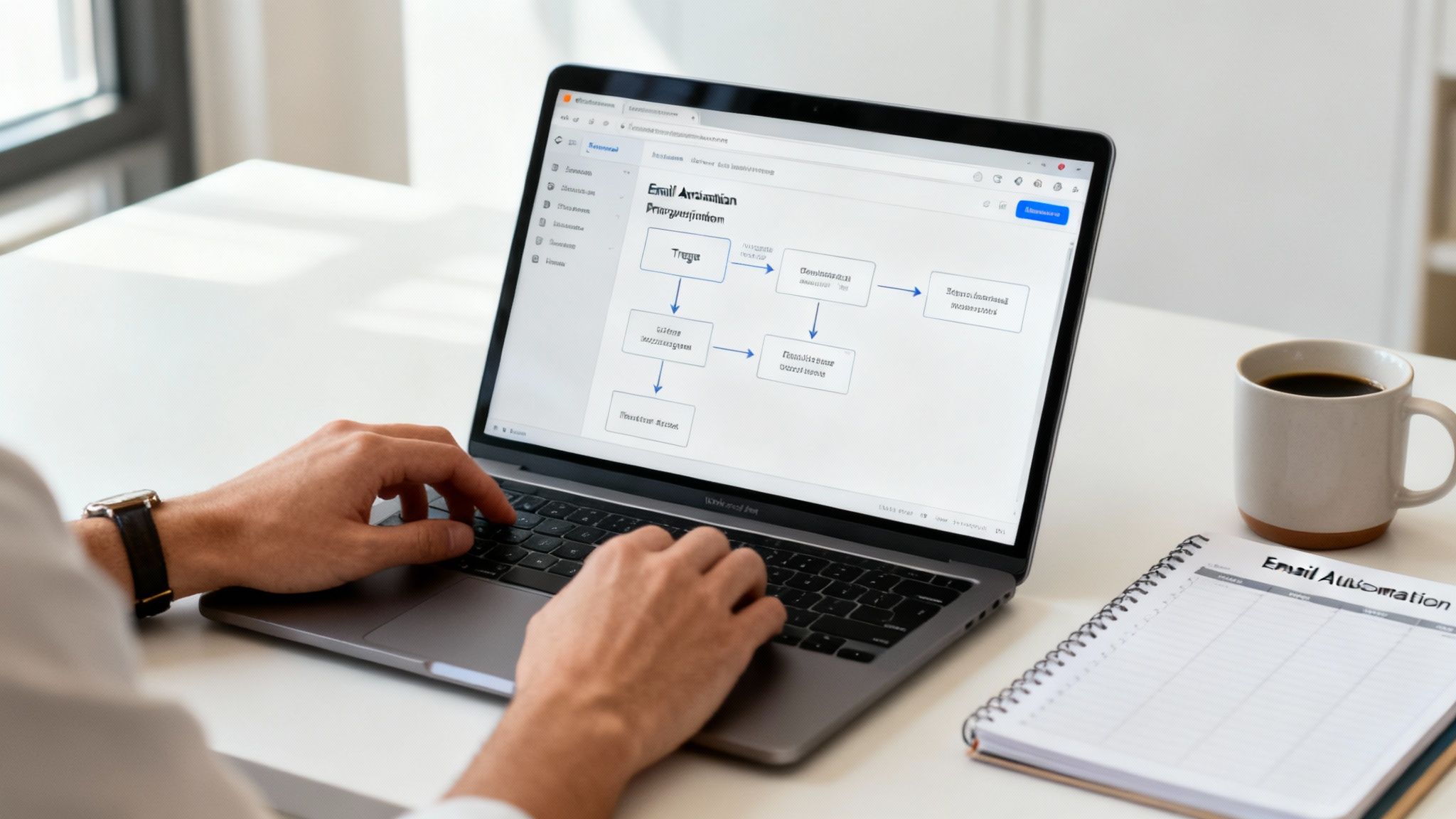
You’ve put in the hard work creating your lead magnet and crafting your funnel pages. But high-quality assets are only half the story. The real magic happens when you make them work for you around the clock, without you having to be there for every single interaction.
This is where automation comes in. It’s what transforms your funnel from a collection of static pages into a dynamic, self-running engine that grows your business.
Automation lets you give a personalized, timely experience to every person who enters your world, no matter when they find you. It’s the system that builds relationships, nurtures interest, and guides people toward a purchase while you're sleeping, creating new products, or coaching your existing clients. To truly scale, you need effective marketing automation to reclaim your time.
Set Up Your Welcome Email Sequence
Those first few moments after someone subscribes are your golden opportunity to make a killer first impression. A welcome email sequence is an automated series of messages designed to introduce your brand, deliver the goods (your lead magnet), and start building real trust from day one.
This isn’t just a single, boring "thanks for signing up" email. Think of it as a strategic conversation, dripped out over a few days.
Here’s a simple but powerful flow I've seen work time and time again:
- Email 1 (Immediately): Deliver the lead magnet you promised. No fluff. Just give them what they came for and briefly hint at what’s coming next.
- Email 2 (Day 2): Share a super valuable tip related to the lead magnet. This reinforces your expertise and proves you're not just another marketer.
- Email 3 (Day 4): Get a little personal. Tell a story about your own journey that connects with their struggles and goals.
- Email 4 (Day 6): Tackle a common misconception or answer a question you get all the time. This proactively handles objections before they even form.
- Email 5 (Day 7): Gently introduce your paid offer as the logical next step for getting even better results.
This carefully planned sequence warms people up, making your eventual offer feel like a helpful suggestion, not a hard sell.
Want to get this right? We break it down even further in our guide to drip campaign best practices. It’s full of actionable tips for writing emails that people actually want to open and read.
https://zanfia.com/blog/drip-campaign-best-practices/
Trigger Workflows Based on What People Actually Do
Next-level automation isn't about blasting the same message to everyone. It’s about setting up smart workflows that react to what your audience does. This makes your communication feel incredibly relevant because it is relevant.
Let’s say a user downloads your e-book on project management. An intelligent workflow might look like this:
- Trigger: User submits the form for the "Project Management Mastery" e-book.
- Action 1: Immediately tag them as interested in "Project Management."
- Action 2: Kick off the 5-part welcome sequence tailored to that specific topic.
- Action 3: After the welcome sequence ends, send an email about your premium "Productivity Powerhouse" online course.
- Trigger: They click the link to the course sales page but don’t buy.
- Action 4: Wait 24 hours, then automatically send a follow-up email showcasing a few student testimonials.
This is how a one-person business can provide the kind of personalized attention that makes you look like a much larger, well-oiled machine.
Automate the Post-Purchase Experience
The last, and arguably most important, piece of the automation puzzle is what happens after someone buys. A smooth post-purchase experience is your best defense against buyer's remorse and the key to turning a new customer into a loyal advocate.
This is where an all-in-one platform like Zanfia really shines. When someone buys your course or membership, the system can handle everything instantly and automatically:
- Grant Instant Access: The customer gets their login details and can dive into the content right away.
- Add to Community: They’re automatically added to the correct private community channels.
- Trigger Onboarding: A brand-new email sequence starts, welcoming them and walking them through the first steps to success.
- Generate an Invoice: A proper invoice is created and sent through a seamless integration with Polish accounting software like inFakt or Fakturownia, keeping your books clean.
For most creators, this kind of hands-off system frees up 5-10+ hours per month. You can say goodbye to administrative headaches and rest easy knowing every new customer is getting a flawless start.
Measuring and Optimizing Your Funnel Performance
Getting your sales funnel built is a huge milestone, but the work doesn’t stop there. Think of your funnel less like a finished project and more like a living, breathing part of your business. It needs regular check-ups and tweaks to keep it running at its best. This is where we shift from building to optimizing—turning guesswork into a data-driven strategy for real growth.
The goal isn't to get bogged down in a dozen different spreadsheets. It’s about zeroing in on a handful of key numbers that give you a clear snapshot of your funnel's health. When you know your data, you can spot the leaks, fix the weak spots, and make small changes that can have a massive impact on your bottom line.
Identifying Your Core Funnel Metrics
To really understand what's happening inside your funnel, you have to track the right numbers at each stage. It’s easy to get overwhelmed by data, so let’s focus on the metrics that matter most—the ones that directly tie to revenue.
Here’s what I always keep a close eye on:
-
Top of Funnel (Awareness): The big one here is your Landing Page Conversion Rate. This tells you exactly what percentage of visitors who see your lead magnet actually sign up. If this number is low, it’s a sign that your offer might not be compelling enough or your page copy isn't connecting with your audience.
-
Middle of Funnel (Consideration): Here, you want to watch your Email Click-Through Rate (CTR). This is a measure of engagement—it shows how many subscribers are actually clicking the links in your nurture emails. High open rates but a poor CTR often means your subject lines are doing their job, but the email content itself isn't motivating people to take the next step.
-
Bottom of Funnel (Conversion): Ultimately, it all comes down to the Sales Page Conversion Rate. This is the percentage of people who land on your sales page and follow through with a purchase. This single number is a powerful indicator of how well your offer, sales copy, and social proof are working together.
Beyond these stage-specific numbers, it’s also smart to keep an eye on your Customer Lifetime Value (LTV). This gives you a big-picture view of your business health, showing how much a customer is worth over the long haul. Understanding this helps you make much smarter decisions about your ad spend. We dive deeper into this in our guide on how to calculate your customer acquisition cost.
Spotting and Fixing Funnel Bottlenecks
Once you start tracking these metrics, you’ll quickly see where your funnel is leaking potential customers. A "bottleneck" is just any point in the process where a big chunk of people drop off. Finding them is the first step to plugging the leaks.
Here’s a classic scenario I see all the time: a lead magnet page is converting at a solid 25%, and the emails are getting a great 5% CTR, which drives plenty of traffic to the sales page. But then you look at the sales page itself, and it’s only converting at 0.5%. Boom. You’ve found your bottleneck. The problem isn’t a lack of interest; it’s something on that sales page that's stopping people in their tracks.
Key Takeaway: Data tells a story. A high click-through rate in your emails followed by a low sales page conversion rate means your audience is interested, but your offer isn't hitting the mark. This is your cue to revisit your sales page copy, strengthen your testimonials, or adjust your pricing.
To help with this, here's a quick reference table for the most important metrics to watch.
Key Funnel Metrics to Track for Optimization
This table summarizes the essential metrics for each funnel stage, what they measure, and the insights you can gain from them.
| Funnel Stage | Key Metric | What It Tells You |
|---|---|---|
| Top of Funnel | Landing Page Conversion Rate | The percentage of visitors who sign up for your lead magnet. This shows the effectiveness of your offer and headline. |
| Middle of Funnel | Email Click-Through Rate (CTR) | The percentage of email subscribers who click a link. This measures engagement and the relevance of your email content. |
| Bottom of Funnel | Sales Page Conversion Rate | The percentage of sales page visitors who make a purchase. This is the ultimate test of your offer, copy, and price. |
| Overall Health | Customer Lifetime Value (LTV) | The total revenue a customer generates over time. This informs your marketing budget and long-term strategy. |
Tracking these numbers gives you a clear, actionable roadmap for making improvements.
The Continuous Cycle of Optimization
Optimization isn’t a one-and-done task; it’s an ongoing process of testing and refining. A good place to start is by looking at industry benchmarks. Across most industries, the average sales funnel conversion rate tends to fall somewhere between 3% and 10%. The businesses that consistently get above 10% are usually the ones who are constantly testing and improving. You can discover more insights about funnel conversion rates on vwo.com to get a better sense of where you stand.
But don't get too hung up on those numbers—use them as a target, not a judgment. The most important thing is to establish your own baseline and work on improving it over time. Think about it: a small tweak that bumps your sales page conversion from 1% to 2% literally doubles your revenue from that funnel. That’s why measurement is absolutely non-negotiable for any serious creator.
Got Questions About Sales Funnels? We've Got Answers.
Jumping into sales funnels can feel like a big step, and it's totally normal to have questions pop up along the way. I've heard them all. Let's walk through some of the most common ones I hear from creators so you can move forward feeling clear and confident.
What’s the Easiest Sales Funnel to Start With?
If you're just getting your feet wet, keep it simple. The best starting point is a classic three-part funnel. Don't overcomplicate it.
First, you need a hook. This is your lead magnet—a super valuable freebie like a PDF checklist or a short video training. You'll offer this on a straightforward landing page in exchange for an email address. That's your door into the funnel.
Next comes the relationship-building part: an automated email sequence. Just 3-5 emails are all you need to start. Your goal here isn't a hard sell; it's to deliver value, build some trust, and gently introduce your paid product.
Finally, you have the offer itself on a dedicated sales page. This is where you sell your e-book, paid newsletter, or online course. This whole approach is fantastic because it minimizes the tech headaches while still doing the heavy lifting of warming up potential customers.
My Two Cents: Seriously, using an all-in-one platform makes this a thousand times easier. With a tool like Zanfia, you can build the landing page, set up the email workflow, and sell the product all under one roof. No more duct-taping three different services together, and you'll have peace of mind from professionally managed SaaS infrastructure.
How Long Does My Sales Funnel Need to Be?
This is a classic "it depends" situation, but the answer really hinges on the price and complexity of what you're selling.
For a low-cost, easy-to-understand product—say, a PLN 100 e-book—a short and sweet funnel is often all you need. We're talking a few days, maybe a week. The buying decision is small, so you don't need a massive, drawn-out campaign.
But if you're selling a premium course or a coaching program for over PLN 2,000, you have to play the long game. People need more time and more information to make a big investment. Your funnel might span several weeks and include more touchpoints—think a live webinar, in-depth case studies, or a multi-part video series. The key is to match the level of trust and value you provide to the price tag of the offer.
My advice? Always start with the simplest version first. You can add more layers once you see what your audience actually engages with.
How Can I Tell if My Funnel Is Actually Working?
You don't need a PhD in data science to figure this out. The secret is to ignore the vanity metrics and zoom in on the conversion rates at each critical step.
Here are the three big ones to watch:
- Landing Page Conversion Rate: What percentage of people who visit your landing page actually sign up for the freebie? This tells you if your initial hook is strong enough.
- Email Click-Through Rate: Are people opening your emails and then clicking the links inside? This is a direct measure of how engaged your new subscribers are.
- Sales Page Conversion Rate: Of all the people who make it to your sales page, how many pull out their credit cards and buy? This is the bottom line.
Forget industry benchmarks for a minute. Your most important job is to establish your own baseline and then try to beat it. If you see a huge drop-off at one of these stages, you've found your bottleneck. That’s exactly where you need to focus your energy. Good analytics will show you these numbers in plain sight, letting you make smart tweaks instead of guessing.
Ready to stop patching together a dozen different tools and build one seamless, automated sales machine that works for you 24/7? With Zanfia, you can create everything from your landing pages and email sequences to your online courses and paid communities—all in one place, with 0% platform transaction fees.
Start building your all-in-one online business with Zanfia today!