

How to Price Digital Downloads A Guide for Creators
Pricing your digital products isn't just about picking a number. It's the single most important lever you have for turning a creative passion into a real business. The biggest mistake creators make? Charging for their time. You need to stop that. Start charging for the value and the transformation you deliver.
Building Your Foundational Pricing Strategy
Before you even think about a price tag, you need to lay the groundwork. A solid pricing strategy is built on smart research and a deep understanding of your market—not a gut feeling. Getting this right from the start saves you from the classic creator pitfall of undervaluing your work and sets you up for actual profitability.
This foundation has never been more critical for creators, especially in markets seeing rapid growth. Your pricing is your ticket to the game, and a smart strategy ensures you capture the full value of your expertise.
Define the Transformation You Offer
Your first move isn’t to spy on your competitors. It's to look inward. You have to get crystal clear on the problem your digital product actually solves. People don't buy a PDF or a video course; they buy an outcome. They buy a solution.
Think about the "before" and "after" for your customer:
- Before: They’re overwhelmed, stuck, or struggling to figure something out.
- After: They’re confident, capable, and have a tangible result to show for it.
That gap between "before" and "after" is where your value lives. You have to be able to spell this out clearly. This is your value proposition—the promise you're making. To really nail this, check out our guide on how to build a powerful value proposition for your brand.
Conduct Smart Market Research
Okay, now you can look at the competition. But this isn't about copying their prices. It's about gathering intelligence to find your perfect spot in the market.
Pick a handful of creators who serve a similar audience and break down their offers:
- Pricing: What are the actual numbers on their sales pages?
- Offer: What’s included? Is it just a PDF, or are there video tutorials, templates, or community access?
- Positioning: Are they the cheap, entry-level option or the premium, go-to expert?
This analysis is how you find your opening. Maybe you see everyone else selling a basic e-book for $29. That's your cue. You can create a premium bundle with video walkthroughs and a private community for $97, positioning yourself as the far more complete solution.
Key Takeaway: Your goal is not to be the cheapest. It's to be the most valuable. Use competitor research to find the gaps and make your product the obvious choice for your ideal customer.
Calculate Your True Costs
Even with low overhead, digital products aren't free. You have to know your numbers to be profitable. This means factoring in both the hard cash you spend and the value of your own time.
- Software and Tools: Add up your monthly or annual bills for design tools, video editors, email platforms, and any other subscriptions. A true all-in-one platform can dramatically reduce these costs.
- Platform Fees: This one is huge. The platform you sell on can take a massive cut. Some platforms skim 5-10% off every single sale. Zanfia is built differently: an AI team runs your creator business behind the scenes, and the platform charges 0% commission on customer sales , so all you pay is the standard payment processor fee. That predictable, subscription-based model means more of every sale stays with you.
- Time Investment: Put a real number on your time. If you spent 50 hours creating a product and you value your time at $25/hour, that's a $1,250 investment you need to earn back.
Once you total these up, you'll know your break-even point. But remember, that’s your floor, not your ceiling. To build out a more advanced framework, you can explore some smart ways to price your online course for maximum profits.
Alright, you've done the groundwork on your costs and value. Now for the fun part: deciding how people will pay you. This is more than just slapping a price tag on your download; it's about choosing the engine that powers your revenue.
This isn't a random choice, but a strategic one that depends entirely on your product and your audience. This decision tree can help you visualize the paths available.
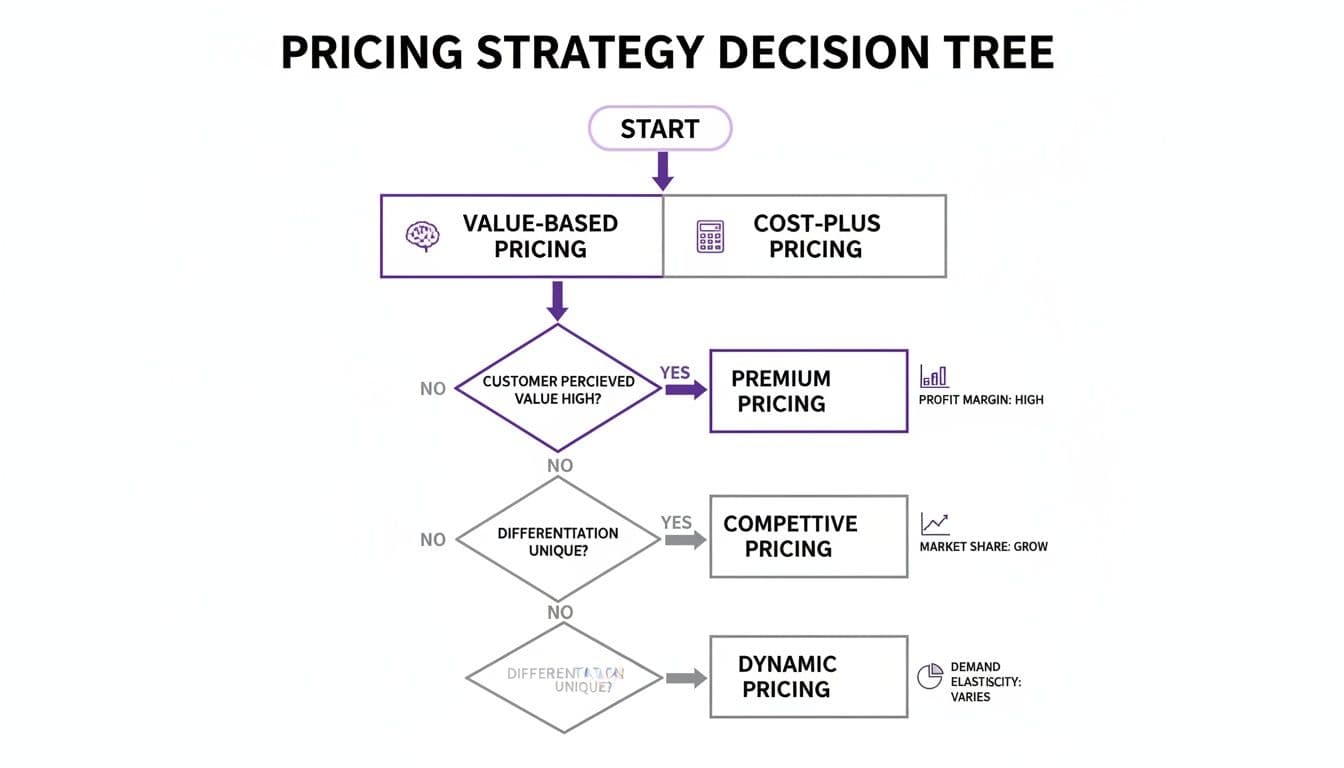
As you can see, while cost-plus pricing has its place, the most durable strategies for digital creators almost always start with value.
To make this decision clearer, let's break down the most common models you'll encounter. Each has its own strengths and is suited for different types of products and business goals.
Comparing Digital Product Pricing Models
This table gives you a quick-glance overview of the main pricing models, helping you match a strategy to your specific digital product.
| Pricing Model | Best For | Pros | Cons |
|---|---|---|---|
| One-Time Purchase | Self-contained products like e-books, templates, and standalone workshops. | Simple to understand; low barrier to entry for customers. | Revenue is tied to new sales; no recurring income. |
| Subscription/Membership | Ongoing content like paid newsletters, course libraries, and private communities. | Creates predictable, recurring revenue; builds long-term relationships. | Requires continuous delivery of value to prevent churn. |
| Tiered Pricing | Complex products like comprehensive courses or software with multiple feature levels. | Caters to different budgets; maximizes revenue from various customer segments. | Can be complex to manage; potential for customer confusion. |
| Bundles & Installments | Creators with multiple related products, or high-ticket offers that benefit from payment plans. | Increases average order value (AOV); installments make premium prices accessible. | Can devalue individual products if not priced carefully. |
By understanding these core differences, you can start to see which model naturally aligns with what you're offering and how you want to build your business.
One-Time Purchase Simplicity
The one-time purchase is the classic, straightforward approach. A customer pays once and gets lifetime access. It's clean, simple, and there are no surprises.
This model is a perfect fit for self-contained products that don't require ongoing updates:
- E-books and in-depth guides
- Digital art packs or design templates
- Single video workshops or tutorials
- An online course that stands on its own
The biggest win here is the low commitment for the customer. It feels like a safe, easy "yes." The trade-off? Your revenue is directly tied to your ability to find new customers. It's a constant hunt.
Subscription and Membership for Predictable Revenue
If your goal is to build a sustainable business with predictable income, the subscription model is your best friend. Customers pay a recurring fee—usually monthly or annually—for continuous access to your content, a community, or updates.
This is the go-to choice for products that deliver value over time. Think of a premium newsletter, an exclusive community, or a growing library of courses. With a platform like Zanfia, you can weave a paid community directly into your course offerings, and your AI team handles the day-to-day work of publishing, tagging and following up with members, either by chat or by voice command. That creates a powerful, sticky experience that justifies a recurring payment. If this model interests you, we have a deep dive on how to develop effective subscription pricing strategies.
Subscriptions transform your business from a series of one-off transactions into a sustainable, predictable revenue stream. This model shifts your focus from chasing the next sale to retaining and delighting the members you already have.
Tiered Pricing to Serve Different Segments
Tiered pricing is where you offer different versions of your product at different prices. The classic "Good, Better, Best" structure works wonders here. Each tier unlocks more content, more features, or more access.
For instance, if you're selling a course, you could structure it like this:
- Entry Tier: The core video lessons.
- Mid Tier: Videos, plus all the downloadable workbooks and templates.
- Top Tier: Everything above, plus access to a private community and monthly live Q&As.
This strategy is incredibly powerful. It lets you meet customers where they are, capturing everyone from the budget-conscious beginner to the professional who wants it all. You stop leaving money on the table.
Bundles to Increase Perceived Value
Bundling is the art of packaging several products together and selling the collection for less than the sum of its parts. It's a psychological powerhouse for increasing your average order value (AOV) and making an offer seem too good to pass up.
Imagine bundling an e-book, a related mini-course, and a set of design templates into a single "Creator's Starter Kit." The perceived value shoots through the roof, nudging customers toward the bigger purchase. For a more advanced take, looking into AI-powered bundle pricing strategies can really optimize your AOV.
Modern creator platforms like Zanfia give you the flexibility to experiment without getting locked in. You can sell a course as a one-time purchase, offer it as part of a recurring subscription, split a $600 course into four installments, and include it in a high-value bundle—all from the same checkout. Twelve product types live under one brand, so as your offer evolves, your pricing strategy can evolve with it.
Applying Pricing Psychology to Boost Conversions
The price on your sales page is more than just a number. It's a powerful signal, a story you tell your customer about your product's quality, confidence, and value. After you've locked in a pricing model, the next move is to present that price in a way that clicks with human psychology. Let's break down how to ethically use proven principles to make your pricing irresistible and guide customers to a confident "yes."
This isn't about deception. It's about understanding how perception drives decisions and using that knowledge to frame your offer in its most compelling light.
Leverage Charm Pricing to Reduce Friction
You see it everywhere for a reason: prices ending in 9, 7, or 5. This is charm pricing, and it works because of a cognitive shortcut called the "left-digit effect." Our brains read left to right, anchoring our perception of a price to the very first digit we see.
Because of this, a price like $97 feels significantly cheaper than $100, even with a minimal actual difference. The brain latches onto the "9," mentally filing it in the "ninety-something" category, which makes the purchase feel less substantial.
- Instead of $50 , try $49 or $47 .
- Instead of $200 , try $197 .
This small tweak can subtly reduce buying friction and increase conversions without forcing you to make deep cuts to your revenue.
Use Price Anchoring to Highlight Value
Price anchoring is a classic and powerful technique. You simply introduce a higher-priced option first to make your main offer seem far more reasonable in comparison. When a customer sees that initial high price, it becomes the reference point for every other price they see.
For example, on a sales page, you might stack your tiers like this:
- The Premium Bundle – $497: Includes the main course, private community access, and 1:1 coaching.
- The Main Course – $197: The complete course plus all templates. This is your target offer.
- The E-book Only – $47: A standalone guide for a smaller commitment.
After seeing the $497 option, the $197 price for the main course suddenly looks like an incredible deal. You’ve successfully framed your core product not as a cost, but as a smart, value-packed investment. To go deeper on these nuances, check out our complete guide on pricing psychology strategies.
Frame the Price to Create Context
A number in a vacuum has no meaning. How you frame it provides the crucial context that helps a customer justify the purchase. A price of $197 might feel steep on its own, but reframing it can change the entire perspective.
Compare your product's price to a small, common expense. A $197 course, framed as "less than your daily coffee for one month," immediately becomes more manageable.
This contextualization shifts the customer’s focus from what they’re spending to what they’re gaining. They aren't just paying $197; they’re investing a familiar, tiny amount to solve a major problem or acquire a valuable skill. It's a proven approach, especially in a market where customers are already primed to buy.
By combining these psychological tactics, you move beyond just slapping a number on a page. You start strategically guiding your customer’s journey, helping them see the immense value you deliver and feel genuinely good about their decision to invest.
Protecting Your Profits by Choosing the Right Platform
That price tag you just put on your product? It's not what you'll actually pocket. After all the hard work of creating something valuable, hidden platform fees and transaction commissions can quietly eat away at your revenue. This is why your choice of platform isn't just a technical decision—it's one of the biggest financial calls you'll make for your business.

To protect your bottom line, you have to get familiar with the fee structures out there. Knowing how they really impact your profit on each sale is the only way to choose a partner that helps you grow, instead of one that just takes a bigger and bigger slice of your success.
The Two Main Fee Models
When you're selling digital downloads, you'll generally run into two types of platform fees. The one you choose will make a massive difference to your bank account.
- Percentage-Based Fees: A lot of platforms take a cut from every single sale. This can be anywhere from 5% to 10% (or even more), and that’s on top of the standard payment processing fees from Stripe or PayPal.
- Flat SaaS Subscription: Other platforms, like Zanfia , operate on a clean SaaS model. You pay a predictable monthly or annual fee and, as of publication, they take 0% commission from your sales. You keep all your revenue, minus the unavoidable processor fees.
At first glance, a percentage fee can seem tempting, especially if you're just starting out with low sales. But as your business scales, those "small" percentages become a serious drag on your income.
How Platform Fees Erode Your Margins
Let's run the numbers. Imagine you sell a digital product for $100. You're making 100 sales a month, bringing in $10,000 in revenue. We'll factor in a standard payment processing fee of roughly 2.9% + $0.30 per transaction.
Here’s how it breaks down:
| Metric | Platform with 10% Fee | Platform with 0% Fee (like Zanfia) |
|---|---|---|
| Gross Revenue | $10,000 | $10,000 |
| Platform Commission | – $1,000 (10%) | – $0 (0%) |
| Payment Processor Fees | ~ $320 | ~ $320 |
| Your Take-Home Profit | ~ $8,680 | ~ $9,680 |
In this scenario, that 10% platform fee costs you $1,000 every single month. For creators doing five and six figures a month, that lost revenue quickly adds up to tens of thousands of dollars a year. That’s money that should be going into your marketing budget, new content, or your own pocket.
By choosing a platform with a 0% transaction fee model, you ensure that your platform costs stay fixed and predictable. You are rewarded for your growth, not penalized for it.
Beyond Fees: Finding a True Partner
Your platform should do more than just take payments—it should be a partner in your growth. A real all-in-one system helps you scale efficiently without tacking on extra costs. Zanfia takes this a step further: an AI team runs the business day to day, and the creator directs it by chat or by voice instead of clicking through settings. Anything you can do in the interface, you can dictate out loud.
An integrated environment saves you both time and money. For instance, Zanfia offers native video hosting, eliminating the need for costly external services. It also keeps your community, courses, and digital downloads unified under your own brand, which dramatically boosts engagement and member retention. Selling is built in too: a checkout with order bumps, installments and upsells, test mode so you can buy your own product before launch, and twelve product types living under a single brand. When you're ready to weigh your options, our guide on the best platforms to sell digital products is a great place to start comparing features and finding the right fit.
Ultimately, knowing how to price your work also means knowing how to protect your profits. Choosing a platform that charges 0% on transactions isn't a small perk—it's a core business strategy that directly fuels your ability to build a sustainable, profitable online brand.
Testing and Refining Your Prices for Long-Term Growth
Pricing a digital product isn’t a one-and-done task. The sharpest creators I know treat it as a living, breathing part of their business. Your initial price is just a starting point—an educated guess. The real money is made by testing, listening, and making data-backed adjustments.
This shifts pricing from a source of anxiety to your most powerful growth lever. The goal isn't just to find a price, but the optimal price that maximizes total revenue and builds a healthy, sustainable business. Every sale, every piece of feedback, is a clue.
Running Simple A/B Tests to Find Your Sweet Spot
The most direct way to get this right is A/B testing. It sounds technical, but it’s really just comparing two prices to see which one performs better in the wild.
For example, you could pit a $49 version of your e-book against a $59 version. Half your visitors see one price, half see the other. The trick is to look beyond the conversion rate. A lower price might get more individual sales, but the higher price could easily bring in more total revenue.
- Scenario A ($49 Price): 100 sales = $4,900 in revenue
- Scenario B ($59 Price): 90 sales = $5,310 in revenue
In this case, Scenario B is the clear winner. You made over $400 more despite having fewer customers. That’s an insight you’d never get from guesswork alone.
Key Metrics to Track for Pricing Insights
To really understand what your pricing is doing, you need to watch the right numbers. Your analytics dashboard is telling you a story about how customers perceive your product's value.
You need to focus on a few essentials:
- Conversion Rate: What percentage of visitors actually buy?
- Total Revenue: The top-line income from all your sales.
- Average Order Value (AOV): How much does a customer typically spend in one transaction?
- Customer Lifetime Value (LTV): The total revenue you can expect from a single customer over their entire relationship with you.
Platforms with deep analytics built-in, like Zanfia, are invaluable here. They give you a clear view of your sales funnel, letting you see exactly how price changes affect what users do. You can even ask your AI team, out loud or in chat, to summarize what changed after a price test, instead of digging through dashboards yourself. For a deeper dive, check out our guide on conversion rate optimization strategies.
Key Takeaway: Stop obsessing over conversion rates alone. Your north star should be maximizing total revenue and customer lifetime value. A slightly lower conversion rate at a higher price is almost always the more profitable move.
Gathering Qualitative Feedback to Understand Perceived Value
Numbers tell you what happened. Talking to your customers tells you why. You need to get inside their heads to understand their perception of your product’s value.
This is easier than it sounds. A short, post-purchase survey can work wonders. Just ask a few simple questions:
- "What was the single biggest reason you decided to buy today?"
- "On a scale of 1-10, how would you rate the value for the price you paid?"
- "Was there anything that almost stopped you from purchasing?"
The answers you get back are pure gold. They might reveal that customers would have happily paid more, point out the one feature that sealed the deal, or uncover a pricing objection you never even thought of. This is the feedback that gives you the confidence to make your next move.
When and How to Raise Your Prices
As your product gets better, your price should, too. So many creators are terrified of raising their prices because they fear backlash. But when you do it right, a price increase actually reinforces your product's quality and boosts your bottom line.
The absolute best time to raise a price is right after a significant product update.
- You added new modules to your flagship course.
- You included a fresh set of templates in a resource pack.
- You launched a private community space for customers.
Frame the announcement around the new value you just delivered. Be completely transparent. Announce the price change ahead of time and give your audience one last chance to buy at the old price. This creates a bit of urgency, rewards your loyal followers, and fairly resets the value proposition for new customers. These updates are way easier when your platform helps you: with Zanfia, you can tell your AI team to grant access after a purchase, tag the new buyers and kick off the follow-up sequence, either by chat or by voice. That kind of dictation-first workflow can save you 5-10+ hours a month, freeing you up to create that new value in the first place.
Common Pricing Questions Answered
Even with a solid framework, a few nagging questions always seem to surface right when you’re about to set your price. It’s completely normal.
Let’s tackle the most common uncertainties we see creators grapple with, so you can price your digital downloads with total confidence.
What Is the Biggest Mistake Creators Make When Pricing?
Hands down, the biggest and most costly mistake is under-pricing. It’s almost always driven by a lack of confidence or a nasty case of "imposter syndrome."
Creators get stuck pricing based on what they think they would pay, completely ignoring the massive transformation their product delivers to a customer with a very real, very urgent problem. This doesn't just leave a huge pile of cash on the table; it can also signal to potential buyers that your product is low-quality.
The fix is a mental shift. Anchor your price to the tangible outcome you provide, not the digital file you're sending.
How Do I Price a Digital Product with No Direct Competitors?
First off, that’s a fantastic position to be in. It means you get to define what the solution is worth. But it doesn't mean you're pricing in a vacuum.
Instead of looking for direct competitors, you need to hunt for "solution competitors." What are people currently doing to solve the problem your product fixes? What are their alternatives?
Think about it this way:
- Does your e-book replace a pricey one-on-one consultation?
- Does your template save a business owner hours of tedious design work?
- Does your online course teach a skill that could help someone land a raise?
Put a number on that return on investment (ROI). If your course helps a client avoid a $1,000 consultation, a $249 price tag suddenly looks like an incredible deal. That tangible benefit is your new pricing anchor. From there, you can introduce a tiered model to capture different segments of the market.
When you're the first to market, you aren't just selling a product; you're educating customers on what the solution is truly worth. Price based on the value you create, not the competition that doesn't exist.
Should I Offer Discounts on My Digital Downloads?
Yes, but you have to be strategic. Throwing out discounts randomly is a fast way to devalue your brand and train your audience to only buy when there's a sale.
The goal isn't to look desperate; it's to create urgency and reward your best customers.
Instead of constant sales, tie promotions to specific, time-sensitive events:
- A brand new product launch
- Your business anniversary
- Annual sales events like Black Friday
Even better, offer bundle discounts or a reduced rate for annual subscriptions (like "get 2 months free"). These tactics increase your average order value without cheapening your core product. Remember, strategic scarcity will always outperform constant availability.
How Does a 0% Transaction Fee Platform Help Me Set Prices?
Using a platform with 0% transaction fees, like Zanfia, gives you absolute pricing clarity and stronger profit margins. It's simple math.
When other platforms skim 5-10% off every single sale, you're forced into a corner. You either have to eat that cost (shrinking your profit) or inflate your price (which could make you less competitive).
With a 0% fee model, the price you set is almost exactly what you take home, minus the standard, unavoidable payment processor fees. On a $100 sale, you might keep ~$96.80 on Zanfia versus just ~$86.80 on a competitor's platform.
That extra margin gives you incredible freedom. You can price more strategically, run ads, invest back into your business, and actually feel rewarded for your work. On top of that, Zanfia is built to sell: an AI team runs the business behind the scenes (dictate by chat or voice), the checkout supports order bumps, installments and upsells, and a test mode lets you buy your own product before launch to make sure everything works. Plans and packaging are plan-dependent, so check the current Zanfia pricing for what's included on your tier.
Ready to stop giving away your profits and start building your business on a platform designed for creators? With Zanfia, you get a true all-in-one solution with 0% platform commission, integrated community tools, an AI team you can direct by chat or voice, and a checkout built to sell, all under your own brand. Start building your online business with Zanfia today.