

How to Sell Digital Products: A Guide for Creators

Selling digital products isn't just about creating something cool; it's about solving a real problem for a specific group of people. The secret sauce is starting with a rock-solid foundation by validating your idea before you pour your heart and soul into it. This simple step is what separates the products that fly off the virtual shelves from those that collect digital dust.
Building Your Digital Product Foundation

Before you even think about designing a logo or recording a single video, you need a blueprint. The path from a spark of an idea to a profitable product is paved with strategy, not just creativity. It's all about finding that sweet spot where your expertise meets a genuine customer need.
The opportunity here is massive. Global e-commerce is on track to smash $8 trillion by 2027, and the online learning market is projected to hit an incredible $840 billion by 2030. This isn't just a trend; it's a fundamental shift in how people learn, grow, and solve their problems.
Pinpoint a Specific Pain Point
Every great digital product starts with a problem. Don't ask, "What can I make?" Instead, ask, "What problem can I solve for someone?" Your knowledge is the tool, but the pain point is the target.
To get your gears turning, think about:
- What are the questions you get asked over and over again?
- What’s a struggle you personally conquered that others are now dealing with?
- Is there a common frustration in your niche that everyone complains about but no one has an easy fix for?
Imagine a freelance graphic designer who constantly sees small business owners fumbling with their social media visuals. That's a clear pain point. Instead of launching a generic "design course," they could create a hyper-specific "Canva Template Pack for Instagram Branding." This targeted solution is far easier to market because it solves one problem, and solves it well.
Choosing the Right Digital Product for Your Audience
Matching your product format to your audience's needs is crucial. A busy professional might not have time for a 20-hour course but would gladly pay for a set of time-saving templates. This table can help you connect your expertise to the right product type.
| Digital Product Type | Best For Creators Who… | Solves This Customer Problem |
|---|---|---|
| E-books & Guides | Are strong writers and want to share foundational knowledge. | "I need a comprehensive, self-paced resource to understand a topic." |
| Online Courses | Excel at teaching and breaking down complex subjects into steps. | "I need structured, in-depth guidance to achieve a specific outcome." |
| Templates & Presets | Have a proven system or aesthetic others want to replicate. | "I want professional results without the steep learning curve or time investment." |
| Workshops/Webinars | Are engaging speakers and can solve a problem in a live setting. | "I need a quick win and the chance to ask an expert questions directly." |
| Memberships/Communities | Enjoy fostering connections and providing ongoing support. | "I need continuous learning, accountability, and a network of peers." |
Thinking through these options helps you move from a vague idea to a tangible product that your audience will actually find useful and be willing to pay for.
Validate Your Idea Before You Build
The single biggest mistake I see new creators make is building in a vacuum. They spend months perfecting a product, only to launch to the sound of crickets. Validation is your insurance policy—it’s getting a real signal from your audience that they want what you're planning to build.
Your first product doesn't need to be your masterpiece. Think of it as your Minimum Viable Product (MVP)—the simplest version you can offer to test the market, get feedback, and build some early momentum.
For example, a fitness coach dreaming of a huge 12-week workout program could first create a simple, one-week meal plan PDF. Selling this for a small price is a brilliant way to test the waters. If 50 people happily buy that meal plan, it’s a powerful sign that a bigger, more expensive program is a great next step. If you're new to this, you can learn more from our guide on what digital downloads are and how they can be a great starting point.
Start Small to Win Big
Some of today's most successful creators didn't start with a high-ticket flagship course. They started small, building trust and a list of actual buyers along the way.
- E-books and Guides: These are perfect for packaging your core knowledge into something someone can buy and use immediately.
- Workshops or Webinars: A live session can solve a very specific problem while building a powerful, personal connection with your audience.
- Templates or Checklists: Give people a tool that saves them time and energy. It's an instant win for them and an easy sale for you.
Starting with a smaller offer lets you learn the ropes of selling without getting overwhelmed. You’ll figure out your marketing message, understand what makes your customers tick, and collect those all-important testimonials. Each small win provides the fuel and the foundation for your next, more ambitious launch.
Picking the Right All-In-One Sales Platform

Figuring out how to sell your digital products is easily one of the biggest decisions you'll make. This isn’t just a tech choice; it's a core business decision that shapes your brand, your customer’s experience, and ultimately, how much money you actually keep. You’ve got a few paths you can take, and honestly, they come with some serious trade-offs.
A lot of people start by trying to patch together a solution using WordPress plugins. It gives you control, sure, but it can quickly turn you into a part-time IT manager. You'll find yourself constantly wrestling with updates, security fixes, and plugins that suddenly don't want to play nice with each other. Every hour spent on that is an hour you're not creating or connecting with your audience.
Then there's the marketplace route, like selling on Etsy. They give you a built-in audience, which is tempting, but you're essentially building your business on someone else's property. Your branding is limited, and you're handing over a slice of every single sale. That really starts to add up as your business grows.
Own Your Brand, Own Your Customer Experience
For creators who are serious about building a long-term business, an all-in-one platform is the most strategic move. This approach brings everything—your courses, community, e-books, subscriptions—under one roof.
This is about more than just convenience. When everything operates from your own custom domain, you’re building an independent, powerful brand. Your customers are interacting with you, not a generic platform. That full white-label control is a game-changer for experts who want their reputation to shine.
"If you plan to sell digital products and build a community of paying customers, Zanfia is the best solution.”
– Mateusz Grzywiński, EFL Teacher
This unified setup also creates an incredibly smooth experience for your customers. They use a single login to watch your courses, jump into community chats, and buy your next product. That kind of seamless integration is what boosts engagement and customer lifetime value—two metrics that are absolutely essential for a sustainable online business.
Why a Unified System Protects Your Bottom Line
One of the sneakiest ways platforms eat into your profits is through fees. Many will hit you with transaction fees on top of a monthly subscription. So, as your sales climb, the amount you're losing to commissions climbs right along with it.
This is where a transparent SaaS model is a breath of fresh air. A platform like Zanfia, for instance, charges a flat zero-percent (0%) transaction fee. The only fees you pay are the standard ones from payment processors like Stripe or PayU. For a creator pulling in PLN 10k–100k+ a month, that can translate to thousands saved every year. That’s money you can pour back into marketing or product development.
This model shows that the platform's success is tied to yours. They grow with you, not by taking a bigger and bigger piece of your pie. To get a better handle on all the possibilities, check out our deep dive on choosing the right platform to sell digital products for your unique business.
Finally Escape the Technical Headaches
Let's be real: for many experts, the fear of technology is a huge roadblock. I see it all the time with "Potential Explorers"—people with incredible knowledge who are stuck in pre-launch paralysis because the tech feels overwhelming. An all-in-one platform is designed to completely remove that barrier.
Instead of trying to sync separate services for video hosting, community forums, and e-commerce, you get one professionally managed solution. Just think about what this means:
- Native Video Hosting: Forget paying for separate, costly services like Vimeo or Wistia just to securely host your course videos. It’s built right in.
- Integrated Community: Your audience isn't scattered across a Discord server or a Facebook Group. They're right there, inside your ecosystem, which is a massive boost for retention.
- Automatic Invoicing: The system can connect directly with accounting tools like inFakt or Fakturownia, putting all that financial admin on autopilot.
When you choose a platform built to handle the heavy lifting, you're free to do what you actually love—creating amazing content and building relationships with your audience. As veteran developer Daniel Roziecki put it, a reliable platform gives you "peace of mind," so you can focus on delivering value, not fighting with tech.
Creating an Engaged Customer Community
Selling a digital product can feel like a one-and-done deal. A customer buys your e-book, downloads your template, and that’s it. But I've learned from years in this space that the most successful creators see that first sale as just the beginning. The real, sustainable growth happens when you turn that single purchase into a long-term relationship. And the best way to do that? A thriving community.
A community transforms one-time buyers into your biggest fans. It's your best defense against customer churn, a direct line to priceless feedback for your next product, and a powerful way to increase the lifetime value of every single person who invests in your work.
The Power of an Integrated Experience
Here’s where a lot of creators go wrong: they outsource their community. They send their paying customers to a chaotic Facebook group or a generic Discord server. This completely dilutes your brand and forces them to engage with you in a space filled with endless distractions. It shatters the seamless experience you’ve worked so hard to build.
Keeping your community and your content under one roof is a total game-changer. Imagine a student watching a lesson in your course and being able to jump directly into a dedicated discussion channel to ask a question—all without ever leaving your branded ecosystem.
This is exactly what platforms like Zanfia are built for. By keeping everything on your own turf, you create a much stickier, more professional experience.
- A single login makes it easy for members to access everything—courses, discussions, and future purchases.
- Topical discussion channels keep conversations organized and on-point. No more endless scrolling to find what you need.
- Read-only announcement channels are perfect for getting important updates out without the noise.
- Seamless integration lets you link course modules directly to relevant community spaces.
This setup makes your customers feel like they're part of something exclusive—your world, not a social media giant's. As you lay the groundwork, it’s worth looking into proven community building strategies to make sure you start strong.
Sparking Conversations and Driving Engagement
Just opening the doors to a community space isn't enough. You have to be the one to light the fire. Your role has to shift from just "content creator" to "community leader." The goal is to make this the go-to place for your members to connect, learn, and feel genuinely supported.
A digital product without a community is a lecture. A digital product with a community is a conversation. One creates a customer; the other creates a loyal fan.
To get things moving, focus on creating consistent connection points. Start a weekly "Ask Me Anything" (AMA) thread where members can get direct access to your brain. Post a thought-provoking question related to a specific course lesson to get people talking. You could even organize members into smaller, more intimate groups based on their purchase or progress.
From One-Time Buyers to Brand Advocates
Before you know it, an engaged community becomes a self-sustaining ecosystem. Your most experienced members will start answering questions from newcomers, sharing their wins, and encouraging others along the way. This doesn't just save you time—it builds powerful social proof right inside your platform.
This is how you turn a simple transaction into a long-term asset. These are the people who will buy your next product without a second thought, sign up for your high-ticket membership, and become your most vocal champions.
By building your community on your own platform, you retain full control over this invaluable asset. For a deeper look at the nuts and bolts, our guide on creating online communities offers even more actionable steps. Ultimately, this isn’t just a nice-to-have; it's a core part of learning how to sell digital products successfully for years to come.
Launching Your Digital Product Effectively
So, you’ve poured your heart and soul into creating an amazing digital product. That’s a huge win, but let's be real—that’s only half the job. A brilliant product won't just sell itself; you need a launch strategy that creates real buzz and excitement.
This is where you shift from being a creator to being a marketer. The goal isn't to push a hard sell but to build genuine authority and guide your ideal customers toward the solution you’ve built for them. When you show up and consistently provide value, buying your product feels like the most natural next step for your audience.
Building Your Audience with Content Marketing
Before anyone will buy from you, they need to know you, like you, and trust you. Hands down, the best way to build that relationship is through content marketing. It’s how you establish yourself as the go-to expert and naturally draw in people who are already looking for what you offer.
Your digital marketing efforts are a huge piece of this puzzle. Blogging is still a powerhouse—in fact, 76% of marketers use it to pull in organic traffic. At the same time, short-form video has been shown to bump conversion rates by a staggering 80%. And with the top spot on Google getting nearly 40% of all clicks, you can't afford to ignore your content and SEO strategy. You can dig into more of these fascinating digital marketing statistics on Hostinger.
Here’s how to put that into practice for your launch:
- Solve Problems with Blog Posts: Write articles that directly tackle the pain points your digital product solves. This does more than just boost your SEO; it pre-qualifies every reader as a potential customer.
- Connect with Short-Form Video: Jump on platforms like Instagram Reels, TikTok, or YouTube Shorts. Share quick tips, a peek behind the scenes, or valuable little nuggets of wisdom. Video builds that personal connection way faster than text ever could.
- Create an Irresistible Lead Magnet: Offer a high-value freebie—like a checklist, a handy template, or a mini-guide—in exchange for an email. This is the crucial bridge that turns a casual follower into an email subscriber.
Your Email List Is Your Biggest Launch Asset
Social media is fantastic for getting discovered, but your email list is where the real sales happen. Think about it: it's a direct, personal line to your most dedicated followers—the people who have literally asked to hear more from you.
Your main job during the pre-launch phase is to grow that list. Once people sign up, nurture them. Send them valuable content that isn't a sales pitch. Share your story, offer exclusive tips, and ask them about what they're struggling with. You're building a foundation of trust, so when you do launch, it feels less like a pitch and more like a helpful recommendation from a friend.
"Your email list is your own private audience. You're not subject to algorithm changes or platform outages. It's the most reliable and profitable asset you can build for your digital business."
Crafting a Launch That Builds Momentum
A great launch isn't just one big "buy now" announcement. It's a carefully planned sequence of events designed to build anticipation and drive people to take action.
This is all about turning an audience of passive observers into a community of advocates. You do that by sparking their interest, engaging them directly, and ultimately earning their loyalty.
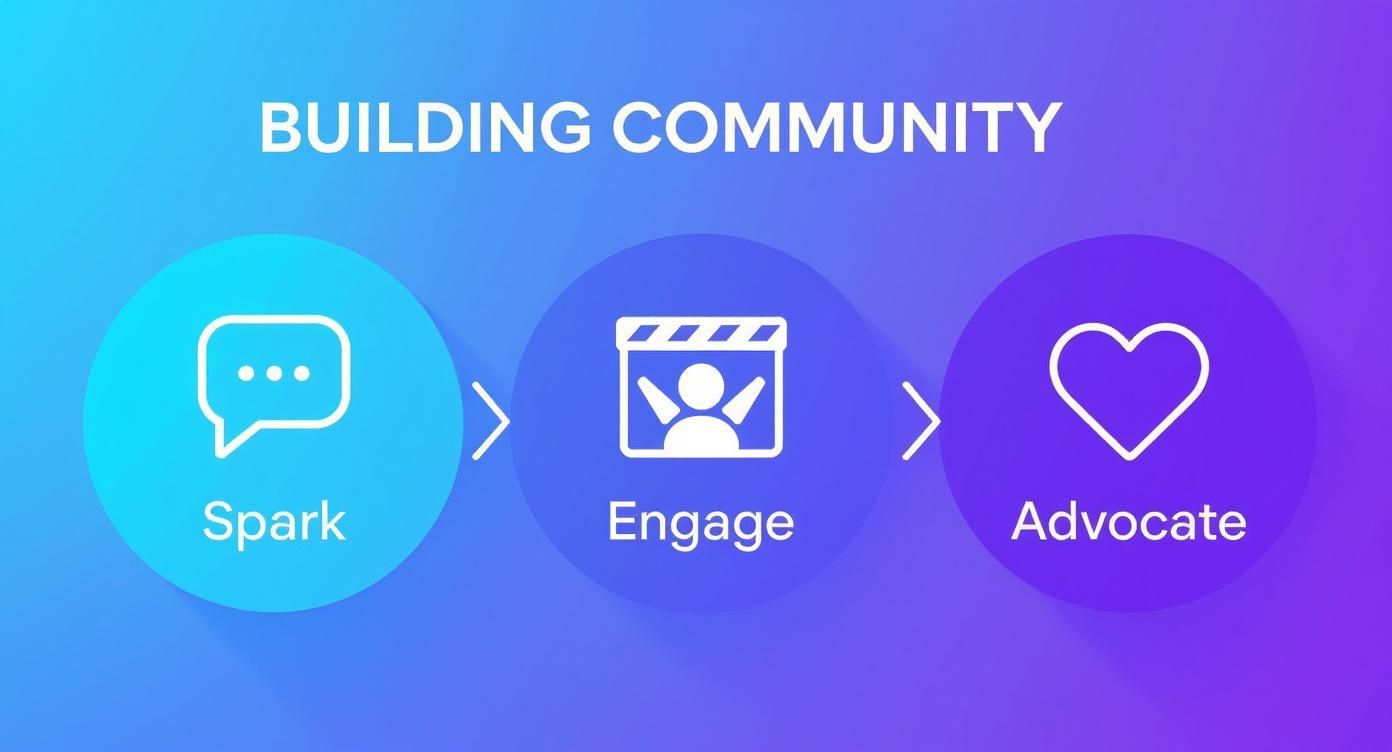
As you can see, a successful launch is built on real connection. It’s about transforming followers into genuine supporters of what you're building.
To help you map this out, I've put together a checklist that breaks down the entire launch process.
Here's a step-by-step checklist to guide your launch strategy. It covers everything from pre-launch activities to post-launch follow-up, ensuring no critical step gets missed along the way.
Your Digital Product Launch Checklist
| Phase | Key Action | Objective |
|---|---|---|
| Pre-Launch (4-6 weeks out) | Define target audience & validate product idea. | Ensure you're building something people actually want and will pay for. |
| Pre-Launch (2-4 weeks out) | Create lead magnet & start building email list. | Grow an engaged audience to launch to. |
| Pre-Launch (1-2 weeks out) | Begin "warm-up" sequence via email & social media. | Build anticipation and prime your audience for the offer. |
| Launch Week (Day 1) | Open the cart with an early-bird offer. | Drive initial sales momentum and reward eager buyers. |
| Launch Week (Mid-Week) | Share testimonials, case studies, and social proof. | Overcome objections and build trust with real-world results. |
| Launch Week (Final 48 Hours) | Announce cart is closing & create urgency. | Encourage fence-sitters to make a decision. |
| Post-Launch | Send a thank-you sequence to new customers. | Onboard new customers and reduce buyer's remorse. |
| Post-Launch | Survey non-buyers to gather feedback. | Understand objections to improve your next launch. |
Following this kind of structured plan takes the guesswork out of launching and helps you build real, sustainable momentum.
By bringing together high-value content, a well-nurtured email list, and a strategic launch sequence, you create an environment where your product becomes the obvious, irresistible solution. This approach to how to sell digital products isn't just more effective—it builds a loyal customer base that will stick with you for the long haul.
Get Your Time Back by Automating Your Business
As your digital product business gains traction, you'll hit a wall. You can either drown in the day-to-day grind of repetitive admin tasks, or you can build smart systems that give you the freedom to create. Automation is what separates the overworked creator from the strategic business owner.
This isn't about becoming a tech wizard overnight. It's about using a platform that does the heavy lifting for you, freeing up what’s easily 5-10+ hours every single month. That's your time to innovate, connect with your community, or simply unplug.
Workflows You Should Automate Yesterday
Picture this: someone buys your course at 2 AM. Without automation, they're left waiting for you to wake up, see the notification, and manually grant them access. That’s a terrible first impression and another thing on your to-do list.
With a smart setup, it all happens in an instant. That’s the power of workflow automation.
- Instant Access: The moment a payment clears, your customer gets immediate access to their course, download, or private community channel. No delays, no friction.
- Seamless Onboarding: New members are automatically dropped into the right community spaces based on their purchase. A customer who bought your "Advanced SEO" course lands right in the advanced channel, ready to go.
- Welcome Email Sequences: A series of automated welcome emails can kick off the second a purchase is made, guiding your new customer and making them feel supported right from the start.
These small, automated touches deliver a polished, professional experience for your customers and pull you out of the weeds of constantly monitoring sales.
Put Your Finances on Autopilot
Let’s be honest, financial admin is a massive time-suck. Manually creating invoices, chasing payments, and staying on top of tax compliance can feel like a full-time job in itself. This is where an integrated platform changes the game.
When your systems handle the busywork, you can focus on the heart of your business—creating value and building relationships. Automation isn't a luxury; it's a necessity for sustainable growth.
For creators in Poland, Zanfia’s direct integrations with invoicing platforms like inFakt and Fakturownia are a lifesaver. Every single purchase automatically generates a compliant invoice and sends it to the customer. You don’t have to lift a finger. This keeps your books clean and ensures you’re meeting local tax rules without the stress.
This kind of financial automation is non-negotiable if you want to scale. It eliminates errors, frees up countless hours, and gives you the peace of mind that your finances are always in order. If you want to dive deeper into this, mastering sales process automation offers some great strategies for boosting efficiency.
Building a Business That Can Actually Scale
Automation isn’t just a time-saver; it’s what makes your business scalable. When your core processes are automated—from the initial sale to onboarding to invoicing—you can handle ten customers just as easily as you can handle a thousand. This is the bedrock that successful "Business Architects" and "Craft Masters" use to blow past the PLN 100k+ per month mark.
Your platform should be able to handle subscription renewals, automatically revoke access if a payment fails or a plan ends, and retry failed card payments. These are the nitty-gritty details that keep a modern digital business running smoothly without your constant intervention.
By building your business on a platform with powerful, native automation, you're creating a resilient and efficient engine, not just selling a product. This approach lets you step back from the daily grind and focus on the big-picture work that truly drives growth.
Smart Pricing and Maximizing Your Revenue

You can create the best digital product in the world, but your pricing strategy is what will ultimately decide your profitability. If you’re only thinking about a single, one-time price tag, you’re leaving money on the table. The real key to long-term success is moving beyond that and building a monetization strategy that unlocks new revenue streams and creates a sustainable business.
Instead of just chasing one-off sales, think about models that build relationships and increase the lifetime value of each customer. This is where things like subscriptions, payment plans, and bundles come into play. They’re powerful tools that speak to different customer needs and budgets, and they can completely change your financial picture for the better.
Thinking Beyond the One-Time Sale
Sticking to a single price is restrictive. The reality is, your audience has different budgets and commitment levels, and your pricing needs to be flexible enough to meet them where they are.
This is exactly why flexible payment models are so effective.
- Recurring Subscriptions: Perfect for ongoing content like communities, newsletters, or resource libraries. Subscriptions give you that predictable monthly income you can build your business on.
- Installment Plans: A high-ticket course at PLN 2,000 can seem intimidating. But breaking it down into four monthly payments of PLN 500 makes it feel instantly more manageable for many people, which can seriously lift your conversion rates.
- Product Bundles: Why sell just one thing? Combine your main course with a related e-book and a template pack. Not only does this give your customer a ton of value, but it's also a classic strategy for increasing average order value.
By giving people more ways to buy, you open the door to a much wider audience without having to discount your core product.
The Hidden Cost of Transaction Fees
One of the sneakiest profit-killers in the digital product space is transaction fees. It's a critical detail to watch out for. Many platforms will lure you in with a low monthly subscription, but then quietly skim a percentage off every single sale you make. These fees add up fast and can silently drain your profits, especially as your business grows.
Think about it: for creators pulling in PLN 10k–100k+ a month, a 5-10% transaction fee means you could be losing thousands every year. That's money that should be going back into your business—or into your pocket.
Choosing a platform with a 0% transaction fee model isn't just about saving a few bucks; it's a fundamental business decision. It guarantees that as your revenue scales up, your profit margins don't shrink.
This is precisely why a transparent SaaS model, like Zanfia’s, is such a game-changer for serious creators. Zanfia takes zero-percent (0%) platform fees on your sales. You keep 100% of the revenue you earn, aside from the standard, unavoidable processing fees from payment operators like Stripe or PayU.
It’s a partnership approach. The platform is designed to grow with you, not take from you. When you have the confidence that you’re keeping what you earn, you can focus on pricing your products based on their true value and building a strong, profitable online business.
Got Questions About Selling Digital Products? We've Got Answers.
We hear the same questions from creators all the time. Let's tackle some of the most common hurdles you might face when you're just starting out, so you can sidestep the usual pitfalls and get straight to building your business.
What's the Best First Digital Product to Sell?
My advice? Start small but valuable. Think about creating an e-book, a paid workshop, or even a focused mini-course.
Jumping straight into a massive flagship course is a huge time sink and a big gamble. A smaller product lets you test the waters, see if people are actually willing to pay for your expertise, and build an audience that trusts you. You'll get real feedback, testimonials, and—most importantly—revenue that you can pour back into your next, bigger launch.
How Can I Manage Payments and Invoicing if I'm Not a Tech Whiz?
Honestly, you don't need to be. The easiest way to handle this is by using an all-in-one platform like Zanfia.
These systems are built to do the heavy lifting for you. They come with payment processors like Stripe, PayU, and Przelewy24 already integrated. When someone buys from you, the platform securely handles the entire transaction—from accepting credit cards or BLIK to automatically creating and sending a proper invoice through services like inFakt or Fakturownia. It's all automated, keeping you compliant without you having to write a single line of code.
Do I Really Need a Community for My Digital Product?
It depends, but for most courses and memberships, a community is the secret sauce. While you might not need one for a simple template download, a community turns a one-off purchase into a lasting relationship.
Think about it: a community gives your customers a place to ask questions, connect with others on the same journey, and get direct support from you. This level of engagement is what keeps them coming back and makes them way more likely to buy your next product. It’s what transforms customers into loyal fans.
Ready to build your digital product business on a platform designed for growth? Join the Polish creators who are successfully selling courses and running communities with Zanfia—all while keeping 100% of their revenue. Start your journey on zanfia.com today.

One comment
Comments are closed.



[…] and sell it. To succeed, you need a robust plan for bringing your AI-powered offers to market. This guide to selling digital products provides an essential overview of the entire process, from creation to […]