

Hybrid Coaching: How to Scale Beyond 1:1 With Courses

A hybrid coaching model pairs a self-paced course with live coaching, community, or 1:1 sessions, so you sell knowledge once but keep the transformation your clients pay for. It breaks the ceiling of trading hours for dollars: the course delivers the “what,” and your coaching delivers the accountability and personalization that turn a $500 program into a $3,000 one.
What Is a Hybrid Coaching Model and Why It Scales
A hybrid coaching model is a productized offer that combines three layers: a structured self-paced course, a group or 1:1 coaching component, and usually a community for accountability. The client gets the flexibility of on-demand learning and the results-focused pressure of a coach who knows their situation.
The math is why coaches move to it. A 1:1 practice charging $200/hour with 20 client hours a week caps at roughly $16,000/month before you burn out. A $1,500 hybrid program with 30 clients per cohort produces $45,000 in the same window, and most of the delivery is asynchronous.
The 2026 ICF Global Consumer Awareness Study found that clients increasingly expect flexible delivery formats, with digital and blended sessions now normalized alongside in-person work. Buyers are not resisting hybrid, they are actively looking for it.
The Problem With Trading Time for Money in 1:1 Coaching
Pure 1:1 coaching has three ceilings that no amount of raising rates fixes.
First, the calendar. There are 168 hours in a week, and after sleep, sales calls, admin, and content, most coaches can hold 15-25 client hours before quality drops. Raise your rate to $500/hour and you buy a bigger ceiling, not a taller one.
Second, the same conversation on repeat. If you have coached 50 clients through the same onboarding, the same mindset block, the same first-90-day plan, you have already made that content 50 times. A course records it once.
Third, income concentration. When a 1:1 client leaves, you lose 10-20% of your monthly revenue in one email. A hybrid program spreads that risk across a cohort.
How to Package a Course + Coaching Offer
The mistake most coaches make is bolting a Zoom call onto an existing course and calling it hybrid. That produces refund requests. A real hybrid offer defines what each layer does.
Use this split:
| Layer | What it delivers | Delivery mode |
|---|---|---|
| Course | Frameworks, tactics, templates, worked examples | Self-paced video, drip unlocked |
| Group coaching | Application to their situation, feedback, unstuck moments | Weekly live call, recorded |
| Community | Peer accountability, wins, questions between calls | Async, threaded discussion |
| 1:1 (optional, higher tier) | Personal roadmap, private feedback on their work | Booked sessions, 30-60 min |
Rule of thumb: if a question shows up in 3 or more 1:1 calls, it belongs in the course. If a question needs your eyes on their specific work, it belongs in coaching. Keep drawing that line and your course gets sharper while your live time gets more valuable.
Using a Course as a Front-End to Higher-Ticket Coaching
The most profitable configuration is not to bundle everything at one price. It is to use a lower-priced course as a front-end that qualifies buyers into a higher-ticket coaching program.
A typical ladder for a business coach as of July 2026:
- Front-end course: $297-497 , 4-6 modules, self-paced
- Group coaching add-on: $997-1,497 , 8-12 weeks, weekly calls plus community
- 1:1 mastermind: $3,000-7,500 , 90 days, 6-8 private sessions
The course does three jobs at once. It generates cashflow, it filters serious buyers from tire-kickers, and it warms people up on your methodology so the upsell conversation is short. A student who has finished module 3 and hit a wall is a pre-qualified coaching lead.
Run the numbers on a $100 course sale to see how much you actually keep. Zanfia charges 0% platform commission as of August 2026, so on Stripe you net roughly $96.80 after the standard 2.9% + $0.30 processor fee. On Gumroad’s 10% fee you net around $86.30 on a direct sale, or as little as $70 through their marketplace. Over 200 course sales that gap is $2,000-$5,000 you keep or hand away.
Separating platform fees (the platform’s cut, which is discretionary) from processor fees (Stripe or PayPal, unavoidable, roughly 2.9% + $0.30 in the US) is the frame most coaches miss. Once you see it, the “cheap” platforms that take 10% look expensive fast.
Adding Community and Live Calls for Accountability
The single strongest predictor of course completion, and therefore of testimonials, referrals, and upsells, is not video quality. It is whether the student feels watched by peers.
Two mechanisms do most of the work:
A cohort community. Threaded discussion, wins channel, question channel, one place where students post progress. This is where accountability happens between your live calls. Coaches who run this well see completion rates jump from the industry-standard 3-15% into the 40-60% range.
Weekly group calls. 60-90 minutes, structured: 10 minutes wins, 40 minutes hot seats, 10 minutes teaching, 10 minutes commitments for the week. Record them. Half your cohort will watch replays, and the replays double as sales assets for the next cohort.
Do not stitch community together with Slack, Circle, and a course tool on a third platform. Every login you add drops weekly engagement by roughly 20%. The platform you pick should put the course lesson, the discussion, and the call replay one click apart.
Pricing and Delivering the Hybrid Program
Price the transformation, not the hours. A 1:1 coach billing $200/hour who delivers a 12-week hybrid program spends maybe 15 hours per client across live calls and Slack answers. That is $3,000 of “time.” The price of the program is $2,500-5,000 because that is what the outcome is worth, not what your calendar cost.
Common structures that work in 2026:
- Cohort-based: Fixed start and end dates, everyone moves together. Best for accountability and community energy. Sell in launches 3-4 times per year.
- Rolling enrollment with monthly cohorts: New group starts each month. Better for cashflow, harder on community depth.
- Course + open coaching membership: Buy the course once, subscribe monthly for ongoing group calls. Best long-term revenue, requires a mature audience.
On delivery, protect three things: the call cadence (never cancel, always record), the response time in community (24 hours max), and the content update rhythm (revisit the course every 6 months so it never feels stale).
How Zanfia Helps Coaches Build Course-Plus-Coaching Programs
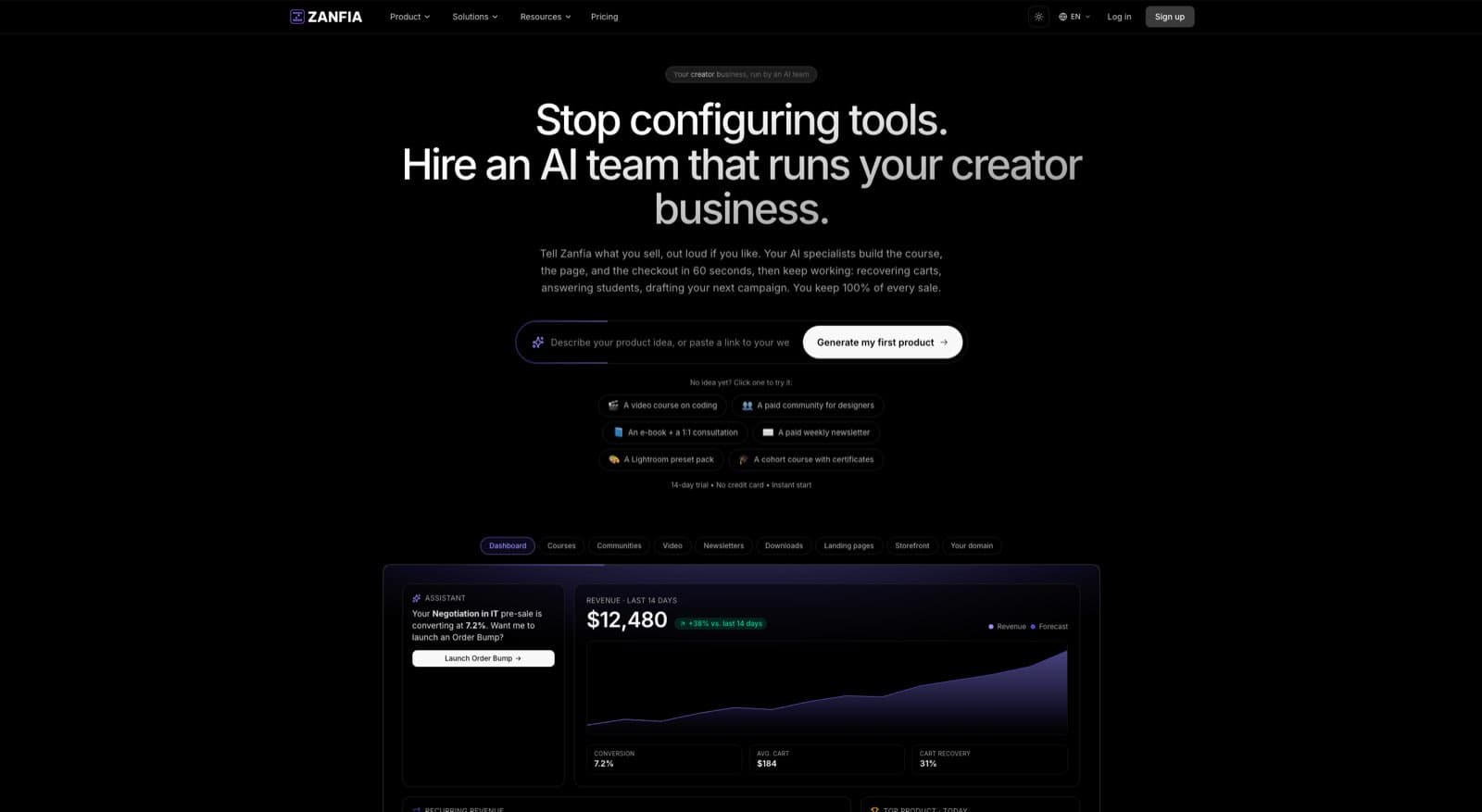
Zanfia is an AI team that runs a hybrid coaching business, with a course, community and consultation surface underneath. As of August 2026, plans start at $39/month, or $31/month billed annually on Starter, with a 14-day free trial and no credit card required. Platform commission on customer sales is 0%: you only pay the payment processor.
Three things matter for a hybrid coach:
Course, community and delivery under one AI-driven roof. Native video with progress memory, drip-unlocked modules, a community with topic channels and groups, and an AI assistant that can perform any action available in the interface, by chat or by voice. Instead of clicking through six screens to publish a new module, drip a lesson, or DM a struggling student, you dictate it and the assistant does the work. For coaches who prefer to bring their own tools, higher plans expose an MCP endpoint so external AI agents can act on your workspace directly. Availability of the full assistant and MCP depends on the plan, see the current Zanfia pricing.
Zanfia 2.0 already ships course quizzes with attempt statistics and per-student completion certificates, and native email campaigns are rolling out to workspaces now. By the time you read this the email module may already be open on your account, so check your dashboard. That closes the last gaps that used to send coaches to Kajabi at roughly $149/month. Same core job, a fraction of the price.
White-label under your own domain. Each creator gets a slug.zanfia.co subdomain or maps a custom domain. Your program looks like your brand, not a template.
Checkout built to sell a productized ladder. Cart 2.0 supports one-time, subscription, installments and trials, with Stripe and PayPal, plus Apple Pay and Google Pay. You can split a $3,000 hybrid program into four monthly payments, add a coaching upgrade as an order bump at checkout without building a second funnel, and run a test purchase in test mode to verify the entire flow (checkout, tracking, welcome email) before your first paying client hits it. All 12 product types (course, community, membership, bundle, consultation and more) live under one brand, so the front-end course and the higher-ticket mastermind sit on the same platform. See zanfia.com/pricing for current plans.
FAQ
How long should a hybrid coaching program run? 8-12 weeks is the sweet spot for most coaches. Long enough to deliver a real transformation, short enough that clients stay engaged and you can run 3-4 cohorts per year.
Do I need to record all my coaching calls? Yes. Half your cohort will miss at least one call, replays double completion rates, and old recordings become bonus content for future cohorts.
Can I run a hybrid model as a solo coach? Yes, up to about 30-40 clients per cohort with one weekly group call and async community. Beyond that you need either a co-coach or a longer cohort cadence.
How do I price group vs 1:1 coaching in the same offer? A typical multiplier is 3-5x. If your group program is $1,500, the 1:1 tier lands at $4,500-7,500 for the same duration.