

Most Profitable Coaching Niches in 2026 (Ranked by Demand and Margin)

The coaching industry crossed $7.31 billion in global revenue in 2024 and is projected to surpass $9 billion in 2026, according to research compiled by Entrepreneurs HQ. But here is the twist most aspiring coaches miss: the average coach earns $67,800 per year, while the top 10% pull in over $250,000. The difference is rarely talent. It is niche selection.
Generalists compete on price. Specialists compete on outcomes. A “life coach” charges $150 per session because clients cannot tell them apart from 50,000 other life coaches on Instagram. A “divorce recovery coach for high-net-worth women in their 50s” charges $850 per session because no one else does exactly that, and the client knows it.
This guide ranks the 10 most profitable coaching niches in 2026 based on three signals: market demand (measured by search volume, corporate budgets, and ICF certification growth), profit margin (what coaches can realistically charge per hour or per program), and barrier to entry (how easy it is to differentiate). We pulled benchmarks from the International Coaching Federation, Entrepreneurs HQ’s 151 coaching statistics report, and public pricing data from coaching marketplaces.
If you are launching a coaching practice in 2026, or repositioning one that has plateaued, this is your shortlist.
Why niche specialization yields 40% higher revenue
The data is consistent across every credible coaching industry report. Specialized coaches out-earn generalists by 30% to 50% on a per-client basis, and by even more on a lifetime-value basis. Here is why.
Specialists own the keyword in their client’s head
When a tech founder needs help managing their first 50-person team, they do not Google “life coach.” They Google “executive coach for first-time CEOs.” If you are the third result, you exist. If you are a generalist who does “a bit of everything,” you are invisible.
Niche positioning is the cheapest form of marketing. You stop competing with 1.5 million generic life coaches and start competing with 200 people who do exactly what you do. Math favors you.
Specialists charge for outcomes, not hours
A generalist sells time: $200 per session, billed monthly. A specialist sells transformation: “Land your next executive role in 90 days” for $8,500. The package includes coaching, but the price tag reflects the outcome, not the calendar.
According to the International Coaching Federation’s 2023 Global Coaching Study, coaches who packaged their work into outcome-based programs reported 41% higher annual revenue than coaches billing hourly. The price ceiling on hourly billing tops out fast. Outcome pricing scales with the value of the outcome.
Specialists attract referrals that match
If you coach “anyone going through a life transition,” your past client cannot describe what you do to a friend. They will not refer. If you coach “women re-entering the workforce after raising children,” every conversation your client has at a school pickup is a potential referral. Niches travel.
Niche 1-3: Executive, Career, and Leadership coaching
The corporate market is the deepest pocket in coaching. Companies budget for executive development the way they budget for legal or accounting fees. These three niches consistently produce the highest individual coaching incomes.
Niche 1: Executive coaching
Executive coaching is the highest-paying niche in the industry. Coaches working with C-suite leaders and senior VPs in mid-market and enterprise companies routinely charge $500 to $1,500 per hour, and high-end practices charge $25,000 to $100,000 for six-month engagements.
The catch: this niche requires real corporate credibility. ICF Professional Certified Coach (PCC) credentials, or better, the Master Certified Coach (MCC), are effectively table stakes. Most successful executive coaches also have 15+ years of prior leadership experience themselves, often as former executives. You cannot fake your way into this niche, but if you have the background, the demand is enormous.
Best for: Former executives, senior consultants, organizational psychologists.
Niche 2: Career coaching
Career coaching has exploded since 2023. Layoffs in tech, finance, and media pushed millions of mid-career professionals into the job market, and many had not interviewed in 10+ years. The result: a massive market of high-income professionals willing to pay $2,000 to $8,000 for a structured job-search program.
The strongest sub-niches within career coaching:
- Tech career coaching (engineering managers, product leaders, designers): $3,500-$10,000 packages.
- Executive career transition (VP and above): $5,000-$20,000 packages.
- Mid-life career change (40-55 year olds pivoting industries): $2,500-$6,000 packages.
Career coaches who build content libraries (interview prep videos, resume templates, salary negotiation scripts) and combine them with group coaching scale faster than 1:1-only practices. The fixed costs of content are low and the leverage is high.
Niche 3: Leadership coaching
Leadership coaching sits one tier below executive coaching in price but has a much larger market. The buyers are typically mid-level managers (often paid for by their employer), or first-time founders managing 5-50 person teams. Typical engagements run $3,000 to $12,000 for a three to six month program.
What makes leadership coaching profitable is corporate contracts. Land one Series B startup as a client and you are coaching 8 to 15 of their managers simultaneously. According to Harvard Business Review’s reporting on the leadership development industry, companies spend over $14 billion annually on leadership training, and a growing share of that is shifting from one-time workshops to ongoing 1:1 coaching.
Niche 4-6: Health, Mindset, and Performance coaching
These three niches serve consumers rather than corporations, which means lower per-client pricing but a vastly larger market and easier entry.
Niche 4: Health and wellness coaching
Health coaching is one of the fastest-growing coaching specialties. The U.S. National Board for Health and Wellness Coaching has certified over 10,000 coaches since 2017, and demand keeps outpacing supply. Pricing ranges from $150 to $400 per session, with six-month transformation packages running $2,000 to $6,000.
The most profitable sub-niches in 2026:
- Hormone health and perimenopause coaching for women 40-55: this is one of the highest-demand, lowest-supply niches in coaching right now. Packages routinely sell for $4,000 to $8,000.
- Diabetes reversal and metabolic health coaching : insurance reimbursement is opening up in the US, making this niche more accessible to mass-market clients.
- Sleep optimization coaching for high-performers: a young niche, but executives and professional athletes will pay $300-$500 per session for measurable improvements.
Health coaches who layer in a community component (private member group with weekly coaching calls) see 3-4x higher client retention than 1:1-only practices.
Niche 5: Mindset coaching
Mindset coaching is the most crowded niche on this list, which is also why it pays well for those who differentiate. The category includes confidence coaching, imposter syndrome work, anxiety and stress reduction, and identity-shift coaching for major life transitions.
Generalist mindset coaches earn $80,000-$120,000 per year. Specialists who serve a specific vertical (mindset coaching for surgeons, mindset coaching for poker players, mindset coaching for women in tech) can charge 2-3x more because they speak the language of the field.
The model that works: short, intense programs (6-12 weeks), $2,500-$5,000 packages, paired with a paid community where clients stay subscribed long after the core program ends.
Niche 6: Performance coaching
Performance coaching borrows the language of sports psychology and applies it to high-stakes professionals: founders, surgeons, sales executives, trial attorneys. The pitch is simple: “You already know what to do. I help you do it under pressure.”
Pricing is strong because the clients have high incomes and treat coaching as an investment in their earning capacity. Typical engagements: $5,000 to $15,000 for a three-to-six-month program. Annual retainers ($24,000-$60,000) are common with executive clients.
The barrier to entry is credibility. You need either a track record of high-performance work yourself (former competitive athlete, ex-special operations, former trial lawyer) or rigorous training (NLP master certification, applied sports psychology background).
Niche 7-10: Niche AI, Sales, and Money coaching
These four niches are the fastest-growing categories in 2026, driven by economic shifts (the AI transition, the entrepreneurship boom, and persistent financial anxiety among professionals).
Niche 7: AI implementation coaching for solopreneurs
This niche barely existed two years ago and is now one of the highest-growth coaching categories. The clients: solopreneurs, agency owners, and small business operators who know they should be using AI but cannot figure out how to integrate it into their workflow.
Typical pricing: $1,500 to $4,000 for a 30-day implementation sprint, or $300-$500 per month for ongoing retainer-style coaching. The work is part teaching, part hands-on building (prompt libraries, workflow automation, content systems).
The best AI coaches in this space are not technologists. They are operators who happen to be early adopters. If you have built systems for your own business using AI tools, you can productize that knowledge fast.
Niche 8: Sales coaching
Sales coaching is the most measurable niche in this entire list, which makes it the easiest to charge premium prices for. The math is simple: if you help a $250,000-a-year salesperson close 10% more, the coaching pays for itself 10x over in the first year.
Sub-niches that work well:
- High-ticket sales coaching for B2B account executives: $5,000-$15,000 programs.
- Sales coaching for service businesses (agencies, consultants, coaches themselves): $2,500-$8,000 programs.
- Cold outreach and LinkedIn sales coaching : increasingly bundled with done-with-you templates and AI tools.
Sales coaches who can show a portfolio of measurable client wins (“my client closed $1.2M in Q1”) can effectively charge whatever they want. Results compound your authority faster in sales than in any other niche.
Niche 9: Money mindset and financial coaching
Financial coaching is not financial advising. You do not need a Series 7 or CFP. You coach clients on the behavioral side of money: budgeting, debt payoff, money mindset, building savings habits, negotiating salary, pricing their own services.
The market is enormous because most adults have unresolved money anxiety. Typical engagements: $1,500-$4,000 for a three-month program, with higher-end “money mindset for entrepreneurs” coaching running $3,500-$8,000.
The fastest-growing sub-niche is pricing and money mindset coaching for service providers, helping coaches, consultants, and creative agency owners charge what they are worth. The pitch writes itself: you help your clients double their rates, and you charge a fraction of the resulting revenue increase.
Niche 10: Relationship and divorce coaching
Relationship coaching as a whole is competitive and mid-priced ($1,500-$4,000 programs are typical), but two sub-niches stand out for profitability:
- Divorce recovery coaching for women 45+ : clients are typically high-income, going through a major life transition, and willing to invest heavily in rebuilding. Packages of $5,000-$10,000 sell consistently.
- Pre-marital and conscious relationship coaching for couples : $300-$500 per session, often as a 10-12 session package totaling $4,000-$6,000.
The therapy-vs-coaching distinction matters here. Make it crystal clear in your marketing that you are a coach, not a licensed therapist. The niche is profitable specifically because clients want forward-looking, action-oriented work rather than clinical mental health treatment.
How to pick a niche (the 4-question test)
Knowing the most profitable niches is one thing. Picking the right one for you is another. Run any niche idea through these four questions before you commit.
Question 1: Do you have direct experience with the problem?
The fastest path to credibility is having lived the transformation you are now selling. Former corporate executives make great executive coaches. Recovered burnouts make great burnout coaches. People who paid off $80,000 in debt make great financial coaches.
This does not mean you need to be a perfect example. It means your story needs to be relevant enough that clients trust you have walked the path before. If you are positioning yourself as a niche expert without any lived experience, you will be out-marketed by someone who has it.
Question 2: Can your ideal client afford your prices?
This sounds obvious and gets ignored constantly. If you want to charge $5,000 per coaching package but your dream client is a 22-year-old freelance designer just starting out, you have a price mismatch.
The math: your average client needs to earn enough that your fee is 1-3% of their annual income for B2C niches, or your fee needs to generate a measurable ROI within 12 months for B2B niches. Anything outside those ranges creates constant sales friction.
Question 3: Is the problem painful enough to pay for?
Coaching is a premium purchase. Clients pay when the pain of not solving the problem exceeds the pain of paying for help. Some problems are urgent and expensive (“I just got fired and I am the breadwinner”). Some problems are chronic but easy to ignore (“I sometimes feel anxious”).
The first category sells. The second one does not, unless you reframe it into something more urgent. Most aspiring coaches pick problems that are too soft and then wonder why they cannot close clients.
Question 4: Is the niche small enough to dominate?
If your niche is so broad you compete with 50,000 other coaches, you are not specialized. If your niche is so narrow there are only 200 potential clients on Earth, you cannot build a business.
The sweet spot: a niche where 10,000 to 100,000 ideal clients exist, where 50-500 other coaches serve them, and where you can become one of the top 20 names in that niche within 18 months of focused marketing.
Pricing benchmarks by niche (2026 data)
The table below summarizes typical pricing in each niche, based on industry surveys and public pricing data from the International Coaching Federation’s Global Coaching Study and Entrepreneurs HQ’s 2026 coaching statistics report. Use these as anchors, not as ceilings. Top performers in each niche routinely charge 2-3x the median.
Hourly rate benchmarks
- Executive coaching: $500-$1,500 per hour (top of market: $2,500+)
- Leadership coaching: $250-$600 per hour
- Career coaching: $200-$500 per hour
- Performance coaching: $300-$800 per hour
- Sales coaching: $250-$700 per hour
- Health and wellness coaching: $150-$400 per hour
- Mindset coaching: $150-$350 per hour
- AI implementation coaching: $200-$500 per hour
- Financial / money mindset coaching: $150-$350 per hour
- Relationship and divorce coaching: $150-$400 per hour
Package pricing benchmarks (3-6 month programs)
- Executive coaching: $15,000-$80,000+
- Leadership coaching: $3,000-$12,000
- Career coaching: $2,000-$10,000
- Performance coaching: $5,000-$25,000
- Sales coaching: $5,000-$20,000
- Health and wellness coaching: $2,000-$8,000
- Mindset coaching: $1,500-$5,000
- AI implementation coaching: $1,500-$6,000
- Financial / money mindset coaching: $1,500-$8,000
- Relationship and divorce coaching: $2,000-$10,000
One pattern stands out across every niche: coaches who package their offering into outcome-based programs (90-day transformation, 6-month executive sprint) earn 40-60% more annually than coaches selling sessions individually, even when serving the same clients. Package pricing is the single highest-leverage move a coach can make.
How Zanfia helps niche coaches scale delivery
Picking a profitable niche is step one. Delivering a profitable coaching business is step two, and this is where most coaches stall. The successful niche coaches we see have all converged on roughly the same delivery stack: a signature 1:1 program, supported by a course or content library, supported by a private community where clients support each other.
The problem is that most coaches stitch this stack together from three or four different tools: a course platform, a community tool, a calendar booking app, and a payment processor. Each one costs $30-$100 per month, none of them talk to each other, and the client experience feels fragmented. A coach charging $5,000 per program cannot afford to look like they are running their business out of half a dozen disconnected apps.
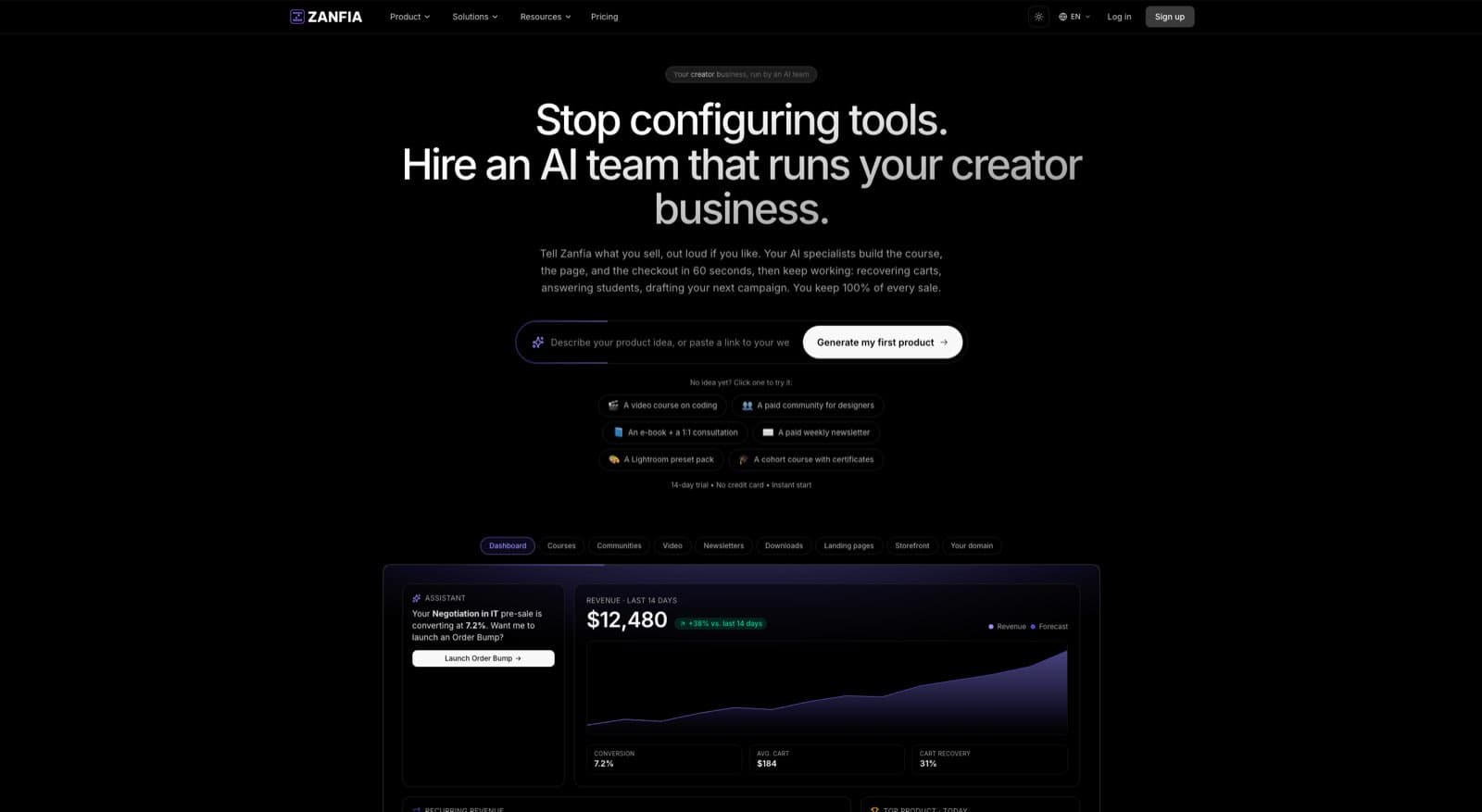
Zanfia is built for this delivery stack, and it is built AI-first. It is an AI team that runs a creator business: an assistant that knows the whole application and performs any action available in the interface, by chat or by voice, so the coach dictates instead of configuring. Courses, communities, paid newsletters, knowledge bases, downloadable resources, and consulting are all surfaces where that AI team does the work, hosted under one roof on your own white-label custom domain. For niche coaches, that combination is the entire delivery infrastructure of the business, and the AI team is the reason it does not eat your week.
Here is how it maps to the way profitable niche coaches actually work:
- Your signature program lives as a course. Drip-released modules unlock week by week, with native video hosting and a smart player that remembers exactly where each client left off. No Vimeo subscription required, no Wistia bill on top of your course platform.
- Your 1:1 coaching is sold through the built-in bookings and consultations flow. Clients pay and schedule in the same flow, on your branded domain, with no third-party scheduler logo in sight. Bookings and consultations are marked as coming soon in the product menu, so check the current Zanfia pricing page or your dashboard for availability.
- Your client community is native to the platform. Topic channels, announcement channels, and group-based organization, all integrated with the course content. There is also an optional community AI agent that writes from your own content, and everything it publishes is labeled as AI so members always know what came from a human and what did not. Clients log into one place for everything, not one tool in one tab and your course in another.
- Your paid newsletter or member-only knowledge base extends client lifetime value. Clients who finish your core program can convert into ongoing subscribers, generating recurring revenue without you needing to constantly close new high-ticket coaching deals.
- Your checkout is built to sell. One-time payments, subscriptions, installments, and free trials are all supported, so you can split an $8,000 program into four monthly payments instead of losing the client at the price tag. Order bumps, subscription upsells, and discount codes are built in, and a test mode lets you buy your own product before launch to verify the whole flow. Payments run through Stripe and PayPal, with Apple Pay and Google Pay supported for mobile checkout.
- Your business runs on your domain, not someone else’s. Custom domain support means your clients never see another platform’s branding. For a coach charging $8,000 per program, that level of professionalism matters. Custom domain and removing Zanfia branding are plan-dependent, so see the current Zanfia pricing .
- You can connect your own AI assistants over MCP. Anything doable by clicking in Zanfia is doable through the MCP endpoint, so your ChatGPT or Claude workflows can act on your workspace directly. Availability depends on the plan, see the current Zanfia pricing .
As of July 2026, Zanfia charges 0% platform transaction fees on customer sales (only payment processor fees apply, such as Stripe’s standard rate). For a coach generating $200,000 per year in client revenue, that alone is the difference between paying $0 and paying $20,000+ in platform fees on competing all-in-one tools. Every plan includes a 14-day free trial with no credit card required, so you can test the platform before committing to a paid tier. Starter is $39/month, or $31/month billed annually. For specific pricing, see the Zanfia pricing page.
Native iOS and Android apps are live, so clients can consume your course content and read your paid newsletter on their phones. Community support in the mobile app is rolling out to workspaces.
Niche coaches who consolidate their delivery stack onto a single platform consistently report two outcomes: clients show higher completion rates because the experience feels integrated, and the coach reclaims 5-10 hours per week previously spent troubleshooting tool integrations. Both of those compound directly into more revenue.
FAQ
What is the most profitable coaching niche in 2026?
Executive coaching is the highest-paying coaching niche in 2026, with top-tier coaches charging $500-$1,500 per hour and packaging six-month engagements at $25,000-$100,000. However, it requires significant corporate credibility, including ICF PCC or MCC certification and typically 15+ years of executive-level experience. For coaches without that background, sales coaching, career coaching, and AI implementation coaching offer the best profit margins with lower barriers to entry.
How much do coaches earn per year on average?
According to industry data compiled by the International Coaching Federation, the average coach earns approximately $67,800 per year globally, with significant variation by region and specialty. The top 10% of coaches earn over $250,000 per year. The single biggest predictor of high coaching income is niche specialization paired with outcome-based package pricing, not hourly billing.
Do I need certification to be a coach?
Certification is not legally required in most countries, but it dramatically affects which niches you can credibly enter. For corporate and executive coaching, ICF certification (ACC, PCC, or MCC) is effectively required by enterprise buyers. For consumer-facing niches like health, mindset, or financial coaching, certification matters less than demonstrated results and authentic personal experience with the problem you are solving.
How do I pick the right coaching niche?
Use the 4-question test: Do you have direct experience with the problem? Can your ideal client afford your prices (1-3% of annual income for B2C, measurable ROI within 12 months for B2B)? Is the problem painful enough that people will pay to solve it urgently? And is the niche small enough that you can become one of the top 20 names within 18 months? A niche that scores well on all four becomes a defensible business.
Should I charge by the hour or by the package?
Almost always by the package. Coaches who sell outcome-based programs (90-day, 6-month, or annual engagements) earn 40-60% more per year than coaches billing hourly, even when serving identical clients. Package pricing also positions you as a transformation provider rather than a time provider, which is what high-value clients want to buy.
How long does it take to build a profitable coaching business?
The realistic timeline for a coach who treats it as a full-time business and focuses on a specific niche is 12-18 months to reach $5,000-$10,000 per month in revenue, and 24-36 months to reach $200,000+ per year. Coaches who try to serve everyone, or who treat coaching as a side project, typically take 3-5 years to reach the same milestones, or never reach them.
What tools do I need to run a coaching business?
At minimum, you need a way to deliver content (your signature program or course), a way for clients to book and pay for sessions, a way for clients to interact with you and each other between sessions, and a checkout that supports one-time and recurring payments. The most efficient setup is an all-in-one platform that consolidates all of these functions onto a single white-label domain, which is what platforms like Zanfia are built for. Stitching together separate tools (course platform + community app + calendar + payment processor) typically costs more and creates a more fragmented client experience.