

8 Website Welcome Message Examples You Can Copy (2026)
First Impressions Matter: Why Your Website's Welcome Message is Your Most Powerful Asset
Your website's welcome message is the digital handshake that can make or break a new relationship with a potential customer. It's your single best chance to communicate value, build trust, and guide visitors toward action, all within seconds. The sentiment that first impressions are everything holds true for your website; you can learn more about why Your Website is Your First Impression: Make It Count. Get it wrong, and visitors bounce. Get it right, and you turn a casual browser into a loyal community member or paying customer.
This guide breaks down eight powerful types of welcome messages, providing strategic analysis, actionable examples, and specific implementation tips. We will move beyond generic templates to show you the "why" behind each approach, from story-driven personalization to problem-solution frameworks. You will learn how to choose the perfect welcome message for a website to captivate your specific audience, whether you're a content creator, entrepreneur, or educator. We'll also explore how an all-in-one platform like Zanfia empowers you to deploy these messages effectively on landing pages, in onboarding emails, and across community portals. Zanfia is built as an AI team that runs the creator business rather than a plain course tool: the assistant knows every screen and can perform any interface action by chat or by voice, agents can act inside your workspace through the MCP endpoint (availability depends on the plan, see the current Zanfia pricing), and the checkout is built to sell with order bumps, installments, upsells, and a test mode that lets you buy your own product before launch. Let's dive into the strategies that transform a simple greeting into a high-performance conversion tool.
1. Value Proposition Welcome Message
A value proposition welcome message gets straight to the point. It immediately tells visitors what tangible benefit they will gain from your website, platform, or product. Instead of listing features, this approach focuses on the core problem you solve or the primary goal you help users achieve, making it a powerful tool for establishing instant relevance and credibility.
This method is especially effective for platforms like Zanfia that put an AI team behind a clear, all-in-one offer. A welcome message like, "Hire your AI team, keep your revenue: build your community, sell courses, and dictate the work by voice, with 0% platform commission," immediately communicates multiple benefits (an AI team doing the work, community, sales, voice control) and a key differentiator (0% platform commission today). It cuts through the noise by answering the visitor's most important question: "What's in it for me?"
Strategic Breakdown
To craft an effective value proposition welcome message for a website, focus on clarity and impact. Your goal is to articulate the end result a user can expect.
- Lead with the Outcome: Start with the most compelling benefit. Words like Build , Launch , Monetize , and Scale are effective because they signal action and growth.
- Be Specific: Vague promises fall flat. Instead of "the all-in-one platform for creators," a message like "Sell digital products under your own brand, with 0% platform commission and an AI assistant that runs the back office by voice" addresses a specific audience and a specific pain point.
- Align with Your CTA: Your welcome message sets an expectation. The call-to-action (CTA) button should complete it. If your headline is "Build your online empire," a CTA like "Start Building" creates a cohesive and compelling user journey.
Key Takeaway: A strong value proposition welcome message acts as a promise. It clearly states the transformation you offer, making it easier for the right audience to self-identify and take the next step.
For creators aiming to build a brand, clearly stating your promise is the first step. For a deeper dive into articulating your unique selling points, exploring what a value proposition is in marketing can provide valuable insights. To see how this concept is applied in practice, you can explore how to define your value proposition with real-world examples.
2. Story-Driven Personalization Welcome Message
A story-driven welcome message connects with visitors on an emotional level by sharing a relatable narrative. This can be a founder's journey, a customer success story, or a community's evolution. This approach builds authenticity and trust, resonating deeply with audiences who value human connection and transparent business practices.
This method is powerful for platforms like Zanfia, where creator success is central to the brand. For instance, a message that starts with a story like, "He was an expert with valuable knowledge but was paralyzed by tech. Then he told his AI assistant what to build, dictated the launch by voice, and his first digital product went live in a week, checkout, order bumps and all," establishes an immediate, aspirational connection. It shows visitors a clear path from potential to reality, answering the question, "Could this work for me too?"

Strategic Breakdown
To create a compelling story-driven welcome message for a website, you must focus on transformation and relatability. Your goal is to make the visitor see themselves in the story you're telling.
- Highlight the Transformation: Focus on the "before and after." A story that includes specific metrics like a creator earning $3k a month hitting a ceiling with piecemeal tools and scaling to $30k+ after unifying their business under one brand and letting an AI assistant handle the back office is far more impactful than a vague statement about success. Show the journey, not just the destination.
- Keep It Authentic: Use real stories from your community. Featuring a diverse range of creators, from first-time launchers to established operators running twelve product types under one brand, makes your message more inclusive and believable.
- Connect Story to Solution: The story must clearly link back to how your product or service enabled the transformation. If the story is about a creator launching a successful community, your CTA should be a direct invitation to do the same, such as "Start Your Community."
Key Takeaway: A story-driven welcome message turns your brand from a faceless entity into a partner in your visitor's journey. It builds an emotional bridge by proving that the success they desire is attainable with your help.
Telling your story effectively is a skill that extends beyond just your website's welcome message. To further refine this ability, you can discover tips on how to make great presentations that captivate and persuade your audience.
3. Problem-Solution-Benefit (PSB) Welcome Message
A Problem-Solution-Benefit (PSB) welcome message hooks visitors by first acknowledging a specific frustration they face. It then introduces your product as the direct solution before highlighting the ultimate positive outcome or benefit. This classic copywriting formula is highly effective because it validates a visitor's pain point, creating an immediate connection and making your solution feel necessary and logical.
This approach is perfect for platforms that solve a clear, widely understood problem. For instance, a welcome message for a website like, "Tired of paying platform commission on every sale? (Problem) Zanfia charges 0% platform commission, so only your payment processor takes its standard cut. (Solution) You keep more of every launch and let the AI assistant run the mechanics in the background. (Benefit)" This PSB formula is persuasive because it mirrors the visitor's internal monologue, making them feel understood.
Strategic Breakdown
To create a powerful PSB welcome message, you must deeply understand your audience's struggles. Your message should feel like an answer to a question they've been asking themselves.
- Lead with a Validated Problem: Start by stating the pain point clearly and concisely. Use language your customers use. "Tired of juggling plugins, external video hosting, and a separate community tool?" speaks directly to creators struggling with a fragmented tech stack.
- Present Your Solution Naturally: The solution should be a direct answer to the problem. After stating the issue, follow with: "Zanfia combines your courses, community, and digital products in one unified system, with an AI assistant that can act on any of it by chat or by voice." The connection is immediate and clear.
- Tie it to a Clear Benefit: The final part should articulate the positive result. For Zanfia, a message like "Tired of juggling tools? Zanfia combines your community, courses, and digital products in one place, and you dictate the busywork to your AI team, so you can save 5-10+ hours a month on admin and focus on creating," moves from problem (tool juggling) to solution (all-in-one platform with an AI team) to benefit (more time to create).
Key Takeaway: The PSB framework guides visitors from a point of frustration to a feeling of relief. By showing you understand their problem, you build trust and position your solution as the only logical next step.
This method of identifying pain and presenting a clear solution is fundamental not just for headlines but for compelling product descriptions as well. To master this technique further, you can explore how to write product descriptions that sell and apply the same psychological principles.
4. Trust-Building Social Proof Welcome Message
A trust-building welcome message uses social proof to establish instant credibility. It showcases elements like user testimonials, customer logos, usage statistics, or industry awards to show visitors that others already trust and value your brand. This approach is powerful for dispelling skepticism and building confidence, especially for platforms that require a commitment of time or money.
This method works well for a platform like Zanfia, which can feature testimonials from respected creators. A quote from an experienced creator such as "the most convenient and simplest way I've found to run paid newsletters, courses and community under one roof, with an assistant that actually does the work" immediately answers the visitor's subconscious question: "Can I trust this?" By showing that recognized experts rely on their service, they reduce hesitation and encourage new users to join a proven ecosystem.
Strategic Breakdown
To create an effective social proof welcome message for a website, you need to present validation that is both authentic and relevant to your target audience. Your goal is to make a visitor feel secure in their decision to engage with you.
- Prioritize Specificity: Vague praise is forgettable. Instead of "Great product," feature testimonials that highlight specific results, like a creator praising the course module's "simplicity and high functionality" or another noting the "peace of mind" Zanfia provides by handling checkout, delivery and access in one place.
- Show, Don't Just Tell: Numbers and logos are powerful. A headline like "Join the creators earning $3k-30k+ a month who trust Zanfia to scale their business" can be more persuasive than paragraphs of text.
- Use Authentic Voices: Authenticity is key. When a real newsletter operator says, "Without Zanfia, running a paid newsletter and community together would be much harder," it provides credible, third-party validation from a real user.
Key Takeaway: A social proof welcome message works by borrowing credibility. It reassures visitors that choosing you is a safe and smart decision, making them more likely to convert.
For creators, building this kind of trust is fundamental. If you're looking for practical ways to gather powerful customer stories, you can explore detailed strategies on how to get testimonials from customers to start building your credibility today.
5. Interactive/Conversational Welcome Message
An interactive welcome message for a website transforms a passive browsing session into an active conversation. It uses chatbots, quizzes, or other dynamic elements to engage visitors immediately, guiding them toward the most relevant content or product pathways based on their responses. This approach creates a personalized journey from the very first click, making visitors feel understood and catered to.
This method is highly effective for businesses with diverse offerings or multiple audience segments. For instance, a chatbot on Zanfia's site could ask, "What best describes you?" with options like "I'm just starting out," "I'm an established expert," or "I need to scale my business." Based on the answer, it can direct newer creators to an easy launch guide and established operators to a page on scaling with 0% platform commission and an MCP endpoint that lets their own agents work directly on the workspace. This makes the first interaction meaningful and efficient.
Strategic Breakdown
To create an effective interactive welcome message, your focus should be on creating a smooth, guided experience that feels personal, not robotic. The goal is to direct users without making them feel forced.
- Ask Guiding Questions: Start with a question that segments your audience. A simple, "What brings you here today?" followed by options like "Sell online courses," "Build a paid community," or "Launch a newsletter," can personalize the user's path.
- Keep it Brief: Limit quizzes or interactive steps to 3-5 questions. Visitors lose patience quickly, so each question must provide clear value and move them closer to a solution.
- Align with Pathways: Each answer should lead to a specific, relevant outcome. If a user says they want to build a community, the next step could be a link to your community features page, detailing how to set up engaging topics for a discussion group , or a prompt to start a free trial.
Key Takeaway: An interactive welcome message acts as a digital concierge. By asking the right questions, you can quickly understand visitor intent and guide them to the exact solution they need, significantly boosting engagement and conversion rates.
6. Segmented/Dynamic Welcome Message
A segmented or dynamic welcome message for a website shows different content based on visitor characteristics. This smart approach uses data like traffic source, device type, geographic location, or past interactions to display the most relevant message to each visitor segment, improving relevance and boosting conversions. It's personalization in its most direct form.
This method works because a one-size-fits-all greeting rarely connects with everyone. For instance, a creator using Zanfia could show a welcome message about launching a first product to a beginner arriving from a "first product" guide, while showing a message about protecting margins and letting the AI assistant run the back office to a seasoned operator coming from a high-level business mastermind. This white-label capability, with each creator on their own slug.zanfia.co subdomain or a custom domain, ensures the message and the entire platform experience reflect the visitor's context and the creator's brand identity.
Strategic Breakdown
To implement a segmented welcome message, you need to identify your most valuable visitor groups and craft messages that speak directly to their needs. The goal is to make each visitor feel like the page was made just for them.
- Start with High-Impact Segments: Don't try to personalize for everyone at once. Begin with easily identifiable and valuable groups, such as first-time creators, established course operators, and community builders.
- Align the Message to the Source: If a user clicks a link from a partner or integration, your welcome message can reflect it directly: "Sync your audience to ActiveCampaign, Kit or MailerLite the moment they buy, and let the AI assistant handle the follow-up inside your workspace." This creates a relevant journey by highlighting a specific integration.
- Ensure a Clear Fallback: Not every visitor can be segmented. Always have a strong, general-purpose welcome message that serves as a default. This ensures no visitor is met with a broken or empty state.
Key Takeaway: A segmented welcome message shifts the conversation from "Here's what we do" to "Here's what we can do for you." By acknowledging a visitor's context, you build instant rapport and guide them more effectively toward conversion.
For creators using a platform like Zanfia, segmentation can be a powerful tool. You can create different landing pages with unique welcome messages for each audience segment and direct traffic accordingly. For more on the technical side of personalization, learning about customer data platforms provides a solid foundation. To understand how to apply these ideas in marketing, you can explore personalization strategies for practical tips.
7. Urgency/Limited-Time Offer Welcome Message
An urgency-driven welcome message taps into the psychological principle of scarcity to encourage immediate action. By highlighting a limited-time offer, exclusive discount, or founding member deal, it creates a sense of motivation that can overcome visitor hesitation and decision paralysis. This approach is powerful for converting visitors who are interested but might otherwise procrastinate.
This method works well for product launches or special promotions. For instance, a platform might use a welcome message like, "Founding Members Wanted: Get 50% off your first year when you join this week." This message immediately frames the offer as exclusive and time-sensitive, appealing to early adopters who value both a good deal and being part of an inaugural group. It directly answers the visitor's question, "Why should I act now?"
Strategic Breakdown
To create an effective urgency-based welcome message for a website, you need to balance motivation with authenticity. Your goal is to create genuine, compelling reasons for a user to act quickly without appearing manipulative.
- Be Authentic: Your offer must be real. If you advertise a "limited-time launch discount," ensure the price actually increases after the launch period. This transparency is crucial for building long-term trust.
- Use Specific Deadlines: Vague phrases like "for a limited time" are less effective than concrete deadlines. "Offer ends Friday at midnight" or using a countdown timer creates a clear and tangible endpoint that drives action.
- Align with Your CTA: The welcome message sets the stage for a time-sensitive decision. If your headline is "Get 40% Off Annual Plans," the call-to-action button should reflect that urgency with text like "Claim My Discount" or "Lock In My Rate."
Key Takeaway: An urgency-based welcome message for a website converts interest into action by creating a compelling reason to sign up now. To maintain credibility, ensure the scarcity is real and follow through on the limitations you set.
8. Feature-Led Welcome Message with Visual Hierarchy
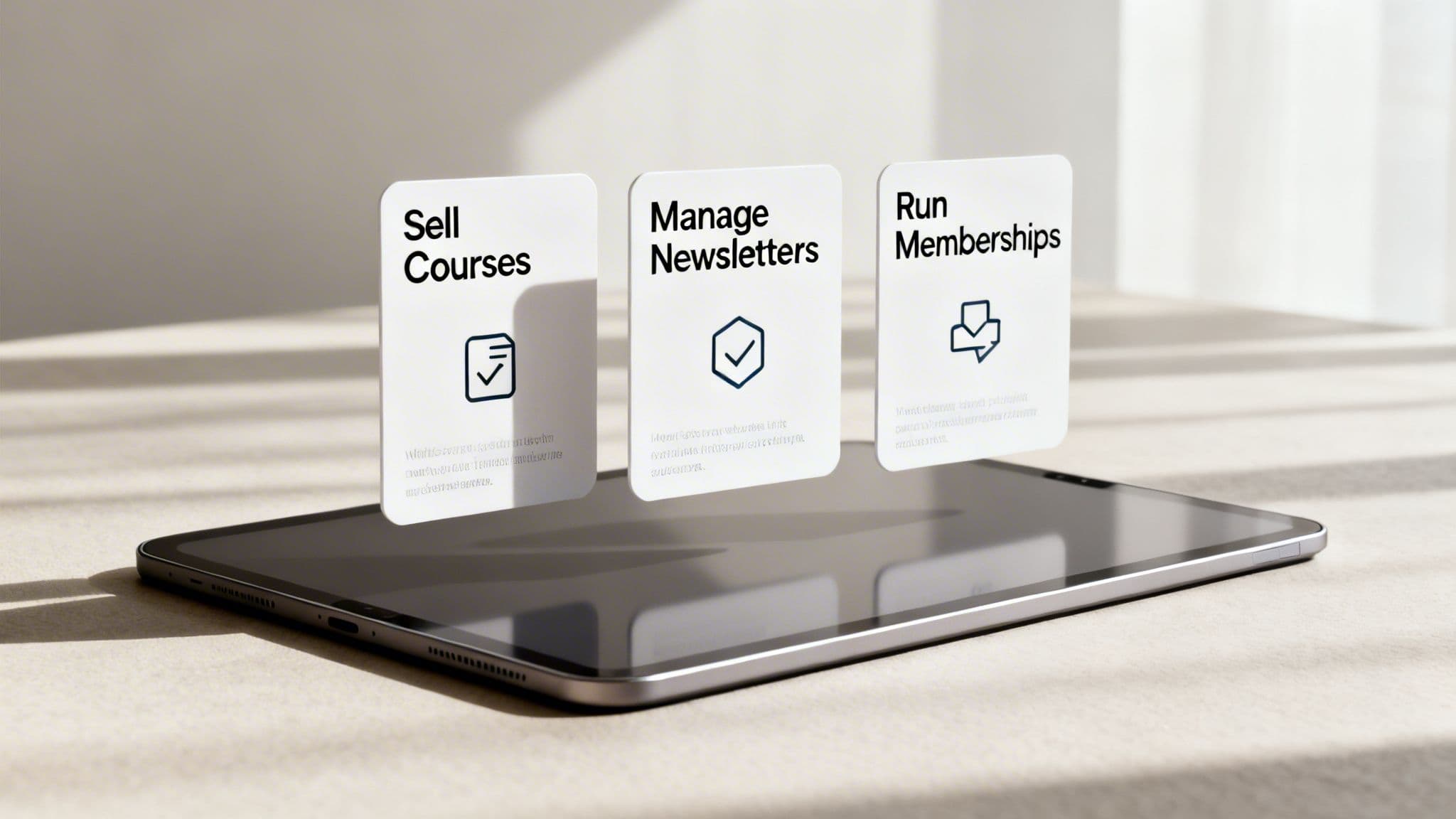
A feature-led welcome message with visual hierarchy is designed to showcase a platform's core capabilities in a quick, digestible format. Instead of relying on a single headline, this approach uses a combination of text and graphics to break down key functions, allowing visitors to scan and understand what you offer at a glance. It's especially effective for all-in-one platforms like Zanfia, where a single value proposition might not capture the full scope of benefits.
This method works by presenting information progressively, guiding the user's eye from the most impactful feature to secondary ones. For a platform like Zanfia, this could mean leading with the AI assistant that acts on any screen by chat or by voice and the MCP endpoint that lets external agents work on the workspace, followed by the integrated community, advanced course tools with native video, and a checkout built to sell with order bumps, installments and test mode. Each feature can be presented as a distinct visual block, creating a clear overview of the platform's power.
Strategic Breakdown
To build an effective feature-led welcome message for a website, you need to combine clear messaging with strong visual organization. This structure helps users quickly grasp the platform's power without feeling overwhelmed.
- Prioritize and Sequence: Lead with the features that solve the biggest pain points. For Zanfia users, the ability to Dictate work to an AI assistant , Build an Integrated Community , and Sell Courses with Native Video are primary draws. Place these at the top or in the most prominent position.
- Pair with Benefits: Don't just list features; state the outcome. Instead of "Native Video Hosting," say "Host your videos without costly subscriptions to Vimeo or Wistia." This connects the function directly to user value, a key part of a good welcome message for a website.
- Use Visual Consistency: Maintain a consistent style for icons, illustrations, or screenshots. This creates a professional, cohesive look that builds trust. Use actual product screenshots to add authenticity and show users exactly what to expect.
Key Takeaway: A feature-led welcome message acts like a visual summary of your platform's power. It breaks down complex offerings into simple, benefit-driven points, enabling visitors to quickly self-qualify and understand how your tool can serve their specific needs.
8 Welcome Message Types Compared
| Approach | Implementation Complexity 🔄 | Resource Requirements 💡 | Expected Outcomes 📊 | Ideal Use Cases ⚡ | Key Advantages ⭐ |
|---|---|---|---|---|---|
| Value Proposition Welcome Message | Low — simple headline + CTA | Low — copywriter, basic A/B tests | 📊 High conversion & lower bounce; clear intent ⭐⭐⭐ | Quick landing pages, time‑pressed visitors, SEO traffic | Direct clarity; quick credibility |
| Story‑Driven Personalization Welcome Message | Medium — content creation & layout updates | Medium — storytelling assets, photos/video | 📊 Strong emotional engagement & recall ⭐⭐⭐ | Founder brands, creator communities, long‑term retention | Builds authenticity; differentiates brand |
| Problem‑Solution‑Benefit (PSB) Welcome Message | Low–Medium — structured copy framework | Medium — customer research + targeted copy | 📊 Persuasive conversions for decision makers ⭐⭐⭐ | B2B/B2C solution pages, visitors aware of problems | Validates pain points; logical flow to CTA |
| Trust‑Building Social Proof Welcome Message | Medium — design + testimonial sourcing | High — verified reviews, logos, media assets | 📊 Significant credibility lift; conversion uplift ⭐⭐⭐⭐ | New/unknown platforms, hesitant buyers | Reduces perceived risk via third‑party validation |
| Interactive/Conversational Welcome Message | High — build flows, chatbot or quiz | High — dev, content, analytics, maintenance | 📊 Increased engagement, richer user data ⭐⭐⭐⭐ | Diverse audiences, product tours, lead qualification | Personalized guidance; captures intent data |
| Segmented/Dynamic Welcome Message | High — rule engine & variant management | High — data layer, CDP, compliance & dev | 📊 Highest relevance and segment conversion ⭐⭐⭐⭐ | High‑traffic sites, targeted ad landing pages | Tailored messaging; better ROI on acquisition |
| Urgency/Limited‑Time Offer Welcome Message | Low–Medium — timers & promo copy | Low — marketing assets, offer controls | 📊 Immediate signup spikes; short‑term lift ⭐⭐⭐ | Launches, promotions, list building campaigns | Drives fast action; increases conversions quickly |
| Feature‑Led Welcome Message with Visual Hierarchy | Medium–High — strong UX and visuals | Medium–High — design, product screenshots, dev | 📊 Clear product understanding; engages feature seekers ⭐⭐⭐ | Feature‑rich platforms, technical audiences, demos | Showcases differentiation; supports progressive discovery |
Unifying Your Creator Business with the Right Welcome
Throughout this guide, we've explored eight distinct approaches to crafting a compelling welcome message for a website. From leading with a 0% platform commission value proposition to building trust with testimonials from respected creators, each strategy offers a unique way to connect with your audience. The core lesson is clear: a welcome message is not a mere pleasantry. It is a strategic asset that sets the tone, communicates your brand's promise, and guides users toward the next critical step.
The most effective welcome messages are born from a deep understanding of both your audience and your operational capabilities. For creators, entrepreneurs, and educators, this means aligning your messaging with a platform that can actually deliver on the promises you make. If you welcome a new student with the promise of a seamless learning experience with integrated video, your system must provide it. If you invite a member into an exclusive community, that space must feel unified with your courses and branded to you, not like an afterthought on Discord or a Facebook group.
Bridging Strategy and Execution
This is where the connection between your welcome message and your tech stack becomes critical. The strategies we've detailed, like segmented welcomes or a feature-led hierarchy, aren't just copywriting theories; they require a robust, integrated backend to execute effectively.
- For the Problem-Solution Welcome: If your message promises to end the pain of platform commission, your platform must actually charge 0% platform commission today, as Zanfia does. This makes your promise credible and powerful.
- For the Feature-Led Welcome: Your platform must have standout features worth highlighting. Promising an AI assistant that acts on any screen by chat or by voice, an MCP endpoint for external agents, native video, integrated community channels, and a checkout with order bumps and installments only works if your system has them built in, eliminating the need for costly external tools.
- For the Trust-Building Welcome: Using testimonials from respected figures is powerful. But that trust is solidified when the entire user experience, from sign-up to payment on Stripe or PayPal with Apple Pay and Google Pay at checkout, is smooth, professional, and reflects your brand, not a generic platform's.
Choosing the right welcome message for a website is the first step. The second, more important step is ensuring you have the infrastructure to support it. Your message writes a check that your platform must be able to cash. A disjointed system of WordPress plugins and external tools often leads to a broken user experience, undermining the trust you worked so hard to build. An all-in-one solution like Zanfia eliminates this friction, letting you focus on creating value while an AI team and native automations handle the rest, from granting course access to triggering welcome emails. This creates a unified brand experience that turns a simple "hello" into lasting loyalty and revenue.
FAQ
How do I know which welcome message type fits my audience?
Match the type to what your visitor needs first. Use Value Proposition when you need instant relevance, Story-Driven when trust and emotional connection matter, PSB when your audience shares a specific frustration, Social Proof when skepticism is high, and Interactive when you have diverse audience segments needing different pathways.
How long should my welcome message be?
Short enough to grasp in seconds. The article stresses that first impressions happen instantly and visitors bounce if you get it wrong, so lead with the outcome or the pain point, keep interactive quizzes to 3-5 questions, and make sure your CTA completes the promise your headline sets.
What makes a testimonial actually persuasive in a welcome message?
Specificity. Vague praise like "great product" is forgettable, so feature testimonials that highlight concrete results, real names, and named outcomes. Numbers and logos work harder than paragraphs, and authentic voices from real users provide credible third-party validation.
How do I align my welcome message with my call-to-action?
The CTA must complete the expectation your headline sets. If your message promises "Build your online empire," the button should say "Start Building," not something generic like "Learn More." This cohesion turns the welcome message into a single continuous journey rather than two disconnected elements.
Can a welcome message really move a visitor from browsing to buying?
Yes, when it validates a specific pain point and links directly to a solution. The Problem-Solution-Benefit framework works because it mirrors the visitor's internal monologue, making them feel understood before you ask for anything. That shift from frustration to relief is what turns a casual browser into a paying customer.
Ready to pair your powerful welcome message with a platform that can deliver on its promise? Zanfia is built as an AI team for creators: dictate the work by voice, let external agents act on your workspace through the MCP endpoint, and sell through a checkout designed to convert, all under your own brand, with 0% platform commission today. Zanfia plans start at $39/month, or $31/month billed annually on Starter, and every plan includes a 14-day free trial with no credit card. See how you can create a seamless customer journey, from the first greeting to the final sale, by visiting Zanfia today.