

Your Ultimate Sales Funnel Template for Digital Products
At its core, a sales funnel template is your reusable blueprint for the customer journey. It’s the framework that guides someone from vaguely knowing you exist to becoming a paying customer for your online course, community, or newsletter. Think of it less as a marketing buzzword and more as a strategic roadmap for building relationships and creating a predictable income stream.
Table of Contents
Why a Sales Funnel Is Non-Negotiable for Your Digital Business
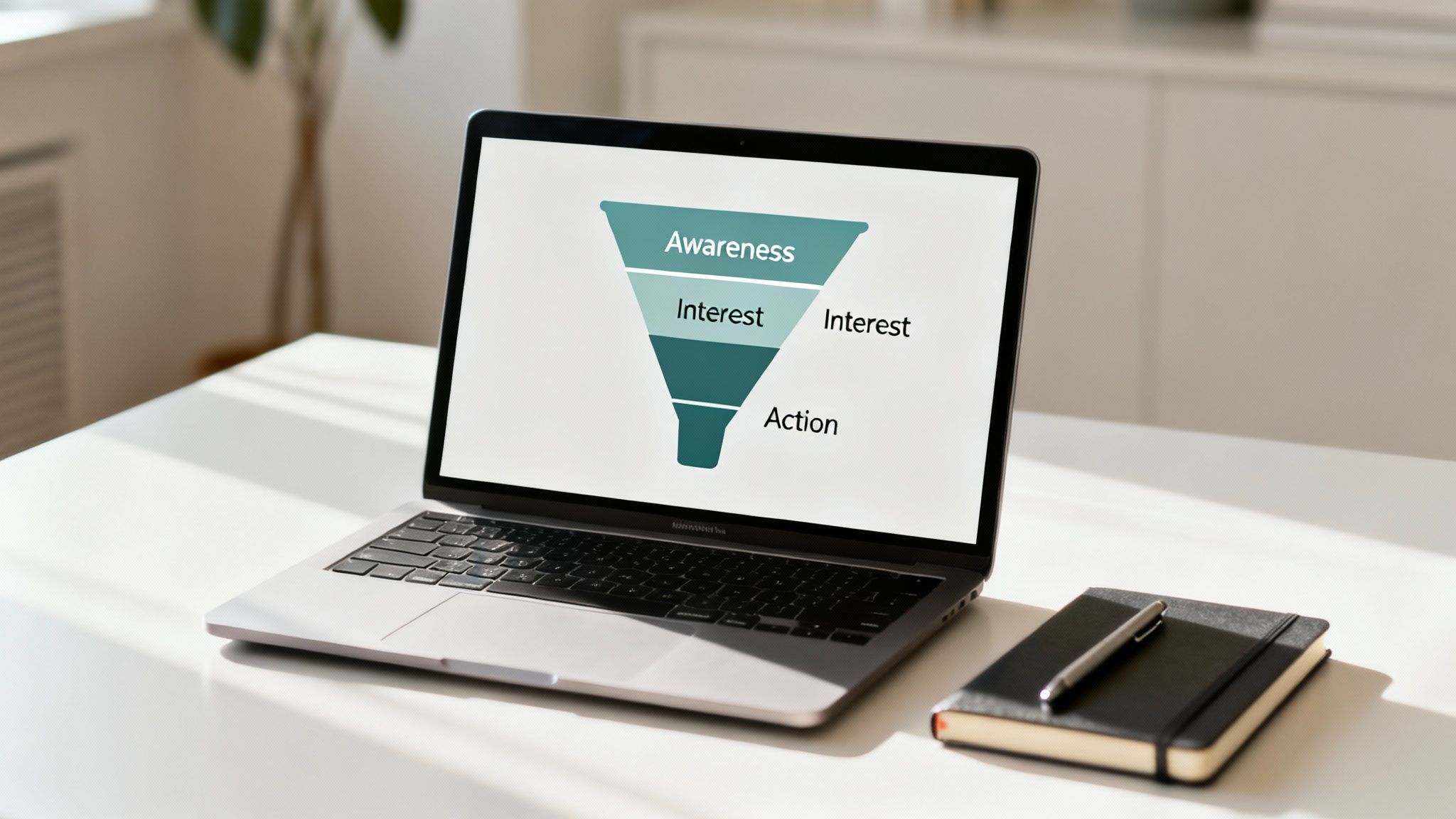
If you've ever poured your heart into launching a brilliant online course or a killer paid newsletter only to hear crickets, you know the pain. So many digital creators have fantastic products but can't seem to bridge the gap between a website visitor and a paying customer. This is exactly where a well-thought-out sales funnel becomes your most valuable asset.
A funnel takes the guesswork out of marketing and turns it into a clear, repeatable system. You're no longer just shouting into the void; you're building a genuine connection by delivering the right message at the right time, every single time.
From Chaos to Clarity
Without a funnel, your marketing can feel like a scattered mess. A social media post here, a newsletter there, maybe an ad when you feel like it. These disconnected actions rarely add up to consistent sales. A sales funnel template brings order to that chaos.
It carves out a deliberate path for your audience to follow:
- Awareness: They stumble upon your brand, maybe through a blog post or a social media share.
- Interest: You offer them something valuable for free—a checklist, a mini-course—and they sign up.
- Desire: Through targeted emails, you nurture that interest, consistently solving their problems and building trust.
- Action: They finally make a purchase, feeling confident because they fully grasp the value you provide.
This isn’t just about selling; it's about building trust at every stage. Each step is a chance to prove your expertise and show you truly understand what your audience needs. If you want to dig deeper into these fundamentals, you can learn more about what a marketing funnel is and how it all works.
A well-designed sales funnel isn’t about tricking people into buying. It’s about building a relationship so strong that buying your product becomes the natural next step for them.
The Power of Automation and Integration
Now, trying to manage this entire journey by hand is a recipe for burnout. This is where an all-in-one platform becomes absolutely essential. Imagine manually granting course access after every payment, adding buyers to the right community channel, or sending out welcome emails. That’s hours of your life gone—time you should be spending creating.
Platforms like Zanfia are designed to put this entire process on autopilot. With powerful automation, you can instantly grant access, trigger welcome email sequences, handle subscription renewals, and add buyers to the right community channels based on their purchases. This alone can easily save you 5–10+ hours a month, letting you focus on value-packed content instead of admin chores.
More importantly, by integrating every step—from the landing page to the payment to community access—you kill the technical headaches of duct-taping multiple tools together. The result is a smooth, professional experience for your customers and more time (and sanity) for you.
Understanding the Four Core Stages of a Winning Sales Funnel
Every sales funnel that actually works is built on a simple, proven psychological framework. It’s often called AIDA, which stands for Awareness, Interest, Desire, and Action.
Think of it as the natural path a complete stranger takes to become a happy, paying customer. To make any sales funnel template effective, you have to understand what your ideal customer needs at each of these four phases. Your job is to meet them where they are, give them something valuable, and gently guide them to the next step.
Awareness: Grabbing Attention in a Crowded Space
The journey starts at the widest part of the funnel: Awareness. At this point, your potential customers might not even realize they have a problem, and they almost certainly don't know you exist. Your only goal here is to get on their radar in a way that feels helpful, not pushy.
This is where your content marketing really has to shine. You’re not selling; you’re attracting the right people by creating genuinely useful content that speaks to their pain points or sparks their curiosity.
For digital creators, this often looks like:
- SEO-Optimized Blog Posts: Writing articles that directly answer the questions your ideal customer is typing into Google.
- Engaging Social Media Content: Sharing quick tips, tutorials, or behind-the-scenes glimpses on the platforms where your audience actually hangs out.
- Guest Appearances: Hopping on podcasts or collaborating with other creators in your niche to get in front of their established audience.
The goal isn't to make a sale. It's simply to make a great first impression and position your brand as a credible, helpful resource.
Interest: Turning a Follower into a Lead
Once someone knows who you are, the next move is to capture their interest and earn a direct line of communication. This is where you convert a passive follower into an active lead. How? By offering them an irresistible "lead magnet"—a valuable freebie in exchange for their email address.
This freebie needs to offer a quick, tangible win. A fitness coach might offer a "7-Day Healthy Meal Plan PDF," or a business mentor could give away a "5-Point Checklist for a High-Converting Sales Page." On an all-in-one system like Zanfia, you can whip up a simple landing page for this offer that automatically adds new subscribers to your email list. Easy.
Desire: Building Trust and Showcasing the Solution
Okay, you now have a direct line to an interested prospect. The Desire stage is all about nurturing that new relationship. You made a promise with your lead magnet, and now it's time to deliver on it—and then keep delivering more value.
This is usually handled through a series of automated emails. You're not just blasting them with sales pitches. You're building real trust by sharing case studies, testimonials, and deeper content that shows them exactly how your paid product solves their bigger problems. If you want to dive deeper, you can explore a variety of sales funnel stages explained to see how this nurturing process builds serious momentum.
The Desire phase is where you prove you understand their struggle and have the solution. It’s a shift from “Here’s what I do” to “Here’s what I can do for you.”
This is also the perfect time to introduce them to your premium offers, maybe through a webinar that demonstrates the power of your online course or an exclusive peek inside your paid community.
Action: Driving the Final Conversion
Finally, after you've built awareness, captured their interest, and created genuine desire, you make your offer. The Action stage is where you ask for the sale. Your call-to-action (CTA) needs to be crystal clear, compelling, and create a sense of urgency.
Your sales page has to be on point, ready to tackle any last-minute doubts. It should always feature:
- A clear, powerful value proposition.
- Social proof like testimonials from real customers.
- A risk-reversal, like a solid money-back guarantee.
And please, make sure the checkout process is seamless. A clunky or confusing payment page will absolutely kill your conversions at the last second. This is why platforms built with local markets in mind, like Zanfia, are so powerful; they integrate with trusted Polish and global gateways like Stripe, PayU, Przelewy24, and BLIK, so customers can pay their preferred way. This final stage is the culmination of all your hard work, turning a warm lead into a valued customer.
How to Build Your Funnel with Practical Steps and Tools
Knowing the theory is one thing, but now it’s time to roll up your sleeves and bring your sales funnel to life. This is where the magic really happens—where you build the core assets that will do the heavy lifting for your business, turning casual visitors into dedicated customers.
The visual below maps out that classic customer journey from initial Awareness to the final Action. Think of this as the blueprint for your entire sales machine.
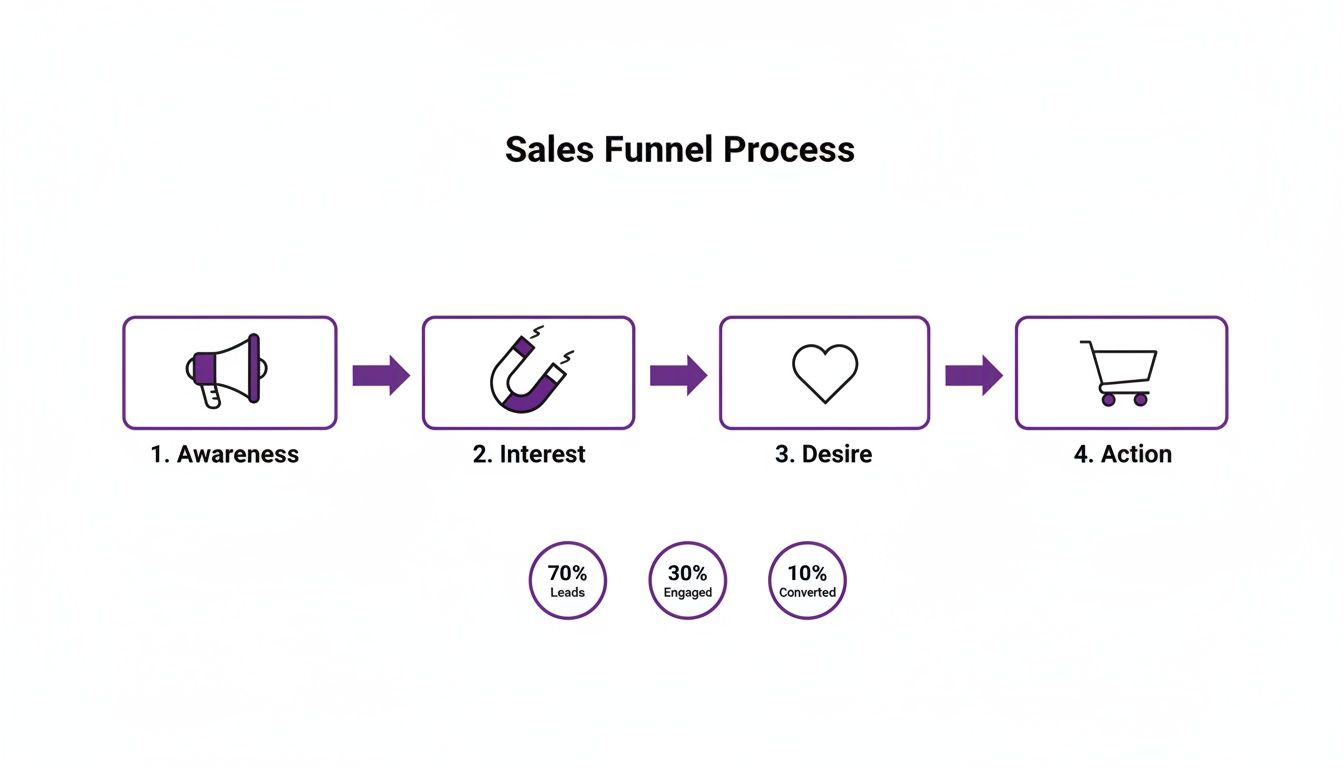
Each stage filters and guides your audience closer to your main offer. Your job is to build the specific pages and messages that make this journey seamless and compelling.
Designing a High-Converting Landing Page
Everything starts with a single, focused landing page for your lead magnet. This page has one job and one job only: to convince someone that your freebie—be it a checklist, an e-book chapter, or a mini-course—is valuable enough to trade their email address for.
To make that happen, your landing page absolutely needs:
- A Killer Headline: Ditch the generic stuff. Instead of "Download My E-book," try something that screams value, like "Get the 5-Step Checklist to Double Your Subscriber Engagement This Month."
- Benefit-Oriented Bullets: List 3-5 key benefits. Always focus on the outcome. So, rather than "10-page PDF," say "Learn the exact scripts I use to save 5 hours on admin tasks weekly." See the difference?
- A Single, Clear Call-to-Action (CTA): Use one big, obvious button with action-oriented text. Think "Send Me the Checklist!" or "Get Instant Access." Make it impossible to miss.
Platforms like Zanfia make this part incredibly simple with built-in landing page creators. You can whip up a professional-looking page that automatically connects to your email system without touching a line of code, ensuring a smooth handoff from the very first click.
Crafting a 5-Part Email Nurture Sequence
Once you have that email, the real work begins. You need to build trust and gently guide them toward your main offer with an automated email nurture sequence. This is how you transform a cold lead into a warm prospect who actually looks forward to your emails.
Here’s a proven, 5-part template you can adapt right away:
- Email 1 (Immediate): Deliver the Goods. Send the lead magnet they signed up for instantly. Keep this email short, friendly, and focused on delivering the promised value.
- Email 2 (Day 2): The Welcome & Connection. Share a little about your story. Why are you so passionate about this topic? Get personal. This is how you build a real connection.
- Email 3 (Day 4): The Quick Win. Offer another piece of high-value content, like a link to a powerful blog post or a short video tutorial. This reinforces your expertise and shows you're generous.
- Email 4 (Day 6): The Problem & The Solution. Gently introduce the problem that your main product solves. Agitate that pain point a little and hint that you have a comprehensive solution ready for them.
- Email 5 (Day 7): The Pitch. It's time to make your offer. Clearly explain what your product is, who it's for, and the transformation it delivers. Link them directly to your sales page.
Automating this entire sequence is crucial for scaling. We dive deep into setting up these kinds of workflows in our guide on marketing automation workflow examples.
Building a Sales Page That Drives Action
Your sales page is the final stop. Its only purpose is to convert an interested prospect into a paying customer. It needs to be persuasive, trustworthy, and crystal clear.
A great sales page doesn't just list features; it sells a transformation. It paints a vivid picture of what your customer's life or business will look like after they buy your product.
A critical piece of the puzzle here is handling payments. You'll need to set up reliable merchant account payment gateways to securely process transactions. Fortunately, Zanfia handles this complexity for you by integrating seamlessly with top providers like Stripe, PayU, and Przelewy24 and supporting Apple Pay and Google Pay.
With the tech handled, you can focus on what matters: the copy and social proof. Use testimonials from past customers, showcase case studies, and clearly state your money-back guarantee to dissolve any last-minute hesitation.
This structured approach pays off—big time. Data shows companies with well-defined sales funnels see revenue grow 18 times faster than their less-organized peers. What's more, these optimized funnels can boost average deal sizes by a massive 102%, turning one-time buyers into high-value customers for life.
Real-World Sales Funnel Templates in Action
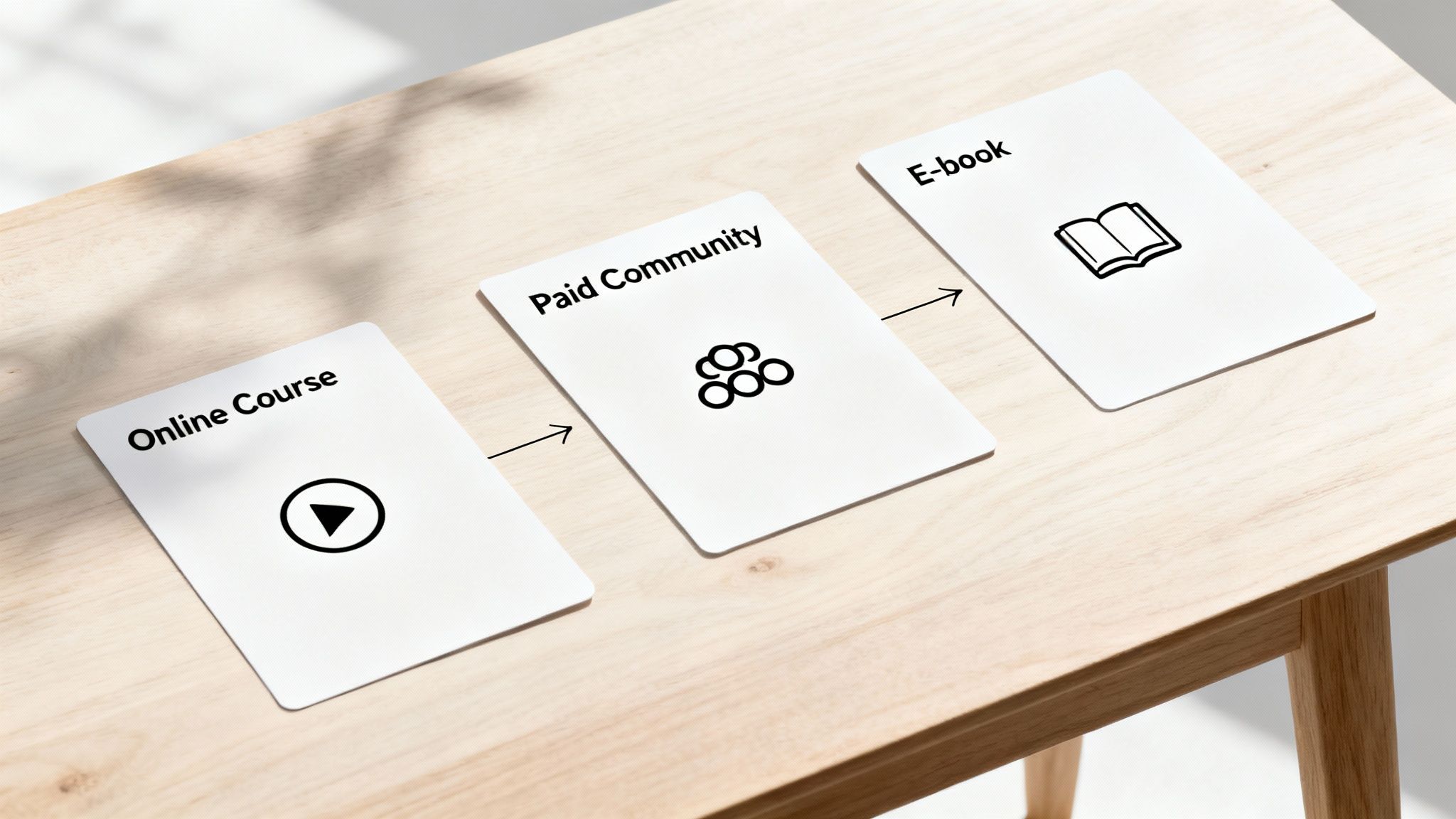
Theory is great, but let's be honest—seeing a proven sales funnel template working in the wild is what makes the concept click. I want to walk you through three practical examples I’ve seen work time and time again, especially for digital products.
These aren't just abstract ideas. They are battle-tested frameworks perfect for creators on platforms like Zanfia, designed to give you a clear roadmap from finding your audience to making a sale. Each one taps into a specific psychological trigger to build trust and gently guide someone toward becoming a customer.
Once you get the hang of these, you can tweak them for your own online course, paid community, or e-book. This is how you build a predictable revenue engine for your business.
The Online Course Funnel
Selling a premium online course is a big ask. Your potential customer is often considering a significant investment, so your funnel has to be built on a foundation of trust and expertise. You need to prove you can deliver the goods before you ever ask for their credit card.
Here’s how that flow usually plays out:
- Attraction: It all starts with high-value content. Think blog posts, social media tutorials, or podcast interviews where you solve a small but painful problem related to your course topic. This gets you on their radar.
- The "Try Before You Buy" Lead Magnet: Your call-to-action shouldn't be a boring PDF. Instead, offer a free mini-course or a live webinar. This is your chance to show off your teaching style and blow them away with value.
- Nurturing the Relationship: Once they're in, an automated email sequence kicks in. It delivers the mini-course lessons or webinar reminders, but it also does more. It shares student success stories, tackles common objections, and builds genuine excitement for the full program.
- The Offer: At the very end of the mini-course or webinar, you make your pitch. By now, buying your premium course feels like the most logical next step for anyone serious about getting the full transformation.
This model is so effective because it lets people experience your teaching firsthand. It removes risk, builds massive trust, and makes the final purchase decision feel a whole lot easier. Zanfia supports this model perfectly with its advanced course features, including native video hosting that eliminates the need for costly external services.
The Paid Community Funnel
Now, selling a recurring subscription is a different ballgame. You’re not selling a one-time fix; you’re selling ongoing connection, support, and exclusive access. The best way to do that? Give them a taste of the community experience.
A free, time-bound challenge is my absolute favorite way to pull this off.
Here’s what that looks like:
- The Hook: You start by promoting a free "5-Day Challenge" that's directly related to what your community is all about. Something like a "5-Day Content Creation Challenge" works perfectly.
- The Experience: Participants join a temporary free group—maybe a dedicated channel right within your Zanfia community—where they get daily prompts and can interact with you and each other. You're literally simulating the paid experience.
- The Invitation: On the last day, after celebrating everyone's progress, you make the offer. You invite them to keep the momentum going by joining your paid community for continued support and more advanced resources.
This sales funnel template is pure gold because it’s powered by social proof and a healthy dose of FOMO. People see others engaging and getting results, creating a powerful desire to stay in the loop and not get left behind.
The E-book Funnel
When it comes to lower-priced products like an e-book, the funnel is usually much shorter and more direct. The commitment is smaller, so the goal is to quickly show the value and drive an immediate purchase.
For lower-ticket items like e-books, the key is to remove friction. The journey from discovery to purchase should be as short and seamless as possible.
This funnel often boils down to a few key moves:
- Lead Magnet: A classic for a reason—offer the first chapter of your e-book for free.
- Immediate Upsell: This is critical. On the thank-you page right after they download the free chapter, hit them with a limited-time offer to buy the full e-book at a small discount. Strike while the iron is hot.
- Quick Follow-Up: A short and sweet email sequence (think 2-3 emails) reminds them of the offer and highlights a few killer testimonials or benefits from the book.
If you need some fresh ideas for that follow-up sequence, our guide on onboarding email sequence examples is packed with templates you can adapt.
Measuring and Optimizing Your Funnel for Better Performance
Getting your sales funnel live is a huge step, but let’s be clear: that’s the starting line, not the finish. The real money and growth come from what you do next—constantly testing, measuring, and tweaking every single part of the process. This is the shift from just hoping things work to knowing what works.
A great sales funnel template isn't something you set and forget. Think of it as a living system. It needs regular check-ups to find the leaks. Where are people dropping off? Is your landing page just not grabbing their attention? Are your emails getting ignored? Is the final sales page failing to convince them to pull out their wallet? Without the data, you’re just flying blind.
Identifying Your Most Important Metrics
To start optimizing, you need to know what to even look at. Drowning in data is just as useless as having none at all, so let’s cut through the noise. You only need to focus on a handful of key performance indicators (KPIs) to get a crystal-clear picture of your funnel's health.
Here are the numbers that truly matter for any digital creator:
- Landing Page Conversion Rate: Simple but critical. What percentage of people who see your lead magnet page actually sign up? This is your first major hurdle.
- Email Open Rate & Click-Through Rate (CTR): Are they even opening your nurture sequence emails? And more importantly, are they clicking the links inside? A low CTR here is a huge red flag—it might mean your subject lines are weak or the content isn't hitting the mark.
- Sales Page Conversion Rate: Of everyone who makes it to your final offer, how many become customers? This metric tells you everything about the power of your sales copy, social proof, and the offer itself.
- Customer Lifetime Value (LTV): How much is one customer actually worth to you over time? Knowing this helps you figure out exactly how much you can afford to spend to get a new one.
Keeping tabs on these numbers is a breeze with an all-in-one platform. Inside Zanfia, the built-in analytics give you deep visibility at every funnel stage, so you can stop guessing and start pinpointing exactly where your efforts will have the biggest impact.
Spotting and Fixing Funnel Bottlenecks
Once you have your data, you can go hunting for bottlenecks—the specific places where you’re losing the most people.
I like to think of it like a leaky pipe. A tiny drip on your landing page might lose you a few leads, but a massive leak on your sales page could be costing you thousands in lost revenue. Your analytics are the map to finding those pressure drops.
A really common bottleneck I see is the jump from "free" to "paid." You might have a great email click-through rate, but if your sales page conversion rate is in the gutter, it’s a sign. Your offer might not be compelling enough, the price could be off, or maybe the page is missing crucial elements like testimonials or a clear guarantee.
To fix these problems, you have to be methodical. This is where A/B testing becomes your best friend. Also known as split testing, it’s just a simple experiment: you compare two versions of a page or an email to see which one performs better. By changing only one thing at a time—a headline, the color of a button, a key image—you get real, hard data on what your audience actually responds to.
The Power of Continuous Improvement
Optimization isn’t a one-and-done task. It’s an ongoing process. But the good news is that even tiny, consistent improvements can compound into massive wins over time. Think about it: improving your landing page conversion from 20% to 25% might not sound earth-shattering, but it means you're suddenly getting 25% more leads into your funnel from the exact same traffic.
Setting benchmarks is a great place to start. Recent industry data shows that top-tier eCommerce funnels are hitting a 23% lead conversion and an incredible 58% close rate. That's a high bar, but it shows what’s possible. More generally, a "good" conversion rate often lands between 3-10%, with most businesses who actively measure their performance seeing around 3.1-5%. The real lesson here is that you have to measure. An estimated 68% of companies don't even have a defined funnel, which is a massive amount of revenue just left on the table. For more on this, check out the 2025 conversion rate benchmarks on FirstPageSage.com.
When you commit to tracking your KPIs and regularly testing new ideas, you turn your funnel from a static page into a dynamic, well-oiled machine that actually grows your business. This data-driven mindset is the key to truly understanding your marketing return on investment, which we dive into deeper in our guide on how to calculate marketing ROI.
Common Sales Funnel Questions (Answered)
Even with the perfect template, you're going to have questions. Building a machine that turns strangers into happy customers for the first time can feel like a huge undertaking, but it’s simpler than it looks. Let's tackle some of the most common questions and roadblocks I see creators run into.
How Long Will This Actually Take to Build?
This is the big one, right? And honestly, the answer is "it depends"—but probably not in the way you're thinking. The real variable isn't your technical skill; it's the complexity of what you're selling.
For something like a simple e-book, you could genuinely get a solid funnel running in a single afternoon. We're talking a landing page, a thank-you page, and a quick 3-part email welcome. It's fast, especially if you aren't fighting with the tech.
Now, if you're launching a signature online course with a live webinar, a detailed sales page, and a ten-day email sequence, you're looking at a week or more to get all the pieces in place. The smart move is to start small. Get a basic, working version live and then add more sophisticated elements later.
The biggest time suck for most creators isn't writing the sales page. It's the technical nightmare of duct-taping three or four different tools together. When your landing page builder, email provider, and checkout are all in one place, you slash your setup time from weeks to hours.
What's a "Good" Conversion Rate for My Funnel?
Chasing some universal "good" conversion rate is a recipe for frustration. Your numbers will always be unique to your audience, your price point, and your traffic source. A 2% conversion rate from a cold Facebook ad is fantastic, while a 2% conversion from your warm email list might be a little disappointing.
Instead of obsessing over a single number, focus on the conversion rates at each step of your funnel. This is where the real insights are.
Here are a few realistic benchmarks to keep in mind:
- Lead Magnet Page: For a truly valuable freebie, seeing 20-40% of visitors sign up is a great target.
- Sales Page: For a paid product, converting 2-5% of visitors is a very healthy number.
- Overall Funnel: When you look at the whole journey from ad click to final purchase, a 1-3% conversion rate is typical. Anything over 5% is absolutely crushing it.
The key is to track your own metrics month over month. The only number you should be competing with is your own from last month.
Can I Use the Same Funnel Template for Different Products?
Absolutely. In fact, you should. This is the whole point of creating a proven template in the first place. The core psychology—Awareness, Interest, Desire, Action—doesn't change whether you're selling a PDF, a membership, or a coaching package.
Obviously, the content has to be tailored. The sales page for your course will need different copy than the one for your e-book. But the underlying structure? That can be duplicated. The layout of your pages, the timing of your emails, the flow from one step to the next—clone it, tweak the content, and launch. It’s a massive time-saver.
Do I Really Need Expensive Software to Build This?
Nope. In fact, starting out by stitching together a bunch of expensive, specialized tools is often a huge mistake. Trying to make a landing page builder, an email service, a course platform, and a payment processor all talk to each other is a fast track to headaches and spiraling monthly bills.
An all-in-one platform is just a smarter, more efficient way to go. You get all the essential tools you need, under one roof, with a single login. For Polish creators, this is where a platform built with the local market in mind really makes a difference. Zanfia, for example, offers a revolutionary 0% transaction fee model, meaning you keep 100% of your revenue. It also automates Polish invoicing with tools like inFakt and Fakturownia, dramatically simplifying compliance.
Ready to stop juggling tools and just build a funnel that works? On Zanfia, you can create your entire sales funnel—from landing pages and email sequences to integrated communities and courses—all in one place. Best of all, with 0% platform fees, you keep 100% of what you earn. Build your first sales funnel with Zanfia today.


