AI Creator Course Review: What to Buy and What to Build First (2026)
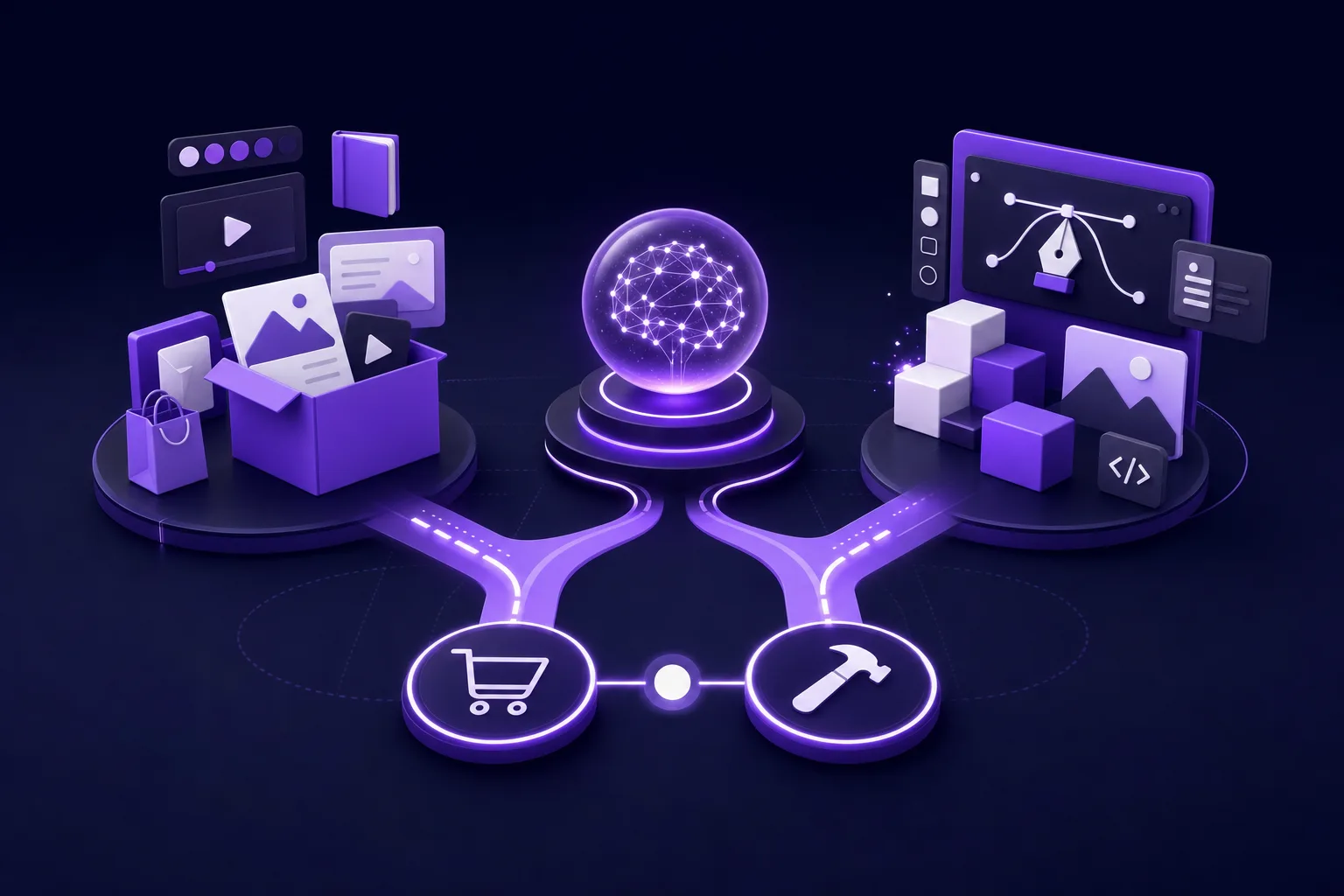
There is no single course called "The AI Creator Course" with a definitive review. The phrase covers a growing category of programs that teach creators to use AI for content, products, and audience growth. This review explains what to look for, which programs are worth your time as of September 2026, and how to build the platform side of your AI-powered business so the course actually pays off.
What "AI creator course" actually means in 2026
The search term "ai creator course review" pulls in three different products, and reviewers rarely separate them. Blurring these three categories is why most comparison pages read as noise.
The first group is courses about using AI as a creator: prompt engineering, workflow automation, AI video and image generation, and AI-assisted writing. Examples include programs from Nicky Saunders, Ann Handley, and the AI Foundations bundle. The second group is courses that use AI to help you build a course: outline generators, script writers, and lesson builders sold as "create a course in a weekend." The third is creator business programs updated with AI modules: legacy programs like Foundr's course-building program or Amy Porterfield's Digital Course Academy, now bolting on AI sections.
A useful review names which of the three you are evaluating. Pick a course that matches how you will actually use AI, not one that promises all three.
How to judge an AI creator course before you buy
Most course reviews grade on production value and testimonials. Neither predicts whether you will finish or earn back the tuition. Five criteria matter more.
Refund window in writing. A 14-day or 30-day refund with no "must complete every module" clause is the honest signal. Legitimate programs stand behind the promise.
Instructor's own AI receipts. Someone teaching AI-assisted writing should show current pieces they used AI to produce, and name the tools. Vague "AI-powered workflow" pitches without artifacts are a soft warning.
Curriculum date on every module. AI tools change monthly. A module recorded in early 2024 teaching GPT-4 prompts is already outdated for GPT-5 and Claude Opus 4.7. If the sales page will not show recording dates, assume the content is old.
A real community, not a Facebook group. Dead groups where the instructor last posted six months ago mean you get lecture videos and nothing else. Active communities where students post work weekly are where the actual learning happens.
An implementation path, not just theory. The best AI courses assume you will publish, sell, or ship something within 30 days. Programs that end at "now go apply this" without a build track lose most students by module three. Research on MOOC completion published in IRRODL by Katy Jordan shows the median online course finishes at under 15%, and structure is the single biggest lever on that number.
AI creator courses worth reviewing as of September 2026
These are current programs with public pricing, active cohorts or evergreen enrollment, and stated refund policies. Verify each before buying: creator course pricing, refund windows, and community activity change often.
| Program | Price | Format | Last updated | Refund policy | Community activity | Limitation |
|---|---|---|---|---|---|---|
| AI Foundations (David Ondrej) | $497 one-time | Self-paced + community | Core modules refreshed through 2026 | Confirm current terms at checkout | Active Skool community with daily posts | Broad AI overview; light on delivery and checkout mechanics |
| Growth School AI Mastermind | ~$1,200 | Cohort, 6 weeks | Refreshed for each cohort launch | Typically no refund once cohort starts | Cohort channel, active for the 6-week window | Community access ends when cohort closes |
| Class Central / Coursera AI specializations | $49/mo | Self-paced modules | Recording dates vary per course, check individually | 7-day free trial, no refund after billing | Course forums, low instructor presence | Academic tone; no creator-business focus |
| Ann Handley MarketingProfs AI Writing | $795 | Self-paced + live Q&A | Updated early 2026 for GPT-5 era | Refunds handled case by case via MarketingProfs support | Moderate Slack activity around live sessions | Writing only, no video or product design tracks |
| Nicky Saunders AI Content Systems | $1,997 | Cohort + templates | Curriculum refreshed for late-2025 cohort | Cohort-dependent; confirm at enrollment | Private group, most active during cohort weeks | Highest ticket; template libraries date quickly |
| Zanfia (delivery platform, not a course) | From $31/mo billed annually | Self-serve platform + AI assistant | Continuously updated; release notes on changelog | 14-day free trial, no credit card required | Native in-platform community per workspace | No built-in Meta Ads panel or referral program yet |
None of the five programs above teaches you how to run the platform side: checkout, delivery, community, upsells. The platform gap is what most students hit around week four.
The math on whether a $997 course pays back
Reviews rarely show the arithmetic, and the arithmetic is the whole point.
Assume you buy a $997 AI creator course and use what you learn to launch your own $199 offer. Selling 10 seats grosses $1,990. On a Gumroad-style platform charging 10% + $0.50 per transaction, processor fees included, you net roughly $1,703. On a percentage-taking marketplace at 30%, you net about $1,393. On a flat-fee platform charging 0% platform commission (only the payment processor's Stripe rate of 2.9% + $0.30), you net about $1,875. Platform choice creates a $482 spread between the cheapest and most expensive delivery layer on the same 10 sales, which by itself is roughly half the tuition.
Scale that to $5,000/month in course sales and the platform-fee gap widens to about $1,150/month. Over a year, the platform you deliver on matters more than the course you bought to learn the craft.
The platform-fee-versus-processor-fee frame is what most AI course reviews miss, and no course covers it. For the underlying mechanics, see our breakdown of platform fee versus processor fee.
What the courses do not teach: delivery infrastructure
Every AI creator course teaches craft. None teach the operational stack you need the day someone hands you $199. That stack has five parts:
Checkout that supports payment plans. A $997 offer without an installment option loses buyers who would have said yes to four payments of $269. Adding installments is one of the highest-impact conversion levers available at checkout.
An order bump on the checkout page. A $47 template bump on a $199 course at a 20% attach rate adds $940 per 100 buyers with zero additional marketing spend. At a 30% attach rate the same bump adds $1,410 per 100 buyers.
Drip content, not a data dump. AI students in particular need pacing: too many tools at once and they freeze. Time-locked module unlocking is what separates a $497 program that gets finished from one that gets abandoned.
A community that lives on the same domain as the course. Sending buyers to a separate Circle or Discord costs completion. Native integration keeps them in one place.
Tracking that survives the cookie deprecation. If you plan to run ads on your course, server-side conversions through Meta CAPI or GA4 measurement protocol are now baseline, not optional.
Where Zanfia fits in an AI creator's stack
Zanfia is an AI team that runs the creator business, and a platform second. The AI-team framing matters when you have just spent months learning to use AI in your craft: the tools that deliver your work should not force you back into manual configuration for every product launch.
The assistant knows the whole application and can perform any action available in the interface, by chat or by voice. You describe what you want to sell, in one sentence, and the platform builds the course, the page, and the checkout. Voice dictation is available on every plan, so you can talk through a launch instead of clicking through it. Advanced AI, including the full assistant and the AI answers drawn from your own content inside a community, is available on higher plans.
On the delivery side, Zanfia handles the five gaps above under one brand. Twelve product types under one account, including bundles and services. Order bumps, installments, subscription upsells, and Apple Pay/Google Pay wallets at checkout. Native video hosting with drip content and moments (timestamped notes). Communities with channels, roles, and a member map, integrated with the course rather than bolted on. Meta Conversions API, GA4, and Microsoft Clarity for tracking, all configurable per product and gated by cookie consent.
For creators who want their AI assistants to act on the workspace directly, the MCP endpoint is available on higher plans. No competitor in the creator platform category exposes their platform to AI agents this way as of publication.
Pricing starts at $39/month, or $31/month billed annually, on the Starter plan. Platform commission on customer sales is 0% on every plan. Only the payment processor (Stripe, roughly 2.9% + $0.30 in the US) takes its standard cut. Every plan includes a 14-day free trial with no credit card.
Limitation: no built-in Meta Ads panel and no referral program yet, and community access inside the mobile app sits behind a per-workspace flag.
Email campaigns are also rolling out to workspaces gradually; until yours has access, you push tags and lists into your existing email tool through the built-in integrations. Referral programs and a Meta Ads panel are on the roadmap, not shipped.
A practical buying sequence
The mistake most creators make is buying the course before they have anywhere to deliver what they build. Reverse the order.
First, run course idea validation with three to five customer interviews. Three to five conversations cost nothing and prevent the most expensive mistake, which is producing a course nobody was waiting for. Second, set up your delivery platform on a 14-day trial and build a test checkout for a $47 mini-offer. If you cannot get a live checkout link in a weekend, no AI course will save you. Third, buy the AI creator course that matches the specific craft gap you have, whether that's AI writing, AI video, or AI-assisted product design.
By the time the course is teaching you to produce faster, you already have the shelf to put the products on.
Frequently asked questions
Is there one AI creator course that covers both craft and business?
Not really. Programs teaching AI craft (writing, video, image generation) rarely go deep on checkout, delivery, or platform fees. Programs teaching the creator business are still catching up to AI tools. Expect to buy one for craft and rely on your platform documentation for the business layer, which is why choosing a platform that handles delivery, community, and checkout under one roof matters as much as the course itself.
How much should an AI creator course cost?
Self-paced programs typically run $497 to $997. Cohort programs with live components run $1,200 to $2,500. Higher-priced programs are not automatically better: verify the recording dates on modules, the activity level of the community, and the refund policy in writing before spending more than $500.
Will an AI course teach me how to sell what I build?
Most cover marketing at a surface level but skip the checkout mechanics that actually convert: installment payments, order bumps, upsells, and platform versus processor fees. On a $199 offer with a $47 bump at a 20% attach rate, skipping that bump leaves $940 per 100 buyers on the table. The delivery platform matters as much as the course.
What's the difference between an AI creator course and a course-building course?
An AI creator course teaches you to use AI as a creator, for content, products, and workflows. A course-building course teaches you to build and sell online courses, sometimes with AI-assisted modules added recently. If you want to sell your AI expertise, you likely need both, but for different reasons: one improves your craft, the other improves your offer design.
How do I know if a course is genuinely current on AI tools?
Ask three questions before buying: what date were the current modules recorded, which AI models does the curriculum cover (GPT-5, Claude Opus 4.7, Gemini 3 Pro are the current front tier as of September 2026), and how often does the instructor update the material. If the sales page does not answer all three, treat the content as potentially outdated.
FAQ
Is there one AI creator course that covers both craft and business?
Not really. Programs teaching AI craft rarely go deep on checkout, delivery, or platform fees, and programs teaching the creator business are still catching up to AI tools. Expect to buy one for craft and rely on your platform documentation for the business layer.
How much should an AI creator course cost?
Self-paced programs typically run $497 to $997. Cohort programs with live components run $1,200 to $2,500. Higher-priced programs are not automatically better: verify recording dates, community activity, and refund policy in writing before spending more than $500.
Will an AI course teach me how to sell what I build?
Most cover marketing at a surface level but skip the checkout mechanics that actually convert: installment payments, order bumps, upsells, and platform versus processor fees. On a $199 offer, missing an order bump alone costs about $940 per 100 buyers.
What's the difference between an AI creator course and a course-building course?
An AI creator course teaches you to use AI as a creator, for content, products, and workflows. A course-building course teaches you to build and sell online courses, sometimes with AI-assisted modules added recently. If you want to sell your AI expertise, you likely need both.
How do I know if a course is genuinely current on AI tools?
Ask three questions before buying: what date were the current modules recorded, which AI models does the curriculum cover, and how often does the instructor update the material. If the sales page does not answer all three, treat the content as potentially outdated.