Mastering Backwards Planning Lesson Plans for Online Courses
If you want to build an online course that actually works, you need to throw out the old playbook. The typical approach—brainstorming topics, outlining modules, and then filming hours of content—is a recipe for disaster.
Instead, you start at the end.
This is the core idea behind backward planning: first, you define the final transformation your student will achieve. Then, you decide how you'll measure their success. Only then do you build the learning path to get them there. It's an outcome-first approach that ensures every single piece of your course has a purpose.
What Is Backwards Planning and Why It Actually Works
Let's cut through the jargon. At its heart, backward planning is a simple but profound shift in thinking.
Imagine you're building a bridge. You wouldn't just start laying down bricks and hope they magically reach the other side, right? You'd begin with a crystal-clear picture of the destination. You'd calculate the exact measurements and then engineer a structure guaranteed to connect both points.
That's precisely how backward planning works for course creation. You're not just cramming in content and hoping for the best. You're starting with the final, tangible result your student will walk away with. This simple pivot changes the fundamental question from "What will I teach?" to "What will my students be able to do?"
This isn't some new-age fad; it's a proven educational strategy that brings laser-like clarity to the entire course creation process. You're reverse-engineering the learning journey to guarantee success.
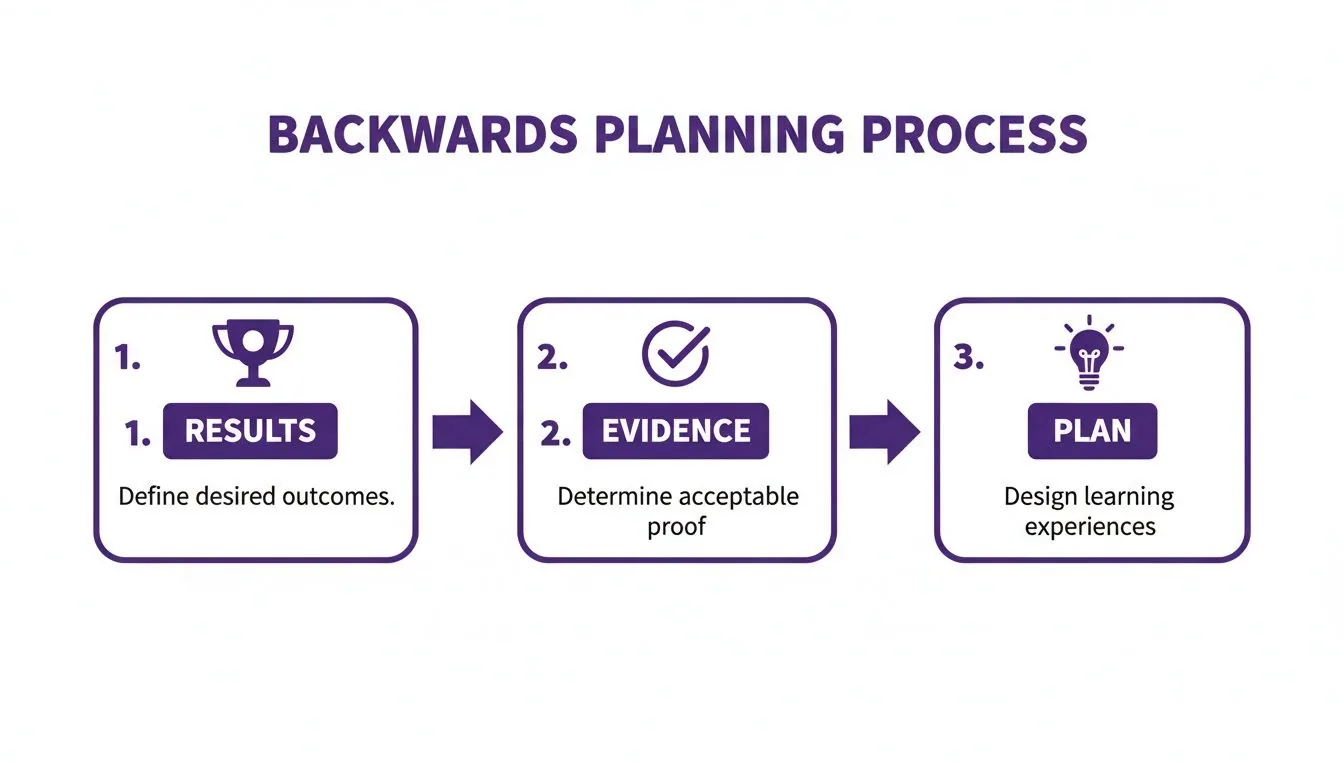
The flow is simple but powerful: the final plan is entirely dependent on the results and evidence you've already defined, ensuring perfect alignment from start to finish.
A Proven Framework for Better Outcomes
This methodology, often called backward design, really hit the mainstream in 2005 with the book Understanding by Design by Grant Wiggins and Jay McTighe. Their three-stage framework—start with desired results, determine acceptable evidence, then plan instruction—was a game-changer.
It shifted educators away from the old-school, content-first model and toward outcome-driven strategies that just plain work better. For online course creators, the results are staggering. We've seen that courses built this way can ensure 90% of content directly supports the final assessments. This focus helps catapult completion rates from the dismal industry average of 12% to over 40%.
The Problem with Traditional Planning
So many creators fall into the "content-first" trap. It feels productive to brainstorm every possible topic, creating a massive outline of modules and lessons. But this usually leads to bloated, unfocused courses that overwhelm students.
The result? Students get lost in a sea of information with no clear path forward. This is where you see engagement drop off, completion rates plummet, and testimonials come back lukewarm at best. Your course ends up being a collection of "interesting stuff" rather than a structured journey that delivers a specific, promised transformation.
The guiding question for every piece of content becomes: "Does this directly help my student achieve the final transformation?" If the answer is no, it doesn't belong in the course. It's that simple.
To make this distinction even clearer, let's break down the two approaches side-by-side.
Backward Planning vs Traditional Planning At a Glance
This table offers a quick comparison, highlighting the fundamental differences in approach and outcomes between the two planning models.
| Aspect | Backward Planning (Outcome-First) | Traditional Planning (Content-First) |
|---|---|---|
| Starting Point | What will students be able to do? | What content should I cover? |
| Focus | Student transformation and results | Covering topics and information |
| Content Role | Serves as a means to an end | Is the end goal itself |
| Assessment | Designed early to measure the final outcome | Created at the end to test content recall |
| Course Structure | Lean, purposeful, and goal-oriented | Often bloated, unfocused, and overwhelming |
| Student Experience | Clear, motivating path to a tangible skill | Confusing, with no clear sense of progress |
| Typical Outcome | High completion rates, strong testimonials | Low completion rates, student frustration |
As you can see, the starting point dictates everything that follows, leading to dramatically different products and student experiences.
Why This Shift Is a Game-Changer
Adopting backward planning isn't just an educational theory; it's a powerful business strategy that leads to better products and happier customers. Here’s why it’s so effective for online creators:
- Creates Purposeful Content: It forces you to cut the fluff and focus only on what's absolutely essential for student success. This will save you countless hours creating content that doesn't actually move the needle.
- Boosts Student Motivation: When students can clearly see the destination and understand how each lesson moves them closer, their motivation and engagement go through the roof.
- Simplifies Your Marketing: A clearly defined outcome is a marketing superpower. It transforms your sales page from vague promises to a concrete guarantee, attracting the right students who are ready to commit.
- Leads to Real Results: By its very nature, this method creates courses that deliver. When students achieve their goals, you get powerful testimonials, strong word-of-mouth referrals, and a thriving online business.
Ultimately, this approach builds trust. You’re not just selling information; you're selling a reliable outcome. This is a foundational concept we explore further in our detailed guide on strategic course design.
Start with the End Goal in Mind
The first step in backward planning is, without question, the most critical one. You have to nail down the final, tangible transformation your student will walk away with. This isn't just a starting point; it's the entire promise of your course, and getting it right makes everything else fall into place.
Let's get one thing straight: people don't buy information. They buy results. So, forget vague topics like "learning email marketing" or "understanding digital art." That’s not what your students are looking for.
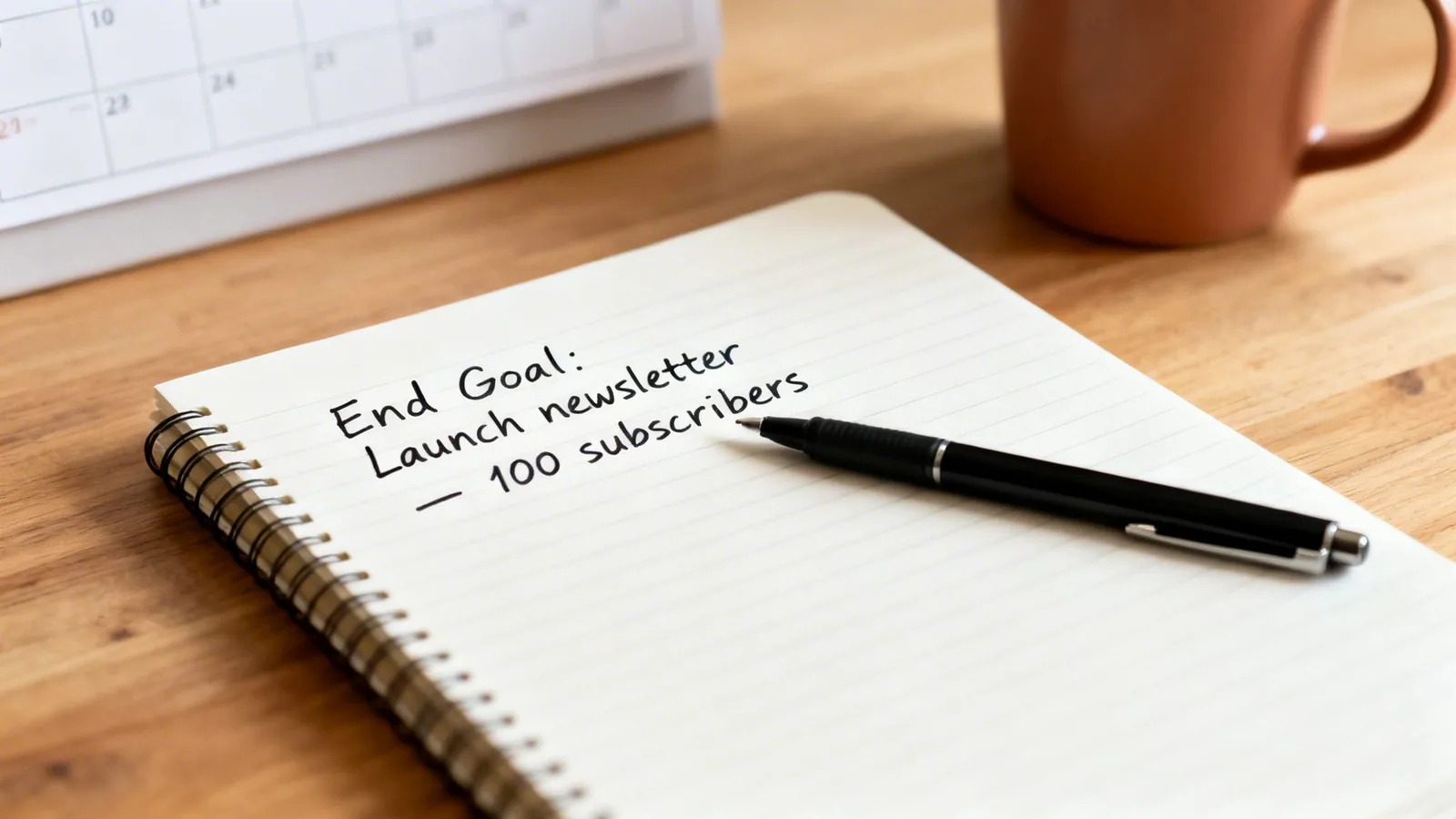
Instead of teaching "email marketing," you're going to empower a student to "build and launch a newsletter that gets its first 100 subscribers." See the difference? That’s a destination. That's a promise. Framing your course this way is a marketing superpower because it immediately connects with people who are serious about getting that exact result.
From Vague Ideas to Powerful Outcomes
To land on a truly compelling end goal, you’ve got to dig deeper than the broad subject you teach. Pinpoint the single most important skill or "big idea" your course delivers. I always tell creators to ask themselves: "What do I want my ideal student to be able to do the day after they finish my course?"
What new power will they have? What problem can they now solve on their own? This is how you translate your expertise into a clear, irresistible promise of transformation.
Writing Outcomes with Action-Oriented Language
The most effective learning outcomes are always built around strong verbs. They describe something a student can physically do, leaving zero room for interpretation. This isn't just about sounding professional; it's about creating crystal-clear expectations for you and your future students.
Here are a few examples of this shift in action across different fields:
- Fitness Coaching: Instead of "Learn about strength training," the goal becomes "Complete a full-body workout using proper form for five key exercises."
- Software Training: Ditch "Introduction to Adobe Illustrator," and promise to help them "Design a professional-looking logo for your brand using core vector tools."
- Digital Art: Move past "Drawing fundamentals," and offer a concrete outcome like "Create a fully rendered digital portrait that demonstrates an understanding of light and shadow."
Each of these examples focuses on a specific, demonstrable skill. That’s the level of clarity you’re aiming for. It’s the same logic that applies to any strategic work—whether you're designing a lesson or defining your business goals for a new marketing campaign.
Here's a simple test: Can you easily picture what a student who has achieved your learning outcome is now capable of doing? If the image is fuzzy, your goal isn't specific enough.
A Simple Framework for Pinpointing Your Core Promise
Struggling to zero in on that one big promise? Sit down and answer these three questions. They’ll force you to get specific about the value you're really selling.
- Who is this for? Get specific about your ideal student. Are they an absolute beginner, an intermediate user needing to level up, or a seasoned pro?
- What will they be able to do? Pick a strong action verb that describes the core skill they’ll master (e.g., build, design, write, launch, analyze).
- What is the tangible result or context? Describe the final project or outcome (e.g., a five-page website, a profitable ad campaign, their first published podcast episode).
When you put it all together, you get something solid. For example: "A beginner freelancer will be able to build a professional five-page portfolio website using a no-code platform."
This statement is now the north star for your entire course. Every lesson, every activity, every assessment will be designed to get your student to that exact destination. If you want to dive deeper into building out your content from here, our guide on how to write a comprehensive curriculum is the perfect next step. This initial clarity is what makes backward planning so powerful—it simplifies every decision you make from this point forward.
Define What Success Looks Like for Your Students
You’ve nailed down the big transformation your students are after. So, what’s next? This is where backward planning really gets interesting. The question becomes simple, but it’s a big one: How will you actually know they’ve made it?
We’re moving from the “what” to the “how.” This isn't about creating stressful, academic-style quizzes that just test rote memory. No, this is about defining what real, tangible proof of learning looks like for your specific skill.
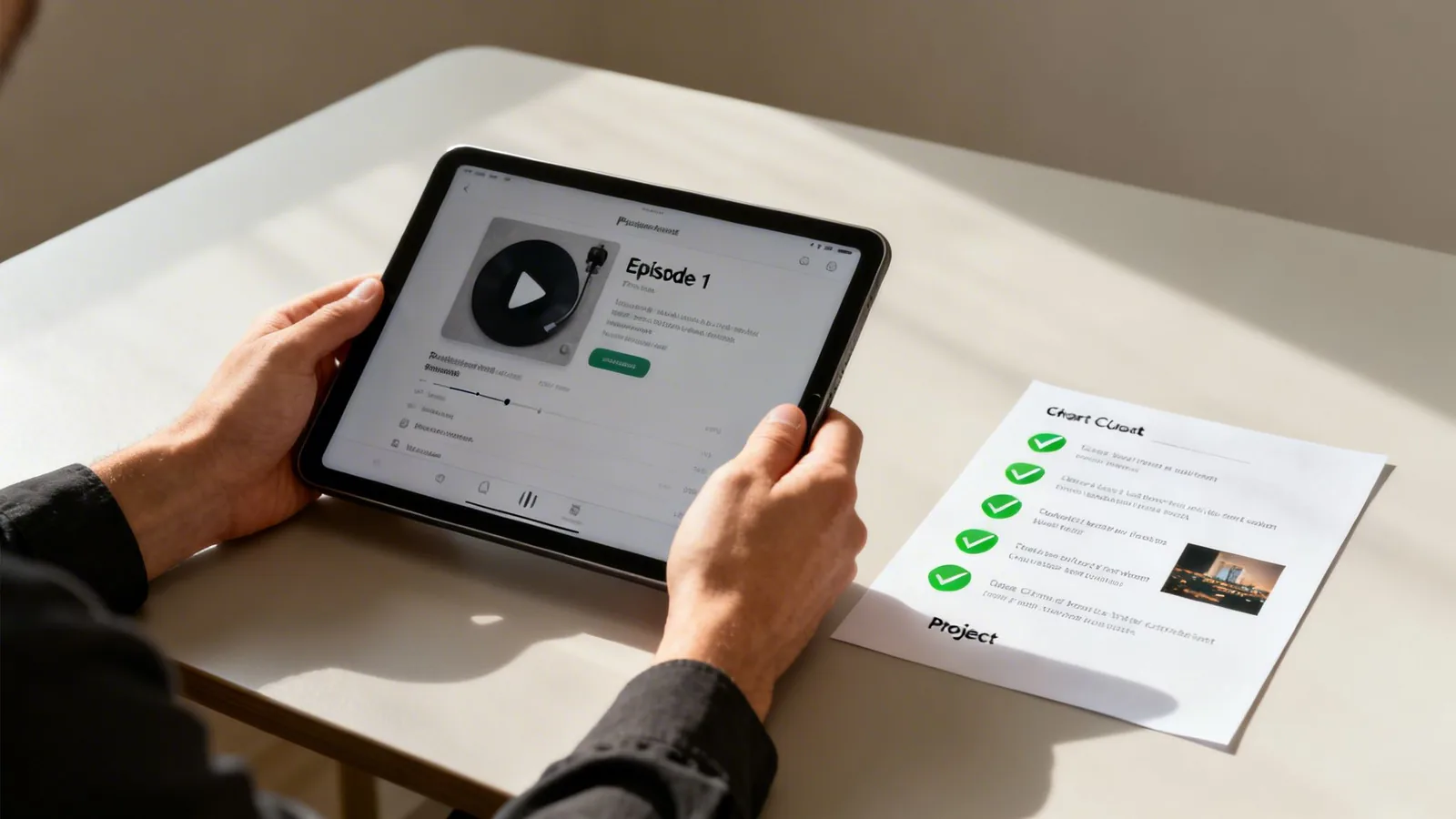
This stage is all about designing assessments that feel less like a test and more like an empowering milestone. Think of practical, real-world tasks that let your students flex their new muscles. If your course is about launching a podcast, the true measure of success isn't a multiple-choice quiz on microphone types—it's getting a link to their very first published episode.
That’s the kind of concrete evidence we’re shooting for. This "proof" becomes the new bullseye for all your content, ensuring every video, worksheet, and lesson pushes them toward that final, practical application.
From Abstract Knowledge to Concrete Proof
The big idea here is to design a final project or task that directly mirrors the real-world skill you promised. If the goal is for students to "design a compelling brand logo," then the assessment has to be submitting a logo design for feedback. Anything else is a miss.
This tight alignment is what makes backward planning so incredibly effective. When there's a straight line from the goal to the final assessment, it cuts through the noise. It gives students a clear, valuable target to aim for, which is a massive motivator.
Choosing the Right Assessment Type
Your final assessment should feel like a performance, not a pop quiz. It’s their chance to show off, to demonstrate that they can now do the thing they came to learn.
So, what kind of project, task, or submission would best showcase their mastery?
Here are a few powerful formats that work exceptionally well for online courses:
- Project-Based Submissions: This is the gold standard. Your students build something real, like a business plan, a piece of code, a marketing campaign brief, or a social media content calendar.
- Case Study Analysis: Give them a real-world scenario and ask them to break it down using the frameworks you've taught. It's fantastic for building critical thinking skills.
- Portfolio Pieces: For any creative or technical skill, the assessment can simply be a portfolio-ready piece—a photograph, a polished article, a short video, you name it.
- Live Demonstrations or Walkthroughs: In a coaching or small group setting, have students walk you through a project they completed or demonstrate a new process live.
See the common thread? These are all active, "doing" assessments. They prove capability, not just comprehension.
Aligning Assessments with Learning Outcomes
Let’s bring this to life. We can take the powerful learning outcomes from the last section and pair them with perfectly aligned assessments. This one-to-one mapping is the beating heart of backward planning.
| Learning Outcome | Mismatched Assessment | Aligned Assessment |
|---|---|---|
| "Complete a full-body workout using proper form." | A quiz on muscle groups. | Submit a short video of them performing the exercises for form feedback. |
| "Design a professional-looking logo for your brand." | A multiple-choice test on design principles. | Submit three logo concepts for their own brand in a PDF. |
| "Launch a newsletter that gets its first 100 subscribers." | An essay about email marketing strategies. | Submit the link to their active newsletter and a screenshot of their subscriber count. |
An assessment should feel like the final, satisfying step of the journey, not a scary hurdle. It's the moment where students get to prove to themselves—and to you—that they can actually do the thing they signed up to learn.
When students see that the final project is a direct application of their new skills, their motivation goes through the roof. We cover this effect in our deep dive on the principles of student engagement.
Platforms like Zanfia are built around this outcome-first model. It works less like a course tool and more like an AI team that runs the delivery side of a creator business: native video hosting with a smart player that remembers student progress, an assistant you can dictate to by chat or voice to build lessons, quizzes and certificates without touching settings, and an MCP endpoint that lets your own AI agents act on the workspace (availability depends on the plan, see the current Zanfia pricing). Powerful automations handle access management so you can focus on feedback that celebrates student wins and locks in learning.
Build the Roadmap to Student Transformation
This is it—the final, most satisfying piece of the puzzle. You’ve already defined the destination and you know exactly what success looks like for your students. Only now, with that rock-solid foundation in place, do we actually start creating the content.
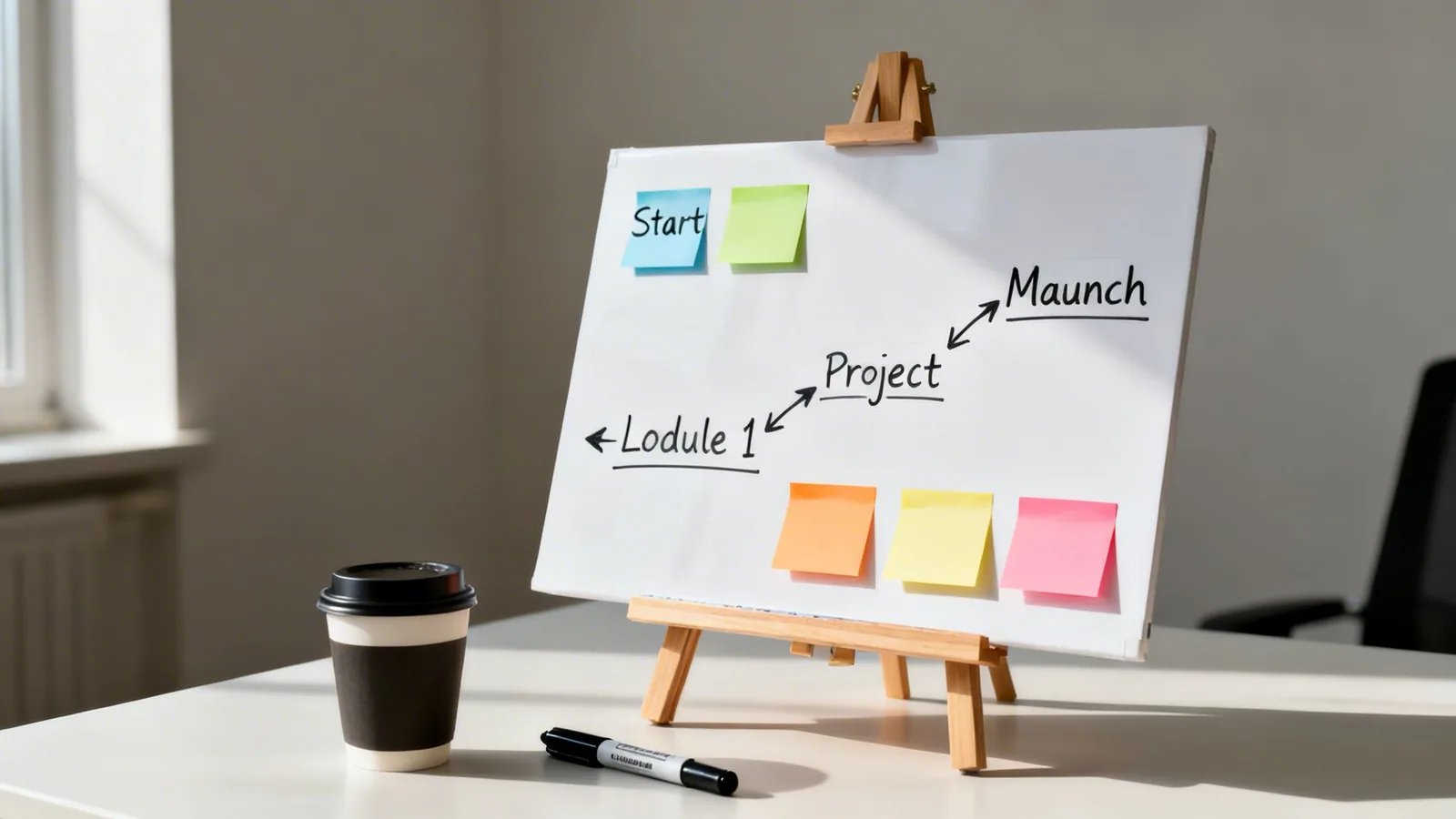
This is where you build the step-by-step path, the literal roadmap that guides your students from where they are right now to that victory you promised them.
It's at this stage that backwards planning lesson plans really start to feel like a superpower. Instead of just brainstorming content ideas and hoping they stick, you’re creating a deliberate, logical sequence of learning experiences. Every single video, worksheet, and community prompt you create will have a clear, direct purpose.
The guiding question for every piece of content becomes simple but non-negotiable: "Does this directly help my student ace their assessment and achieve the final transformation?" If the answer is no, it gets cut. This ruthless focus is what makes the method so incredibly efficient.
From Assessment to Actionable Lessons
The easiest way to structure your course is to work backward directly from the final assessment. Look at that final project or task you designed. What are the essential skills and knowledge a student absolutely needs to complete it successfully?
Each of those components can become a module or a major lesson in your course. This approach guarantees your content is perfectly scaffolded, with each lesson building logically on the last.
Let's stick with our earlier example: a course where the final assessment is to "Submit three logo concepts for their own brand."
To get there, a student would need to:
- Understand core design principles (like balance, contrast, and hierarchy).
- Learn how to use the essential tools in their design software.
- Know how to conduct basic research on their brand's industry and competitors.
- Develop a process for brainstorming and sketching initial ideas.
Boom. You’ve just outlined the first four modules of your course. This isn’t guesswork; it’s a logical breakdown of the skills required to hit the target. It’s a clean, efficient way to structure your thinking and is a core part of building a great online course outline.
Choosing the Right Content Formats
With your modules mapped out, you can start thinking about the best way to deliver the information. Don't just default to recording a long series of videos. A great course uses a mix of formats to keep students engaged and cater to different learning styles.
Consider a blend of these for your lessons:
- Video Lessons: Perfect for demonstrating processes, explaining complex concepts, and building a personal connection. Keep them short and focused on a single idea.
- Text-Based Lessons: Great for providing detailed instructions, checklists, scripts, or supplementary info that students can easily reference later.
- Worksheets & Templates: These are absolute gold for turning passive learning into active practice. Give them fillable PDFs or templates they can use immediately.
- Community Challenges: Use your community space for peer feedback, group projects, or weekly challenges that encourage application and interaction.
- Live Q&A Sessions: Offer chances for students to ask questions and get direct feedback, which strengthens both their learning and their connection to the community.
The goal is to choose the format that best serves the learning objective for that specific lesson. This creates a much more varied and dynamic experience.
The most powerful lesson plans are not just about transmitting information; they are about designing experiences. Your job is to create activities that allow students to practice, fail, get feedback, and ultimately master the skill themselves.
The Efficiency and Impact of This Approach
This structured method isn't just better for your students; it’s a lifesaver for you as a creator. It prevents you from wasting weeks creating content that doesn't actually contribute to the end goal. A platform with powerful automations can save you an additional 5-10+ hours a month by handling tasks like granting course access after payment, letting you focus on value-packed content instead of admin chores.
When it's time to actually create your resources, tools that speed up documentation are a massive help. Learning how to leverage voice typing in Google Docs, for example, can significantly accelerate the drafting of your lesson plans.
By focusing only on essential, goal-aligned content, you build a better course in less time, leading to happier students and a healthier business.
Common Backwards Planning Mistakes (And How to Fix Them)
Making the switch to backward planning is a huge unlock for course creators, but it’s not always a smooth transition. Shifting your brain from a "what will I teach?" mindset to a "what will they do?" mindset takes practice.
I’ve seen a few common hurdles trip people up when they first adopt this model. Let's walk through them so you can sidestep these issues from the get-go.
Setting Vague or Unmeasurable Goals
This is, hands down, the biggest mistake I see. We start with a goal like, "Students will understand social media marketing." On the surface, it sounds fine. But how do you actually measure "understand"?
A mushy goal like that creates a domino effect. Your assessments become fuzzy, your content wanders, and your students are left unsure if they've actually succeeded.
The Fix: Get surgical with your verbs. Banish words like "understand," "know," or "learn." Instead, use strong, observable action verbs that describe something a student can physically do. Think: design, build, write, launch, or analyze.
Instead of the vague goal, try this: "Students will design a 7-day content calendar for an Instagram account that aligns with a specific brand identity." Now that is a concrete outcome you can see, touch, and build a project around.
Creating Mismatched Assessments
Another common slip-up is designing an assessment that doesn't actually test the skill you promised. This happens when there's a major disconnect between the learning outcome and the "proof" you ask for at the end.
For example, you teach a practical skill like "how to edit a podcast intro," but the final assessment is a multiple-choice quiz on audio software features. The quiz only tests rote memorization, not the student's ability to actually perform the task.
Your assessment isn't a pop quiz on what a student remembers; it's a performance of what they can now do. The format of the assessment must mirror the real-world application of the skill.
The Fix: For every assessment, run it through a quick "Alignment Test." Ask yourself one simple question: "Does this task require my student to perform the exact skill I described in my learning outcome?"
- If the goal is to "write compelling sales copy," the assessment must be to write a piece of sales copy.
- If the goal is to "run a profitable Facebook ad," the assessment must involve analyzing the results of a real or simulated ad campaign.
This simple check ensures your assessment is a true measure of competence. For more ideas on this, checking out some of the best practices for online teaching can really help flesh out your approach to building powerful, authentic assessments.
Getting Overwhelmed by the Planning Stage
Sometimes, creators get stuck in "analysis paralysis." The backward design process can feel so big and important that you spend weeks trying to perfect the end goal and assessment, never actually getting around to creating the lessons.
This is especially common when you try to apply the model to an entire, massive signature course all at once. The sheer scope can be paralyzing.
The Fix: Start small. Seriously. Don't try to backward plan your entire 12-module magnum opus in one sitting. Pick just one module or even a single lesson.
- Define the micro-outcome for just that one module.
- Design the specific mini-assessment for that module.
- Map out the 3–5 lessons needed to get your students there.
Tackling it in these smaller, manageable chunks makes the process feel way less intimidating. Once you nail it for one module, you’ll have the confidence and the blueprint to handle the rest of the course.
Your Questions About Backwards Planning Answered
Once you start applying backward planning to your own courses, you're bound to run into some practical questions. It's totally normal. This final section is all about tackling those common queries I hear from creators when they're in the thick of it, giving you clear, actionable answers to keep you moving forward.
How Long Should This Planning Process Take?
That's the million-dollar question, isn't it? The honest answer is: it depends. There’s no magic number here. Think of the time you spend on backward planning as a direct investment in your course's quality and your own sanity. Rushing this part is a classic rookie mistake.
For a smaller workshop or a mini-course, you might block out a solid afternoon—maybe two—to really nail down your outcome, your assessment, and the lesson path. But for a flagship signature course? This strategic work could easily take a week or even longer. It’s not about speed; it's about clarity.
Think of it this way: every hour spent in planning saves you at least three hours down the road in re-filming content, answering confused student questions, or redesigning modules that don't land. It’s the most valuable time you'll spend on your course.
Can I Use This for a Small Product Like an Ebook?
Absolutely! The beauty of backward planning is that the principles scale down just as well as they scale up. It works brilliantly for smaller, focused products like ebooks, one-off workshops, or even a paid newsletter series. The core idea is identical—you just have a tighter scope.
Here’s how it would look for an ebook:
- Define the Outcome: What is the single, powerful transformation the reader will experience? What new thing will they be able to do after finishing your ebook?
- Determine the "Proof": This is your linchpin. Is it a game-changing template? A comprehensive checklist? This piece of "proof" is the tangible deliverable that brings the outcome to life, and it should be the centerpiece of your ebook.
- Plan the Content: Now, structure your chapters to build directly toward that key takeaway. Every single chapter must serve the purpose of getting the reader one step closer to their goal. No fluff allowed.
What's the Real Difference Between a Learning Objective and a Module Title?
This is a super common point of confusion, but getting this right is critical. A module title is just a label—a signpost. A learning objective is a promise—a destination.
Imagine you're on a road trip. The module title is a generic sign on the highway that says, "Midwest Region." It tells you where you are, but not where you're going. The learning objective is the specific destination you’re actually trying to reach, like, "You will be able to navigate downtown Chicago's grid system without a GPS."
- Module Title (The Label): "Module 3: Logo Design Fundamentals"
- Learning Objective (The Promise): "By the end of this module, you will be able to design a compelling logo using three core design principles."
A title tells students the topic. An objective tells them what they’ll be able to do.
How Does This Make Updating My Course Easier?
This is one of the biggest long-term payoffs of using backwards planning lesson plans. When your course is built on a solid, outcome-driven framework, it becomes wonderfully modular.
Because every lesson and activity is directly tied to a specific, measurable objective, you can easily swap out or update individual pieces without the whole thing falling apart. Let's say a piece of software you teach gets a major update. You don't have to panic and re-record the entire course. You just replace the one or two lessons focused on that specific tool, confident that the core structure and learning path remain perfectly intact.
It’s like being able to change a single tire on a car instead of having to replace the entire chassis. This approach future-proofs your content, making it far simpler to keep your course fresh, relevant, and valuable for years to come.
Ready to build and sell your expertly planned course? Zanfia is built around an AI team that runs the delivery side of a creator business, with 0% platform commission on customer sales (as of August 2026). You dictate lessons, quizzes, certificates and pages to the assistant by chat or voice instead of clicking through settings, and your own agents can act on the workspace over the MCP endpoint (availability depends on the plan, see the current Zanfia pricing). The checkout is built to sell too: order bumps, upsells, installments that split a $600 course into four payments, and a test mode to buy your own product end-to-end before launch. Start with a 14-day free trial, no credit card required, at https://zanfia.com.