

How to Make an Affiliate Link That Actually Converts

You found a product you already recommend in DMs, emails, or client calls. Maybe it is a course platform, a design tool, a newsletter app, or a payment solution you use every week. The missing piece is not enthusiasm. It is turning that recommendation into a link that tracks properly, fits the context, and gives you a real shot at earning from the value you are already creating.
That is where many creators get stuck. They think affiliate marketing starts when a brand approves them. In practice, it starts when they stop treating the link like a random URL and start treating it like an asset.
A good affiliate link does three jobs at once. It sends people to the right destination. It tells the merchant you referred the visitor. It gives you enough tracking data to improve future promotions instead of guessing. If you want a broader foundation before you publish anything, this guide on how to start an affiliate website is useful because it connects link strategy with the bigger content and monetization system around it.
Your First Step in Monetizing Your Recommendations
An affiliate link is simple on the surface. You join a program, get a special URL, and share it. But the quality of that URL matters more than beginners expect.
The metric that proves this is the Average Affiliate Conversion Rate, calculated as conversions from affiliate visitors divided by total affiliate visitors, multiplied by 100. In effective programs, that benchmark is 5%, and the basic example is clear: 1,000 affiliate-referred clicks yielding 50 sales equals a 5% conversion rate according to Rewardful’s affiliate marketing metrics guide. That is why link creation is not just administrative work. It affects whether your recommendation produces revenue or just traffic.
A lot of wasted affiliate effort comes from sending people to generic pages. If someone clicks because you praised a specific feature, product, or offer, dropping them on a homepage creates friction. Precise destination URLs tend to serve the click better because the message and landing page stay aligned.
That is also why ethical affiliate marketing works best for creators with trust. You are not trying to wedge a link into unrelated content. You are organizing your recommendations so people can act on them easily, and so you can measure what resonates. If you want a simple primer on the model itself before you get tactical, Zanfia’s explanation of what affiliate marketing is is a solid starting point.
The Anatomy of a High-Performing Affiliate Link
Most affiliate links look messy because they combine several jobs into one string. Once you understand the parts, they stop looking random.

The core pieces
A typical affiliate link usually includes these elements:
- Base URL . This is the destination page, such as a pricing page, product page, or signup page.
- Affiliate ID . This tells the program that you sent the click.
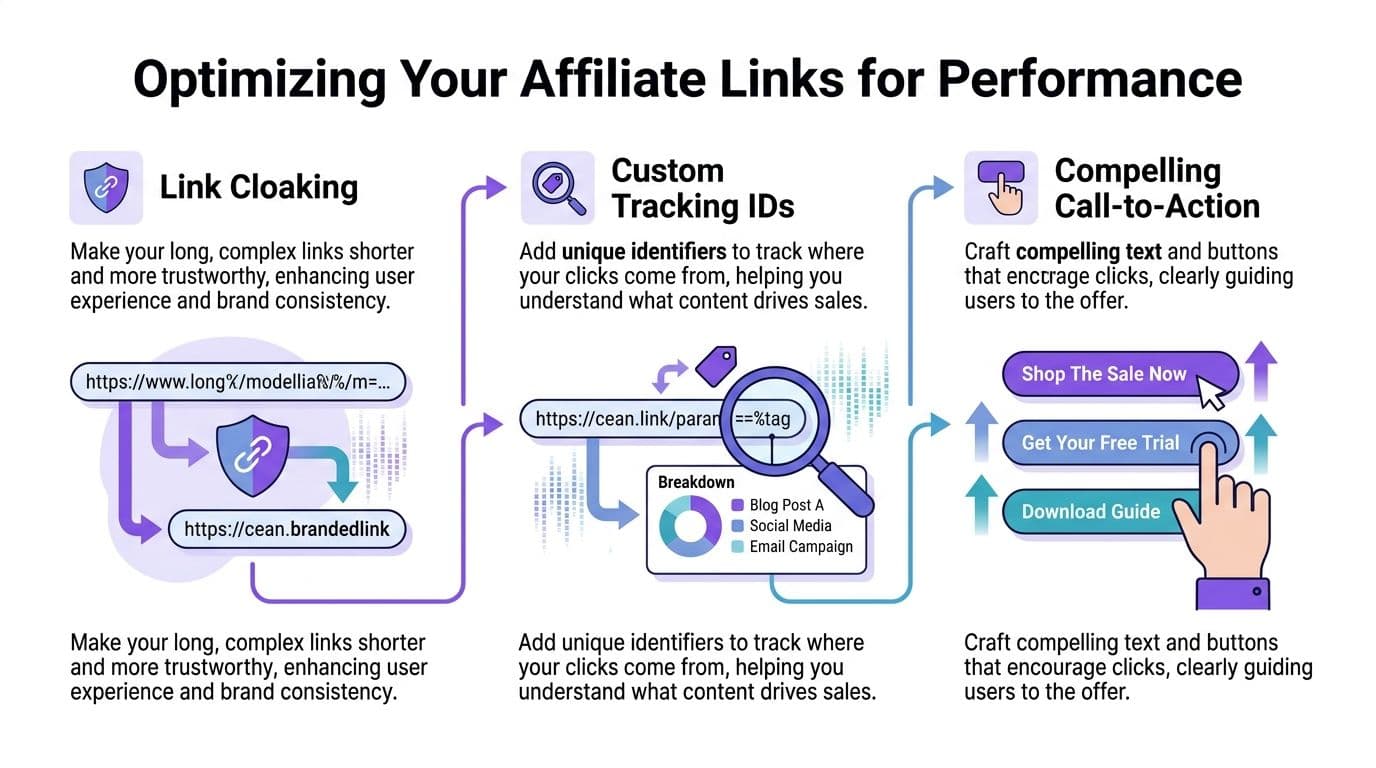
- Tracking parameters . These can include sub-IDs or campaign tags so you know whether a click came from a blog post, email, YouTube description, or a specific campaign.
- Optional redirect layer . Some programs or plugins place a redirect in front of the final URL for cleaner sharing and management.
If you look at a long affiliate link and only see clutter, you miss the operational value. Every extra parameter should exist for a reason. If it does not help attribution, testing, or reporting, it is just noise.
What each part changes in practice
The base URL influences relevance. A homepage may be acceptable for broad brand awareness. It is weak for review content, tutorials, or comparison posts where the reader expects a direct path.
The affiliate ID protects your commission. Without it, the merchant cannot attribute the referral correctly.
The sub-ID helps with diagnosis. If you use one link in a blog article and another in an email, you want to know which placement generated the click. A parameter such as sub=blogpost1 turns one affiliate relationship into something measurable.
The redirect or cloaked layer helps with presentation and maintenance. If a merchant changes a destination page later, you can often update the target in one place instead of editing links across your whole site.
Tip: If you cannot explain what every part of a link does, do not publish it yet. Hidden complexity causes reporting mistakes later.
Why anatomy matters for conversion work
The better you understand link structure, the easier it becomes to improve placement, call-to-action wording, and destination match. That is where conversion work starts. If you want to sharpen the page and message side of the equation, these conversion rate optimization strategies help frame what happens after the click.
How to Generate Your Affiliate Link in Any Program
There is a common workflow behind most affiliate systems, whether you are using ShareASale, CJ Affiliate, Impact, or a direct in-house program.

Start with the right program
Join programs that fit your audience and your content. Relevance matters more than cramming dozens of offers into your stack.
One practical benchmark from a guide on expert link setup is to start with high-conversion programs on networks like ShareASale. After approval, you usually go to a Links or Creatives area, choose the product or landing page, and generate a URL containing your affiliate ID. That same guide notes that untested links fail up to 40% of the time due to broken redirects, which is why testing in an incognito browser before publishing is essential, as explained in this walkthrough on creating an affiliate link.
The dashboard path is usually predictable
Inside most programs, the path looks something like this:
- Log in to the affiliate dashboard
- Find the merchant or product you want to promote
- Open the links, creatives, or assets section
- Choose a destination page
- Generate the affiliate link
- Add a sub-ID if the program allows it
- Test the final URL before publishing
That sequence does not sound complicated, but the biggest mistake happens at step four. Creators often choose the default merchant homepage because it is easy. Use the page that best matches the promise in your content.
Use deep links whenever possible
A deep link sends users to a specific page inside the merchant’s site instead of the homepage. If your article reviews a membership product, link to the membership page. If your YouTube video teaches one feature, link to that feature page if the program permits it.
Deep linking reduces friction because the visitor lands where their intent already points. That usually creates a smoother click-to-action path than broad top-level pages.
If you want another practical walkthrough from a different angle, HiveHQ published a useful guide on setting up affiliate links that complements this dashboard-first process.
Add source tracking before you publish
When the dashboard gives you a raw link, it is not finished. Add a sub-ID to identify the source when possible. That can be as simple as marking whether the click came from a comparison article, email sequence, or resource page.
Knowing this is important: "which offer worked" is not enough. You also want to know where it worked.
A quick visual walkthrough can help if you prefer to see the workflow in action.
Test like a publisher, not a hobbyist
Before the link goes live, check these points:
- Open it in incognito . This helps you catch login-state issues or cached redirects.
- Confirm the destination page . Make sure it lands on the exact page you intended.
- Check your tracking parameters . If the program supports sub-IDs, verify they remain attached after redirect.
- Test on mobile . A link that works on desktop but breaks in an app browser creates silent losses.
You do not need a huge system to learn how to make an affiliate link well. You need repeatable habits.
For creators managing a lot of moving pieces, strong process design matters as much as the link itself. That is where workflow thinking helps, and these workflow automation tools are worth studying if your content operation is growing.
Optimizing Your Link for Trust Clicks and Tracking
A raw affiliate link is functional. A refined affiliate link is easier to click, easier to trust, and easier to analyze.
Cloak when presentation matters
Long affiliate URLs can look suspicious, especially in social posts, comments, podcasts, and text-first placements. Cloaking tools such as Pretty Links or ThirstyAffiliates help you turn a clunky tracking URL into something branded and readable.
A cleaner link helps in a few ways:
- It looks intentional . Branded links feel less like a random redirect.
- It is easier to remember . Useful for podcasts, videos, and offline mentions.
- It is easier to manage . You can update the destination later without changing every published reference.
That said, cloaking is not always the best choice. In close-knit communities or educational content, some audiences appreciate transparent URLs because they understand affiliate relationships and value openness. The decision is strategic, not cosmetic.
Add UTM tags for analysis outside the affiliate dashboard
Affiliate dashboards tell you part of the story. UTM parameters help you connect click behavior with your own analytics setup.
Common UTM fields include:
| Parameter | What it tells you |
|---|---|
| utm_source | Where the traffic came from, such as newsletter or blog |
| utm_medium | The channel type, such as affiliate or email |
| utm_campaign | The specific promotion, launch, or content angle |
If your affiliate link already contains program parameters, add UTMs carefully so you do not break the URL structure. Always test the final link after appending anything.
UTMs become especially useful when one offer appears across multiple content formats. A merchant dashboard may tell you the click happened. Your analytics can help explain the user journey around that click.
Write the click invitation, not just the link
The Click-Through Rate, or CTR, measures how compellingly the link is presented. It is calculated as clicks divided by impressions, multiplied by 100. A 2% CTR is described as a strong engagement benchmark in this affiliate KPI guide. That same guide notes that placing links inside the main content with benefit-focused calls to action tends to perform better than burying them in the footer.
That has a practical implication. The sentence around the link often matters more than the link itself.
Compare these two approaches:
- “Here’s the tool.”
- “If you want to host lessons and keep all customer activity in one place, this is the platform I’d start with.”
The second gives the reader a reason to click. It connects the offer to a problem they are trying to solve.
Key takeaway: A link gets the credit. The surrounding message earns the click.
Disclose clearly and early
Disclosure is part of conversion quality, not separate from it. Readers do not resent affiliate links nearly as much as they resent feeling tricked.
A practical disclosure does not need to be awkward. It can be a short sentence near the first affiliate mention, a note above a resource list, or a direct label in a social post. The important thing is clarity.
A simple optimization stack
If you want a clean working setup, use this order:
- Generate the original affiliate URL
- Choose whether to cloak it based on channel and audience
- Append UTMs or sub-IDs where appropriate
- Write a specific CTA near the link
- Add a clear disclosure
- Test the complete path on desktop and mobile
Most underperforming affiliate links are not broken because the merchant is bad. They underperform because the creator publishes the first draft of the link and never improves the delivery.
Deploying Your Affiliate Link Where It Adds Value
A link does not convert because it exists. It converts because it appears where the audience already wants help.

Random placement creates random results. Contextual placement creates intent. That is why the best affiliate links are usually embedded in tutorials, comparisons, resource pages, onboarding emails, and recommendation threads where the product solves a live problem.
Match the link to the moment
Some placements are naturally stronger than others:
- Tutorials and how-to posts . The reader is already trying to do something.
- Review and comparison content . Intent is high because the reader is evaluating options.
- Resource pages . Strong when your audience wants your full tool stack in one place.
- Email sequences . Useful when the recommendation fits the stage of the subscriber journey.
- Community posts or member areas . Effective when the recommendation is tightly connected to the discussion.
The placement should answer a question the audience already has. If the reader must stop and wonder why the link is there, the setup is weak.
Change the angle for different audience segments
Most creators stop at “place the link in good content.” That is not enough. The framing around the link should change depending on who is reading.
A guide on affiliate angles points out that many tutorials miss the chance to test different messages, such as pain-point, dream-based, or social-proof framing, for different community groups. For creators with segmented audiences, matching the offer angle to values and engagement level can outperform one-size-fits-all placement, as discussed in this article on ad angles in affiliate marketing.
That means the same tool can be introduced in different ways:
- For beginners . Lead with simplicity and speed to first result.
- For experienced operators . Lead with control, integration, or workflow fit.
- For premium buyers . Lead with reliability, brand presentation, or customer experience.
The link stays the same. The message around it changes.
Tip: Do not A/B test only buttons. Test the promise that leads into the affiliate recommendation.
Use landing environments that support the click
If you are sending traffic from your own site, the page around the affiliate recommendation matters. A cluttered page weakens even a strong offer. A focused page strengthens it.
That why it helps to understand what a landing page is and how it differs from general content pages. Sometimes a recommendation belongs inside an article. Sometimes it deserves a dedicated tools page or a focused resource section.
Troubleshoot failing links
Not every problem is obvious. Watch for these failure points:
- Broken redirects . The link opens, but not on the intended destination.
- Expired or changed product pages . The merchant moved the offer.
- Missing attribution parameters . The click happens, but your tracking is incomplete.
- Weak context . The technical setup is fine, but the audience has no reason to act.
A lot of creators blame the program too early. First check the path, the placement, and the message.
Integrating Affiliate Links Into Your Zanfia Ecosystem
Affiliate links work differently when they live inside a branded environment you control. The recommendation feels less like rented attention and more like curated guidance.
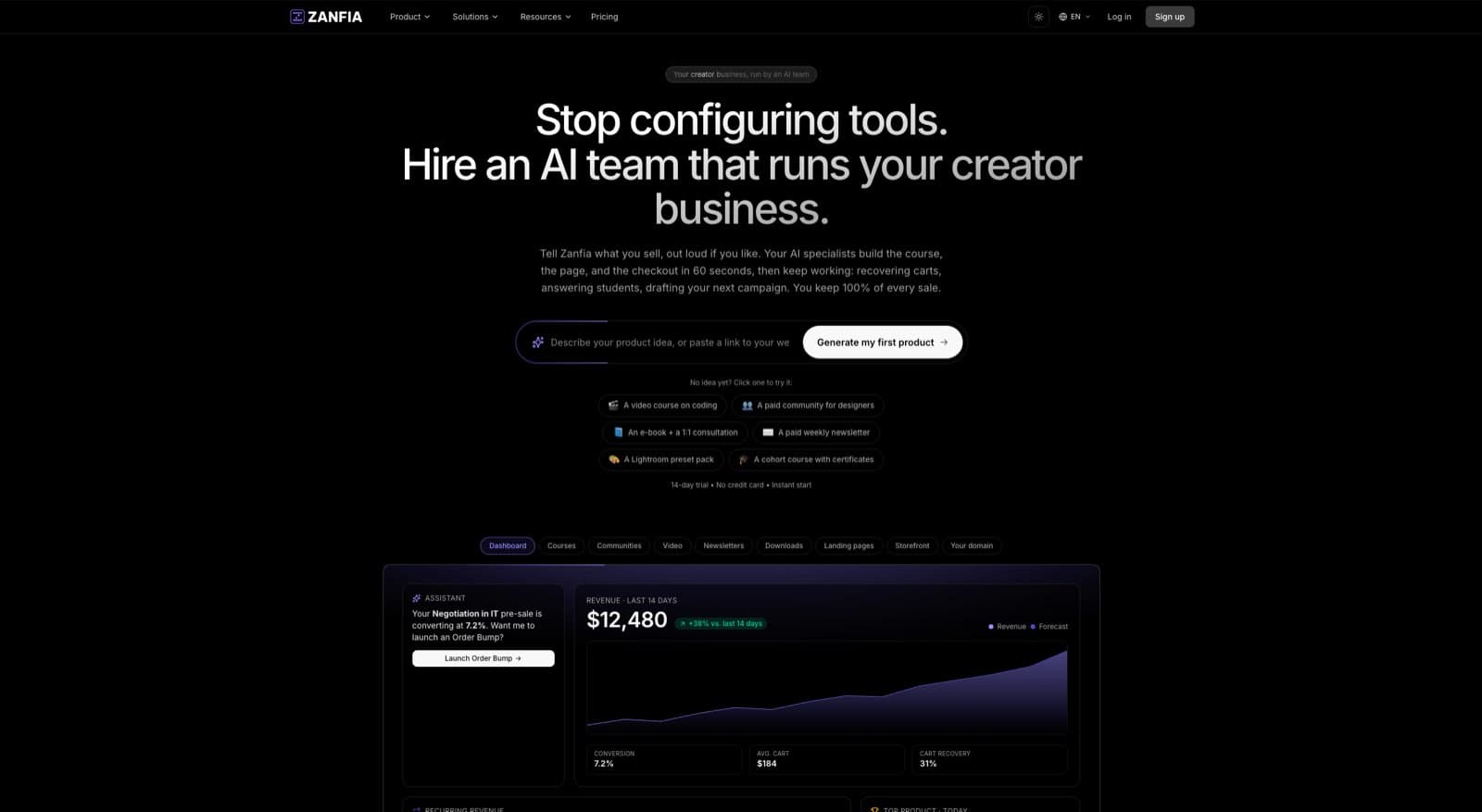
Zanfia is built as an AI team that runs a creator business, not just a place to host content. Behind the storefront, an assistant that knows every part of the interface handles the work: you dictate an instruction by chat or by voice, and the assistant carries it out. That matters for affiliate work because the surfaces where you place recommendations, whether a course, a paid newsletter, a knowledge base, or a community, all sit inside the same branded platform where checkout, upsells, and tracking are wired together and built to convert.
For creators running courses, communities, paid newsletters, or digital product libraries, the strongest affiliate placements are usually not banners. They are embedded recommendations inside lessons, onboarding materials, member resources, and discussion threads where the tool or service directly supports the outcome the audience wants. A checkout with order bumps, installments, and upsells means a $600 course can be split into four payments without leaving your domain, and test mode lets you buy your own product before launch to confirm the whole flow works.
That creates different opportunities for different creator stages:
- Business Architects can build a structured resources hub for software, service providers, and operating tools they already use across their business.
- Craft Masters can place premium recommendations inside advanced lessons, bonus modules, or private member channels where context is strong and trust is already established.
- Potential Explorers can keep it simple by recommending a short list of complementary tools or beginner-friendly products inside their first paid asset.
The trust question matters here. A guide on affiliate link creation notes that creators on branded platforms need to think carefully about the trade-off between cloaked and transparent links because community confidence, email deliverability, and recommendation integrity all matter, especially when the relationship with the audience is close, as explained in Impact’s guide for publishers.
In practice, that means you do not need one rigid rule. Cloaked links may make sense in social posts or space-limited formats. Transparent links may feel better in course materials, member emails, or expert resource pages where openness supports trust.
From Link to Revenue Your Path Forward
Learning how to make an affiliate link is not the hard part. The hard part is treating the link like a business asset instead of a throwaway URL.
The creators who do this well follow a simple progression. They generate the right link, improve it for trust and tracking, place it where it helps the audience, and keep refining the message around it. That is how a recommendation turns into repeatable revenue.
Keep these actions in front of you:
- Choose the right destination . Send people to the most relevant page, not the broadest one.
- Track source and context . Use sub-IDs and analytics tags so you know what is working.
- Test before publishing . Open every final link in an incognito window and on mobile.
- Write a real CTA . The sentence around the link should explain the benefit of clicking.
- Match placement to intent . Put affiliate links where they solve a current problem.
- Refine the system . Review performance and improve one variable at a time.
If you already create educational content, audience trust is your unfair advantage. Affiliate marketing works best when it behaves like good teaching. You recommend the right next tool, at the right moment, for the right reason.
If you want to connect affiliate recommendations with a broader monetization path, it helps to think in terms of what a sales funnel is rather than isolated clicks.
FAQ
What is a sub-ID in an affiliate link and why should I use one?
A sub-ID is a tracking parameter you add to your affiliate URL, such as sub=blogpost1, that tells you which placement generated a click. It turns one affiliate relationship into something measurable, so you can see whether a click came from a blog post, email, YouTube description, or a specific campaign. Without sub-IDs you know which offer worked, but not where it worked.
When should I cloak an affiliate link, and when should I leave it raw?
Cloak when presentation matters: social posts, comments, podcasts, videos, and offline mentions, where a long tracking URL looks suspicious and a branded link feels intentional. Leave links raw in close-knit communities or educational content where the audience understands affiliate relationships and values transparent URLs. The decision is strategic based on channel and audience, not just cosmetic.
Should I send affiliate traffic to a homepage or a deep link?
Use a deep link whenever the program permits it, because visitors land where their intent already points and friction drops. A homepage can work for broad brand awareness, but it is weak for review content, tutorials, or comparison posts where the reader expects a direct path. If your article praises a specific feature or offer, dropping the visitor on a generic page breaks the alignment between message and landing page.
How do I test an affiliate link before publishing it?
Open it in incognito to catch login-state issues or cached redirects, confirm it lands on the exact page you intended, and verify that any sub-IDs or tracking parameters remain attached after the redirect. Test on mobile as well, because a link that works on desktop can silently break in an in-app browser. Skipping this matters because untested links fail up to 40% of the time due to broken redirects.
What is a reasonable conversion rate and click-through rate to aim for?
In effective programs, the benchmark Average Affiliate Conversion Rate is around 5%, meaning 1,000 affiliate-referred clicks yielding 50 sales. For Click-Through Rate, a 2% CTR is described as a strong engagement benchmark, and it tends to improve when links sit inside the main content with benefit-focused calls to action rather than buried in the footer.
If you want a branded home for your courses, community, paid newsletter, and digital products, Zanfia works well for creators who want an AI team handling the operational work while they focus on the recommendation itself. You dictate what needs to happen by chat or voice, and the assistant executes it across your storefront. The checkout is built to sell, with order bumps, installments, and upsells wired in, and 12 product types live under one brand and one custom domain. Platform commission on customer sales is 0%, only payment processor fees apply, and every plan starts with a 14-day free trial with no credit card required.