

Group Mentoring vs 1:1: How to Scale a Mentorship Without Burning Out
You started your mentorship because you love the deep, transformational work of one-on-one guidance. But three years in, your calendar is a wall of 45-minute blocks, your inbox is drowning in Voxer messages, and you’re turning away qualified leads because there’s simply no more time to sell. You’ve hit the ceiling that every successful mentor eventually crashes into: your business is capped by the number of hours in your week.
The instinct is to raise prices. That works for a while. Then it stops working, because there’s a ceiling on what individual clients will pay, and every price hike thins out your pipeline. The other instinct is to hire associate mentors and franchise your methodology. That works too, but it turns you from a mentor into a manager, which is often the opposite of why you started.
There’s a third path that most solo mentors underuse: group mentoring. Done right, it multiplies your revenue per hour by 3-8x, deepens client outcomes through peer accountability, and gives you back your calendar. Done wrong, it feels like a boring webinar where you’re the only one talking and half the group ghosts after month two.
This guide breaks down the real tradeoffs of group mentoring vs 1 on 1, the optimal group size for actual interaction, the product ladder that keeps your premium 1:1 slots profitable, and the operational structure you need to run groups that don’t feel like a lecture. If you’re serious about scaling a mentoring business without burning out, this is the model that works.
The hard ceiling of 1:1 mentoring
Let’s do the math that nobody wants to do out loud.
Say you charge $500 per hour for 1:1 mentoring — a solid rate that puts you in the top tier of independent mentors. You want to work 25 client-facing hours per week (leaving room for prep, admin, marketing, and, you know, life). That’s $12,500 per week or roughly $600,000 per year at full capacity.
That sounds great until you actually try to live it. You’d need to sell 25 mentoring hours every single week, 48 weeks a year. That means constant sales pressure, no meaningful vacation, and a Monday-to-Friday calendar that leaves zero room for creating content, building a course, or doing any of the leveraged work that grows your practice long-term. And the moment you get sick, take a week off, or have a family emergency, revenue drops to zero.
The 1:1 model has three structural problems that no amount of price optimization can fix:
- Time is the constraint, not price. You can’t stretch a 45-minute session into holding four clients at once. Your revenue is bounded by hours available.
- The premium ceiling is real. Most markets support $500-$1,500 per hour for expert mentors. Above that, you’re competing with hedge fund advisors and executive coaches serving Fortune 500 leaders — a completely different sales cycle.
- Sales pressure never stops. Since every hour worked is an hour of income, taking time to build passive assets (courses, communities, content libraries) directly costs you revenue.
The Harvard Business Review has covered how expert service providers hit revenue plateaus when they can’t decouple income from time. Their consistent finding: the mentors and coaches who break through the ceiling do it by productizing their expertise into scalable formats. Group mentoring is the first and often best step in that direction.
Why group mentoring multiplies revenue per hour
Here’s the same math with a group model.
Instead of eight $500 one-hour sessions per day, you run one 90-minute group mentoring session with 12 members paying $750 per month each. That’s $9,000 in monthly recurring revenue from 90 minutes of your time (plus, realistically, another 3-4 hours of async support in a community channel). You could run four groups like that per month and generate $36,000 per month working roughly 20 client-facing hours — while charging each member less than they’d pay for a single 1:1 session.
Effective hourly rate: around $1,800 per client-facing hour, if you count only the live sessions. Even including async time, you’re likely doubling or tripling your 1:1 effective rate.
This isn’t just an arithmetic trick. Group mentoring genuinely delivers value that 1:1 can’t:
- Peer learning compounds. When one member describes a struggle, four others recognize it in themselves. Insights land through peer stories, not just expert answers.
- Accountability multiplies. Members show up because their peers see them. Progress reports become public commitments. Ghosting costs social capital, not just money.
- Diverse case studies. Instead of one client working through one problem in isolation, the group hears 12 different applications of the same principle across 12 different contexts.
- Network effects. Members build relationships with each other. That community becomes a reason to stay long after they’ve extracted the tactical value from your teaching.
Research from the Co-Active Training Institute on coaching effectiveness has repeatedly found that group formats can match — and in some dimensions exceed — 1:1 outcomes for behavioral change and skill acquisition, particularly when peer accountability structures are built into the program. The key phrase is “built into the program.” Groups don’t create accountability by accident. You have to design for it.
What you gain and lose in a group format
Group mentoring isn’t a strict upgrade from 1:1. You trade specific benefits for specific others, and if you don’t understand the tradeoff, you’ll build the wrong container for your clients.
What you gain
- Leverage. Your teaching, frameworks, and case studies reach 8-15 people at once instead of one.
- Community. Members build relationships that keep them engaged when motivation dips.
- Diversity of perspective. Every member brings a different context, and the group learns from all of them.
- Predictable revenue. Group programs are typically sold as multi-month cohorts or ongoing memberships, smoothing your monthly income.
- Your energy. One prepared session serves the whole group. You stop repeating the same explanations across six separate 1:1 calls.
What you lose
- Deep personalization. You can’t spend 30 minutes on one member’s specific tax situation, private grief, or unique strategic dilemma.
- Confidentiality. Some conversations require a closed door. Group members won’t share their most sensitive challenges with 11 strangers.
- Speed of response. A 1:1 client gets your full attention on their exact question. A group member waits their turn.
- Custom pacing. Groups move at the pace of the group. Faster members get impatient; slower members feel left behind.
The mistake most mentors make is trying to convert their entire 1:1 practice into a group format. Some of your best clients need — and will pay for — the depth that only 1:1 provides. The right move isn’t to replace 1:1. It’s to make group your core offering and keep 1:1 as a premium tier for the clients who genuinely need it.
Optimal group size for real interaction
This is where most group mentoring programs die: they get too big, too fast.
There’s a specific range where group mentoring actually works, and outside that range, it degrades into either a boring lecture (too big) or an expensive 1:1 with awkward observers (too small). Based on cohort research from executive education programs and my own observation across dozens of running groups, the sweet spot is:
- 8-15 members per group. Below 8, you don’t get enough diversity of perspective, and members feel exposed. Above 15, most members stop speaking in live sessions and the format becomes a webinar.
- 90-minute live sessions. Shorter sessions don’t leave room for real dialogue. Longer sessions destroy attention and turn cognitive load into fatigue.
- Cohort-based structure with defined start and end dates. Rolling admissions kill group cohesion. Members bond when they start and finish together.
The interaction ceiling
In a 90-minute session with 12 members, doing the math on real airtime:
- ~15 minutes for you to teach or frame the day’s topic
- ~60 minutes for group discussion and hot seats (5 minutes per member on average)
- ~15 minutes for wrap-up, next steps, and community reinforcement
That’s five focused minutes per member per session. Try to fit 20 members into the same 90 minutes and you’re down to two minutes each, which is barely enough to describe a problem, let alone solve one. Try to fit 30 and you’ve built a webinar.
If your topic naturally requires more airtime per person (deep coaching, therapy-adjacent work, high-stakes strategic decisions), shrink the group. If your topic is more educational (teaching a specific methodology, running structured exercises), you can go slightly larger. But 15 is a hard ceiling for anything that calls itself “mentoring” rather than “training.”
The product ladder: group core, 1:1 premium tier
The mentors who make group mentoring work at scale don’t abandon 1:1. They restructure their entire offer into a ladder that funnels clients into the right container for their needs and budget.
Here’s the canonical structure that works across most mentoring niches:
Tier 1: Free or low-cost content (top of funnel)
Newsletter, podcast, YouTube channel, or free community. This is how prospects discover you and evaluate whether your thinking matches how they want to grow. No hard sell. Zero pressure. Value-first for months before any commercial conversation.
Tier 2: Self-paced course or knowledge base ($200-$800 one-time)
A structured version of your core methodology that someone can consume without you being present. This filters out prospects who aren’t ready to invest in themselves and gives motivated buyers a taste of your framework. It also does double duty as a pre-requisite or bonus for your group program.
Tier 3: Group mentoring cohort ($500-$2,000 per month, 3-12 month commitment)
Your primary revenue engine. Cohort-based, 8-15 members, weekly or bi-weekly live sessions, active community between sessions. This is where 70-80% of your revenue should come from once the model is running.
Tier 4: 1:1 premium mentoring ($1,000-$5,000+ per month)
Reserved for clients who genuinely need private guidance — often senior professionals, founders with sensitive strategic questions, or people whose growth requires a confidential container. You keep 3-8 slots open here, no more.
Tier 5: Live intensives or masterminds ($5,000-$25,000+ per event)
Once you’ve built a strong group model, in-person retreats or high-touch quarterly masterminds create premium experiences that graduate members buy repeatedly. These are usually offered to your existing group and 1:1 clients rather than sold cold.
The magic of this ladder is that most clients enter through Tier 3 (group), and only a small fraction escalate to Tier 4 (1:1 premium). But that fraction pays 3-5x per month, which keeps your 1:1 practice ultra-profitable while requiring almost none of your calendar.
You’re no longer selling hours. You’re selling access to a portfolio of containers, and clients choose the one that fits their stage and budget.
Running group sessions that don’t feel like a webinar
This is where the operational rubber meets the road. You can design the perfect product ladder, but if your live group sessions feel like a mediocre webinar, members will churn by month three and refer no one.
Here’s what separates high-engagement group mentoring from the forgettable, monologue-heavy version:
Open with a real-time check-in
Every session starts with each member giving a 30-60 second update: what they’re working on, what’s stuck, what they’ve won since last time. This does three things: it forces attendance and preparation, it surfaces the topics that will actually make the session relevant, and it establishes speaking as the default posture (rather than passive watching).
Teach for 15 minutes maximum
If you have more than 15 minutes of teaching content, pre-record it and make it prerequisite viewing. Live time is too expensive and too participatory to burn on lecture. The live session is for application, discussion, and hot seats.
Run hot seats every session
Rotate 2-3 members per session into the hot seat — 10-15 minutes where the group focuses entirely on their specific challenge. Everyone else learns by watching one problem get solved in depth, and the hot-seated member gets 1:1-quality attention with the added bonus of peer input.
Use breakout rooms for peer-to-peer work
Pair or triple members up for structured exercises: reviewing each other’s plans, roleplaying difficult conversations, or workshopping specific decisions. This distributes airtime, builds relationships across the cohort, and keeps energy high even when you’re not the one speaking.
Close with commitments
End every session with each member stating one specific action they’ll take before the next meeting. Public commitments create accountability. Silent participation creates ghosting.
Invest in async community between sessions
The live session is one leverage point. The bigger one is what happens in your community channels between sessions. Members should be asking each other questions, sharing progress, dropping resources, and celebrating wins — daily, not just during scheduled sessions. If the community feels dead between sessions, you have a group of clients paying for a monthly Zoom call, not a mentoring container.
The Pew Research Center’s research on online learning communities consistently finds that engagement between formal sessions is a stronger predictor of member retention and outcomes than the sessions themselves. Build accordingly.
How Zanfia’s AI team runs the operations of a group mentoring practice
Running a group mentoring practice at scale requires infrastructure that most mentors underestimate until it’s causing chaos. You need cohort organization, member-only content delivery, structured discussion, announcement broadcasts, and a place to host the pre-recorded teaching so live sessions can stay short. If you’re stitching that together across Zoom + Circle + Kajabi + Airtable, you’re spending 5-10 hours a week just administering the platform stack. That’s tax on your leverage.
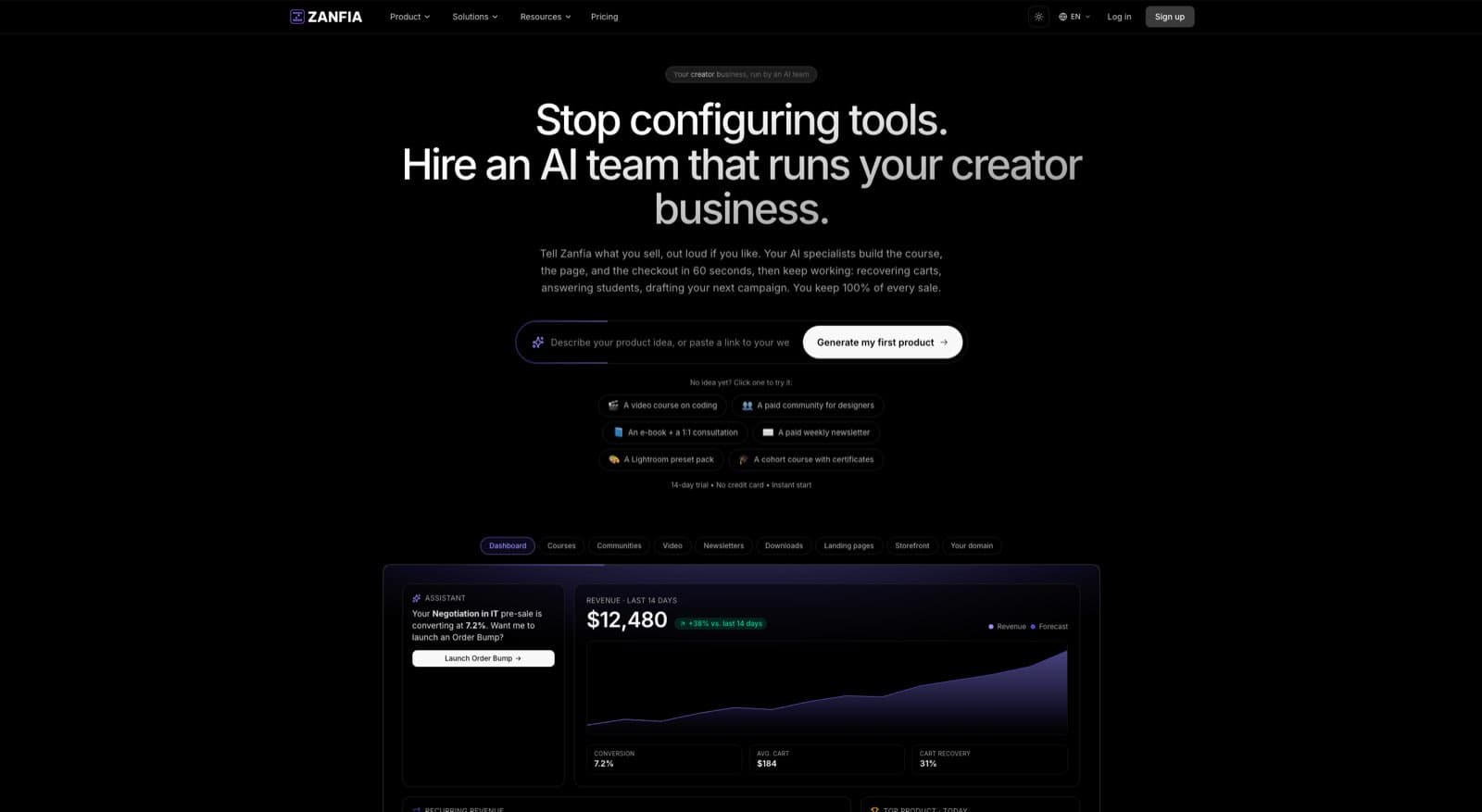
Zanfia takes a different approach: instead of handing you another dashboard to configure, it puts an AI team in charge of the work. You describe what you want (“open enrollment for Cohort Fall, announce it in the community, publish a checkout with a paid-in-full option and three installments”) and the assistant performs it inside the platform. You can dictate that request by voice on a walk, or send it from your own AI assistant through Zanfia’s MCP endpoint, which lets outside agents work directly on your workspace (availability depends on the plan — see the current Zanfia pricing). Everything the AI does inside a community is labeled as AI, so members always know what came from you and what came from your assistant.
Underneath that AI layer, the platform gives group mentoring the pieces it actually needs:
- Group-based member organization. Each cohort lives in its own group with its own channels, content, and permissions. When Cohort Spring finishes and Cohort Summer starts, members don’t get commingled or confused about which discussions belong to their program.
- Topic discussion channels. Structure your community around the actual work: one channel for weekly commitments, one for hot seat prep, one for wins, one for tactical questions, and so on. Members find what they need without scrolling through a chaotic feed.
- Announcement-only channels. When you need to broadcast schedule changes, session recordings, or program updates, use read-only announcement channels so critical information doesn’t get buried under discussion.
- Native course integration. Your pre-recorded teaching (the material that used to eat 45 minutes of every live session) lives in the same platform as your community. Members watch modules, then discuss them in the channels, then apply them in the live sessions — all without switching tools.
- Native video hosting with progress memory. Members can pause a module, come back three days later, and resume exactly where they left off. No Vimeo subscription, no Wistia integration, no broken embeds.
- White-label custom domain. Your program lives at yourbrand.zanfia.co or your own domain, not a subdomain of someone else’s platform. Members see your brand throughout the entire experience.
- 0% platform fees on customer sales. When you’re charging $750 per member per month and running 40 members across cohorts, platform commissions add up fast. As of publication, Zanfia charges 0% on customer sales (only payment processor fees apply, e.g., Stripe, roughly 2.9% + $0.30 in the US).
- A checkout built to sell. Cohort-based programs typically sell either as monthly subscriptions or paid-in-full with installments — you can split a $2,400 cohort seat into four payments of $600 without leaving the platform. Order bumps let members add a 1:1 intensive at checkout, and test mode lets you buy your own product to verify the whole flow before opening enrollment.
- 12 product types under one brand. Your group mentoring cohort, your self-paced course, your paid newsletter, your one-off consultations and your bundle offers all live in one workspace. Members buy across them without landing in a different tool with a different login.
- Native iOS and Android app. Members access courses, paid newsletters, and knowledge bases from mobile (community support is on the roadmap, not yet live). This alone reduces the async engagement drop-off that kills most group programs — members check in from their phone during commutes and lunch breaks, not just at their desk.
The point isn’t that Zanfia is the only way to run a group mentoring program. It’s that the operational overhead of running one grows nonlinearly as you scale, and every hour spent on platform administration is an hour not spent on client outcomes or growing the practice. Handing the admin to an AI team on a single platform is the difference between running four cohorts as a solo mentor and needing to hire an operations manager to keep the wheels on.
If you’re currently stitching together Zoom, Circle or Discord, a course platform, an email tool, and a payment processor, see how Zanfia consolidates the group mentoring stack under one roof.
FAQ
Is group mentoring less effective than 1:1?
Not necessarily. For behavioral change, skill acquisition, and long-term accountability, well-designed group mentoring can match or exceed 1:1 outcomes because of peer accountability and diverse case exposure. 1:1 remains superior for highly confidential situations, deeply personalized strategic guidance, and clients whose challenges don’t generalize well to a group context.
What’s the ideal group size for mentoring?
8-15 members per group is the sweet spot for real interaction. Below 8 you lose diversity of perspective; above 15 most members stop speaking in live sessions and the format degrades into a webinar. If your topic requires deeper coaching or high-stakes conversations, stay closer to 8. If it’s more educational and methodology-driven, you can push toward 15.
How much should I charge for group mentoring vs 1:1?
A common structure is to charge 25-40% of your 1:1 monthly rate for group access, then reserve a premium 1:1 tier at 2-3x your current rate for clients who need private guidance. If you’re charging $2,000 per month for 1:1, group mentoring at $600-$800 per month makes group your primary revenue engine while premium 1:1 slots at $4,000-$6,000 per month keep individual attention profitable and scarce.
How do I transition existing 1:1 clients into a group program?
Don’t force it. Offer existing clients a choice: continue 1:1 at your new premium rate, or transition to the group at the standard group price with a founding-member bonus (grandfather pricing, exclusive access to your first cohort, or a personal consulting call as a welcome). Some clients will happily downgrade to group and save money. Others need 1:1 and will pay the new premium. Both outcomes are wins.
How often should group mentoring sessions run?
Weekly or bi-weekly live sessions work for most programs. Weekly maintains momentum but requires more of your prep and delivery energy. Bi-weekly gives members more time to apply insights between sessions and reduces your load, but requires stronger async community engagement to keep the program feeling active. Test both — the right cadence depends on how much application work each session generates.
What if I’m bad at running live groups?
It’s a learnable skill, not a personality trait. The core competencies — facilitating discussion, running hot seats, managing airtime, calling in quieter members — can all be practiced and improved. Start with a small pilot cohort (5-6 members) at a discounted rate, record every session, review your facilitation, and iterate. By your third cohort, you’ll have found the rhythm.
Can I run group mentoring while keeping my 1:1 practice?
Yes, and that’s exactly the structure that works best. Group becomes your primary revenue engine, 1:1 becomes a small premium tier for clients who genuinely need private guidance. Most successful mentors end up with 8-15 group members per cohort, 2-4 cohorts running at any time, and 3-8 premium 1:1 slots. That structure generates 3-5x the revenue of pure 1:1 while requiring less of your calendar.
The mentoring business you built through 1:1 was proof that your methodology works. The mentoring business you scale through groups is the version that gives you leverage, sustainability, and the freedom to actually enjoy the practice you built. Choose the container that matches how you want to work — and build the infrastructure to run it well.