

AI-Enhanced Digital Products to Sell in 2026 (Worksheets, Packs, and Toolkits)
The creator economy is in the middle of a quiet shift. Buyers used to pay for static PDFs, swipe files, and Notion templates. Now they’re paying more — and faster — for digital products that have AI baked in: prompt libraries that actually solve a workflow, worksheets that auto-personalize, toolkits that pair a custom GPT with a strategy doc, and packs that get updated every time the underlying model changes. If you sell digital products and you haven’t shipped an AI-enhanced version yet, you’re already late to the category buyers are searching for in 2026.
This guide breaks down the ten AI digital products to sell that are converting right now, how to price them so you’re not racing to the bottom, how to add the kind of expertise that separates a $9 prompt pack from a $97 toolkit, and how to turn what used to be a one-time sale into a recurring subscription. We’ll also cover honest positioning — what AI can and can’t do for your buyer — because the creators winning this category are the ones who don’t oversell.
Why AI-Enhanced Products Are the Fastest-Growing Creator Category
Three forces are stacking on top of each other and pushing AI-enhanced digital products into the fastest-growing slice of the creator economy.
The first is buyer behavior. Search demand for terms like “AI prompts for [profession]”, “ChatGPT templates”, and “AI toolkit” has more than tripled in the last 18 months across English-speaking markets. People aren’t searching for theory anymore — they’re searching for done-for-you systems they can plug into their own workflow tonight. According to Pew Research, the share of working adults who have used generative AI for a job-related task has roughly doubled year over year, and a meaningful percentage report they’re willing to pay for tools that help them get more out of the models they already use.
The second is supply-side maturity. The first wave of AI products was “500 ChatGPT prompts for $7” PDFs — low quality, easy to clone, race-to-the-bottom pricing. That wave is dying. The second wave is structured, expert-curated, and tied to a specific workflow or outcome: a fitness coach’s AI program-design toolkit, a copywriter’s brand-voice cloning pack, a therapist’s session-prep worksheet system. These products command real prices because they require real expertise to build.
The third is the recurring-revenue opportunity. AI models update constantly. Prompts that worked great on GPT-4 need tweaks for GPT-5. Claude prompts behave differently than Gemini prompts. Every model release creates a legitimate reason for buyers to come back for an updated version — which is exactly why so many creators are converting one-time digital products into subscription packs.
The creators making real money here aren’t the ones with the biggest prompt libraries. They’re the ones who treat AI as a layer on top of deep domain expertise, package it for a specific buyer, and deliver it through a platform that handles updates and recurring billing without breaking. We’ll get to that delivery layer in section seven.
10 AI-Enhanced Products Buyers Are Paying for Right Now
Here are the ten formats converting best in 2026, ranked roughly from easiest to ship to most defensible long-term.
1. Niche Prompt Packs ($19–$97)
Not “500 prompts for everything” — niche packs that solve one specific workflow for one specific buyer. Think: “42 ChatGPT prompts for personal trainers writing client check-ins” or “AI prompts for B2B SaaS landing page copy.” The defensible version includes the prompt, the recommended model, the output format, and a worked example showing the prompt in action.
2. AI Worksheets and Fillable Templates ($27–$79)
These are interactive worksheets that pair a structured framework with AI prompts at each step. A goal-setting worksheet where every reflection prompt also gives you the AI prompt to expand on your answer. A business plan template where each section includes the AI prompt to stress-test your assumptions. Buyers love these because they bridge the gap between “blank page” and “AI does it for me.”
3. Custom GPT Bundles ($47–$197)
A pack of three to five custom GPTs built around a single workflow, delivered with setup instructions, a strategy doc explaining when to use which GPT, and update access. Examples: a content creator’s pack (headline writer, outline builder, hook generator, repurposer), a recruiter’s pack (JD writer, screening question generator, candidate evaluation framework).
4. AI Brand Voice Kits ($97–$297)
The buyer fills out a guided questionnaire about their brand. The kit returns prompts, custom GPT instructions, and example outputs trained on their voice. Massive demand from solopreneurs, agencies, and consultants who want consistent AI-generated content without sounding like a robot.
5. AI-Powered Notion / Obsidian / ClickUp Templates ($37–$127)
Workspace templates with embedded AI workflows. A second-brain template with prompts for weekly review. A content calendar with prompts for ideation and repurposing. A CRM template with prompts for follow-up emails.
6. AI Toolkit Bundles ($147–$497)
A bundled product that includes prompts, custom GPTs, worksheets, a video walkthrough, and a strategy guide — all built around one outcome. Example: “The AI Course Launch Toolkit” with prompts for landing page copy, GPTs for sales emails, worksheets for module outlining, and a video showing how it all fits together. This is the highest-value tier for most creators.
7. AI Audit and Self-Diagnostic Workbooks ($49–$149)
Workbooks that walk the buyer through diagnosing a problem in their business, with AI prompts at each step to surface insights. “AI Marketing Audit Workbook,” “AI Operations Bottleneck Finder,” “AI Personal Productivity Assessment.”
8. Prompt Engineering Mini-Courses ($97–$297)
Not full courses on AI — short, focused courses on how to use AI for one specific outcome. “Prompt Engineering for Copywriters,” “Claude for Lawyers,” “AI for Therapists.” These convert well because they pair training with the prompts themselves.
9. AI-Updated Subscription Packs ($9–$49/month)
The buyer subscribes and gets a fresh pack every month — new prompts as models update, new worksheets as new use cases emerge, new GPTs as Anthropic and OpenAI release new features. This is where one-time products become annuities. We’ll cover this in detail in section five.
10. AI Consulting Productized Offers ($497–$2,500)
The highest end: a productized service where you deliver an AI implementation for a specific outcome. “I’ll build your custom GPT for client onboarding,” “I’ll set up your AI content workflow.” Sold as a one-time deliverable, often with optional ongoing subscription for updates.
How to Add Real Expertise So It Isn’t ‘Just a Prompt Dump’
This is where 90% of AI digital products fail and the other 10% command premium prices. A prompt dump is a list. An AI-enhanced product is a system. Here’s how to make the jump.
Anchor every prompt to a real outcome. Don’t say “use this prompt to write better emails.” Say “use this prompt when you’re writing a re-engagement email to a lead who went cold 30+ days ago, and you want to lead with a value proposition rather than a discount.” Specificity is what separates expert products from generic ones.
Show the worked example. Every prompt should ship with at least one real output, ideally two — one good, one mediocre — with annotations explaining why the good one worked. Buyers learn faster, and you signal that you actually use what you sell.
Include the why, not just the what. Explain why you structured the prompt that way. Why you put the role at the start. Why you used XML tags or numbered steps. Why you specified output format. Buyers who understand the why can adapt your prompts to their context — which makes your product more valuable, not less.
Stress-test against multiple models. Run your prompts on ChatGPT, Claude, and Gemini. Note which model performs best for each use case, and where the differences matter. This is high-effort work that most prompt sellers skip, and it’s what justifies a premium price.
Bundle in the strategic context. A worksheet for client check-ins is fine. A worksheet for client check-ins that includes a one-page guide on the psychology of retention, the cadence research, and how the AI prompts fit into a broader retention strategy — that’s a premium product.
Stay in your lane. The biggest mistake creators make is selling AI products outside their domain expertise. If you’re a fitness coach, sell AI products for fitness coaches. If you’re a freelance writer, sell AI products for freelance writers. The depth of your domain knowledge is what AI can’t replicate — and it’s what buyers are paying for. Harvard Business Review’s research on AI augmentation consistently finds that AI multiplies expertise rather than replacing it. Your domain knowledge is the multiplier.
Pricing AI Worksheets, Packs, and Toolkits Without Underselling
The biggest mistake in this category is anchoring to the cheap prompt PDFs that flooded the market in 2023. Those products set a buyer expectation of $5–$15, and creators who price within that range are competing on a treadmill they can’t win.
Here’s how to price by tier.
Entry tier: $19–$47. This is for tightly-scoped prompt packs and single-purpose worksheets. The buyer expectation here is “a focused tool I can use today.” If you’re shipping a 30-prompt pack for a specific workflow, this is your range. Don’t go below $19 unless you’re using the product as a lead magnet.
Mid tier: $67–$147. This is the sweet spot for AI toolkits — bundled products with prompts, worksheets, custom GPT setup, and a strategy guide. Buyers at this price point are looking for “a complete system for one outcome.” Most of your premium digital product revenue will live here.
High tier: $197–$497. Comprehensive toolkits with multiple custom GPTs, video walkthroughs, multi-week workflows, and case studies. Often sold with bonus calls or community access. This tier requires real positioning work and serious depth.
Recurring: $9–$49/month. Subscription packs with monthly updates. Lower price point, but the math is compelling — a $19/month subscription with 12-month retention is worth more than a $97 one-time sale, and it compounds.
A few pricing principles that hold up regardless of tier.
Price for the outcome, not the asset count. “500 prompts for $9” is a race to the bottom. “The AI Client Retention System: 30 prompts, 5 worksheets, and 1 custom GPT for $147” sells the result.
Use anchored pricing. List the components separately, then offer the bundle. “Prompts $97, Worksheets $47, Custom GPT $97 — together $147.” Buyers see the value before they see the price.
Offer payment plans for products above $200. The Cart 2.0 setup in most modern creator platforms makes this trivial, and it can lift conversion by 20–40% on higher-priced products.
Don’t discount your way to traction. AI products are still a young category with strong buyer appetite. If your product isn’t converting at full price, the issue is usually positioning or the offer itself, not the price.
Updating AI Products: Turning a One-Time Sale Into a Subscription
This is the single biggest revenue unlock for AI digital product creators. The reason: AI models change constantly, and that’s not a bug — it’s the engine of your recurring revenue.
Every few months, Anthropic, OpenAI, and Google release new models with different capabilities. Prompt structures that worked beautifully on the previous model sometimes underperform on the new one. New features (custom GPTs, Claude Projects, Gemini Gems) create entirely new product opportunities. Your buyers can’t keep up. You can. And that’s the subscription opportunity.
There are three subscription models that work well in this category.
Model 1: The Monthly Update Pack. A flat monthly subscription ($19–$49) where subscribers get a fresh pack of prompts, worksheets, or templates each month. Updates to existing prompts when models change. New use cases as they emerge.
Model 2: The Living Library. A one-time purchase ($147–$297) that grants lifetime access to a continuously-updated library. Most creators pair this with an optional monthly subscription for new releases. Buyer psychology: “I bought the library, I want to keep it current.”
Model 3: The Membership Hybrid. A subscription ($29–$97/month) that bundles AI product updates with a community where members share their adaptations, ask questions, and get prompt feedback. This is the highest-value model because you’re selling updates AND access — and community drops your churn dramatically.
The biggest objection creators raise: “I don’t want to commit to monthly content.” Fair. Here’s the realistic effort: an update pack is usually 5–15 prompts, 1–2 new worksheets, and a brief changelog explaining what changed and why. Most creators batch this into 2–4 hours per month once they have a system. Forbes coverage of subscription business models consistently shows that subscription revenue compounds dramatically when churn stays below 10% monthly — and AI products have inherently sticky churn because the underlying utility keeps evolving.
Honest Positioning: What AI Can and Can’t Do for Your Buyer
The creators winning this category are the ones who don’t oversell. Buyers are sophisticated enough now to spot the “AI will 10x your business” pitch, and they punish it with refunds and negative reviews.
What to claim. AI can save time on first drafts. AI can surface ideas you wouldn’t have considered. AI can structure complex thinking. AI can scale repetitive tasks. AI can pair with a framework to give beginners professional-quality starting points.
What not to claim. AI doesn’t replace expert judgment. AI doesn’t guarantee results. AI doesn’t make your buyer a millionaire by next quarter. AI doesn’t work without iteration and editing. AI is not a magic content machine.
The framing that works best in product copy: “This toolkit gives you the prompts, worksheets, and GPTs I use to [specific outcome]. You’ll still need to bring your own context and judgment — but you won’t be starting from a blank page.” Honest, specific, and it sets buyer expectations correctly.
The bonus: honest positioning attracts higher-quality buyers. The buyer who refunds a $47 prompt pack because “AI didn’t write my book for me” is the buyer who would have churned out of your subscription in 30 days anyway. Filter them out at the offer level.
How Zanfia Delivers AI Product Packs and Subscriptions With 0% Fees
Here’s where most AI product creators hit a wall. You’ve built the prompts, the worksheets, the toolkit. Now you need a delivery layer that can ship them securely, handle monthly updates without making your buyers jump through hoops, run subscription billing cleanly, and not eat 10–30% of every sale in platform fees.
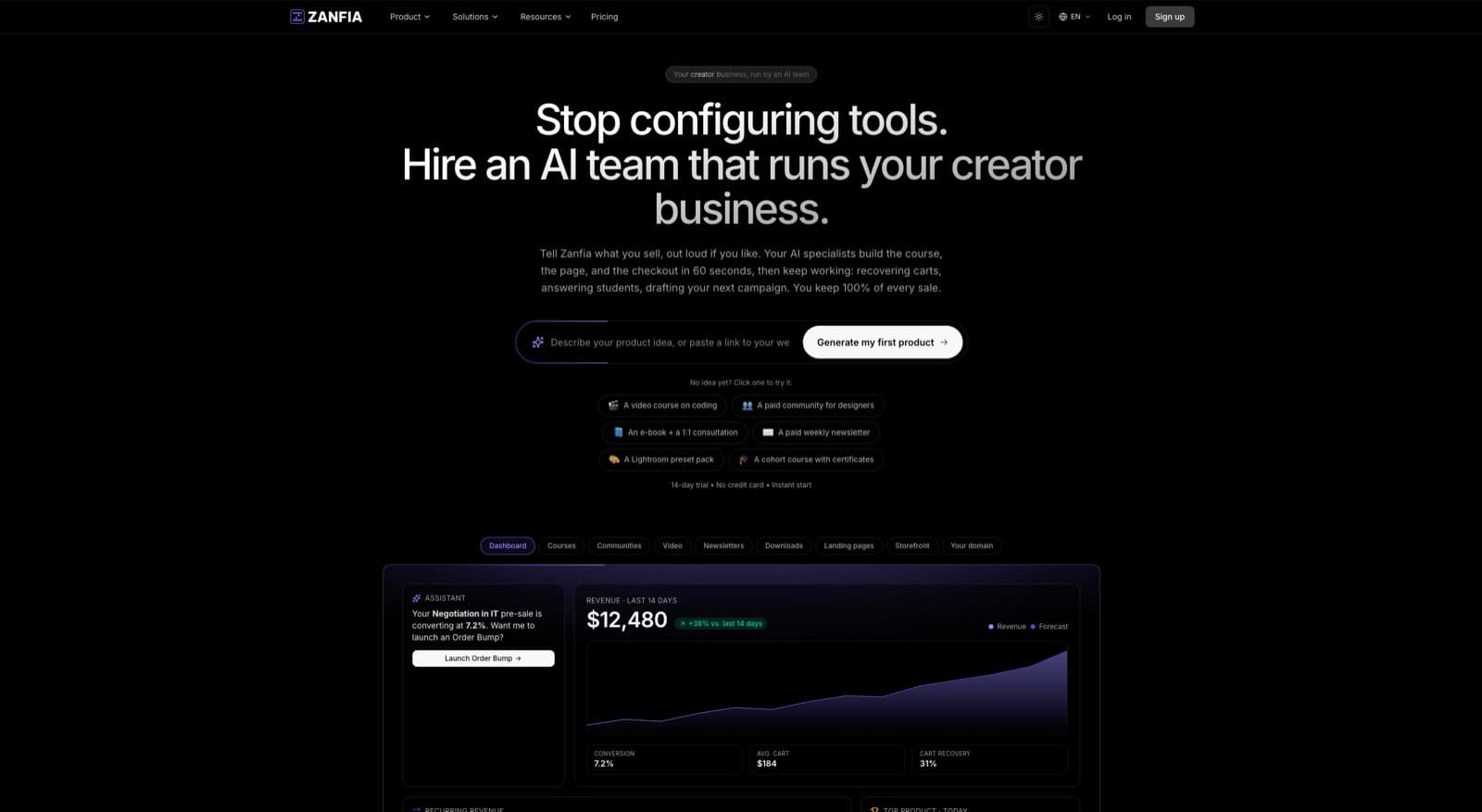
Zanfia is built around a different premise than most creator tools: it’s an AI team that runs the business side of your creator work, with the storefront, checkout, subscriptions, and content delivery as the surfaces where that work lands. For an AI digital product creator, that means the expertise you package into prompts, worksheets, and GPTs stays yours — Zanfia handles the launching, selling, updating, and supporting around it. You describe what you want changed on a landing page, or ask the assistant to spin up a subscription plan, and it happens; you can do it by chat or by voice while you’re walking away from the desk. Anything you can do by clicking, an outside AI agent can do too through the Zanfia MCP endpoint, which is available on higher plans (see the current Zanfia pricing) — a real edge if you already work with Claude Desktop, Cursor, or your own tooling.
The commercial side is built for selling, not just for hosting files. Cart 2.0 supports one-time, subscription, installment, and trial pricing on the same checkout, with order bumps and upsells so a $147 toolkit can be split into four payments or paired with a $29/month update pack at the moment of purchase. You can turn on test mode to buy your own product before launch and confirm the whole flow — checkout, receipt, delivery, tracking — is firing correctly. Twelve product types (courses, communities, paid newsletters, downloads, bundles, digital content, services, consultations, events, membership, knowledge base, custom) live under one brand, so a creator can sell a $47 prompt pack, a $297 toolkit, and a $29/month living-library subscription from the same storefront without stitching platforms together.
Here’s what that looks like in practice for AI digital product creators.
0% platform fees. Zanfia charges 0% platform transaction fees on customer sales today. Only standard payment processor fees apply (Stripe or PayPal). Compare that to Gumroad’s 10% + $0.50 per transaction on direct sales, or 30% via the marketplace. On a $147 toolkit, that fee difference is the price of a nice dinner. On a subscription that runs for 12 months, it’s the difference between a side project and a real income stream.
Secure file delivery for ebooks, worksheets, and toolkits. Upload your PDFs, fillable worksheets, custom GPT setup guides, and bundled assets. Buyers get secure download access tied to their purchase. No more sharing Dropbox links that get passed around.
Cart 2.0 with one-time, subscription, installment, and trial pricing. Run a $47 prompt pack as a one-time sale, a $147 toolkit with a 3-month payment plan, and a $29/month update subscription — all from the same platform, same checkout. Apple Pay and Google Pay are supported natively, which lifts mobile conversion meaningfully.
Subscription billing for AI update packs. Set up your monthly or annual subscription, deliver the update each month through the knowledge base, and let recurring billing handle itself. When buyers churn, they churn cleanly — no chargebacks from people forgetting they subscribed.
Knowledge bases for living libraries. If you’re running the “living library” subscription model, Zanfia’s knowledge base feature gives you a searchable, structured place to publish your prompt library, custom GPT guides, and worksheet collection. Subscribers get login access. Non-subscribers don’t.
Communities for the membership hybrid. If you’re running an AI product subscription with a community layer (which dramatically reduces churn), Zanfia includes native community channels — topic discussions, announcement-only channels, group organization — all integrated with your product delivery. There’s also a community AI agent that can post from your own content, and everything it publishes is labeled as AI, so members always know what came from you and what came from the agent.
White-label on your own domain. Your AI product store lives at your slug on zanfia.co, or you can map your custom domain. No Zanfia branding in front of your buyers on higher plans (see the current Zanfia pricing). Your brand, your domain, your trust.
Native mobile app. Your subscribers can access courses, paid newsletters, and knowledge bases through Zanfia’s native iOS and Android app. If a chunk of your AI product is delivered as a knowledge base or short-form course, your buyers can pull it up on their phone the next time they’re at their desk wondering which prompt to use. (Community access in the mobile app is rolling out to workspaces — by the time you read this it may already be available on your account, so check your dashboard.)
For pricing tiers and specifics, head to zanfia.com/pricing. Every plan starts with a 14-day free trial, no credit card required, so you can test the platform before you commit. If you’re already monetizing online content through scattered tools, Zanfia is purpose-built to consolidate the stack. And if you’re still evaluating where to set up shop, our guide to choosing a platform to sell digital products walks through the trade-offs.
FAQ
What are the best AI digital products to sell in 2026?
The fastest-growing categories are niche prompt packs ($19–$97), AI worksheets and fillable templates ($27–$79), custom GPT bundles ($47–$197), AI toolkit bundles ($147–$497), and AI-updated subscription packs ($9–$49/month). The common thread: products tied to a specific buyer and a specific outcome, not generic “500 prompts for everyone” PDFs.
How much can you charge for AI worksheets and toolkits?
Entry-tier AI worksheets typically sell for $27–$79. Mid-tier toolkits that bundle prompts, worksheets, and custom GPT instructions sell for $67–$147. Comprehensive high-tier toolkits with video walkthroughs and multi-week workflows can sell for $197–$497. Subscription update packs typically sit at $9–$49/month.
Are AI prompt packs still worth selling in 2026?
Yes, but only if they’re niche and expert-curated. The “500 ChatGPT prompts for $7” market is dead. The market that’s growing is tightly-scoped prompt packs that solve one specific workflow for one specific buyer, with worked examples, model recommendations, and the strategic context buyers need to adapt the prompts to their situation.
What’s the difference between a prompt pack and an AI toolkit?
A prompt pack is a focused collection of prompts (usually 20–50) for one workflow. An AI toolkit is a bundled product that includes prompts plus worksheets, custom GPT setup, a strategy guide, and often a video walkthrough — all built around one outcome. Toolkits command 3–5x the price of prompt packs because they deliver a complete system.
How do you turn a one-time AI product into a subscription?
Three models work well: a monthly update pack ($19–$49/month) where subscribers get fresh prompts as models change; a living library ($147–$297 one-time plus optional monthly updates); or a membership hybrid ($29–$97/month) that bundles updates with a community where members share adaptations and ask questions. The membership hybrid has the lowest churn.
Where should you sell AI digital products?
You need a platform that handles secure file delivery, subscription billing, knowledge base hosting (for libraries), and ideally community (for memberships) — all without taking a 10–30% cut of every sale. Zanfia is built for exactly this stack, with 0% platform fees, white-label custom domain, and a native mobile app, and starts at $39/month (or $31/month billed annually) on the Starter plan. Compare options at zanfia.com/pricing.