

How to Price Online Course Tiers That Sell in 2026

Price online course tiers by the transformation you deliver, not by hours of video. The winning structure in 2026 is a three-tier ladder (Content, Community, Coaching) at roughly 1x, 3x, and 8x your anchor price. This lets a self-paced buyer pay $200, a community buyer pay $600, and a coaching buyer pay $1,500+ without you producing three separate courses.
The Four Course Price Tiers and What Each Signals
Before you set numbers, understand what each price band signals to a buyer. Price is positioning. A $47 course and a $2,000 course are not the same product with different price tags. They attract different buyers with different expectations.
| Price band | Signal to buyer | What it must deliver | Typical buyer |
|---|---|---|---|
| $0-49 | Impulse buy, low risk | One clear win, 1-3 hours | Curious, testing you |
| $50-299 | Serious self-study | Full skill, structured path | DIY learner on a budget |
| $300-999 | Professional investment | Skill + support + accountability | Career changer, side-hustler |
| $1,000-5,000+ | Transformation purchase | Outcome, coaching, cohort | Business owner, professional |
Most creators price too low because they anchor on what they would pay, not what the outcome is worth. If your course helps a freelancer land one $3,000 client, charging $97 for it is not generous, it is a positioning error. The buyer discounts the outcome to match the price.
Price on Transformation, Not Hours of Video
The most common pricing mistake in 2026 is still the video-hours calculation: “40 hours of content, so it must be worth $497.” Nobody buys a course to consume 40 hours. They buy it to reach a specific outcome. Longer is often worse.
Ask three questions to anchor your price:
- What is the dollar value of the outcome? A course that helps a coach book their first paying client is worth a fraction of that first client’s fee, not a fraction of your production cost.
- How urgent is the pain? “I need to file quarterly taxes in 2 weeks” commands 5-10x the price of “I want to learn accounting someday.”
- Who else solves this? If the alternative is a $200/hour consultant or a $10,000 agency, your $997 course is a bargain, not expensive.
Show the math to yourself before you show it to a buyer. If your course helps a Shopify seller add $500/month in revenue, the annual value is $6,000. Priced at $597, the buyer’s payback period is roughly six weeks. That framing decides the price, not your instinct about what feels fair.
The 3 Cs Ladder: Content, Community, Coaching
The framework that consistently produces the highest revenue per launch in 2026 is the 3 Cs ladder. You build the course once, then package it three ways.
| Tier | What buyer gets | Price multiplier | Example (anchored at $200) |
|---|---|---|---|
| Content | Self-paced course, lifetime access | 1x | $200 |
| Community | Course + private community, group Q&A | 3x | $600 |
| Coaching | Course + community + 1-on-1 or small-group coaching | 7-8x | $1,500 |
The math changes your business. If 100 buyers pick tier 1 at $200, you earn $20,000. If those same 100 buyers spread across the three tiers at typical ratios (60% / 30% / 10%), you earn: $12,000 + $18,000 + $15,000 = $45,000. Same course, same audience, more than 2x the revenue.
The ratios matter. The middle tier should always be the one you want most buyers to pick. If nobody buys the top tier, drop the price 20%. If everyone buys the top tier, raise it 30%. You are looking for a genuine spread.
Building Good, Better, Best Without Extra Content
You do not need three separate courses. You need one course with three access levels. The upper tiers add access to you and to peers, not more lessons.
Here is a concrete template:
- Good ($197): Full course, lifetime updates, downloadable templates. Delivered on-demand.
- Better ($597): Everything in Good + private community access + monthly group Q&A call + peer feedback threads.
- Best ($1,997): Everything in Better + 4 x 45-minute 1-on-1 calls + direct message access for 90 days + portfolio review.
Notice what the upper tiers actually add: your time, other buyers’ time, and accountability. That is what commands the multiplier. Producing more video is the trap that keeps creators stuck at the low tier. Access is what scales price.
The community tier is the sweet spot for most creators. It doubles or triples your revenue and its cost to you (a couple of hours a week hosting Q&A) is fixed no matter how many buyers you have. The coaching tier caps at your available hours, which is the point: you sell 5-15 coaching seats per cohort, not 500.
One-Time vs Subscription vs Installments
Once you have chosen the tiers, choose the billing model. Each fits a different course type.
| Model | Best for | Buyer psychology | Cash flow |
|---|---|---|---|
| One-time | Skill-based courses with a defined endpoint | Finish and own it | Lumpy, launch-driven |
| Subscription | Communities, evergreen libraries, ongoing coaching | Renew if using it | Predictable MRR |
| Installments | Premium tiers ($500+) | Fits monthly budget | Bridges cash + conversion |
Installments are the underused option. Splitting a $997 course into 3 payments of $397 (a small markup for financing) typically lifts conversion 20-40% on premium tiers without cannibalizing full-pay buyers. The 3x math works because a $397 first charge feels equivalent to a $397 one-time course, which most buyers can approve without deliberation.
Subscriptions work when the value is ongoing. A monthly community, a rolling coaching cohort, or a “new templates every month” library all fit. Wrapping a finished course in a subscription usually backfires: buyers finish the material in month two, cancel in month three, and feel tricked.
Order Bumps and Upsells to Raise Average Order Value
Tiers do most of the work, but the checkout page can add another 15-30% to average order value without touching your pricing structure. Two tools do the heavy lifting: order bumps and post-purchase upsells.
An order bump is a small add-on presented on the checkout page itself, usually with a single checkbox. Rule of thumb: price it at 15-25% of the main product. If your course is $497, a $97 bump (“Add the 30-day accountability workbook”) is the right range. Take rates commonly land between 20% and 40%.
A post-purchase upsell appears immediately after payment, on a one-time offer screen. This is where you offer the tier upgrade the buyer did not pick: “You bought Content. Add Community for $400 more, just this once.” Zanfia is rolling out one-click post-purchase offers with accept/decline chains, so buyers upgrade without re-entering payment details. Creators typically pay separately for this in SamCart or ThriveCart.
The math compounds. On 100 buyers of a $497 course:
- Base revenue: $49,700
-
- 30% take a $97 order bump: +$2,910
-
- 15% take a $400 upsell: +$6,000
- New total: $58,610 (18% lift, zero new content produced)
Two guardrails. First, do not put the tier decision at the checkout. Force the buyer to pick a tier on the sales page. The bump and upsell are for adjacent products, not for the core choice. Second, the upsell must be a genuine complement, not a bait-and-switch. If it feels like you withheld something obvious from the main offer, you damage the relationship.
How Zanfia helps course creators build pricing tiers
The reason most creators end up with one flat price is not strategy, it is tooling. Stitching Teachable + Circle + a separate checkout tool to build a three-tier ladder takes weeks and three subscriptions. Zanfia collapses that stack into an AI team that runs the business for you: an assistant that knows every screen in the product and performs any action available in the interface by chat or by voice, so you can dictate a new tier or a new bundle instead of clicking through settings. Bring your own agents over the MCP endpoint and they can act on the same workspace (availability depends on the plan, see the current Zanfia pricing).
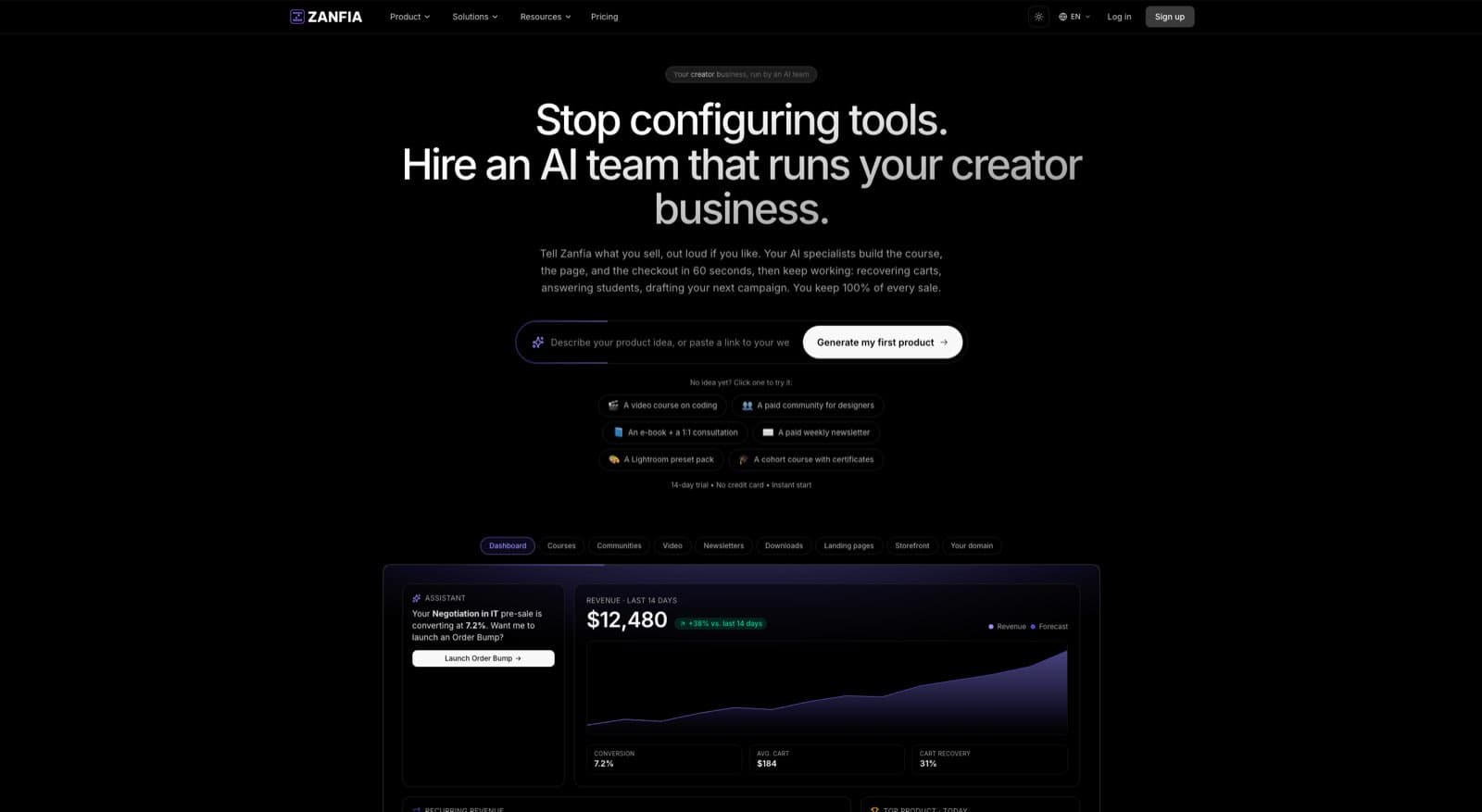
Because 12 product types (courses, communities, newsletters, memberships, downloads, consultations, bundles and more) live under one roof, you can package each tier as a different bundle without wiring three tools together. Cart 2.0 handles one-time, subscription, installment, and free-trial pricing on the same product, with Stripe and PayPal (plus Apple Pay and Google Pay) at checkout. Order bumps invoice separately per add-on, and subscription upsells sit on the same checkout page. Test mode lets you buy your own $600 community tier before launch to confirm the checkout, receipts and tracking work end to end, with test orders hidden from the real order list. Discount codes (percentage or flat) and multi-quantity offers for team licensing round out the tier toolkit. Everything runs under your own domain (each creator gets a slug.zanfia.co subdomain, or can map a custom domain), so buyers never see a marketplace logo.
Zanfia is also rolling out one-click post-purchase offers this summer, with interstitial accept/decline chains and downsells. That gives creators a way to move buyers from a lower tier into a higher one immediately after checkout, without asking them to re-run a full cart.
The fee structure matters when you do the tier math. As of August 2026, Zanfia charges 0% platform commission on customer sales. The only cut is your payment processor’s (Stripe is roughly 2.9% + $0.30 in the US). Compare that with Gumroad’s 10% + $0.50 per transaction on direct sales, or 20-30% via the Gumroad marketplace. On a 100-buyer launch of a $597 tier, that difference is worth $4,000-$18,000 in take-home revenue depending on which platform you compare against.
Plans start at $39/month, or $31/month billed annually, with a 14-day free trial and no credit card required. Full pricing at zanfia.com/pricing.
FAQ
What should I charge for my first online course? Anchor on the outcome value, not your production time. For a first course teaching a defined skill, most creators land somewhere between $147 and $497 for the base tier. Below $100 you attract buyers who do not finish; above $500 without social proof you struggle to convert.
How many pricing tiers should I offer? Three. Two tiers force a false binary; four or more paralyze the buyer. The middle tier should be the one you want most people to pick, priced roughly 3x the base.
Should my course be a subscription or one-time payment? One-time for finished skill courses. Subscription for communities, evergreen libraries, or ongoing coaching. Do not wrap a completable course in a subscription; buyers cancel the moment they finish.
Do order bumps really work? Yes, consistently, when priced at 15-25% of the main offer and positioned as a natural complement. Expect 20-40% take rates. They add 5-10% to average order value with no extra content production.