Top Strategies for Increasing Average Order Value in 2025

For digital creators and online entrepreneurs, converting a visitor into a customer is a major victory. But what if each sale could deliver more value, not just for your bottom line, but for your customers too? The key lies in shifting focus from simply making a sale to maximizing the value of every single transaction. This is where the crucial metric of Average Order Value (AOV) comes into play. Before diving into specific tactics, it's essential to grasp what Average Order Value is and how to effectively grow it within your e-commerce operations.
Increasing your AOV doesn't have to involve complex tactics or finding new customers; it's about strategically presenting more value to people who are already in the process of buying. This guide breaks down eight powerful, actionable strategies designed specifically for digital product sellers and community builders. From smart product bundling to personalized recommendations, these techniques will help you boost revenue and enhance customer satisfaction. We will also explore how an all-in-one platform like Zanfia streamlines the implementation of these strategies, automating the heavy lifting so you can focus on creating high-impact content and building a more profitable online business.
1. Product Bundling
Product bundling is a classic yet powerful strategy for increasing average order value (AOV). It involves grouping multiple complementary products or services into a single package, often offered at a discounted price compared to buying each item separately. This method capitalizes on the customer's desire for value and convenience, encouraging them to purchase more in one transaction.
For digital creators, this opens up numerous possibilities. Instead of selling a single online course, you can create a comprehensive "Transformation Kit" that bundles the course with a companion e-book and access to an exclusive community. For a platform like Zanfia, this means creators can seamlessly package an online course with entry into a private community channel, an e-book, and a set of templates—all sold as a single, high-value product. This not only provides a complete solution but also significantly raises the transaction value.
How to Implement Product Bundling Effectively
To make your bundles irresistible, focus on creating a cohesive package that solves a larger problem. Analyze your sales data to see which products are frequently purchased together, as this is a strong indicator of a natural bundle. A fitness coach, for example, might notice clients buying both a workout plan and a nutrition guide, making them a perfect pair for an official "Total Fitness Bundle."
Here are some actionable tips:
- Create Tiered Options: Offer different levels like a "Basic Bundle" (course + e-book) and a "Premium Bundle" (course + e-book + community access). This caters to various budgets and commitment levels.
- Communicate the Savings: Clearly display the total value of the individual items versus the bundled price. Highlighting the discount (e.g., "Save $50!") makes the value proposition tangible and compelling.
- Leverage Platform Tools: Use a platform built for this. Zanfia's integrated ecosystem allows creators to effortlessly create and manage complex product bundles, including combining one-time purchases with subscriptions or installment plans, all while automatically granting access to the right course lessons and community channels upon purchase.
To give you a quick reference on the impact of this strategy, here are some key data points on product bundling.
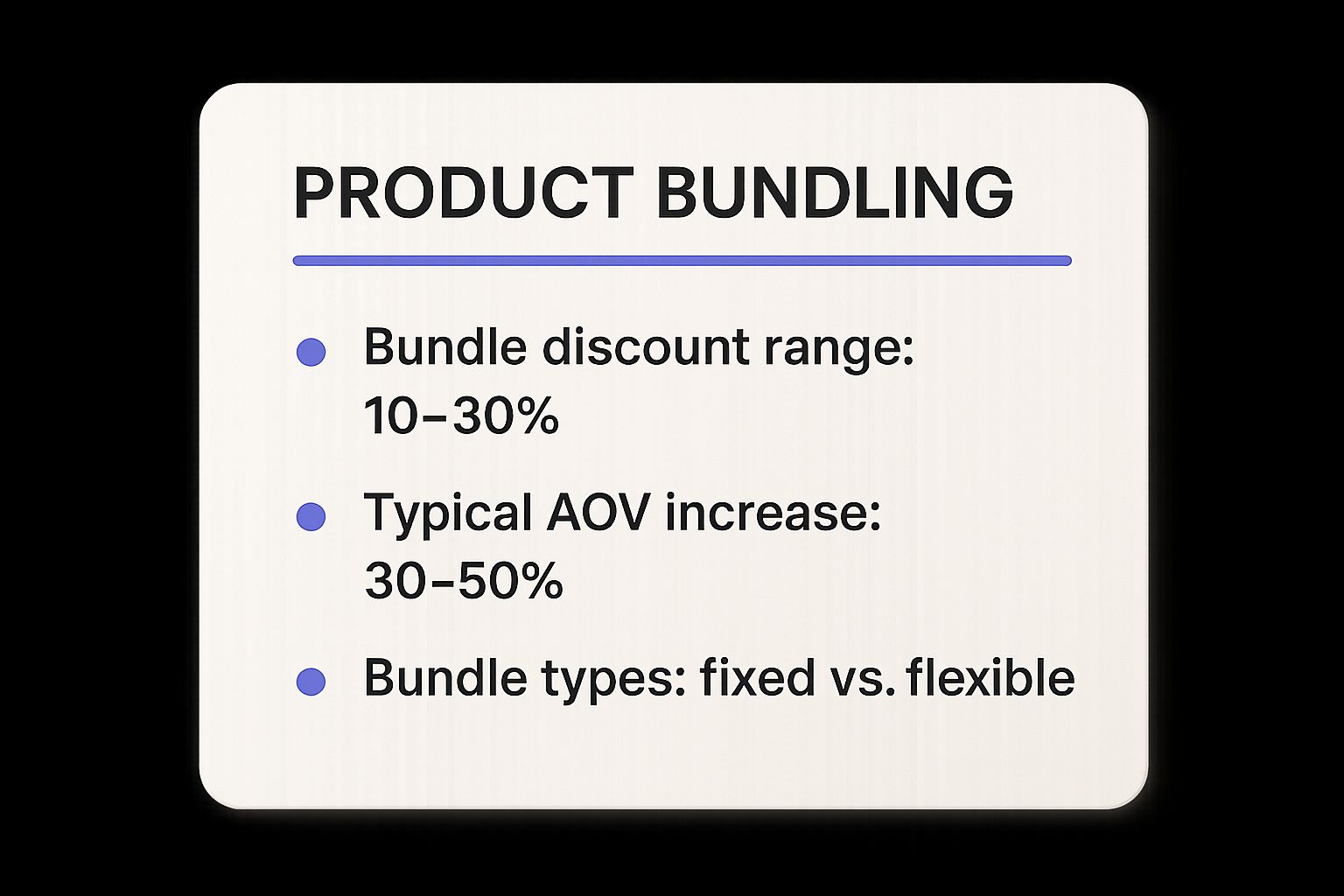
As the data shows, a well-executed bundle can increase AOV by 30-50%, making it a highly effective tactic. By packaging your digital products into high-value offers, you create a win-win scenario: your customers get a complete, cost-effective solution, and you successfully boost your revenue per transaction. Learn more about how bundling can be a part of your strategy for selling high-ticket products.
2. Free Shipping Thresholds
Free shipping thresholds are a powerful psychological lever for increasing average order value (AOV). This strategy involves offering free shipping once a customer's cart total reaches a specific minimum amount. The appeal of avoiding shipping costs is often strong enough to motivate customers to add more items to their cart, directly boosting the value of their transaction.
For digital creators, this might seem less relevant, but it's highly effective when selling physical companions to digital products, like workbooks, branded merchandise, or journals. A creator selling a design course could offer a premium toolkit with physical supplies. Setting a shipping threshold encourages students to buy the full kit rather than just a few items, ensuring they have everything they need while you increase your AOV.
How to Implement Free Shipping Thresholds Effectively
The key is to set your threshold strategically. It should be high enough to encourage extra spending but low enough to feel achievable. A common practice is to calculate your current average order value and set the free shipping threshold approximately 20-30% above that number. This makes it a small, justifiable leap for the customer.
Here are some actionable tips:
- Use Dynamic Messaging: Implement a banner in the shopping cart that updates in real-time, such as, "You're only $12 away from free shipping!" This creates a sense of urgency and clarifies the path to the reward.
- Recommend Threshold-Reaching Products: Suggest small, relevant items that can help a customer cross the free shipping line. This is a subtle form of upselling that feels helpful rather than pushy.
- Make the Offer Visible: Don't hide your free shipping offer until the checkout page. Display it prominently on a sitewide banner and on product pages to influence purchasing decisions from the start.
By removing the friction of shipping costs, you not only make the purchase more attractive but also guide customers toward spending more. This tactic transforms a potential pain point into a direct and effective tool for increasing average order value and improving the overall customer experience.
3. Upselling and Cross-Selling
Upselling and cross-selling are two powerful, closely related tactics for increasing average order value by capitalizing on a customer's existing purchase intent. Upselling encourages customers to buy a more premium, higher-priced version of a product, while cross-selling suggests adding complementary items to their order. These strategies work because they present relevant, high-value offers at the precise moment a customer is ready to buy.
For digital creators, this means you can strategically guide customers toward more comprehensive solutions. When a student is about to purchase your foundational "Social Media Marketing 101" course, you can upsell them to the "Complete Mastery Bundle" which includes advanced modules and one-on-one coaching. Similarly, at checkout, you could cross-sell a set of "Canva Social Media Templates" that perfectly complements the course material, making the original purchase even more valuable.
How to Implement Upselling and Cross-Selling Effectively
The key to successful upselling and cross-selling is relevance and timing. The offer must feel like a helpful suggestion that enhances the customer's experience, not a pushy sales tactic. Analyze your customer journey to identify the best moments for these offers, such as on the product page, in the shopping cart, or even in a post-purchase email sequence.
Here are some actionable tips:
- Offer Genuine Value: Ensure your upsell provides clear, additional benefits. For example, upgrading from a standard e-book to a premium version could include video tutorials and a workbook. The value must justify the price increase.
- Limit the Options: Avoid overwhelming customers with too many choices. Present a small, curated selection of 2-3 relevant upsells or cross-sells. The "good-better-best" model is a classic upselling framework that works well.
- Automate with Platform Tools: Use a platform like Zanfia to build sophisticated sales funnels. Zanfia allows you to create one-click upsells and order bumps directly within the checkout process, making it seamless for customers to add more value to their purchase without re-entering payment details. This frictionless experience, combined with 0% platform fees, is critical for maximizing conversions and revenue.
By strategically presenting higher-tier products and relevant add-ons, you not only succeed in increasing average order value but also help customers achieve better outcomes. To dive deeper into these tactics, you can learn more about upselling and cross-selling on zanfia.com.
4. Volume Discounts and Quantity Breaks
Volume discounts, also known as quantity breaks, are a straightforward yet highly effective strategy for increasing average order value (AOV). This method incentivizes customers to purchase larger quantities of a product by offering a reduced per-unit price as their order volume increases. It's a classic win-win: customers feel they are getting a better deal by buying in bulk, and you successfully increase the total value of the transaction.
For businesses selling digital products or access, this can take many forms. A creator selling social media templates could offer 10 templates for a set price, but a pack of 50 for a significantly lower per-template cost. Similarly, a community owner might sell a single month of access, but offer a 25% discount on a 12-month "all-access pass." This encourages a larger upfront commitment and purchase.
How to Implement Volume Discounts Effectively
The key to successful volume discounts is to make the value proposition crystal clear and irresistible. Your pricing tiers should be structured to guide customers toward the higher-quantity, higher-value option. It's crucial to calculate your break-even points to ensure each tier remains profitable while still offering a compelling incentive.
Here are some actionable tips:
- Clearly Display the Savings: Don't make customers do the math. Prominently display the savings on higher-quantity options, using callouts like "Best Value!" or "Save 20% when you buy 3!"
- Use Visual Cues: On your sales page, visually highlight the recommended or most popular tier. A different color, a border, or a simple banner can draw the customer's eye directly to the option you want them to choose.
- Combine with Subscriptions: For digital access or communities, offering a quantity break on a longer-term subscription (e.g., a yearly plan vs. a monthly one) is a powerful way to lock in predictable revenue and boost AOV simultaneously.
- Simplify the Choice: Make the quantity selector or pricing table easy to understand and use. On platforms like Zanfia, you can easily configure flexible pricing plans for the same product, such as a one-time purchase, subscription, or installment plans, presenting clear tiered options to your customers without technical hassle. This allows creators to test various quantity break strategies effortlessly.
By making bulk purchases financially attractive, you shift the customer's mindset from "Should I buy this?" to "How many should I buy?" This subtle change is a powerful driver for increasing average order value and improving your overall revenue per customer.
5. Loyalty Programs and Tiered Rewards
Loyalty programs are a strategic approach to increasing average order value by incentivizing repeat business and higher spending. By offering rewards, points, or exclusive benefits, you encourage customers to make larger or more frequent purchases to unlock greater value. This transforms one-time buyers into dedicated, long-term brand advocates.
For digital creators, this can take the form of a tiered membership system where access to content and community perks improves as a customer's lifetime spending increases. A member who buys a single e-book might be in the "Bronze" tier, while someone who purchases a high-ticket course and community access could reach the "Gold" tier, unlocking exclusive Q&A sessions or early access to new material. This gamifies the purchasing experience and motivates customers to invest more into your ecosystem.
How to Implement Loyalty Programs Effectively
A successful loyalty program feels like a value-add, not a marketing gimmick. The key is to make the rewards meaningful and the path to earning them clear and achievable. Analyze your customer data to set tier thresholds just above your current AOV, nudging customers to add one more item to their cart to reach the next level. For instance, if your average order is $45, setting the first reward tier at $60 can be a powerful motivator.
Here are some actionable tips:
- Keep It Simple: Ensure the rules for earning and redeeming points are transparent and easy to understand. Complexity creates friction and reduces participation.
- Visualize Progress: Use progress bars or clear visual indicators to show customers how close they are to the next tier. This leverages the psychological principle of goal completion.
- Offer Experiential Rewards: For top tiers, move beyond simple discounts. Offer exclusive rewards like one-on-one coaching calls, early access to new products, or invitations to special online events to create a strong emotional connection.
- Automate Tier Management: Use a platform like Zanfia to automate this process. Its powerful workflow features can instantly add customers to the right community groups or trigger welcome sequences based on their purchase, ensuring rewards are granted instantly upon qualification and saving creators 5-10+ hours a month in manual administration.
By building a structured rewards system, you not only succeed in increasing average order value but also cultivate a loyal community that feels recognized and appreciated for its continued support. This strategy can be integrated with various monetization methods, a concept further explored when building a subscription-based business model.
6. Limited-Time Offers and Flash Sales
Limited-time offers and flash sales are powerful psychological triggers for increasing average order value (AOV). This strategy leverages urgency and the fear of missing out (FOMO) by making a special deal available for a very short period. This time pressure encourages customers to make purchase decisions more quickly and often prompts them to add more to their cart to maximize the limited-time savings.
For digital creators, a well-timed flash sale can reignite interest in an existing course or digital product. Imagine offering a 48-hour "Creator's Power Pack" flash sale that includes your premium course, a bundle of exclusive templates, and a bonus Q&A session, all at a significant discount. This not only drives a surge in sales but also incentivizes customers who were on the fence to commit, often at a higher price point than a single product purchase.
How to Implement Limited-Time Offers Effectively
The key to a successful flash sale is creating a sense of genuine urgency without devaluing your brand. The offer must feel special and rare. A great example is a "back to school" or end-of-quarter promotion on your educational content, which feels natural and timely. By limiting the frequency of these sales, you maintain their impact and avoid training your audience to wait for discounts.
Here are some actionable tips:
- Build Anticipation: Promote your flash sale 24-48 hours in advance through email and social media to create a buzz. Use countdown timers on your sales page and in your communications to visually reinforce the deadline.
- Combine with a Threshold: Pair your flash sale with a free shipping offer or a bonus digital download for orders over a certain amount. This directly encourages customers to add more items to their cart, boosting your AOV.
- Segment Your Offers: Create exclusive "early access" or a deeper discount for your most loyal community members or email subscribers. This rewards your best customers and makes them feel valued, strengthening the relationship.
- Ensure Technical Readiness: Flash sales can create significant traffic spikes. Platforms like Zanfia are built on robust, professionally managed SaaS infrastructure, ensuring your site remains fast and stable even during a high-volume promotion, so you never lose a sale due to technical glitches.
7. Minimum Order Requirements for Promotions
Setting minimum order requirements for promotions is a savvy tactic for increasing average order value (AOV). This strategy works by offering customers an attractive reward, like a free gift or an exclusive discount, but only once their cart total reaches a specific threshold. Unlike a free shipping minimum that simply removes a negative, this method adds a tangible, positive value, reframing a higher spend as an opportunity to gain something extra.
For digital creators, this can be highly effective. Imagine offering an exclusive Q&A session replay or a bonus mini-course to anyone who spends over $100. This incentivizes customers who were considering a single $79 course to add a small e-book or template pack to their order just to unlock the additional value, directly boosting the transaction total.
How to Implement Minimum Order Promotions Effectively
The key is to set a threshold that feels achievable yet pushes customers just beyond their typical spending habits. Analyze your current AOV and set your minimum 20-30% higher to create a realistic goal. The reward itself must be genuinely desirable; think of it as a compelling bonus, not a way to offload unpopular products. Brands like Sephora and Ulta Beauty master this by offering coveted deluxe samples or gift-with-purchase items at various spending tiers.
Here are some actionable tips:
- Create Tiered Rewards: Motivate even higher spending by offering progressively better rewards at different levels (e.g., a free template at $75, a mini-course at $125).
- Show Progress Visually: Implement a dynamic cart that shows customers how close they are to the reward, such as "You're only $17 away from your free gift!" This visual cue is a powerful motivator.
- Recommend Qualifying Products: Suggest relevant, lower-priced items that can help a customer reach the threshold, simplifying their decision-making process and making the upsell feel helpful.
- Combine with Flexible Payments: Making larger purchases more accessible can further enhance this strategy. Zanfia's modern payment system integrates with Stripe, PayU, and Przelewy24, supporting Apple Pay and Google Pay to reduce friction for larger orders, making customers more likely to reach higher promotional tiers. This removes payment barriers, unlike many payment options similar to Affirm that may require separate integrations.
This method successfully gamifies the shopping experience, turning a simple purchase into a rewarding achievement. By carefully structuring your offers, you can create a powerful system for boosting AOV. You can learn more about scaling with systems that drive predictable revenue growth.
8. Personalized Product Recommendations
Personalized product recommendations leverage customer data and browsing behavior to suggest relevant products tailored to each individual shopper. This strategy moves beyond generic "most popular" sections by using purchase history, viewed items, and AI algorithms to surface products a specific customer is highly likely to buy. It's a powerful way of increasing average order value by making the shopping experience feel more like a helpful, curated service than a simple sales pitch.
For digital creators, this means going beyond one-size-fits-all promotions. If a customer has purchased your "Beginner's Guide to Digital Marketing" e-book, a personalized system could automatically recommend your "Social Media Ads Masterclass" or a one-on-one "Strategy Session" on their next visit. These timely suggestions are highly relevant, making them feel like a natural next step in the customer's journey and encouraging a larger purchase.

How to Implement Personalized Recommendations Effectively
To succeed with personalization, start by understanding your customer's path. Analyze which products are often viewed after a specific purchase or what content leads to a sale. This insight allows you to build recommendation logic that genuinely helps your audience discover more value. Amazon famously pioneered this, driving a significant portion of its revenue by showing customers what others like them also bought.
Here are some actionable tips:
- Segment Your Audience: Start by creating basic customer segments (e.g., "New Subscribers," "Repeat Course Buyers") and tailor recommendations for each group before implementing complex AI.
- Optimize Placement: Test displaying recommendations in multiple high-impact locations like the homepage, on product pages, in the shopping cart, and even in post-purchase emails.
- Vary Recommendation Types: Don't just show "customers also bought." Mix in suggestions like "trending in your community," "because you viewed [product]," or "complete your kit."
- Personalize the Title: Instead of a generic "Recommended for You," try more specific titles like "Based on Your Interest in Content Creation" to make the suggestion feel more bespoke and relevant.
Effective personalization is a core component of a high-performing sales funnel. By guiding customers to the right products at the right time, you can significantly boost both AOV and customer satisfaction. Learn more about how this fits into a broader plan with these conversion rate optimization strategies.
8 Strategies to Increase Average Order Value Comparison
| Strategy | Implementation Complexity 🔄 | Resource Requirements ⚡ | Expected Outcomes 📊 | Ideal Use Cases 💡 | Key Advantages ⭐ |
|---|---|---|---|---|---|
| Product Bundling | Medium – requires inventory and logistics coordination | Moderate – data analytics and inventory control | AOV increase 30-50%, moves slow inventory | Complementary products, themed occasions | Increases multi-item purchases, reduces decision fatigue |
| Free Shipping Thresholds | Low to Medium – simple rule with UI elements | Low – mostly marketing and shipping cost analysis | AOV increase 10-30%, boosts order consolidation | Any online retail with shipping costs | Strong psychological motivator, easy customer understanding |
| Upselling and Cross-Selling | Medium to High – requires data analysis and personalization | Moderate to High – AI and browsing data needed | Significant AOV uplift, higher conversion rates | Retail with varied product tiers or complements | Leverages purchase intent, enhances customer experience |
| Volume Discounts and Quantity Breaks | Medium – tiered pricing setup and inventory management | Low to Medium – pricing strategy and stock planning | AOV increase 40-100%, reduces per-order costs | Consumables, B2B, products with repeat purchase | Encourages bulk buying, boosts transaction size |
| Loyalty Programs and Tiered Rewards | High – requires robust infrastructure and ongoing management | High – technology, rewards, and communication | Increases lifetime value and purchase frequency | Brands seeking repeat customers and long-term loyalty | Builds strong brand loyalty, reduces price sensitivity |
| Limited-Time Offers and Flash Sales | Medium – event marketing and infrastructure scaling | Moderate to High – marketing and fulfillment peak handling | AOV increase 25-40%, traffic spikes | Inventory clearance, promotional events | Creates urgency, generates excitement and buzz |
| Minimum Order Requirements for Promotions | Medium – tiered rewards setup and communication | Moderate – rewards costs and inventory control | AOV increase 30-60%, encourages product discovery | Retail aiming to add value rather than removing fees | Positive reward framing, excites customers |
| Personalized Product Recommendations | High – AI/ML algorithms, data infrastructure | High – technical expertise and ongoing optimization | AOV increase 20-50%, higher conversion and discovery | Large catalog retailers, data-rich environments | Highly relevant suggestions, scalable personalization |
From Tactics to System: Integrating Your AOV Strategy
We've explored a powerful suite of strategies for increasing average order value, from the magnetic pull of product bundling and free shipping thresholds to the strategic precision of upselling, volume discounts, and personalized recommendations. Each tactic, whether it's a tiered loyalty program or a high-urgency flash sale, offers a direct path to boosting your revenue per transaction. But the true breakthrough happens when you stop seeing these as isolated tools and start building them into a cohesive, intelligent system.
The goal is not to randomly deploy promotions. Instead, it's to create a customer journey where every step logically and helpfully presents an opportunity for greater value. A new customer might be drawn in by a minimum order discount, then presented with a relevant one-click upsell post-purchase. A loyal member might unlock exclusive bundles through your tiered rewards program. This interconnected approach transforms one-off transactions into a sustainable growth engine.
Unifying Your Strategy for Maximum Impact
Think of it this way: a well-crafted product bundle can serve as the perfect upsell at checkout. A limited-time offer can be amplified by offering installment plans, making a higher-priced package feel more accessible and increasing its conversion rate. Personalized recommendations aren't just for product pages; they can be automated to follow up after a purchase, suggesting the next logical step in a customer's learning path.
This strategic integration is the key to successfully increasing average order value without alienating your audience. You are not just pushing for a bigger sale; you are proactively solving your customers' next problem and delivering a more comprehensive solution. When a customer feels understood and sees the clear benefit of adding more to their cart, a higher AOV becomes the natural, positive outcome of a great customer experience.
The Foundation for Effortless Implementation
Executing this level of strategic coordination can seem daunting. Juggling different plugins for bundling, separate apps for upselling, and another tool for loyalty programs often leads to technical headaches and a fragmented customer experience. This is where the right technological foundation becomes a non-negotiable asset. A true all-in-one platform is designed to be the central nervous system for your AOV strategy.
Zanfia provides this unified ecosystem, allowing creators to implement all these strategies from a single dashboard. Instead of wrestling with incompatible plugins, you can build product bundles, configure one-click upsells, create installment plans, and automate access to community channels based on purchases—all within one system. This eliminates technical friction, letting you focus on crafting irresistible offers for your audience. With this approach, you create a system that not only grows your revenue but also deepens customer loyalty and satisfaction.
Ready to stop juggling tools and start building a powerful, integrated system for increasing your average order value? Zanfia provides the all-in-one platform you need to effortlessly implement bundles, upsells, subscriptions, and more, all with 0% platform transaction fees. See how you can unify your digital product business and keep 100% of your revenue by visiting Zanfia today.