

Knowledge Base Software Comparison: Finding Your Ideal Platform

Picking the right knowledge base software really comes down to what you're trying to build. If you're a creator or a business aiming to sell your expertise and keep your brand front and center, you'll want a platform that does more than just host articles. The sweet spot is a tool that bundles a knowledge library with a community, courses, and digital product sales—all under your own branded domain. This keeps everything in one place, avoiding the disjointed experience and sneaky fees that come from stitching together multiple apps.
Choosing Your Ideal Knowledge Base Software
The search for the perfect platform can feel like a chore, especially with so many options popping up. The market for this kind of software is booming, with some analysts expecting it to be worth over USD 13 billion by 2025. That growth is happening for a reason: everyone is moving toward self-service. This makes your choice more important than ever.
To cut through the noise, start with your main goal. Are you focused on building a lively community? Selling online courses? Or are you scaling a business with multiple digital offerings? This decision path can help you figure out where to start.
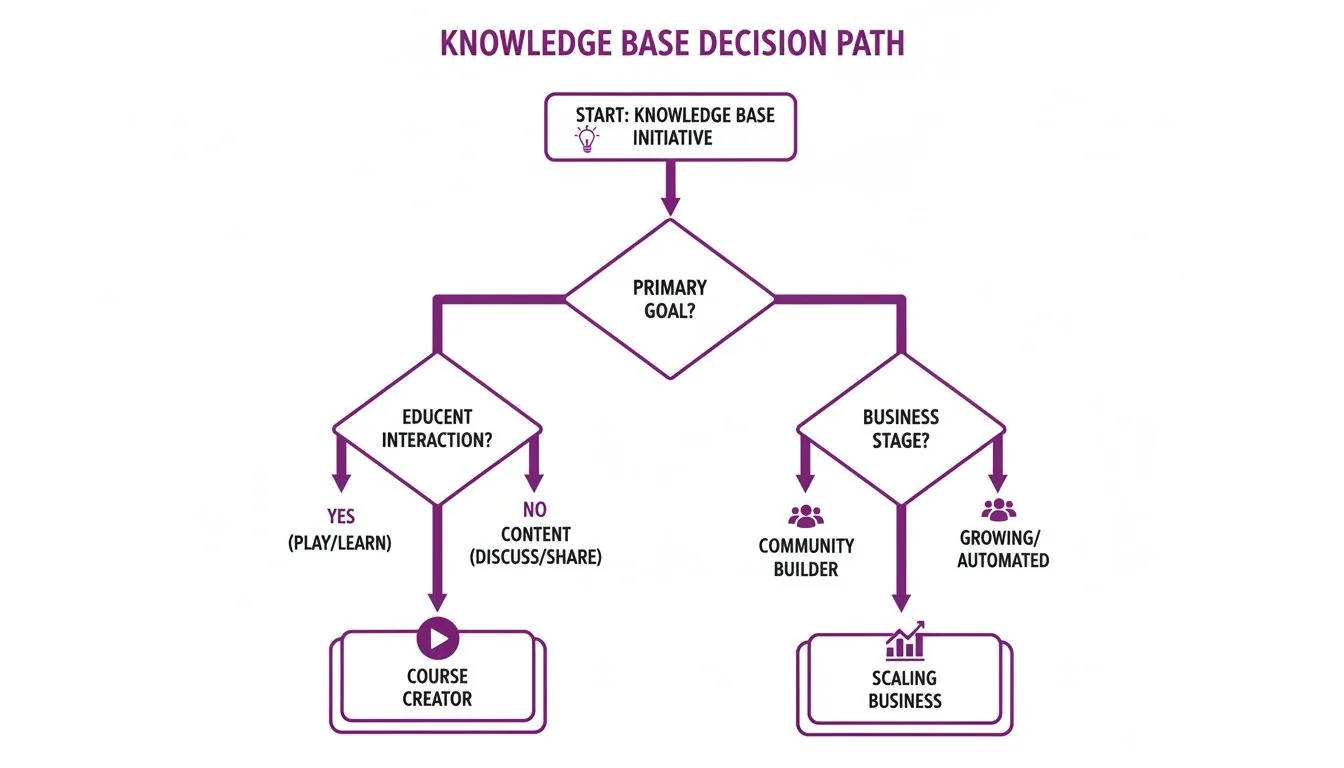
As you can see, there are different routes for creators, community builders, and established businesses. But the most powerful solutions are the ones that bring all three functions together. A unified model is the secret to building long-term relationships with your customers.
Understanding The Different Software Archetypes
Not all knowledge base platforms are built the same. They tend to fall into a few distinct categories, each designed for a different job. Figuring out which archetype fits your needs is the first step to narrowing down your options. For instance, if you’re a business managing highly detailed product specs, you’d want to look into specialized technical knowledge management software.
To give you a quick lay of the land, I've broken down the main software types and who they're for. This should help you quickly pinpoint which category makes the most sense for you.
Quick Comparison Of Knowledge Base Software Types
| Software Type | Primary Use Case | Key Strength | Ideal For |
|---|---|---|---|
| All-in-One Creator Platforms | Monetizing expertise through courses, community, and digital products, with an AI team doing the work behind the scenes. | Integrated ecosystem with a single login, plus voice-driven operation and a checkout built to sell (order bumps, installments, upsells). | "Business Architects" and "Craft Masters" needing seamless sales and engagement tools. |
| Community-First Platforms | Building and engaging a dedicated member community. | Gamification and discussion-focused features. | Creators whose primary product is the community itself, like those on Skool. |
| Standalone Knowledge Bases | Providing customer self-service support and internal documentation. | Advanced search, ticketing integration, and content organization. | SaaS companies and large enterprises focused on reducing support tickets. |
| WordPress + Plugin Stacks | Building a highly customizable site with full data ownership. | Maximum flexibility and control over every aspect of the site. | Tech-savvy users who are comfortable managing updates, security, and multiple plugins. |
Each of these approaches has its own set of pros and cons. But for creators who want to build a real, sustainable business, the all-in-one model provides the clearest path to growth. It keeps your operations simple, cuts down on technical headaches, and keeps your audience right where you want them: inside your own branded world. You can dive deeper into this topic in our guide on the best platform for content creators.
Core Criteria For Evaluating Knowledge Base Platforms
With so many options on the market, choosing the right knowledge base software can feel overwhelming. To make a confident decision, you need to look past flashy feature lists and focus on what will actually impact your business day-to-day. A solid evaluation framework helps you see the nuances that separate an okay tool from a great one.
We're going to break down the five critical pillars that determine a platform's real value. Think of these as a personalized scorecard to measure each option against what truly matters for your growth. Interestingly, many of the core principles for evaluating top SaaS affiliate software platforms apply here, as most knowledge base solutions operate on a similar model.

Monetization Models And True Cost
Let's start with the most important factor: how the platform handles money. A flexible monetization engine is non-negotiable if you plan to sell your knowledge.
You need the ability to package and sell your content in multiple ways:
- One-time purchases for things like ebooks or downloadable guides.
- Recurring subscriptions for ongoing access to a community or newsletter.
- Installment plans to make your high-ticket courses more affordable (splitting a $600 course into four payments changes who can say yes).
- Product bundles and order bumps at checkout to create tiered offers and lift average order value.
But the price tag isn't the whole story. The real cost is often hidden in the fees. Many platforms skim a percentage off every sale, which can seriously eat into your revenue as you grow. Zanfia charges 0% platform commission on customer sales, so you only pay the standard processor cut (Stripe is roughly 2.9% + $0.30 in the US). That keeps your costs predictable and your business more scalable.
Content And Community Integration
A knowledge base is powerful, but it becomes a genuine asset when connected to an active community. When your content and conversations are siloed—say, a course on one platform and a community on Discord—you create unnecessary friction and risk losing engagement.
A truly integrated system brings it all together. Imagine linking a specific community channel directly to a lesson in your course. This creates a unified, seamless learning environment that keeps your audience engaged and under your brand's umbrella. Don't settle for platforms that push your members to third-party tools where you have no control.
Brand And Domain Control
Your brand is everything. The right software should elevate it, not hide it behind its own. For any serious business or creator, full white-labeling isn't a luxury; it's a necessity.
This means using your own custom domain for your sales pages, your courses, and your community. The customer journey should feel seamless and entirely yours. Platforms that plaster their own logo all over your site can undermine your authority and look unprofessional. Your brand should always be the star of the show.
Automation Power And Workflow Efficiency
Let's be honest, administrative tasks are a huge time sink. The difference between a good platform and a great one often comes down to its automation capabilities. On Zanfia, the goal goes further: an AI team runs the day-to-day of your business, and you can dictate what needs to happen by chat or by voice instead of clicking through screens. It frees you up to focus on creating.
Think about these essential automations:
- Instantly granting course and community access right after a purchase.
- Sending out automated welcome sequences to new members.
- Handling subscription renewals and cancellations without you lifting a finger.
- Revoking access if a payment fails or an installment plan ends.
These workflows can easily save you 5–10+ hours per month. That’s a significant return on investment, freeing you up to focus on what actually grows your business. Getting these systems right is a core component of good knowledge management best practices.
Technical Scalability And Integrations
Finally, you need a platform that can grow with you. That means robust API access and webhooks that let you connect to your favorite CRM, email marketing tools, and other essential software. Zanfia also exposes an MCP endpoint, so AI assistants can act directly on your workspace—a rare capability that gets more valuable as you rely on AI in your day-to-day work. Availability of the MCP endpoint and the full Assistant depends on the plan, so check the current Zanfia pricing.
Scalability also means giving buyers the payment methods they expect. In the US that means cards, Apple Pay and Google Pay through Stripe and PayPal, plus the ability to run test-mode purchases to verify checkout and tracking end to end before your first real sale.
A Detailed Knowledge Base Software Comparison
Now that we have a solid framework for what to look for, let’s put the leading platforms to the test. This isn't just a feature checklist; we're going to dive into a real-world comparison of popular options through the lens of a digital creator or expert-led business. We'll examine all-in-one solutions like Zanfia, community-first tools like Skool, and international giants like Kajabi to see how they truly stack up.
The goal here is to get past the marketing fluff and look at the practical impact of their business models, tech, and the level of brand control you get. We’ll pay close attention to monetization flexibility, video hosting, community integration, and the quality of the checkout experience to give you a clear picture of what each platform really offers.

Zanfia: An AI Team Running a Unified Creator Ecosystem
Zanfia is positioned less as a course tool and more as an AI team that runs a creator business, with courses, communities, newsletters and digital products as the surfaces where that team's work lands. Its entire philosophy is about giving creators maximum control over their brand and, most importantly, their revenue—and doing the operational work for you, by chat or by voice.
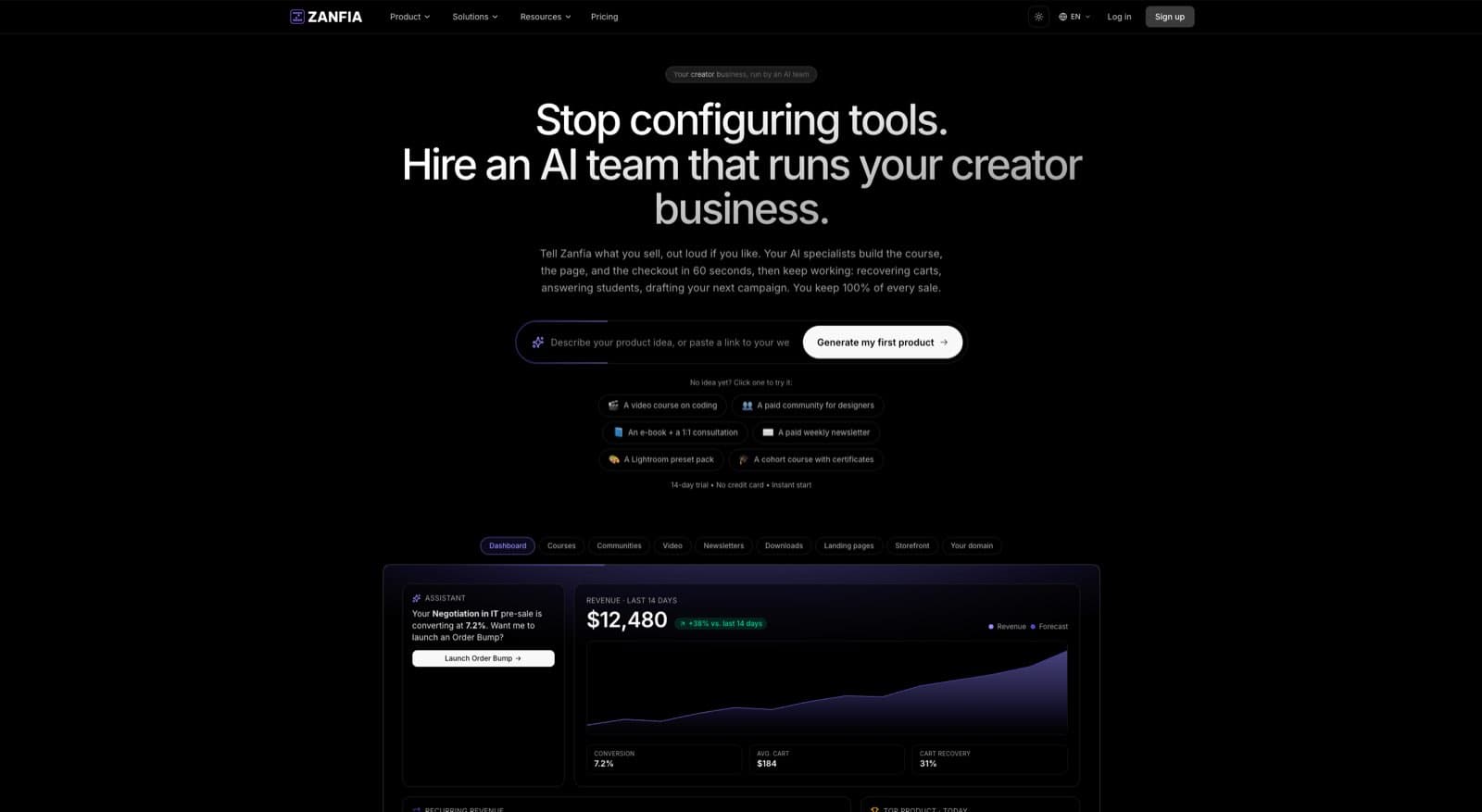
The most striking differentiator is the pricing model. Zanfia charges 0% platform commission on customer sales—it's a pure SaaS subscription, so you only pay the standard fees to payment processors like Stripe or PayPal. Entry is $39/month, or $31/month billed annually, on Starter (as of August 2026, see the Zanfia pricing page). For creators pulling in serious monthly revenue, the savings on commissions alone are substantial.
According to Artur Kurasiński, a respected entrepreneur and investor, Zanfia is “the most convenient and simplest solution for paid newsletters, courses and community.”
Another huge win is the unified community and course structure. Instead of shunting your members off to a separate Discord or Facebook Group, Zanfia builds the community right into your course content—and a community AI agent can help publish from your own material (everything it publishes is labeled as AI, so there's no ambiguity for members). This creates a seamless, branded learning hub that keeps people engaged and coming back.
On the technical side, Zanfia includes native video hosting, so you can ditch paid third-party services like Vimeo or Wistia (though integrations are still an option). Powerful automations can save you 5–10+ hours per month by handling things like granting access after a sale and sending welcome messages. The checkout itself is built to sell—order bumps, installments (split a $600 course into four payments), subscription upsells, and a test mode so you can buy your own product to verify the flow before you launch. Twelve product types (courses, newsletters, communities, memberships, knowledge bases, downloads, digital content, services, events, consultations, bundles and custom) live under one brand. Advanced pieces like the MCP endpoint and full Assistant are available on higher plans, so check the current Zanfia pricing.
Skool: A Pure Community-First Platform
Skool has exploded in popularity thanks to its laser focus on one thing: building paid communities. Its real strength is its simplicity and clever gamification features, which are fantastic for sparking member interaction.
But that single-minded focus comes with trade-offs. The monetization model is quite rigid, primarily supporting just a single monthly subscription for community access. If you want to sell one-off products, bundles, installment plans, or build out sophisticated funnels, you're out of luck. This makes it a tough fit for creators with a diverse mix of offerings like e-books, standalone courses, or different membership tiers.
You also give up a lot of brand control. Skool is functional, but it doesn't offer true white-labeling or custom domain support. Your community will always live on a Skool-branded platform, which can be a deal-breaker for established experts who've worked hard to build a premium, independent brand. Creators needing more versatility should explore a detailed online course platform comparison to see why multi-product sales capabilities are so critical.
Kajabi and Teachable: The International Giants
Platforms like Kajabi and Teachable are the big, well-known players in the course creation space. They offer a very broad suite of tools, from course builders and email marketing to landing page creators.
The main drawback is cost at scale. Kajabi's entry tier is roughly $149/month, versus $31/month on Zanfia Starter (billed annually). Many of these platforms also still rely on transaction fees, particularly on their lower-priced plans. While the features are powerful, the costs can add up fast and eat into your profits.
Kajabi does have a mature, built-in email marketing stack, and if that's your headline requirement it's worth considering. Zanfia's own native email campaigns are rolling out to workspaces—by the time you read this it may already be available on your account, so check your dashboard or the pricing page.
WordPress with Plugins: The DIY Approach
For the creator who craves ultimate control, a self-hosted WordPress site with plugins like LearnDash or MemberPress is a well-trodden path. This route gives you total ownership of your data and limitless customization.
That freedom, however, comes with a hefty price: technical maintenance. When you manage a WordPress stack, you're the one on the hook for hosting, security, plugin updates, and wrestling with compatibility issues. It demands a solid level of tech-savviness and can easily become a time-sucking distraction from what you should be doing—creating content.
And while the initial software costs might look low, the hidden costs of premium plugins, reliable hosting, and maybe even a developer's time can spiral quickly. A managed SaaS solution like Zanfia takes all that off your plate for a predictable cost. It’s why veteran developer Daniel Roziecki praised it for letting him focus on teaching instead of "wrestling with tech."
Feature Matrix: Knowledge Base and Creator Platforms
To really crystallize the differences, let's look at these platforms side-by-side. This table cuts through the noise and focuses on the differentiators that matter most to creators.
| Feature | Zanfia | Skool | Kajabi/Teachable | WordPress + Plugins |
|---|---|---|---|---|
| Platform Fees | 0% on all plans | 2.9% (Stripe fee) | Varies (often 0-10%) | None (hosting/plugin costs) |
| Product Types | 12 types under one brand: courses, community, subscriptions, bundles, events, consultations, and more | Community Subscription Only | Courses, Memberships | Fully Customizable |
| White-Label/Domain | Custom domain available (plan-dependent, see Zanfia pricing) | Limited | Yes (on higher plans) | Yes (self-hosted) |
| Native Video Hosting | Yes, included | No (YouTube/Vimeo only) | Yes (on higher plans) | No (requires third-party) |
| Checkout Built to Sell | Order bumps, installments, upsells, test mode | Single monthly subscription only | Order bumps and upsells (plan-dependent) | Possible via plugins |
| AI & MCP for Agents | Voice-driven Assistant, MCP endpoint for AI assistants (plan-dependent) | Not available | Not available | Not available out of the box |
| Tech Management | Fully managed (SaaS) | Fully managed (SaaS) | Fully managed (SaaS) | Self-managed (requires expertise) |
Laying it all out like this makes one thing clear: the "best" choice really depends on your priorities. For creators looking for a scalable, all-in-one solution with predictable costs, a checkout built to sell, and an AI team that can be run by chat or by voice, Zanfia is a strong option worth evaluating alongside the others.
Finding Your Fit With Persona-Based Recommendations
Let's be honest: the idea of a single "best" platform is a myth. The right choice in any knowledge base software comparison comes down to your specific business stage and what you're trying to achieve. A tool that's perfect for a scaling business could easily overwhelm someone just starting out. This is where thinking in terms of personas can cut through the noise.
We’re going to look at three common profiles I see all the time. By figuring out which one sounds most like you, you can focus on the platforms that will actually help you grow, not just add to your to-do list. This whole approach is about understanding who you're building for, a concept we dig into in our guide to audience segmentation strategies.
The Potential Explorer Seeking Simplicity
This is the expert who has incredible knowledge to share but is stuck in pre-launch paralysis. They’re drowning in tech options and just need the simplest, lowest-risk way to get their first digital product out the door. Forget a complex suite of features—their top priority is ease of use and the confidence to finally hit "publish."
For the Potential Explorer, an all-in-one platform is a lifesaver. It completely removes the headache of duct-taping separate tools for payments, courses, and community, which is where most of the frustration comes from.
What they really need:
- An Intuitive Course Builder: Something with a simple drag-and-drop interface, so they can upload content without a single technical migraine.
- Integrated Payments: A no-fuss way to connect a payment gateway and start selling right away.
- Managed Infrastructure: A platform that handles all the hosting, security, and updates in the background, offering total peace of mind.
A platform like Zanfia was practically built for this exact scenario. You start with a 14-day free trial (no credit card required), and instead of clicking through dozens of setup screens you can dictate what you want to build—the AI Assistant performs actions available in the interface by chat or by voice. A course, community, and sales page can be set up in a single afternoon. It's all about removing the technical roadblocks that keep great ideas on the shelf.
The Business Architect Focused On Scaling
The Business Architect is a seasoned creator who's already got consistent revenue, often in the mid-five to six-figure range monthly. They've likely maxed out their current setup—often a messy collection of different tools—and now they need a professional, integrated system that lets them scale without killing their profit margins.
This person thinks in terms of systems, automation, and lifetime value. They're tired of watching revenue disappear into high transaction fees and losing time on manual, repetitive tasks.
For the Business Architect, the financials are often the tipping point. Zanfia's 0% platform commission on customer sales means every dollar you don't pay in take-rate stays in your business, on top of paying only the standard processor fees. That’s a powerful lever for growth.
Zanfia is designed for this stage of the journey. Powerful automations that handle post-purchase access and subscription management can easily save 5–10+ hours per month. Flexible ways to sell—bundles, subscriptions, installment plans, order bumps and post-checkout upsells—let you build the sophisticated funnels needed to maximize customer value. And because the platform exposes a public REST API, CLI and webhooks (available on higher plans, see the current Zanfia pricing), you can plug it into the rest of your stack instead of duplicating work.
The Craft Master Demanding Excellence
Finally, we have the Craft Master. This is the top-tier expert or industry leader, running a mature, high-revenue business. For them, delivering a premium, seamless experience is everything. Their brand’s reputation is on the line, so the technology has to be elegant, reliable, and completely invisible to their clients.
Brand control is non-negotiable here. This person needs a platform that offers true white-labeling, letting them use their own custom domain and branding on every single page. The customer journey should feel like their brand, not the software's.
Here’s what’s on their must-have list:
- Full White-Label and Custom Domain: This is crucial for a professional, seamless brand experience, from the first ad to the final lesson.
- Native Video Hosting: Delivers a high-quality, buffer-free viewing experience without sending users to a third-party player.
- Deep Integrations and Agent-Ready Infrastructure: API access, webhooks and an MCP endpoint so AI assistants can act directly on the workspace, connecting the platform to their wider tech stack including CRMs and advanced marketing tools.
Zanfia steps up here by providing custom domain support, native video hosting for that premium feel, and API, CLI, webhooks and MCP for deeper customization. Availability of these advanced pieces depends on the plan, so check the current Zanfia pricing. Craft Masters can build a technical foundation that’s every bit as polished and professional as the content they create.
Why the Ecosystem and Support Can Make or Break Your Business
Picking software based on features alone is a classic mistake. It’s like buying a high-performance car but ignoring the cost of parts, the availability of mechanics, or how it handles on your local roads. Your knowledge base platform isn’t just a tool; it’s a business partner. The ecosystem around it—integrations, the company's business model, and the support you get—is what will either fuel your growth or become a constant source of friction.
A platform's ecosystem can be a powerful tailwind, pushing you forward, or a frustrating headwind holding you back. This is especially true when you get into the nitty-gritty of running your business, like payments, tracking and support. You want a platform whose success is aligned with yours, one that gives you the infrastructure to run your operation smoothly and profitably.
Payments, Tracking and Test Mode
Customers pay how they’re used to paying. In the US that means cards, Apple Pay and Google Pay through Stripe and PayPal—all supported natively on Zanfia's checkout. Not offering the wallets your buyers expect isn't just an inconvenience; it's a direct cause of lost sales.
Tracking matters just as much. Zanfia connects to nine tracking platforms out of the box, including Meta Conversions API, Google Analytics 4, Google Tag Manager, TikTok, Microsoft Clarity and Hotjar (session recordings and heatmaps of your checkout pages)—all configurable per product, all behind cookie consent. Before you spend a dollar on ads, run a test-mode purchase: it opens the real checkout in test mode, fires conversion events to your test surfaces (GA4 DebugView, Meta and TikTok test event codes), and keeps test orders out of your real order list. It's the closest thing to a sandbox for verifying that checkout and tracking actually work end to end.
How the Platform's Business Model Impacts Your Wallet
A platform’s pricing tells you a lot about its priorities. Many popular tools you'll see in comparisons take a cut of every sale you make. This commission model might seem appealing when you're starting out, but it creates a messy conflict of interest: the better you do, the more they take.
This model really starts to hurt once you gain momentum. For a creator earning six figures a month, a 5-10% platform fee adds up to thousands of dollars in lost revenue. Every. Single. Month.
A simple, flat-rate SaaS subscription, on the other hand, creates a genuine partnership. Zanfia charges a flat monthly subscription—$39/month, or $31/month billed annually, on Starter (as of August 2026)—and you keep the rest of your revenue minus the standard processor fees. It’s a clean, transparent model. This is a crucial factor when choosing the right platform to sell digital products.
A 0% platform commission on customer sales isn't just a pricing feature; it’s a philosophy. It shows respect for your work and your profit margins, and as your business scales, your profits scale right alongside it. That alignment is what you should look for in a true partner.
Frequently Asked Questions About Knowledge Base Software
Picking the right platform is a big decision, and it’s completely normal to have questions. Let's tackle some of the most common ones that come up when comparing knowledge base software, so you can move forward with confidence.

What Is The Biggest Hidden Cost In Knowledge Base Software?
Hands down, the single biggest hidden cost is often the platform transaction fees. Many providers lure you in with a low monthly subscription, but then quietly skim 5-10% off every single sale you make. This cut is taken on top of what payment processors like Stripe already charge (roughly 2.9% + $0.30 in the US).
As your business scales, these percentage-based fees become a massive drain, potentially costing you thousands of dollars in lost profit. A creator earning $20,000 a month could lose $1,000 or more every month just to platform commissions.
Always look beyond the sticker price and calculate the long-term financial hit. This is where Zanfia stands apart by charging 0% platform commission on customer sales. You only pay the standard processor rates. This transparent model keeps your costs predictable and lets you keep the rest of your hard-earned revenue—a critical advantage for any growing business.
Do I Need A Platform With Built-In Community Features?
For almost any digital creator or expert today, an integrated community isn't just a "nice-to-have" feature; it's essential for driving engagement and building real customer loyalty. When you send people off to external tools like Discord or a Facebook Group, you’re creating a fractured experience.
This fragmentation pulls your audience away from your core brand and makes it much harder to keep them focused and invested.
An all-in-one platform that brings your knowledge base, courses, and community together under your own domain creates a seamless, powerful hub. It dramatically simplifies your life as a creator and, more importantly, it keeps your members completely immersed in your world, which is a huge boost for retention and lifetime value.
How Important Is Native Video Hosting For Courses?
Native video hosting is a total game-changer if you're selling online courses. Relying on third-party services like Vimeo or Wistia just means another monthly bill and another piece of tech to manage and integrate.
Platforms offering native hosting streamline your entire workflow. They cut down your overhead costs and deliver a much smoother, more professional experience for your students. The video player is embedded right into your course, and it often comes with handy features like automatically saving a student's progress.
Look for a solution that provides this out of the box, like Zanfia, but also gives you the flexibility to use other services if you have a specific need. That combination offers the best of both worlds: simplicity and choice.
Can I Use My Own Domain And Branding On These Platforms?
This is a crucial point of comparison, and the answer varies wildly between platforms. For anyone serious about building a strong, independent brand, full white-labeling and custom domain support are non-negotiable.
Some platforms, particularly those that started as community tools, force their branding all over your pages. This can seriously dilute your professional image and cheapen the premium experience you're trying to build. For established experts, that's often a dealbreaker.
Solutions like Zanfia offer custom domain support so your audience interacts with your brand, not the software's—from the moment someone lands on your sales page to the very last lesson. Availability depends on the plan, so check the current Zanfia pricing. It's fundamental for maintaining control and authority.
Ready to build and scale your online business without giving up a slice of your revenue? Zanfia is an AI team that runs your creator business: 0% platform commission on customer sales, native video, an integrated community, a checkout built to sell, and an Assistant you can drive by chat or by voice—all under your own brand. Start with a 14-day free trial, no credit card required. Explore Zanfia today and take full control of your digital future.