

MailerLite vs Mailchimp: Which Is the Smarter Choice in 2026?

When you stack up MailerLite vs Mailchimp, the decision almost always hinges on your budget and tolerance for complexity. For most creators, solopreneurs, and small businesses, MailerLite is the smarter choice. It delivers affordable, predictable pricing, a truly useful free plan, and all the features you actually need.
Mailchimp, while a powerful platform, has become increasingly expensive and convoluted. It’s now better suited for larger companies with dedicated marketing teams and the deep pockets to fund its all-in-one ambitions.
MailerLite vs Mailchimp: The Definitive Verdict
The difference between these two platforms comes down to their core philosophy. MailerLite is built on providing the essential email marketing tools you need, making them excellent, and keeping the pricing simple and scalable. It’s why it has become a favorite for anyone who prizes value and ease of use.

Mailchimp, on the other hand, wants to be your entire marketing department in one dashboard. While its feature list is a mile long, many of the most critical tools—like advanced automation and multi-step funnels—are locked away behind expensive high-tier plans. This creates a frustrating glass ceiling for growing businesses that quickly outgrow the limitations on its cheaper plans.
Quick Comparison Summary
To cut through the noise in the MailerLite vs Mailchimp debate, it helps to see how they compare on the things that matter most. We'll dive deep into each area, but this table gives you the at-a-glance summary.
| Feature | MailerLite | Mailchimp |
|---|---|---|
| Ideal User | Creators, solopreneurs, and SMBs | Larger companies and marketing teams |
| Pricing Model | Affordable and scalable | Complex and often expensive |
| Free Plan | Generous: 1,000 subscribers, 12,000 emails/mo | Limited: 500 subscribers, 1,000 emails/mo |
| Core Strength | Excellent value and ease of use | All-in-one marketing features |
| Ease of Use | Highly intuitive and user-friendly | Steeper learning curve |
Here’s the bottom line: MailerLite gives you the 90% of features that drive real results, but at a fraction of the cost. Mailchimp offers a sprawling suite of tools, but you’ll pay a steep premium for features you might never touch. For creators using platforms like Zanfia, where protecting profit margins is everything, MailerLite is the more strategic and cost-effective partner for growth. Zanfia is an AI team that runs the creator business behind the scenes, with courses, communities, paid newsletters and digital products all living under one white-label brand, and its 0% platform transaction fee model means every dollar saved on tools like email marketing directly boosts a creator’s bottom line. The creator can dictate the work to the assistant by chat or by voice, and everything lands in a checkout built to sell, with order bumps, installments and test mode.
Understanding the Market Shift in 2026
To really get the MailerLite vs Mailchimp debate, you have to see the tectonic shift happening in email marketing. For years, Mailchimp was the undisputed king, the default choice so dominant it became synonymous with the entire category. But that ground is no longer stable.
The major tremor was its acquisition by Intuit, which brought a series of unpopular changes to its pricing and, most critically, its free plan. As limits got tighter and costs went up, a huge opportunity opened up. Creators and small businesses, who watch every dollar, started looking for a new home for their email lists.
The Challenger Steps Up
MailerLite moved in to fill that vacuum, and it did so masterfully. Its appeal wasn’t just being a cheaper knock-off; it was about delivering incredible value. While Mailchimp started putting essential tools like advanced automation behind expensive paywalls, MailerLite gave them to users from the get-go.
This split the market into two clear paths:
- Mailchimp began to feel like a tool for established companies with deep pockets and a need for an all-in-one suite.
- MailerLite positioned itself as the smart, lean, and powerful partner for the modern creator and bootstrap entrepreneur.
This isn’t just a feeling; the numbers tell a clear story. While Mailchimp still holds a respectable share of the Marketing Automation market, MailerLite has aggressively captured significant ground, and its growth is accelerating. Data shows Mailchimp’s active user base has faced challenges, a slide often linked to its pricing strategy.
Even more telling is its churn. Of the domains that have ever used Mailchimp, a significant portion are no longer active today, giving it a high churn rate in its class. You can explore more data on these market trends and see the full analysis.
The takeaway is simple: the market is splitting. Mailchimp is chasing the enterprise segment with a premium, all-in-one suite. MailerLite is winning over everyone else by delivering powerful, user-friendly tools that don’t penalize you for growing.
Why This Matters for Creators
This shake-up is especially critical for digital creators, including those using all-in-one platforms like Zanfia. For an entrepreneur, every dollar saved on software is a dollar you can pour back into your content, marketing, or community.
Mailchimp’s model, where your bill can jump unexpectedly as you grow, is a direct threat to the predictable operational costs a creator needs. MailerLite’s approach is the polar opposite. Its transparent pricing and generous features are perfectly aligned with a creator’s financial reality, giving you the freedom to scale your audience without the fear of hitting a paywall for a feature you suddenly need. This is particularly true for seasoned creators earning five figures a month who need to protect their margins while scaling efficiently. It’s simply the more strategic choice for long-term growth.
Comparing Core Features and Functionality
When you’re comparing MailerLite vs Mailchimp, you have to look past the surface. Yes, both send emails. But the real differences show up in the daily-use features: the email editor, the automation builder, and how they handle your contact lists. This is where their core philosophies diverge, and it’s what will ultimately shape your workflow.
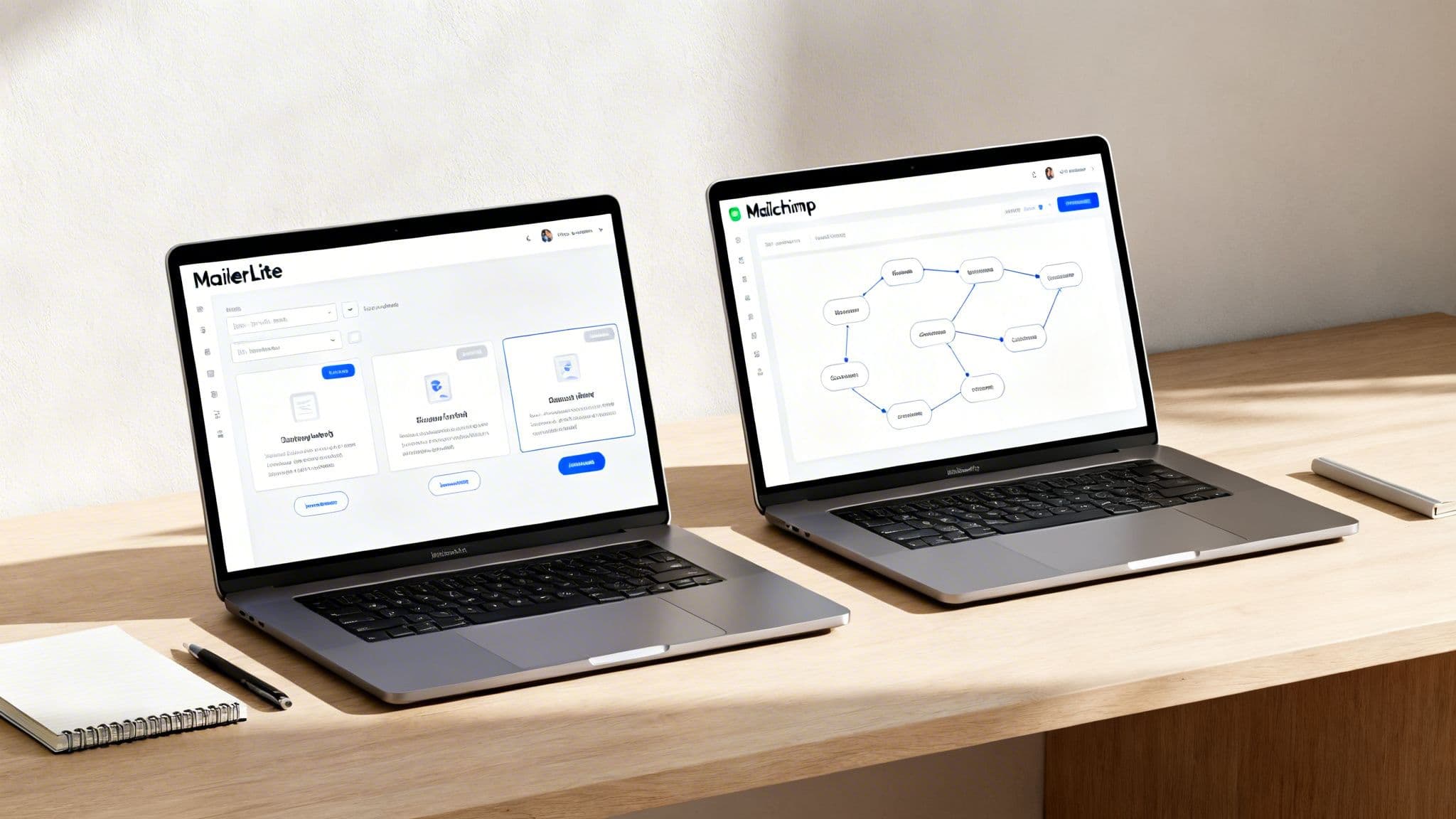
Let’s get into the practical, hands-on differences so you can see which tool actually fits the way you want to work—and grow your business.
Email Editors and Design Flexibility
Building the actual email is where you’ll spend most of your time, so the editor experience is crucial. Both platforms give you drag-and-drop builders, but how they feel and what they produce are worlds apart.
MailerLite’s Editor is all about simplicity and speed. It gets out of your way and gives you three focused options to work with:
- Drag & Drop Editor: A clean, modern builder for creating polished, visually rich emails without any fuss.
- Rich-Text Editor: Perfect for those personal, text-only emails that look like they came straight from your inbox, which can seriously boost deliverability.
- Custom HTML Editor: For the pros who want to code their own templates from scratch and have total control.
This flexibility is a huge advantage. You can pick the right tool for the job, whether it’s a big promotional campaign or a quick, plain-text note to a specific segment. The whole experience feels light and responsive.
Mailchimp’s Editor, on the other hand, can feel a bit clunky. While it’s also a drag-and-drop tool, it has become bloated over the years with added features and AI tools that sometimes slow it down. It boasts over 200 templates, but frankly, a lot of them look dated next to MailerLite’s more contemporary designs. It’s a powerful, one-size-fits-all builder, but it definitely comes with a steeper learning curve.
Automation Workflows
If email is the car, automation is the engine. This is a critical area in the MailerLite vs Mailchimp debate, because a good welcome series or a smart sales funnel can completely change your business.
Key Insight: MailerLite gives you powerful, multi-step automations even on its free plan. Mailchimp gates its automation features so aggressively that its free and low-tier plans are basically useless for anyone serious about building automated funnels.
MailerLite’s visual automation builder is a genuine highlight. It’s a clean canvas where you can easily map out entire customer journeys with triggers, actions, and conditional logic. You can build out sophisticated sequences—welcoming subscribers, nurturing leads who click a specific link, or winning back cold contacts—without paying for a top-tier plan. If you’re just getting started, our guide on what email automation is is a great primer.
Mailchimp calls its automations “Customer Journeys.” They can be powerful, but the most useful workflows are locked away in the pricey Standard and Premium plans. The free plan is limited to single-step automations, which is barely enough to send one welcome email. If you want to build a proper multi-email welcome series, you have to upgrade. That’s a massive roadblock for new businesses and creators.
For a creator on a platform like Zanfia, MailerLite pairs well with the AI team that already runs the business day to day. The creator dictates by chat or by voice, the assistant carries out anything available in the interface, and the built-in Workflows engine grants course access, adds members to community channels and triggers welcome emails the moment a sale lands, saving 5-10+ hours a month on plumbing. It’s far more practical and cost-effective than paying for advanced Mailchimp tiers just to get basic automation.
List Management and Segmentation
How your email platform manages your subscribers directly affects two things: your ability to send targeted messages and, just as importantly, how much you end up paying.
MailerLite uses a simple, subscriber-centric system. You have one master list of subscribers, and you can organize them into unlimited groups and segments. The key is that a subscriber can belong to multiple groups, but you are only ever charged for them once. It’s clean, intuitive, and makes segmentation a breeze. You can create a group for “eBook Buyers” and another for “Webinar Attendees” and never worry about paying double.
Mailchimp, in stark contrast, uses an audience-centric model. Each “Audience” is a siloed list, and this is where the trouble begins. If the same person signs up for your “Newsletter” audience and later joins your “Customer” audience, Mailchimp counts—and bills you for—two contacts. This structure can cause your monthly bill to skyrocket unexpectedly as you create different lead magnets or product lists. While Mailchimp does offer tags for segmentation, its fundamental audience structure actively encourages a practice that can become very expensive if you’re not careful.
A Deep Dive Into Pricing and Long-Term Value
Cost is where the MailerLite vs Mailchimp debate gets really interesting. On the surface, both platforms use tiered plans based on your subscriber count. But dig a little deeper, and you’ll find their pricing philosophies are worlds apart, creating a massive gap in what you actually pay over the long haul.
It’s not just about the sticker price. Hidden costs and frustrating limitations can quietly eat away at your profits, and this is where one platform clearly pulls ahead.

For creators and growing businesses, especially those building a business where every dollar matters, understanding the total cost of your email platform isn’t just smart—it’s crucial for survival.
Free Plans: The First Big Difference
The free plans tell you everything you need to know about each company’s strategy. MailerLite gives you a real runway to get your business off the ground. Mailchimp gives you a very, very short leash.
- MailerLite’s Free Plan: You get a generous 1,000 subscribers and can send up to 12,000 emails per month. Most importantly, this includes access to core growth tools like the visual automation builder and landing pages. You can build real marketing funnels right from day one, for free.
- Mailchimp’s Free Plan: This has become incredibly restrictive. It caps you at just 500 contacts and a tiny 1,000 monthly sends. Worse, it locks away essential features like multi-step automations, making it tough to do anything more than send a basic weekly newsletter.
For a new creator looking for the simplest, lowest-risk way to launch a first product, MailerLite’s free plan is a genuine toolkit. Mailchimp’s feels more like a limited demo designed to force you onto a paid plan as fast as possible. If you pair MailerLite’s free tier with Zanfia’s 14-day free trial (no credit card required), you can get a full sales stack up and running without spending a cent, and dictate the work to the AI assistant instead of clicking through settings.
The Subscriber Billing Trap
This is the single most important pricing detail you need to understand. It’s a small thing that can make your Mailchimp bill balloon without you even realizing it.
MailerLite’s model is simple and fair: you are billed for each unique email address on your list. One person, one contact.
Mailchimp, however, uses an “audience-centric” model. If the same subscriber exists on two different lists (they call them “Audiences”)—say, one for your main newsletter and another for a course waitlist—you are billed for two contacts. This practice of charging for duplicate subscribers punishes you for using good marketing segmentation.
This billing difference isn’t a minor detail; it’s a structural flaw in Mailchimp’s pricing that actively works against smart marketers. For any creator who needs to segment their audience for different products, courses, or newsletters, MailerLite’s approach provides predictable, fair pricing that scales with your business, not against it.
It’s exactly these kinds of nuances that make it so important to look past the marketing hype when choosing from the best email newsletter platforms on the market.
Paid Plans and Scaling Costs
As your list grows, MailerLite’s cost advantage becomes even clearer. Their paid “Growing Business” plan starts at just $15/month for up to 1,000 subscribers and unlimited email sends.
To get similar features from Mailchimp, you’d be looking at their “Standard” plan, which can run you $45/month or more for the same subscriber count, all while still imposing sending limits. The cost gap only widens from there. A list of 5,000 contacts on MailerLite’s “Growing Business” plan is a flat $39/month. On Mailchimp, that cost can easily double, especially once duplicate contacts start adding up.
To make this concrete, let’s compare the estimated monthly costs for their core paid plans as of early 2026.
MailerLite vs Mailchimp Monthly Cost Comparison (2026)
This table shows the estimated monthly cost for MailerLite and Mailchimp at different subscriber levels. Notice how the price difference accelerates as your list grows.
| Subscribers | MailerLite Estimated Monthly Cost | Mailchimp Estimated Monthly Cost |
|---|---|---|
| 1,000 | $15 (Growing Business) | $45 (Standard) |
| 5,000 | $39 (Growing Business) | $100 (Standard) |
| 10,000 | $73 (Growing Business) | $135 (Standard) |
Note: Costs are based on comparable paid plans as of early 2026 and are subject to change. Mailchimp’s costs can be higher due to their policy of billing for duplicate contacts across audiences.
The table makes the trend obvious: as your audience grows, your savings with MailerLite compound. For a creator just hitting their stride, a difference of $50-$100 per month is substantial. That’s money that could be put back into growing your business, not just covering software fees.
Evaluating Advanced Tools and Analytics
Beyond just firing off a weekly newsletter, the real value in the MailerLite vs Mailchimp debate comes down to the tools that help you grow your list and optimize your strategy. We’re talking about things like templates, analytics, A/B testing, and landing pages.
But more features aren’t always better, especially when they introduce complexity and drive up your monthly bill. Let’s dig into which platform gives you the most effective tools for growth, without the unnecessary overhead.
Email Templates and Design Quality
The design of your email is your digital first impression, and it speaks volumes about your brand. Both platforms give you templates to start with, but their philosophy and execution are worlds apart.
MailerLite offers a focused library of over 90 clean, modern templates. The designs feel current and are mobile-responsive straight out of the gate. Crucially, MailerLite also provides a simple rich-text editor, which is perfect for sending those personal, plain-text style emails that often get better deliverability and feel more authentic.
Mailchimp, on the other hand, boasts a huge library of over 200 templates. While the selection is massive, many of the designs feel dated and often require a lot of fiddling to look sharp. The sheer volume can be a real time-sink, and finding a truly great starting point is harder than it should be.
The key difference here is quality over quantity. MailerLite’s curated, modern templates help you build beautiful emails fast. Mailchimp’s larger but less consistent library feels like a trade-off between choice and efficiency.
Analytics and Reporting Dashboards
Data should empower you, not paralyze you. How that information is presented determines whether you can make smart decisions or just get lost in the numbers.
MailerLite’s analytics are built for clarity. The dashboard shows you the most critical metrics—open rates, click rates, and unsubscribe rates—in a clean, easy-to-digest format. You get exactly what you need to see what’s working without getting bogged down in secondary data points.
Mailchimp is famous for its granular analytics, offering deep dives into click maps, e-commerce performance, and subscriber demographics. While powerful, this level of detail can be overkill for a solopreneur or small business without a dedicated analyst. Pulling out the key insights often means digging through multiple reports.
For creators using a platform like Zanfia, which provides deep, built-in analytics for the entire sales and engagement funnel, MailerLite’s direct approach to email stats is a natural fit. Zanfia’s AI team handles courses, communities and paid newsletters under one white-label brand, exposes an MCP endpoint so agents can act on the workspace directly (availability depends on the plan, see the current Zanfia pricing), and ends everything in a checkout built to sell, with order bumps, installments and test mode for buying your own product before launch. MailerLite gives you the 20% of email data that drives 80% of the results, so you can focus on the big picture of your business.
Landing Pages and Extra Growth Tools
Both platforms offer tools beyond email to help you capture leads and grow your audience, including landing pages, surveys, and even website builders.
Here’s a quick breakdown of these essential extras:
- Landing Pages: Both provide drag-and-drop builders. MailerLite’s editor is famously intuitive and, critically, is available on its free plan. This means you can create lead magnet opt-in pages without spending a dime. Mailchimp’s builder is capable but feels more restrictive on its lower-tier plans.
- A/B Testing: This is a major differentiator. MailerLite includes A/B testing for subject lines and content on its paid plans. Mailchimp locks its more powerful multivariate testing behind its top-tier Premium plan, putting a vital optimization tool out of reach for most small businesses.
- Surveys and Quizzes: Both have tools for creating surveys. MailerLite’s is simple and effective for gathering subscriber feedback. Mailchimp’s survey tools are a bit more robust but are often bundled into a feature set you’re paying a premium for.
Ultimately, MailerLite delivers all the essential growth tools you need to run effective campaigns without the steep costs. As you get more advanced, you can use these tools to build out powerful marketing automation workflow examples to scale your business. While Mailchimp’s high-end features are impressive, their price tag often isn’t justifiable for most creators and small businesses.
Which Platform Is Right for You
So, how do you cut through the noise and pick the right email platform? The choice between MailerLite and Mailchimp really boils down to where your business is today and where you plan to take it.
This decision tree cuts right to the chase, mapping out the best path based on your budget and feature requirements.
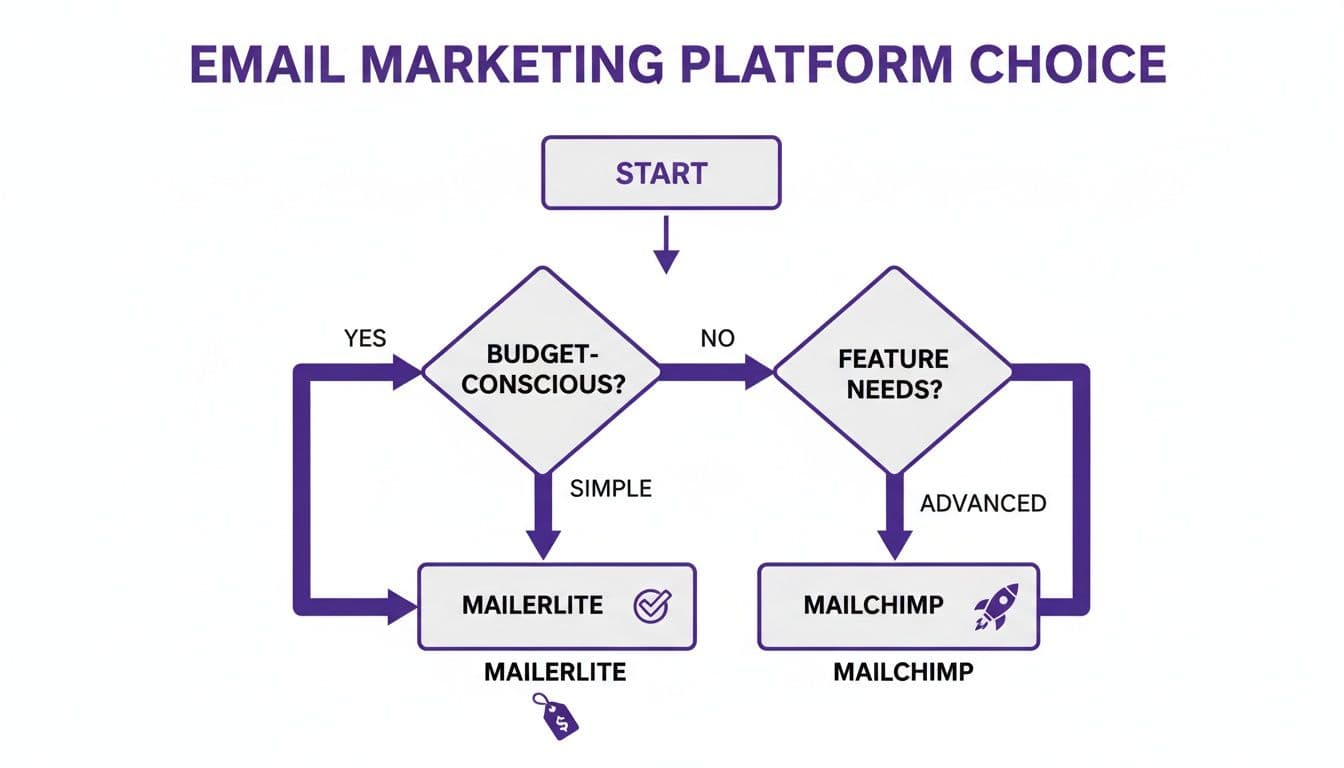
The flowchart makes the pattern clear: if you’re focused on budget and core effectiveness, the path leads to MailerLite. If you have advanced needs and a budget to match, Mailchimp enters the conversation.
Solopreneurs and Creators
For solopreneurs, digital creators, and experts building a business on a platform like Zanfia, MailerLite is a strong fit for the email side of the stack. Your business model is built on maximizing revenue while keeping your fixed costs low, and MailerLite’s entire philosophy aligns with that goal. Its generous free plan isn’t just a trial; it’s a genuine runway for growth.
You get access to critical features like multi-step automations right out of the gate—the very same tools Mailchimp hides behind its expensive paywalls. The simple editor and fair billing mean you can spend your time creating, not fighting with software or dreading surprise invoices. MailerLite delivers the 90% of features you’ll actually use, without the punishing cost. Pair it with Zanfia to hand the operational work to an AI team you can steer by voice, and you get an email tool plus a full sales stack that ends in a checkout built to sell.
Small Businesses on a Budget
If you’re a small business owner where every dollar counts, the MailerLite vs Mailchimp debate lands firmly in favor of MailerLite. The cost difference is impossible to ignore, with its paid plans often coming in 50-70% cheaper than Mailchimp’s for the exact same list size. This isn’t just a minor saving; it’s a significant operational advantage.
Beyond the price tag, MailerLite’s unlimited email sends on paid plans eliminate the stress of hitting a monthly limit right before a major launch. You get powerful marketing tools like A/B testing and landing pages for a fraction of the cost, letting you run a sophisticated operation without a big-company budget.
Key Takeaway: For a small business, MailerLite offers a professional, scalable platform that respects your budget. It delivers the robust functionality needed to support real growth, without forcing you into expensive upgrades for essential tools.
Established Companies and Marketing Teams
While MailerLite is the smarter choice for most, there are specific situations where Mailchimp can be the right fit. This is typically the case for larger, established companies with a dedicated marketing team and a substantial budget to work with. For top-tier experts earning six figures a month who need rock-solid tech to match their premium positioning, the extensive feature set of a high-tier Mailchimp plan might align with their needs, provided the cost is not a primary concern.
For a team that needs a single dashboard for a lightweight CRM, social media scheduling, and advanced reporting, Mailchimp offers a unified—albeit pricey—solution. If your team has the resources to act on its granular analytics and use its full suite of tools, from transactional email to social ad integrations, the premium cost might be justified.
Even then, the decision isn’t a slam dunk. If your primary need is still just powerful and efficient email marketing, MailerLite remains a compelling and far more cost-effective alternative.
No matter which platform you choose, successful campaigns hinge on getting your emails into the inbox. You can always run a quick check with a trusted email deliverability & spam checker. To really get this right, take a look at our guide on how to improve your email deliverability for practical, actionable tips.
Frequently Asked Questions
When you’re weighing two major platforms like MailerLite and Mailchimp, a few key questions always come up. Let’s tackle the ones I hear most often to clear up any lingering doubts.
Is It Difficult to Migrate from Mailchimp to MailerLite?
This is a big one, and the fear of a messy migration keeps a lot of people stuck. The good news? Switching from Mailchimp to MailerLite is much less painful than you’d think.
MailerLite has clearly invested in making this process as smooth as possible. The migration boils down to a few core tasks:
- Export your subscriber list out of Mailchimp.
- Import that same list directly into MailerLite.
- Rebuild your main signup forms and essential automations.
For most businesses, this isn’t a week-long project. You can knock out the entire transfer in well under an hour. MailerLite’s support is also on standby if you hit any snags.
Which Platform Has Better Email Deliverability?
Both MailerLite and Mailchimp are top-tier players with excellent deliverability records. They both work hard to protect their sender reputations, which means your emails have a great shot at hitting the inbox on either platform.
Honestly, for most users, deliverability differences will come down to your own list hygiene and sending practices, not the tool itself. The real takeaway here is that you do not have to sacrifice deliverability to get MailerLite’s better pricing. You’re getting incredible value without a compromise on this critical metric. A great way to protect your reputation from day one is by building a strong onboarding email sequence to welcome new subscribers properly.
Does MailerLite Integrate with Other Marketing Tools?
Yes, and it’s surprisingly robust. MailerLite boasts a library of over 160 native integrations, covering all the essentials. It syncs up smoothly with major players like Shopify, WordPress, and a wide range of popular CRMs.
But it doesn’t stop there. For everything else, MailerLite’s Zapier integration acts as the universal connector, linking it to thousands of other apps. This means you can be confident it will slot right into your existing tech stack and support the workflows you need to run your business. Thinking about your broader strategy is also key when Choosing Marketing Automation Software for Small Business.
When you move beyond email and need a platform to sell digital products, build a community, and host courses, Zanfia is an AI team that runs the creator business under one white-label brand, with 12 product types (courses, communities, paid newsletters, memberships, digital products, bookings and more) living side by side. The creator dictates the work to the assistant by chat or by voice, agents can act on the workspace through an MCP endpoint (availability depends on the plan, see the current Zanfia pricing), and the checkout is built to sell, with order bumps, installments and test mode for buying your own product before launch. Platform commission on customer sales is currently 0%, so every dollar of revenue lands in your account minus the standard payment processor fees. Start with a 14-day free trial, no credit card required. Explore how Zanfia can scale your business.