

Choosing the Best Membership Site Software in 2026

Think of it this way: what if you could build your own private, digital clubhouse for your most dedicated followers? A place you own, you control, and you profit from directly. That’s the real power behind modern membership site software.
This isn't just another tool. It's an entire business engine that lets you bring your content, your community, and your revenue streams together under one roof, your roof.
What Is Membership Site Software and Why It Matters

At its heart, membership site software is an all-in-one platform designed to let you sell exclusive access to your work and build a thriving community around it. It’s the answer to the chaos of juggling a dozen different apps, one for your online course, another for your community forum, and a tangled mess of payment processors. This software consolidates all of it.
Zanfia takes this a step further: rather than being another course tool, it acts as an AI team that runs the delivery side of a creator business. A creator can dictate the work by chat or voice, and the assistant executes anything available in the interface, whether that means spinning up a course, a community, a paid newsletter, an ebook, or a knowledge base under a single custom domain. Higher plans also expose an MCP endpoint so external AI agents can act on the workspace directly.
For creators, experts, and online businesses, this represents a massive strategic shift. Instead of building your audience on rented land like social media, where algorithms change and you don't own your followers, you build a direct, unshakable relationship with your members. You get full control over your brand, your data, and crucially, your income.
The market is exploding for a reason. Valued at USD 5.67 billion in 2025, the global membership management software market is on track to hit USD 8.03 billion by 2032, according to insights from maximizemarketresearch.com. That growth is fueled by creators demanding smarter ways to engage their audience and get paid for their work.
The Core Functions of This Software
So, what does this software actually do? Think of it as your digital business manager, handling the entire member journey from the moment they sign up to the day they renew. It’s designed to automate all the tedious administrative work so you can get back to what you love: creating amazing content and connecting with your people.
For instance, when a new member joins your top-tier plan, the software can automatically:
- Process their payment through gateways like Stripe or PayPal, with Apple Pay and Google Pay supported at the wallet level.
- Grant them instant access to the right courses and content.
- Add them to an exclusive channel within your community space based on their purchase.
- Trigger a welcome email sequence and hand off the new customer to your existing email tool with the right tags and lists applied.
That kind of seamless automation saves countless hours and gives every member a polished, professional experience from day one. These platforms are also fundamental to building a group that sticks around, you can explore our deep dive into what is community building to see how these pieces fit together.
To give you a clearer picture, let's break down the essential capabilities that define these platforms.
Core Functions of Membership Site Software
This table gives a quick overview of what these platforms do at a glance, helping you understand their core value.
| Function | Primary Benefit for Creators |
|---|---|
| Content Gating & Security | Protects your premium courses, videos, and downloads so only paying members can access them. |
| Payment & Subscription Management | Automates recurring billing, one-time sales, and installment plans, securing your revenue. |
| Integrated Community Tools | Fosters member engagement with forums and chat, all under your brand, boosting retention. |
| Automation Workflows | Saves significant time on manual tasks like member onboarding and access management. |
Ultimately, these functions work together to create a powerful, self-sustaining business model that puts you in the driver's seat.
Unpacking the Essential Platform Features
Forget the endless, confusing feature lists. When you're building a membership business, only a handful of features truly move the needle. These aren't just checkboxes; they're the core engines that will run your business, keep your members hooked, and actually generate revenue.
Let's cut through the noise and focus on the five non-negotiable capabilities. Get these right, and you'll transform a simple content library into a thriving, profitable community hub.
Content Gating and Secure Delivery
At the end of the day, a membership is about selling access. Content gating is the digital lock and key that protects your premium content, your courses, ebooks, and videos, ensuring only paying members can get to them.
A solid platform lets you create different access levels, or tiers, without any technical headaches. For example, you could have a "Silver" tier with a monthly newsletter and a "Gold" tier with the newsletter plus your flagship online course. The software should handle all the permissions automatically, granting or revoking access as subscriptions change. This is how you actually make money. For online courses, look for platforms offering native video hosting to avoid costly external services like Vimeo, while also supporting integrations if you need them.
Integrated Community Tools
One of the biggest mistakes you can make is sending your paying members to a free Facebook Group or a Discord server. This shatters the user experience, pulls people away from your branded home, and ultimately costs you members.
The best platforms keep everything under one roof, your roof. This is a massive driver for engagement, lifetime value, and retention because it creates a single, seamless world for both learning and connecting.
Look for a platform with community tools built right in:
- Topical Discussion Channels: Lets members chat about specific course lessons or shared interests, keeping conversations focused and valuable.
- Announcement Channels: A read-only space for you to post important updates, so your key messages never get buried.
- Seamless Course Integration: Community discussions linked directly within your lessons, so students can ask questions and get help right where they need it.
Flexible Payment and Subscription Models
Your ability to earn is tied directly to the payment options you can offer. This isn't just about taking credit cards; it's about having the flexibility to sell your work in different ways to meet your customers where they are.
Your software absolutely must support these models:
- One-Time Purchases: The go-to for selling standalone products like ebooks, templates, or individual workshops.
- Recurring Subscriptions: The lifeblood of a membership. This is what creates predictable, stable revenue through monthly or annual plans.
- Installment Plans: A powerful way to make high-ticket courses more accessible. Split a $600 course into four auto-charged payments instead of asking for the full amount up front.
- Bundles and Upsells: The ability to package products or offer order bumps at checkout is key to increasing your average order value.
Powerful Automation and Workflows
What if you could save 5 to 10+ hours every single month on admin work? That’s what great automation does. Instead of manually onboarding new members, chasing down failed payments, or removing access when someone cancels, the right software does it all for you.
These automated workflows are what allow you to scale. They grant course access the second a payment goes through, add new members to the right community channels, and send out welcome emails. On Zanfia, that same layer also syncs tags, lists and fields into whatever email tool you already use (ActiveCampaign, Mailchimp, ConvertKit, MailerLite, GetResponse and more), and it can grant or revoke Discord roles or Circle memberships as access changes. This frees you up to do what you're actually good at: creating amazing content.
Built-in Analytics and Reporting
You can't grow what you can't measure. Good analytics give you a clear view of your entire business, from marketing performance to member engagement. Want to know which lesson has the highest drop-off rate or which community channel is buzzing with activity? That data should be easy to find.
This is what helps you make smart decisions. You can spot a bottleneck in your sales funnel, see what content resonates, and double down on what your members value most. If you want a deep dive on this, check out our detailed learning management system features comparison. Strong analytics replace guesswork with a clear, data-driven roadmap for growth.
How to Choose the Right Membership Software for You
Picking your membership software is a make-or-break decision for your business. This isn't just about buying a tool; it's about building the entire foundation your digital business will stand on. Get it right, and you're set for smooth, predictable growth. Get it wrong, and you're in for a world of technical headaches, unhappy members, and money left on the table.
Let’s cut through the marketing fluff. Here’s a practical guide to the four factors that really matter when making your choice.
All-in-One vs. a Piecemeal Stack
Your first big fork in the road is deciding between a single, integrated platform or trying to patch together a system yourself. The do-it-yourself (DIY) route, usually built on WordPress, means you're juggling separate plugins for memberships, courses, a community forum, and payments. It sounds flexible, but in reality, you're building a fragile house of cards that needs constant maintenance and a ton of technical know-how.
An all-in-one platform is the exact opposite. It pulls every critical function, your courses, community, payments, and newsletters, into one unified system. On Zanfia specifically, that system is designed to be driven by an AI team: you can dictate what should happen next by chat or voice, and on higher plans you can even connect your own AI agents through an MCP endpoint. Everything lives under one roof, managed by a single login. This doesn't just make your life easier; it creates a far better, more cohesive experience for your members, who no longer have to bounce between different sites to get what they paid for.
To help you visualize this, here's a quick look at the pros and cons of each approach.
Platform Comparison All-in-One vs. DIY WordPress Stack
| Factor | All-in-One Platform (e.g., Zanfia) | DIY WordPress Stack |
|---|---|---|
| Setup & Maintenance | Fast setup, no technical skills needed. All updates and security are handled for you. | Requires technical skill, plugin configuration, and ongoing manual updates. You are responsible for security. |
| Cost Structure | Predictable monthly/annual subscription. Often includes hosting, video, and support. | Multiple costs: hosting, domain, premium plugins (often annual fees for each), and potential developer fees. |
| User Experience | Seamless. A single login gives members access to everything under your brand. | Fragmented. Members may need multiple logins for courses, community, etc., often with clashing designs. |
| Reliability | High. Built and tested to work together. One point of contact for support. | Prone to conflicts. A single plugin update can break the entire site. Support is scattered across different developers. |
| Scalability | Designed to grow with you. Infrastructure handles increased traffic and sales without issue. | Can become slow and unstable as you add more plugins and traffic. Scaling requires technical optimization. |
Ultimately, an all-in-one platform frees you to focus on your business, while a DIY stack forces you to become your own IT department.
This flowchart breaks down how your business goals connect directly to the features you’ll need.
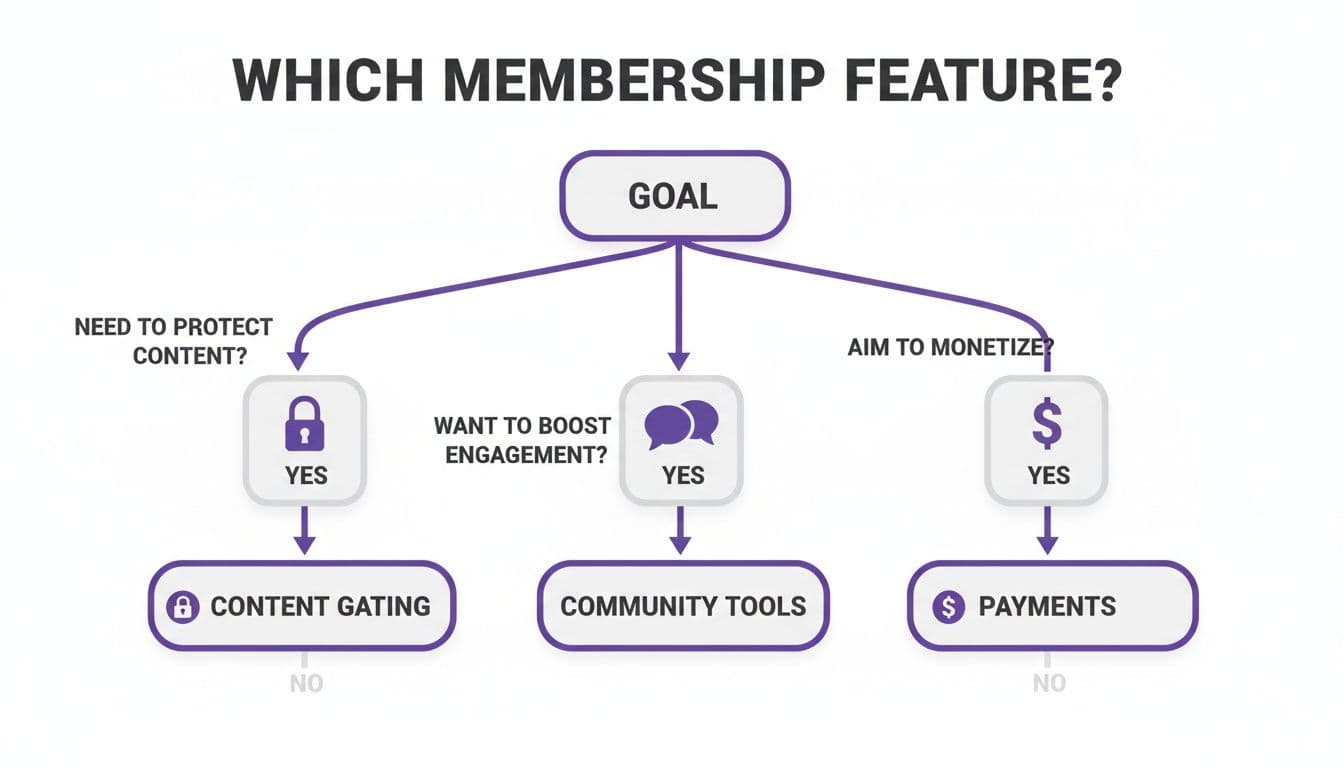
As you can see, core goals like protecting your content, engaging your audience, and actually getting paid all require distinct tools. When those tools are built to work together from the start, your entire business runs better.
The True Cost of Ownership
Don't just look at the monthly price tag, it’s rarely the full picture. Many membership platforms take a percentage of every single sale you make, typically anywhere from 5% to 10%. These transaction fees might seem small when you're just starting, but they become a massive drag on your profits as you scale.
Let's do the math. If you're bringing in $10,000 per month, a 5% platform fee costs you $500 every single month. That's $6,000 a year that could have been reinvested into your business. For a creator earning $100,000 a month, that fee eats up $60,000 a year. That’s money straight out of your pocket.
Here's where the model is changing. As of 2026, Zanfia charges 0% platform commission on customer sales across every plan. You keep 100% of your revenue from the platform's side. The only fees you ever pay are the standard, unavoidable ones from payment processors like Stripe or PayPal, roughly 2.9% + $0.30 per transaction in the US. That predictable SaaS subscription makes scaling your business far more profitable.
A platform that keeps its own cut at 0% is a true partner. It’s designed to help you grow without taking a bigger and bigger slice of your success as your revenue climbs. This is especially attractive for established creators tired of watching commissions eat into their margins.
Scalability From Day One
The platform that works for your first 100 members might completely fall apart when you hit 1,000 or 10,000. Scalability means choosing software that can handle your biggest ambitions from day one, so you're not forced into a painful and expensive migration down the road.
Look for a platform that gives you room to grow:
- Flexible Product Types: Can you easily sell different kinds of products, ebooks, courses, paid newsletters, and community access, all from the same dashboard? Zanfia currently supports 12 product types under one brand, from courses and communities to bundles, services, and consultations.
- Advanced Monetization: Does it support recurring subscriptions, payment plans, and product bundles to help you maximize revenue?
- Rock-Solid Infrastructure: Is your site running on professionally managed hosting that can handle sudden traffic spikes? Does it include native video hosting so you don't have to pay for another service?
A truly scalable solution gives you the confidence to focus on creating great content, knowing your tech won't ever be the bottleneck. For a deeper dive, you can learn more about membership and subscription models in our guide.
Branding and White-Label Customization
Your brand is your most valuable asset. The last thing you want is for your members' experience to be covered in another company's logo. It instantly dilutes your brand and makes your entire operation look less professional.
This is why true white-label control is non-negotiable. You need the ability to use your own custom domain (like community.yourbrand.com) and completely remove the platform's branding. When a member logs in, they should feel like they’re entering your world, not some generic third-party service.
This level of control is vital for established experts and premium brands. It signals ownership, professionalism, and builds the long-term trust that turns customers into lifelong fans.
Comparing the Top Membership Platform Options
The world of membership software can feel overwhelming. Dozens of platforms promise you the world, but they all operate on different philosophies. To find the right fit, you have to look past the marketing and understand the core DNA of each type of solution.
Think of it like choosing a business partner. You need to know how they think, how they make money, and whether their model supports your vision for growth and profit.
Let’s break down the three main flavors of membership platforms so you can see which one truly lines up with your goals.
International All-in-One Giants
You've probably heard of the big international players like Kajabi and Teachable. They package a wide array of course and marketing tools into one ecosystem, making it easy for creators to get up and running quickly.
The trade-off is usually cost. Kajabi's entry tier lands around $149 per month, and both Teachable and Kajabi still take transaction fees on lower plans. Zanfia is built on the opposite model: entry is $39 per month, or $31 per month billed annually, on the Starter plan, with 0% platform commission on customer sales across every tier. Higher plans also expose an MCP endpoint so your own AI agents can act on the workspace, which none of the traditional giants currently offer.
Community-First Platforms
A newer wave of software, like Skool, has emerged with one primary focus: community. Their entire platform is built around creating an engaging, gamified space where members can connect and interact. This is their core strength.
The trade-off? You often sacrifice flexibility in how you make money and present your brand. These platforms tend to have rigid payment models, usually locking you into a single monthly subscription for community access. This makes it difficult to sell standalone products, offer installment plans for high-ticket courses, or bundle different offers together.
Worse, many of these tools give you limited white-label options, forcing your members to log into their brand, not yours. An alternative like Zanfia gives you the best of both worlds, powerful, integrated community features combined with white-label control on higher plans and a flexible checkout that handles subscriptions, installments, one-off sales, and order bumps. Availability of white-label domains and Zanfia branding removal depends on the plan, see the current Zanfia pricing.
The WordPress Plugin Stack
For the creator who wants total control, the DIY route of building a site with WordPress and a collection of plugins is always an option. You get to hand-pick every feature and customize every pixel.
But this freedom comes at a huge cost: technical headaches and relentless maintenance. You essentially become an IT manager, responsible for juggling plugins for memberships, courses, payments, and community. One bad update can crash your entire business, and you're solely responsible for security.
This approach forces you to become your own IT manager, wrestling with tech instead of focusing on content. A managed SaaS solution removes this burden entirely, offering professionally managed infrastructure, automatic updates, and peace of mind. As 30-year veteran developer Daniel Roziecki notes, Zanfia provides "peace of mind," letting him focus on teaching instead of wrestling with tech.
It’s no surprise that all-in-one SaaS platforms have taken over. In fact, cloud-based membership software now accounts for roughly 65% of the global market. Creators are voting with their wallets for tools that automate the busywork and handle the technical heavy lifting for them.
To get a better sense of how different content platforms stack up, it's helpful to compare related tools like the best blogging platforms for beginners. For an even deeper dive into course-specific solutions, check out our guide on the best LMS for small business.
At the end of the day, the right membership software should feel invisible. It should empower you to build your business with confidence, clarity, and control, without getting in your way.
Your Step-By-Step Membership Site Launch Plan

Ready to turn your idea into a paid community? Launching a membership site isn't the technical monster people make it out to be. The trick is to break the project into a clear, actionable roadmap.
This is your five-stage launch plan. We’ll cover everything from content strategy to onboarding your first members, showing you exactly how the right membership site software makes each step brutally simple.
1. Define Your Membership Model and Tiers
First things first: what are you actually selling? Figure out your content delivery strategy. Will members get everything at once, or will you use a "drip" model to release content over time and keep them hooked?
Then, decide on your access structure. Are you offering a single all-access pass or creating multiple tiers like Basic, Premium, and VIP? Each tier should offer a clear jump in value. The right platform supports different personas: "Potential Explorers" looking for the simplest way to launch their first product, "Business Architects" needing to scale efficiently, and "Craft Masters" requiring elegant tech for their premium brand.
This is the blueprint for your entire business model. A flexible platform lets you experiment with everything from one-time product sales to recurring monthly subscriptions, giving you multiple income streams from day one.
2. Create Your Core Content
You do not need a giant library of content to launch. In fact, it's smarter to start small. Launch with a single, high-impact asset, a focused mini-course, a detailed ebook, or a small resource hub. This lets you validate your idea fast and build momentum.
Focus on quality, not quantity. Your initial content needs to solve a real, specific problem for your ideal member. For instance, a seasoned business owner will happily pay for an advanced course on scaling, while a beginner just wants a simple checklist to get started.
Focus on value over production, content should be practical and useful, not just polished. If you already have popular posts, videos, or webinars, consider repurposing them into exclusive member-only content to maximize your effort.
If you’re building a course, look for software with native video hosting. This is a non-negotiable feature. It saves you from paying for separate services like Vimeo and keeps the entire learning experience inside your branded ecosystem. Zanfia, for example, offers native video hosting with a smart player that saves student progress.
3. Set Up Your Platform and Payments
This is where an all-in-one platform pays for itself. You’re not duct-taping ten different tools together; you’re flipping switches inside a single dashboard. On Zanfia, you can even dictate most of this setup out loud to the assistant instead of clicking through settings screens.
Here's what this step actually involves:
- Branding: Customize the platform to look and feel like your brand. A true white-label solution allows you to use your own domain and logo, which builds immediate trust and professionalism.
- Payments: Connect your payment gateways. Zanfia supports Stripe and PayPal , with Apple Pay and Google Pay at the wallet level, plus recurring subscriptions and auto-charged installment plans. Letting customers pay how they want, including breaking a high-ticket product into a few payments, is a simple way to boost conversions.
- Automations: Build workflows that run the business for you. When someone pays, they should get instant access to their course, an invite to your community, and a welcome email. This should all happen automatically, alongside two-way sync with your existing email tool (ActiveCampaign, Mailchimp, ConvertKit, MailerLite, GetResponse and more).
4. Craft Your Launch Marketing Plan
Now it's time to make some noise. Start teasing your launch on social media and to your email list weeks in advance. The goal is to build a waitlist of eager buyers.
Offer an "early bird" discount to the first group of members. It rewards your most loyal followers and generates the initial sales velocity you need to create social proof.
Before you send a single ad to a paid checkout, run a test purchase through it. Zanfia opens the real checkout in test mode via a shareable link that expires after 1 hour, 24 hours, or 7 days, and fires conversion events into the test surfaces of GA4, Meta, and TikTok so you can verify the whole funnel end to end without polluting your live pixel. Catching a broken thank-you page or a misfiring pixel before launch day is worth a lot more than fixing it after.
Speaking of social proof, use it. Get testimonials from anyone who has seen your work. A single quote from a respected name can be more powerful than a thousand words of sales copy.
5. Onboard Your First Members
A sale isn't the end of the journey; it’s the beginning. A sloppy onboarding experience is the fastest way to lose a member.
Use automated welcome emails to show new members exactly what to do next. Point them to the most important content and give them a clear call to action, like introducing themselves in the community.
This is your shot to make every new member feel seen and valued from the moment they join. Follow this roadmap, and you’ll find launching is a manageable, and even exciting, process. For a deeper dive, check out our guide on how to launch an online course.
The Future of Membership Sites and Key Trends
The membership economy isn’t just a passing fad; it's picking up serious speed. If you want to stay ahead of the curve, you need to think about where the market is headed and choose software that’s built for the future, not just what works today.
The numbers don't lie. The market for paid membership platforms is set to explode from USD 8.92 billion in 2026 to a massive USD 16.25 billion by 2030. This isn't just random growth, it's driven by creators like you who are tired of volatile income and want stable, recurring revenue. You can dive into the complete forecast on paid membership platforms to see the full picture.
The Rise of Integrated Experiences
The single biggest trend? The death of the digital Frankenstein. Your members are over it. They don’t want to log into one site for your course, another for your community, and a third to manage their payments.
The future is about bringing everything under one roof, and increasingly, about letting AI run the delivery layer. Think about it: a member watches a lesson and can immediately jump into a discussion about it right there, on the same page, and on the creator side, an assistant can produce the next module or spin up a new checkout on voice command. On Zanfia specifically, external AI agents can even act on the workspace through an MCP endpoint on higher plans (see the current Zanfia pricing). That is the new benchmark for a premium experience.
Choosing a forward-thinking partner means selecting software that anticipates where the market is going. The future belongs to platforms that weave community into every part of the experience, use data to create deep personalization, and deliver a flawless mobile experience right out of the box.
Hyper-Niche Communities and Mobile-First Access
As the digital space gets more crowded, the smartest creators are niching down, hard. Forget trying to appeal to everyone. Hyper-niche memberships that serve a very specific audience with laser-focused content are winning. Your software has to make it easy to build and manage these dedicated spaces for your superfans.
At the same time, your members are living on their phones. A clunky website that requires pinching and zooming is an instant cancellation. Today, a smooth, app-like experience on mobile isn't a bonus feature. It’s a core requirement for survival. If your members can't learn, connect, and buy from you on the go, you're already behind.
Frequently Asked Questions
When you're diving into the world of membership sites, a few big questions always come up. Let's get you some straight answers so you can make the right moves.
How Much Does It Cost to Start a Membership Site?
Don't just look at the monthly subscription. The real number to watch is the total cost of ownership. Many platforms will tempt you with a low starting price, but then they'll skim a 5 to 10% transaction fee off every single sale you make. As you grow, those "small" fees start to eat a massive hole in your profits.
A much smarter, more scalable model is a flat-rate subscription. Zanfia starts at $39 per month, or $31 per month billed annually, on the Starter plan, and every plan comes with a 14-day free trial, no credit card required. Because Zanfia currently charges 0% platform commission, your only sales-related costs are the standard processing fees from gateways like Stripe or PayPal. That means more of the revenue you work so hard for stays in your business to reinvest and scale.
How Much Content Do I Need Before Launching?
This is a classic one, and it's a huge source of launch paralysis. The answer? Way less than you think. You absolutely do not need a giant library of content to open your doors. In fact, starting small is the smarter play.
Go live with a single, high-value offer. It could be a powerful mini-course, a detailed ebook, or exclusive access to a small, focused community. This lets you test the waters, get real feedback from your first members, and build momentum. You'll avoid spending months creating content that might not even hit the mark. Always remember: value beats volume, every time.
Can I Move My Membership Site to a New Platform Later?
Technically, yes. But honestly, it's a nightmare. Migrating a membership site is almost always a painful, expensive, and risky ordeal. You're looking at complex data exports, the potential loss of member data and course progress, and a massive technical headache trying to glue everything back together. It’s a huge disruption for you and your members.
This is exactly why choosing a scalable, all-in-one platform from day one is so critical. You want a system that can grow with you, from selling your first digital product to managing a thriving community with thousands of members. This gives you the peace of mind that your tech will never be the thing holding your business back. Looking ahead, integrating advanced content creation methods will be key. Exploring resources like the best AI podcast generators can help membership site owners stay ahead by efficiently producing high-quality audio content.
Ready to build, launch, and scale your membership business on a platform that grows with you? Zanfia is an all-in-one creator platform where an AI team runs the delivery layer for you: you can dictate courses, communities, and paid newsletters by chat or voice, sell them through a checkout built for order bumps, installments and upsells, and start on a 14-day free trial with 0% platform commission on customer sales. Discover how Zanfia can transform your creator business today.