

How to launch an online course: Fast-track your success in 2026
Launching an online course feels like a massive undertaking, but it really boils down to a clear, repeatable process: you validate your idea, design a great curriculum, and then launch it to the world. It’s all about moving from a concept in your head to a profitable digital product without getting bogged down in the process.
Your Roadmap From Course Idea to Launch Day
Creating and launching an online course is one of the single most powerful ways to package your expertise and build a business that can scale. You’re not just selling content; you're building a clear path for students to get real, tangible results.
And the demand is explosive. The global online education market is projected to rocket from $185.20 billion in 2024 to an incredible $279.30 billion by 2029. You can read more about these online education market trends, but the takeaway is simple: people are actively searching for guided learning from experts like you.
This guide moves past the theory. We’re giving you the exact, actionable framework that successful creators use to turn their knowledge into a thriving online course.
This simple visual breaks down the entire journey. You prove people want your course, you build it to deliver on its promise, and then you execute a structured launch to bring in students.
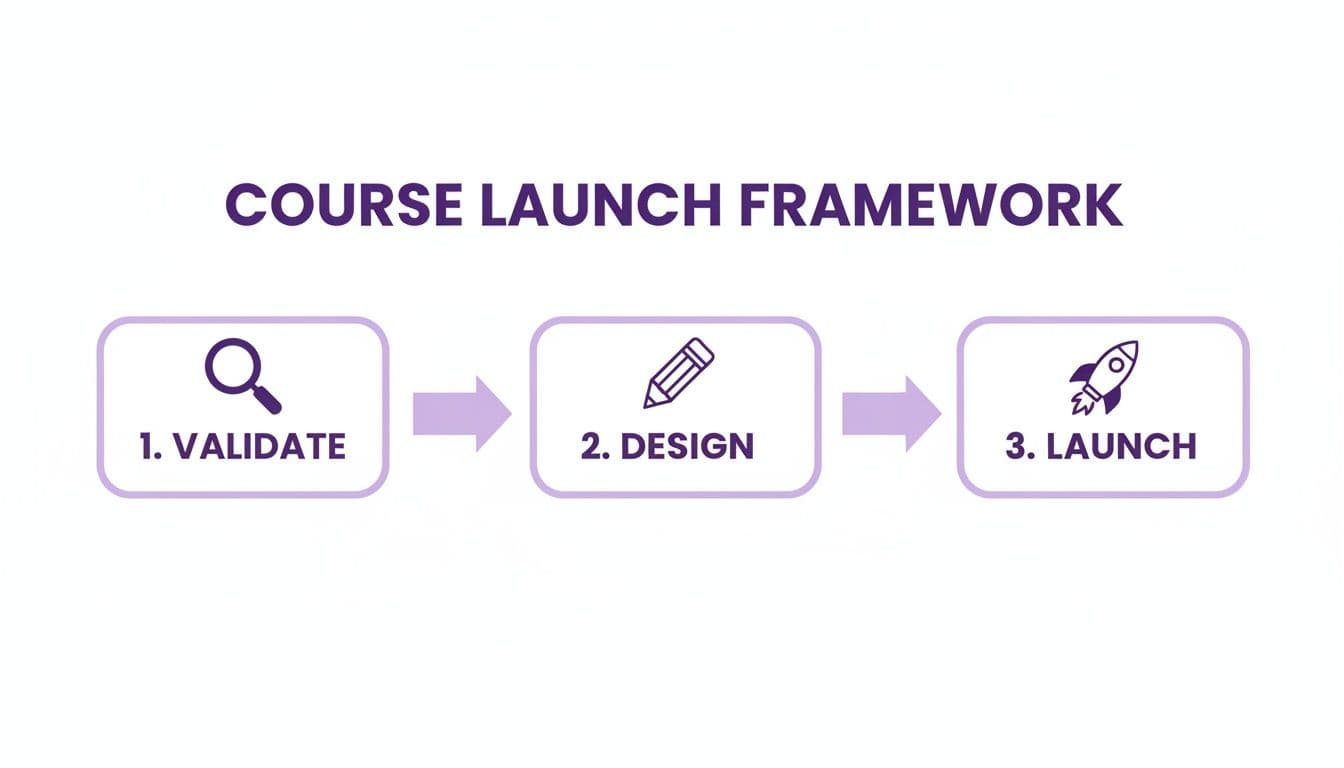
Following this process ensures you’re not building in a vacuum. You’re creating a product people have already raised their hands for and you have a clear plan to sell it. It’s a proven approach that strips away the guesswork and maximizes your shot at a successful launch.
Your 7-Phase Online Course Launch Framework
We’re going to walk through the entire journey, from that first spark of an idea all the way to celebrating your first student enrollments. This high-level framework outlines the essential phases every creator needs to master.
| Phase | Key Objective | Core Activities |
|---|---|---|
| 1. Validate Your Idea | Prove there's a paying audience. | Market research, audience surveys, pre-selling a pilot. |
| 2. Design Your Curriculum | Create a results-oriented learning path. | Outline modules, define student outcomes, choose lesson formats. |
| 3. Produce Course Content | Bring your curriculum to life. | Record videos, write workbooks, create quizzes and assets. |
| 4. Set Pricing & Offers | Define your business model. | Choose price points, create payment plans, and bundle offers. |
| 5. Configure Your Platform | Build your course home. | Upload content, set up landing pages, and configure checkout. |
| 6. Build Your Audience & Funnel | Generate leads before you launch. | Create a lead magnet, build an email sequence, and grow your list. |
| 7. Launch & Iterate | Execute the sales campaign. | Open and close the cart, run marketing campaigns, gather feedback. |
This roadmap gives you a clear, step-by-step process to follow. It turns an overwhelming project into a series of manageable, actionable steps.
And while the strategy is crucial, the right tech stack makes it all possible. This is where a platform like Zanfia starts to matter more than most creators expect. Zanfia is really an AI team you hire to run your course business: the assistant knows every corner of the interface and performs the work by chat or by voice, so you dictate what you need instead of clicking through settings. That same team stands behind a checkout built to sell (order bumps, installments, upsells, and a test mode so you can buy your own product before launch), with native video hosting so you skip the Vimeo or Wistia subscription. Availability of the deeper AI capabilities and the MCP endpoint depends on the plan, so check the current Zanfia pricing.
Validating Your Course Idea Before You Build Anything
Let's talk about the single biggest mistake new creators make. They disappear for months, meticulously building a course, only to launch it to the sound of crickets.
The fastest way to fail is to build something nobody actually wants to buy. This validation phase is your insurance policy. It's how you prove, with cold, hard evidence, that a real demand exists for your knowledge before you record a single video.
Your job right now isn't to guess; it's to listen. You need to become a fly on the wall where your future students already hang out. Think Facebook groups, Reddit communities, industry forums, and even the comments section of popular blogs. Look for the same questions popping up again and again. Pay attention to the specific words people use to describe their frustrations.
This is about more than just finding a topic. You're hunting for a painful, expensive problem that people are actively trying to solve. Before you invest a minute of your time building, you have to nail down how to identify your target audience. Once you know exactly who you're talking to, you can pinpoint the transformation they are willing to pay for.
Test the Waters Without Building the Ship
The only validation that truly matters isn't someone saying they would buy your course; it's someone pulling out their credit card and actually buying it. The best way to get this proof is with a low-effort offer, what the startup world calls a Minimum Viable Product (MVP). This single step de-risks the entire project.
Your goal is to get a small financial commitment from a handful of people. This proves your idea has legs and, better yet, gives you a small group of founding members to build the course for.
Here are a few ways to test your idea with a real offer:
- Run a Paid Workshop: Host a live 90-minute workshop on one core concept from your course idea. If you can sell 10-20 tickets, you have a validated topic and a ready-made list of ideal customers.
- Offer a Pre-Sale: Set up a simple sales page outlining your course curriculum, the transformation it promises, and a special "founder's price." Be completely transparent that the course is still in development and give a clear delivery date.
- Launch a "Beta" Round: Frame it as an exclusive opportunity for a small group to get hands-on support from you as you build the course with their direct feedback. This makes your first customers feel like valued insiders.
The most common trap is asking friends and family, "Do you think this is a good idea?" This is feel-good feedback, not real validation. The only proof that matters comes from a stranger willing to exchange their money for your promised solution.
Getting even a few pre-sales gives you incredible momentum. You now have revenue in the bank, a hard deadline, and—most importantly—a small group of paying customers who are counting on you. This is the perfect cure for the pre-launch paralysis that so many creators feel when they get overwhelmed by the tech.
Analyze the Market to Find Your Angle
Once you have a rough idea, it's time to do some opposition research. Look at what your competitors are already offering. The goal here isn't to copy them; it's to find the gaps they've left open for you.
Ask yourself these questions:
- What are they doing really well?
- What are their students complaining about in reviews or comments?
- What crucial piece of the puzzle are they missing?
Your unique angle could be anything—a more practical, hands-on approach, a tighter focus on a specific niche, or simply a better learning experience. For example, a common pain point for students is having to jump between different tools for the course content, community discussions, and resources.
By offering a unified learning environment on a platform like Zanfia, you differentiate yourself by solving that problem in one place: courses, community, and paid newsletters live under one brand, with an AI assistant that helps you run all of it by voice or chat. That integrated experience keeps members engaged and lifts lifetime value, turning a simple course into a thriving digital ecosystem.
As you start gathering these early leads and feedback, you'll need a system to capture their interest. Be sure to check out our guide on how to create lead magnets to get that process started.
Designing a Transformational Course Curriculum
With your course idea validated, it's time to get into the good stuff: building the actual learning experience. This is where you create the heart of your offer. The goal isn't just to share information, but to build a course that delivers a real, measurable transformation for your students.
It all starts with a rock-solid curriculum.
The absolute best way to structure your course is to work backward from the end result you promise. What specific skill or outcome will your students have when they finish? Once you’ve pinpointed that destination, you can map out the major milestones they need to hit to get there.
These milestones become your course modules.
Structuring Your Curriculum for Transformation
Each module should tackle one major step in their journey. Then, within each module, you create individual lessons that break that big step down into smaller, digestible actions. This modular approach is crucial for preventing student overwhelm and giving them a clear sense of progress.
Think of it like building a staircase. You can't just leap from the ground floor to the top. Your modules are the landings, and your lessons are the individual steps that make the climb feel achievable. For a deeper dive on this, we've written extensively about backwards planning for lesson plans.
A well-designed curriculum breaks down like this:
- Modules: The big-picture concepts or phases of the journey.
- Lessons: The specific, actionable steps within each module—a mix of video tutorials, text, and exercises.
- Resources: The tools that help students apply what they've learned, like checklists, worksheets, templates, or code snippets.
Choosing the Right Lesson Formats
To keep your students hooked, you need to mix up your content formats. Nobody wants to stare at an endless series of "talking head" videos. A dynamic course blends different teaching styles to fit the specific content you're delivering.
For example, a video is perfect for demonstrating a complex process on-screen. A downloadable PDF checklist is ideal for reinforcing a multi-step workflow. Quizzes are great for checking comprehension, and text-based lessons can provide deep-dive explanations that students can easily reference later.
The key is to ask: what's the best format for this specific learning objective?
The most effective courses feel less like a lecture and more like a guided workshop. By blending video, text, and interactive elements, you cater to different learning styles and significantly increase the chances that your students will not only finish your course but also achieve the results they paid for.
Producing Professional Content on a Budget
The idea of video production can feel intimidating, but you don't need a Hollywood budget to create high-quality course content. Modern smartphones shoot incredible video, and a simple lavalier microphone can dramatically improve your audio quality for a tiny investment.
Often, the biggest differentiator is just good lighting. You can get amazing results with a simple ring light or even by just filming in a room with plenty of natural light.
The most critical decision you'll make, however, is your hosting platform. The last thing you want is to be juggling multiple expensive services just to deliver your content. A key part of planning how to launch an online course is finding a platform that simplifies your tech stack, not complicates it.
For example, Zanfia includes native video hosting, so you skip the separate Vimeo or Wistia subscription while keeping the option to embed YouTube, Vimeo, Wistia or Bunny.net when you already have content there. The smart player saves each student's progress automatically, and quizzes and completion certificates are built in. Because Zanfia is AI-first, you can also ask the assistant, out loud, to draft a quiz from a lesson or spin up a landing page for the module you just recorded, instead of clicking through settings. This all-in-one approach saves money and eliminates the technical headaches of stitching different tools together.
Pricing and Packaging Your Online Course

Let's be blunt: how you price your course is just as important as what's inside it. This isn't about slapping a random number on your work. It's about communicating the true value of the transformation you’re offering and building a real business model around it.
A classic mistake is peeking at what your competitors are charging and just going a little lower. That’s a race to the bottom you’ll never win. Instead, anchor your price to the outcome. If your course helps someone earn a promotion worth an extra $10,000 a year, a $1,000 price tag is a no-brainer investment. This is value-based pricing, and it flips the script from cost to return.
Beyond the One-Time Sale
Thinking your only option is a single, one-time payment is a huge mistake. It’s leaving money on the table. Modern buyers have different budgets and preferences, and a little flexibility in your offers can dramatically boost your conversions.
This is a critical part of building a course business that doesn't just spike during a launch but generates predictable income.
- Installment Plans: A $1,200 course becomes far more accessible when it's broken down into 3 payments of $400 . You open the doors to more people without devaluing your product.
- Subscriptions: If you have an ongoing community or host monthly live sessions, a recurring subscription is the perfect fit. It creates a stable, predictable revenue stream you can count on.
- Bundles: Package your main course with an e-book, some templates, or a private community pass. Bundles instantly increase the perceived value and encourage customers to go all-in with your ecosystem.
This is where your choice of platform becomes mission-critical. Zanfia, for example, lets you build one-time payments, installment plans, subscriptions, order bumps, upsells, and product bundles from the same checkout, and dictate the setup to the AI assistant instead of clicking through it. You get the freedom to design offers that actually sell.
Configuring Your Digital Storefront
Once your pricing strategy is locked in, it's time to build your storefront. This is the hands-on part: uploading your content, crafting your sales page, and connecting all the plumbing needed to take payments and grant access automatically. A clunky checkout is a conversion killer, so this has to be seamless.
Here’s a quick checklist for setting up your course on an all-in-one platform:
- Upload and Organize Content: Lay out your modules and lessons. Get your videos, worksheets, and any bonus materials uploaded and structured logically.
- Create Your Offerings: Set up your price points in the system, making sure to build out any installment plans or subscription models you decided on.
- Connect Payment Gateways: This is a big one. You need to integrate with trusted processors your customers know. Zanfia connects natively with Stripe and PayPal , plus Apple Pay and Google Pay through Stripe, so US and international buyers get the checkout they already trust.
- Test the checkout before you launch: Don't guess whether it works. Zanfia's test mode opens the real checkout in a sandboxed state, fires conversion events to your GA4 DebugView and to Meta/TikTok test surfaces, and keeps test orders out of your real order list. You can literally buy your own course before your first customer does.
Keeping Every Dollar You Earn
One of the most overlooked hits to your profit margin is transaction fees. So many platforms quietly skim a percentage off every single sale. It might not seem like much at first, but it can easily add up to thousands of dollars lost every year.
This is where Zanfia's model stands out. As of the current model, Zanfia charges 0% platform commission on your customer sales, so you only pay the standard payment-processor fees (Stripe is roughly 2.9% + $0.30 in the US). For a creator doing five figures a month, that single difference can put thousands back into their pocket—money for growth, not platform commissions.
By thoughtfully pricing your course and picking a platform that’s a true financial partner, you’re not just launching a product. You’re building a business built for the long haul. For a deeper look into the mental triggers behind buying decisions, check out our guide on pricing psychology strategies.
Building Your Pre-Launch Audience and Funnel
A huge mistake I see creators make is thinking a launch starts the day they open for sales. The truth? A profitable launch is the culmination of weeks, sometimes months, of groundwork. It all comes down to building a relationship with an audience that is genuinely excited for what you have to offer.
In this phase, you’re shifting from just a content creator to a true community builder. And your single most valuable asset here is your email list. It’s the one direct line to your most loyal followers that you completely own, totally independent of fickle social media algorithms.
Create a Lead Magnet That Attracts Your Ideal Student
The fastest way to grow your email list with the right people is by offering a high-value lead magnet. This is a free piece of content you give away in exchange for an email address. The trick is to solve a small, specific problem for your ideal student. Give them a quick win and a taste of the results your full course will deliver.
Don’t give away the entire farm. Just offer a compelling piece of the puzzle.
- Free Checklist: A simple, scannable checklist that helps them complete a specific task. Think "The 10-Point Checklist for a Perfect Sourdough Starter."
- Mini-Course: A short, 3-part email or video series that teaches one core concept. For example, "Your First 3 Guitar Chords in 3 Days."
- Webinar or Workshop: A live training that tackles a common pain point head-on, delivering immediate value and positioning you as the expert.
This initial exchange is the very beginning of a relationship. You've just proven you can help, which is the first step toward them trusting you with a bigger investment down the road.
Nurture Your Audience with an Automated Funnel
Once someone joins your list, the real work begins. You can’t just let them sit there. You need to nurture that new connection and gently guide them toward your upcoming course. This is done with an automated email sequence—often called a nurture sequence or a sales funnel.
This sequence is your opportunity to build trust, establish your authority, and frame your course as the clear solution to their larger problem. It’s where you can really connect. You can learn more about what funnels are used for and how to structure them in our detailed guide. And when you're ready to guide them toward enrollment, learning how to build sales funnels that actually convert is absolutely critical.
Let Automation Do the Heavy Lifting
Trying to manually manage every new subscriber, send welcome emails, and grant course access is a recipe for burnout. This is where smart automations become your best friend, saving you countless hours of busywork and ensuring a slick, professional experience for every single person. For anyone serious about scaling an online course business, this is non-negotiable.
Zanfia's visual automation builder handles this for you: grant course access the moment payment clears, drop buyers into the right community channels based on what they bought, and trigger welcome sequences that push tags, lists and fields into your own email tool (ActiveCampaign, Kit, Mailchimp, MailerLite and others). Because the assistant can build and edit these workflows by voice or chat, you can set most of it up by describing what you want.
An integrated platform is a total game-changer here. Instead of fighting with third-party tools to glue your payment processor to your course platform and your community, a unified system handles it all behind the scenes. This creates a polished, seamless welcome experience that makes your new students feel valued from the second they click "buy."
Executing a Profitable Launch and Beyond

After all the hard work and preparation, this is the moment. Your doors are officially open. This is your launch—a focused 5-10 day “open cart” period where every piece of your marketing puzzle clicks into place. A great launch isn’t just luck; it’s a carefully choreographed sequence of events designed to build a wave of excitement, handle objections, and ultimately drive enrollments.
Your launch starts with a bang: a clear, confident announcement to your email list and social media followers. This is where you’ll get your first rush of sales, usually from the loyal fans who’ve been waiting for this. But to keep that energy going, you need to create genuine urgency.
Creating Urgency and Driving Sales
Let's be clear: urgency isn't about being pushy. It's about prompting a decision. Life is busy, and for most people, "I'll get to it later" is the same as "never." A firm, limited-time launch window is your single most effective tool for cutting through the noise.
Here’s a launch week structure I’ve seen work time and time again:
- Open Cart Announcement: A high-energy email declaring that enrollment is live. Make it an event.
- Social Proof and Testimonials: Follow up by sharing results and quotes from your beta testers. Zanfia even lets you display those testimonials directly on the checkout page so the social proof is right where the buying decision happens.
- Live Q&A or Webinar: Go live to tackle common questions and objections head-on. This is your chance to connect with anyone who is on the fence.
- Urgency Reminders: The final countdown is crucial. Send emails at the 48-hour and 24-hour marks before the cart closes, reminding everyone that time is running out.
You’ll almost always see sales spike right at the beginning and then again in the final few hours. That's just human nature. We respond to deadlines. Make sure yours are firm. If you want a deeper dive into mapping this out, our sales funnel template will give you a fantastic head start.
Life After the Launch Cart Closes
Don't pop the champagne just because the cart is closed. Your job isn't over; in many ways, it's just beginning. The post-launch phase is where you build a real, long-term business by delivering an experience that turns customers into raving fans.
First up, you need a flawless onboarding process. Your new students should feel welcomed, not abandoned. A simple automated welcome email sequence is a must—guide them through the platform and get them excited to join the community.
Next, it’s all about fostering that community. This is where your choice of platform can either become your greatest asset or your biggest headache. Too many creators make a critical mistake here.
A common frustration is having course content on one site and the community on another, like a Facebook group or Discord server. This fractures the experience and hurts engagement. A successful launch is about building a brand ecosystem, not just selling a product.
Platforms built for this from the ground up make a real difference. Compared with Skool, Zanfia offers full white-label control on your own domain plus a checkout built to sell (subscriptions, installments, order bumps and upsells) instead of a community-only payment model. Compared with Kajabi or Teachable, the sharper differentiator is the AI-first setup: an assistant that runs the day-to-day work by chat or voice, and an MCP endpoint so your own AI tools can plug in and act on your workspace (availability of those depends on the plan—see the current Zanfia pricing). All of it sits under one brand, so students stay engaged, completion rates go up, and you get the testimonials you'll need for your next big launch.
Common Questions (and Real Answers) About Launching Your Course
As you get closer to launch day, a few nagging questions always seem to surface. I've heard these hundreds of times from creators just like you. Let's get them answered so you can move forward with clarity.
How Much Will It Actually Cost to Launch My Course?
Your budget can swing wildly, from a shoestring setup of a few hundred dollars to a more professional launch costing upwards of $5,000. The two biggest line items are almost always your video/audio equipment and the platform you choose to host your course.
This is where an all-in-one platform like Zanfia really changes the math. It consolidates your software costs (course hosting, video, community, checkout, automations, AI assistant) into one predictable SaaS subscription starting at $39/month, or $31/month billed annually on the Starter plan, and every plan comes with a 14-day free trial and no credit card required. On top of that, Zanfia's current model charges 0% platform commission on your customer sales, so you're not penalized with a percentage cut every time somebody buys. See the current Zanfia pricing for the full plan lineup.
What's the "Right" Length for an Online Course?
This is a trap. The best creators don't ask about length; they obsess over transformation. Your course should be exactly as long as it needs to be to deliver the promised result, and not a minute longer.
Honestly, a tight, 2-hour course that solves a single, painful problem is infinitely more valuable than a sprawling 10-hour epic that 90% of students never finish. Your goal is to maximize student results and completion rates. A good platform helps you see that: Zanfia's course analytics surface learner progress, drop-off, and quiz results, so you know exactly which lesson is losing people and can trim or rework it.
What if Someone Rips Off My Course Content?
It's a valid concern, but let’s be realistic. While content theft can happen, your true, defensible asset isn't just the information. It’s your unique perspective, your teaching style, and the community you build around your work. Those are the things no one can ever copy.
The ultimate defense against copycats is to build a community so valuable that the course content becomes secondary. When the real draw is the connection, support, and access to you and other members, your offer becomes impossible to replicate.
This is why platforms that weave community directly into the learning experience are so useful. Zanfia unifies your course, community, and content under your own brand, and its community can even include an AI agent that writes from your own material (with everything it publishes labeled as AI). The experience itself—not just the videos—becomes your key differentiator.
Ready to stop wrestling with tech and start building your business? With Zanfia, you build your course, your community, and your entire brand in one place, with an AI team that runs the day-to-day work by chat or voice, and 0% platform commission on your sales. Start free for 14 days, no credit card required.