What Is a Sales Funnel and How to Build One That Converts
So, what exactly is a sales funnel?
Think of it as the path you create for someone, guiding them from the moment they first hear about you all the way to becoming a happy, paying customer. It’s the journey from "Who are you?" to "Here's my money!"—a deliberate system designed to turn casual browsers into loyal supporters of your courses, memberships, and digital products.
Table of Contents
The Sales Funnel, Demystified
The classic analogy is a real-world funnel for a reason. You pour a whole lot of potential customers in at the wide top—these are the people who show a flicker of interest. As they move down through the stages, some will naturally drop off. That's okay. The ones who stick around are the ones who are a perfect fit for what you offer, and they eventually come out the narrow end: the purchase.
For creators like us, this isn't about slimy, high-pressure sales tactics. It's about building genuine relationships. Your job is to deliver the right kind of value at just the right time, leading people through a series of steps that build trust and show them exactly how your product solves their problem.
From Chaos to Clarity
Without a sales funnel, your business can feel like a rollercoaster. You post something on social media, get a burst of sales, and then… crickets for weeks. A funnel replaces that stressful guesswork with a reliable, repeatable system.
It’s a game-changer because it helps you:
- Anticipate what your audience needs at every step.
- Automate your marketing and sales, freeing you up from tedious manual work.
- Pinpoint exactly where people are dropping off so you can fix the leaks.
This structured approach is how you scale an online business without losing your mind. The numbers don't lie: the average sales funnel conversion rate hovers around a humble 2.35%. But top performers? They're hitting over 5.31%. That's a huge difference, and a well-built funnel on an integrated platform is how you get there.
Building Your Foundation
The first real step in this journey is attracting people with something genuinely valuable. This is often a freebie called a lead magnet—think a handy checklist, a mini-ebook, or a free email course. Its only job is to grab someone's attention and earn you permission to keep the conversation going.
To get this crucial first step right, check out these proven strategies for how to create lead magnets that turn casual visitors into genuinely interested subscribers. This is the foundation your entire funnel is built on.
A Stage-by-Stage Breakdown of the Sales Funnel
Knowing the definition of a sales funnel is one thing, but seeing it in action is where the real lightbulb moments happen. Every creator, whether they realize it or not, is guiding their audience through a journey. By understanding the distinct stages of this path, you can stop leaving things to chance and start designing an experience that builds trust and makes selling feel natural.
The classic model, often called AIDA, breaks this journey into four phases: Awareness, Interest, Desire, and Action. Each step reflects a change in your potential customer's mindset, and each one requires a different approach from you. It’s a bit like moving from a casual coffee meeting to a long-term partnership.
To really get into your customer's head at each of these points, diving into customer journey mapping is a game-changer. It helps you see your funnel through their eyes, spotting gaps and finding opportunities to make their experience smoother and more connected.
This diagram gives a great high-level view of how the stages flow together, taking a big crowd and narrowing it down to a core group of buyers.
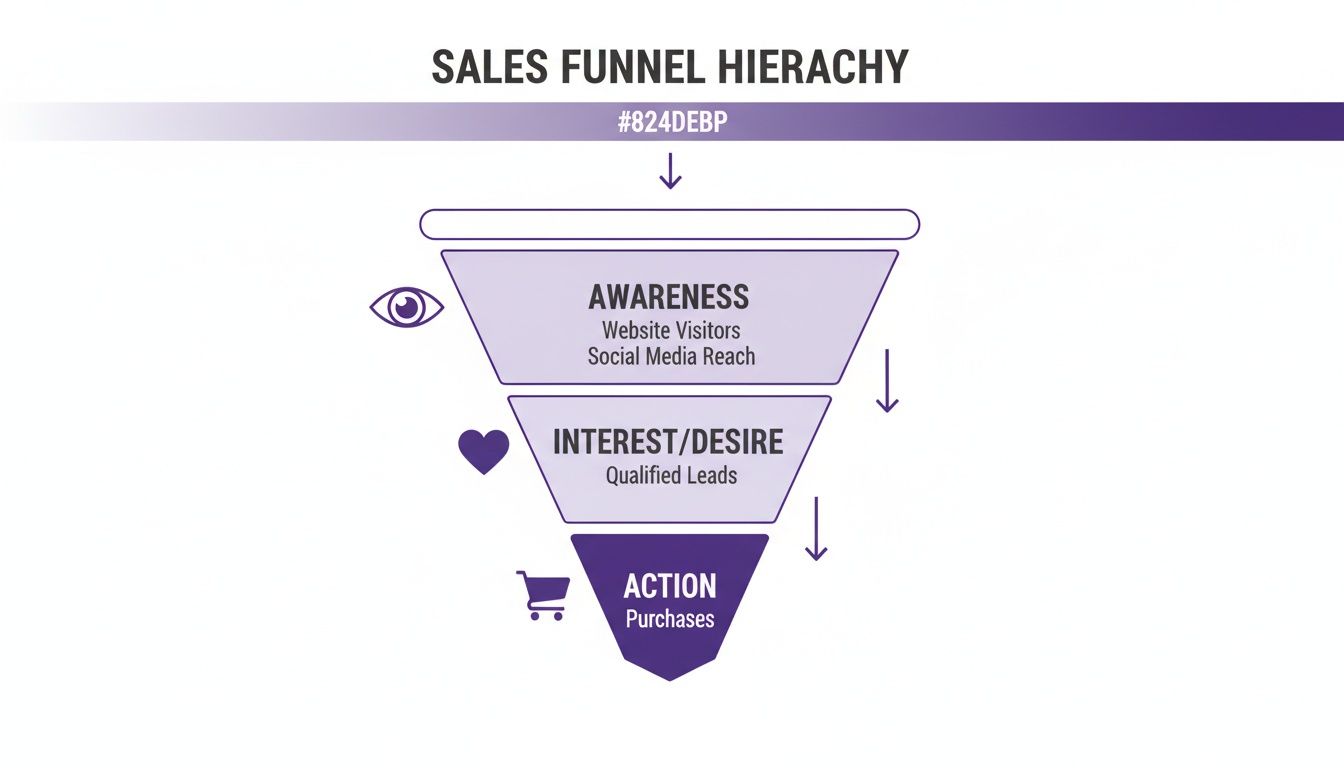
As you can see, the process is designed to filter people through, ensuring that those who reach the end are the ones who are truly ready to buy.
Stage 1: Awareness
This is the very top of your funnel—the first "hello." At this point, people are just discovering you exist. They aren't looking to buy anything just yet. They're scrolling social media, searching Google, or listening to podcasts to find answers, get inspired, or be entertained.
Your only goal here is to get noticed. You need to cast a wide, but smart, net with helpful and engaging content that attracts the right kind of audience.
- What this looks like: Blog posts, TikTok videos, podcast episodes, free tutorials on YouTube, or shareable infographics.
- Your goal: Grab their attention and get them to click through to your website or profile.
- What they're thinking: "Hmm, I'm struggling with this problem, and this person seems to get it."
Stage 2: Interest and Desire
Okay, you’ve got their attention. Now what? The next step is to turn that flicker of interest into a genuine desire for what you offer. This is where you gently guide a casual visitor toward becoming an active lead. The most effective way to do this is by offering a "lead magnet"—something valuable like a guide, checklist, or mini-course—in exchange for their email address.
This exchange is a pivotal moment. It signals they're more committed and gives you permission to start building a real relationship. Through a well-planned email sequence, you can start nurturing that interest, sharing your expertise, and showing them how your paid products are the perfect solution they've been looking for.
The key takeaway here? Moving someone from Interest to Desire is all about shifting the focus from their general problem to your specific solution. You're no longer just some expert; you're the expert who can help them get where they want to go.
Stage 3: Action
This is it—the moment of truth. Your lead has been warmed up, they see the value in what you do, and they're seriously considering making a purchase. Your job now is to make saying "yes" as easy and compelling as possible. A killer sales page and a simple, frictionless checkout are non-negotiable here.
Your offer needs to be crystal clear and irresistible, with a strong call-to-action (CTA) that tells them exactly what to do next. On a platform like Zanfia, this whole flow is seamless—from the sales page to payment gateways like Stripe, PayU, and Przelewy24—so you don't lose motivated buyers to clunky tech. To really nail this final step, brushing up on landing page optimization best practices can make a massive difference in your conversion rates.
How to Build Your First Sales Funnel
Alright, enough with the theory. Let's get our hands dirty and actually build this thing.
Putting your first sales funnel together doesn't have to feel like you're trying to launch a rocket. The whole point is to create a simple, guided path that takes someone from "Who are you?" to "Here's my money!"
We're going to walk through a classic, proven model that works like a charm for creators selling courses, memberships, or digital products. It’s a simple blueprint that breaks down into three core steps.

Step 1: Capture Attention with a Lead Magnet
Your first real move is to give people a compelling reason to hand over their email address. This is where the Interest stage kicks into high gear. You need to offer a valuable little nugget of content—what we call a lead magnet—that solves a specific, nagging problem for your ideal customer.
It could be a downloadable checklist, a short video tutorial, or even a free chapter of your ebook. The secret is offering an irresistible "quick win." If you want to dive deeper into this crucial first step, check out our guide on how to build an email list from the ground up.
Step 2: Nurture Trust with an Automated Email Sequence
Once someone joins your list, the real work begins. Now it's time to build trust and show them you know your stuff. This is how you create Desire. But you won't be doing this by hand for every single person—that's what an automated welcome email sequence is for.
This is just a series of 3-5 emails that get sent out automatically over a few days.
- Email 1 (The Welcome Mat): This goes out immediately. It delivers the lead magnet and gives them a warm welcome.
- Email 2 (The Connection): A day or two later, share your story or a powerful case study. Let them get to know the person behind the brand.
- Email 3 (The Value Drop): A couple of days after that, provide another genuinely helpful tip or tackle a common pain point. No selling, just helping.
- Email 4 (The Gentle Nudge): Now, you can gently introduce your paid product as the logical next step to solve their bigger problem.
This sequence is designed to build a real relationship before you ever ask for the sale. Platforms like Zanfia make this a breeze by letting you trigger welcome sequences or grant course access instantly after payment, saving you 5-10+ hours a month on manual tasks.
Step 3: Drive Action with a Clear Offer
After you've warmed up your new subscribers, it’s time to ask for the sale. This is the Action stage. The final email in your sequence should point them directly to a dedicated sales page for your course, membership, or digital download.
This page has one job: to convert. It needs to clearly spell out the benefits of your offer, handle any doubts they might have, and make the checkout process smooth as silk. This is where an all-in-one system like Zanfia really shines, especially with its revolutionary 0% platform fee model. Creators keep 100% of their revenue, paying only standard payment operator fees, which is a game-changer for protecting profit margins.
Here's a hard truth: 48% of businesses feel their funnels are only somewhat effective, and a whopping 79% of leads never convert simply because they aren't nurtured properly. On the flip side, companies that actively nurture their leads see 50% more sales at a 33% lower cost. This is exactly why solid automation isn't a luxury—it's essential for saving time and making more money.
Advanced Funnel Strategies to Scale Your Business
So, you’ve built a sales funnel that’s working. It’s consistently turning curious visitors into happy customers. Now what? It's time to stop thinking about just getting more people into your funnel and start thinking about how to get more value from every person already in it.
This is where the real growth happens. We’re moving beyond just selling a single online course or e-book. We’re going to build a sophisticated system that introduces your customers to multiple, perfectly timed offers they actually want.
Expanding Your Product Ecosystem
The secret to serious scaling is building out a "product ladder." Think of it as creating a range of offers at different price points to meet people wherever they are on their journey with you. This not only serves a wider audience but also gives your most dedicated followers a clear path to go deeper.
Here are a few powerful ways to do this:
- Product Bundling: Instead of selling an e-book, a mini-course, and a template pack separately, why not combine them? Bundling them into a single, high-value package makes the decision to buy a no-brainer.
- Tiered Memberships: Got a community or a content library? Create different subscription levels. A basic tier might get your newsletter, while a premium tier unlocks exclusive courses, live Q&As, and private community channels.
- Upsells and Cross-sells: This one is classic for a reason. Right after someone buys from you, offer them a relevant, complementary product. For instance, if they just bought your introductory course, you could immediately offer a one-click upsell for a bundle of advanced masterclasses at a special price.
An all-in-one platform is your best friend here. With Zanfia, you can automatically enroll a customer in a premium community channel the moment they buy a course bundle. It creates a seamless, high-end experience without you lifting a finger.
To really dig into scaling your funnel, it helps to use a proven system. A modern growth strategy framework, including the AARRR model, is a fantastic place to start.
Automating for Effortless Growth
As you add more offers and your funnels get more complex, automation goes from being a "nice-to-have" to a "can't-live-without." Your goal is to build intelligent customer journeys that run on their own, so you can get back to what you do best: creating great stuff.
Just imagine this: a single purchase kicks off a whole sequence of events. The customer gets instant access to their course, they’re automatically added to the right community space, and they receive a personalized welcome email sequence. Setting up systems like this can easily save you 5–10+ hours a month on tedious admin work.
For some real-world inspiration, check out these marketing automation workflow examples and see how you can put them to work in your own business.
By weaving together a diverse product ecosystem and smart automation, you’re no longer just running a simple sales path. You’re building a dynamic, revenue-generating engine that fuels your business as it grows.
Measuring Success with Key Funnel Metrics
Building a sales funnel without tracking its performance is a shot in the dark. You might be putting in a ton of effort, but you'll have no real idea if you're actually getting closer to your goals. To figure out what’s working—and more importantly, what isn’t—you have to get comfortable with the numbers.
This isn't about becoming a data scientist overnight. It’s about turning vague guesses into a clear, actionable strategy. The data shows you exactly where people are losing interest and dropping out of your funnel, so you can make smart adjustments that directly impact your sales.

To help you get started, here's a breakdown of the most important metrics to watch at each stage of your funnel.
Essential Funnel Metrics for Digital Creators
This table zeroes in on the key performance indicators (KPIs) that give you the clearest picture of your funnel's health.
| Funnel Stage | Key Metric to Track | What It Tells You |
|---|---|---|
| Awareness | Traffic Sources & Volume | It shows where your audience discovers you (e.g., Google, Instagram, referrals) and helps you focus your marketing efforts. |
| Interest | Lead Magnet Conversion Rate | This is the percentage of visitors who sign up for your freebie. A low number might mean your offer or landing page needs tweaking. |
| Consideration | Email Open & Click-Through Rates (CTR) | These numbers reveal how engaged your subscribers are. Are they opening your emails and clicking your links? It signals their buying intent. |
| Conversion | Sales Conversion Rate | The ultimate test. This is the percentage of people who make a purchase. It directly measures the effectiveness of your sales page and offer. |
| Retention | Churn Rate & Lifetime Value (LTV) | For memberships or recurring products, churn shows how many people cancel. LTV tells you the total revenue you can expect from a single customer. |
Focusing on these core numbers prevents you from getting lost in a sea of data. They are your funnel's vital signs.
How To Spot and Fix Problems in Your Funnel
Your metrics will quickly point out the "leaks" in your funnel—the spots where people are leaving. For instance, imagine your emails get a ton of clicks, but your sales page has a dismal conversion rate. That's a huge clue! The problem isn't getting people interested; it’s the sales page itself that's failing to convince them.
The goal isn't just to look at data; it's to use that data to ask smarter questions. A high drop-off rate isn't a failure—it's a signpost telling you exactly where to focus your energy for the biggest impact.
By keeping an eye on these KPIs, you can make informed decisions to improve your messaging, strengthen your offers, and ultimately, build a more profitable business. Another critical number to get a handle on is how much it costs you to get a new customer. To dive deeper, check out our guide on how to calculate customer acquisition cost. Knowing these figures is what separates a hobby from a sustainable business.
Got Questions About Sales Funnels?
As you start mapping out your own sales funnel, you're bound to have some questions pop up. It happens to everyone. This last section is all about tackling the most common ones we hear from creators, giving you clear answers so you can build with confidence.
How Long Does It Really Take to Build a Sales Funnel?
Honestly, it depends on what you're creating. If you're selling a straightforward digital product like an e-book, you could spin up a simple, effective funnel in just a few hours using a platform like Zanfia. That includes a landing page for your lead magnet, a few welcome emails, and your sales page.
Now, if you're building a more involved funnel for a high-ticket online course, you'll probably need a few days to nail it. That might involve creating webinar content, writing a longer email sequence to build trust, and setting up different pricing options. The best advice? Start simple, launch quickly, and then improve based on what your results are telling you.
What’s the Difference Between a Sales Funnel and a Website?
Here’s a good way to think about it: your website is like a public library. People can wander around, browse different aisles (pages), and explore topics at their own leisure. There are tons of options and no single required path.
A sales funnel, on the other hand, is a guided tour with a very specific destination in mind: making a purchase. It’s designed to remove all the other doors and distractions, leading a visitor step-by-step toward one focused action. This is exactly why funnels convert so much better—they are built for a single purpose.
Do I Need a Huge Audience to Make a Sales Funnel Work?
Not at all. In fact, a sales funnel is one of the best ways to monetize a small but super-engaged audience. This is all about the quality of your leads, not the quantity.
A funnel helps you get the most value from every single person who shows interest by building a real relationship and showing them the right offer at the perfect moment. A creator with just 1,000 true fans can build an incredibly profitable and sustainable business with one great sales funnel.
Can I Have More Than One Sales Funnel?
Yes, and you absolutely should! As your business grows, having multiple sales funnels for different products or for different types of customers is a brilliant strategy. For example, you might have one funnel that sells an introductory e-book and another, more detailed funnel for your premium community membership.
This is where using a unified system really helps. You can manage all of your funnels from one dashboard, creating a seamless experience that serves your entire audience, no matter where they are in their journey with you.
Ready to stop juggling a dozen different tools and start building a profitable sales funnel with ease? Zanfia gives you everything you need—course creation, community management, email automation, and simple payments—all in one spot with zero platform transaction fees. Build your first funnel with Zanfia today.