Crafting the Perfect Outline of Course That Sells
Think of your course outline as the strategic roadmap that turns your expertise into a structured, valuable learning journey. It's so much more than a table of contents; it's the very blueprint that ensures a logical flow, prevents frustrating knowledge gaps, and keeps your students hooked from the first lesson to the last.
Table of Contents
Your Course Blueprint: Why a Great Outline Is Non-Negotiable
Before you even think about hitting record on a video or writing a single lesson, your course's success is already being decided by one critical document: the outline. This isn't just some administrative task to check off a list. It's the foundational act of course creation that defines the promise you're making to your students.

A meticulously planned course outline is your north star. It guides every single decision you'll make during content development. It forces you to get crystal clear on the student's journey, taking them from their current problem to their desired transformation, one logical step at a time.
The Strategic Value of an Outline
I like to think of an outline as the architectural plan for a house. You wouldn't just start building without one, right? You might end up with a staircase that leads nowhere or a kitchen without plumbing. In the same way, an outline stops you from creating a course full of disconnected lessons, repetitive information, or crucial gaps that leave students confused and ready to quit.
A strong outline delivers value in a few key ways:
- Clarity and Focus: It makes you distill your knowledge down to its most essential components, forcing you to cut the fluff that doesn't directly serve the student's end goal.
- Logical Progression: It ensures each lesson builds upon the last. This creates a natural and intuitive learning path that builds both momentum and confidence.
- Marketing Alignment: Your outline doubles as a powerful marketing tool. You can lift module and lesson titles directly for your sales page to show potential buyers the exact value and transformation they're signing up for.
- Efficient Creation: With a detailed plan in hand, the actual process of recording videos and writing content becomes exponentially faster and less stressful. You're not staring at a blank page anymore; you're simply executing a well-defined plan.
A great outline is a promise. It tells a potential student, "I have a clear, organized path to get you from where you are to where you want to be. Trust me." This builds confidence long before they ever click "buy."
Ultimately, the time you invest in a comprehensive outline is a direct investment in your students' success and your business's reputation. It’s the difference between a random collection of videos and a truly life-changing educational experience.
For a deeper dive into the entire process, from idea to launch, check out our guide on how to create and sell online courses. This resource will help you connect your brilliant outline to a successful launch strategy.
Defining Clear Learning Objectives That Attract Students
Every great online course starts with a clear destination in mind. Before you even begin to map out modules or individual lessons, you have to nail down the transformation your students will experience. Learning objectives are the specific, measurable promises you make to them, turning a fuzzy idea into a tangible skill.
Think about it this way. Which sounds better? "Learn about SEO" or "Perform a complete technical SEO audit for a small business website using industry-standard tools." One is just a topic; the other is a marketable outcome.
That shift from abstract concept to concrete ability is the secret sauce of a successful course outline. It forces you to get inside your student's head and answer their single most important question: "What will I actually be able to do when I'm done with this?"
The Power of Action-Oriented Objectives
I've found the best learning objectives always pivot on strong action verbs. These verbs describe things you can see and measure, leaving zero room for doubt. Ditch passive words like "understand" or "know" and swap in something dynamic.
Let's say you're building a course on graphic design. Your objectives might look like this:
- Design a professional logo using Adobe Illustrator's core tools.
- Create a cohesive brand style guide with custom color palettes and typography.
- Prepare high-resolution files for both print and digital applications.
See how each one is a mini-promise? It demonstrates immediate value. When you list these on your sales page, they become powerful marketing hooks, showing potential students exactly what they’re paying for.
Your learning objectives aren't just an educational tool; they're a sales tool. Clear, outcome-focused objectives build trust and turn browsers into buyers because they can literally picture their future success.
This level of clarity is more important than ever. The e-learning market is booming—valued at $399 billion in 2022, it's expected to hit $1 trillion by 2032. And with 81% of students finding online education as good as or better than in-person classes, a well-defined outline is your ticket to standing out. You can dig into more stats about the booming online learning industry on entrepreneurshq.com.
From Broad Goals to Specific Outcomes
To get started on your own objectives, try a simple brainstorming exercise. First, write down the big, overarching goal for your course. What’s the ultimate win? Then, start breaking that down into the smaller, actionable steps someone would need to take to get there. This process pretty much builds your course structure for you.
Here’s a quick example for a course on creating a paid newsletter:
- Broad Goal: Start a successful paid newsletter.
- Specific Objectives:
- Identify a profitable niche and define a unique value proposition.
- Write compelling welcome emails that convert free subscribers to paid members.
- Set up a payment system and manage subscriptions using a platform like Zanfia.
- Develop a content strategy that retains subscribers for the long term.
Notice how each objective is a specific skill your student can walk away with. This detail doesn't just guide your content; it helps you create a much more effective learning path. For a deeper dive, our guide on how to create a curriculum that delivers results is a great next step.
By grounding your course in clear, action-driven objectives, you're building an unshakable foundation. It guarantees that every video, worksheet, and quiz you create has a purpose—moving your students closer to their goal and making your course an investment they can't afford to pass up.
Structuring Your Content into Engaging Modules and Lessons
Once you've nailed down your learning objectives, it's time to build the actual skeleton of your course. This is the fun part, where you start mapping out the journey your students will take, turning your expertise into a logical, step-by-step path to success. Think of your outline as the scaffolding that holds up their entire transformation.
The real goal here is to break down what feels like a massive, complex topic into manageable chunks. Each module should feel like a significant milestone, and within each module, the lessons should tackle one specific concept or skill. This approach creates a powerful sense of forward momentum and keeps students from feeling overwhelmed.
From Big Ideas to Bite-Sized Lessons
I’ve found the most effective way to build a course outline is to work backward from your main learning objectives. Look at that final transformation you promised and ask yourself, "What are the major phases someone needs to master to get there?" Those phases are your modules.
Let's say your big course promise is to "Launch a profitable podcast." Working backward, the major steps become pretty clear:
- Module 1: Finding Your Niche & Crafting Your Killer Concept
- Module 2: The Essential Gear & Recording Setups (On a Budget!)
- Module 3: Pro-Level Editing & Post-Production Basics
- Module 4: Your Step-by-Step Launch & Marketing Plan
- Module 5: Monetization Strategies & Long-Term Growth
See how that works? Each module is a self-contained unit that achieves a specific part of the overall goal. This structure gives your students a clear roadmap, so they always know where they are and what’s coming next. From there, you just zoom in and break each module down into smaller, focused lessons.
The Art of Sequencing and Flow
How you order your modules and lessons is absolutely critical. A logical progression is everything. It builds momentum and confidence because each lesson naturally builds on the one before it. Get this right, and the learning path feels intuitive and almost effortless for the student.
Here's a common mistake I see all the time: front-loading a course with tons of theory. Creators will spend the first two modules on the history of their topic before getting to any of the "how-to" stuff. Don't do that.
Instead, engineer an early win. Give your students something tangible they can do or achieve within the first few lessons. This quick, practical result instantly proves the value of your course and gets them hooked, motivating them to stick with it.
This simple diagram shows how a fuzzy idea evolves into a sharp, actionable objective that will guide your content creation.
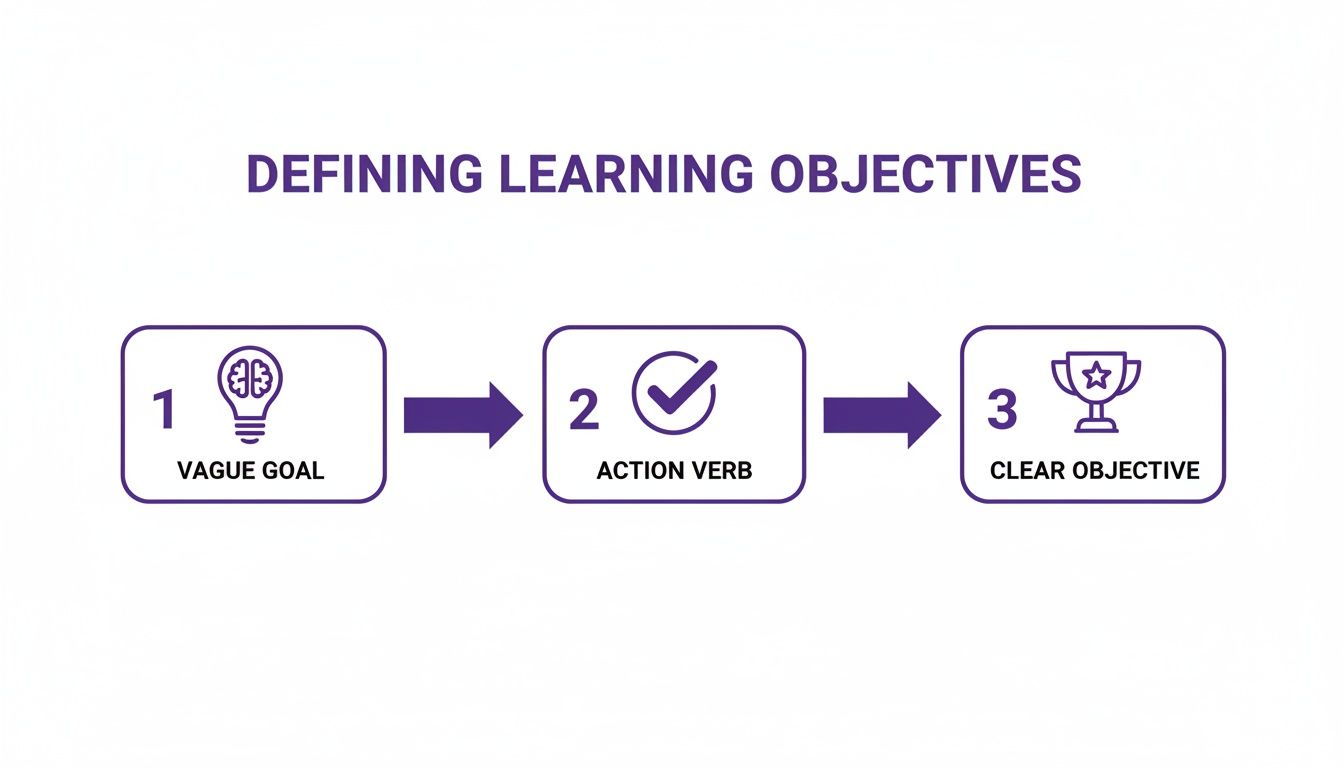
The image breaks it down perfectly: you start with a general goal, make it active and specific, and end with a measurable outcome that can be directly translated into a lesson or module.
A well-sequenced course feels like a good story. It has a clear beginning, a series of challenges that build skills (the middle), and a satisfying conclusion where the hero—your student—achieves their goal.
To make sure your course modules are perfectly organized and truly connect with students, looking into key content strategy services can give you a professional edge. A solid content strategy is the foundation of any great learning experience.
To help you visualize this, here’s a simple template you can use to map out your own course.
Sample Module and Lesson Structure
Use this template to organize your course content logically, ensuring each part builds towards your final learning objective.
| Module Title | Module Objective | Lesson Title | Lesson Format (Video, PDF, Quiz) | Key Takeaway |
|---|---|---|---|---|
| Module 1: Finding Your Niche | Students will identify a profitable and passionate podcast niche. | The "Passion vs. Profit" Framework | Video (10 min) + Worksheet (PDF) | A validated niche that has both audience and income potential. |
| How to Research Your Competitors (Without Wasting Time) | Video (8 min) | Understanding the market landscape to find your unique angle. | ||
| Creating Your Ideal Listener Avatar | PDF Guide + Template | A clear picture of who you're creating content for. | ||
| Module 2: Essential Gear & Recording | Students will choose and set up their recording equipment. | The Only 3 Mics You Need to Consider | Video (12 min) | Confidence in purchasing the right microphone for their budget. |
| Setting Up Your Free Recording Software in Under 15 Minutes | Video Tutorial (15 min) | A fully functional recording setup ready to go. | ||
| Module 1 Review Quiz | Quiz (5 questions) | Reinforcement of core concepts before moving on. |
Mapping your course this way provides immense clarity, not just for your students, but for you as the creator.
Naming Your Modules and Lessons for Clarity
Finally, don't just gloss over the names of your modules and lessons. These titles are tiny little headlines that should be clear, benefit-driven, and maybe even a little enticing. Ditch generic labels like "Introduction" or "Lesson 3" for something descriptive and action-oriented.
Let's compare two titles for the same lesson:
- Vague: "Recording Software"
- Benefit-Driven: "Choosing and Setting Up Your Free Recording Software in Under 15 Minutes"
The second option is infinitely better, right? It tells the student exactly what they will learn and what the outcome will be (it's free and fast!). This small tweak makes your entire course outline feel more appealing and sets crystal-clear expectations. Good naming makes the journey feel achievable right from the start.
For a deeper dive into structuring your educational content, check out our comprehensive guide on strategic course design online.
Designing Activities That Actually Keep Students Engaged
Let's be honest: a course full of nothing but talking-head videos is a fast track to student boredom and sky-high dropout rates. If you want to create a course that people not only finish but also rave about, you have to get them doing things. This means weaving active learning opportunities—like engaging activities, practical projects, and smart assessments—right into the fabric of your outline of course.
Think of these elements as more than just "homework." They're the critical moments where knowledge clicks into place, where a student’s confidence grows, and where they stay motivated because they can see and feel their own progress. When someone can immediately apply what you've just taught them, the lesson sticks.

The online learning world is booming. The market for massive open online courses (MOOCs) hit an incredible USD 26 billion and is expected to rocket up at a 39.3% CAGR through 2034. And with 73% of students saying they prefer learning online, the audience is definitely there. But so is the competition. Your secret weapon is a course that people actually complete. For more on this trend, check out the massive growth in online courses on gminsights.com.
Weaving Activities into Your Course Outline
Don't treat activities like an afterthought you tack on at the end. As you're mapping out your modules and lessons, constantly ask yourself: "What's the best way for a student to practice this specific skill right now?"
For instance, if you just finished a lesson on writing killer email subject lines, don't just jump to the next video. Instead, pop in a simple worksheet that challenges them to write five different subject lines for a sample product. This kind of immediate application makes the learning concrete.
Here are a few ideas to get you started:
- Worksheets and Templates: These are fantastic for giving students a structured head start. A budgeting template in a personal finance course or a content calendar in a social media marketing course are tools they can use right away.
- Real-World Projects: Assign small, bite-sized projects that mimic what they’d do in the real world. In a web design course, this could be creating a simple wireframe for a homepage. It perfectly closes the gap between theory and actual practice.
- Peer-to-Peer Feedback: Create a space where students can share their work. This not only reinforces their own understanding but fosters a community. The power of this approach is huge; you can learn more about what social learning is and how it benefits students in our guide.
The real magic happens when a student moves from passively absorbing information to actively creating something with it. That shift from knowing to doing is where the transformation lies.
Creating Quizzes That Reinforce, Not Intimidate
The word "quiz" can make people sweat, but in an online course, it's not about passing or failing. It’s a simple, low-stakes tool to check for understanding and help jog your students' memory.
Keep quizzes short and sweet. A quick 3-5 question multiple-choice quiz at the end of a module can do wonders. It provides a little confidence boost and confirms for the student that they've nailed the key concepts before they move on.
Platforms like Zanfia make it incredibly easy to build these interactive elements directly into your course. You can add quizzes, link to your downloadable worksheets, and even create advanced community spaces—with topical discussion channels and group-based organization—all under your own brand for a unified learning and interaction environment.
The Power of a Capstone Project
To really bring it all home, consider adding a capstone project at the very end of your course. This is the big finale—a substantial project that requires students to pull together everything they've learned and create something meaningful.
Here’s what that might look like:
- Public Speaking Course: Students record and submit a 5-minute speech.
- Copywriting Course: The final project is to write a complete sales page for a fictional brand.
- Coding Course: Learners build a simple but functional web application.
A capstone project gives your students a clear, satisfying finish line. It’s the ultimate proof—to them and to you—that they’ve achieved the outcome your course promised. When you plan for this final project from the very beginning of your outlining process, it forces you to make sure every module and lesson logically builds toward that goal, keeping your entire course focused and effective.
Bringing Your Course Outline to Life
You've done the hard work of creating a solid course outline. That document is more than just a plan; it's the blueprint for a valuable digital product. Now for the exciting part: turning that blueprint into a real, living course that people will be eager to buy and finish. This is where your structured plan becomes a tangible asset for your business.
The platform you choose to build on is absolutely critical for this next phase. You need more than just a place to dump your videos. A great platform handles the entire student journey—from the moment they pay to how they interact with you and other students. Getting this right means you can focus on creating incredible content instead of fighting with clunky technology.
From Blueprint to a Live Course
The first real step is to mirror your outline's structure on your chosen platform. If you've already organized your content into logical modules and lessons, this should be a breeze. Modern platforms like Zanfia are designed to think like course creators, so setting up the basic shell of your course can take just a few minutes.
You’ll want to create your modules, name each lesson exactly as you have it in your outline, and start uploading your content. Whether you're using videos, PDFs, worksheets, or quizzes, the idea is to build the course precisely as you envisioned it on paper.
Here’s a pro tip: look for a platform with native video hosting. Relying on third-party services like Vimeo or Wistia can add surprisingly high monthly costs and another layer of technical complexity. An all-in-one system with built-in hosting saves you that headache and money. A smart video player that automatically saves a student's progress is another small detail that makes a massive difference in the learning experience. For more on this, check out our guide on how to create effective video training.
Setting Up Flexible Pricing and Access
How you sell your course is just as important as what's inside it. A rigid, one-size-fits-all payment model just doesn't cut it anymore. Your platform should give you the flexibility to meet your customers where they are.
Think about all the ways you could package your course:
- One-Time Purchase: The classic model. Students pay once for lifetime access. Simple and effective.
- Subscription Model: Perfect if you're building a membership or providing ongoing content updates.
- Installment Plans: A fantastic way to lower the barrier to entry for higher-ticket courses, making them accessible to a wider audience.
- Product Bundles: This is a great way to increase your average order value. Package your course with an e-book, a community membership, or another digital download.
Setting these options up should be a matter of a few clicks, not a technical nightmare. With Zanfia, for instance, you can create all of these different offers easily and keep 100% of your revenue, since we charge flat zero-percent (0 %) platform transaction fees.
Connecting Your Course to a Thriving Community
Want to know one of the best ways to keep students engaged and see them through to the finish line? Integrate your course directly with a dedicated community. Instead of sending your paying customers off to a noisy Facebook group or a separate Discord server, you can keep them right inside your own branded ecosystem.
This is where your blueprint really comes alive. When a student buys your course, you can set up automations to instantly:
- Grant them access to the course content.
- Add them to the right private channel inside your community.
- Kick off a welcome email sequence.
This kind of seamless integration creates a powerful learning environment. Students can discuss what they're learning, ask you questions, and share their wins right alongside the course material. This unified experience is a game-changer for member retention and lifetime value. To really nail this, especially for flexible online courses, resources like this ultimate guide to online study and flexible courses are incredibly helpful.
The moment a student completes a purchase is your first, best chance to make them feel part of something bigger. Automating their entry into a dedicated community space transforms a simple transaction into the beginning of a relationship.
Automating the Business Side of Your Course
The final piece of the puzzle is automating all the tedious administrative work that can quickly bog you down. I'm talking about payment processing, invoicing, and managing student access. A professional and seamless experience is expected, and the right platform handles these details behind the scenes.
A true all-in-one system handles these details behind the scenes. For example, Zanfia integrates seamlessly with Polish and global payment gateways—Stripe, PayU, Przelewy24, BLIK—to ensure your checkout process is smooth and reliable. It can also connect directly to Polish invoicing systems like inFakt and Fakturownia, automatically generating and sending invoices after every single sale.
This isn't just a minor convenience. These automations can easily save you 5-10+ hours a month, freeing you up to do what you do best: engage with your students and create more amazing content.
Answering Your Course Outline Questions
Even with a roadmap in hand, you’re bound to hit a few tricky questions when building your course outline. I've been there. So, let's tackle some of the most common hurdles course creators face. Think of this as a quick chat to clear up any lingering doubts and get you back to creating with confidence.
How Long Should My Online Course Be?
This is the question I hear more than any other, and the answer is surprisingly simple: it should be as long as it needs to be to deliver the transformation you promised. That's it. Not a minute longer.
People aren't paying for hours of video; they're paying for a result. When you get hung up on a target runtime, you start adding fluff, and that just waters down your core message.
Instead of thinking in hours, think in terms of impact. A solid framework I've seen work time and again is to build your course with 3 to 7 modules, each containing 3 to 7 individual lessons. Aim to keep each video lesson snappy and focused—somewhere between 5 and 15 minutes is the sweet spot. This bite-sized structure keeps your content digestible and gives students that satisfying feeling of making progress.
The real value of a course isn't its length, but its efficiency. A two-hour course that solves a massive problem is infinitely more valuable than a meandering 10-hour one. Respect your students' time, and they'll respect you as an expert.
Let your outline be your guide. Once you've covered every learning objective and you can confidently say your student will get their desired outcome, your course is the perfect length.
What’s the Best Way to Validate My Course Idea?
Before you pour your heart and soul into creating content, you have to make sure people will actually pay for it. The best way to do this isn't by guessing, but by talking to real people. Go where your target audience hangs out—social media groups, forums, or even your own email list—and just start a conversation.
But don't ask a lazy question like, "Would you buy this?" Instead, dig deeper. Ask about their biggest roadblocks and frustrations with your topic. What have they already tried that failed? The answers you get are pure gold. They'll show you exactly how to tweak your outline to solve their real-world problems.
Another fantastic validation strategy is to pre-sell a "beta" or "pilot" version of your course. It's a game-changer. Here's how it works:
- Map out a solid outline of your core modules and what students will learn.
- Offer it at a steep discount to a small group of "founding members."
- Create the content week-by-week, gathering their feedback as you go.
This does two things beautifully: it confirms people are willing to pay for your idea, and it helps you co-create a course that's practically guaranteed to hit the mark.
Should I Include Bonuses in My Course Outline?
Yes. A thousand times, yes. Bonuses are one of your most powerful tools for boosting the perceived value of your course and tipping hesitant buyers over the edge. But the trick is to plan them from the start, right in your outline, so they feel like a core part of the experience, not just a random afterthought.
A great bonus has to be relevant. It should help your students get results faster, more easily, or more effectively. Tossing in unrelated extras can actually make your offer feel cheap.
Here are a few ideas for effective bonuses to bake into your outline:
- Templates & Checklists: Give them done-for-you resources that save time and mental energy.
- Case Studies: Show them how your concepts work in the real world with in-depth examples.
- Private Community Access: Create a space where they can connect with peers and get support.
- "Office Hours" Calls: Offer live Q&A sessions for direct access and personalized feedback.
When you plan these from day one, you can weave them into your marketing and show potential students just how much value you’re packing into your offer.
How Detailed Should My Initial Course Outline Be?
Your first draft of the outline should be incredibly detailed. Don't think of it as a rough sketch; treat it like an architect's blueprint for a house. The more work you do here, the easier and faster your recording sessions will be. A vague outline guarantees a chaotic creation process. A detailed one gives you a clear script.
For every single lesson in your outline, you should be able to jot down 3 to 5 bullet points that cover:
- The main ideas you'll teach.
- The specific examples or stories you'll use to make those ideas stick.
- The one key takeaway a student must have before moving on.
Getting this granular forces you to think through the logical flow of your entire course. You’ll instantly spot gaps or sections where the progression feels clunky. It turns content creation from a daunting task of staring at a blank screen into a simple process of executing a well-laid plan. Trust me, the time you invest here will save you countless hours of headaches later.
Ready to turn that carefully crafted outline into a real, thriving online business? Zanfia is the all-in-one Polish platform designed for digital creators who want to build, sell, and manage their courses, communities, and digital products—all under their own domain. With features like native video hosting, 0 % platform transaction fees, and powerful automations, you can focus on what you do best—creating amazing content for your students.