10 Email Subject Line Best Practices for 2026 That Drive Opens
In the crowded inbox of a modern consumer, your email subject line isn't just a headline-it's the gatekeeper to your content, courses, and community. A great one can skyrocket your open rates, drive sales for your digital products, and deepen engagement within your paid membership. A weak one gets ignored, deleted, or worse, flagged as spam, leaving your valuable content unseen and your business potential untapped. This is a critical reality for ambitious creators using an all-in-one platform like Zanfia to manage their courses, newsletters, and memberships, where every email is an opportunity to strengthen relationships and generate revenue.
Mastering the art of the subject line is a non-negotiable, high-leverage skill that separates creators who struggle to gain traction from those who scale their online businesses effectively. It’s the single most important sentence that determines whether the hours you poured into creating amazing content actually get seen. To truly measure the impact of your subject line efforts, understanding what constitutes a strong performance against industry averages is key; you can find helpful data by reviewing good email open rate benchmarks for context.
This guide cuts through the noise to deliver 10 proven email subject line best practices, complete with actionable templates and strategies specifically tailored for digital product creators. We'll explore the psychology behind what makes subscribers click, how to leverage data for continuous improvement, and how to craft messages that feel personal, urgent, and valuable. By implementing these techniques, you can turn your email list into your most powerful business asset.
Table of Contents
1. Keep Subject Lines Short and Concise
In the battle for attention in a crowded inbox, brevity is your greatest ally. One of the most foundational email subject line best practices is to keep your message short, scannable, and straight to the point. Research from industry leaders like HubSpot and Campaign Monitor consistently shows that shorter subject lines drive higher open rates, especially since a significant portion of emails are now read on mobile devices where screen space is limited.
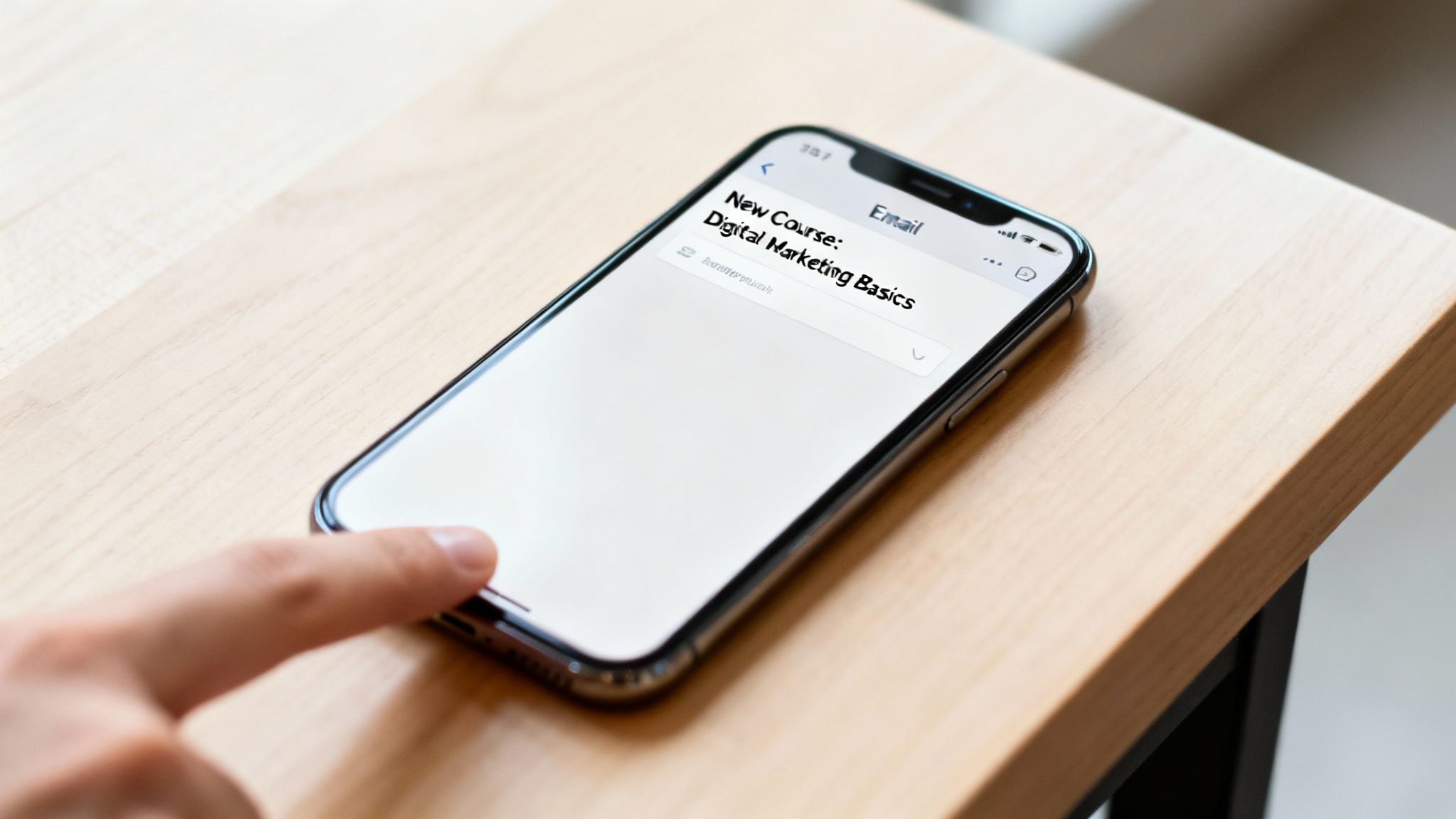
A concise subject line, ideally under 50 characters, ensures your entire message is visible without being truncated. This clarity reduces cognitive load, allowing subscribers to instantly grasp the email's value proposition. For creators on an integrated platform, this is critical whether you're announcing a course launch, sending a community update, or promoting a new paid newsletter. A short subject line cuts through the noise and delivers your core message immediately.
Why This Approach Works
The primary benefit is improved mobile visibility. With a majority of users checking email on their phones, a long subject line risks getting cut off, hiding the most crucial information. A shorter subject line also conveys confidence and clarity, making your email feel more professional and less like spam. It forces you to distill your message down to its most impactful components, respecting your audience's time.
Actionable Tips for Implementation
- Front-Load Key Information: Always place the most compelling words or offer at the beginning of the subject line. Instead of "Check Out the Special Offer on Our New Course," try "50% Off: New Course Inside!"
- Test Lengths for Different Goals: You might find that a very short, punchy subject line like "Course Enrollment Closes Soon" works best for urgency-driven sales, while a slightly longer but still concise line like "This Week's Community Roundup & Q&A" is better for regular newsletters.
- Use a Preview Tool: Utilize tools like Email Subject Line Checkers or your email service provider's preview function to see exactly how your subject line will appear on various devices and email clients.
- Focus on a Single Idea: Avoid cramming multiple messages into one subject line. If you're announcing a new course and a community event, send separate, focused emails with clear, concise subject lines for each.
2. Create a Sense of Urgency Without Being Manipulative
Urgency is a powerful psychological trigger that encourages immediate action by creating a fear of missing out (FOMO) or highlighting a time-sensitive opportunity. For digital creators, strategically using urgency in subject lines can significantly boost open and conversion rates, especially when launching limited-time course enrollments, membership promotions, or exclusive content drops. The key to making this one of the most effective email subject line best practices is authenticity; the urgency must reflect genuine time constraints, not false scarcity.
A well-crafted urgent subject line tells subscribers that the window of opportunity is closing, prompting them to act now rather than later. For example, a creator launching a cohort-based course with a strict enrollment deadline can use urgency to drive last-minute sign-ups. This approach transforms passive interest into active engagement by clearly communicating that hesitation will lead to a missed chance.
Why This Approach Works
This method leverages the principle of loss aversion, where people are more motivated to avoid losing something than to gain something of equal value. By framing an offer as temporary, you create a sense of scarcity that increases its perceived value. This is especially potent for creators selling high-value digital products like courses or memberships, as it helps overcome purchase procrastination and drives decisive action from potential customers.
Actionable Tips for Implementation
- Be Genuine and Truthful: Only use urgency when it's real. If your course enrollment genuinely closes on Friday, state it clearly. Fabricating deadlines erodes trust and can lead to unsubscribes.
- Pair Urgency with Value: The urgency should amplify an already compelling offer. Instead of just "Ending Soon," try "Last Chance: PLN 500 Off Annual Creator Package" to remind subscribers what they stand to lose.
- Use Specific Timeframes: Vague deadlines are less effective. Use clear, concrete timelines like "48 Hours Left," "Closes Tomorrow at Midnight," or "Final Call: Enrollment Ends in 3 Hours" to create a stronger push.
- Reserve for Key Moments: Overusing urgency leads to fatigue. Limit these types of subject lines to critical points in your campaign, such as the final 24-48 hours before an offer expires, to maintain their impact.
3. Use Personalization and Segmentation
Moving beyond a one-size-fits-all approach is a game-changer for email marketing, and leveraging personalization is one of the most impactful email subject line best practices you can adopt. Personalized subject lines that include a recipient's name or reference their past behavior can achieve open rates 20-50% higher than generic ones. This tactic transforms a mass email into a direct, one-to-one conversation, immediately signaling that the content inside is relevant to the individual subscriber.

For creators, this strategy is exceptionally powerful. By segmenting your audience into distinct groups-such as free community members versus paid course students, or highly engaged subscribers versus inactive ones-you can tailor your messaging with incredible precision. A new course announcement can be framed differently for a past student than for a brand-new lead, dramatically boosting its relevance and your conversion rates.
Why This Approach Works
The core benefit is relevance. When a subscriber sees their name or a reference to an action they took (like viewing a course page), their brain registers the message as important and specifically for them. This connection cuts through inbox clutter and builds a stronger relationship with your audience. Segmentation ensures that you're sending the right message to the right person at the right time, preventing audience fatigue and increasing the perceived value of your communications.
Actionable Tips for Implementation
- Start with First Name Personalization: The simplest and often most effective starting point is adding a
{{PROTECTED_SHORTCODES_42}}merge tag. Subject lines like "Joanna, Your Advanced Marketing Course is Ready" feel instantly more personal. - Leverage Platform Analytics: Use your platform's data to create segments based on course interest, membership tier, or purchase history. You can then target these groups with highly specific offers, such as "[FirstName], 20% Off Courses You've Been Viewing."
- Segment by Engagement: Create separate lists for your most active community members and those who haven't engaged recently. Send your best content to the active group and run re-engagement campaigns with tailored subject lines for the inactive segment.
- Maintain Data Hygiene: Personalization is only as good as your data. Regularly clean your email list to ensure names and other custom fields are formatted correctly to avoid embarrassing errors like "Hey [FNAME]," in a subject line. Explore how to build effective segments in our detailed guide to audience segmentation strategies on Zanfia.com.
4. Ask a Question to Spark Curiosity
Posing a question in your subject line is a powerful psychological trigger that instantly engages the human brain. This is one of the most effective email subject line best practices because questions invite participation and create a knowledge gap, compelling subscribers to open the email to find the answer. This strategy transforms a passive announcement into an active conversation, making your audience feel seen and understood.
For digital creators, this technique is exceptionally valuable for promoting courses, engaging communities, or launching new products. A subject line like "What's stopping your community from growing?" is far more intriguing than "Tips for Community Growth." It directly addresses a subscriber's potential pain point and positions the email's content as the solution they've been seeking, driving higher open rates and deeper engagement.
Why This Approach Works
Question-based subject lines work by sparking innate curiosity. When people see a question, their mind automatically starts formulating an answer or realizes they don't know it, creating a desire for resolution. This "curiosity gap" makes the email feel more personal and relevant. It shifts the dynamic from you broadcasting a message to you starting a helpful dialogue, which is perfect for building the strong relationships needed for a thriving online business.
Actionable Tips for Implementation
- Align the Question with a Pain Point: Frame questions around common challenges your audience faces. Instead of a generic question, use one like, "Are you making these common membership mistakes?" to hit a specific nerve.
- Promise a Clear Answer: Ensure your email content directly and thoroughly answers the question posed in the subject line. Failing to deliver on this promise can erode trust and harm future engagement.
- Combine with a Benefit: Amplify the impact by pairing a question with a clear benefit. For example, "Ready to 3X your digital product sales? Here's how" is more compelling than the question alone.
- Position Platform Features as the Solution: Ask questions where a platform feature is the answer. A question like, "Tired of paying high transaction fees?" naturally leads to a discussion of Zanfia's 0% platform fee model. This is a great way to highlight your platform's value in your welcome sequence. To learn more, check out these powerful onboarding email sequence examples.
5. Include Numbers and Specific Data Points
In an inbox filled with vague promises, numbers cut through the clutter and offer concrete value. One of the most effective email subject line best practices involves using specific data points and numbers to make your message more tangible and credible. Research consistently shows that subject lines containing digits perform better because they set clear expectations and draw the eye, making your email stand out.

For creators, this tactic is incredibly powerful for showcasing the results your courses, communities, or newsletters deliver. A subject line like "The 7-Step Framework to Launch a Course" feels more structured and actionable than "How to Launch a Course." Numbers make your promises specific and believable, turning an abstract benefit into a measurable outcome that subscribers can easily understand and desire.
Why This Approach Works
Numbers work because the human brain is naturally drawn to them as symbols of logic, order, and evidence. A subject line with a statistic or a numbered list implies that the email contains well-organized, data-backed information, which increases its perceived value. This specificity builds immediate trust and makes your claims more persuasive, directly boosting open rates by promising a clear, digestible takeaway.
Actionable Tips for Implementation
- Use Odd Numbers: Studies suggest odd numbers like 3, 5, and 7 often feel more authentic and less manufactured than even numbers, which can lead to higher engagement. Try "3 Mistakes to Avoid" instead of "Some Mistakes to Avoid."
- Quantify the Benefit: Focus on numbers that represent tangible results. This could be time saved, revenue earned, or skills learned. For example: "How I made my first PLN 10k with Zanfia" or "Save 5+ hours a week with this automation."
- Leverage Social Proof: Use numbers to highlight the success of your community or products. A subject line like "Join 500+ creators in our community" is much more compelling than "Join our creator community."
- Ensure Accuracy: Always use accurate, verifiable data. Misleading statistics can damage your brand's credibility. If you're citing industry research or your own results, be prepared to back up your claims within the email body.
6. Avoid Spam Trigger Words and Phrases
One of the most critical yet overlooked email subject line best practices is steering clear of words and phrases that trigger spam filters. Even the most valuable email is worthless if it never reaches the inbox. Email service providers use sophisticated algorithms to detect language commonly associated with spam, and using these trigger words can significantly harm your deliverability, ensuring your carefully crafted message gets buried in the junk folder.
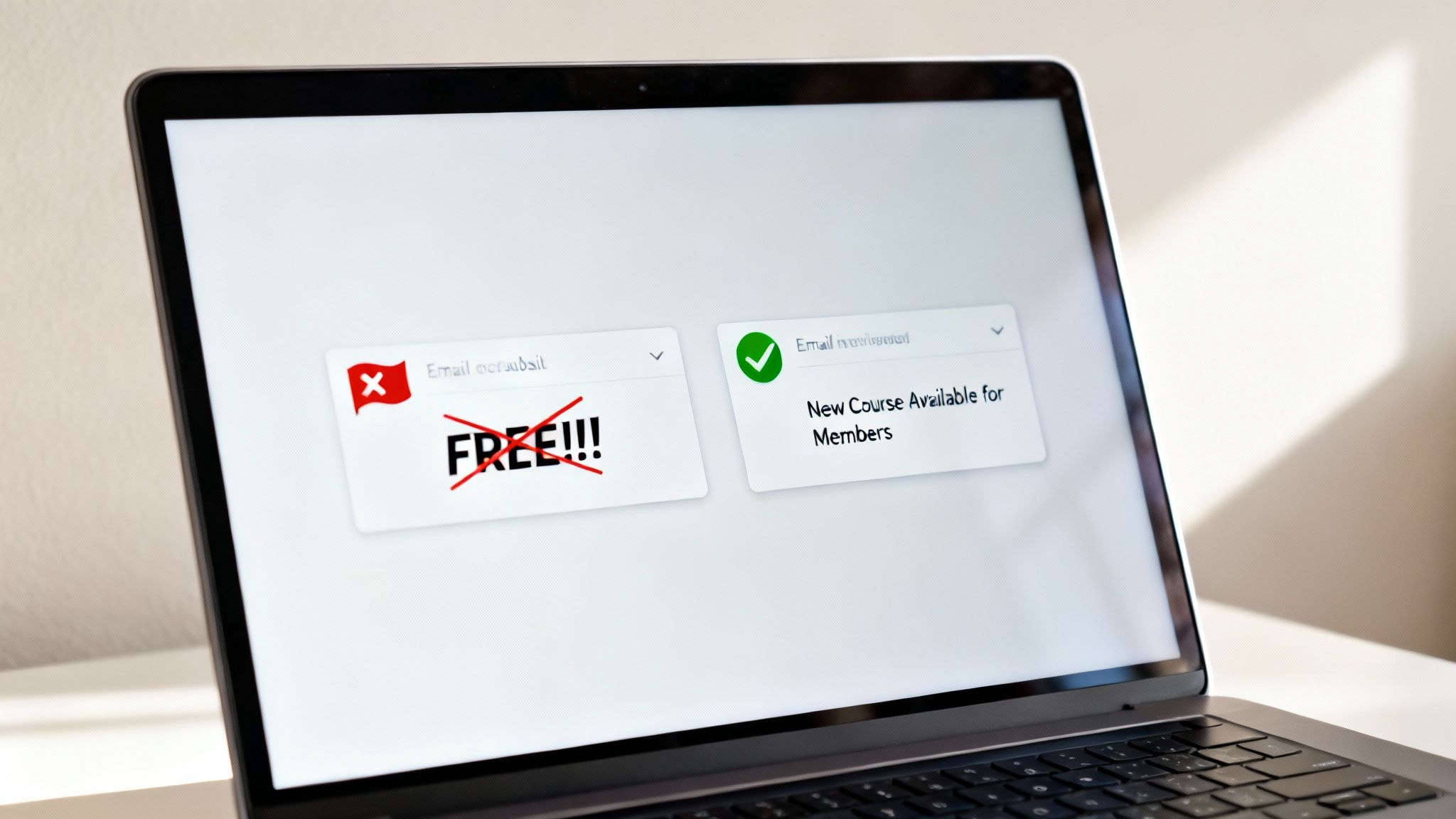
For digital creators, this is non-negotiable. Whether you're sending a course update, a paid newsletter, or a community announcement, landing in the spam folder breaks the line of communication with your audience. Words like ‘free,’ ‘urgent,’ ‘act now,’ ‘best deal,’ and excessive punctuation are red flags. Avoiding them ensures your content is judged on its merit, not filtered out before it even has a chance to be seen.
Why This Approach Works
This practice directly protects and improves your sender reputation and deliverability. Email providers track how recipients interact with your emails; high spam complaint rates or low engagement can damage your reputation, making it harder for future emails to reach the primary inbox. By avoiding spam triggers, you signal to filters that your content is legitimate and valuable, building trust with both mailbox providers and your subscribers.
Actionable Tips for Implementation
- Focus on Value, Not Hype: Instead of "Best Deal Ever," try a subject line that highlights a specific benefit, like "Join 5,000+ Creators Today." Replace hype with authentic, value-driven language.
- Rephrase Urgent Calls-to-Action: Urgency is effective, but spammy phrasing is not. Instead of "Urgent!!! Act Now!!!," use a clear, specific deadline like "Enrollment Closes Friday."
- Use Spam Checkers: Before sending a campaign, run your subject line through a spam checker tool. Many email service providers offer this feature to assess the risk of your subject line being flagged.
- Mind Your Punctuation and Formatting: Avoid using multiple exclamation points, writing in ALL CAPS, or using unconventional spacing. These are classic spam indicators that can hurt your deliverability.
7. Use Power Words and Emotional Language
Words have the power to evoke emotion and inspire action. One of the most effective email subject line best practices is to strategically use "power words" and emotional language that tap into your subscribers' core desires, pain points, or aspirations. These are words that trigger a psychological or emotional response, making your email feel more compelling and urgent.
For digital creators, this means using words that resonate with the goals of entrepreneurship, learning, and community building. Phrases that promise a transformation, reveal a secret, or offer an exclusive opportunity can dramatically increase curiosity and drive opens. This technique, popularized by copywriting experts, moves your subject line from a simple announcement to a persuasive invitation.
Why This Approach Works
The human brain is wired to respond to emotional cues. Power words like "unlock," "proven," "transform," and "exclusive" cut through analytical thinking and appeal directly to a subscriber's feelings. This creates a stronger connection and positions your content, whether it's a new course or a community update, as a valuable solution to their problems or a direct path to their goals, making them far more likely to click and engage.
Actionable Tips for Implementation
- Align Words with Creator Goals: Focus on words that speak to the aspirations of your audience. Use terms like "launch," "monetize," "master," and "scale" to connect your offer directly to their business objectives.
- Combine with a Specific Benefit: A power word is most effective when paired with a clear outcome. Instead of "New Course Available," try "Unlock the Secret to a 6-Figure Creator Income."
- Use Authenticity: Your email content must deliver on the promise made in the subject line. If you use the word "exclusive," ensure the offer truly is limited. Misleading your audience erodes trust and damages your brand reputation.
- Vary Your Power Words: Avoid relying on the same few power words in every email campaign. Overuse can diminish their impact. Keep a running list and rotate them to maintain freshness and effectiveness.
- Test Emotional Angles: Use A/B testing to see which emotional triggers resonate most with your audience. Does a subject line focused on overcoming a struggle ("Stop Wasting Time on Admin") perform better than one focused on achieving a goal ("Automate Your Business & Save 10+ Hours/Mo")?
8. A/B Test Subject Lines Systematically
Instead of guessing what works, one of the most powerful email subject line best practices is to let your audience's actions guide you. A/B testing, also known as split testing, is a data-driven method where you send two variations of a subject line to small, similar segments of your audience. The version that generates the highest open rate is the "winner," providing you with clear insights into what resonates with your subscribers.
For creators, systematic A/B testing is a game-changer. It transforms your email marketing from a creative exercise into a scientific process of continuous improvement. By testing one variable at a time, such as length, personalization, or tone, you can methodically refine your approach for every course launch, community announcement, or newsletter, ensuring your messages always make the maximum impact.
Why This Approach Works
The core benefit of A/B testing is that it replaces assumptions with data. What you think is a compelling subject line may not be what actually motivates your audience to click. This method provides concrete evidence about your specific audience's preferences, eliminating guesswork and helping you optimize for higher engagement. Over time, these small, incremental gains in open rates compound, leading to significantly more traffic, sales, and community interaction.
Actionable Tips for Implementation
- Isolate a Single Variable: To get clear results, only change one element between your two subject lines. Test length (e.g., "New Course Available" vs. "How to Launch Your Online Course in 30 Days") or personalization (e.g., "5 Membership Strategies" vs. "[FirstName], Discover 5 Membership Strategies"), but not both at once.
- Ensure Test Group Integrity: Your audience segments for the test must be statistically similar and large enough to yield meaningful results. Most modern email platforms can handle this automatically.
- Document Everything: Keep a simple spreadsheet to track your tests, the variables, the results, and any insights you gain. This log will help you identify long-term patterns in what your audience responds to. For more complex sequences, you can explore various email drip campaign examples to structure your tests.
- Implement and Iterate: Once a test concludes, apply the winning variation to the rest of your email list and use the insights to inform future campaigns. The goal is to build on each success.
9. Align Subject Lines with Email Content (Avoid Misleading Claims)
In the world of digital products and online communities, trust is your most valuable currency. Your subject line is a promise to your audience, and one of the most crucial email subject line best practices is ensuring the body of your email delivers on that promise. Misleading or "clickbait" subject lines that don't align with the email's content might secure a temporary open, but they will quickly erode trust, increase unsubscribe rates, and damage your sender reputation.
For creators, whose businesses are built on authentic relationships and community engagement, this principle is non-negotiable. Whether you're announcing a new course module or a special offer, your subject line must accurately reflect the value waiting inside the email. This transparency builds a loyal following that not only opens your emails but also invests in your products because they trust you to be straightforward and honest.
Why This Approach Works
The core benefit is long-term subscriber trust and engagement. When your audience knows that your subject lines are a reliable preview of your content, they are more likely to open your emails consistently. This practice also ensures you comply with regulations like the CAN-SPAM Act, which prohibits deceptive subject lines. This means higher retention rates in your communities and paid newsletters, as members feel respected rather than tricked.
Actionable Tips for Implementation
- Write Your Subject Line Last: Finalize your email content first. Once you know exactly what the email contains, it's much easier to write a subject line that is both compelling and accurate.
- Verify Before Sending: Have a team member or a peer review your email to confirm the subject line is a fair representation of the content. A fresh pair of eyes can easily spot a potential mismatch.
- Audit Your Automations: If you use a platform with powerful automation features, regularly review the subject lines in your welcome sequences or post-purchase emails. Ensure they still align with the triggered content, especially if you've updated the email body.
- Be Specific and Deliver: If your subject line promises "5 Ways to Boost Course Engagement," make sure the email body clearly lists exactly five distinct strategies. For more guidance on creating valuable content, explore these email newsletter best practices.
10. Incorporate FOMO (Fear of Pissing Out) Strategically
Tapping into the psychological principle of scarcity is a powerful technique in email marketing. Incorporating FOMO (Fear of Missing Out) strategically leverages our innate desire to avoid losing a valuable opportunity, exclusive content, or limited resource. When subscribers feel a sense of urgency or exclusivity, they are more motivated to act immediately, making this one of the most effective email subject line best practices for driving conversions.
FOMO-based subject lines are particularly potent for creators announcing limited-time offers or exclusive access. Whether it's for early-bird pricing on a new course, a small number of seats in a premium mastermind, or a founding member discount for a new community, this approach creates a compelling reason for your audience to open your email now. The key is to ensure the scarcity is genuine; authentic urgency builds trust, while manufactured hype can erode it.
Why This Approach Works
This tactic is effective because it triggers a psychological response rooted in Robert Cialdini's principle of scarcity. People assign more value to things that are less available. A subject line that signals a closing window of opportunity or a limited supply bypasses procrastination and encourages immediate decision-making. For Polish creators, this is perfect for time-sensitive launches where every hour counts, helping to push subscribers who are on the fence to finally commit.
Actionable Tips for Implementation
- Be Authentic with Scarcity: Only use FOMO when there is a real deadline or a genuine limit. For example, if you offer "founding member" pricing for your new community, make sure that price truly expires on the stated date.
- Combine Urgency with Value: Clearly state what the subscriber is about to miss. Instead of a vague "Don't Miss Out," try "Last Chance: Founding Member Pricing Expires Tonight." This connects the urgency directly to a specific, valuable offer.
- Use Specific Numbers: Quantifying the scarcity makes it more tangible and believable. "Only 3 Spots Left: Join Our Elite Creator Mastermind" is far more powerful than "Limited Spots Available."
- Monitor Unsubscribe Rates: A spike in unsubscribes after sending a FOMO-heavy email is a clear sign of overuse. Reserve this tactic for your most important, time-sensitive campaigns to avoid subscriber fatigue and maintain its impact.
10-Point Email Subject Line Best-Practices Comparison
| Strategy | 🔄 Implementation Complexity | 💡 Resource Requirements | 📊 Expected Outcomes | ⚡ Ideal Use Cases | ⭐ Key Advantages |
|---|---|---|---|---|---|
| Keep Subject Lines Short and Concise | Low — simple copy edits | Minimal — basic testing tools | Better mobile display; modest open-rate lift | Mobile-heavy lists; quick announcements, previews | Clear, scannable, preview-friendly |
| Create a Sense of Urgency Without Being Manipulative | Medium — careful wording and timing | Moderate — calendar, genuine deadlines | Higher opens & conversions when authentic | Limited-time enrollments; promotions | Drives immediate action; boosts conversions |
| Use Personalization and Segmentation | High — data & automation setup | Significant — analytics, clean data, segmentation | Much higher open & conversion rates | Behavior-driven campaigns; tiered audiences | Increases relevance, retention and LTV |
| Ask a Question to Spark Curiosity | Low–Medium — creative copywriting | Low — testing and content alignment | Higher open rates via curiosity mechanism | Newsletters, educational content, community invites | Engages curiosity; stands out in inbox |
| Include Numbers and Specific Data Points | Low — craft numeric claims carefully | Low–Medium — verify data and sources | Increased opens; greater perceived credibility | Results-focused offers; guides and case studies | Specificity boosts credibility and scanability |
| Avoid Spam Trigger Words and Phrases | Low — review and revise copy | Low — spam-check tools and guidelines | Improved deliverability and inbox placement | All sends, especially promotional emails | Protects sender reputation; higher inbox reach |
| Use Power Words and Emotional Language | Medium — tone selection and testing | Low–Medium — audience research & A/B tests | Higher engagement when authentic | Launches, promotional and motivational messages | Emotional motivators increase clicks and loyalty |
| A/B Test Subject Lines Systematically | High — experimental design & analysis | Significant — tools, sample size, time | Data-driven optimization; measurable lifts | Major campaigns; iterative improvement cycles | Replaces guesswork; reveals audience preferences |
| Align Subject Lines with Email Content (Avoid Misleading Claims) | Low–Medium — editorial checks | Low — review process, team verification | Lower unsubscribes; stronger long-term trust | Onboarding, transactional, and promotional emails | Builds credibility and sustainable engagement |
| Incorporate FOMO (Fear of Missing Out) Strategically | Medium — manage real scarcity authentically | Moderate — inventory/timing tracking, limits | High short-term opens/conversions if genuine | Early-bird pricing, limited cohorts, exclusive access | Drives urgency and community participation |
From Best Practices to Best Results: Your Next Steps
You've just navigated a comprehensive roundup of the most effective email subject line best practices, from leveraging urgency and personalization to the critical importance of A/B testing and avoiding spam triggers. It's easy to see this collection of tips as a simple checklist, but the real power lies in viewing them as a strategic toolkit. Mastering these techniques is not a one-time setup; it's a dynamic, ongoing process of learning, testing, and adapting to the unique pulse of your audience.
The ultimate goal extends far beyond achieving a higher open rate. It's about building a relationship of trust and anticipation. When your subscribers see your name in their inbox, they should feel a flicker of excitement, confident that valuable, relevant, and engaging content awaits them. For creators and entrepreneurs, this connection is the lifeblood of your digital business. Your emails are the primary bridge between your audience and the thriving ecosystems you've built, whether it's an exclusive community, an in-depth online course, or a premium newsletter.
Distilling Strategy from Tactics
To truly transform these practices into powerful results, let's consolidate the most critical takeaways. Think of these as the foundational pillars of your email communication strategy:
- Clarity Over Cuteness: While clever wordplay can be effective, it should never come at the expense of clarity. Your audience is busy. A subject line that clearly communicates the value inside the email will almost always outperform a vague or overly cryptic one.
- Authenticity is Non-Negotiable: Strategies like urgency and FOMO are potent, but they must be used ethically. Your claims must align perfectly with the email's content. Misleading your audience for a temporary boost in opens will erode trust and lead to higher unsubscribe rates over time.
- Personalization is Power: Moving beyond just using a recipient's first name, true personalization comes from segmentation. Sending targeted messages to specific groups based on their purchase history, course progress, or community engagement shows you understand their needs. This level of relevance makes your emails feel less like marketing and more like a personal conversation.
- Data is Your Co-pilot: Your intuition is valuable, but data provides the map. Systematically A/B testing your subject lines is the single most effective way to understand what resonates with your specific audience. Don't guess; test, measure, and iterate.
Putting It All into Action: Your Go-Forward Plan
Feeling overwhelmed by the sheer number of ideas? Don't be. The key is to start small and build momentum. Here’s a simple, actionable plan for your next campaign:
- Choose One Variable: Pick just one best practice from this article to focus on. For instance, decide you will test a question-based subject line against a statement-based one.
- Formulate a Hypothesis: State your assumption clearly. "I believe a subject line asking a question about a common pain point will get a higher open rate than one that simply announces my new course module."
- Run a Clean A/B Test: Use your email service provider's tools to send each version to a statistically significant portion of your list.
- Analyze and Apply: Once the results are in, don't just note the winner. Ask why it won. Was it the curiosity? The direct address of a problem? Apply that learning to your next email.
By consistently applying this "test and learn" cycle, you'll move from implementing generic email subject line best practices to developing a finely-tuned instinct for what truly captivates your subscribers. Remember, to achieve overall campaign success, remember to integrate these subject line best practices within a solid understanding of broader email marketing principles. A great subject line is the start, but it needs to be part of a cohesive and value-driven strategy.
Your subject line is the digital handshake that initiates a conversation. It’s your single best chance to prove that your email is worth your subscriber's most precious resource: their attention. By investing the time to craft compelling, honest, and strategic subject lines, you're not just improving a metric; you're strengthening the very foundation of your online business and fostering a loyal audience eager to engage with the incredible value you provide.
Ready to turn these best practices into a thriving business? A great subject line gets the open, but an all-in-one platform like Zanfia ensures the experience that follows is seamless, professional, and profitable. From hosting your courses and community to automating payments with 0% platform fees, Zanfia handles the tech so you can focus on creating and connecting.