How to Build a Membership Site: A Thriving Blueprint

Before you even think about which platform to use or what your logo should look like, you need a solid plan. A membership site isn't just a collection of content behind a paywall; it's a promise of transformation. The real key is to create a blueprint before you build, making sure your site solves a real problem for a specific group of people.
Building Your Membership Site Blueprint
Rushing into the "build" phase is the single biggest mistake creators make. A strong strategic foundation is what separates a vibrant, growing community from a digital ghost town. It all comes down to getting incredibly clear on who you're serving, what you're offering them, and why they should care enough to pay for it.
Nailing this initial planning has never been more critical. The market for membership site platforms was valued at $7.9 billion in 2025 and is expected to rocket to $14.3 billion by 2033—that's a massive 14.70% compound annual growth rate. This boom means more opportunity, but it also means way more competition. A solid blueprint isn't just a good idea; it's non-negotiable.
Define Your Ideal Member
You can't build a successful membership for "everybody." Your first and most important job is to get a deep, almost obsessive, understanding of your ideal member. Go way beyond basic demographics and get into their heads.
- What are their biggest frustrations and pain points in your niche? What keeps them up at night?
- What are they truly hoping to achieve? Paint a picture of what success looks like for them.
- Where are they looking for answers right now? And more importantly, what are those solutions lacking?
A crucial first step is to identify your target audience in detail. I always recommend creating a detailed persona. Give them a name, a job, and a backstory. This makes it tangible. From that point on, every decision—from content ideas to community guidelines—gets filtered through the lens of that one specific person.
Articulate Your Core Value Proposition
Okay, so you know who you're serving. Now, what exactly are you offering them? Your value proposition is the promise you make. It needs to be a clear, simple statement that communicates the primary benefit of joining. It’s not about the stuff they get; it’s about the outcome they’ll achieve.
For example, don't just say, "Get access to 10 video courses." That’s a feature. Instead, frame it as a transformation: "Master the art of sourdough baking in 90 days, even if you've never baked before." See the difference? That promise is the magnetic force that will attract the right people and set clear expectations from the very beginning.
This flow from a broad niche to a specific promise is the core of your strategy.
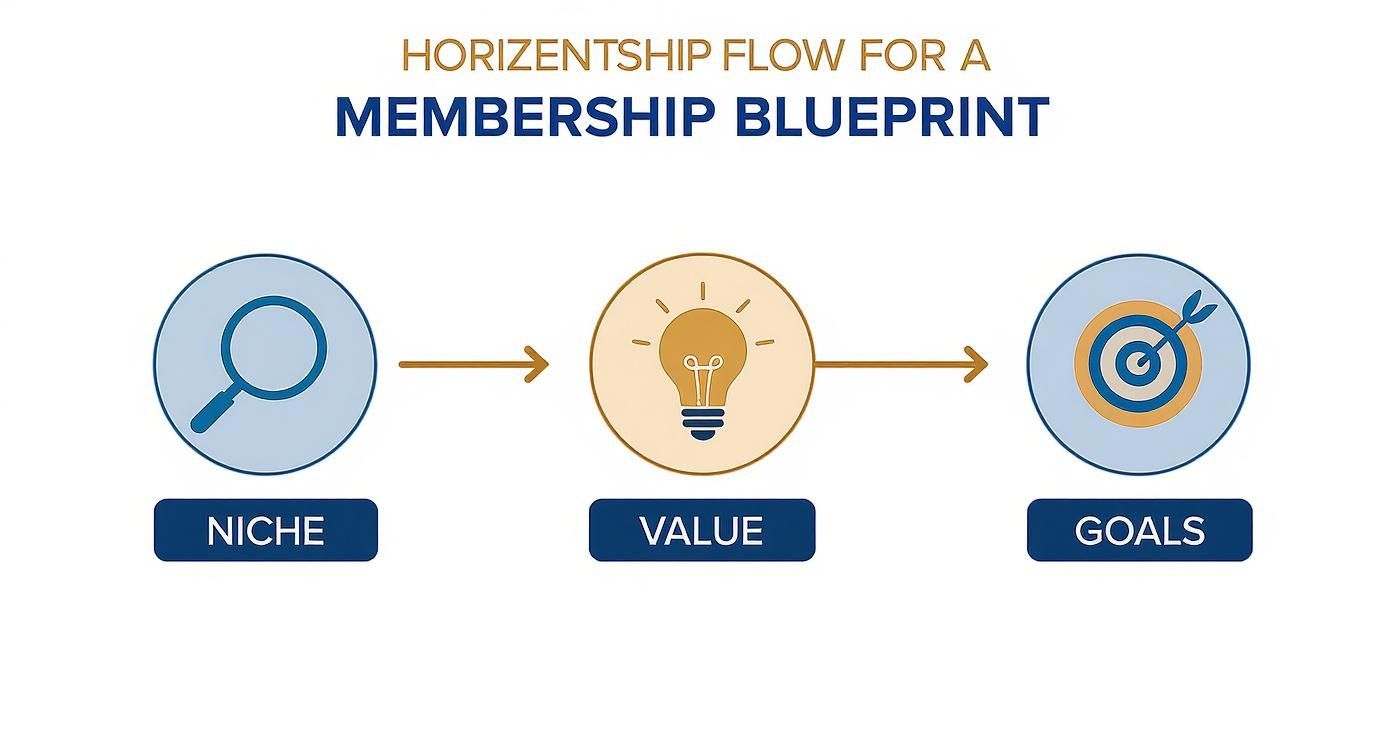
This process ensures that every part of your membership is built with a clear purpose, guiding your members toward a real result.
Before moving on, it's helpful to organize these core ideas. This simple table can act as your strategic cheatsheet.
Core Components of Your Membership Site Blueprint
| Strategic Element | Key Question to Answer | Example for a Fitness Coach |
|---|---|---|
| Ideal Member | Who are you serving? (Be specific!) | "Busy working moms, 30-45, who want to lose baby weight but only have 30 minutes a day to work out at home." |
| Value Proposition | What transformation do you promise? | "A supportive community and quick, effective home workouts to help you feel strong and confident in your body again." |
| Business Goals | What does success look like for you? | "Reach 100 paying members and $5,000 MRR within the first six months." |
| Member Goals | What success will your members achieve? | "Members will complete the 12-week 'Fit Mom' program and be able to do 10 consecutive push-ups." |
Having this level of clarity makes every subsequent decision infinitely easier.
Set Clear Business and Member Goals
Finally, your blueprint needs measurable goals—both for your business and for your members. What does success actually look like six months or a year down the road?
For your members, a goal might be mastering a specific skill or hitting a personal milestone. For you, the business owner, it could be reaching a certain number of active members or hitting a monthly recurring revenue (MRR) target.
These goals give you a roadmap. They help you prioritize what to build and what to ignore, and they give you a way to measure what’s actually working. For your members, this structure is what guides them toward the transformation you promised in the first place. Ultimately, the strength of your community will hinge on how well you help people achieve those outcomes. For a deeper dive on this, check out our guide on https://zanfia.com/blog/forming-a-community/ with purpose.
Crafting Your Content and Community Experience

Okay, you've got your strategy locked in. Now comes the fun part—building the actual experience that your members will pay for. This is where your big idea comes to life through a smart mix of content and community.
There's an old saying that's more relevant than ever: "They come for the content, but they stay for the community." The most successful memberships aren't just digital libraries; they're vibrant ecosystems where people learn, connect, and grow together.
Your mission is to build an experience that feels indispensable.
Designing Your Core Content Offerings
The content is the tangible promise you're delivering. It needs to be a direct solution to the problems you identified in your initial strategy. Don't fall into the trap of creating content just to have more of it. Every video, guide, or template should have a clear purpose in helping your members get from A to B.
I've found the best approach is a blended one, mixing up formats to keep things interesting and cater to different learning styles.
- Structured Courses: These are gold for teaching a specific skill or walking members through a step-by-step process. A platform with native video hosting and progress tracking is a lifesaver here, giving members a smooth learning experience without you having to juggle costly third-party tools like Vimeo or Wistia.
- Knowledge Libraries: Think of this as a go-to vault of resources. We're talking templates, checklists, scripts, and other downloadable assets. This is all about providing quick, on-demand wins for your members.
- Paid Newsletters & Downloads: Monetize your expertise through premium newsletters, e-books, or other digital downloads, sold either as standalone products or as part of a larger membership bundle.
The real magic happens when you combine these. Imagine a flagship course supported by a full resource library and a monthly live coaching call. That’s a powerful, multi-layered value proposition.
The Unbeatable Power of an Integrated Community
This is it. This is the one thing that will make or break your membership site's long-term success. While great content gets people in the door, a strong community makes them feel like they belong—and keeps them paying, month after month.
The biggest mistake I see creators make is outsourcing their community to a separate platform like a Facebook Group or Discord. When you send people away from your site, you shatter the experience. You introduce countless distractions and, worst of all, you lose control over your brand and audience.
An integrated community—where discussion forums live right alongside your courses, all under your own domain—is a game-changer for engagement and retention. It creates a unified world where learning and connection happen in the same place.
An all-in-one platform is the only way to do this right. For example, Zanfia lets you build a community-based business with topic-specific channels and automatically group members based on their purchases. Someone who joins your "Beginner's Course" can instantly get access to a private channel with their peers, creating a sticky experience that dramatically boosts lifetime value.
Fostering Genuine Connection and Engagement
Just opening a forum isn't enough. You have to actively cultivate the community, especially when it's new. It’s your job to get the ball rolling, spark conversations, and make every single member feel seen and heard.
Good community management is absolutely essential for long-term health. The data confirms this; the 2025 Membership Marketing Benchmarking Report found that 86% of membership organizations see member engagement as a top priority. Why? Because they know it’s the key to sustainability. You can see more insights in the full report on membership marketing trends.
Here are a few simple, practical ways to get your community buzzing from day one:
- Welcome Rituals: Start a dedicated thread where new members can introduce themselves. Prompt them with a few fun questions.
- Weekly Prompts: Post a regular discussion starter related to your content. Keep it simple and open-ended to encourage replies.
- Member Spotlights: Publicly celebrate member wins and progress. This builds a powerful culture of support and recognition.
When you fuse high-value content with a deeply integrated and well-tended community, you create something far more valuable than the sum of its parts. For more advanced ideas, check out these powerful community engagement strategies you can put into action.
Choosing Your Membership Technology Stack

Okay, you've got your strategy mapped out. Now for the big decision: what engine will actually power your membership site?
Getting this right is crucial. The right tech stack works like a silent partner, humming away in the background to make your life easier and give your members a smooth experience. The wrong tech? It quickly becomes a constant headache of plugin conflicts, technical glitches, and time spent troubleshooting instead of creating.
At the end of the day, this choice really comes down to two main paths: you can either piece together a Do-It-Yourself (DIY) system, usually with WordPress, or you can go with a unified, all-in-one platform.
All-in-One Platforms vs. a WordPress Setup
The WordPress route offers endless flexibility, but it also casts you in the role of system administrator. You'll find yourself researching, installing, and trying to get separate plugins for memberships, payments, courses, forums, and email marketing to all play nicely together. It can work, but this piecemeal approach often creates a fragile ecosystem where one plugin update can bring everything crashing down.
An all-in-one platform, on the other hand, is built from the ground up to run a membership business. Everything—from courses and community to payments and automations—is designed to work together from the start. This approach is for creators who want to focus on content and community, not on wrestling with tech. As serial entrepreneur Artur Kurasiński notes, a platform like Zanfia is "the most convenient and simplest solution for paid newsletters, courses and community on the Polish market."
The subscription economy is booming for a reason. By 2025, it's predicted that 53% of all software revenue will come from subscription models. This trend is powered by platforms that make it easy to manage recurring payments and different membership tiers. If you're curious, you can find more on these membership site trends and statistics.
The Core Jobs Your Tech Has to Nail
No matter which path you take, your tech stack has to handle a few non-negotiable jobs flawlessly. The only difference is whether you manage them from a single dashboard or from five different ones.
- Secure Payment Processing: Your system must connect to trusted payment gateways like Stripe, PayU, or Przelewy24. It also needs to support popular, easy-to-use methods like BLIK, Apple Pay, and Google Pay to maximize conversions.
- Automated Access Control: This is huge. The second a payment goes through, the system has to grant the new member immediate access to exactly the right content and community spaces. Just as important, it needs to automatically revoke access if their subscription ends.
- Content Delivery & Hosting: If you’re creating video courses, you need a reliable place to host them. A platform with native video hosting saves you the cost and hassle of paying for a separate service like Vimeo or Wistia.
For creators in Poland, there’s an extra layer: seamless integration with local invoicing software like inFakt or Fakturownia. This automates your accounting and keeps you compliant with local tax laws—a critical detail many international platforms simply miss.
Your goal is to build a business, not a full-time IT project. A unified system that automates the tedious stuff—granting access, sending welcome emails, generating invoices—can realistically save you 5–10 hours of manual work every single month. That's time you can pour back into what really matters: creating value for your members.
Making the Right Choice for Your Business
To make this decision a bit clearer, let's put these two approaches head-to-head on the features that matter most when you're starting out.
This table breaks down the key differences between going with an all-in-one solution versus building your own system with WordPress and various plugins.
Membership Tech Stack Comparison All-in-One vs WordPress Plugins
| Feature | All-in-One Platform (e.g., Zanfia) | WordPress + Plugins |
|---|---|---|
| Ease of Use | User-friendly, no technical skills required. Everything is managed from one dashboard. | Requires technical knowledge to install, configure, and maintain multiple plugins. |
| Maintenance | Professionally managed. The platform handles all updates, security, and backups. | Your responsibility. You must manage all plugin and theme updates, security, and backups. |
| Integrations | Built-in connections for payments, email, and community that work seamlessly together. | Relies on third-party integrations between plugins, which can be prone to conflicts and breaking. |
| Cost Structure | Predictable SaaS subscription with 0% platform transaction fees. You keep 100% of revenue. | Lower upfront cost, but expenses add up with premium plugins, themes, and developer help. |
| Community | Fully integrated community spaces live alongside course content under one login and your own domain. | Requires separate forum plugins that can feel disconnected from the main content. |
| Support | Centralized support team that understands the entire system and local market needs. | Support is fragmented across different plugin developers, often leading to finger-pointing. |
So, what's the verdict?
If you crave total control and have the technical chops (or the budget to hire someone who does), WordPress can be an incredibly powerful tool.
However, for most creators—from "Potential Explorers" launching their first product to "Business Architects" scaling past PLN 10k a month—an all-in-one platform offers a faster, more reliable, and far less stressful path to launching a profitable membership site. For a deeper analysis, explore our guide on the best platforms for course creators.
Nailing Your Pricing and Monetization Strategy

Let's talk about one of the most pivotal decisions you'll make: how to price your membership. This isn't just about picking a number. Your pricing sends a powerful message about the value you're offering, shapes how members see their commitment, and ultimately determines whether your business will thrive long-term.
Get this right, and you’ll build a reliable revenue stream that fuels your growth. The goal is to find that perfect balance between what your members feel is a fair price and what your expertise and content are truly worth.
Choosing Your Core Monetization Model
First things first, you need a core model that makes sense for the kind of value you provide. You can always evolve, but your initial choice sets the stage for how members will engage with your work.
Here are a few proven approaches I’ve seen work time and time again:
- Recurring Subscriptions: This is the bread and butter of most successful membership sites. Offering monthly or annual plans creates predictable revenue, which is the holy grail for any online business.
- One-Time Purchases: A great fit for standalone products. Think of a signature online course, a detailed e-book, or a toolkit of templates. It’s a clean, simple transaction for a specific, high-value resource.
- Installment Plans: These are magic for making high-ticket items feel much more accessible. Breaking a larger price tag into smaller monthly payments can dramatically lift conversion rates for premium programs.
- Product Bundles: A brilliant way to increase your average order value. Why sell one thing when you can package several together? You could bundle your main course with community access and a resource library for an irresistible offer.
The most successful creators don't just stick to one; they use a flexible mix. A comprehensive platform like Zanfia lets you offer all of these monetization models—subscriptions, one-off sales, payment plans, and bundles—all from a single dashboard, giving you maximum flexibility. For a deeper dive, check out our guide on subscription business model examples for creators.
The Psychology of Tiered Pricing
Once you’ve got your model, think about creating tiers. This is more than just offering options; it's a powerful psychological tool that frames your offer around value instead of just cost.
The classic three-tier structure is popular for a reason—it works.
- The Entry-Point Tier: An affordable way to bring new people into your world. It gives them a taste of the core value and starts building a relationship.
- The "Most Popular" Tier: This is your flagship offering. It should solve your ideal member's main problem and strike the perfect balance between price and features.
- The Premium Tier: For your superfans. This is where you offer exclusive perks, one-on-one access, or other high-touch benefits for a premium price.
This structure doesn't just present choices; it guides them. By highlighting the middle tier as the "best value," you gently steer most people toward the option that's most profitable for you and most impactful for them.
Keep an Eye on the Fees
Finally, a crucial detail that directly hits your bank account: fees. When you sell anything online, you’ll encounter two kinds of fees, and the difference is massive.
The most overlooked cost for growing creators isn't marketing—it's platform commissions. A 0% platform transaction fee model means you keep 100% of your revenue, protecting your margins as you scale. You only pay the standard, unavoidable fees charged by payment processors like Stripe or PayU.
This distinction is everything. Platforms that skim a percentage off every sale are essentially taking a cut of your success. As your revenue climbs, so does the amount you're giving away.
By choosing a platform with a straightforward SaaS subscription and zero platform fees, you ensure your hard-earned money stays yours. This becomes incredibly important for creators earning PLN 10k–100k+ a month, where even a small percentage can add up to thousands in lost income. Your pricing strategy should be fueling your business, not someone else’s.
Launching and Growing Your Community
Getting your membership site live isn't the finish line—it’s the starting gun. A great launch is all about creating a burst of initial energy that you can channel into long-term, sustainable growth. Once those doors are open, the real work begins: bringing in the right people, making them feel at home, and giving them a reason to stick around.
Flicking the "on" switch and hoping for the best is a common mistake and a recipe for a quiet, empty community. A strategic launch builds excitement and ensures you have a core group of enthusiastic founding members ready to go from day one.
Building Pre-Launch Buzz
Your best launches actually begin weeks or even months before you’re officially open. The goal here is to gather an audience that’s not just aware of what you’re building, but is genuinely excited to join the moment you go live. Think of this pre-launch phase as your opportunity to build a direct connection with your future biggest fans.
Here are a few tactics that I’ve seen work wonders:
- Start a Waitlist: Set up a simple landing page that gives a sneak peek of your membership. Offer a special "founder's price" or an exclusive bonus to anyone who signs up for the launch notification. This list isn't just a collection of emails; it's your first wave of committed members.
- Share the Journey: Take people behind the scenes on social media or in your newsletter. Show them snippets of course content, a walkthrough of the community platform, or the branding process. It makes your audience feel invested and part of the creation story.
- Run a Founder's Launch: Before you open the doors to everyone, invite a small, hand-picked group to join. This gives you priceless feedback, helps you squash any last-minute technical bugs, and generates your first testimonials. That kind of social proof is pure gold.
Creating a Seamless Onboarding Experience
What happens in the first 48 hours after someone signs up can make the difference between a member who stays for two months and one who stays for two years. If their first impression is confusing or overwhelming, they're likely to churn out fast. Your onboarding absolutely must be smooth, welcoming, and focused on delivering a quick, immediate win.
The goal is to make every new member feel smart and capable right from their first login. Point them to the most valuable areas, show them exactly how to get started, and encourage them to introduce themselves in the community.
A well-structured welcome sequence is your best friend for onboarding. It's an automated series of emails that walks new members through the essential first steps, making sure they see the full value of their membership without feeling lost or abandoned.
Automating this is a huge time-saver. With an all-in-one platform, you can trigger a welcome email sequence the moment a new member's payment goes through. This ensures everyone gets the same high-quality introduction, instantly adds them to the right community channels, and grants course access without any manual work. For more on this, we've put together a guide covering drip campaign best practices.
Driving Long-Term Sustainable Growth
After the initial launch buzz fades and your first members are settled in, your focus needs to shift to consistent, sustainable growth. This is less about big, flashy promotions and more about building reliable systems that steadily attract your ideal members.
Content marketing is your most powerful engine for this. By creating genuinely helpful blog posts, videos, or podcast episodes that solve the exact problems your membership addresses, you attract the right audience and build trust. When you’ve already given them so much value for free, joining your paid community becomes the natural next step.
As you grow, it's smart to look at proven SaaS growth strategies for inspiration. Many of the principles for growing software companies—like a laser focus on user retention and referral programs—apply directly to scaling a membership.
Finally, never, ever underestimate the power of social proof. Actively ask for and showcase testimonials from your happiest members. Their success stories are far more persuasive than anything you could ever write yourself. As Wojciech Pisarski, CEO of wMinutę, says, "Without Zanfia, developing a paid newsletter and community in Poland would be much harder—it’s the best tool in the market."
Frequently Asked Questions
Jumping into the world of memberships can feel like a huge step, and it's natural to have questions. Getting a handle on these common concerns is the key to moving forward without getting stuck. Let's tackle some of the biggest questions creators ask when they're just getting started.
How Much Content Do I Need Before Launching?
This is probably the number one thing that keeps people from ever launching. The good news? You almost certainly need less than you think. The classic mistake is trying to build a massive, comprehensive library of content before you even have a single member.
A much smarter strategy is to launch with what we call a "Minimum Viable Product." Think of it as your solid starting point. This could be the first module of your big course, a small handful of high-impact resources, or even just your core community space with a few great conversation starters.
Your first members are your founding partners. By launching sooner, you get to build what they actually want and need based on their real feedback. You avoid wasting months creating content nobody ends up using.
What Is the Best Way to Handle Payments and Invoicing?
Honestly, trying to manage this stuff manually is a nightmare waiting to happen. Chasing payments, sending invoices one by one, and manually granting access doesn't scale. As soon as you get a few members, it becomes a huge time-drain and is incredibly prone to error.
The only sustainable solution is an integrated system. You need a platform that handles everything automatically.
Look for a system that connects with trusted payment gateways like Stripe, PayU, and Przelewy24, and supports modern payment methods like BLIK, Apple Pay, and Google Pay. The easier it is for people to pay, the more people will sign up.
The gold standard is a platform that also automates your invoicing with local accounting software. For anyone operating in Poland, for instance, a direct link to inFakt or Fakturownia is a game-changer. It means the entire financial process—from payment to a compliant invoice—happens on its own, freeing you up to focus on your members.
Should I Offer a Free Trial for My Membership?
This is a great question, and the answer really depends on your goals and the kind of community you're building. Free trials are fantastic for getting a high volume of sign-ups, but be prepared for a potentially high churn rate. A lot of people will sign up with no real intention of staying.
A great middle-ground is a low-cost introductory offer, maybe PLN 5 for the first week. It’s a small barrier, but it’s enough to filter for people who are genuinely interested and have some "skin in the game."
For high-end memberships or coaching programs, I'd usually recommend skipping trials altogether. Your energy is better spent creating a compelling sales page, running live webinars to show off your expertise, and gathering powerful testimonials. This way, every single person who joins is committed from day one.
How Do I Keep Members Engaged Long-Term?
Getting members is one thing; keeping them is the real challenge. Long-term retention comes down to three key ingredients: ongoing value, a real sense of community, and making your members feel important.
- Fresh Value: Don't let your site become a static library. You need to keep things fresh with monthly workshops, new resources, or live Q&A sessions. Give them a reason to keep coming back.
- Active Community: A community doesn't run itself. You have to be in there starting discussions, running fun challenges, and encouraging people to connect with each other.
- Member Recognition: People love to be seen. Celebrate their wins, feature their work, and acknowledge their progress. It makes them feel like a valued part of something special.
This is why having your content and community on one integrated platform is so powerful. When the conversation happens right alongside the content, engagement becomes natural and effortless.
Ready to build a thriving membership business without the technical headaches or hidden fees? Zanfia provides all the tools you need in one unified platform, from advanced courses and integrated communities to automated invoicing and a 0% platform transaction fee model. Start building your membership site with Zanfia today!