

How to Build Personal Brand: Your 2026 Blueprint
You probably already know enough to help people.
What usually blocks you isn't expertise. It's the mess around it. One tool for courses, another for payments, a private group somewhere else, email in a separate app, and a social audience you don't own. Add platform fees and constant context switching, and "building a personal brand" starts to feel less like strategy and more like unpaid systems work.
That framing is the first mistake. A personal brand isn't your profile photo, your color palette, or how often you post. It's the public expression of what you solve, who you solve it for, and why people should trust you enough to buy from you, hire you, or follow your work over time.
That trust has commercial consequences. 74% of Americans are more likely to trust someone with an established personal brand, and 58% would pay more for services from an independent professional with a strong brand versus a large corporation, according to Brand Builders Group research. If you're serious about learning how to build personal brand assets that compound, you need a business system, not a visibility hobby.
Beyond the Likes: Building a Brand That's a Real Business
Most creators start in public and build in private. They post on LinkedIn or Instagram, collect some attention, maybe get a few DMs, and assume momentum means progress. Then reality hits. The audience is scattered, the offer is vague, the delivery experience feels patched together, and each sale creates more admin.
A real personal brand business works differently. It turns attention into audience, audience into customers, and customers into repeat buyers and advocates. That requires structure. If your content lives in one place, your course in another, your community on a third platform, and your payments somewhere else, people feel the seams. So do you.
A lot of creators also over-index on surface activity. They spend hours posting and very little time designing the system behind the post. If you need help tightening the publishing side, this guide on managing social media for creators is useful because it focuses on process instead of generic engagement advice.
What changes when you treat your brand like a business
Three shifts matter:
- You stop chasing broad visibility. You aim for relevance with a specific buyer or member.
- You build on owned channels. Social platforms help discovery, but your business needs a home you control.
- You package expertise. Posts build awareness. Products create revenue.
Personal branding gets easier when you stop asking, "How do I get noticed?" and start asking, "What outcome am I consistently known for?"
That owned-home mindset matters even more if community is part of your offer. This breakdown of a community platform for creators is worth reading because community isn't an add-on anymore. For many experts, it's the product that keeps the brand alive between launches.
Lay Your Foundation by Defining Your Brand and Audience
Most weak personal brands don't fail because the creator lacks knowledge. They fail because the message shifts every week. One day they're a consultant. Next week they're a thought leader. Then they start talking to everyone and helping no one.
A critical failure point in personal branding is message inconsistency. Expert frameworks require developing a unified brand messaging architecture by auditing your digital footprint, defining a brand story, and creating content pillars where 60-70% addresses audience problems, 20-30% shares educational content, and 10% reveals personality, as outlined by the University of Pennsylvania's guidance on building a personal brand online.

Audit what already exists
Before you publish anything new, review what people already see when they look you up.
Check these first:
- Your search footprint. Look at your LinkedIn profile, bios, guest appearances, old websites, and outdated offers.
- Your language. Do your headlines, summaries, and pinned content describe the same problem and audience?
- Your proof. Testimonials, results, teaching samples, and product pages should all point in the same direction.
A useful exercise is to compare self-perception with market perception. Ask a few people in your network what they think you help with. If their answers are broad or inconsistent, your brand message isn't landing yet.
Write a brand story people can repeat
Your brand story doesn't need to be dramatic. It needs to be clear enough that someone else could repeat it accurately.
Use this simple structure:
- Who you help
- What problem you solve
- How you solve it
- Why your approach is different
That last point matters. Differentiation isn't about sounding bigger. It's about sounding specific. "I help founders communicate better" is weak. "I help subject-matter experts turn expertise into paid education products" is far easier to remember and buy into.
If you need help shaping that language, these brand statements examples are a practical reference because they show how positioning becomes usable messaging.
Practical rule: If a stranger can't understand your value in one short paragraph, your future content will be harder to create and harder to sell.
Build content pillars before content assets
Don't brainstorm random post ideas. Define 3 to 4 content pillars first.
A strong set usually includes:
| Pillar | What it does | Example |
|---|---|---|
| Problem solving | Addresses audience pain directly | Mistakes experts make when launching a course |
| Education | Teaches frameworks and methods | How to structure a paid community |
| Proof and perspective | Shows your way of thinking | Why owned platforms beat scattered tools |
| Personality | Makes the brand human | Work habits, lessons learned, operating principles |
When you document these pillars, future decisions get easier. Your posts become more coherent. Your course lessons feel connected. Your community channels make sense. Your brand stops sounding improvised.
Develop Your Content Engine and Authority
A lot of people ask how to build personal brand reach, but reach isn't the hard part. Consistency is. The creators who last usually aren't the loudest. They're the easiest to understand and the easiest to come back to.
That's why trying to be everywhere is usually a mistake. Success requires platform-specific optimization, not omnichannel saturation. Focusing strategically on 1-2 primary channels yields superior results. Even posting once weekly on a single platform can generate "massive returns" for small businesses, while sporadic multi-platform posting dilutes brand impact, according to Robert Walters' personal brand guidance.
Choose your primary channel by buying intent
Pick platforms based on where people make trust decisions, not where content feels easiest to publish.
A simple decision filter:
- LinkedIn works well for consultants, B2B educators, service providers, and operators selling expertise.
- Instagram plus LinkedIn can work for coaches, wellness creators, and lifestyle educators who need both credibility and visual storytelling.
- A blog or knowledge hub works when your audience searches for answers and wants depth before buying.
This matters more than format. A polished carousel on the wrong platform won't outperform a direct text post where your buyers already pay attention.
If your plan needs structure, this guide on how to create a content strategy is a good reference because it helps turn broad themes into a repeatable publishing rhythm.
Build around keystone content
Authority grows faster when you create a few durable assets instead of dozens of disposable ones.
A useful operating model looks like this:
- Create one keystone piece. This could be an article, workshop, video lesson, or detailed newsletter issue.
- Cut it into smaller assets. Pull out a strong idea for LinkedIn, one objection for email, one story for short-form video.
- Send people back to the hub. Every derivative post should point toward an owned asset, signup, or product entry point.
One strong idea explained in five useful ways beats five shallow ideas posted once.
What usually works and what usually doesn't
Here's the trade-off most creators learn late.
What works
- Repeating the same core message in fresh examples
- Teaching from real problems your buyers already face
- Publishing on a cadence you can sustain for months
- Using long-form content to create reusable intellectual property
What doesn't
- Reinventing your identity every quarter
- Posting trend-driven content disconnected from your offer
- Treating engagement as the primary success metric
- Building a content calendar before defining the buyer journey
Your content engine should make your future products easier to sell. If it doesn't, you're feeding the algorithm more than you're building your business.
Build Your Signature Product Suite with Zanfia
A creator posts for months, earns attention, gets DMs asking for help, and still has no clean way to sell. That gap is where personal brands stall.
Revenue starts when expertise is packaged into offers people can buy, use, renew, and share with others. A strong brand does not stop at audience trust. It turns that trust into a product suite with clear outcomes and a buying path that makes sense.
Start with one flagship outcome
Begin with the main transformation people already associate with your work. For one brand, that is a course. For another, it is a paid community, premium newsletter, or a bundle that combines teaching with implementation.
Use this filter before building anything:
| Product type | Best for | What buyers want |
|---|---|---|
| Course | Structured transformation | A clear path from problem to result |
| Paid community | Ongoing support and access | Feedback, accountability, peers |
| Premium newsletter | Regular insight and curation | Consistent thinking from a trusted expert |
| Download or e-book | Fast implementation | A focused solution with low friction |
The mistake I see often is product sprawl. Creators add low-ticket downloads, a course, coaching, a membership, and a newsletter before any of it connects. More SKUs do not create a stronger business. Better product logic does.
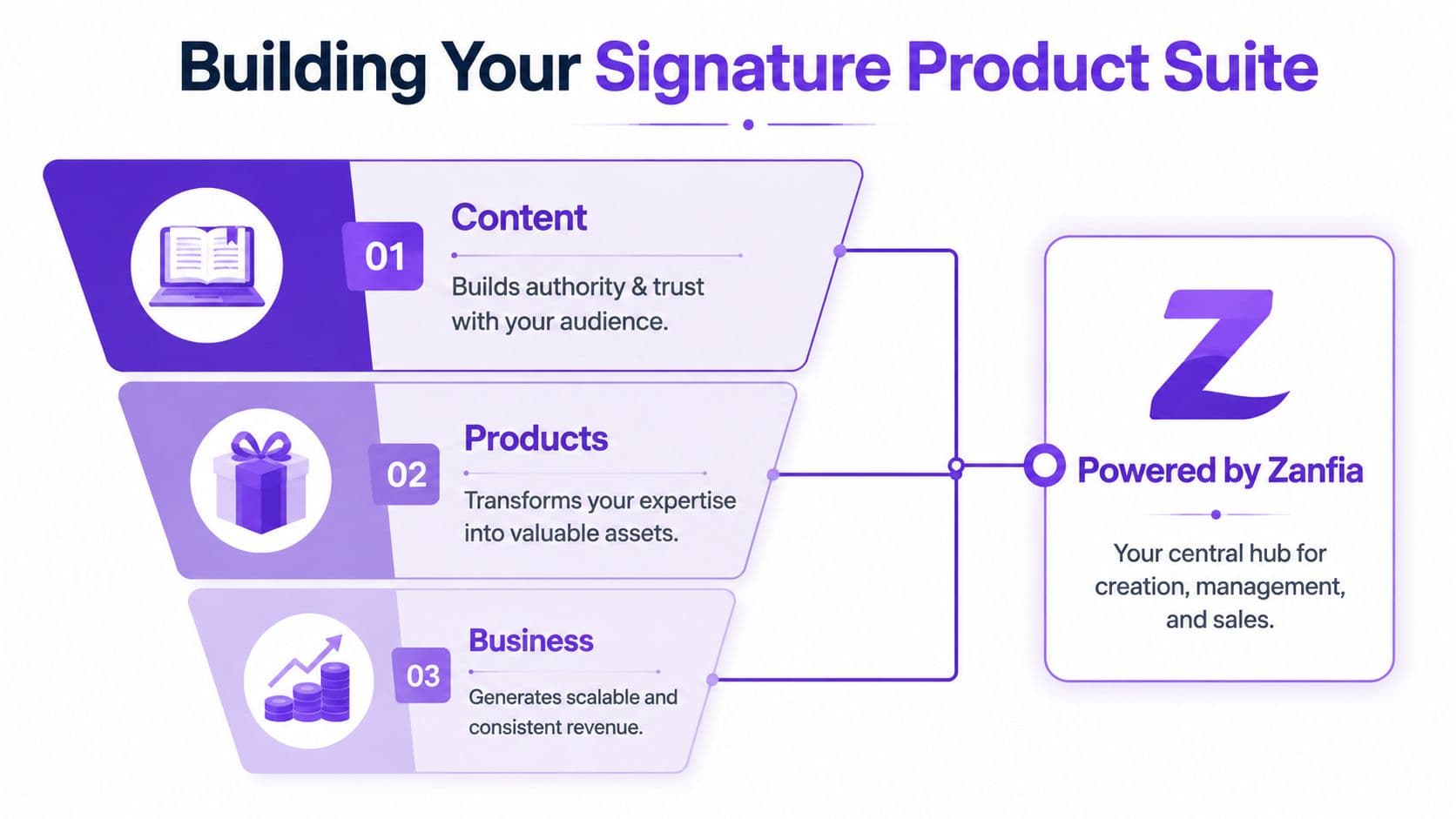
In practice, the cleanest suite usually has three layers. An entry offer for fast wins. A core offer for the main transformation. A retention layer for ongoing support, updates, or access.
Build the suite around customer movement
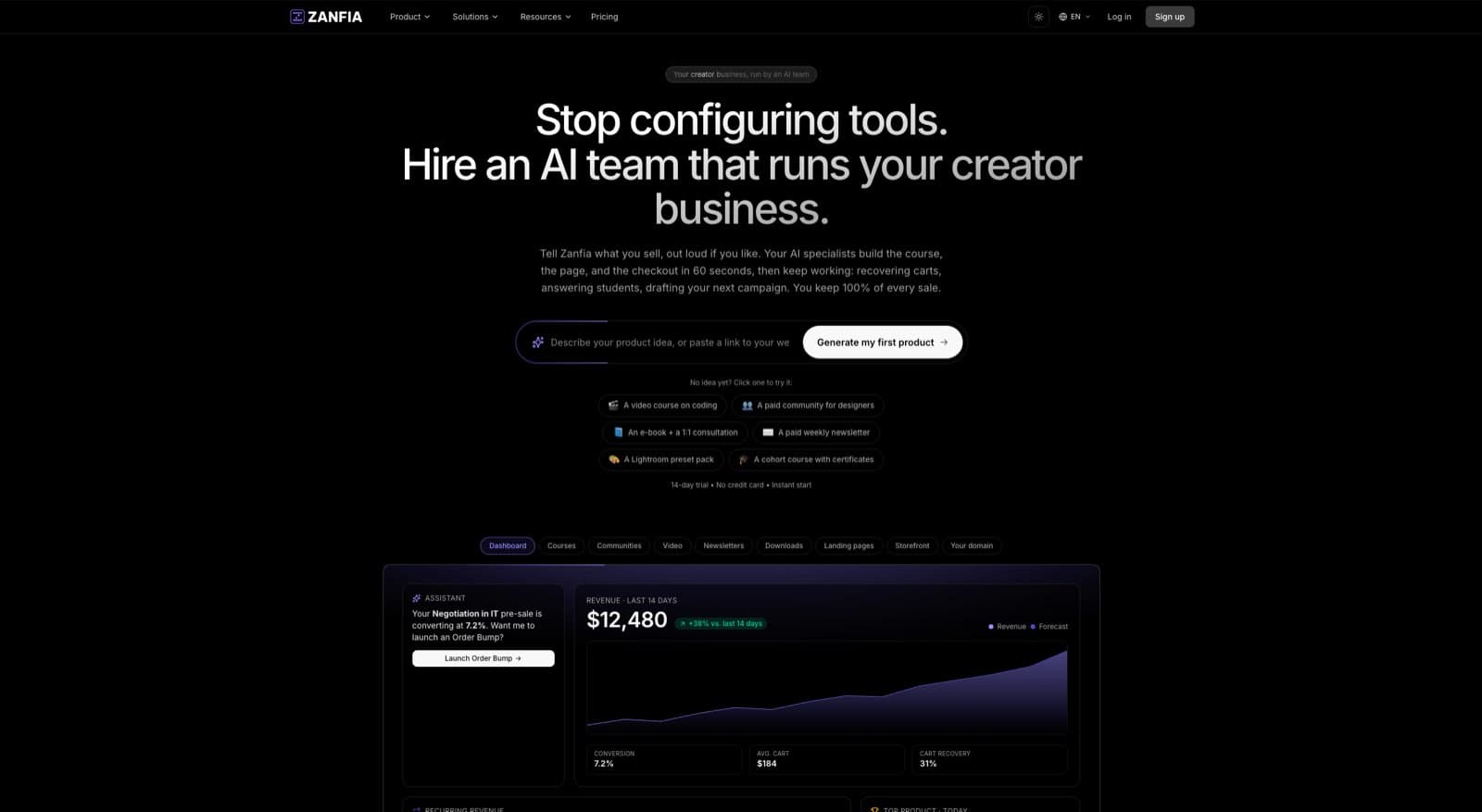
At this stage, platform structure affects margin, operations, and brand perception. Zanfia is set up as an AI team that runs the creator business, not just a place to host a course. The assistant knows the whole application and can perform any action available in the interface by chat or by voice, so packaging a suite starts with dictating what you want instead of clicking through configuration screens. Under that AI layer sit 12 product types (courses, communities, paid newsletters, memberships, knowledge bases, downloads, digital content, services, events, consultations, bundles, custom) living under one custom domain with white-label control, native video hosting, built-in automations, and 0% platform commission on customer sales (only payment processor fees apply, roughly 2.9% + $0.30 in the US through Stripe and PayPal). The checkout supports one-time payments, subscriptions, installment plans and order bumps, and a test mode lets you buy your own product end to end before launch to confirm checkout and tracking work.
That setup changes how a personal brand grows. Instead of sending buyers across disconnected tools, logins, and checkout pages, you can build one branded customer journey inside a single system, and hand more of the operational work to the assistant as the suite grows. For agent-based workflows, Zanfia also exposes an MCP endpoint so your own AI assistants can act on the workspace (this and the full assistant are available on higher plans, see the current Zanfia pricing).
A practical flow often looks like this:
- Free resource or mini training
- Paid course for the core skill
- Private member space for implementation
- Newsletter or subscription layer for retention
- Downloadable templates for faster execution
That matters because product design is not just about format. It is about reducing friction between interest and purchase, then between purchase and results. One domain, one login, and one brand environment usually convert better than a stack of patched-together tools, and they are easier to operate as the business grows, especially when a $600 course can be split into four installments at the same checkout instead of being pushed to a separate payment plan tool.
If you are still sorting out what belongs in your offer stack, this guide on what is a digital product helps clarify the difference between free content and assets customers will pay for.
Paid acquisition can support this system too. Once the suite is clear, creators can use tools like ShortGenius automated ad generation to produce creative faster and test which entry offer brings in qualified buyers, not just cheap clicks.
Avoid the common product sequencing mistake
Many creators try to launch the highest-priced offer first. The problem is simple. Without enough proof, language, and demand signals from the audience, the offer asks for too much trust too early.
A better sequence is less exciting at first and far more stable later.
Start with one repeated problem. Watch which idea keeps generating replies, objections, and buying questions. Turn that into a paid product. Add community, subscription, or additional layers only after customers show they want continuity, accountability, or deeper access.
That is how a personal brand becomes a business with an efficient operational structure. The audience sees a consistent promise. The buyer gets a clear next step. The creator keeps more revenue because the products, payments, delivery, and brand experience live in one place.
Distribute Your Content and Grow an Owned Audience
The most dangerous mistake in personal branding is confusing access with ownership.
A large following on a social platform can disappear into low reach, account issues, changing formats, or simple audience drift. That's why smart creators use social media for discovery but build their real business on owned channels, where the audience relationship doesn't depend on someone else's feed design.

Move people from attention to access
Your audience needs a reason to leave the platform and join your world.
That reason usually isn't "join my newsletter" by itself. It's a specific promise. A checklist, mini-course, workshop replay, free lesson, or member-only discussion gives people a concrete next step.
The handoff should be simple:
- Public content creates awareness
- Free owned asset earns the opt-in
- Email or community onboarding deepens trust
- Paid offer solves the bigger problem
This isn't about forcing everyone into a funnel. It's about giving serious followers a better environment to continue the relationship.
Why community sharing outperforms brand broadcasting
People trust people more than logos. That's not just intuition. When brand messages are shared by employees, or in this case community members, they can receive 561% more reach than messages from official channels. Leads generated through these social activities convert 7 times more frequently than other leads, according to Human to Brand's personal branding statistics roundup.
That has direct implications for your growth model.
When a member shares:
- a result they got from your course,
- a useful insight from your newsletter,
- a discussion they joined in your community,
their network sees a recommendation with context, not a promotion. That kind of distribution compounds differently.
The strongest growth signal isn't that you posted. It's that someone else talked about your work without being asked.
This short walkthrough is useful if you want to see how audience movement and offer positioning can work in practice:
Use paid amplification carefully
Ads can help, but they work best when the destination is already clear. If you're testing creatives for a lead magnet, workshop, or low-friction entry point, tools like ShortGenius automated ad generation can speed up production for video-style ad variations. The strategic part still matters most. The ad should push people toward an owned asset, not toward more casual platform consumption.
If your distribution strategy keeps feeding social reach without collecting direct audience access, you're renting momentum instead of building equity.
Design Automated Funnels to Monetize Your Brand
A personal brand stops feeling fragile when revenue doesn't depend on you being online every hour.
That's what automation fixes. Not creativity. Not trust. It removes the repetitive operational work that slows down sales and delivery. If someone buys from you, they shouldn't wait for a manual email, a spreadsheet update, or an access request in your inbox.

A simple brand funnel that actually scales
A practical setup looks like this:
- Discovery Someone finds a post, article, guest appearance, or referral.
- Entry point They claim a free resource, join a free group, or subscribe to your newsletter.
- Onboarding They receive a welcome sequence that explains what you do, who it's for, and where to start.
- Core offer You present the course, community, or bundle that solves the next obvious problem.
- Post-purchase delivery Access is granted automatically, invoicing is triggered, and the buyer lands in the right member experience.
When this flow works, your brand feels more professional because the customer experience is cleaner.
What to automate first
Don't automate everything at once. Start with the points where manual work creates delay or inconsistency.
Focus on these:
- Access control so buyers instantly enter the right course or member area
- Welcome emails so new leads and customers don't go cold
- Product-based segmentation so community access reflects what someone purchased
- Billing admin so invoices and renewals don't become operational drag
The author's brief states that these automations can save 5-10+ hours a month. That matters because admin debt compounds. Every manual step you tolerate during a small launch becomes a bottleneck when the audience grows.
If you want a reference point for mapping these flows, these sales funnels templates are useful because they help translate a vague buyer journey into concrete stages.
Operational note: The more your delivery depends on manual intervention, the harder it is to scale premium positioning.
Don't ignore the email layer
Most creators obsess over the landing page and neglect deliverability. That's a mistake. If your welcome emails or launch emails hit spam, the funnel breaks even when the offer is solid. Running your messages through an email spam checker before a launch is a sensible step, especially if you haven't reviewed your sending quality in a while.
The same logic applies to payments and purchasing options. One-time pricing is simple, but it isn't always the best match for the customer. Installments can reduce friction. Subscriptions fit ongoing value. Bundles often raise average order value because they match how people want to learn and interact.
A strong funnel doesn't pressure people. It removes friction, delivers fast, and keeps the experience aligned with the promise your brand made in public.
Measure, Optimize, and Scale Your Brand Business
A personal brand starts to behave like a business when decisions come from performance, not vibes. The creators who scale profitably review the numbers behind attention, conversion, delivery, and retention, then make small corrections before weak spots turn into expensive habits.
That shift matters.
Plenty of creators can generate interest for a launch. Fewer can explain which topic attracts buyers instead of spectators, which offer gets completed instead of refunded, or which email sequence turns first-time customers into repeat buyers. Those are the patterns that determine whether the brand can grow without adding chaos.
Watch the signals that reflect trust
Vanity metrics have limited use. Reach can show that a message spread. It does not show whether the right people moved closer to a purchase.
Track signals tied to commercial intent and customer quality:
- Topics that generate qualified replies, consultation requests, or purchase questions
- Opt-ins that lead to email opens, clicks, and actual sales activity
- Drop-off points during checkout, onboarding, or product activation
- Post-purchase behavior, including completion, renewals, referrals, and support volume
These numbers are more useful than raw follower growth because they expose where trust holds and where it breaks. If people click but do not buy, the offer or pricing may be off. If they buy but never finish, the product promise and delivery may not match. If customers complete and return, the brand is building real equity.
Optimize for margin, retention, and repeatability
Scaling a personal brand is not about doing more of everything. It is about keeping what works, fixing what leaks, and removing custom work that should have been systemized months ago.
A practical review cycle looks like this. Check content performance weekly. Review funnel conversion and email performance after each campaign. Audit product completion, churn, and support requests every month. Then make one or two changes that have a clear business effect, such as rewriting a weak sales page section, shortening onboarding, changing a pricing structure, or cutting a low-intent lead magnet.
A unified system matters in practice. If your content lives in one tool, your checkout in another, your course delivery in a third, and your email automation somewhere else, diagnosis gets messy fast. Zanfia is built as an AI team that runs the operational layer for you: the assistant handles work across products, payments, audience, automation and analytics under your own domain by chat or voice, and higher plans expose an MCP endpoint so your own agents can act on the workspace too. That makes it easier to see the full customer path and improve it without duct-taping reports together.
The goal is not more dashboards. The goal is cleaner decisions.
Brands that last usually scale through better economics, not louder promotion. Better retention lowers the pressure to launch constantly. Better onboarding reduces support load. Better product structure increases completion and referrals. Better attribution shows which channels deserve more time and which ones only create noise.
That is how authority turns into an asset. You publish with intent, measure what affects revenue, refine the system, and scale from owned infrastructure instead of rented attention.
FAQ
How long does it take to build a personal brand that actually generates revenue?
The article doesn't give a fixed timeline, but it emphasizes that consistency beats speed. Creators who last aren't the loudest but the easiest to understand and return to, and even posting once weekly on a single platform can generate significant returns. Expect months of sustained publishing on a chosen cadence before your product suite starts converting attention into repeat revenue.
How do I choose between LinkedIn, Instagram, and a blog as my primary channel?
Pick based on where your buyers make trust decisions, not where publishing feels easiest. LinkedIn works for consultants, B2B educators, and service providers selling expertise, Instagram plus LinkedIn suits coaches and lifestyle educators needing visual storytelling, and a blog works when your audience searches for answers and wants depth before buying. Focusing strategically on 1-2 primary channels yields superior results to sporadic multi-platform posting.
What's the ideal content mix for personal branding posts?
Expert frameworks recommend content pillars where 60-70% addresses audience problems, 20-30% shares educational content, and 10% reveals personality. Define 3 to 4 pillars before brainstorming individual posts, typically covering problem solving, education, proof and perspective, and personality. This structure makes future decisions easier and keeps your posts, course lessons, and community channels coherent.
Should I launch my highest-priced offer first to maximize revenue?
No, that's a common sequencing mistake. Without enough proof, language, and demand signals from your audience, a premium offer asks for too much trust too early. Start with one repeated problem your audience keeps asking about, turn that into a paid product, and only add community, subscription, or higher-tier layers after customers show they want continuity or deeper access.
What should my product suite look like when I'm ready to monetize?
The cleanest suite has three layers: an entry offer for fast wins, a core offer for the main transformation, and a retention layer for ongoing support or access. A practical flow moves buyers from a free resource to a paid course for the core skill, then into a private member space, a newsletter or subscription for retention, and downloadable templates for faster execution. Avoid product sprawl, as better product logic beats more SKUs.
If you want one place to turn expertise into courses, newsletters, community, and digital products under your own domain, Zanfia is built for that operating model. It gives creators an AI team they can direct by chat or voice, white-label control, native video hosting, a checkout with installments and order bumps built to sell, automation, analytics, and 0% platform commission on customer sales (only payment processor fees apply), so your personal brand can function like a real business instead of a stack of disconnected tools. A 14-day free trial is available, no credit card required.