How to Calculate Marketing ROI for Real Results
Calculating your marketing ROI doesn't have to be complicated. In fact, it all comes back to one simple, powerful formula: (Revenue – Marketing Cost) / Marketing Cost.
Getting a handle on this calculation is the single most important step you can take to figure out which of your marketing efforts are actually making you money and which are just expensive hobbies. It’s how you turn marketing from a cost center into a predictable engine for growth.
Table of Contents
The Classic Marketing ROI Formula
At its core, marketing Return on Investment (ROI) is a no-nonsense measure of profitability. It answers one critical question: for every dollar I spent, how many dollars did I get back?

A positive ROI means you’re in the black. A negative one is a clear sign that it’s time to rethink your strategy. For digital creators especially, this number is gold. It guides smart decisions on where to invest your time and money, whether that’s launching a new course, promoting a paid community, or growing a newsletter.
This formula is the foundation for everything else we'll cover. It cuts right through the noise of vanity metrics like likes and shares to focus on the only thing that really matters: your bottom line.
Putting the Formula into Practice
Let's ground this with a real-world scenario. Imagine you're a creator on Zanfia launching a targeted email campaign for your new online course about community building.
You spend PLN 10,000 total on design, copywriting, and fees for your email platform. Three months later, you can directly attribute PLN 50,000 in revenue from course sales to that specific campaign.
Let's plug that into our formula:(PLN 50,000 - PLN 10,000) / PLN 10,000
The result is 4, which translates to a massive 400% ROI. This means for every single zloty you invested, you got PLN 4 back in profit.
This quick calculation instantly tells you the campaign was a huge success. You now have a hard number to justify future marketing spend and compare how different strategies stack up against each other. For a deeper dive into proving the value of your efforts, check out this guide on measuring content marketing ROI.
Key Takeaway: The classic ROI formula is your starting line. It's a quick, powerful way to get a baseline read on a campaign's financial health before you start layering in more complex metrics like customer lifetime value.
Breaking Down the Components
To really nail this calculation, you have to be crystal clear on what each part of the formula means. Let's break it down using a table.
The Classic Marketing ROI Formula at a Glance
This table simplifies the core components of the ROI formula, giving you clear definitions and practical examples tailored for a digital creator's business.
| Component | What It Means | Example for a Digital Creator |
|---|---|---|
| Revenue from Marketing | The total income directly generated by your specific marketing campaign. | Total sales from an online course sold via a Facebook ad campaign. |
| Marketing Cost | The total amount spent to create and run the campaign. | Includes ad spend, freelance copywriter fees, and design software subscriptions. |
| The Result (ROI) | The return, expressed as a percentage or ratio, on your initial investment. | A result of 300% (or 3:1) means you earned PLN 3 for every PLN 1 spent. |
With these definitions in hand, you can confidently apply the formula to any campaign and get a reliable measure of its performance.
Defining Your Marketing Investment: What to Actually Include
To get a real marketing ROI number, you have to be brutally honest about what you're actually spending. It's so tempting to just look at your ad spend and call it a day, but that's a surefire way to get a dangerously inflated number.
The real cost of any marketing effort goes way beyond what you pay Google or Meta.

A proper investment total captures every single dollar and hour that goes into bringing a campaign to life. If you're not tracking these costs, you're flying blind on profitability. Let's break down exactly what you should be counting.
Direct Campaign Costs
These are the easy ones—the hard costs you can see on an invoice or credit card statement. They're directly tied to running your campaign.
- Ad Spend: The money you're paying platforms like Google, Facebook, LinkedIn, or TikTok to get in front of people.
- Software and Tools: All those monthly subscriptions add up. Think email marketing platforms, landing page builders, or social media scheduling tools.
- Freelancers and Agencies: Any fees you pay to outside help, like copywriters, graphic designers, video editors, or a full-service marketing agency.
- Influencer Fees: Payments to creators or influencers for collaborations and promotional posts.
For a creator using Zanfia, this list is your foundation. Launching a new course? Your direct costs are your Facebook ad spend, your email tool's monthly fee, and that one-time payment to the designer who made your sales page look amazing. And since Zanfia charges 0% platform transaction fees, you don't have to worry about the platform taking a cut of every sale, which makes this calculation a whole lot cleaner.
Indirect and Overhead Costs
This is where most people get it wrong. Indirect costs, sometimes called "soft costs," are just as real as your ad spend, and they can have a massive impact on your total investment. They’re the resources you're using that don't come with a neat invoice.
Key Insight: One of the biggest hidden costs is your own time. If you spend 20 hours setting up a campaign, that time has a value. Assigning an hourly rate to your work provides a more accurate picture of your true marketing investment.
These often-missed costs include:
- Team Salaries: The portion of your (or your team's) salary for the time spent on the campaign. If a team member spends 25% of their week on a specific launch, then 25% of their weekly salary is a campaign cost. Simple as that.
- Content Creation: The hours and resources that go into producing content. For a webinar, this isn't just the ad spend—it's the time spent on research, building the slide deck, and doing practice runs.
- Overhead: A slice of your general business expenses. A small percentage of your office rent or utilities can, and should, be allocated to your marketing efforts.
Getting a handle on these expenses is a non-negotiable part of financial tracking. To see how this fits into the bigger picture, check out our guide on how customer acquisition cost is calculated.
Separating One-Time vs. Recurring Costs
Finally, for a smarter analysis, you need to draw a line between your initial setup costs and the ongoing, recurring expenses.
One-time costs could be hiring a designer for a brand template or buying a lifetime license for a piece of software. Recurring costs are things like your monthly ad spend or software subscriptions that hit every 30 days.
Why does this matter? Because it lets you evaluate performance more accurately. You can analyze the ROI of a campaign's day-to-day execution without a huge, one-off setup fee skewing the numbers. This is critical for making smart calls on whether to continue, scale up, or kill a campaign based on its ongoing performance—not its initial buy-in.
Look Past Revenue: Why Gross Profit ROI Is the Metric That Actually Matters
Chasing revenue is a classic rookie mistake. It's a vanity metric that feels great on a dashboard but can easily mask serious profitability problems. I've seen it happen time and time again: two campaigns generate the exact same revenue, but one is a massive success while the other is secretly bleeding cash.
The difference? The cost of actually creating and delivering the product.
This is where the Gross Profit ROI formula comes in. It cuts through the noise and gives you a brutally honest look at how your marketing is really performing. For digital creators, this isn't just a "nice-to-have" metric; it's a game-changer.
What Is Your "Digital COGS," Anyway?
It’s tempting to think digital products have zero cost of goods sold (COGS), but that's a myth. Even if you're not shipping physical boxes, you have direct expenses tied to every single sale. Ignoring them means you don't know your true profit margins.
For a creator on Zanfia, these "digital COGS" might include things like:
- Payment Processor Fees: Zanfia is famous for its 0% platform fees, but you still have to pay the piper—Stripe, PayU, or Przelewy24. Those transaction fees are a direct cost on every sale.
- Video Hosting: If you’re using an external service like Vimeo or Wistia to host your course videos, that subscription is absolutely part of your COGS. (This is one area where Zanfia's powerful native video hosting can save you a ton, eliminating the need for costly external services).
- Content Creation Software: Did you use specific design tools for your e-book or a premium video editor for your course? A portion of those costs should be attributed here.
- Affiliate Commissions: This is a big one. Every payout to a partner who promotes your stuff is a direct cost tied to the revenue they generate.
Once you add up all these direct expenses, you can calculate your Gross Profit. The math is simple: Total Revenue – Cost of Goods Sold. This is the cash you have left before you even touch your marketing budget.
Putting the Gross Profit ROI Formula to Work
With your gross profit number in hand, you can now use a much sharper, more meaningful formula to calculate your marketing ROI. This completely shifts the focus from top-line sales to bottom-line profitability.
Here’s the formula:
(Gross Profit – Marketing Investment) / Marketing Investment
Let's run through a quick example. Imagine you're a digital marketer who just ran a Facebook ad campaign for your flagship course. You spent PLN 15,000 on ads, which brought in a fantastic PLN 60,000 in revenue. Looks great, right?
But wait. After you account for PLN 25,000 in video production, software licenses, and payment processing fees, your actual gross profit is only PLN 35,000.
Now, let's plug that into our smarter formula: (PLN 35,000 – PLN 15,000) / PLN 15,000 = 1.33. That’s a 133% ROI. Still good, but it paints a much more realistic picture than the one revenue alone would suggest. You can dive deeper into this concept in this excellent marketing ROI breakdown from Sprinklr.
Key Takeaway: A revenue-based ROI might make a campaign look like a grand slam. But a gross profit ROI could reveal it was just a base hit—or even a strikeout. This is the insight you need to make smart calls on your pricing and ad spend.
Why This Is So Critical for Zanfia Creators
Once you start tracking Gross Profit ROI, you start making better strategic decisions. Period.
If your ROI is lower than you'd like after factoring in COGS, it’s a clear signal. Maybe your course price is too low. Maybe your production costs are spiraling out of control. This data gives you the power to fix it. It might push you to bundle products to drive up the purchase value, a tactic we cover in our guide on how to increase average order value.
By moving beyond simple revenue, you start thinking like a CFO. You gain a deep, powerful understanding of your business’s financial health. And you can ensure every single dollar you spend on marketing isn't just making noise, but is actually building a profitable, sustainable business for the long haul.
Mastering Attribution Models to Connect Sales to Campaigns
So, how do you really know which marketing effort landed the sale? Was it the blog post they found on Google, that webinar they joined last week, or the final promo email you sent? Answering this is the whole challenge of attribution modeling.
Without a clear way to assign credit, you're just guessing where your marketing budget should go. Attribution models give you a framework to connect your sales back to the specific campaigns that made them happen, giving you the clarity you need for an accurate marketing ROI. This isn't just about a number; it’s about finally understanding the entire customer journey. For a deeper dive, it's worth exploring what is attribution modeling to see how it applies to different businesses.
This flow chart breaks down how to get from raw revenue to a much more useful gross profit calculation, which is a crucial step before you even think about attribution.
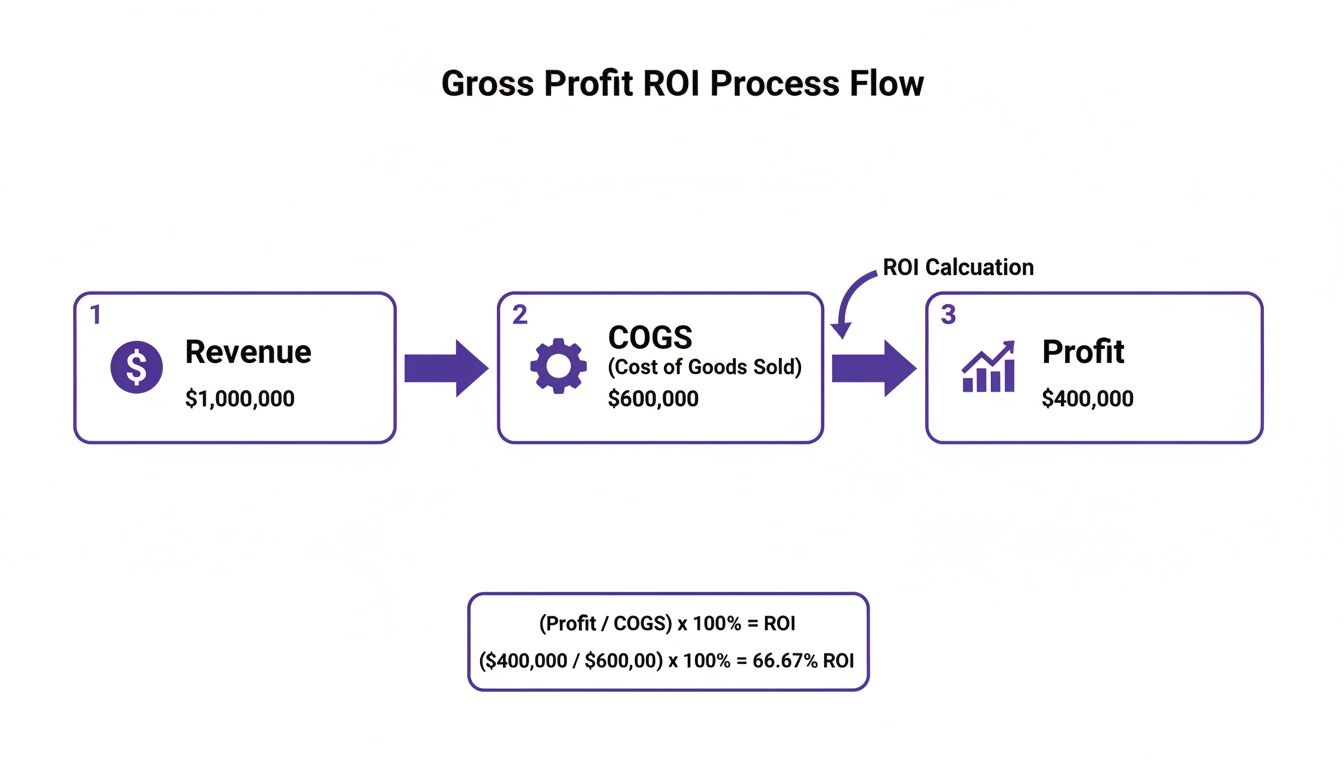
As you can see, you only get to true profitability after you've subtracted the direct costs of your products (COGS) from your total revenue.
Simple Models: First-Touch and Last-Touch
The two most straightforward ways to get started are with First-Touch and Last-Touch models. They're dead simple to implement and give you a quick look at performance from opposite ends of the customer journey.
- First-Touch Attribution: This model gives 100% of the credit to the very first marketing channel a customer ever interacted with. It’s brilliant for figuring out which channels are best at generating brand new awareness and bringing people into your world.
- Last-Touch Attribution: On the flip side, this model assigns 100% of the credit to the final touchpoint right before a customer converted. It's super useful for identifying what finally convinces people to click "buy."
For a Zanfia creator, a First-Touch model might show that your SEO-optimized blog posts are discovery powerhouses. But a Last-Touch model could reveal it's your weekly paid newsletter that consistently drives course sales.
Heads Up: While simple, these single-touch models have a massive blind spot. They completely ignore every other interaction a customer has along the way. This can cause you to seriously undervalue critical mid-funnel activities like webinars or your community engagement.
A More Balanced View: Multi-Touch Models
Most customer journeys are messy. People bounce between your channels over days, weeks, or even months. Multi-touch attribution models recognize this reality by spreading the credit across several different touchpoints.
There are a few popular multi-touch models, each giving you a different perspective:
- Linear Attribution: This one is the diplomat—it splits credit equally among all touchpoints. If a customer clicked a Facebook ad, read a blog, and then converted from an email, each channel gets 33% of the credit. It assumes every interaction was equally important.
- Time-Decay Attribution: Here, the touchpoints closest to the sale get the most credit. That final email might get 40%, the webinar from last week gets 20%, and the initial blog post from a month ago gets just 5%. This model gives more weight to the actions that pushed the customer over the finish line.
- Position-Based (U-Shaped) Attribution: This is a hybrid model that gives 40% credit to the first touch and 40% to the last touch, then splits the remaining 20% among all the interactions in between. It's great for businesses that value both discovery and conversion channels.
Multi-touch models give you a much more realistic picture of how your marketing works as a system. They help you appreciate how different parts of your marketing funnel all contribute to the final sale.
How to Choose the Right Model for Your Business
There's no single "best" attribution model. The right one for you depends entirely on your business goals and how long it takes for a customer to buy.
- If your main goal is brand awareness and lead generation, a First-Touch model is incredibly insightful. It shows you what's filling the top of your funnel.
- If you have a short, simple sales cycle (like selling a low-cost ebook), a Last-Touch model might be all you need to see what gets people to buy right now.
- For businesses with longer, more complex sales cycles—think high-ticket courses or annual community memberships—a Multi-Touch model like Time-Decay or Position-Based is essential. It provides the nuanced data you need to justify investing in nurturing activities that don't lead to immediate sales but are vital for long-term conversions.
By picking the right attribution model, you can finally move from guesswork to data-backed confidence. You'll be able to connect sales directly to your campaigns and calculate a marketing ROI that actually reflects reality.
The Long Game: Calculating ROI with Customer Lifetime Value
Focusing only on the first sale is like judging a movie by its opening scene—you miss the entire story. The most successful and sustainable online businesses are built on long-term relationships, not one-off transactions. This is where we need to shift our perspective from short-term wins to lasting profitability.
By weaving Customer Lifetime Value (CLV) into your ROI calculation, you start to see the true impact of your marketing. You begin to understand that acquiring the right customers—the ones who stick around—is far more valuable than simply making a quick sale. For creators building a business on community and repeat engagement, this is a total game-changer.
What Is Customer Lifetime Value?
Simply put, Customer Lifetime Value is a prediction of the total net profit you'll make from any given customer over their entire relationship with you. It answers the crucial question: "How much is one customer really worth to my business over time?"
For a creator selling a single e-book, the initial sale might be the end of the story. But if you’re running a paid community, a subscription newsletter, or a series of online courses on Zanfia, that first purchase is just the beginning.
A customer who buys your PLN 100 course today might subscribe to your PLN 50/month community for the next two years. Their immediate value is PLN 100, but their lifetime value is closer to PLN 1,300. This is the difference between surviving and thriving.
Knowing this number helps you make much smarter decisions about how much you can afford to spend to acquire a new customer. If you know a customer is worth PLN 1,300 over their lifetime, spending PLN 150 to acquire them suddenly looks like an incredible investment.
How to Calculate CLV for Your Digital Products
Calculating a precise CLV can get pretty complex, but for most creators, a simple, powerful formula is all you need to get started. This approach gives you a reliable estimate to guide your marketing strategy, especially if you have subscription-based products.
Here’s the straightforward formula to use:
CLV = Average Purchase Value x Purchase Frequency x Average Customer Lifespan
Let's break this down with an example of a creator running a paid newsletter on Zanfia.
- Average Purchase Value: This is just the average amount a customer spends each time they pay you. For a newsletter priced at PLN 49 per month, this value is easy.
- Purchase Frequency: How often does a customer buy from you in a specific period? For a monthly subscription, the frequency is 12 times per year.
- Average Customer Lifespan: This is the average length of time a customer stays subscribed. Let's say your analytics show that, on average, a member sticks around for 1.5 years.
Now, let's plug those numbers in:CLV = PLN 49 x 12 (per year) x 1.5 years = PLN 882
This tells you that, on average, each new subscriber you bring in is worth PLN 882 to your business over their lifetime. You can find a more detailed breakdown in our complete guide to calculating customer lifetime value.
Tying It All Back to Marketing ROI
Now for the magic. Once you have your CLV, you can create a far more insightful ROI calculation that reflects long-term profitability. Instead of using one-time revenue in your formula, you swap it out for CLV.
The new formula looks like this:
Long-Term ROI = (CLV – Marketing Cost) / Marketing Cost
Let’s see how this plays out by comparing two scenarios. Imagine you ran a campaign that cost PLN 5,000 and brought in 50 new subscribers to your PLN 49/month newsletter.
Short-Term ROI vs. Long-Term CLV-Based ROI
This table illustrates the dramatic difference between judging a campaign on its immediate results versus its true long-term value.
| Metric | Standard ROI Calculation | CLV-Based ROI Calculation |
|---|---|---|
| Revenue Generated | PLN 2,450 (50 subs x PLN 49) | PLN 44,100 (50 subs x PLN 882 CLV) |
| Marketing Cost | PLN 5,000 | PLN 5,000 |
| ROI Formula | (2,450 - 5,000) / 5,000 |
(44,100 - 5,000) / 5,000 |
| Calculated ROI | -51% | +782% |
Based on the short-term view, the campaign was a failure. You lost money and would probably stop running it.
But when you look at it through the lens of CLV, that "failed" campaign is revealed as your most profitable investment of the year. This long-game perspective is absolutely essential for building a resilient business. It gives you the confidence to invest in campaigns that attract high-value, loyal customers, even if the initial return isn't immediately spectacular.
Putting Theory into Practice: Tracking ROI with Zanfia Analytics
All the formulas in the world don't mean much until you can apply them to your own business. This is where the rubber meets the road—turning abstract ROI concepts into a repeatable process that actually helps you grow. The next logical step isn't more theory; it's finding a practical how.
For creators using Zanfia, this is the easy part. Our built-in analytics are designed to give you the exact numbers you need, right inside your dashboard. No more wrestling with complicated spreadsheets or expensive third-party tools. You can finally close the loop between running a campaign and seeing the financial results, all in one place.

Let's walk through a real-world scenario to see exactly how this works.
Finding Your Revenue: A Creator's Example
Meet Ania, a creator who just launched her first e-book, "The Community Builder's Blueprint," on Zanfia. To kick things off, she ran a targeted social media campaign for one month, spending PLN 2,000 on ads. Now, it's time to see if that investment paid off.
To get her revenue number, Ania just logs into her Zanfia dashboard and heads straight to the analytics section. From there, she can slice and dice her sales data with a couple of clicks:
- Product Filter: She selects her e-book.
- Date Range: She sets it to the exact month the ad campaign was running.
Instantly, the dashboard tells her the e-book brought in PLN 10,000 in direct sales during that period. That’s the "Revenue" figure she needs for her ROI formula. And because Zanfia has 0% platform fees, she knows that number is clean—the only deductions are the standard payment processing fees, giving her a crystal-clear picture of her earnings.
Connecting Sales to the Right Traffic Sources
Okay, so she knows the what (PLN 10,000 in revenue), but she needs to be sure about the where. Was it really the ad campaign that drove those sales? This is where attribution becomes critical.
Zanfia’s analytics give you that visibility, showing which channels are sending you visitors and, most importantly, which ones are actually converting.
A quick look at her traffic source data confirms it: 85% of her e-book sales came directly from visitors who clicked on her social media campaign links. This gives her the confidence to directly attribute that PLN 10,000 in revenue to her PLN 2,000 ad spend.
This is the kind of direct link between marketing effort and sales results that makes for an accurate, trustworthy ROI calculation. If you want to get even deeper into interpreting these numbers, our guide on how to analyze your website traffic is a great next step.
With both her revenue (PLN 10,000) and her marketing cost (PLN 2,000) clearly identified right inside Zanfia, Ania can now plug them into the formula:
(PLN 10,000 - PLN 2,000) / PLN 2,000 = 4
That's a 400% ROI. What was once a complex theory is now a simple, powerful, and data-driven tool she can use to make smarter decisions for her business.
Your Top Marketing ROI Questions, Answered
Let's dig into some of the most common questions creators and marketers run into when they first start measuring their marketing ROI.
How Often Should I Actually Calculate This Stuff?
There’s no one-size-fits-all answer here—it really depends on the rhythm of your business.
If you’re running a short, high-intensity campaign like a product launch, you’ll want to calculate your ROI the moment it wraps up. That gives you a clean, immediate snapshot of how it performed.
But for your long-game strategies, like SEO or content marketing, a quarterly check-in is usually best. It's a long enough timeframe to spot real trends and avoid getting bogged down by tiny, meaningless fluctuations. For most of us, though, a monthly review is the sweet spot. It keeps you on top of things and lets you make quick adjustments before small problems become big ones.
So, What’s a “Good” Marketing ROI Anyway?
Everyone wants that magic number, and while it varies, a 5:1 ratio is a solid benchmark to shoot for. That translates to a 500% ROI, or making PLN 5 for every PLN 1 you spend. Pretty great, right?
But context is everything. A 2:1 ratio could be a massive win for a business with high-ticket courses and a huge Customer Lifetime Value (CLV). On the other hand, if you're selling low-cost digital products, you might be aiming for a 10:1 ratio to make it worthwhile.
The real goal isn't hitting some arbitrary number. It's about making sure your ROI is consistently positive and, most importantly, always getting better.
Can I Calculate ROI for Things That Don’t Directly Make Sales?
Absolutely, you just have to think about it a little differently. For campaigns focused on things like brand awareness or boosting social media engagement, you need to track the leading indicators that eventually turn into revenue.
For example, let's say you run a campaign that doesn't sell a thing but gets you a ton of new email subscribers. If you know from past data what an average subscriber is worth to your business over time, you can assign a real dollar value to that campaign's success. It’s not as direct as a sales-based ROI, but it’s a smart way to prove the value of all that crucial top-of-funnel work.
Ready to stop guessing and start measuring what actually moves the needle? Zanfia gives you all the tools you need—from sales analytics to community engagement—in one place. You can finally see exactly what’s driving your business forward.