

How to Make Money by Digital Marketing: A Modern Creator’s Guide
Let's get straight to the point: the key to making money with digital marketing isn't about chasing algorithms or mastering a dozen different platforms. It's about packaging what you already know into a digital product that solves a real problem for a specific group of people.
We're talking about building a real business around your expertise—think online courses, paid communities, or premium newsletters—not just collecting likes and shares.
Your Blueprint for Digital Marketing Monetization
Feeling swamped by all the different ways to supposedly make money online? You're not alone. The secret is to stop chasing random tactics and start building a reliable business system. This isn't some get-rich-quick scheme; it's a proven framework for turning your knowledge into a sustainable income stream.
It all starts with a simple mindset shift: you’re not just a creator anymore. You’re a business owner.
The entire process boils down to three key pillars: identifying your expertise, packaging it into a product, and connecting it to the right audience. Whether you're a seasoned expert or just starting to map out your skills, this model works. Your job is to create something so valuable that people are happy to pay for it.
Identifying Your Most Profitable Knowledge
Before you can sell anything, you have to get crystal clear on the unique value you offer. What specific problems can you solve? What results can you deliver? Your most profitable skill isn't always what you assume; it’s what your audience is desperately looking for a solution to.
This is the foundation. Getting this right is everything. To position yourself effectively, it helps to understand some proven digital marketing strategies for small businesses so you can see where your expertise fits in the market.
Think about it: What questions do people ask you all the time? What’s the one skill you’ve spent years perfecting? That’s where your first product idea is hiding.
This diagram shows how simple the blueprint really is. It’s about finding the sweet spot where your expertise, your product, and your audience all meet.
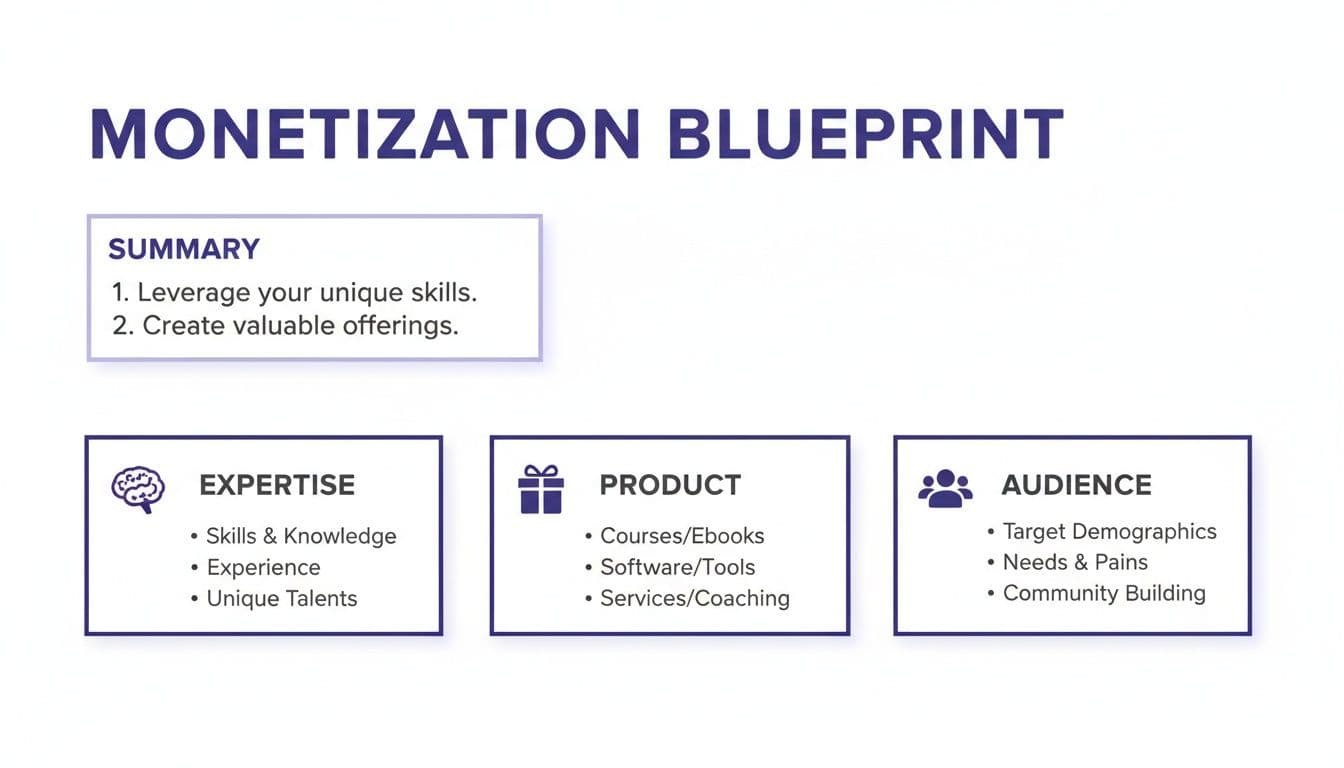
Success happens right at that intersection—what you know, how you sell it, and who you sell it to. It's that simple.
Choosing Your Monetization Path
Once you’ve pinpointed your core expertise, it’s time to choose the right vehicle to deliver it. The magic of digital products is their scalability. You build it once and can sell it over and over again.
Here’s a quick comparison of popular digital product models to help you find your ideal starting point.
Digital Monetization Models at a Glance
| Monetization Model | Best For | Effort to Create | Revenue Potential |
|---|---|---|---|
| Online Courses | Teaching a complex, step-by-step process with a clear outcome. | High | High |
| Paid Communities | Fostering connection, ongoing support, and exclusive access. | Medium | Medium (Recurring) |
| Digital Downloads | Offering templates, e-books, or guides as a low-cost entry point. | Low | Low to Medium |
| Paid Newsletters | Delivering premium, niche insights directly to subscribers' inboxes. | Low to Medium | Medium (Recurring) |
| 1-on-1 Coaching/Services | Providing high-touch, personalized solutions for a premium price. | Low (per client) | Very High |
This table should give you a good sense of where you might start. But remember, the most successful creators don't just stick to one model. They build a complete ecosystem.
They might use a low-cost e-book to bring in new customers, then upsell them into a signature course, and finally invite them into an exclusive community for recurring revenue and ongoing support.
This is exactly the kind of stack an all-in-one platform like Zanfia is built for. Zanfia positions itself as an AI team running the business day to day, and it lands that work in the surfaces creators actually sell through: courses, communities, paid newsletters and digital products, all under your own brand. You can dictate actions to the assistant by chat or by voice instead of clicking through menus, and the checkout is built to sell with order bumps, installments and subscription upsells so a $600 course can be split into four payments at the same page.
If you want to go deeper on this, we've broken down exactly what content monetization is and how to apply it.
Choosing Your Profitable Digital Product

You've got the blueprint, now it's time to pick the right vehicle for your expertise. Profitable digital products live at the intersection of your unique skills, what your audience desperately needs, and your long-term vision.
This is where you decide how to package your knowledge into something that feels authentic and, more importantly, scalable. Let's dig into the models that actually work.
Transform Knowledge into High-Value Online Courses
Online courses are the powerhouse of digital monetization for a reason. They give you the space to teach a complex, step-by-step process that delivers a clear transformation for your students. If you have deep expertise in a specific area, a course is the perfect format to command a premium price.
The problem? The tech. So many creators get bogged down trying to stitch together separate tools for video hosting, payments, and student interaction. It gets expensive and confusing, fast.
This is where an all-in-one platform makes a world of difference. Zanfia hosts video natively on Bunny.net so you don't pay Vimeo or Wistia on the side, and the same AI team that runs your business can generate chapters, transcripts and summaries from the lesson you just uploaded. You dictate what needs to happen next, by chat or by voice, and it lands in the course your students already see.
Your students get a slick, seamless experience. A smart video player that automatically saves student progress is the kind of professional touch that makes a huge difference. As Przemysław Niemczuk of TreningBiegacza.pl praises, Zanfia's course module offers “simplicity and high functionality.”
Build and Monetize Exclusive Paid Communities
While courses are amazing for structured learning, paid communities create ongoing value and, critically, recurring revenue. A community is where your members connect, get support, and access exclusive content—fostering a powerful sense of belonging that keeps them subscribed month after month.
The classic mistake is building your community on a platform you don't own, like a Facebook Group or Discord. You're sending your paying customers away from your brand, giving up control, and ultimately building an asset for another company.
A much smarter approach is integrating your community directly with your other products. Imagine a student finishing a lesson and immediately jumping into a dedicated community channel to discuss it—all without leaving your site. This is exactly what a unified platform like Zanfia is built for, and there's an AI community agent that can draft posts from your own content (everything it publishes is clearly labeled as AI, so members always know what came from you and what came from the assistant).
- Integrated Learning: Connect discussion channels directly to your course modules or lessons.
- Tiered Access: Automatically grant access to specific community groups based on what a customer buys.
- Unified Brand Experience: Keep your audience under your custom domain, which strengthens loyalty and skyrockets member retention.
This unified model is a massive lever for boosting engagement and customer lifetime value—two metrics that are non-negotiable for a sustainable business.
Sell E-books, Newsletters, and Bundled Offers
Not every product needs to be a flagship course. E-books, digital downloads, and paid newsletters are fantastic, low-friction ways to monetize your expertise, especially for creators looking for the simplest way to launch their first product. As serial entrepreneur Artur Kurasiński notes, Zanfia is “the most convenient and simplest solution for paid newsletters, courses and community on the Polish market.”
The real magic happens when you start combining these different products. Zanfia lets you sell 12 different product types under one brand—courses, communities, newsletters, memberships, downloads, ebooks, consultations, bundles and more—so you don't need three tools stitched together. An integrated e-commerce system lets you create flexible offers for different customer segments and budgets:
- One-Time Purchases: Perfect for e-books, templates, and standalone mini-courses.
- Subscriptions: The go-to model for paid newsletters and ongoing community access.
- Installment Plans: Make your high-ticket courses more accessible by letting customers pay over time.
- Product Bundles: Skyrocket your average order value by packaging a course, e-book, and community access into one irresistible offer.
This kind of flexibility is essential for maximizing revenue, especially when paired with a platform that charges 0% platform fees on customer sales today. Where competitors take a cut of every transaction, Zanfia's SaaS subscription model means you only pay the standard payment processor fee (Stripe is roughly 2.9% + $0.30 in the US). That's a huge lever for protecting your margins as you scale.
Building an Audience That Is Eager to Buy

Let's be blunt: a brilliant digital product is just a collection of files until it connects with an audience. Your entire monetization plan rests on building a tribe of people who not only trust you but are genuinely excited to buy from you. Forget vanity metrics. We're here to build real connections that convert.
This isn't about shouting into the void and hoping for the best. It’s about building a methodical system that attracts your ideal customer, establishes your authority, and nurtures a relationship long before you ever ask for the sale.
Establish Authority with Content Marketing
The fastest way to earn trust is to give away your expertise for free. Consistent, high-value content—whether it's blog posts, videos, or podcasts—is the engine for your audience growth. By solving real problems for your audience at no cost, you instantly demonstrate your value and become their go-to resource.
Think of it this way: your free content answers the "what" and "why," proving you're the right guide. Your paid products deliver the "how." For a deeper dive on building this engine, check out our guide on how to create a content strategy that actually works.
Get Discovered with Targeted SEO
Creating incredible content is pointless if your ideal customers never find it. Search Engine Optimization (SEO) is the mechanism that puts your content in front of people at the exact moment they're searching for a solution you provide.
This isn't about stuffing keywords. It’s about understanding user intent.
Focus on long-tail keywords—those specific, multi-word phrases that signal a user is deep in the research phase. Instead of targeting a broad term like "fitness," you’ll get far more qualified traffic by aiming for "at-home workout plan for busy moms." This attracts a motivated audience that is much closer to making a purchase.
When you consistently publish in-depth content that answers specific questions, you start ranking. This creates a predictable, organic flow of traffic from people actively looking for exactly what you offer.
Turn Followers into Community with Social Media
Social media is not a billboard; it’s a conversation. Use it to engage, ask questions, share behind-the-scenes content, and build genuine rapport. The goal is to evolve from a faceless brand into a trusted advisor people feel they know.
Forget chasing viral trends. Focus on creating content that sparks discussion and delivers real value.
- Share expert snippets: Pull quick, actionable tips from your courses or blog posts.
- Ask engaging questions: Get your audience talking about their biggest challenges.
- Show your personality: People connect with people. Let them see the human behind the brand.
Every interaction is an opportunity to strengthen that connection and guide people from rented land (social media) to your owned platforms.
Own Your Audience with an Email List
Your email list is, without question, the single most valuable asset in your digital business. You own it. No algorithm can suddenly throttle your reach. It's a direct, unfiltered line to your most engaged followers.
The primary goal of your content, SEO, and social media efforts should be to drive email subscriptions. Offer a valuable "lead magnet"—a checklist, template, or mini-guide—in exchange for their email.
Once someone subscribes, you can nurture that relationship with regular, high-value emails. This direct line of communication builds immense trust, so when you launch a product, you have an audience that's already sold on your expertise. This is the core pillar of how to make money by digital marketing effectively.
Crafting Your Sales Funnel and Setting Your Price

You’ve got a great product and a growing audience. Now for the real work: turning a casual follower into a paying customer. This journey is your sales funnel, and building a good one is what separates creators with a hobby from those with a business.
Think of it as the path you lay out for people. Your content grabs their attention, your email list builds trust, and your sales page seals the deal. It's a deliberate process designed to guide someone from "What's this?" to "I need this."
Designing Your Offer and Pricing Strategy
Pricing is more than just a number—it’s a signal of value. The way you structure your offers can make or break a sale, so your goal is to provide options that fit different budgets and needs.
This is where an all-in-one platform like Zanfia becomes your secret weapon. It gives you the power to create a flexible pricing strategy right from the start, which is a massive part of learning how to make money with digital marketing.
You can mix and match different payment models to maximize conversions:
- One-Time Purchases: Perfect for e-books, templates, or a single workshop. It’s a straightforward transaction and an easy entry point for new customers.
- Subscriptions: The engine of predictable, recurring revenue. This is a must-have for paid communities, newsletters, or ongoing content access. It creates a stable financial foundation.
- Installment Plans: Don’t let a high price tag scare people away. Splitting a $600 course into four monthly payments at the same checkout can dramatically lift your conversion rates.
By offering a mix, you cater to a wider audience and avoid leaving money on the table.
The Psychology of Bundling and Upsells
One of the quickest ways to boost your average order value (AOV) is with smart bundling. Instead of just selling a course, why not create a bundle? Package the course with a related e-book and a month of community access for a single, compelling price.
When your platform makes this easy, you can combine products into irresistible offers without any tech headaches. Order bumps at checkout let you offer a coaching call or a template pack right next to the main product, with separate invoicing per add-on, and subscription upsells turn a one-time buyer into recurring revenue on the same page. The customer's focus shifts from the cost to the incredible value they're getting in one shot.
This is a go-to strategy for top-tier creators. They know that a customer who has already decided to buy is in the perfect mindset to spend a little more for a lot more value. A simple bundle or upsell at checkout can bump your revenue by 10-30%.
Removing Friction at Checkout
Every click, every field, every extra step in the checkout process is a chance for a customer to abandon their cart. A clunky or untrustworthy payment page will kill your sales, no matter how amazing your product is. Make it effortless for people to give you money.
This is why native payment gateway integrations are essential. When US customers see familiar, trusted options like Stripe and PayPal, with Apple Pay and Google Pay right on the checkout, it builds instant credibility and cuts friction to almost nothing.
Before you ever run traffic to a paid ad, Zanfia lets you open the real checkout in test mode through a shareable link. You run a test purchase yourself, GA4 events show up in DebugView with no setup, Meta and TikTok pixels accept an optional test event code so the live pixel stays clean, and the test orders stay hidden from your real order list. That way you catch a broken funnel before you spend a dollar on ads, not after.
Automating Your Business for Growth and Freedom
The secret to scaling your online business without burning out isn't working harder. It's automation. As a creator, your time is your most valuable asset—time that should be spent on your craft, not lost in a sea of administrative chores.
Too many entrepreneurs get trapped in the manual grind. They're answering the same onboarding emails, granting course access one by one, and chasing down invoices. This isn't just exhausting; it puts a hard ceiling on your growth.
The solution is to build a business that works for you, even when you aren't. By setting up smart automations, you can reclaim 5–10+ hours every single month while delivering a flawless, professional experience to your customers 24/7. This is how you build a business that lasts.
Key Automations to Set Up Immediately
Let's focus on the workflows that give you the biggest return on your time. The goal is to automate the entire customer journey, from the moment someone clicks "buy" to the second they feel welcomed into your world.
This is where an all-in-one platform like Zanfia really shines. It handles these critical handoffs through a visual Workflows builder, with triggers for purchase, subscription renewed, access ending in 14/7/3/1 days, failed payment, trial started, and more. If you'd rather skip the click-through, you can just tell the assistant what to automate, out loud, and it wires the workflow up for you.
Here are the essential automations every creator needs to have running:
- Instant Access After Purchase: The second a customer buys your course or digital download, they should get access. Automating this eliminates frustrating delays and support tickets, creating an incredible first impression.
- Automated Community Onboarding: Stop manually adding new members to your community channels. A simple workflow can automatically add buyers to the right groups based on the specific product they purchased.
- Triggered Welcome Email Sequences: A new customer is at their peak level of excitement. Zanfia syncs tags, lists and custom fields into your email tool (ActiveCampaign, Kit, Mailchimp, MailerLite, and more), so the welcome series you already send fires the moment they buy.
Just these three automations alone can take your customer experience from amateur to pro overnight.
As EFL teacher Mateusz Grzywiński confirms, “If you plan to sell digital products and build a community of paying customers, Zanfia is a great solution.” The "peace of mind" that veteran developer Daniel Roziecki highlights comes directly from letting these powerful automations handle the busywork.
Automating the Back-End Admin Work
Automation isn't just for your customers; it's also your best weapon against the tedious back-end work that comes with running a business. Juggling payments, subscriptions, and access management can quickly become a full-time job if you let it.
This is another area where an integrated platform is a game-changer. Instead of wrestling with separate tools that don't talk to each other, you can run everything from one central hub, and expose the whole workspace to your AI assistants through Zanfia's MCP endpoint if you want to go further (availability depends on the plan, see the current Zanfia pricing).
Here are the back-end automations to get in place:
- Subscription Management: Let the system handle recurring payments, send reminders for expiring credit cards, and manage access based on subscription status. This makes your recurring revenue stable and predictable.
- Outbound Webhooks: Fire GET or POST calls to any external system you already use (accounting, CRM, fulfillment) the moment an event happens on Zanfia, with Basic auth, Bearer or an API key. Your invoicing tool, your dashboard, or your own scripts get the data without you touching a spreadsheet.
- Access Revocation: What happens when a subscription ends or you issue a refund? A smart system automatically revokes access to the course or community, closing the loop with zero manual effort from you.
By setting up these workflows, you're not just saving time—you're building a resilient, scalable business engine. If you want to dig deeper, you can learn more about how to automate your business and unlock even more freedom.
Optimizing Your Strategy with Analytics
Launching your digital product is a massive milestone, but it's the starting line, not the finish. The real key to scaling your income—and learning how to make money with digital marketing for the long haul—comes from what you do next. It's time to stop guessing and start measuring.
This is where you graduate from being just a creator to a data-savvy business owner. Instead of feeling buried in spreadsheets, you can use a few key numbers to find the hidden growth levers in your business. A clear, data-driven strategy is what separates the creators who thrive from those who just get by.
Identifying Key Funnel Metrics
To really optimize your business, you need to track the right metrics at each stage of your sales funnel. This isn't about collecting data for its own sake; it’s about pulling out actionable insights that lead directly to more revenue. Thankfully, integrated analytics dashboards make this way easier than it sounds.
Start by zeroing in on these core areas:
- Landing Page Conversion Rate: What percentage of people hitting your sales page actually click the "buy" button? This is your first and most important truth-teller about how well your offer and messaging are landing.
- Checkout Abandonment Rate: How many people add your product to their cart but never finish the purchase? A high number here is a massive red flag, often pointing to friction in your payment process.
- Customer Lifetime Value (CLV): What is the total revenue you can realistically expect from a single customer over their entire journey with you? Increasing your CLV is the secret to building a sustainable, long-term business.
These numbers tell a story. By watching them closely, you can spot problems and opportunities before they get out of hand.
Finding and Fixing Bottlenecks
Your analytics will quickly shine a spotlight on "bottlenecks"—the exact points in your funnel where you're losing potential customers.
A low landing page conversion rate could mean your sales copy isn't hitting the mark, or maybe your price is creating sticker shock. High cart abandonment might signal a clunky checkout flow or a lack of trusted payment options like Apple Pay or Google Pay.
Once you spot a bottleneck, you can start testing solutions. This is where A/B testing becomes your absolute best friend. You can create two versions of a sales page with one single change—a new headline, a different call-to-action, a new testimonial video—and let the data tell you which one performs better.
Platforms with built-in analytics, like Zanfia, give you this visibility without needing to stitch together complex third-party tools. GA4, Meta Conversions API, TikTok, X and LinkedIn all fire from Zanfia by default, and Microsoft Clarity and Hotjar run session recordings and heatmaps on your checkout pages, so you can literally watch where people hesitate before they leave.
Analyzing Engagement to Reduce Churn
For courses and communities, your work is far from over once the sale is made. You have to keep your members engaged to reduce churn and maximize their lifetime value. Dive into your engagement analytics to understand exactly how customers are interacting with your content.
Ask yourself:
- Which course lessons have the highest completion rates?
- Which community channels are sparking the best discussions?
- Where are students dropping off inside the course?
This information is pure gold. It tells you exactly what content resonates with your audience and what needs to be fixed. If you see a huge drop-off after a specific module, it might be too complex, too long, or just not relevant enough.
By continuously refining your product based on real user behavior, you create a better experience. That leads to happier customers, glowing testimonials, and—you guessed it—more sales.
Frequently Asked Questions
Let's tackle some of the biggest questions that pop up when you're first figuring out how to make money with digital marketing.
How Much Money Can I Realistically Make?
This is the big one, isn't it? The honest answer is: it depends entirely on your niche, the size of your engaged audience, and the real value you deliver.
When you're just starting, a few hundred dollars a month is a fantastic and realistic goal. But as you build, the ceiling gets much, much higher. Established experts on platforms like Zanfia routinely run five- and six-figure monthly businesses on top of courses, communities and subscriptions combined.
The secret isn't a magic trick. It's a focus on building a real community and offering high-value digital products—think courses and memberships—that create a sustainable, recurring revenue engine. As of publication, Zanfia charges 0% platform commission on customer sales, so 100% of that revenue stays with you (only the payment processor takes its standard cut).
Do I Need a Huge Social Media Following to Start?
Absolutely not. Forget vanity metrics. A small, fired-up audience of 1,000 "true fans" who hang on your every word is infinitely more valuable than 100,000 passive followers who barely notice you.
Your real focus should be on building a targeted email list and a private community. Why? Because you own that relationship. These are the channels where you can have direct conversations and build trust, and they consistently crush social media on conversion rates. An all-in-one platform lets you build this community under your own brand and domain from day one, and every plan starts with a 14-day free trial with no credit card required, so you can test the fit before you commit.
What Is the Best Digital Product to Sell First?
Don't try to build your magnum opus right out of the gate. For most creators, the smartest first move is a smaller, focused digital product.
Think about a high-value e-book, a punchy mini-course, or a paid live workshop. This is your low-risk way to dip your toes in the water, especially for "Potential Explorers" who are overwhelmed by tech. You get to test your topic, see if people will actually pay for it, and build your own confidence before you sink hundreds of hours into a massive flagship course. Getting that first sale is a huge milestone, and the feedback you'll gather is priceless.
Ready to turn your expertise into a scalable business with 0% platform transaction fees on customer sales? See how Zanfia puts an AI team behind your courses, community and checkout, so you can dictate the work by chat or by voice and let it land where it sells. Start your 14-day free trial with Zanfia today.