

What Is Customer Experience Management And Why It Matters For Creators
Ever heard the term Customer Experience Management (CEM)? It sounds like something reserved for big corporations with entire departments dedicated to it, but the truth is, it’s one of the most powerful tools a digital creator can have.
At its core, CEM (or CXM) is the art of intentionally mapping out every single interaction someone has with your brand and making each one feel seamless, valuable, and genuinely human. It’s about zooming out from the individual product—your course, your newsletter, your community—and looking at the entire journey. From the first time someone sees your Instagram ad to the support email they send six months later, every moment matters.
Unpacking The Customer Journey

Think of yourself less as a creator and more as the host of a fantastic party. Your product is the main event, sure, but the experience starts the moment someone gets the invitation. Is it easy to find the venue? Is the welcome warm? Is it easy to get a drink? That whole vibe—that’s customer experience management.
This journey starts long before anyone clicks "buy." It's a series of moments, or “touchpoints,” that build on each other:
- Discovery: The moment a potential fan stumbles upon your work—a shared social media post, a mention on a podcast, or a targeted ad. What's their first impression?
- Consideration: They’re intrigued. Now they’re on your landing page, reading your free newsletter, or looking over your course syllabus. Is the information clear and compelling?
- Purchase: How smooth is your checkout process? Is it confusing? Does it feel secure? A clunky payment page can kill a sale instantly.
- Onboarding: The sale is done! What happens next? A generic receipt, or a thoughtful welcome email that shows them exactly how to access their new course or community?
- Engagement: Now they’re in. This is everything from their interactions in your community forum to the video quality in your lessons and the helpfulness of your support.
Each of these touchpoints is a chance to either build trust or create friction. A smooth, connected journey turns a one-time buyer into a loyal advocate, while a frustrating one can make them regret their purchase, no matter how good your content is.
To help visualize this for your own business, here’s a breakdown of common touchpoints for creators.
Key Customer Touchpoints For Digital Creators
This table outlines some of the most common interaction points where you can apply CEM principles to create a better experience for your audience.
| Touchpoint | What It Looks Like | Impact On Experience |
|---|---|---|
| Social Media Post | A video reel, a helpful thread, or an Instagram story. | Sets the initial tone and showcases your expertise and personality. |
| Landing Page | The sales page for your course or digital product. | Must be clear, persuasive, and answer key questions to build trust. |
| Checkout Process | The cart and payment gateway, including order bumps and installment plans. | A simple, secure, and fast process reduces cart abandonment and lifts average order value. |
| Welcome Email | The first email after purchase. | A warm, informative welcome sets a positive tone for the relationship. |
| Course Platform | The user interface where they access lessons. | An intuitive, easy-to-navigate platform enhances the learning process. |
| Community Forum | A Discord server, Slack channel, or built-in forum. | A well-moderated and engaging space fosters connection and belonging. |
| Customer Support | Replying to DMs, emails, or community questions. | Fast, empathetic support turns potential problems into loyalty-building moments. |
By consciously thinking through each of these stages, you move from just selling things to building a cohesive brand world that people want to be a part of.
The Mindset Shift From Product To Experience
In a market flooded with content, your product alone often isn't enough to stand out. The real competitive advantage comes from the experience you build around it. CEM is fundamentally about figuring out how to improve customer satisfaction at every single one of those touchpoints.
It's a proactive mindset. Customer service reacts to problems after they happen. Customer experience management designs a journey so intuitive and positive that problems rarely come up in the first place.
For a solo creator or a small team, this isn’t some complicated corporate flowchart. It’s simply about putting yourself in your audience's shoes and making them feel seen, heard, and valued. When you manage the full experience, you’re not just selling a course; you’re building a thriving community. If you want to dive deeper into that piece of the puzzle, our guide on what is community management is a great next step.
This shift is what turns one-off transactions into genuine, long-term relationships—the absolute bedrock of a sustainable creator business.
Why A CEM Strategy Is Your Greatest Competitive Advantage
In a jam-packed digital world, your course or e-book isn't enough to stand on its own. The real magic—the thing that builds a lasting, defensible business—is the experience you wrap around your product. A smart customer experience strategy isn't just some corporate buzzword; it’s the engine that powers sustainable growth.
When people have a positive, frictionless journey with you, they don't just buy once. They stick around. This directly fuels your most important metrics, turning one-time customers into a reliable stream of recurring revenue.
Investing in customer experience isn’t an expense. It's a high-return strategy that builds a protective moat around your brand, making you the only logical choice in your niche.
This commitment to the end-to-end journey is what separates thriving creators from those constantly scrambling for new customers. It's a fundamental shift from chasing short-term sales to building long-term relationships.
From One-Time Sales to Lasting Loyalty
Here’s a hard truth: getting a new customer can cost five times more than keeping an existing one. A CEM strategy is, at its core, a retention machine. By making sure every interaction is smooth and adds value—from an easy checkout to a warm welcome email—you give people compelling reasons to stay.
This loyalty pays off in a higher Customer Lifetime Value (LTV). A happy member who feels seen and supported is far more likely to renew their subscription, buy your next course, or upgrade to a premium community. They stop seeing you as just a vendor and start seeing you as a trusted guide. For a deeper look at this key metric, check out our guide on Customer Lifetime Value calculation.
Turning Customers Into Your Best Marketers
One of the most powerful results of a killer customer experience is something you can't buy: genuine, word-of-mouth marketing. When someone has a fantastic experience, they become a walking billboard for your brand—a true fan who happily sings your praises for free.
Just think about it:
- They’ll be the one recommending your course in a crowded Facebook group.
- They’ll share their wins and tag you on social media.
- They’ll tell their friends and colleagues they have to join your community.
This kind of social proof is infinitely more powerful than any ad you could run because it's built on trust. The platforms that win here become the most convenient and simplest solution on the market because they deliver an experience worth talking about.
The Profitability of a Great Experience
Focusing on the customer journey isn't just about warm fuzzies; it hits the bottom line. Hard. Market data shows that companies that put the customer first are 60% more profitable than those that don't. This isn't a coincidence. It's a clear signal that the best brands now compete on the quality of their experience, not just the features of their products. You can find more stats on this trend and others over at scoop.market.us.
For a digital creator, this means every hour you spend tweaking your course platform for better usability or setting up a helpful automated email is a direct investment in your profitability. Choosing a platform with a 0% platform fee model, like Zanfia, further protects your margins on the revenue earned from your excellent customer experience.
At the end of the day, a CEM strategy is your greatest competitive advantage because it’s nearly impossible to copy. A competitor can rip off your course topic or mimic your sales funnel, but they can't replicate the trust, loyalty, and community you build through a thousand tiny, positive interactions. It’s what makes your brand a strong choice for creators who want a resilient business that can weather any storm.
The Core Pillars Of A Modern CEM Program
Building a standout customer experience program isn’t about throwing a huge budget or a massive team at the problem. It’s about having a simple, actionable framework that actually guides your decisions. For digital creators, this whole sophisticated concept can be boiled down to four core pillars that make it feel achievable and impactful.
Think of these pillars as the foundation of a sturdy bridge connecting you to your audience. Each one is essential for creating a smooth, reliable journey that turns a one-time buyer into a loyal, paying community member for life.
Pillar 1: Deeply Understand Your Customer
The first and most critical pillar is about going way beyond surface-level demographics. You have to truly get inside your customer’s world. It’s not enough to know their age or where they live; you need to grasp their goals, their biggest frustrations, and the exact path they take when they interact with your brand.
This means you need to map out their journey from start to finish. Where do they get stuck? Which parts of your course do they binge-watch or keep replaying? Finding these friction points and moments of delight lets you make surgical improvements. For instance, analytics inside your course platform might show a huge drop-off rate on a specific lesson—a clear signal that it needs to be simplified or re-recorded.
Pillar 2: Design Seamless Interactions
Once you understand the journey, the next job is to make every single interaction feel effortless. A seamless experience means bulldozing any obstacle standing between your customer and their goal, whether that’s buying your e-book or just trying to find lesson three of your flagship course.
This pillar is all about operational excellence. Look at your checkout process—is it a one-click breeze, or does it feel like filling out a tax return? After someone buys, is access to the product immediate and obvious? Zanfia is built around this idea: an AI team runs the business for you, you can dictate what happens next by chat or voice instead of clicking through settings, and the checkout is built to sell with order bumps, installments and test mode so you can buy your own product before launch. Automations instantly grant course access after payment and add a new member to the right community channel, so the professional, frustration-free experience happens without your input every time.
A great customer experience feels invisible. When every step is logical and effortless, the customer doesn't notice the technology; they only notice the value you're providing.
Pillar 3: Gather And Act On Feedback
You can’t improve what you don’t measure. The third pillar is about creating systems to consistently gather feedback and—this is the important part—actually act on it. This is what turns customer experience from a guessing game into a data-backed strategy.
Feedback isn't just about sending out a survey once a year. It's about creating ongoing loops that catch insights right where they happen.
- Community Discussions: Your community is an absolute goldmine of real-time feedback. Pay close attention to the questions people ask, the features they request, and the challenges they're constantly running into.
- Simple Surveys: Use tools to fire off short, targeted surveys after someone finishes a course or has a support interaction to see how things went.
- Direct Conversations: Never underestimate the power of just asking. A quick DM or a simple poll in your community can reveal more than a 20-question survey ever could.
The key is to close the loop. When a customer suggests an improvement and you actually implement it, tell them! This proves you’re listening and makes them feel like a valued partner in your brand’s growth. It's crucial to have a central spot for this info, and you can learn more about this in our guide on how to create a knowledge base to organize feedback and FAQs.
Pillar 4: Personalize Their Journey
Finally, the fourth pillar ties everything together by using all that data and insight to make each customer feel seen as an individual. In the creator world, personalization isn't about using a [first_name] tag in an email; it's about delivering the right thing at the right time.
Use the data you have to tailor the experience. For example, automation can trigger a personalized welcome email sequence based on the specific product someone just bought. If a student is stuck halfway through a course, you could send a motivational nudge or a link to a helpful resource in the community. This level of thoughtful communication shows you get their journey and are invested in their success, transforming a simple transaction into a real relationship.
Key Metrics To Track Your Customer Experience Success
Creating a great customer experience is one thing, but how do you actually know if it’s working? You don't need a data science degree to figure this out. The truth is, effective customer experience management comes down to tracking a handful of key metrics that tell a clear story about what your audience is feeling.
Think of these metrics as your business's compass. They guide you toward smarter decisions, helping you pinpoint what's clicking with your community and what's causing friction. Without them, you're just guessing.
The visual below breaks down the core pillars of a CEM program. The "Gather" and "Personalize" stages are where metrics become absolutely essential—they’re how you turn feedback into action.
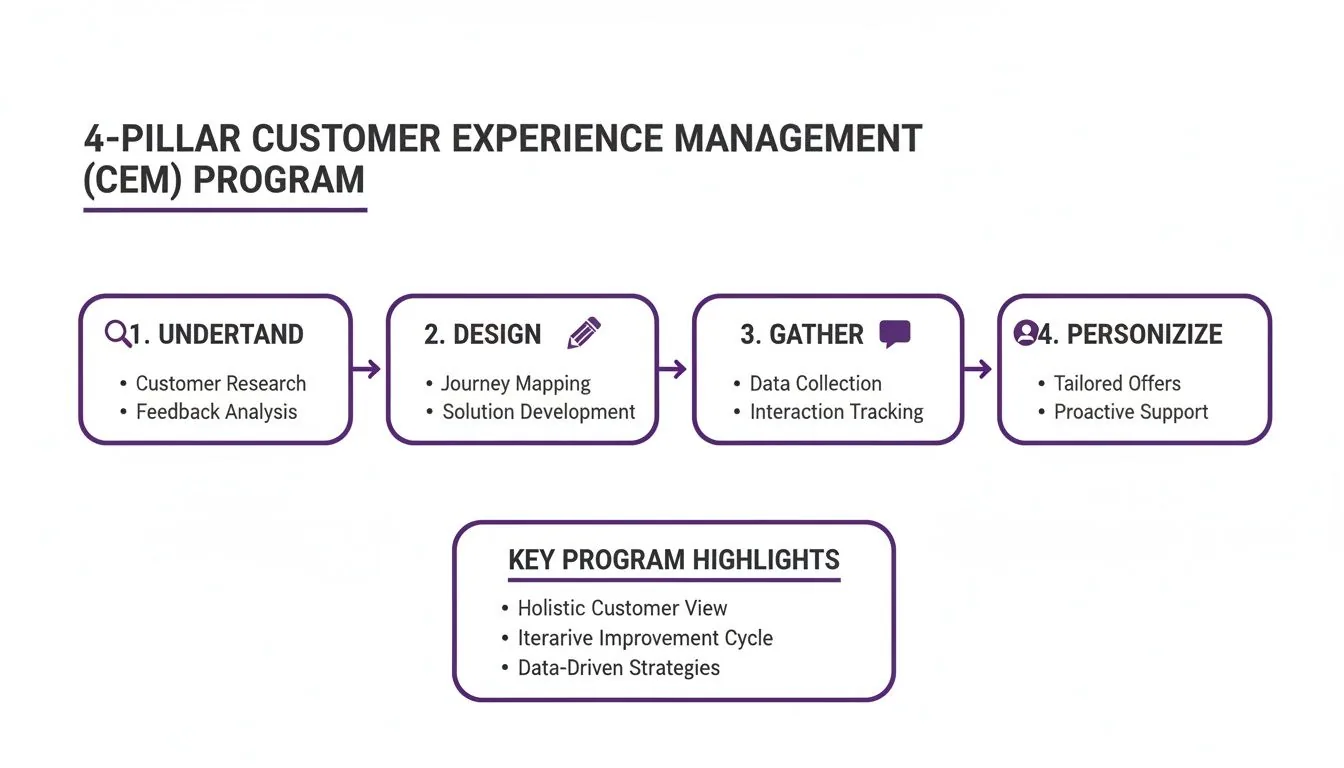
This framework isn't just a theoretical model. It shows that gathering feedback and personalizing the journey are the engine of great CEM, and metrics are the fuel that makes it all run.
Foundational CX Metrics
Let's start with the basics. These are the direct feedback metrics that capture how your customers feel in the moment. They are your first line of defense for understanding how people perceive their interactions with your brand.
- Customer Satisfaction (CSAT): This is the most straightforward of the bunch. You simply ask, “How satisfied were you with this experience?” right after an interaction, like finishing a course module or getting a support question answered. It’s perfect for getting a quick pulse check on specific touchpoints.
- Net Promoter Score (NPS): NPS is all about measuring loyalty with one powerful question: “On a scale of 0-10, how likely are you to recommend our brand to a friend?” This single question segments your audience into Promoters (9-10), Passives (7-8), and Detractors (0-6), giving you a high-level snapshot of your brand's health.
- Customer Effort Score (CES): This one asks, “How easy was it to get your issue resolved?” CES is a fantastic predictor of loyalty because it hones in on a universal truth: people hate friction. The less effort someone has to put in to get value, the more likely they are to stick around.
CEM Metrics At A Glance
To make it even clearer, here’s a quick-reference guide to these essential customer experience metrics. Think of this table as your cheat sheet for asking the right questions.
| Metric | What It Measures | How To Ask It | Why It Matters |
|---|---|---|---|
| CSAT | Short-term happiness with a specific interaction. | "How satisfied were you with your recent [interaction]?" | Pinpoints specific moments of friction or delight. |
| NPS | Overall brand loyalty and advocacy. | "How likely are you to recommend us to a friend?" | Predicts long-term growth and word-of-mouth marketing. |
| CES | The ease of a customer's experience. | "How easy was it to [get your issue resolved]?" | High effort is a leading cause of churn. |
These three metrics give you the "what" and the "how"—what people feel and how easy it was. Now, let's connect that to the numbers that really drive your business.
Business-Focused Success Metrics
While sentiment scores are vital, they don't tell the whole story. You have to connect those feelings to tangible business outcomes that directly impact your revenue and growth.
A high NPS score is nice, but a low churn rate pays the bills. The goal is to use sentiment data to improve the business metrics that truly matter.
Here are the key business numbers to watch:
- Churn Rate: This is the percentage of your members or subscribers who cancel over a specific period. For any creator with a recurring revenue model, this is one of the most critical health indicators you have. A high churn rate is almost always a symptom of a poor customer experience.
- Customer Lifetime Value (LTV): LTV represents the total revenue you can expect from a single customer over their entire relationship with you. A great experience keeps people coming back for more, which directly increases LTV. If you want to get a real handle on this, start by learning more about the Customer Lifetime Value calculation.
These metrics move beyond feelings and into financial health. They prove that investing in your customer's experience isn't just a "nice-to-have"—it's a direct investment in your business's future.
How To Build Your First CEM Strategy Step-By-Step
Moving from knowing what Customer Experience Management is to actually building a strategy can feel like a massive jump. But it doesn't have to be some overly academic, complicated process.
Let's break it down into a clear, step-by-step roadmap. This is your guide to turning theory into action, with five practical steps to launch a CEM plan that works for you, not against you.
Step 1: Map Your Customer Journey
Before you can fix or improve anything, you have to see the whole picture. The first, most crucial step is to map out every single touchpoint someone has with your brand—from the second they discover you to long after they’ve become a customer.
Seriously, grab a whiteboard or just a plain document and trace their path. Ask yourself what happens at each stage:
- Discovery: How are people finding me in the first place? (Social media, ads, a friend's recommendation?)
- Consideration: What's the next thing they do? (Visit my site, sign up for the newsletter, watch a video?)
- Purchase: What is the checkout experience really like? (Is it seamless and secure, or clunky and confusing?)
- Onboarding: What happens the moment after they buy? (Do they get a clear welcome email or just… silence?)
- Engagement: How do they use my course or community? (Is the platform actually easy to get around?)
This simple exercise is incredibly revealing. It will immediately show you where your brand shines and, more importantly, expose the friction points that need your attention. A confusing post-purchase experience is one of the most common pitfalls, which is why a solid process matters so much. You can learn more about this crucial first step in our guide on what is customer onboarding.
Step 2: Set Clear CX Goals
With your journey map complete, you can now set specific, measurable goals. Vague ambitions like “make customers happier” are impossible to track and act on. Your goals need to be tied to tangible outcomes.
Good CX goals sound like this:
- “Reduce support tickets about course access by 20% in the next quarter.”
- “Boost my course completion rate by 15% by adding weekly check-in emails.”
- “Improve our Net Promoter Score (NPS) from 40 to 50 by the end of the year.”
Goals like these give you a clear target to aim for. They transform your CEM plan from a collection of nice ideas into a real, actionable business strategy.
Step 3: Choose The Right Tools
Trying to manage your customer experience with a patchwork of disconnected tools is a recipe for chaos. A customer’s payment info might be in one system, their course progress in another, and their community posts somewhere else entirely. This creates a clunky, disjointed experience for them and an administrative nightmare for you.
This is where an all-in-one platform becomes your single greatest asset.
An integrated system like Zanfia is more than a simpler tech stack. It gives you an AI team that actually runs the business, a voice-ready assistant so you can dictate what happens next instead of clicking, and a checkout built to sell across 12 product types under one brand.
When your community, courses, and payments all live in one place, you can create a smooth, branded experience. A single login gives customers access to everything, getting rid of the frustration of juggling multiple passwords and platforms. An all-in-one approach also means you can offer flexible pricing like subscriptions, installment plans (for example, splitting a $600 course into four payments), order bumps and bundles, all managed through one modern payment system with Stripe and PayPal.
Step 4: Implement Feedback Loops
Your customers hold all the answers. They are the ultimate source of truth about their own experience. The trick is creating simple, consistent ways to listen to what they're telling you.
You don’t need complex enterprise software for this. Just create clear channels for feedback and—this is the important part—act on what you hear.
Here are two powerful ways to do it:
- Automated Surveys: Send a short, simple survey after a customer finishes a course or hits their 30-day membership anniversary. Ask what went well and what could be better.
- Community Channels: Create a specific channel or space in your community just for feedback and suggestions. This gives members a public forum to share ideas, which makes them feel heard and valued.
The most critical part? Closing the loop. When someone offers a great suggestion and you actually implement it, thank them publicly. This proves to everyone that you're listening and actively making things better for the whole community.
Step 5: Automate and Optimize
The final step is to put your CEM strategy on autopilot. Manual, repetitive tasks aren't just a drain on your time; they're a massive source of human error that can cheapen the customer experience. Automation ensures every single customer gets a consistent, professional experience, every single time.
This is exactly where Zanfia earns its keep. Instead of you configuring workflow after workflow, you tell the AI team what should happen and it runs the business day to day. By chat or by voice, it can:
- Instantly grant course access after a payment goes through.
- Automatically add new customers to the right community channels.
- Trigger a personalized welcome email sequence.
- Handle subscription renewals and payment reminders without you lifting a finger.
By automating these key processes, you can easily save 5-10+ hours a month on tedious admin work. That's time you can pour back into what you do best: creating amazing content and building real relationships with your community.
The Power Of Community In Customer Experience

These days, a great customer experience goes way beyond a smooth checkout or a quick support email. The most successful creators have figured out that true loyalty isn't built on transactions. It’s forged in a sense of belonging.
This is where a thriving online community becomes your secret weapon for retention, feedback, and genuine customer success. It stops being a nice-to-have "add-on" and becomes the very heart of your customer's journey. You're no longer just delivering content; you're building a living, breathing ecosystem where members connect with you and, just as importantly, with each other.
The Virtuous Cycle Of Integrated Communities
When you build your community right alongside your courses and products, something magic happens. You create a powerful, self-sustaining loop. Members don't just passively consume your content—they talk about it, ask each other questions, and celebrate their wins together.
This peer-to-peer support is priceless. It takes a huge load off your shoulders while creating a collaborative vibe that keeps people coming back.
A strong community is a cornerstone of effective Customer Experience Management. To truly harness this power, understanding how to build community online is essential for fostering loyalty and engagement.
This approach also gives you the most authentic feedback channel imaginable. Forget clunky surveys. You get to see exactly where people get stuck, what ideas get them fired up, and what they wish you'd create next. That kind of raw insight is gold for making your current offers better and planning your next big move.
Keeping Your Brand And Audience Unified
So what’s the alternative? A disjointed, clunky experience. Far too many creators send their paying customers off to random Facebook Groups or Discord servers. It works, kind of, but it completely fractures the customer journey and waters down your brand.
You're forcing your members to create yet another login, learn a new interface, and interact with your brand in a space you don't really own or control. All that friction gets in the way of the premium, seamless experience you're trying to build.
In contrast, Zanfia pulls everything together under your own branded roof and puts an AI team behind it. Members use a single login to watch courses, jump into discussions, and manage their subscription. You dictate what should happen next by chat or voice instead of clicking through settings, and the checkout is built to sell with order bumps, installments, upsells and test mode so you can buy your own product before launch. It feels professional, cohesive, and reinforces your brand at every single touchpoint. Custom domain and white-label options mean your clients experience your brand, not the platform's.
When you keep your community, courses, and checkout in one place, you dramatically boost engagement and retention. Your customers feel like they’re part of your world, not just another user on a third-party social network. A recent PwC study found that 73% of customers point to experience as a key factor in their purchasing decisions, a trend that only got stronger as our lives moved online. It shows why a unified, branded experience isn’t a luxury anymore—it’s how you stand out.
Ultimately, an integrated community turns passive customers into active participants, and eventually, into true fans who become your biggest advocates.
Got Questions? We've Got Answers.
As you start wrapping your head around Customer Experience Management, a few common questions always pop up. Let's tackle them head-on.
Is This a "Big Company" Thing?
Not at all. In fact, you could argue CEM is more critical for solo creators and small businesses. It's your secret weapon. You can build genuine relationships and foster a tight-knit community in a way massive corporations simply can't. A thoughtful experience is what makes people remember you, not just your product.
Customer Service vs. Customer Experience… What's the Real Difference?
Think of it like this: Customer service is reactive. It’s the essential help you provide when someone hits a snag. Customer experience, on the other hand, is proactive. It’s the entire journey you design from the ground up to prevent those snags and create moments of delight.
Great service is just one chapter in the story of a great experience.
How Much Time is This Going to Eat Up?
Getting your strategy set up does take some focused effort upfront, no doubt. But here's the twist: a good CEM strategy, powered by the right tools, actually gives you time back. By automating things like welcome sequences or feedback requests with a platform like Zanfia, you can easily save 5–10+ hours a month on manual tasks.
Okay, What's the Easiest First Step I Can Take?
Map your customer's journey. Seriously. Grab a piece of paper (or open a doc) and trace every single step a new customer takes, from the moment they discover you to the moment they get their first win. You'll instantly see where the friction is and spot quick wins that can make a massive difference.
Ready to bring your courses, community, and payments under one roof for a truly seamless customer experience? Zanfia is an AI team that runs the business for you. You dictate what should happen next by chat or voice, and it lands in a checkout built to sell with 0% platform fees as of publication (payment processor fees still apply). Start your 14-day free trial, no credit card required, at https://zanfia.com.