

10 Best Facebook Advertising Groups for 2026

You post a question about a stalled campaign and get three completely different answers in an hour. One buyer says touch nothing. Another says rebuild the ad set. A third says the pixel is the actual problem. That moment usually decides whether facebook advertising groups become useful operating rooms or just another source of noise.
The difference comes down to fit. The right group depends on what stage you are in and what kind of problem you need to solve. A beginner usually needs patient answers on setup, tracking, and account structure. An active media buyer needs fast signal on platform bugs, policy shifts, attribution issues, and creative fatigue. An agency owner often needs a smaller room with people who have already dealt with the same client-side mess.
I use these groups as tools, not as generic networking spaces. Some work best as free, high-volume help desks. Some are messy but still valuable if you know how to search before posting and ignore recycled advice. Some are paid communities where one strong thread or a quick comment from an experienced operator can cover the membership fee.
The scale of Facebook advertising makes that distinction hard to ignore. Meta reports that its Family of Apps reaches billions of people globally, and the platform still attracts a huge advertiser base, as noted in the company's investor reporting. Bad advice in a small channel is annoying. Bad advice inside a platform this large gets expensive fast.
If you're also using groups to generate leads, pair that activity with a broader system for leveraging social platforms for lead generation. Learn in rented communities first. Then, once a group no longer gives you reliable signal, move the audience, conversations, and revenue paths into an owned platform you control.
Table of Contents
1. Facebook Ad Buyers AdLeaks
A campaign goes sideways on a Tuesday morning. CPMs spike, a clean ad gets rejected, or Events Manager starts reporting nonsense. In that moment, Facebook Ad Buyers on Facebook is one of the faster places to check whether you have an account problem or a platform problem.
That is the primary strength of AdLeaks' main Facebook group. It gives you volume. A lot of volume. If multiple buyers in different verticals start reporting the same billing issue, delivery drop, or review delay, you get signal faster than you would by waiting on support or guessing inside your own account.
Where it helps most
The group is most useful for short-cycle problem solving:
- Policy confusion: Threads on disapprovals, restricted categories, and borderline compliance cases show up constantly.
- Platform changes: Renamed settings, new placement behavior, and reporting shifts usually appear here early.
- Troubleshooting: Pixel issues, Events Manager bugs, audience questions, and strange delivery patterns often get responses quickly.
Meta's own business reporting shows how large and active its ad ecosystem still is, as noted in Meta investor reporting. At that scale, bad platform information costs real money. A group like this helps you sanity-check what you are seeing before you make a rushed change.
Practical rule: Search the group before posting. The useful answer is often buried in a thread from three days ago.
The trade-off is quality control. Big free groups attract strong operators, beginners, vendors, and people repeating advice they have never tested. High comment volume can look authoritative when it is really just noise.
I use this group as a monitoring layer and a triage desk. It is good for spotting trends, confirming bugs, and pressure-testing what other buyers are seeing across accounts. Once your questions become more strategic, such as account structure, team process, client communication, or scaling creative systems, a giant free Facebook group usually stops being enough. That is the point where paid communities, or eventually an owned community you control, start to make more sense.
2. AdLeaks Platinum members-only groups
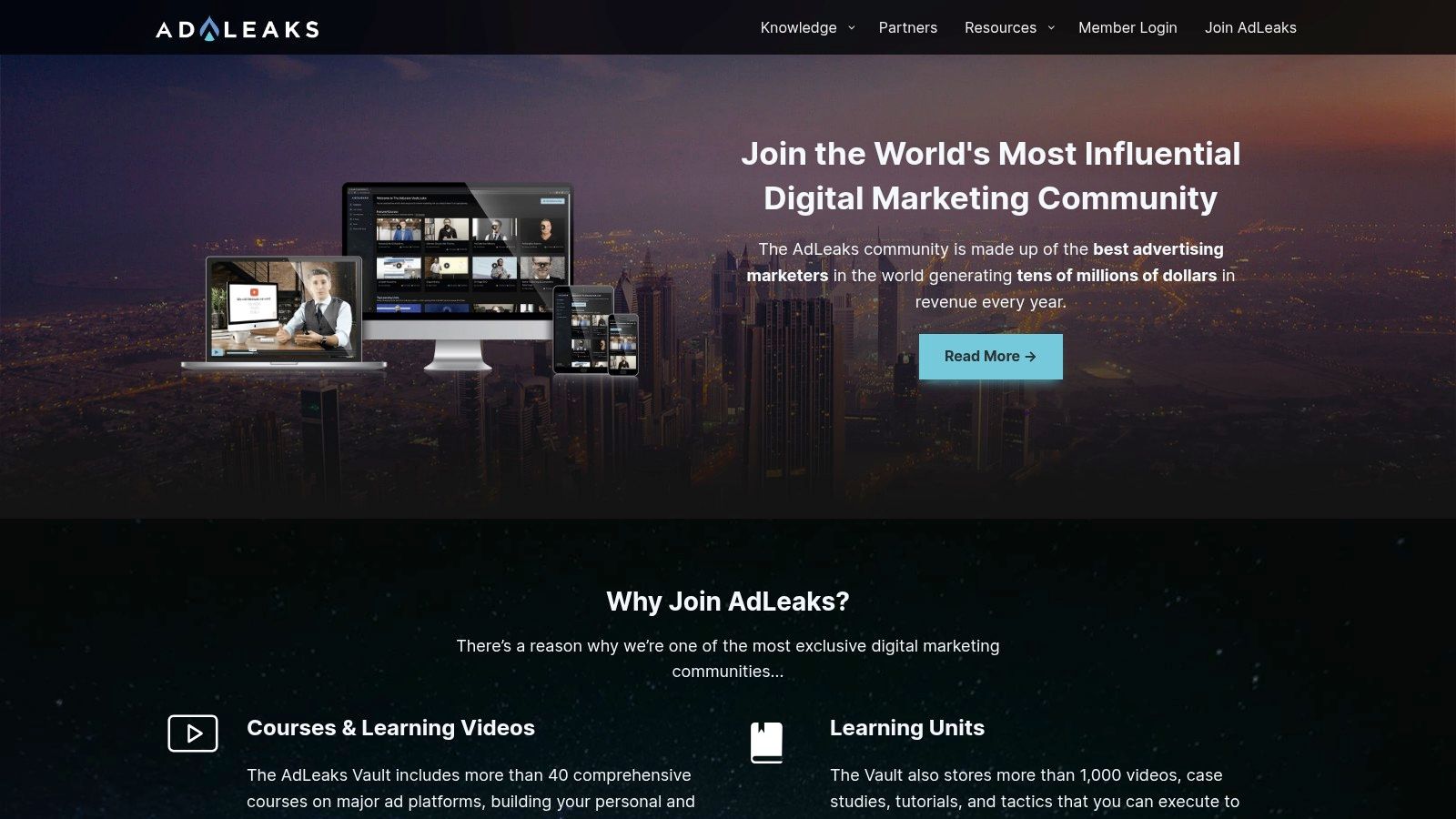
A common turning point looks like this. The team is spending enough that bad advice gets expensive, but they are still relying on broad Facebook threads, scattered Slack DMs, and bookmarked videos to solve operational problems. That is usually when AdLeaks Platinum starts to make sense.
What you are paying for is not just access. You are paying for a tighter signal-to-noise ratio and a better system for finding answers later. The private groups matter, but the bigger advantage is the mix of discussion, Slack speed, and the Vault as a reference layer. If an agency lead needs to train a new buyer or an in-house team needs a repeatable process, that combination is more useful than a fast comment thread that disappears in 48 hours.
I see the best fit in three cases:
- Agency operators managing multiple accounts: They need faster pattern recognition, SOPs, and examples they can adapt across clients.
- In-house teams with real revenue pressure: They need practical fixes and peer input without waiting on Meta support.
- Experienced founder-operators: They need direct answers and tested process, not basic campaign setup advice.
There is a real trade-off. Paid communities can save time, but they can also create another layer of tools, notifications, and memberships to manage. If your team already struggles with process discipline, adding Facebook groups, Slack channels, resource libraries, and office hours can turn into more tabs instead of better decisions.
Used well, though, a group like this can shorten the gap between seeing a problem and choosing a response. That matters more once your questions shift from “how do I launch this campaign?” to “how should we structure creative testing across brands?”, “what reporting standard should the team follow?”, or “which account issues deserve escalation versus monitoring?”
That shift is the bigger reason to join a paid community. Free groups are good for exposure. Paid groups are better for operating cadence.
They are still rented ground, though. You do not control the audience, the rules, or the archive. If a community becomes central to your team's learning, lead flow, or customer education, there is a point where graduating to an owned community platform is the smarter move. Facebook groups can help you get sharper. They are rarely the best long-term place to build a brand asset you fully control.
3. Facebook Ads Rockstars Alex Fedotoff
Managing a product account with rising spend means the essential question is no longer which campaign setting to test next. Instead, the focus shifts to whether the offer is weak, the creative is stale, or the product page is hindering conversion after the click. In this environment, Facebook Ads Rockstars is typically more helpful than a broad Facebook ads group.
The group is built around eCommerce operators. That focus helps if you sell physical products and Meta is one of your main acquisition channels. You will see more discussion around hooks, bundles, landing page friction, average order value, and creative fatigue than around generic platform troubleshooting.
Best for product brands that need creative and offer feedback
The practical value here comes from the type of questions members tend to bring:
- Creative testing: New angles, fresh concepts, and feedback on what is getting attention in-feed.
- Offer discussion: Price, bundles, discounts, and positioning, not just click metrics.
- Store economics: Whether ads are supporting a healthy business model, not just producing cheap traffic.
- Scaling decisions: How operators are handling spend increases once a product starts to hit.
That makes the group a better fit for DTC brands than for service businesses, local lead gen, SaaS, or B2B teams. You can still pick up useful Meta ideas from those business models, but you will spend more time filtering for relevance.
There is a trade-off. Niche groups often produce stronger discussion because members share similar constraints. They also create blind spots. If your account problems come from CRM handoff, sales process, or a long consideration cycle, this group will not give you much signal. It is strongest when the business lives or dies on product, page, offer, and ad creative.
I also treat personality-led groups with some discipline. During launches or promos, the signal-to-noise ratio can drop fast. The fix is simple. Skim for teardown threads, campaign examples, and comment chains where operators explain why they made a change. Ignore the hype.
Used well, a group like this can sharpen your creative process and speed up decision-making for a store account. Used badly, it becomes another rented channel where your team consumes screenshots without building its own testing system. That is the bigger filter I use with any Facebook community. Join for pattern recognition, then move your best frameworks, swipe files, and review process into a place you control.
4. AdHacks Community Gabriel St‑Germain
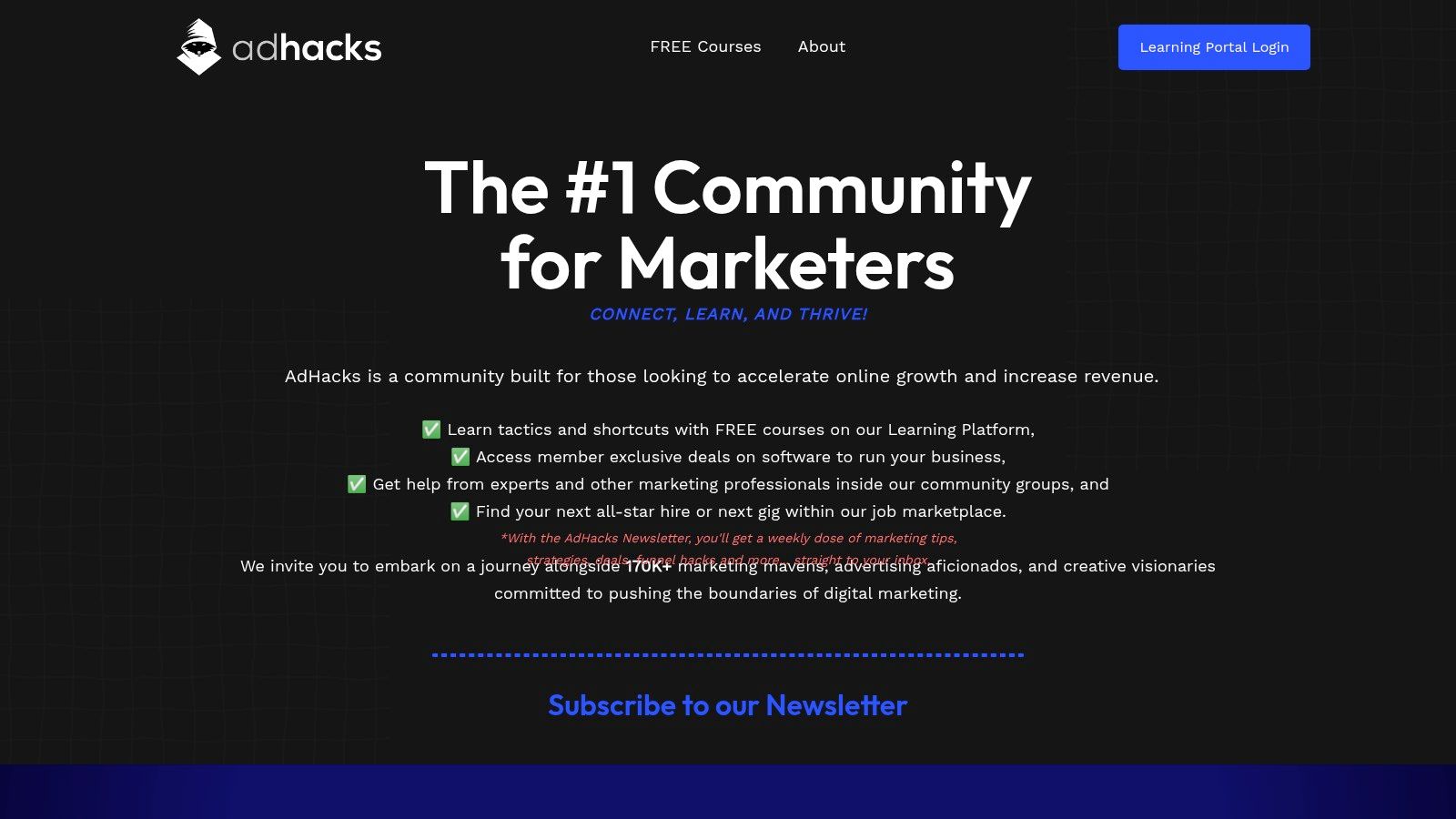
AdHacks fits buyers who are tired of treating Meta as a self-contained machine. If the ad account looks fine but results still feel soft, this type of community becomes more useful.
That is the primary appeal here. The conversations tend to pull performance problems back into the full system, including offer, landing page, email, attribution, and channel mix. For anyone managing growth beyond a single dashboard, that matters.
Why the cross-channel view matters
A mobile-first campaign can produce strong click volume and still miss target because the rest of the funnel is weak. The traffic is not always the issue. Sometimes the page loads poorly on mobile, the lead magnet attracts low-intent clicks, or the follow-up sequence fails to convert the interest the ad created.
A broader community helps in that situation. You can pressure-test questions like:
- Meta plus email: Does the promise in the ad still hold up once the prospect enters the sequence?
- Meta plus YouTube or Google: Is Facebook creating fresh demand, or just catching people who were already warm?
- Creative versus funnel issues: Did the ad underperform, or did it send decent traffic into a weak page?
That makes AdHacks useful for ambitious beginners who need to stop blaming Facebook for every bad result. It also helps intermediate buyers connect acquisition to retention and monetization, which is usually where account performance either compounds or stalls.
Field note: Groups that obsess over setup often attract marketers who confuse settings with strategy.
There is a trade-off. Cross-channel communities usually produce broader, more practical thinking, but they can be lighter on niche Meta details. If you need sharp discussion on policy edge cases, large account governance, or advanced platform-specific troubleshooting, other groups will be stronger.
I like AdHacks as a working room for marketers building an actual growth system, not just chasing better CPMs. Use it to diagnose bottlenecks across channels, then document the winning playbooks inside your own team hub. That is the line I keep coming back to with facebook advertising groups. They are useful for borrowed insight, but the long-term value comes from turning what you learn into processes, assets, and community you control.
5. Power Hitters Club PHC Jon Loomer
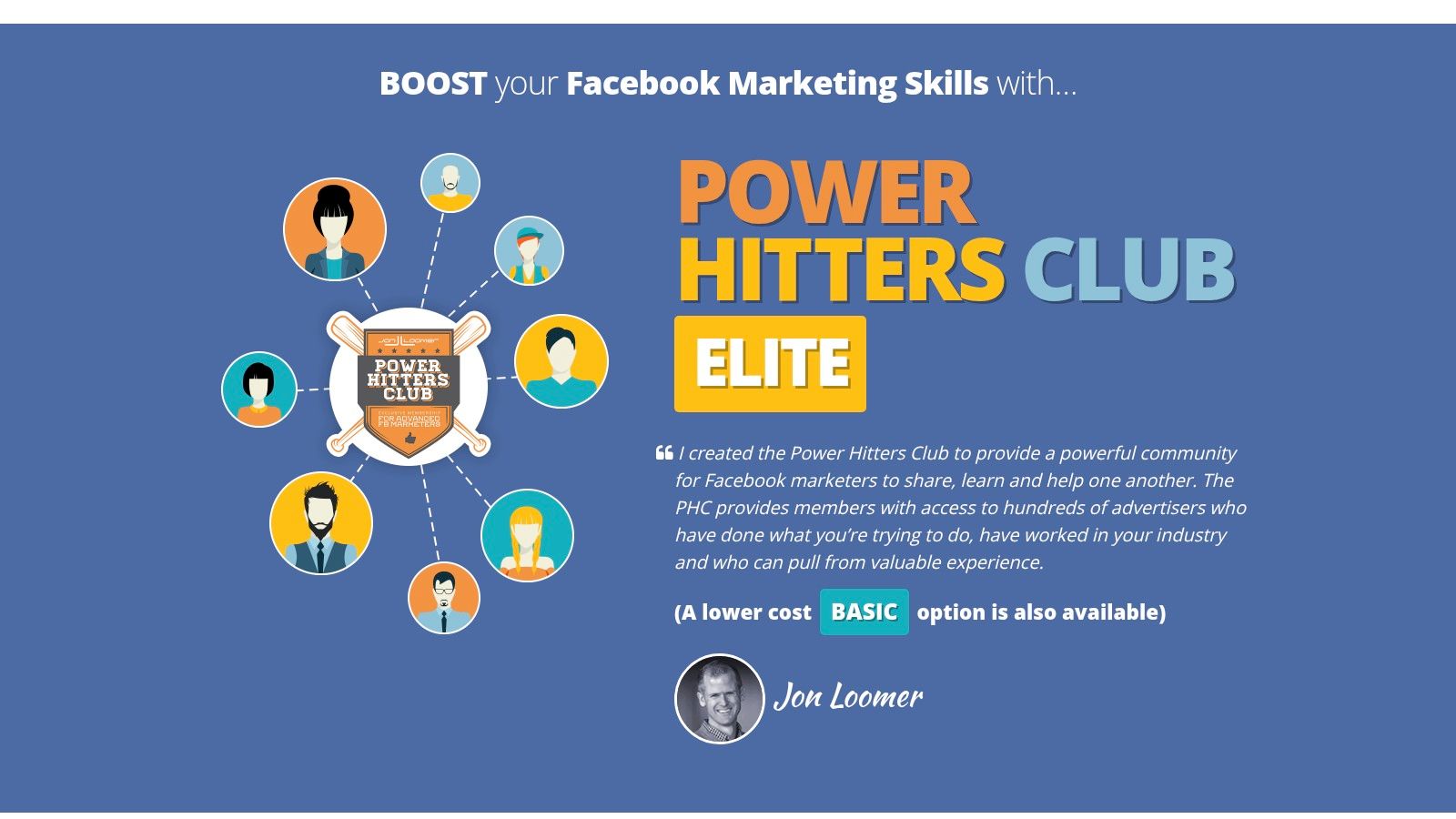
Power Hitters Club is one of the better rooms for buyers who need clear interpretation, not more noise. Its primary value is context. Meta rolls out changes constantly, and PHC helps experienced advertisers sort out which updates matter, which ones are edge cases, and which ones are getting overhyped.
That matters more once you manage spend across multiple accounts or report to clients who expect answers before Meta documentation catches up.
Where PHC stands out
Jon Loomer has built a reputation on careful platform analysis, and that shows in the community. The discussions tend to stay focused on feature changes, attribution questions, audience behavior, and setup decisions that affect account performance in practice. You get less chest-thumping and more “here's what changed, here's how I'm testing it, and here's what I still don't trust yet.”
PHC works best for a specific type of member:
- Advanced media buyers: People already inside Ads Manager every day who need sharper interpretation.
- Consultants and strategists: People translating platform changes into client guidance.
- In-house teams with active spend: Teams that need to make fewer bad calls when Meta changes reporting, automation, or campaign controls.
The trade-off is obvious. Beginners can still learn a lot here, but the value is much higher once you already understand the basics. If you are still wrestling with campaign structure, event setup, or basic creative testing, a broader and more forgiving Facebook group will usually give you faster returns.
I like PHC for signal control. It saves time, cuts down on bad assumptions, and gives serious buyers a better way to process what Meta is doing before they change account strategy. It also highlights a bigger pattern with facebook advertising groups in general. They are strongest when you use them as an input, not as your operating system. Once your team has repeatable lessons from communities like this, the smart move is to document them in an owned space where your training, decision logs, and playbooks actually belong to you.
6. eCommerce Elites Mastermind Steve and Evan Tan
eCommerce Elites Mastermind is one of the better Facebook groups for store owners who need feedback tied to actual e-commerce constraints. The useful discussions are rarely about ads in isolation. They usually connect creative, offer, landing page, average order value, and fulfillment. That makes the group more practical than broad media buying communities where people judge performance without looking at the store behind it.
I use groups like this for speed. A merchant can post a product page, a bundle, or a new ad angle and get immediate reactions from people dealing with the same questions.
The best use case is tactical diagnosis. If results are soft, the problem might be the ad. It might also be weak economics, unclear product positioning, poor mobile UX, or an offer that does not give Meta enough room to work. In a store-focused room, those issues get surfaced faster because members are looking at the whole buying path, not just CPMs and click-through rates.
This group is especially useful for:
- Product and offer feedback: Quick reality checks on bundles, pricing, hooks, and positioning.
- Creative decisions: Input on UGC angles, product demonstrations, and what to test next.
- Store friction: Feedback on landing pages, checkout flow, trust signals, and conversion blockers.
The trade-off is noise. Active e-commerce groups attract agency pitches, app vendors, and screenshot posts with no context on margins, returning customer mix, or fulfillment problems. Good members learn to filter aggressively and ignore advice that treats every store like the same business.
That filtering step matters more than people admit. Facebook groups are best used as temporary signal sources. Once your team starts seeing repeated patterns in pricing, creative winners, or on-site friction, capture those lessons in your own docs, training, or private community. That is usually the point where a business should graduate from rented attention inside Facebook groups to an owned environment that protects its playbooks, customer relationships, and revenue channels.
If you run a product business, relevance wins here. A smaller room full of operators who understand merchandising and margin pressure will usually beat a larger generic ads group.
7. Blue Ribbon Mastermind Smart Marketer Ezra Firestone

Blue Ribbon Mastermind isn't really a “group” in the casual Facebook sense. It's a leadership room with a Facebook layer attached.
That distinction matters. The discussion quality in high-ticket masterminds usually comes from who gets excluded, not from how many people are allowed in. If you're running a larger brand, peer quality matters more than group activity.
Why senior operators need a different room
Many founders spend too long in broad facebook advertising groups that helped them early on but stop helping once the business becomes more complex. At that point, you need conversations that include operations, leadership, cash flow, offer architecture, and team decisions.
This kind of room works when you need:
- Strategic context: Paid traffic decisions tied to brand and business model.
- Peer-level pressure testing: Feedback from operators dealing with similar complexity.
- Less noise: Fewer beginner questions, more senior trade-offs.
Senior communities are less about hacks and more about judgment.
The main downside is obvious. It's expensive, selective, and unnecessary for most smaller advertisers. If you're still trying to stabilize one account, a mastermind like this is probably overkill.
But for established brands, there's a reason these rooms exist. The best insight often isn't a tactic. It's hearing how another operator made a call when the platform data was unclear and the business stakes were high.
8. Facebook Ads Community Plus
Facebook Ads Community + earns its place for a different reason than the premium rooms. It is useful on the days when Ads Manager breaks your routine and you need fast signal from a large pool of active buyers.
A common example is a tracking issue that appears out of nowhere. Lead quality drops, a custom conversion stops reporting, or a campaign setting looks different from yesterday. In a group like this, you can usually tell within minutes whether you are dealing with an account-specific problem or a wider Meta rollout.
Best used as a diagnostic room
This group is strongest for practical, early-stage questions such as:
- Setup help: Pixel configuration, Conversions API basics, event mapping, attribution questions.
- Platform changes: Settings that moved, features that were renamed, or options that vanished.
- Quick confirmation: Whether other advertisers are seeing the same reporting or delivery issue.
That makes it useful for newer advertisers, but I also keep an eye on groups like this for one reason. Volume. Broad communities surface platform friction faster than curated masterminds because more people are posting the same problem at the same time.
The trade-off is quality control. Good advice sits right beside recycled tactics, outdated recommendations, and confident answers from people with very limited account experience.
Use the group accordingly. Treat it as a first-pass filter, not a final authority. If the same issues keep coming up, that is usually the point where smart operators stop relying on rented attention inside Facebook groups and start building an owned community, customer list, or member base they control directly. Groups are good for discovery and troubleshooting. They are weaker as a long-term system for protecting brand equity or revenue.
9. Facebook Ads and Google Ads Services Expert
Facebook Ads & Google Ads Services Expert is useful when you buy traffic across channels and don't want every problem framed as a Meta-only problem. That's more important than it sounds.
A lot of ad buyers struggle because they interpret Meta performance without comparing it to search, demand capture, or the rest of the paid mix. Cross-platform groups help you spot when the issue is channel-specific and when it's broader.
Better for buyers who compare channels
The reason to join this kind of group is perspective:
- Attribution discussions: You can compare how Meta and Google tell different stories.
- Budget allocation questions: Useful when one platform starts pulling against the other.
- Creative versus intent: Helpful when you need to separate audience demand from ad execution.
The caution here is curation. Compared with premium rooms, the quality can swing more from thread to thread. Some posts are practical. Some are thin. Advice should be tested, not adopted on faith.
Still, for marketers who run both social and search, a mixed room often surfaces better questions than a siloed room does. If your job is broader than Meta, your communities should be too.
10. Local Business Facebook Ad Buyers AdLeaks network
A local lead campaign can look profitable in Ads Manager and still fail in the actual business. The form fills come in. Nobody calls them back for six hours. Half the leads never get booked. Then the owner says Facebook ads do not work.
Local Business Facebook Ad Buyers is useful because the people in the room usually understand that problem chain. If you run ads for dentists, med spas, contractors, gyms, restaurants, or multi-location service brands, a niche group is often more practical than a giant general forum.
The conversations are closer to how local accounts win. That means less theory about broad scaling and more discussion around offer-market fit, lead handling, booking rates, no-show reduction, and what happens between the click and the sale.
Why niche communities are more useful for local accounts
Advice for local advertisers breaks down fast if the person giving it has only worked on national eCommerce or info funnels. In this type of group, the better threads usually focus on questions like:
- Lead form versus landing page: The right choice depends on sales friction, call handling, and how much qualification the business needs before an appointment.
- Local targeting decisions: Radius targeting, zip clusters, and multi-location account structure matter more here than they do in broader buying communities.
- Creative that matches local intent: Local proof, neighborhood specificity, before-and-after assets, and direct offers often beat polished brand creative.
- Operational bottlenecks: Slow follow-up, weak scripting, and poor calendar management can hurt results more than campaign settings do.
That last point is why groups like this are useful strategically, not just tactically. They help media buyers see where Facebook group advice stops being enough. If the underlying problem is intake, retention, referrals, or customer communication, the business may need its own community or owned audience channel instead of relying on rented platforms and scattered conversations inside someone else's group.
I like these local operator rooms for fast pattern recognition. You can see the same issues repeat across verticals, bad CRM handoff, weak front-desk process, unclear offers, poor review generation, and learn what is fixable with ads versus what needs a business-side change.
The trade-off is narrow scope. If your work is mostly DTC, info products, or national lead gen, this will be a support room, not your main one. But for booked calls, appointments, store visits, and local service revenue, specialized communities usually produce better advice, faster.
Top 10 Facebook Advertising Groups Comparison
| Community | Core focus & features ✨ | Expertise & signal ★🏆 | Best for 👥 | Price & value 💰 |
|---|---|---|---|---|
| Facebook Ad Buyers (AdLeaks) | Meta ads tactics, policy, fast troubleshooting, niche subgroups ✨ | ★★★★, large experienced base | 👥 Performance media buyers & troubleshooters | 💰 Free, high signal if you search first |
| AdLeaks Platinum (members-only) | Vault (courses/briefs), Slack + private groups, vetted experts ✨ | ★★★★★ 🏆, expert-dense, SOPs & playbooks | 👥 Teams & senior performance marketers | 💰 Paid, premium ROI for teams |
| Facebook Ads Rockstars (Alex Fedotoff) | eCommerce scaling, creative teardowns, operator playbooks ✨ | ★★★★, strong moderation | 👥 eCommerce advertisers scaling creatives | 💰 Free (FB), high eComm relevance |
| AdHacks Community (Gabriel St‑Germain) | Cross-channel Meta/TikTok/Google, mini-courses, practical resources ✨ | ★★★½, helpful cross-channel POV | 👥 Ambitious beginners → intermediate growth marketers | 💰 Free / freemium hub options |
| Power Hitters Club (PHC) – Jon Loomer | Weekly webinars, living ad briefs, advanced Q&A ✨ | ★★★★★ 🏆, timely feature & policy interpretation | 👥 Advanced Meta advertisers & consultants | 💰 Paid, premium, best with active use |
| eCommerce Elites Mastermind (Steve & Evan Tan) | Rapid peer testing, UGC creatives, store-level ad tactics ✨ | ★★★★, operator-oriented, fast feedback | 👥 DTC founders & media buyers | 💰 Mostly free FB group; some paid offerings |
| Blue Ribbon Mastermind (Smart Marketer) | Curated senior-level discussion, live deep dives, strict vetting ✨ | ★★★★★ 🏆, top-tier operator quality | 👥 7–9 figure brand owners & leadership teams | 💰 Expensive / invite-only, high strategic value |
| Facebook Ads Community + | General Ads Manager Q&A, pixel/CAPI, crowd-sourced fixes ✨ | ★★★, mixed expertise, fast replies | 👥 Beginners & DIY advertisers | 💰 Free, great for basics |
| Facebook Ads & Google Ads Services Expert | Cross-platform troubleshooting, setup reviews, tactical comparisons ✨ | ★★★½, practical cross-channel tips | 👥 Cross-platform buyers & PPC consultants | 💰 Free, verify advice before acting |
| Local Business Facebook Ad Buyers (AdLeaks) | Local targeting, booking workflows, lead-gen best practices ✨ | ★★★★, niche, relevant peers | 👥 Local-service advertisers (salons, clinics, trades) | 💰 Free, high relevance for local campaigns |
Final Thoughts
The best facebook advertising groups aren't the ones with the most members. They're the ones that match your current operating level and your business model.
If you're early, broad groups help you get unstuck. You can fix setup problems, compare notes on bugs, and learn basic account hygiene. If you're running real spend, the open groups start to show their limits. Too many repeated questions. Too much advice without context. Too little distinction between a small account anecdote and an actual pattern.
That's where paid communities and niche groups earn their keep. A good paid room can reduce the time you spend guessing. A good niche room can save you from applying bad generic advice to a business model it was never built for.
There's another point most listicles skip. Facebook groups are rented ground. They're useful for learning, networking, feedback, and even lead generation, but you don't control the environment. Group rules change. Reach changes. Moderators change. Your best audience interactions sit on someone else's platform.
That matters more now because direct group member targeting isn't available, but indirect workflows around engaged audiences are still where smart operators find an advantage. Meta allows retargeting people who interacted with your Page or posts, and one overlooked strategy is to use Facebook group participation to spark those public engagements, then segment that data and build compliant audiences from it. The opportunity is outlined well in this guide to what's possible and not possible with Facebook group targeting.
For creators, educators, and community-led brands, that creates a natural graduation path. Use facebook advertising groups to listen, test positioning, and meet buyers where they already spend time. Then move your best audience into a space you own.
That's the strategic split. Facebook groups are excellent top-of-funnel and mid-funnel environments. They help you validate messaging, spot objections, and build relationships. But if you want brand control, cleaner monetization, and a stronger customer experience, you eventually need an owned community platform under your own domain.
That shift is especially important if you sell courses, memberships, newsletters, downloads, or bundled digital offers. In that model, the Facebook group should support the business. It shouldn't be the business. Learn in the groups. Network in the groups. Retarget ethically from real engagement where allowed. But build the long-term asset somewhere you control.
If you're outgrowing facebook advertising groups and want one place to sell courses, paid newsletters, memberships, downloads, and a branded community under your own domain, Zanfia is worth a close look. It gives creators and businesses an all-in-one setup with 0% platform fees, native video hosting, built-in automations, white-label branding on every plan, and a unified community plus e-commerce experience. It's a practical next step when you want to stop renting attention and start owning the relationship.


