

Selling With Confidence: A Creator’s Blueprint
You know the feeling. You built something useful. A course that solves a real problem. A paid newsletter people asked for. A membership community your audience says they want. Then the moment you have to put a price on it, explain why it matters, or ask for the sale, your certainty drops.
That drop is common. It’s also where most advice becomes useless.
A lot of content about selling with confidence stays at the mindset level. Think better thoughts. Visualize success. Stop fearing rejection. Some of that helps, but it doesn’t solve the underlying problem. Research suggests 68% of sales professionals experience a drop in confidence when moving from training to real-world interactions, especially during rejection, negotiation, and objection handling, as noted in this discussion of the implementation paradox. Creators feel that gap even more sharply because they’re often selling their own expertise, not someone else’s product.
Sales confidence isn’t a personality trait. It’s a system.
The creators who sell well usually aren’t the loudest or most naturally persuasive. They’re the ones who can explain the outcome clearly, handle objections without spiraling, and rely on a process when emotions run hot. They don’t need to “feel amazing” every day. They need a repeatable way to move from interest to decision.
That’s why the practical side matters as much as psychology. Your message, your offer design, your community, your checkout flow, your follow-up sequence, your analytics. Each one either supports confidence or erodes it. If your tools are fragmented, your sales process feels fragile. If your positioning is vague, every objection feels personal. If your brand authority is weak, your pricing feels harder to defend. Building that foundation starts long before the sales call, which is why sharpening your positioning through work like building a personal brand that signals clear expertise often does more for confidence than another motivational exercise.
Introduction
Selling with confidence starts when you stop treating confidence like a mood.
Most creators try to solve sales anxiety at the emotional level alone. They tell themselves to be bolder, less awkward, more assertive. But confidence usually breaks for practical reasons. You’re unclear on the buyer’s problem. Your offer is too broad. Your pricing feels arbitrary. Your follow-up process is inconsistent. You haven’t practiced the conversation enough to stay calm when someone pushes back.
That’s why “just believe in yourself” rarely holds up in a real sales moment.
Confidence follows clarity
Confidence gets stronger when three things are true:
- You know the problem well. You can describe it better than the buyer can.
- You can connect your offer to a result. Not just features, but a meaningful change.
- You have a reliable process. You know what happens before, during, and after the sale.
When one of those is missing, hesitation shows up fast. You start overexplaining. You discount too early. You avoid direct offers. You fill your launches with educational content and then whisper the pitch.
Practical rule: If you feel nervous selling, don’t ask first whether your mindset is broken. Ask whether your sales process is underbuilt.
The real shift
A confident seller isn’t someone who never hears “no.” It’s someone who can hear “no,” stay steady, and keep the conversation useful.
That steadiness comes from preparation, positioning, and operational support. For creators, that includes the whole environment around the sale. The community where objections surface early. The checkout experience that doesn’t create friction. The automation that delivers what was promised immediately. The analytics that tell you whether the issue is traffic, message, offer, or conversion.
When those pieces work together, confidence stops being vague. It becomes observable. You present your work more directly, defend your price more calmly, and make cleaner decisions after every launch.
Reframe Your Mindset From Seller to Guide
Most creators hesitate because they still carry a bad model of sales in their head.
They picture a pushy closer. Someone performative. Someone who talks too much, listens too little, and forces urgency where it doesn’t belong. If that’s your internal picture of selling, of course you’ll resist becoming “good at sales.” You don’t want to become that person.
A better model is simpler. You are not a persuader first. You are a guide.

Drop the borrowed sales persona
Guides do three things well. They diagnose. They explain. They recommend.
That sounds obvious, but it changes the emotional frame of the whole interaction. You’re not asking someone to rescue your business by buying. You’re helping them make a better decision about a problem they already have.
Many experts often hit a wall. They know their field thoroughly, but when money enters the conversation, they leave their expertise and slip into awkward persuasion. The fix is to stay inside your natural strength. If you’re analytical, sell through clarity. If you’re relational, sell through trust and conversation. If you teach well, sell through structured explanation.
According to Integrity Solutions, the top 10% of salespeople can hit over 200% of quota, and 70% of underperformers successfully shift their mindset after a self-audit of internal beliefs. The same source notes that focusing on strengths can increase win rates by 28%, as explained in their article on belief alignment and strengths-based selling.
Run a belief audit
If your sales confidence collapses at the offer stage, inspect the belief underneath it.
Ask yourself:
- Do I believe selling is service, or do I believe it’s pressure?
- Do I trust the outcome of my offer, or only the effort behind it?
- Do I assume buyers are skeptical for good reasons, or do I treat skepticism as rejection?
- Do I think asking for money makes me less credible?
- Do I speak about my work like an expert, or like someone asking for permission?
Those questions usually expose friction. Not “I lack confidence,” but “I don’t yet have a clean belief about value.”
You don’t need a louder personality. You need a more accurate story about what your offer does for the right buyer.
A creator who sees themselves as a guide also builds authority differently. They don’t chase visibility for its own sake. They publish insight, take positions, and teach in a way that creates trust before the sale. That’s the heart of thought leadership that actually supports commercial trust.
A better internal script
Try replacing these mental scripts:
| Old script | Better script |
|---|---|
| “I hope they buy.” | “I’ll help them decide well.” |
| “I need to prove I’m worth it.” | “I need to clarify the fit.” |
| “I’m bad at sales.” | “I’m learning to diagnose and recommend.” |
| “Objections mean they’re not interested.” | “Objections show where clarity is missing.” |
That shift matters because confidence follows role clarity. The more clearly you understand your role, the less you wobble when the conversation gets uncomfortable.
Build Your Confidence Muscle with Daily Practice
Confidence that hasn’t been practiced won’t survive a real objection.
That’s where many smart creators get blindsided. They know their subject. They’ve built the product. They may even have a strong sales page. But when a prospect says, “I’m not sure this is worth it,” everything suddenly feels personal. The issue isn’t knowledge. It’s lack of rehearsal.

Practice outcomes, not features
One of the clearest patterns in sales performance is this. High-performing salespeople achieve 25% to 40% higher close rates by shifting from feature-based pitches to outcome-focused explanations, and this approach can lead to 85% buyer trust scores compared with 55% for feature-focused sellers, according to Skaled’s analysis of outcome-focused selling.
Creators often do the opposite. They explain modules, lesson counts, access terms, downloads, community tabs, bonus calls. That’s useful later, but it rarely creates conviction first.
A stronger practice habit is to build every pitch around this sequence:
- Problem: What is frustrating, expensive, slow, or unclear in the buyer’s current situation?
- Desired change: What do they want instead?
- Mechanism: How does your product help them get there?
- Fit: Who is this for, and who is it not for?
That last part matters. Confidence rises when you stop trying to make every lead fit.
A simple daily drill
Use one offer and rehearse it five different ways across the week.
Day one: Explain the offer in plain language to a beginner. Day two: Explain it to a skeptical buyer who thinks they can solve the problem alone. Day three: Explain it to someone who says they don’t have time. Day four: Explain it to someone who says the price feels high. Day five: Explain why they should choose your approach instead of staying with scattered free content.
Keep each response short. Around a minute or two spoken aloud is enough. If you can’t explain the offer clearly without rambling, the issue isn’t confidence. It’s message discipline.
A short visual on pitching can help before you rehearse your own version:
Handle objections as requests for clarity
Objections usually mean one of four things:
| Objection | What it often means | Better response angle |
|---|---|---|
| “It’s too expensive” | The value isn’t concrete yet | Reconnect price to cost of inaction or desired outcome |
| “I need to think about it” | The decision feels risky or vague | Clarify fit, next step, and what they still need to evaluate |
| “I don’t have time” | They don’t see the path to implementation | Show the simplest starting path and what can wait |
| “I’m not ready” | Timing, trust, or priority is off | Diagnose which one before pushing |
Don’t answer the literal objection too quickly. First identify the uncertainty underneath it.
What actually works
Creators improve fastest when they practice in conditions that feel mildly uncomfortable but not high stakes. Role-play with a peer. Record yourself answering objections. Rewrite your sales page headline after hearing your own verbal explanation. Turn common objections into FAQ copy, launch emails, and onboarding language.
What doesn’t work is trying to “wing it” because you know your material. Subject mastery and sales readiness are not the same skill. One gives you content. The other gives you composure.
Engineer a Confident Pricing and Offer Strategy
Pricing anxiety usually has less to do with greed than with weak offer architecture.
If your only path to purchase is one big yes, one price, one format, one level of access, then every sales conversation becomes tense. You feel trapped. The buyer feels pressure. A single objection can stall the whole decision.
Confidence improves when the offer has shape.
Price the transformation, then widen entry points
Creators often default to pricing based on effort. How long the course took to make. How many videos they recorded. How much support they’ll need to provide. Buyers don’t think that way. They care about the change your product helps them create.
That’s why a confident offer usually includes a clear value path, not just a number.
For example:
- A person who wants structured learning may buy a one-time course
- Someone who wants support and accountability may prefer a subscription community
- A buyer who feels the value but hesitates on cash flow may need installments
- A warmer lead may want a bundle because they already trust your process
Those aren’t just pricing mechanics. They lower emotional friction on both sides. You’re no longer defending a single format. You’re helping the buyer choose the right entry point.
If you sell educational or creator products, it also helps to study adjacent monetization models. Some of the thinking behind strategies for AI-powered income is useful here, not because AI solves pricing, but because it forces you to think in terms of offer packaging, recurring value, and scalable delivery.
Use the platform to support the pricing conversation
A practical advantage of an all-in-one setup is that you can match the offer to the buyer without stitching together multiple tools. Zanfia is built around an AI team that runs the operational side of a creator business, so pricing conversations don’t stall on setup work. You can dictate offer changes to the assistant by voice or chat, and it acts inside the same interface you’d otherwise click through. The checkout is built to sell: one-time purchases, subscriptions, installment plans that let you split a $600 course into four payments, order bumps, and upsells sit in one flow, alongside 12 product types (courses, communities, memberships, paid newsletters, bundles, downloads, consultations and more) under a single custom domain. Test mode lets you buy your own product end to end before the first real sale, and the platform takes a 0% commission on customer sales, with only the payment processor’s standard fee applying. Higher plans unlock the full AI Assistant, the MCP endpoint for connecting your own agents, and white-label AI; availability depends on the plan, so check the current Zanfia pricing. Zanfia charges 0% platform commission on Starter ($39/month, or $31 billed annually) and every tier above it.
That matters for confidence because operational friction leaks into sales behavior. If your delivery is messy, you’ll subconsciously under-sell. If your margins are unclear, your price becomes harder to defend. If your offer depends on external tools that confuse buyers, every checkout feels riskier than it should.
For a sharper view of how buyers interpret price signals, this breakdown of pricing psychology strategies is worth studying.
Build offers that reduce resistance
Use this decision lens before changing your price:
- Is the buyer paying for access, implementation, support, or identity? These are different products, even when the core content overlaps.
- Where does hesitation happen most often? Early buyers may need a smaller entry offer. Warm buyers may need a clearer premium path.
- What creates unnecessary force? If your whole business depends on one premium product, you’ll feel that pressure on every call.
A confident price is easier to hold when the buyer has more than one legitimate way to say yes.
Creators don’t need lower prices as often as they need cleaner offer design.
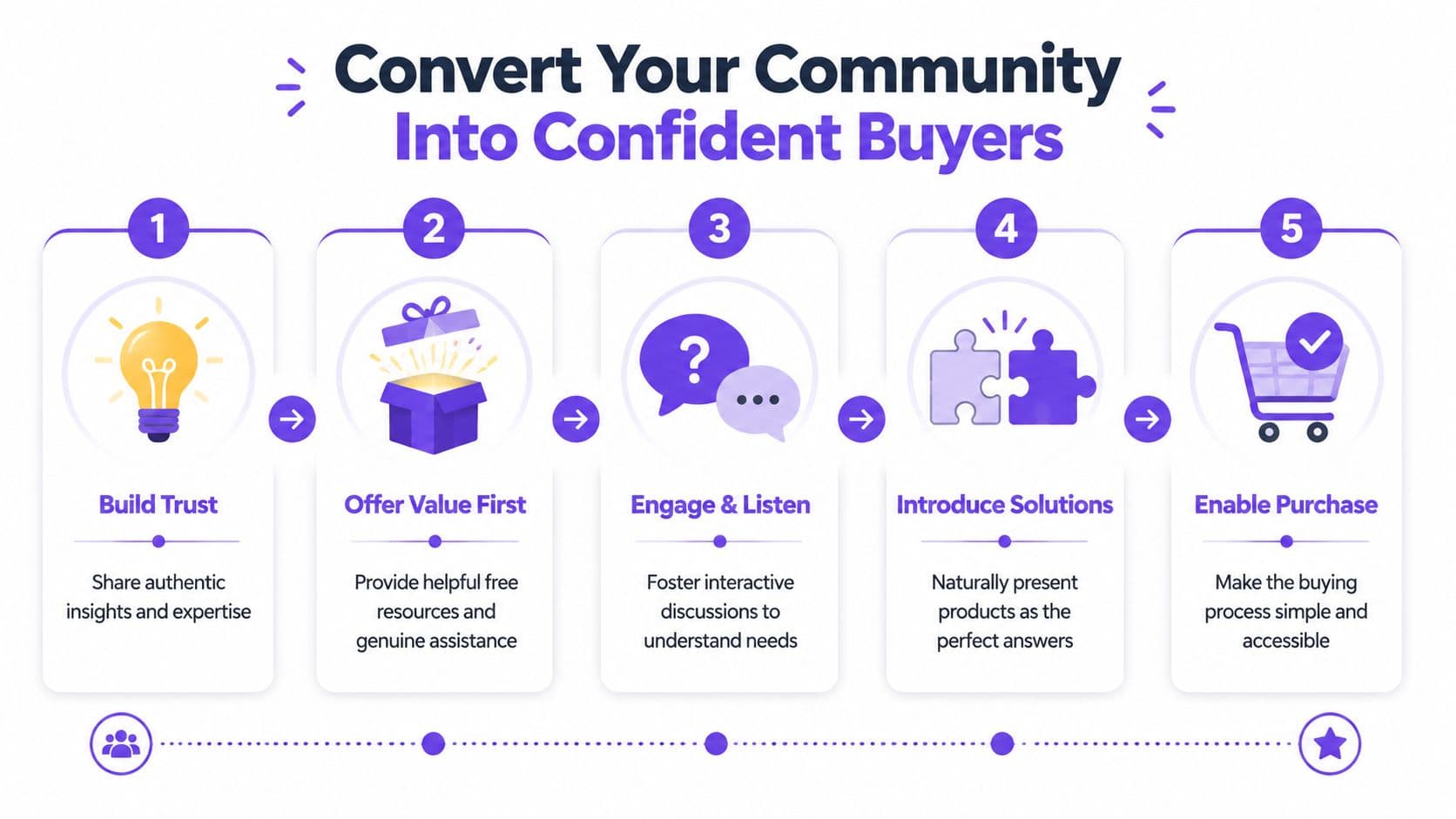
Convert Your Community Into Confident Buyers
Community changes the emotional texture of selling.
When you sell to strangers, every launch feels like a test. When you sell inside an engaged community, the process becomes more collaborative. You already know the language people use. You hear recurring frustrations. You see what gets questions, what gets silence, and what people ask for repeatedly.
That information is confidence.
According to RAIN Group, top-performing sellers are 59% more likely to collaborate extensively with buyers throughout the process, and those top sellers achieve a 72% win rate on proposed sales in the same sales performance analysis. For creators, that collaboration often happens inside the audience environment itself.
The community is where confidence gets validated
A strong community gives you three commercial advantages.
- You hear demand in the customer’s own words. That improves messaging fast.
- You can test ideas before launching. That reduces guesswork.
- You create visible trust. Members see questions answered, wins shared, and objections resolved in public.
Selling then becomes less about persuasion and more about organized response to demand.
A simple community selling rhythm
Use a steady cadence rather than random bursts of promotion.
Listen first. Track repeated questions, stalled efforts, and recurring goals. Teach in public. Share useful answers in discussion threads, announcements, or short lessons. Name the pattern. Show members what problem keeps appearing. Present the offer. Position the product as the structured answer to a pattern they already recognize. Keep buying easy. Reduce steps between interest and enrollment.
That’s also why lead tracking matters. If you want a cleaner handoff from conversation to conversion, a practical framework for leads and conversions helps you see where community attention turns into revenue.
Use automations to remove avoidable friction
Community-driven selling works best when the operational side is invisible to the buyer.
Here’s what to automate:
- Access delivery: Buyers should receive course or membership access immediately after payment.
- Channel assignment: Customers should land in the correct community space based on what they purchased.
- Welcome flow: A short onboarding email sequence should tell them where to start and what to do next.
- Subscription handling: Renewals, access changes, and membership updates should happen without manual chasing.
The less admin you carry into a launch, the calmer and more direct you’ll sound during the sale.
What hurts confidence is manual patchwork. A creator sells a product, then scrambles to send links, update access, answer onboarding emails, and sort payments. After two or three launches, they don’t just feel busy. They start to resent selling itself because fulfillment feels chaotic.
The community model works when the buyer experience feels coherent from the first question to the first win.
Automate Your Sales Process for Lasting Confidence
Short-term confidence comes from preparation. Lasting confidence comes from proof.
That proof usually arrives through systems and data. Without them, creators interpret every weak launch emotionally. “People don’t want this.” “My audience is cold.” “I’m bad at selling.” Sometimes the underlying issue is much smaller. The offer was strong, but the sales page was unclear. The demand existed, but the checkout flow created drop-off. The community was engaged, but the onboarding sequence was weak.
That’s the measurement blind spot.
A 2025 survey found 54% of creators couldn’t pinpoint why they hesitated to sell, which is why diagnostic tools that analyze positioning, engagement, and conversion behavior matter, as described in this piece on the measurement blind spot for creators.
Replace vague anxiety with observable checkpoints
A confident sales system answers practical questions:
| Funnel stage | Question to ask |
|---|---|
| Offer view | Are people reaching the page or hearing the pitch consistently? |
| Conversion | Do they understand the value and next step clearly enough to buy? |
| Onboarding | Do new customers know what to do immediately after purchase? |
| Engagement | Are buyers using the product, joining the community, and finding quick wins? |
| Retention | Are subscribers staying because the ongoing value is visible? |
That framework sounds basic, but it stops the spiral. Instead of “my selling is bad,” you get a concrete problem statement.
Automate the handoff after the sale
Creators often think automation is about convenience. It’s also about trust.
When someone buys, the product should feel real immediately. Payment goes through. Access appears. The right email lands. The right community entry opens. The invoice is generated. Nothing about that sequence should depend on your memory or mood.
If you’re building better follow-up systems, it also helps to understand how other operators structure communication flows. This guide to AI tools for inbox autopilot is useful as a reference for thinking about message timing, automation logic, and reducing manual email load.
For creators using integrated workflows, this kind of setup usually includes:
- Checkout to access automation
- Purchase-based tagging or segmentation
- Welcome and onboarding sequences
- Subscription renewal handling
- Invoice generation and delivery
- Analytics that show where the buyer journey stalls
The direct business benefit is time saved. The psychological benefit is bigger. You stop carrying the whole sale in your head.
Let analytics coach you
The creators who become steady sellers don’t avoid disappointment. They shorten the time between disappointment and diagnosis.
Review your funnel after every launch or promotion. Look for breakpoints. If people engage but don’t buy, your message or offer may be off. If they buy but disappear, onboarding likely needs work. If a specific community topic creates unusual response, that may be your next product angle.
For a practical view on system design, these marketing automation workflow examples can help you think through what should be manual, what should be automated, and where confidence comes from having fewer moving parts.
The point isn’t to become robotic. It’s to make your confidence less dependent on daily emotion and more dependent on a process you can inspect, improve, and trust.
FAQ
What's the difference between selling as a persuader versus selling as a guide?
A persuader tries to convince someone to buy, which creates pressure on both sides and often triggers hesitation. A guide diagnoses the buyer's problem, explains the situation clearly, and recommends a fit. That shift changes the emotional frame: you're helping someone make a better decision about a problem they already have, not asking them to rescue your business.
Why does explaining features hurt my close rate compared to explaining outcomes?
Feature-based pitches list modules, lesson counts, and access terms, but they rarely create conviction because they don't connect to what the buyer actually wants. Outcome-focused explanations can lift close rates by 25-40% and reach 85% buyer trust scores compared with 55% for feature-focused sellers. Anchor every pitch in the problem, the desired change, the mechanism, and who the fit is (and isn't) for.
How should I respond when a prospect says "it's too expensive"?
Treat it as a request for clarity, not a final answer. It usually means the value isn't concrete yet, so reconnect the price to the cost of inaction or the desired outcome instead of defending the number. Don't answer the literal objection too quickly, first identify the uncertainty underneath it.
How do I practice sales conversations without a live prospect?
Take one offer and rehearse it five different ways across a week: to a beginner, a skeptic, someone short on time, someone who thinks the price is high, and someone comparing you to free content. Keep each version to a minute or two spoken aloud. Role-play with a peer, record yourself answering objections, and rewrite your sales page after hearing your own verbal explanation.
Why does offering multiple entry points make pricing conversations easier?
A single price and format forces every buyer into one big yes, which makes each objection feel like it can stall the whole decision. Structured learners may want a one-time course, others prefer a subscription community, some need installments for cash flow, and warm leads may want a bundle. Widening entry points lowers emotional friction and shifts the conversation from defending a number to helping the buyer pick the right fit.
If you want a simpler way to run a creator business, take a look at Zanfia. It’s an AI team you can direct by chat or by voice: the assistant performs anything available in the interface, from launching a new product to updating a checkout, while you keep everything under your own brand and domain. Courses, communities, paid newsletters, memberships, downloads, consultations and bundles all live in one place, and the checkout is built to sell, with order bumps, installments and test mode so you can buy your own product before your first customer does. Try it free for 14 days, no credit card required.