

Agitate and Solve: A Guide to High-Converting Copy

You finished the course. You set up the checkout. You posted about it. A few people clicked, maybe a few even replied with “this looks amazing,” and then the sales page sat there doing almost nothing.
That situation is common among creators selling expertise. The product often isn't the weak point. The message is. Buyers don't move because your offer contains value in theory. They move when your copy makes the pain of staying stuck feel real, then shows a credible path out.
That's why agitate and solve still matters. The PAS framework is widely treated as a classic direct-response structure because it matches how people process pain and relief, and it works especially well when the audience already knows the pain point they're dealing with, such as low engagement, inconsistent sales, or messy community management, as noted in StoryPrompt's breakdown of PAS.
For creators, that gap between “good content” and “clear demand” shows up everywhere. You can teach brilliantly and still undersell. You can build a thoughtful membership and still struggle to explain why someone should join now, not later. If that sounds familiar, it's worth tightening the message before rebuilding the product or rewriting your entire content strategy.
Table of Contents
Why Your Great Content Is Not Selling
A creator spends weeks recording lessons, organizing modules, writing worksheets, and polishing onboarding emails. The product is useful. The ideas are tested. The students who do buy tend to like it.
But the page headline says something soft like “Learn my complete system.” The email says “I'm excited to share this with you.” The offer description lists what's included before it names the cost of doing nothing. Buyers understand the topic, but they don't feel the urgency.

That's the quiet problem behind a lot of disappointing launches. The product may be strong, but the copy never bridges the gap between value and action. It explains. It doesn't compel.
The buyer doesn't need more information
Most creators default to teaching in their marketing because teaching is what they're good at. They explain the framework, share tips, and describe the modules. Then they wonder why readers nod along and leave.
The missing piece is emotional relevance. People rarely buy because an offer is “helpful.” They buy because the copy helps them name a current frustration, feel the consequences of letting it continue, and trust the solution enough to move.
Practical rule: If your audience already knows they have a problem, don't spend most of the page proving you're smart. Spend it proving you understand what the problem costs them.
For digital products, that pain is usually concrete. The course isn't selling consistently. The paid community feels scattered. The newsletter audience reads but doesn't convert. Admin work eats the week. Revenue leaks through fees and tool overlap. Those are not abstract business goals. Those are active annoyances.
Why creators often miss this
Creators are close to their work. That's useful for building the product and dangerous for writing the offer. You know how much effort went into the lessons, templates, and setup. Your buyer only knows what still feels broken on their side.
A vague promise like “grow your business” asks the reader to do too much interpretive work. They have to connect your broad claim to their specific reality. Most won't.
Agitate and solve fixes that by forcing specificity. It asks a harder question: what exact friction is the buyer dealing with today, what gets worse if they keep tolerating it, and what outcome makes action feel justified right now?
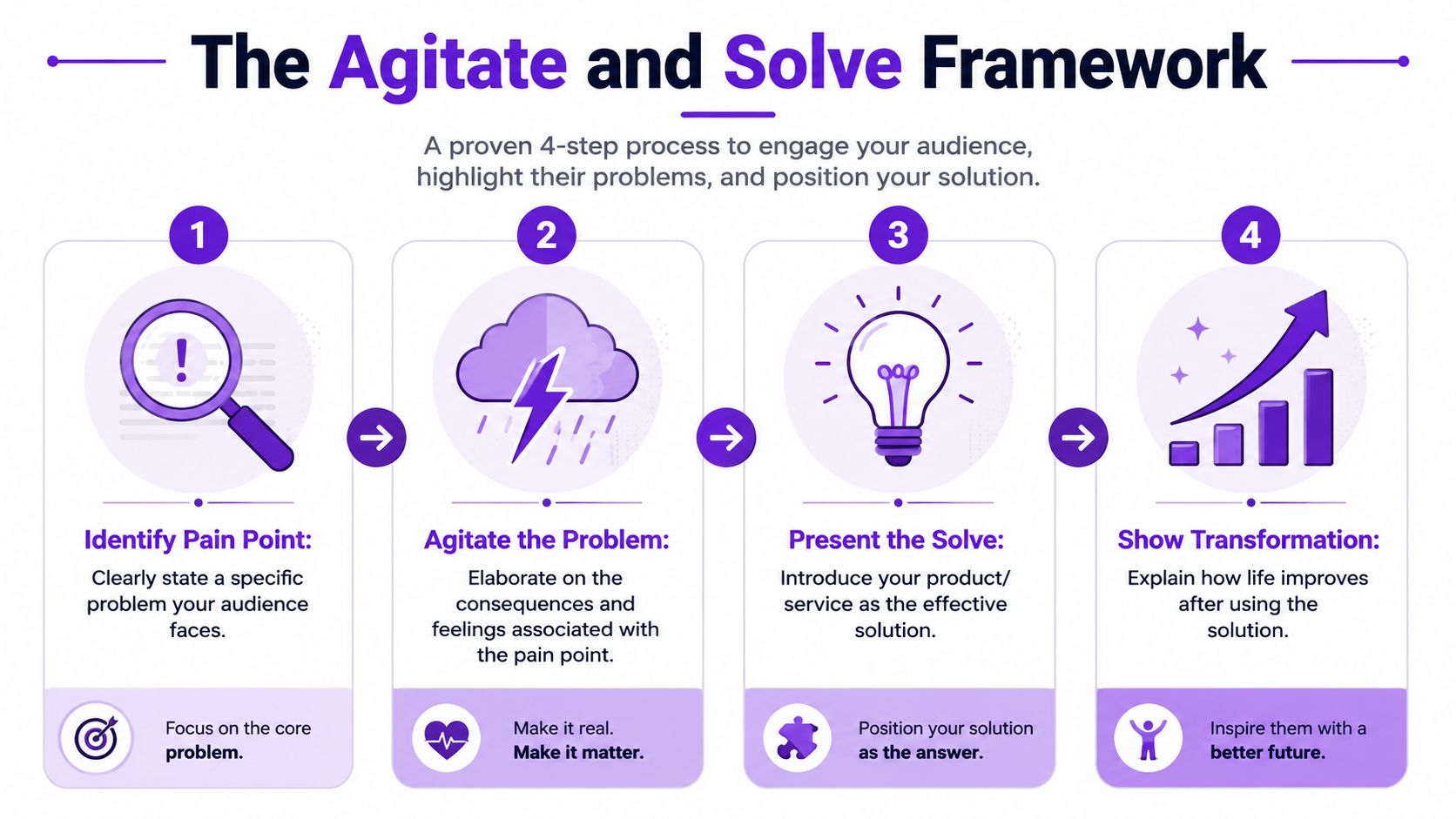
Understanding the Agitate and Solve Framework
The framework looks simple because it is simple. That's part of why it survives. Good persuasion usually gets clearer when you remove extra steps.
Problem means one sharp pain
The problem is the entry point. Its job is to make the right reader think, “yes, that's me.”
The strongest problem statements are narrow. They don't say “you want more growth.” They say something closer to, “you're selling expertise through five disconnected tools, and every sale creates one more admin task.” That kind of line earns attention because it describes lived experience, not ambition.
A useful way to check this section is with a quick filter:
| Weak problem | Strong problem |
|---|---|
| Grow your audience | Your audience reads, but few people buy |
| Build a better course business | Students get access, but onboarding feels messy |
| Monetize your expertise | You've got knowledge people want, but the tech keeps slowing launch decisions |
Agitate means making the cost visible
The agitate stage increases urgency. It focuses on consequences, emotions, and unresolved pain. Good agitation shows what the problem looks like in real life, why it exists, and why the audience still hasn't solved it, which is how Copyhackers explains effective agitation copy.
That means naming friction the reader already feels:
- Operational friction: Purchases come in, and you still have to manually sort access.
- Financial friction: Tool costs stack up, and fees chip away at already hard-won sales.
- Emotional friction: Every launch feels heavier than it should because the backend is brittle.
- Brand friction: Your audience experiences your offer through borrowed platforms and scattered logins.
Agitation doesn't invent fear. It clarifies the price of continuing as usual.
A short teaching aid helps here:
Solve means relief with direction
The solve stage is where many creators lose momentum. They shift from pain to a random list of features. That breaks the logic of the message.
The solve needs to feel like the natural answer to the exact problem you just intensified. If the pain is fragmented tools, the solve is unified delivery. If the pain is revenue leakage, the solve is a cleaner business model. If the pain is admin overload, the solve is automation that removes recurring manual work.
The best solve doesn't change the subject. It closes the tension the copy created.
A simple four-part flow works well:
- Name the pain.
- Show what it's costing.
- Present the offer as the direct fix.
- Show the improved state after adoption.
That final part matters more for high-value digital products and communities than many creators realize. Buyers aren't purchasing a file upload or a checkout page. They're purchasing a calmer operation, stronger customer experience, and a business they can manage.
How to Write Agitate Copy That Compels Not Repels
Most weak copy has too little tension. Most bad copy has too much of the wrong kind.
When creators hear “agitate,” they often overcorrect into melodrama. Suddenly every inconvenience becomes a crisis. Every pain point gets inflated. Readers can feel that instantly, and trust drops.
The better approach is empathetic pressure. You don't need to scare people. You need to describe the consequences of the problem so clearly that readers feel understood and motivated.
Start with the reality they already live in
If your audience sells courses, communities, newsletters, or downloads, their frustration usually isn't a single dramatic moment. It's repeated friction.
One login for the course. Another tool for community. Another system for payments. Another place to track who bought what. Another manual step after checkout. Another small fee that seems manageable until the month closes and margins look thinner than expected.
That's where good agitation begins. Not with hype. With recognition.
Here are lines that move in the right direction:
- Specific operational pain: “Every new sale creates another access task you have to remember.”
- Brand pain: “Your audience joins for your expertise, then experiences it through someone else's platform.”
- Momentum pain: “You don't avoid launching because the offer is weak. You avoid launching because the setup feels annoying every time.”
Those lines work because they sound observed, not theatrical.
Explain why the problem remains unsolved
A key part of agitation is showing why the audience is still stuck. Often, they haven't failed because they're lazy. They've failed because the available fixes are partial.
Creators patch things together. They use one tool because it seems fast, another because it handles payments, another because it hosts content, another because it sends invoices or emails. The stack grows. So does the drag.
If you want better inputs for this stage, study customer language before you write. Interview notes, support messages, objection logs, and actionable VoC data can show you the exact phrases buyers use when they describe friction in their own words.
Use their wording: When a buyer says “I'm tired of babysitting the backend,” that's stronger than any polished sentence you invent in isolation.
Agitate the consequence, not the person
Here, trust either survives or breaks.
Don't shame the reader for being disorganized, behind, or late. Agitate the situation instead. Show what the setup causes. Show what it prevents. Show how it keeps stealing attention from the work they want to do.
Compare these approaches:
| Repelling agitation | Compelling agitation |
|---|---|
| You're failing because you chose the wrong tools | Your current tool mix keeps creating extra work after every sale |
| If you don't fix this now, your business will collapse | If this stays messy, launches will keep feeling harder than they need to |
| Serious creators would never run things this way | You've probably outgrown a setup that once felt good enough |
The second column respects the reader. Respect is a conversion tool.
Use downstream consequences
Agitation gets stronger when you trace the next effect, then the next one after that.
A scattered system doesn't just feel untidy. It slows launches. It increases manual work. It weakens the customer experience. It makes every product expansion feel heavier. That's the chain.
You can apply that logic in email copy too. If your promotional emails sound flat, the issue may not be the offer itself. It may be that the message reaches inboxes without enough tension in the opening. That's one reason tightening the emotional framing and the email subject line matters before you touch the body copy.
Keep the agitation proportionate
Fear-heavy messaging only works when people also feel they can do something about the problem. If the reader feels threatened but not capable, they often disengage instead of converting. That's why effective agitation is controlled. It creates urgency, then leaves room for relief in the solve.
For high-value communities and digital products, this matters even more. Your audience isn't just deciding whether to buy. They're deciding whether to trust your judgment, join your ecosystem, and stay connected to your brand over time.
Crafting the Solve That Your Audience Craves
The solve earns the sale when it shows a better operating reality your reader can believe and step into. For creators selling high-value products, memberships, and communities, that matters more than a long feature stack. Buyers are not asking, "What does this tool include?" They are asking, "Will this help me run this business without turning every launch into more admin?"
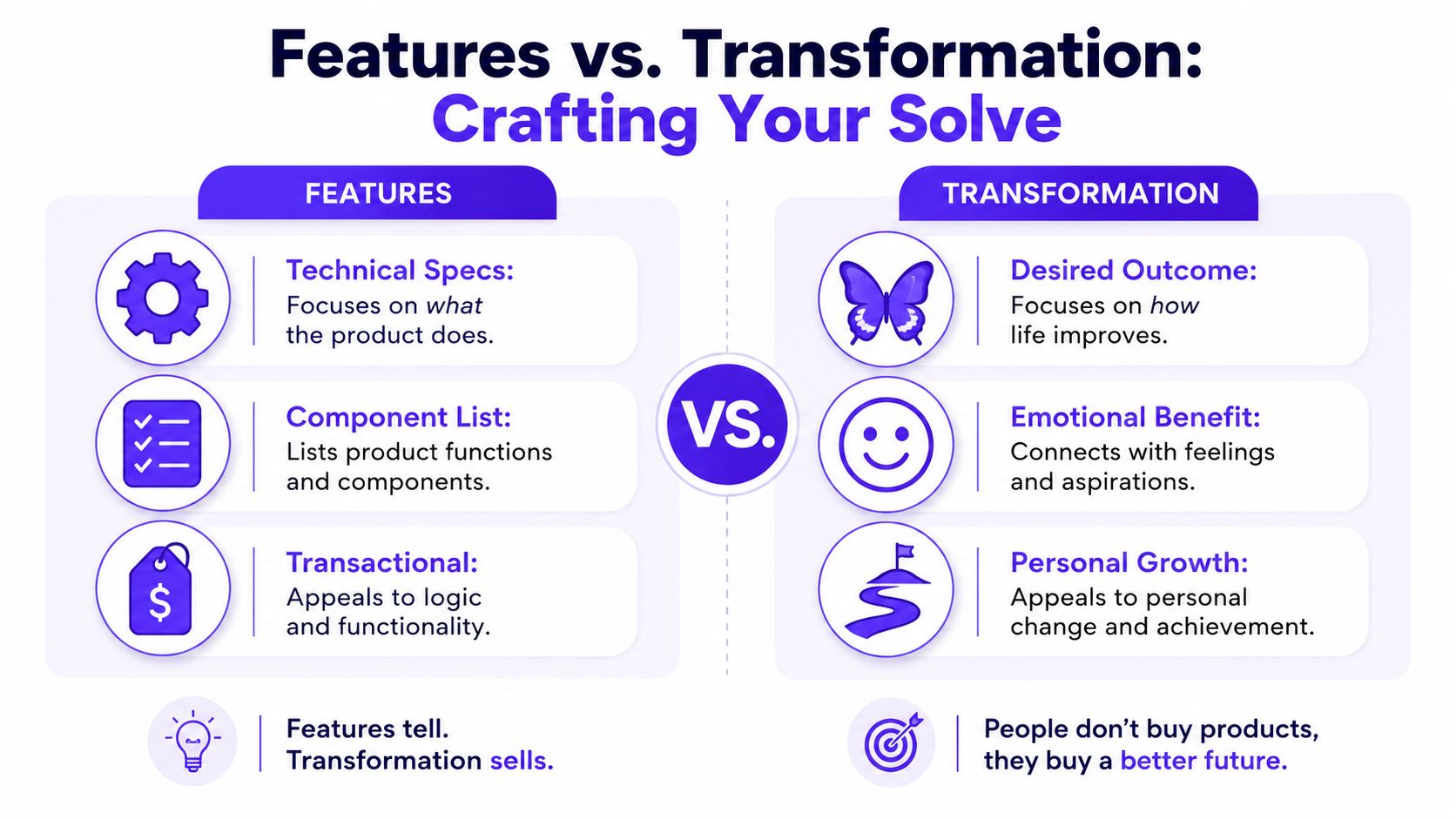
Good solve copy answers that question directly.
Pair each pain with one clear outcome
If your agitation focused on operational drag, your solve should show what gets lighter. If the agitation focused on a messy customer experience, your solve should show what becomes smoother for the buyer. If the agitation focused on stalled growth, your solve should show what becomes easier to scale without adding another layer of tools.
That sounds simple, but many creators lose the thread here. They agitate well, then switch into product-tour mode. The copy starts listing functions instead of resolving tension.
A stronger method is to match each friction to one visible improvement:
Pain: “You're paying for multiple moving parts and still managing too much manually.”
Solve: “Run courses, community, digital products, payments, and access rules in one place so each sale creates less admin.”
Pain: “Your delivery feels disconnected from your brand.”
Solve: “Keep the customer experience under your own domain so the product feels like part of one business, not a stack of patched-together tools.”
Pain: “Video hosting adds another bill and another setup to maintain.”
Solve: “Deliver course video inside the same system you use to sell and grant access.”
Notice the trade-off here. Specificity converts better than broad promises, but too much detail slows momentum. The solve should clarify the change, not bury it.
Make the transformation concrete
High-value offers need more than relief. They need a believable before-and-after.
A strong solve does not stop at “save time” or “grow faster.” It shows what changes in the creator's day-to-day business. Fewer support emails after checkout. Fewer access issues during a launch. Less hesitation about promoting harder because fulfillment no longer breaks under volume.
That is what makes the solve persuasive. It speaks to the business behind the offer, not just the offer itself.
If you are still building the front end of that journey, a useful lead magnet strategy for creators selling digital products can make the transformation feel tangible before the full sale happens.
Show the next step with low friction
Urgency without a clear next move creates doubt. The reader needs to see the relief and know how to reach it.
Keep that step concrete:
Show the relief
Describe what becomes easier, cleaner, or more profitable.Show the action
Tell them what to do next, such as starting a trial, setting up the first product, or reviewing how the system handles checkout, access, and delivery.
This is especially important for communities and premium digital products. The buyer is not only purchasing content. They are committing to a transformation and trusting you to deliver it in a way that feels organized and credible.
Ground the solve in operational reality
The strongest solve copy usually ties a promised outcome to how the business runs.
Zanfia combines courses, community, paid newsletters, digital products, payments, automations, custom-domain white-label delivery, native video hosting, flexible pricing formats, and payment support for Stripe, PayU, Przelewy24, BLIK, and Tpay. It also connects invoicing through inFakt and Fakturownia, and charges 0% platform fees on customer sales, excluding payment operator fees. For creators stuck doing repetitive post-purchase tasks, that means fewer handoffs, fewer separate tools, and less backend cleanup. According to internal data, its automations can save 5–10+ hours a month.
That kind of solve works because it resolves the friction your reader already feels. Less tool sprawl. More control over delivery. A business that feels easier to run without making the customer experience feel smaller or colder.
A good solve makes the buyer think, “That would remove the headache that keeps slowing me down.”
Agitate and Solve in Action Templates and Examples
Theory helps. Templates get used.
These examples are built for creators selling expertise, memberships, and digital products. Treat them as starting points. Keep the structure. Replace the details with your audience's actual language.
Promotional email for a course launch
Subject idea: You didn't need more content. You needed a cleaner system.
Opening
You already know your material is valuable. The problem is that selling it keeps turning into a technical project. Every launch means checking payments, fixing access, answering setup questions, and patching the experience together after the fact.
Agitate
That drains energy before students even enter the course. It also makes growth harder. When delivery feels messy, you hesitate to promote harder because every new customer creates more operational work.
Solve
The better move is to sell the course inside a setup where purchase, access, video delivery, and member experience work together. That gives students a smoother start and gives you room to focus on teaching instead of backend cleanup.
CTA
See how the full system works.
Landing page hero for a paid community
A community offer needs more emotional texture because the purchase is ongoing, not one-and-done.
Use a structure like this:
| Copy element | Example |
|---|---|
| Headline | Build a paid community people want to stay in |
| Problem | Most memberships lose momentum when discussion, content, and payments live in separate places |
| Agitate | Members drift when the experience feels fragmented, and you keep spending time managing tools instead of leading the room |
| Solve | Bring conversations, premium content, and access into one branded member space |
| CTA | Start building your membership system |
That hero works because it sells continuity, not just access.
Sales page section for a digital download
Digital downloads are often sold too lightly. The page explains what's included and skips why the buyer should care now.
A stronger section can read like this:
You don't need another file that sits unread in a folder. You need a resource that removes the friction slowing your next decision. If you're stuck between too many tools, unclear packaging, or messy delivery, this guide helps you simplify the path and launch with less hesitation.
The solve then continues with outcome framing, not a list of chapters.
A simple fill-in framework
Use this when you write your own page:
Problem
“You're trying to ___, but ___ keeps getting in the way.”Agitate
“That means ___ keeps happening, which leads to ___.”Solve
“Instead of juggling ___, use a setup that lets you ___.”Transformation
“So you can spend more time on ___ and less time on ___.”
If you're mapping this into a full launch path, these sales funnel templates can help you decide where each version belongs, from lead capture to sales page to post-purchase flow.
Common Pitfalls and How to A/B Test Your Copy
Most PAS failures are not subtle. You can usually spot them in one pass.
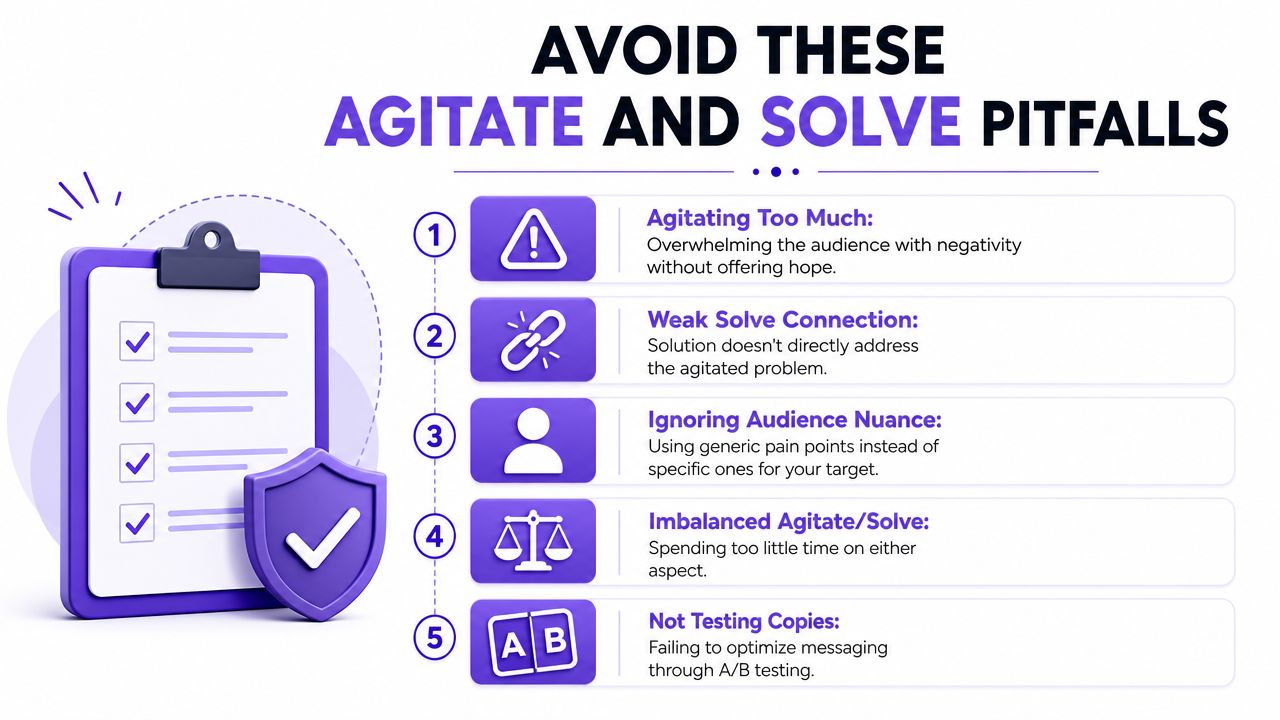
One common failure is the vague problem statement. Another is emotional exaggeration that feels manipulative. A third is solution dumping, where the writer unloads features before the reader fully feels the problem, all of which are flagged in this PAS tutorial.
Use this checklist before you publish:
- Sharpen the problem: Replace broad claims like “grow your business” with one visible friction.
- Tone down the drama: If the copy sounds more alarmed than your buyer feels, pull it back.
- Check solve logic: Make sure every solution point answers something you already agitated.
- Protect trust: If the copy blames the reader, rewrite it around consequences instead.
- Cut feature piles: Keep only the details that resolve the pain you named.
A/B testing should stay equally simple. Don't test everything at once.
Try one contrast at a time:
| Test angle | Version A | Version B |
|---|---|---|
| Problem frame | Lost revenue | Lost time |
| Agitation style | Operational frustration | Brand dilution |
| Solve frame | Simplify your stack | Keep more of your revenue |
| CTA language | See how it works | Start building now |
If your copy underperforms, don't assume the offer is weak. First check whether the message is precise enough, emotionally honest enough, and easy enough to act on. That's the heart of good conversion rate optimization.
If your digital business feels harder to run than it should, Zanfia is worth a look. It gives creators one place to sell courses, newsletters, communities, and downloads under their own domain, with native video hosting, automations, invoicing integrations, flexible pricing, and 0% platform fees on sales, with only payment operator fees applying. That makes it a practical option when your copy is finally doing its job and your backend needs to keep up.


