

25 Best Digital Products to Sell in 2026 (With Examples)

The best digital products to sell in 2026 are the ones that solve a specific, expensive problem for a defined audience: ebooks, Notion templates, design assets, AI prompt packs, and audio bundles lead the pack. This guide covers 25 proven ideas with real examples, plus how to validate which one to build first before you waste a weekend on the wrong bet.
What Makes a Digital Product Profitable in 2026
Profitable digital products share three traits: they solve a painful problem, they target a buyer who already spends money on adjacent tools, and they cost near-zero to fulfill after the first sale. Everything else is decoration.
The market is real. Statista projects the global e-learning market alone to hit $400 billion by 2026, and digital downloads on marketplaces like Etsy grew 42% year-over-year through 2025 according to Etsy’s own seller reports. The catch: platform fees eat 10-30% of every sale on marketplaces, which is why more sellers are moving to their own storefronts.
Here is the math that decides which platform you pick. On a $100 sale, a 0% platform fee nets you $96.80 after Stripe’s 2.9% + $0.30. A 10% platform fee like Gumroad’s direct sales rate nets $86.30. A 30% marketplace cut leaves $70. That is a $26.80 difference on a single transaction, and it compounds across every sale you make in 2026.
Ebooks, Guides and Checklists
Ebooks are the workhorse of digital products. Low production cost, high perceived value, and they scale infinitely once written.
1. Niche how-to ebooks ($15-49)
Not “how to start a business” but “how to price freelance UX audits for SaaS clients.” Specificity wins. A 40-page PDF solving one expensive problem outsells a 300-page generalist book every time.
2. Industry reports and data guides ($49-199)
Original research or curated data. Think “State of Freelance Copywriting Rates 2026.” Buyers pay premium prices because the data saves them hours of research.
3. Swipe files and checklists ($9-29)
Cold email templates, launch checklists, onboarding sequences. Low ticket, high volume, easy upsell to a full course.
4. Workbooks and journals ($19-39)
Fillable PDFs for goal-setting, business planning, or coaching frameworks. Coaches bundle these with 1-on-1 calls.
5. Recipe and meal-plan bundles ($12-39)
Food creators dominate this space. Dietary niches (keto, gluten-free, plant-based) command higher prices than generic cookbooks.
Notion Templates, Planners and Spreadsheets
The productivity template market exploded when Notion opened its template gallery. Top sellers earn six figures annually from a handful of templates.
6. Notion CRM and business dashboards ($29-99)
Small business owners pay for polished systems. A well-built freelance CRM template regularly sells 2,000+ copies at $49.
7. Content calendars for creators ($19-49)
YouTube planning, podcast production, newsletter workflows. Sell to the creators already spending on tools.
8. Financial trackers and budget spreadsheets ($15-39)
Personal finance influencers move these by the thousand. Google Sheets versions sell as well as Notion.
9. Second-brain templates ($39-79)
Zettelkasten systems, PARA method setups, knowledge management vaults. Buyers are researchers, writers, and consultants.
10. Habit and goal-tracking planners ($12-29)
Digital planners for iPad (GoodNotes/Notability) are a $50M+ subcategory. Fitness and self-improvement niches convert hardest.
Design Assets, Presets and Fonts
Design assets are pure margin. Build once, sell forever, no ongoing fulfillment.
11. Lightroom presets and mobile filters ($15-49)
Photography influencers built entire businesses on preset packs. Bundle 20-30 presets and sell for $39.
12. Canva templates for social media ($9-39)
Instagram carousels, LinkedIn carousels, Pinterest pins. Sell in themed packs (30 posts for wedding photographers, etc.).
13. Custom fonts and typefaces ($20-149)
Independent type designers sell direct through their own sites for higher margins than Creative Market.
14. Icon packs and illustration bundles ($29-99)
SaaS founders and designers pay for consistent icon systems. Line-style and 3D icon packs sell strongest.
15. Video LUTs and Premiere Pro presets ($29-79)
Cinematic color grading packs for YouTubers and wedding videographers. Higher ticket than photo presets.
AI Prompt Packs and Worksheets
AI prompt libraries went from novelty to legitimate category in 2024-2025. The buyers are professionals who need repeatable, tested prompts, not hobbyists.
16. Role-specific prompt libraries ($29-99)
“200 ChatGPT prompts for real estate agents.” “150 Claude prompts for lawyers.” Niche vertical prompts outsell generic packs 5:1.
17. AI workflow templates ($49-199)
Multi-step prompt chains for content production, research, or customer service. Bundle with a Notion template and price higher.
18. Custom GPT and Claude project setups ($39-129)
Pre-configured system prompts for specific workflows. Include instructions, example inputs, and troubleshooting guides.
19. Midjourney and image-gen prompt packs ($19-59)
Aesthetic-specific prompt libraries (cinematic, editorial, product photography). Include the exact parameters, not just the prompt text.
Audio Products and Bundles
Audio is underserved compared to visual products, which is exactly why margins are strong.
20. Royalty-free music and sound effects ($19-99)
Producers sell loop packs, sample libraries, and stems to other musicians and video creators.
21. Guided meditation libraries ($29-79)
Wellness practitioners bundle 20-30 sessions themed by outcome (sleep, focus, anxiety). Sell as downloads or drip through a members area.
22. Language learning audio courses ($39-149)
Conversation-based lessons for specific scenarios (business Japanese, medical Spanish). Underserved niches beat mass-market apps.
23. Voice-over and jingle packs ($29-99)
Pre-recorded VO for YouTubers who cannot record their own. Multiple voice options, various lengths, cleared for commercial use.
24. Frequency and binaural beats bundles ($19-49)
Focus, sleep, and meditation audio. Small but loyal buyer base with high repeat purchase rates.
25. Podcast production kits ($49-199)
Intros, outros, transitions, ad-break stingers. Sell to the 5 million podcasters who need consistent branding.
How to Validate Which Idea to Build First
Do not build first. Validate first. Here is the sequence that saves weekends:
Search for buyer intent. Check Etsy, Gumroad, and Creative Market for existing versions of your idea. Multiple sellers at $20-50 with 100+ reviews means the market is real. Zero competitors is usually a bad sign, not an opportunity.
Pre-sell before building. Post the concept on the platform where your buyers hang out (Twitter, LinkedIn, Reddit, a niche Discord). Offer a $10 pre-order with a two-week delivery date. If 10 people buy, you have a product. If nobody buys, you saved yourself a weekend.
Price by outcome, not by page count. A 20-page checklist that saves a lawyer four billable hours is worth $199, not $19. A 200-page ebook covering basics is worth $15. Match price to the dollar value of the problem you solve.
Pick a platform based on take-home revenue, not features. This is where sellers lose the most money. Run the numbers below on your actual expected volume before you commit.
Platform Comparison: What You Actually Take Home
Here is what $10,000 in monthly digital product sales looks like on each major option, as of July 2026. Processor fees assume US Stripe rates of 2.9% + $0.30 per transaction at an average $30 order value.
| Platform | Platform Fee | Take-Home on $10k/month | Best For |
|---|---|---|---|
| Zanfia | 0% + $39/month plan ($31 billed annually) | ~$9,570 | Sellers who want their own domain, order bumps and installment plans built in |
| Gumroad (direct) | 10% + $0.50/transaction | ~$8,570 | Starting out, no domain needed |
| Etsy Digital | 6.5% + $0.20 listing fees | ~$8,850 | Marketplace discovery for design/template sellers |
| Kajabi Basic | 0% + $149/month plan | ~$9,530 | Sellers who need advanced marketing automation |
| Payhip Free | 5% | ~$9,090 | Testing without monthly commitment |
The pattern: at $10k/month, a flat monthly plan pays for itself many times over compared to per-transaction fees. Below $2,000/month, a per-sale model like Gumroad or Payhip is cheaper. Do the math on your own volume before signing anything.
Where Zanfia Fits for Digital-Product Sellers
Zanfia is an AI team that runs the business behind your digital products, and a storefront second. As of August 2026, plans start at $39/month, or $31/month billed annually, with a 14-day free trial and no credit card required. Platform commission on customer sales is 0%; only the payment processor takes its standard cut (Stripe is roughly 2.9% + $0.30 in the US). Full pricing is at zanfia.com/pricing.
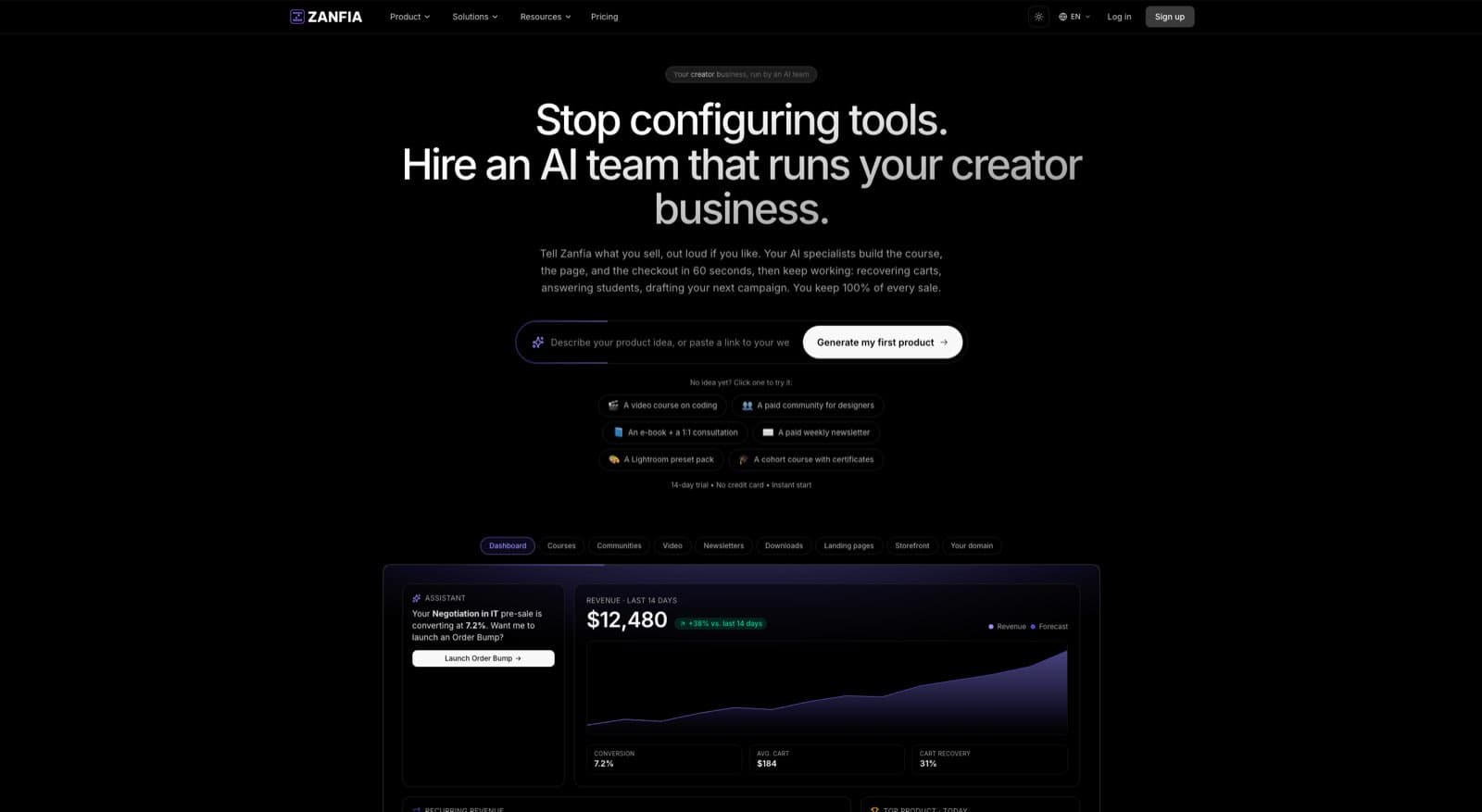
What matters for digital-product sellers specifically: instead of clicking through settings, you dictate the work by chat or by voice and the assistant performs any action available in the interface, from setting up a new download to editing a checkout. Secure file delivery for ebooks and downloads, Cart 2.0 with one-time pricing, subscriptions and installment plans (split a $600 bundle into four payments), and order bumps that let you attach a $19 checklist to a $49 template purchase and increase average order value without extra work. Stripe and PayPal are both supported, and Apple Pay and Google Pay work at checkout out of the box.
You also get your own subdomain (yourname.zanfia.co) or can map a custom domain, which matters because branded checkout converts noticeably better than a marketplace URL and it is yours to keep. If you outgrow single downloads, the same account handles 12 product types under one brand: courses, communities, paid newsletters, knowledge bases, bundles and consulting bookings, so you do not migrate stacks when your business changes shape. Before you launch, test mode lets you buy your own product end to end (checkout, delivery, tracking) with orders tagged TEST and hidden from your real order list.
For sellers who already work with AI tools, Zanfia exposes an MCP endpoint so assistants like Claude or ChatGPT can act on your workspace directly, and offers API, CLI and webhooks for custom automation. Availability of the MCP endpoint and the full assistant depends on the plan, so check the current Zanfia pricing before you decide.
The comparison worth running before you commit: Kajabi’s entry tier is roughly $149/month as of July 2026, and Zanfia’s entry is $31 to $39. The gap covers a lot of paid ads, a lot of new templates, or simply take-home revenue you keep. Verify Kajabi’s current number on their pricing page before you decide, because competitor pricing moves, but the order of magnitude is the story.
FAQ
What is the most profitable digital product to sell in 2026? Niche how-to ebooks and industry reports have the highest margins because they solve expensive problems for professional buyers willing to pay $49-199. Notion templates and AI prompt packs come next, with strong repeat-buyer behavior.
How much money can you make selling digital products? Top sellers on platforms like Gumroad and Etsy report $10,000-$100,000+ per month. Realistic first-year expectations for a focused seller with one validated product are $500-$5,000 monthly, scaling from there with additional products and traffic.
Do I need my own website to sell digital products? No, but you will keep more money and build a real brand if you do. Marketplaces like Etsy and Gumroad handle discovery but take 6-10% of every sale. Your own storefront on a white-label platform keeps more revenue and gives you the email list.
How do I price a digital product? Price by the value of the problem you solve, not by page count or hours to create. A checklist saving a professional four billable hours is worth $99-199. Test three price points on your audience and let buyer behavior decide.
What is the cheapest way to start selling digital products? Payhip or Gumroad with their free plans, since you only pay per transaction. Once monthly sales exceed roughly $2,000, a flat-fee platform like Zanfia (from $31/month billed annually) becomes cheaper because you skip the 5-10% per-sale cut.