

How to Become a Digital Creator and Build a Business

So you want to be a digital creator? The first thing to understand is that it's far more than just hitting "record" and hoping for viral fame. Building a real, sustainable career means you're actually building a business—one that requires a solid plan.
At its core, success boils down to a few key things: finding a specific audience you can serve, creating genuinely helpful content for them, building a real community around your work, and then finding the right way to earn an income from it. This isn't a race; it's about building a strong foundation, piece by piece.
Your Blueprint for a Digital Creator Business

Forget the myth of overnight success. The creators who last are the ones who treat their work like a business, and every good business starts with a blueprint. This plan is your roadmap, guiding every decision and keeping your efforts laser-focused on what actually moves the needle.
The entire framework rests on four core pillars. Each one builds on the last, creating a powerful system that turns your passion and expertise into a thriving online enterprise. Once you understand these pillars, the path forward becomes much clearer and less intimidating.
The Four Pillars of a Digital Creator Business
Before we get into the nitty-gritty tactics, let's look at the big picture. This framework will be your North Star as you navigate the challenges of creating content, growing an audience, and eventually, making money.
Here's a quick look at the essential stages that form the foundation of any successful creator business.
The Four Pillars of a Digital Creator Business
| Pillar | Core Action | Key Objective |
|---|---|---|
| Niche & Brand | Identify a specific audience and define your unique value. | To become the go-to expert in a focused area. |
| Content Creation | Produce valuable content that addresses your audience's pain points. | To build authority and attract your ideal followers. |
| Community Building | Foster a space for interaction, connection, and loyalty. | To turn passive followers into active supporters. |
| Monetization | Offer paid products or services that solve deeper problems. | To generate sustainable income from your expertise. |
This structured approach is what separates the hobbyists from the pros. You’re not just throwing content at the wall to see what sticks; you're intentionally building assets that support a long-term business. If you want a closer look at the day-to-day grind, our guide on what a digital creator does breaks it down even further.
"If you plan to sell digital products and build a community of paying customers, Zanfia is the best solution.”
— Mateusz Grzywiński, EFL Teacher
A key part of working smarter is learning how to get the most out of every piece of content you create. This is where smart content repurposing strategies come in. They allow you to multiply your impact without multiplying your workload.
Throughout this guide, we'll dive deep into each of these pillars, giving you the practical, actionable steps you need to build your creator business with confidence.
Finding Your Profitable Niche and Unique Brand

So, you want to be a digital creator. The first, most critical step on this journey is deciding where you'll plant your flag. I'm talking about your niche. This isn't just about picking something you like; it’s about finding that sweet spot where your expertise, your audience's problems, and real market demand all overlap.
A well-defined niche is your entire foundation. It helps you create laser-focused content that speaks directly to the right people.
Think specific. Don't just be a "fitness" creator—that's a crowded ocean. Instead, you could be the expert in "strength training for busy parents over 40." See the difference? That kind of specificity makes you memorable and establishes you as the go-to authority for a very distinct group of people.
Validating Your Niche Idea
Passion is fuel, but it won't keep the business running on its own. You have to make sure there’s a real, breathing audience for your topic—and that they're willing to pay for solutions to their problems.
How do you find out? You become a detective.
Dive into online communities where your potential audience hangs out. Think Reddit forums, specific Facebook groups, or even the comment sections on YouTube videos in your space. These places are goldmines for understanding what people are genuinely struggling with.
As you explore, keep these questions in mind:
- What are their biggest frustrations? Pay close attention to the exact words and phrases they use to describe their pain points.
- Are they already buying things to solve this? Look for existing courses, e-books, coaching programs, or tools. Don't be scared of competition; it's usually a great sign that a market is healthy and profitable.
- What's your unique spin? How can your personal experience or a fresh perspective set you apart from everyone else?
Once you have a clear picture of their problems, you can start mapping out how you'll solve them. Our guide on popular digital products to sell is a fantastic resource for brainstorming ways to turn your expertise into something people will actually buy.
Creating Your Ideal Follower Profile
To create content that hits home every single time, you need to know exactly who you're talking to. This is where creating an "Ideal Follower Profile" (sometimes called an avatar) becomes a game-changer. Don't just think about demographics; give this person a name, a job, and a story.
What are their day-to-day challenges? What are their secret ambitions? What's keeping them up at night? The more vivid you can make this person in your mind, the easier it will be to create content that feels like you're speaking directly to them. Every post, video, and email should be written for this one person.
Building a brand is not about being seen by everyone; it's about being deeply valued by the right people. Your niche and your ideal follower profile are the tools that make this possible.
Building a Brand That Stands Out
You've got a validated niche and a crystal-clear picture of your ideal follower. Now it's time to wrap it all up in a brand identity that feels like you. This is the combination of your name, your voice, and your visual style that makes you instantly recognizable.
Your brand should be an authentic reflection of your personality while also resonating with the community you want to build.
Focus on these key elements:
- Brand Name: Pick something memorable and easy to spell that hints at what you do. Before you commit, do a quick search to make sure the name and social media handles are available.
- Brand Voice: How do you want to sound? Authoritative and polished? Or more like a casual, encouraging friend? Whichever you choose, keep it consistent everywhere.
- Visual Identity: This covers your logo, color scheme, and fonts. These visual elements create a cohesive look that builds trust and makes your content feel professional.
- Core Message: What’s your mission? Try to boil it down into a single, powerful sentence. This is your "why," and it will attract people who believe in what you believe in.
Think of your brand as a promise. It tells your audience what they can expect from you and builds the kind of connection that turns casual viewers into a true community. Putting in this foundational work now will pay off massively down the road.
Crafting Content That Connects and Converts

Alright, you’ve picked your niche and started building your brand. Now for the fun part: creating the content that will actually pull your business forward. This is where the magic happens. Your content is how you find your people, earn their trust, and eventually, offer them something they’re happy to pay for.
The real goal isn't just to churn out posts. It’s to craft experiences that solve real-world problems for your audience. Think of every blog post, video, or guide as a stepping stone on a path you’re building—one that leads your followers from where they are to where they want to be.
Choosing Your Content Formats
As a creator, you have a ton of options, and it's easy to get overwhelmed. My advice? Don't try to be everywhere at once. Just pick one or two formats that genuinely play to your strengths and, more importantly, match how your audience likes to learn.
Here’s a quick rundown of the heavy hitters for new creators:
- Online Courses: This is the gold standard for in-depth teaching. If you need to walk someone through a complex skill or a step-by-step system, a course is the way to go. They position you as a true expert and can command a premium price.
- E-books and Digital Downloads: Think of these as your "quick wins." They’re much faster to create than a full course and give your audience an affordable way to get a tangible result from you. It’s a perfect way to build trust for bigger offerings down the road.
- Paid Communities: If your niche thrives on connection and accountability, a community is a brilliant move. People join for the content but stay for the relationships. Plus, they generate recurring revenue, which is a total game-changer for stabilizing your income.
- Paid Newsletters: Perfect for writers who want to deliver exclusive, high-value ideas directly to their biggest fans. It's an intimate format that builds a deep, personal connection with your readers.
The creator economy is massive—we're talking over 207 million creators worldwide. But the reality is that only about 4% of them earn over $100,000 a year. The difference almost always comes down to making smart, strategic choices about what to create and how to sell it.
Building a Sustainable Content Workflow
Consistency is the name of the game, but it's also a fast track to burnout if you don't have a solid system in place. You have to work smarter, not just harder.
The one technique that has saved my sanity time and time again is content batching. Instead of trying to create something new from scratch every single day, you group similar tasks together. For example, you could spend a Monday brainstorming and scripting all your videos for the month. Tuesday is for filming, and Wednesday is for editing.
"The [Zanfia] course module is distinguished by its simplicity and high functionality… it gives me peace of mind."
— Daniel Roziecki, Developer & Mentor
And don't think you need a professional studio to get started. A good microphone is probably the single best investment you can make early on, as clear audio often matters more than perfect video. Beyond that, your smartphone and some simple editing software are more than enough to produce great content.
Structuring Content for Maximum Value
What separates good content from truly great content? Structure. Great content isn't just a brain dump of everything you know; it’s a carefully designed path that takes someone from a point of pain to a point of clarity.
Before you ever hit record or type a single word, ask yourself this one question: "What specific outcome will my audience get from this?"
This mindset is crucial when you start creating products. Each module in your course should be a logical step toward the final promised transformation. And as you think about getting that content in front of the right people, understanding things like strategic advertising on social media platforms can make a world of difference.
At the end of the day, your job is to become an indispensable resource for your audience. Once people know that your content delivers real results, they won’t just follow you—they’ll be eager to invest in your paid offerings. To get even deeper into this, check out our guide on how to build a powerful content marketing strategy.
Building a Thriving Community You Actually Own
Content is what gets people in the door, but a community is what makes them pull up a chair and stay. An audience watches from the sidelines; a community jumps into the game. This is where casual followers transform into true supporters who feel like they're part of something bigger—and it's a critical turning point for any serious creator.
Too many creators build their communities on rented land. Think Facebook Groups or Discord servers. While these platforms are familiar, they pull your people away from your home base. Suddenly, your members are juggling different logins and getting distracted by another platform's notifications. It splits their attention and breaks the cohesive experience you’ve worked so hard to build.
The real power move is to own the experience. When your community lives on your own domain, right alongside your content, you create a focused, branded hub. Everything and everyone is in one place, reinforcing your brand and keeping your members locked in.
Why an Integrated Community Is a Game-Changer
An integrated community isn't just a forum bolted onto your site. It’s a living, breathing space where learning, connection, and conversation all happen together.
Picture this: a student finishes a lesson in your course and, without leaving the page, pops into a discussion channel dedicated to that specific module. They can ask questions, share a breakthrough, and connect with peers who are on the exact same page.
That seamless flow is what turns a one-time customer into a long-term fan. It removes all the friction and keeps the spotlight right where it belongs: on the value you're delivering.
With a platform like Zanfia, you can build this kind of ecosystem without the technical headaches:
- Topical Discussion Channels: Let members dive deep into specific subjects. This keeps conversations organized and makes it easy for people to find what they’re looking for.
- Announcement Channels: Create read-only spaces for your most important updates, so your key messages never get buried.
- Group-Based Organization: You can automatically add members to certain community groups when they buy a specific product, creating exclusive spaces for different tiers of customers.
This kind of structure creates a professional, focused environment that encourages real interaction. Instead of shipping your hard-won customers off to a third-party app, you’re inviting them deeper into your world. That’s how you seriously increase their lifetime value. For a deeper dive, explore our guide on how to build a thriving online community.
"Without Zanfia, developing a paid newsletter and community in Poland would be much harder—it’s the best tool in the market."
— Wojciech Pisarski, CEO of wMinutę
How to Kickstart Real Engagement
A community space is just an empty room until people start talking. As the creator, it’s your job to get the conversation started.
Don't just open the doors and hope for the best. You have to be the catalyst.
Here are a few proven ways to breathe life into your new community:
- Host Exclusive Q&A Sessions: Set aside time each week or month to answer questions live. It delivers massive value and shows your members you're invested in their journey.
- Run Member-Led Challenges: Get people involved by launching a weekly or monthly challenge related to your niche. This builds incredible momentum and helps members get real-world results together.
- Spotlight Member Success Stories: When you see a member crushing it, celebrate them! Featuring their wins provides powerful social proof and inspires everyone else to step up.
Building a community is a long-term investment in your business’s most important asset: your people. The market for digital content creation tools is expected to explode from $27.1 billion in 2023 to $90.4 billion by 2033. Creators with strong, owned communities are the ones who will be in the best position to capitalize on this growth. You can learn more about these market projections and their impact.
By owning your space, you're not just building an audience—you're building a loyal, resilient foundation that will champion your work for years to come.
Turning Your Passion into Profit with Smart Monetization
This is where all your hard work—your vision, your content, and your community—comes together to build a real, sustainable business. Monetization isn't just about getting paid; it's about creating a value exchange that lets you keep showing up for your audience for the long run. A smart strategy gives you control, predictability, and the freedom to grow.
The path you take here will literally shape your financial future as a creator. It's the difference between chasing unpredictable ad revenue and building a direct, stable income from your own digital products. This is how you build a powerful financial engine for your creator business.
Choosing the Right Monetization Model
Look, not all monetization strategies are created equal. The creators I've seen succeed don't just pick one thing; they build a diverse portfolio of income streams that actually make sense for their content and what their audience needs.
Here are a few of the most effective models I've seen work time and time again:
- Online Courses: Package your expertise into a high-value, structured format. You can sell courses with one-time payments, installment plans, or even as part of a subscription, giving you tons of flexibility.
- Paid Communities & Memberships: This is a game-changer for predictable revenue. Offer exclusive access, content, and a direct line to you for a recurring monthly or annual fee.
- E-books & Digital Downloads: These are perfect for getting started. They're relatively quick to create and give your audience an affordable way to get a quick win from your expertise, building trust for your more premium offers down the line.
- Product Bundles: This is a pro move. Combine a course, community access, and a few e-books into a single, high-value package. Bundles dramatically increase the perceived value and can give your average order value a serious boost.
The market for digital content tools is absolutely exploding, projected to grow from $27.1B in 2023 to a massive $90.4B by 2033.
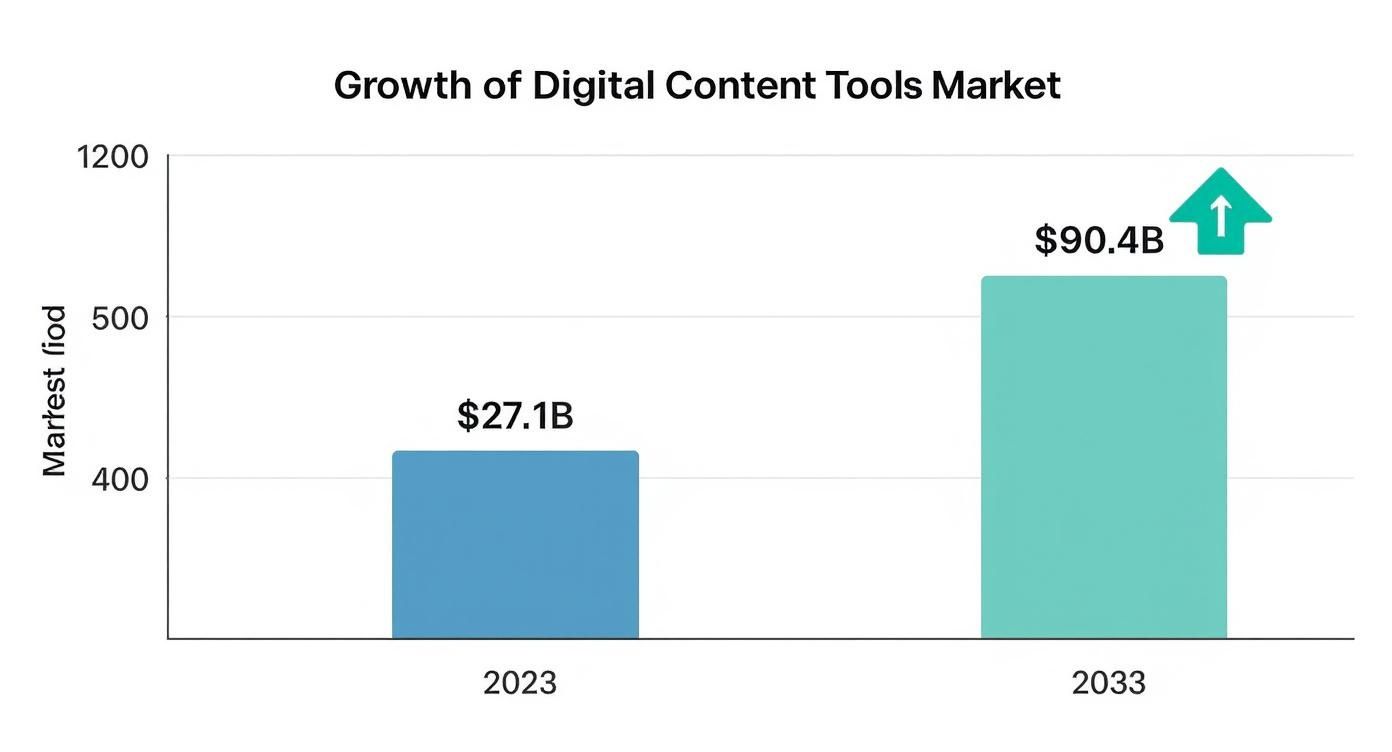
This incredible growth points to a huge opportunity for creators who are ready to build and sell their own digital products. For a deeper dive into these strategies, check out our complete guide on how to successfully monetize your online content.
Why Zero Percent Platform Fees Are a Game-Changer
One of the biggest, quietest profit killers for creators is platform fees. So many platforms take a slice of your pie—often 5-10% or more—from every single sale you make. As your business scales, this adds up to thousands of dollars lost every year.
Let's put that into perspective. Imagine you're earning PLN 10,000 per month. A platform charging an 8% fee is costing you PLN 800 every single month. That's PLN 9,600 a year that could have been reinvested into new equipment, marketing, or your own development.
A 0% platform fee model completely changes the math for your business. It means you, the creator, keep 100% of the revenue you worked so hard for. The only fees you pay are the standard, unavoidable ones from payment processors like Stripe or PayU.
This is what a true partnership looks like—where the platform helps you grow with you, not at your expense.
Here’s a quick look at how much you can save when you're not giving away a percentage of every sale.
Platform Fee Impact on a Creator's Monthly Revenue
| Monthly Revenue (PLN) | Typical Platform (8% Fee) | Revenue Lost to Fees | Zanfia (0% Fee) | Annual Savings with Zanfia |
|---|---|---|---|---|
| PLN 5,000 | PLN 4,600 | PLN 400 | PLN 5,000 | PLN 4,800 |
| PLN 10,000 | PLN 9,200 | PLN 800 | PLN 10,000 | PLN 9,600 |
| PLN 25,000 | PLN 23,000 | PLN 2,000 | PLN 25,000 | PLN 24,000 |
| PLN 50,000 | PLN 46,000 | PLN 4,000 | PLN 50,000 | PLN 48,000 |
As you can see, the savings become significant as you grow, making a 0% fee structure essential for scaling your profits.
Automate Your Financial Workflow and Get Your Time Back
Being a creator shouldn't mean you have to moonlight as an administrator. Smart automation can easily save you 5-10+ hours every single month, freeing you up to focus on what you actually enjoy: creating great content.
A modern all-in-one platform can handle the entire financial side of things for you.
- Seamless Payments: It should integrate directly with popular gateways like Stripe, PayU, Przelewy24, and BLIK, so your customers can pay how they want, including with Apple Pay and Google Pay.
- Instant Access Delivery: The moment a customer's payment clears, they should automatically get access to their course or community. No more manual emails or onboarding.
- Automated Invoicing: A good system connects with accounting tools like inFakt or Fakturownia to generate and send invoices automatically, which makes bookkeeping and tax time so much easier.
- Subscription Management: It should also handle all the tricky parts of recurring payments, from renewal reminders to automatically revoking access if a subscription ends.
These automations aren't just about efficiency; they create a polished, professional experience for your customers while eliminating the tedious tasks that lead to burnout.
And let's be real—many creators are juggling this alongside other commitments. With roughly 6 in 10 creators holding down full-time jobs, time-saving automations are more than just a convenience; they're a necessity.
By building a smart financial engine, you’re not just earning an income. You're building a scalable, efficient business that respects your time and maximizes your profit.
Common Questions About Becoming a Creator
Jumping into the world of digital creation can feel like staring up at a huge mountain. You’ve got the drive, but a million questions are probably swirling around in your head. Am I doing this right? Do I have what it takes? Let's clear the air and tackle some of the biggest concerns that hold aspiring creators back.
How Much Money Do I Need to Start?
This is a big one, and there’s a common myth that you need a hefty budget to get off the ground. Honestly, your biggest investment at the start isn't cash—it's your time and energy. You can start creating fantastic content with the smartphone in your pocket and some free software.
The real financial drain isn't the initial setup; it's the inefficient systems you might patch together later. Imagine paying for a website builder, then another tool for your online courses, and yet another for your community. Those separate subscription fees add up fast.
A much smarter, more sustainable approach is to find an all-in-one platform from the get-go. By choosing a platform with a simple, predictable subscription and 0% transaction fees, your costs don't unexpectedly spike when you start making sales. You can start lean and scale up without your tech stack eating into your profits.
How Long Does It Take to Make a Full-Time Income?
If only there were a magic number! The truth is, the timeline is different for everyone. It really depends on your niche, how consistently you show up, and how you choose to make money. I've seen some creators hit a full-time income in as little as 6-12 months, but for many others, it's a journey that takes a couple of years of solid, focused work.
The most direct path? Build a real connection with your audience and sell your own digital products—think courses, e-books, or a membership community. This approach gives you a stable income stream you can actually rely on, instead of chasing unpredictable ad revenue or constantly battling social media algorithms.
"Zanfia is the most convenient and simplest solution for paid newsletters, courses and community on the Polish market."
— Artur Kurasiński, Serial Entrepreneur & Tech Investor
Do I Need to Be a Top Expert to Start?
Not at all. This is probably the single biggest mental hurdle for new creators. You don't need to be the world's leading authority on a subject to teach it. You just need to know a bit more than the people you're trying to help.
Think about it: some of the most relatable and successful creators are just a few steps ahead of their audience. They’re guiding people through a journey they just finished themselves. That fresh experience is what makes their advice so practical and valuable. Being authentic and sharing what you're learning right now is often more powerful than having decades of formal training. Just be honest about where you are and focus on delivering genuine value.
What Is the Biggest Mistake New Creators Make?
It's a classic: waiting for everything to be "perfect" before launching. I've seen so many talented people get stuck in this cycle of endless planning, tweaking, and second-guessing. They never actually get their knowledge out into the world.
Another huge misstep is building a massive following on "rented land"—like social media—without a plan to bring those people into your own ecosystem. An all-in-one platform helps you sidestep both of these traps.
- It makes the technology simple, so you can ditch the overwhelm and launch your first digital product with confidence.
- It becomes your central hub for your content, community, and email list, all under your own brand and on your own domain.
This puts you in the driver's seat of your business and, more importantly, your relationship with your audience. It’s the difference between building on sand and building on solid ground.
Ready to move past the questions and start building your creator business on a platform designed for growth? Zanfia provides the all-in-one toolkit you need to launch your courses, build your community, and sell your digital products—all with 0% platform fees. Take control of your business and keep 100% of your revenue by getting started today.


