

Community management social media: A Practical Guide to Engagement
At its heart, social media community management is the art of bringing people together around your brand. It’s about more than just posting updates; it's about sparking conversations, nurturing relationships, and turning casual followers into a genuine, dedicated tribe. The real goal is to create a space where people feel like they belong—not just to your brand, but to each other.
Building Your Community's Foundation for Success
Before you even think about your first welcome post or community event, you need to lay the groundwork. The strongest communities are built on a solid foundation of purpose. What's the "why" behind your group? Nail this down from the get-go, because it will guide every single decision you make, from the content you create to the platform you ultimately call home.
Are you building a support hub for students navigating your online course? A networking space for freelance designers? Or a tight-knit circle of super-fans for your latest product? Getting that clarity early on is what allows you to set meaningful goals and the Key Performance Indicators (KPIs) to track them, like member engagement, retention rates, and the quality of user-generated content.
From Public Square to Private Hub
Kicking things off on big social media platforms makes a lot of sense. That's where your audience already hangs out, so it’s the easiest place to find your first members. But there's a catch: building on rented land is risky. You're at the mercy of algorithm changes, constant distractions, and you have very little control over your brand or your data.
This is why a smart transition plan is so important. Think of it as a journey from a broad, public space to a more focused, private one.
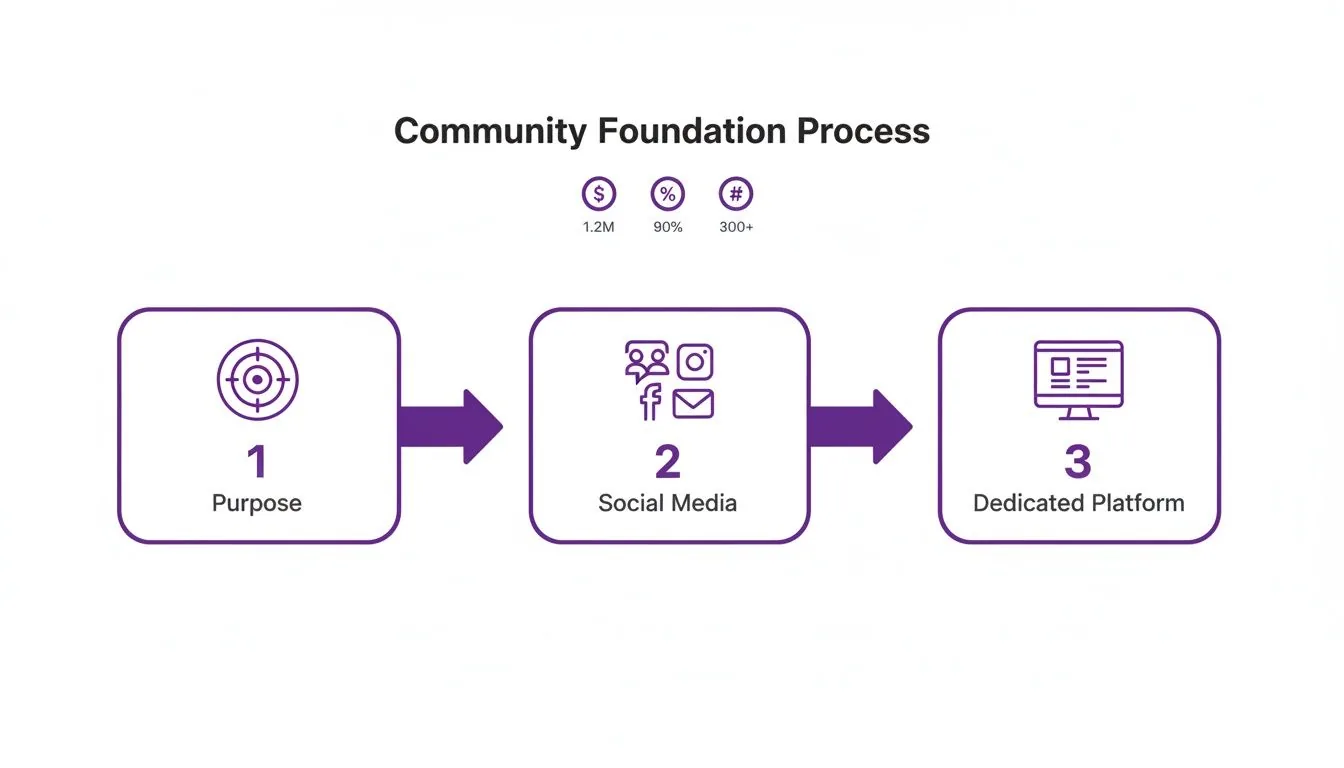
This path shows how you evolve from casting a wide net on social media to creating a high-value, exclusive environment on a platform you own.
Once you’ve proven there's an appetite for your community, the next big step is moving your most dedicated members to an all-in-one platform like Zanfia. Zanfia is built as an AI team that runs your creator business, and the community is where that work lands: an assistant that knows every action the interface can perform (by chat or by voice), an MCP endpoint so your own AI agents can act on your workspace, and a checkout built to sell with order bumps, installments and upsells across 12 product types under one brand. Everything lives on your own domain, so members read discussions, take the course and check out in one place instead of being shuttled off to a third-party tool. If you're starting from square one, our guide on how to form a community is a great resource. For more on building that initial presence, check out these effective social media management strategies.
This isn't just theory; the numbers back it up. Brands with thriving online communities see a 53% higher customer retention rate than those without. You're not just collecting followers; you're building a loyal base of advocates. For anyone selling digital products, that’s a complete game-changer.
Defining Roles and Responsibilities
As your community grows, you can't be everywhere at once. Trying to handle content, moderation, and engagement single-handedly is a fast track to burnout. Defining clear roles—even if you're the one wearing all the hats at first—helps keep everything running smoothly. It ensures no critical task falls through the cracks.
Below is a breakdown of the key roles that make a community hum. Understanding these functions will help you build your team or structure your own time effectively.
Key Roles in Community Management
| Role | Primary Focus | Key Responsibilities | Example Metric |
|---|---|---|---|
| Community Manager | Strategy & Growth | Sets the overall vision, plans content calendars, analyzes data, and leads growth initiatives. | Month-over-Month Member Growth |
| Moderator | Safety & Health | Enforces community guidelines, resolves conflicts, and reviews user-reported content. | Response Time to Flags |
| Content Creator | Engagement & Value | Develops posts, videos, and articles; crafts discussion prompts and hosts live events. | Average Engagement per Post |
| Member Advocate | Feedback & Support | Gathers member feedback, answers questions, and champions the voice of the community internally. | Member Satisfaction Score (NPS) |
Even if you're a one-person show, thinking in terms of these roles helps you allocate your time where it's needed most. As you scale, you'll know exactly what kind of help you need to bring on board.
Developing a Content and Conversation Strategy
A killer community doesn't pop up out of nowhere. It’s built on purpose, with a smart plan for both the content you share and the conversations you want to start. Think of your content as the spark, but genuine conversation is the fuel that keeps the fire burning. The whole point is to stop just talking at your members and start creating a space where they actually want to jump in and participate.
The secret? Building a content calendar around a few core "pillars." This is a total game-changer for keeping your feed from getting stale and repetitive. One day you might be teaching something new, the next you're celebrating a member's win, and the next you're just having a laugh. This mix is what makes your community a must-visit spot online.
Crafting Your Content Pillars
Your pillars are just the main themes you'll hit on again and again. Having a framework like this makes creating content so much easier and keeps everything you post tied directly to your community's big-picture goal.
- Educational Content: This is where you deliver pure value. Think tutorials, quick tips, breakdowns of industry news, or simple "how-to" guides that solve a real problem for your audience.
- Inspirational Content: Nothing builds connection like a good story. Share member success stories, post a motivational quote that actually hits home for your niche, or celebrate a milestone the group achieved together.
- Interactive Content: This stuff exists just to get people talking. Run polls, host "Ask Me anything" (AMA) sessions with experts, or start weekly threads like a "Friday Wins" or "Motivation Monday" post.
- Behind-the-Scenes Content: Show the real people behind the brand. Sharing your process, talking about a challenge you overcame, or just giving a peek into a typical day builds a ton of trust and makes your brand feel human.
By rotating through these pillars, you’ll appeal to all the different reasons people show up, making your community a place they genuinely want to check every day.
Sparking Genuine Conversations
Okay, so you've posted something. That's only half the job. The real art is in the questions you ask to get the conversation flowing. Ditch the boring, generic prompts like "What do you think?" and start crafting open-ended questions that beg for a real story.
A great conversation starter doesn't just ask a question—it creates an opening for members to share their unique experiences and connect with others who have been in their shoes. This is the foundation of turning a group of followers into a true community.
For instance, instead of asking, "Do you like our new feature?" try something like, "What's the most creative way you've used our new feature to solve a problem this week?" See the difference? That little tweak pushes people to share a story, not just a yes-or-no answer.
Building on these small interactions is the heart of effective community engagement strategies that build real loyalty. When members see others sharing detailed, honest experiences, they feel safer and more excited to do the same. This creates an amazing feedback loop of authentic, high-quality conversation.
Laying the Groundwork: Moderation and Proactive Engagement
A thriving online community doesn't just happen on its own—it's carefully built and maintained. The real secret to a great community lies in finding that sweet spot between firm, fair moderation and warm, proactive engagement. It all starts with setting clear ground rules that everyone understands and agrees to.
Think of your community guidelines as the constitution for your group. They define the culture you want to build and give you a framework for dealing with issues when they pop up. Being transparent and consistent is key; it builds trust and shows members you’re serious about protecting the space for everyone. If you're not sure where to begin, these community guidelines examples are a fantastic starting point.

Go Beyond Rules to Build Real Relationships
But let's be honest, just enforcing rules can feel a bit like policing. Great community management is about nurturing the positive energy that’s already there. Your job is to spot the superstars in your group—the ones who are always jumping in to help, sharing amazing insights, or just hyping everyone up.
These are your future brand advocates and maybe even your next moderators. Find ways to empower them. You could create special roles, give them a sneak peek at new content, or just give them a public shout-out. When you celebrate the good stuff, you get more of it. It creates a self-sustaining cycle of positivity.
The real magic happens when you make every single member feel seen. Thoughtfully responding to all feedback, good and bad, shows you're actually listening and that their voice truly matters.
How to Handle Feedback and Spark Growth
The way you handle feedback, especially the critical kind, says everything about your community's leadership. A negative comment isn’t a fire to be put out; it’s a chance to show you care. Acknowledge their point, thank them for being candid, and show them you’re taking action. When you handle criticism with grace, you build a massive amount of trust with everyone else who's watching.
This kind of hands-on management really pays off. Just look at the engagement rates across different platforms. LinkedIn leads the pack with a 6.50% median rate, Facebook comes in at 5.07%, and TikTok is right there at 4.86%. This tells us that people crave spaces where they can have meaningful discussions, making your role as a community manager more important than ever.
To keep your community healthy as it scales, you might need to look into different content moderation services that can help you manage all the user-generated content. Combining smart tools with a human touch is the key to building a resilient culture where people feel respected and can't wait to contribute.
Measuring What Matters for Community Health
If you really want to grow your community, you have to look past the flashy, surface-level numbers. Follower counts are nice for the ego, but true community management on social media is about understanding genuine engagement, not just how many eyeballs saw your post.
Focusing on the right metrics tells the real story. It shows you what’s hitting the mark, what’s falling flat, and where you should be putting your time and effort.
Vanity metrics like likes and views can be misleading. They don't give you the full picture. The numbers that really matter are the ones that show people are truly connecting with your brand and, more importantly, with each other.
Key Metrics for a Healthy Community
To get a real sense of your community's pulse, you need to track a few core metrics that reflect actual interaction and loyalty. This data becomes your guide for making smart decisions.
- Active Member Rate: This is the big one. What percentage of your members have actually posted, commented, or reacted in the last 30 days ? A high active member rate is the clearest sign of a lively, buzzing community.
- Comment-to-Post Ratio: Look at the average number of comments you get per post. A strong ratio here means your content is sparking real conversations, not just getting a passive glance.
- Member Retention Rate: Are people sticking around? Tracking how many members stay month-over-month is a direct reflection of the value they're getting from being there.
When you let data guide your decisions, community management stops being guesswork and becomes a strategic part of your business. Understanding what content keeps people coming back allows you to build loyalty and increase their long-term value.
Conducting Regular Health Checks
Make it a habit to do a community "health check" every month. This isn’t about drowning in spreadsheets; it's about spotting patterns and making better choices next month.
Start by looking at your best-performing posts. What did they have in common? Were they open-ended questions? Behind-the-scenes looks? Member shoutouts?
Then, do the same for the posts that flopped. Was the topic off-base? Was the call to action confusing? This simple review process lets you test your ideas and constantly fine-tune your content strategy.
This focus on engagement and retention is what creates real business impact. By tracking these metrics, you can directly connect your community-building efforts to financial outcomes. For a deeper dive into this, our guide on calculating customer lifetime value shows how these concepts are linked.
Ultimately, measuring what actually matters is how you build a community that doesn't just grow in size, but in strength. It's what turns a passive audience into a thriving, supportive ecosystem and one of your most valuable business assets.
Turning Your Community into a Business Engine
You’ve built an incredible community. It's engaged, it's growing, and it's full of people who trust you. So, what's next? Many creators hesitate at this point, worried that trying to make money will scare people away.
The secret is to stop thinking about "monetization" as a dirty word. It’s not about slapping a price tag on everything. Instead, think of it as creating a premium experience for your most loyal fans—the ones who are hungry for more. You’ve already given them so much value for free; offering a paid option is the natural next step for those who want to go deeper.

Unifying The Member Experience
The biggest mistake I see creators make is trying to duct-tape different tools together. They'll have a free Facebook group here, a course on another platform over there, and a payment processor somewhere else entirely. This creates a confusing and disjointed experience for members and a massive headache for you.
Bringing everything—your community, courses, and content—under one roof is a game-changer. It smooths out the entire journey for your members.
Think about it from their perspective: a member is loving the free discussions in your community. With just one click, they can unlock a premium course and a private channel without ever leaving your branded space. That seamless flow is how you convert casual followers into paying customers for life.
This is where a dedicated platform like Zanfia really shines. Zanfia is an AI team that runs your creator business, and the community is one of the places that work shows up: the assistant handles anything the interface can do (dictated by voice or typed in chat), your own agents can act on the workspace through the MCP endpoint, and the checkout is built to sell with order bumps, installments and upsells across 12 product types. Community, courses, native video hosting and paid memberships all live in one dashboard on your own domain, which is what keeps people engaged and lifts their lifetime value.
Platform Comparison for Community Monetization
Choosing the right home for your community is crucial. A scattered approach can feel free at first, but it often costs you in lost sales and administrative burnout. A dedicated platform streamlines everything.
| Feature | Scattered Social Media Groups | Dedicated Platform (e.g., Zanfia) |
|---|---|---|
| User Experience | Fragmented; members must navigate multiple sites and logins. | Seamless; single login for community, courses, and payments. |
| Branding & Control | Limited; subject to platform algorithms and branding. | Fully customizable; you own the experience and the data. |
| Monetization Tools | Basic or non-existent; requires third-party integrations. | Integrated; a checkout built to sell with order bumps, installments and upsells, plus test mode so you can buy your own product end-to-end before launch. |
| Transaction Fees | Varies, but platforms often take a significant cut. | Predictable; Zanfia charges 0% platform transaction fees. |
| Member Data & Insight | Minimal; you don't own the audience or their data. | Comprehensive; access to analytics on engagement and sales. |
While social media groups are great for top-of-funnel engagement, a dedicated platform is where you build a real, sustainable business.
Choosing Your Monetization Model
Once you have your home base sorted, you can start layering in different ways to earn an income. The best approach usually involves a mix of strategies to give your members options at different price points.
Here are a few proven models:
- Paid Newsletters: Go deep on your expertise. Offer exclusive insights and analysis for a recurring subscription, giving paying members content they can’t get anywhere else.
- Exclusive Online Courses: Solve a specific, high-value problem for your audience. You can package your knowledge into a structured course and sell it with a one-time price, or split a $600 course into four installments right at checkout.
- Tiered Memberships: This is where you can get creative. Bundle your offerings into different subscription levels. A basic tier might grant access to the private community, while a premium tier could include a course and a monthly live Q&A with you.
Flexibility is key, and platforms like Zanfia are designed for exactly this. As of publication, Zanfia charges 0% platform transaction fees, so you keep 100% of your revenue minus standard payment processor fees. Availability of individual capabilities depends on the plan, so check the current Zanfia pricing for what’s included at each tier. Every plan starts with a 14-day free trial and no credit card required.
If you want to dig deeper into these strategies, check out our guide to recurring revenue business models.
There’s a reason brands are pouring money into community management. The latest research on social media trends shows that social media budgets for community-led initiatives are surging. By building a true business engine around your community, you’re not just selling a product—you're creating a scalable, independent brand that you own and control.
Your Top Community Management Questions, Answered
If you're managing a social media community, you know the same questions pop up time and time again. Whether you’re just getting your group off the ground or trying to fine-tune an established one, you need real answers to real challenges. Let's tackle some of the most common ones I hear from fellow creators.
How Much Time Should I Really Be Spending on This Every Day?
This is the million-dollar question, isn't it? The honest answer is: it depends. The size and energy of your group will dictate your schedule, but the goal is consistency and efficiency, not being chained to your screen 24/7.
For a newer community, say under 1,000 members, blocking out 1-2 hours a day is a solid starting point. Use that time for the heavy hitters: posting fresh content, asking engaging questions, personally welcoming new faces, and replying to comments. As your community blossoms, so will the time commitment.
The trick is to work smarter. I’m a huge fan of batching my tasks. I’ll dedicate one block of time to creating all my content for the week, another for scheduling, and specific check-in times for engaging with members. This stops me from getting sucked into the constant notification vortex.
A huge myth in this space is that more hours logged automatically creates a better community. It's not true. Focused, strategic time is what moves the needle. Quality over quantity, every single time.
Automation is your best friend here. A platform like Zanfia pairs a visual workflow builder with an AI assistant you can dictate to by voice, so you can trigger the boring stuff (granting course access after payment, dropping buyers into the right community channels, sending welcome emails) by telling the assistant what you want instead of clicking through menus. That easily saves 5–10+ hours a month and frees you up to focus on creating value.
What Are the Biggest Mistakes People Make?
I've seen even the most experienced community managers stumble. Knowing where the common landmines are is the best way to sidestep them and keep your community healthy.
Here are a few classic blunders:
- Going MIA: If you disappear for days on end, it signals that the community isn’t a priority. Consistency is the bedrock of trust and keeps the energy alive.
- The Non-Stop Sales Pitch: Stick to the 80/20 rule . 80% of your content should provide pure value, with only 20% being promotional. No one wants to hang out in a space that feels like one long commercial.
- No House Rules: A community without clear guidelines is a recipe for disaster. Rules aren't about being restrictive; they're about protecting the positive and supportive culture you're working so hard to build.
But the most critical strategic mistake? Building your entire empire on rented land. When you rely solely on a social media platform, you're at the mercy of their algorithm. One little tweak can tank your reach overnight. The smartest long-term play is to migrate your core members to a platform you actually control and can white-label with your own domain.
My Community Is a Ghost Town. How Do I Revive It?
Bringing a quiet community back from the brink is totally doable, but it takes a focused re-engagement push. The first thing you need to do is listen. Put out a poll or ask your few remaining active members what they actually want to see. What would make them excited to show up again?
Once you have some feedback, inject some new energy. Kick off something fresh and time-sensitive to create a little FOMO. Think about a weekly live Q&A, a 7-day challenge, or a fun contest that gets people talking right now. You need a compelling reason for them to start checking back in.
And never, ever forget the power of the personal touch. Send a direct message to a few of your most valuable members from the past. A simple, "Hey, we're getting things fired up again and I've really missed your input," can work wonders. Reviving a community is all about showing up, day after day, and proving its value all over again.
Ready to stop juggling scattered social media groups and bring everyone home to a branded hub you own? With Zanfia, an AI team runs the busywork of your creator business (by chat or by voice), your own agents can plug in through the MCP endpoint, and a checkout built to sell brings your courses, community and content together in one place, with 0% platform fees so you keep 100% of your hard-earned revenue. Start with a 14-day free trial, no credit card required.