

How to Reduce Subscription Churn for Digital Creators (2026 Tactics)
Subscription churn is the quiet tax on every digital creator’s business. You spend months building an audience, weeks crafting an offer, and days perfecting your onboarding, only to watch a steady trickle of members cancel before they ever see the value you promised. The math is brutal: at 10% monthly churn, you replace your entire member base every 10 months just to stay flat. At 5%, you double your effective lifetime value. The gap between a thriving creator business and a stagnant one usually comes down to two or three percentage points of monthly retention.
The good news is that churn is not random. It follows patterns, responds to interventions, and rewards creators who treat retention as a system instead of a vibe. This guide walks through the specific tactics that work in 2026: how to separate the churn you can fight from the churn you cannot, which onboarding moments predict who stays, why offering a pause button can save one in five cancellations, and how the 30-60-90 day win-back sequence brings dormant subscribers back to revenue. By the end, you will have a concrete playbook to lower your churn rate, plus a clear view of how modern creator platforms handle the lifecycle work natively so you stop duct-taping it yourself.
Why churn is the silent killer of creator MRR
Monthly recurring revenue feels like a victory lap when you first hit it. The same $50 subscription that took a one-time sale to land now renews automatically, month after month. Until it doesn’t. Churn is the silent killer because it works against compounding. Every new member you acquire has to first replace the one who left before contributing to growth. When churn is low, your MRR is a snowball. When churn is high, you’re running on a treadmill.
Here is the math that creators rarely run on themselves. A membership at $30 per month with 5% monthly churn produces an average customer lifetime of 20 months and a lifetime value of $600. That same membership at 10% monthly churn drops to 10 months and $300. The difference is not a marketing problem or a pricing problem. It is a retention problem, and it cuts your business in half without changing a single line on your landing page.
According to ProfitWell’s subscription benchmarks, creator and community-based subscriptions tend to run higher monthly churn than B2B SaaS, often in the 8-15% range for early-stage creators and 4-7% for established operators with mature onboarding. The platforms with the best retention share three traits: they make the first week of membership unmissable, they give members a graceful way to take a break, and they treat cancellation as a conversation, not a confirmation page.
The other reason churn deserves more attention than most creators give it: every percentage point you shave off churn compounds. A creator running $20,000 in MRR with 8% monthly churn loses $1,600 every month before counting new signups. Dropping to 5% saves $600 per month, which over a year is $7,200 in recovered revenue without spending an extra dollar on acquisition. That is a full marketing budget hiding inside your existing member base.
Voluntary vs involuntary churn (the math)
The first move in any serious churn-reduction effort is splitting your churn into two buckets. Voluntary churn happens when a member actively chooses to cancel. They click the button, fill out the form, and leave. Involuntary churn happens when a payment fails and the member never intentionally left at all. Their card expired, their bank flagged the charge, or a temporary insufficient-funds event triggered a chain of failed retries. These two churn types look identical on a dashboard but require completely different fixes.
For most creator subscriptions, involuntary churn accounts for somewhere between 20% and 40% of total monthly losses. That number shocks creators when they first measure it because it represents pure recovery opportunity. These members wanted to stay. They just had a payment issue that nobody addressed in time. Stripe’s billing research shows that smart dunning, which is the practice of retrying failed payments on optimal days with backup recovery emails, can recover 40-70% of involuntary churn. That alone can drop your overall churn rate by several points.
Voluntary churn is the harder problem and the more strategic one. It requires you to understand why people leave. The four most common reasons in creator businesses are: the member never activated and never got value, the content cadence slowed down or felt stale, life circumstances changed (job loss, moving, new baby), and the offer no longer fits their stage (they outgrew the beginner content, or they stopped needing what you teach). Each reason maps to a different intervention. Activation failure is an onboarding problem. Cadence fatigue is a content calendar problem. Life events are a pause-vs-cancel problem. Outgrowing the offer is a tiering problem.
Before you do anything else, instrument your platform to tag every cancellation with a reason code. Even a simple three-option dropdown (too expensive, not using it, found something else) gives you the data to know where to focus. Creators who skip this step end up guessing, which means they fix the wrong things and stay frustrated.
Onboarding: the first 7 days that predict retention
The single highest-leverage point in your entire churn strategy is the first seven days after signup. If a member logs in, consumes value, and feels progress in that window, they tend to stay for months. If they sign up, get distracted, and never come back, they cancel within 30-60 days regardless of how good your content is. This is not opinion. It is the consistent finding across every subscription cohort study I’ve seen.
The implication is uncomfortable for creators who pour all their energy into the product itself: your retention is decided before the member ever touches the meat of what you sell. The first 7 days are an onboarding job, not a content job. Here is what works.
Day 0 is the welcome moment. Within 30 minutes of signup, the member needs a personal-feeling welcome that points them to one specific thing to do next. Not a tour of the whole platform. Not a 12-minute orientation video. One specific action. “Watch this 4-minute video, then post your goal in the community channel.” That single instruction does more for retention than a polished onboarding sequence because it produces an immediate behavior, and behavior predicts retention better than intention.
Days 1-3 are the activation window. Your goal is to get the member to complete a small, tangible win. For course creators, that’s finishing the first lesson. For community operators, that’s posting their first comment or introduction. For newsletter publishers, that’s reading at least one premium issue. Track these milestones explicitly. Members who hit the first activation milestone within 72 hours churn at roughly half the rate of those who don’t.
Days 4-7 are the habit window. By the end of week one, the member should have logged in at least three times. Each visit reinforces that the subscription is part of their routine, not a forgotten line on their credit card statement. Send a check-in email on day 5 with a personalized prompt. “Last week you started lesson 2. Here’s what’s waiting.” Specificity beats generic encouragement every time.
The signals that predict churn before it happens
Three signals during week one consistently predict cancellation within the first 60 days: no login within 72 hours of signup, no content consumed in the first 7 days, and no engagement with community or peer features (when those exist). If you can identify members showing any two of these signals by day 7, you have a chance to intervene before the cancel button. A simple email asking if they need help getting started recovers a meaningful percentage of at-risk members. Doing nothing is the default that costs you the most.
Pause vs cancel: the option that saves 20% of churners
One of the most underused tactics in creator subscriptions is offering a pause option as an alternative to outright cancellation. When members hit your cancellation flow, a meaningful share of them are not done with you forever. They are dealing with a temporary situation: a busy season at work, a financial crunch, a vacation, a health issue. If their only option is “cancel,” you lose them entirely and have to win them back from zero. If their option is “pause for one, two, or three months,” you keep the relationship intact and resume billing automatically.
Industry data consistently shows that offering pause as an option captures 15-25% of would-be cancellers. They pause instead of cancelling, and a healthy majority of paused members do reactivate when the pause ends. The math is simple. If 100 members hit your cancel flow this month and 20 take a pause option instead, you have just deferred $600 of churn at a $30/month price point. Across a year that compounds to thousands of dollars of revenue that would otherwise have vanished.
The implementation matters. The pause option must be obvious, not buried. Place it before the cancel button, not after, with framing that respects the member’s autonomy: “Need a break? Pause your membership for 1, 2, or 3 months instead.” Make the reactivation automatic and frictionless. The member should not have to dig out their credit card again. They should not have to re-enroll in anything. The pause ends, the billing resumes, and they pick up where they left off.
One important caution: do not use pause as a manipulative tactic to delay churn that should be honored. If a member wants to leave, let them leave. The pause option is for the genuine “life is hectic right now” segment, not for sandbagging unhappy customers. Used cleanly, it builds trust and saves revenue. Used cynically, it generates support tickets and brand damage.
Win-back emails and the 30-60-90 day sequence
Once a member cancels, the work is not over. A well-built win-back sequence over the following 90 days reactivates a meaningful percentage of churned subscribers, often 5-15% depending on category. The economics are excellent because the cost of a win-back email is essentially zero compared to the cost of acquiring a brand-new member through paid channels.
The 30-60-90 framework breaks the post-cancellation period into three windows, each with a different emotional tone and offer.
Day 30: the soft check-in
Thirty days after cancellation, the member is past the initial decision and starting to notice what they’re missing. The day 30 email is not a sales pitch. It is a check-in. Subject line example: “How’s it going since you left?” The body acknowledges that they made a choice, asks open-endedly if there’s anything you could have done differently, and mentions one specific thing that has launched or shipped since they left. No discount. No urgency. Just signal that you noticed they left and you care.
This email serves two purposes. First, it sometimes prompts an immediate return from members who paused on their own and forgot to reactivate. Second, it reopens the conversation so the day 60 and day 90 emails do not arrive cold.
Day 60: the new-and-improved pitch
Sixty days after cancellation, lead with what is genuinely new. A new module. A new community feature. A new live event. A new collaboration. This email is about novelty. It reminds the former member that the product they left has continued to evolve, and offers a low-friction way to come back. A 50% discount for the first month is a strong, finite incentive. Use it sparingly so it stays valuable.
Day 90: the honest goodbye (or last call)
Ninety days is the inflection point where most win-back math stops paying off. The day 90 email is your last meaningful touch. The framing is honest: “This is probably the last time you’ll hear from me. Here’s a final offer if you want to come back. Otherwise, no hard feelings, and thanks for being part of this.” Counterintuitively, the dignified-goodbye framing converts well because it removes any sense of pressure and triggers the small pang of loss aversion.
Across all three emails, the principles are the same: personal-feeling tone, specific (not generic) content, no manipulation, and a clear opt-out. Members who unsubscribe from win-backs should be respected. The ones who stay on the list and ignore the emails sometimes convert months later for reasons you cannot see.
Annual plans, multi-tier, and discount strategies
The pricing structure of your subscription is itself a churn lever. Three moves consistently lower churn at the offer level, before any retention email is ever sent.
First, offer annual plans alongside monthly. Annual subscribers churn at a fraction of the rate of monthly subscribers because they make the decision once per year instead of twelve times per year. Every renewal decision is a chance to leave, and reducing the number of decisions is the cleanest churn reduction available. Price the annual plan at 2 months free (so a $30/month plan is $300/year). The discount is large enough to drive meaningful uptake without sacrificing too much margin. Roughly 20-40% of new signups will take the annual option when it is presented well at checkout.
Second, build multiple tiers. A single-tier subscription forces every member into the same box, which means some will outgrow it and others will under-utilize it. Both ends churn. A tiered model (for example, basic at $20, pro at $50, elite at $150) lets members downgrade instead of cancelling when their needs shrink, and upgrade when their needs grow. Downgrade is far better than cancel from a revenue and relationship standpoint.
Third, use targeted discounts surgically, not broadly. A blanket 30% off coupon attracts price-sensitive members who churn fast. A targeted save offer (“stay another 3 months at 40% off”) presented at the cancellation moment recovers revenue without training your entire audience to wait for promos. The key is segmentation: discounts to retain are different from discounts to acquire, and they should never bleed into each other.
A note on grandfathering. When you raise prices, grandfather your existing members at their original rate for at least 12 months. Forcing a price hike on long-term subscribers triggers cancellation events and produces a wave of angry support tickets. Grandfathering buys goodwill and gives the new pricing time to mature in the market.
How Zanfia handles subscription lifecycle natively
One of the reasons creator churn stays high is that most platforms make lifecycle management someone else’s problem. You stitch together a course tool, a community tool, a checkout, and a billing system, and somewhere in the cracks between those systems, churn slips through. Cards expire silently. Pause requests come in as support tickets. Win-back emails get sent manually if they get sent at all. The retention work piles up until it becomes nobody’s job.
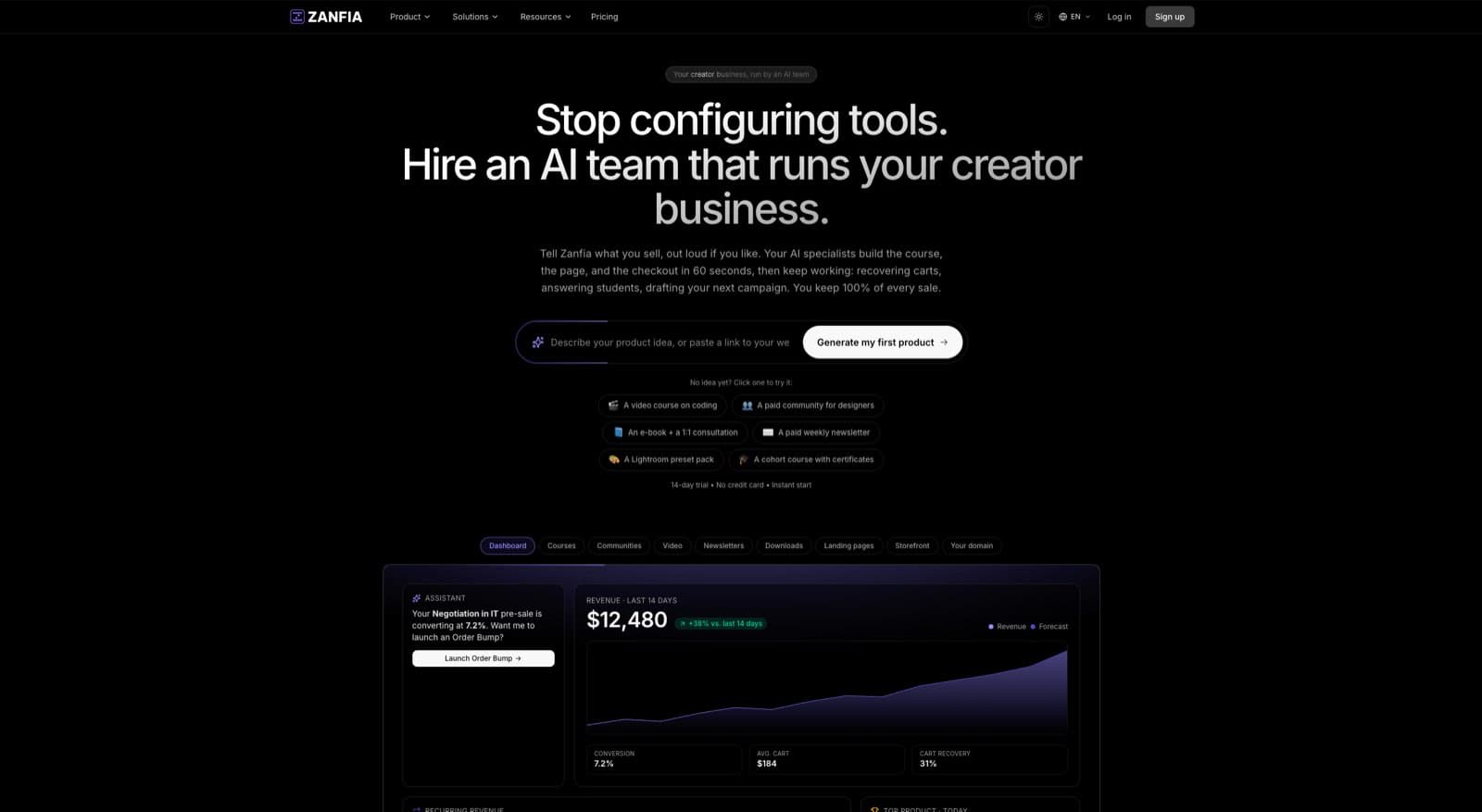
Zanfia is positioned as an AI team that runs a creator business, with the platform underneath. The AI team does the lifecycle work for you: courses, communities, paid newsletters, knowledge bases, ebooks, consulting bookings, and recurring subscriptions live under one roof, and the creator can dictate any action available in the interface by chat or by voice instead of clicking through settings. Anything doable in the interface is also doable through the MCP endpoint, so a creator can point their own AI assistant at their workspace and let it work (MCP is on every plan, see the current Zanfia pricing). That changes what’s possible in retention work.
On the involuntary churn side, Zanfia’s Cart 2.0 supports recurring billing through Stripe and PayPal, with Apple Pay and Google Pay at checkout. Failed payments are retried automatically through dunning logic, and members get notified to update their payment method before they ever realize anything went wrong. The 20-40% of churn that hides in expired cards becomes recoverable revenue instead of silent loss.
On the voluntary churn side, the platform supports the lifecycle states members actually need: a 14-day free trial to lower the initial commitment, paused subscriptions to handle the “life is busy” cases, tier upgrades and downgrades to keep members at the right price point, and clean cancellation flows that can capture exit reasons for analysis. The pause-vs-cancel move that saves 15-25% of churners is a built-in option rather than something you have to engineer. You can also test the whole flow before a real subscriber ever sees it: test mode opens the real checkout with a shareable link, fires conversion events to the test surfaces of GA4, Meta and TikTok, and keeps test orders out of your real order list.
On the activation side, Zanfia’s native combination of courses, communities, and content under one login removes the fragmentation that kills onboarding. Members don’t sign up for a course and then get pushed to a separate Circle or Discord for community and a separate Substack for the newsletter. Everything lives in one interface under your own white-label domain (each creator gets a `slug.zanfia.co` subdomain or can map their own custom domain). The fewer logins and apps a member juggles in week one, the more likely they are to activate. Twelve product types (course, newsletter, community, membership, knowledge base, downloads, digital content, service, event, consultation, bundle, custom) live under one brand, so you can package a payment plan, an order bump and an upsell on the same checkout without stitching a second tool onto the side.
The native iOS and Android mobile app extends activation into the place where most creators lose engagement: the phone. Members can consume courses, paid newsletters, and knowledge bases without ever opening a laptop. (Community support in the mobile app is on the roadmap, not yet live.) A member who installs the app and uses it within the first week is dramatically more likely to stay past month three.
The economics back this up. Zanfia charges 0% platform transaction fees on customer sales as of 2026 (only payment processor fees from Stripe or PayPal apply), which means the money you save on retention stays in your pocket instead of getting taxed by the platform. Every plan starts with a 14-day free trial with no credit card required, so you can test the fit before committing to a paid tier. For specific pricing, see zanfia.com/pricing.
None of this means churn solves itself. You still need the discipline to instrument cancellation reasons, build win-back sequences, and offer annual plans. But the infrastructure does the boring repetitive work for you, which means the strategic retention work actually gets done instead of perpetually sitting on the to-do list.
FAQ
What is a good churn rate for a creator subscription business?
For early-stage creator subscriptions, monthly churn typically runs 8-15%. Established operators with mature onboarding tend to land in the 4-7% range. Anything under 5% monthly puts you in the strong category for creator businesses. Annual subscriptions skew the math significantly: a business with mostly annual subscribers will see much lower effective monthly churn because renewal decisions happen once per year.
How much of my churn is preventable?
A reasonable estimate is that 50-70% of total churn is addressable with intervention. Involuntary churn (20-40% of the total) can be cut by 40-70% with proper dunning. Voluntary churn from poor activation, missing pause options, and weak win-back sequences typically accounts for another 20-30% of preventable losses. The remaining 30-50% is structural: members who genuinely outgrew the offer, had real life changes, or were never a good fit in the first place.
Should I offer a free trial or a money-back guarantee?
For subscription products under $50/month, a 7-14 day free trial usually outperforms a money-back guarantee because it lowers the initial commitment without requiring the friction of a refund request. For higher-ticket subscriptions ($100+/month), a money-back guarantee can outperform because the trial period isn’t long enough to fully experience the value. Test both if you can. The right answer depends on how long your activation curve takes.
How quickly should I act on a failed payment?
Smart dunning retries on day 1, day 3, and day 7 after the initial failure, with backup emails alerting the member to update their card. After day 14, recovery rates drop sharply, and the relationship usually goes cold. The fastest interventions recover the most revenue, which is why automation handles this better than manual outreach.
Is annual billing always better than monthly for churn? Annual billing reduces churn frequency but does not eliminate it. Annual subscribers churn at renewal, often in a clump that creates lumpy revenue. The win is that annual subscribers churn 60-80% less often than monthly subscribers on a normalized basis, and they pay more upfront, which improves cash flow. Offering both gives members the choice and lets you capture the segment that prefers each model.
What’s the single biggest mistake creators make with churn?
Not measuring it. Creators routinely watch new MRR like a hawk and ignore churn until they hit a growth plateau and can’t figure out why. The plateau is almost always a churn problem hiding behind acquisition numbers. Instrument your churn rate by cohort, by plan, and by cancellation reason from day one. The data alone will surface 80% of your retention opportunities without any expert consulting.
Churn is not a vibe to feel bad about. It is a system to build. Onboarding, lifecycle options, win-back sequences, and pricing structure each contribute a measurable percentage point or two, and those points compound across every member you ever acquire. The creators who treat retention as a discipline win the long game. The ones who keep pouring money into acquisition while ignoring the leaky bucket eventually run out of runway. Build the system once and let it work for you every month after.